
Nobody enjoys the moment a remote, toy, or game controller goes silent mid-use. The cycle of buying, using, and tossing alkaline cells is not just a chore — it’s a recurring expense that adds up over the lifetime of every household device. A dedicated rechargeable battery system eliminates this completely, swapping disposable waste for a rotating set of cells that deliver consistent power for years.
I’m Min — the co-founder and writer behind Gadgets Feed. For this guide, I analyzed dozens of battery chemistry types, charger architectures, and real user experiences to isolate the kits that actually deliver on their claims of capacity and cycle life.
After sorting through the specs and user feedback, the right aa rechargeable batteries and charger will pay for themselves within the first few months of normal household use.
How To Choose The Best AA Rechargeable Batteries And Charger
Every rechargeable battery kit looks similar from the outside, but the internal chemistry, charging circuitry, and slot configuration determine whether a set delivers consistent power or becomes a drawer of dead cells. Focus on three core areas to make the right investment.
Chemistry: NiMH vs. Lithium-Ion
NiMH cells output a nominal 1.2V throughout the discharge cycle, which works perfectly for most devices designed around that voltage. Lithium-Ion rechargeables internally regulate to a 1.5V constant output, making them a drop-in replacement for alkaline cells in devices that are sensitive to voltage drops. Lithium packs also tolerate cold much better — some operate down to -20°F — making them the choice for outdoor cameras or gear stored in unheated spaces.
Charger Architecture: Independent Channels Are Non-Negotiable
A charger with independent slots treats each cell individually. This is critical because mixing cells of different ages or states of charge is unavoidable. Pair-only chargers simply cut off when the first cell in the pair hits full, leaving the second partially charged. Independent chargers monitor and terminate each cell on its own, maximizing every charge cycle and prolonging the life of your battery investment.
Capacity Ratings: mAh vs. mWh
Milliamp-hours (mAh) measure charge capacity at the battery’s nominal voltage. For NiMH cells at 1.2V, a 2800mAh battery delivers about 3.36 watt-hours. Lithium cells often advertise in milliwatt-hours (mWh) to highlight total energy storage. A 3700mWh lithium battery at 1.5V translates to roughly 2466mAh. Comparing capacities requires normalizing to watt-hours — look for the highest watt-hour number within your chosen chemistry for maximum runtime.
Quick Comparison
On smaller screens, swipe sideways to see the full table.
| Model | Category | Best For | Key Spec | Amazon |
|---|---|---|---|---|
| Panasonic Eneloop | Premium NiMH | Ultra-long cycle life | 2100 cycles per cell | Amazon |
| RayHom 12-Pack 3700mWh | Lithium High-Cap | Blink cameras/cold weather | 3700mWh / 1.5V constant | Amazon |
| RayHom 12-Slot 3400mWh | Lithium Bulk Pack | Household bulk replacement | 3400mWh / 12 cells | Amazon |
| Amazon Basics 8-Bay | Mid-Range NiMH | Budget-conscious families | 2000mAh / USB-C charger | Amazon |
| Granicell 2800mAh | Value NiMH | High-drain toys | 2800mAh / 8-cell kit | Amazon |
| BEVIGOR 8-Bay | Value NiMH Combo | Mixed AA/AAA usage | 1500 cycles / 2800mAh | Amazon |
| imuto Lithium 4AA+4AAA | Entry Lithium | Compact carry/travel | 3000mWh AA / integrated case | Amazon |
In‑Depth Reviews
1. Panasonic Eneloop K-KJ17MCA4BA

This pack pairs four 2000mAh AA cells with the BQ-CC17 charger, which treats each slot independently — a feature that prevents the uneven charging pair-based chargers introduce over time. The cells hold 70% charge after ten years in storage, making them a true set-and-forget solution for cameras, clocks, or emergency gear.
Rated for 2100 recharge cycles per cell, these batteries outlast most other NiMH options by a significant margin. The charger automatically detects and rejects non-rechargeable chemistries, and its compact 100-240V input means it works internationally without a converter. Users consistently report 20-30 hours of gameplay in an Xbox controller on a single charge with moderate features enabled.
The kit ships with only four cells, and the charger does not include a USB input — it plugs directly into a wall outlet. For households that need a foundational set with proven longevity, this remains the benchmark that others chase. The plastic strip inside the charger slot must be removed before first use, a step that catches some buyers off guard.
Why it’s great
- Individual slot charging prevents uneven cell wear
- 2100 recharge cycles per cell — class-leading
- Holds 70% charge after 10 years in storage
Good to know
- Includes only 4 AA batteries — may need a second set for high-drain homes
- No USB-C or USB input on charger — wall plug only
- Internal strip in charger must be removed before use
2. RayHom 12-Pack 3700mWh Lithium
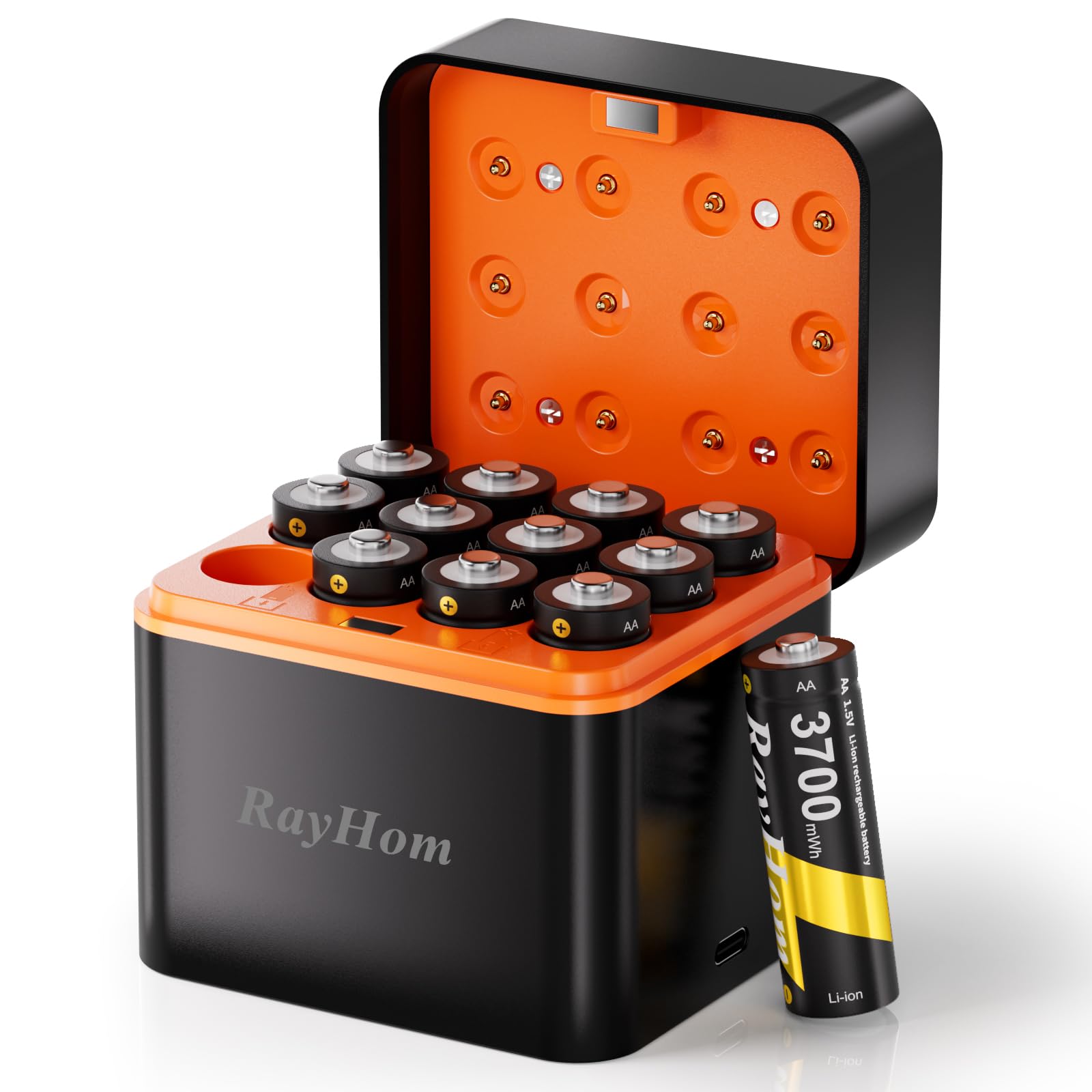
RayHom steps into the premium lithium-chemistry arena with a 12-cell kit that maintains a constant 1.5V output until total depletion. This is the critical distinction from NiMH — devices that rely on a stable voltage, like Blink cameras or smart doorbells, will run consistently longer without the gradual dimming behavior of lower-voltage chemistries. Each cell is rated at 3700mWh, translating to substantial runtimes in high-consumption gear.
The 12-slot charger uses independent channels, charges any combination of 1 to 12 cells, and completes a full set in roughly two hours via USB-C input at 5V 2A. The LED indicator system distinguishes charging (red), full (green), rejected cells (flashing red), and overheating (flashing green). The cells operate in extreme temperatures from -20°F to 131°F, making this kit the right choice for outdoor security cameras in cold climates.
The kit ships with a few reports of dead-on-arrival cells. Customer service appears responsive — replacements are shipped within a week in most documented cases. The charger’s lid-style magnetic enclosure can eject multiple cells at once when opened carelessly. For households running multiple high-drain smart home devices, the capacity per dollar is very difficult to match.
Why it’s great
- Constant 1.5V output — no voltage sag during discharge
- 3700mWh per cell, 12 cells included for bulk coverage
- USB-C fast charging completes in about 2 hours
Good to know
- Occasional DOA cells reported — test all 12 on arrival
- Magnetic lid can spill multiple cells during open
- Lithium chemistry costs more upfront than NiMH
3. RayHom 12-Slot 3400mWh Lithium
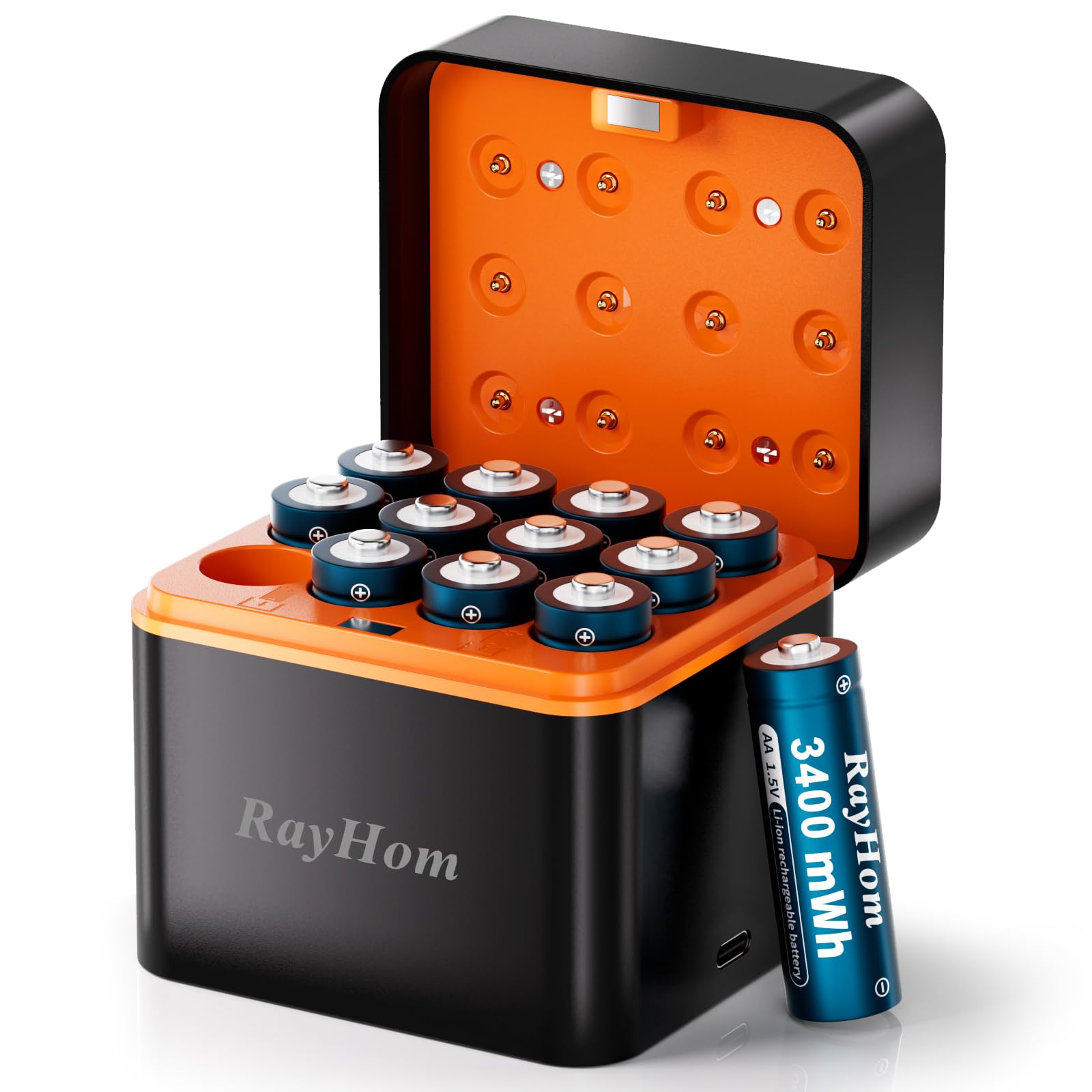
The MCU-controlled charger delivers a 350mA pulse current with automatic trickle-mode transition. The △V cutoff technology prevents overcharging by precisely detecting the voltage peak per cell — a feature typically reserved for premium standalone chargers.
The charger case uses a magnetic-sealed full-wrap design that protects cells from dust and moisture when stored. Each slot works independently, so mixing depleted and fresh cells is safe. The LED status per slot shows red for charging and green for full. USB-C input powers the unit, and charging speed is about 30% faster than the average NiMH charger. Users report reliable performance in game controllers, flashlights, and digital cameras.
Cell removal can be slightly fiddly — the tight fit that protects the contacts also makes extraction a two-finger effort. A small number of units have shown inconsistent LED behavior across slots. For homes that want a bulk lithium solution with intelligent charging safeguards, this kit hits a strong performance point below the top-tier price.
Why it’s great
- MCU-controlled pulse charging with △V cutoff
- Magnetic-sealed case protects stored cells
- 30% faster charging than standard NiMH chargers
Good to know
- Cells fit tightly — removal requires some effort
- Occasional LED inconsistencies reported
- Charger should be unplugged after charge to protect cell life
4. Amazon Basics 8-Bay NiMH with USB-C

Amazon Basics enters the rechargeable conversation with a straightforward NiMH bundle: eight 2000mAh AA cells plus an 8-bay charger powered via USB-C. The charger uses four LED indicators — slow blink for charging, solid white for full, fast blink for error (defective or alkaline cell), and a power-on sequence sweep. The cells are pre-charged out of the box and maintain 80% capacity for up to 12 months in storage.
A full charge of all eight batteries takes about ten hours via a 5W USB input. The independent charging slots treat each cell individually, so mixing partially discharged and fresh cells is safe. The bundle does not include an AC adapter, only a USB-C cable. Users report solid performance in Xbox controllers and VR accessories, with weeks of runtime before needing a top-up.
Durability concerns are real — some units have seen chargers fail after a handful of cycles and cells stop accepting charge prematurely. The failure window often sits just beyond the return period. The batteries themselves are 2000mAh, which is 800mAh below the high-capacity NiMH options from competitors. For families on a tight budget who rotate gear regularly, this kit offers decent initial value with caveats on long-term reliability.
Why it’s great
- 8 AA cells and 8-slot charger in one affordable bundle
- Independent slots treat each cell individually
- Pre-charged and ready to use immediately
Good to know
- 2000mAh capacity — lower than competing NiMH options
- No AC adapter included — USB-C cable only
- Some chargers and batteries fail within first few cycles
5. Granicell 2800mAh AA 8-Pack with Charger
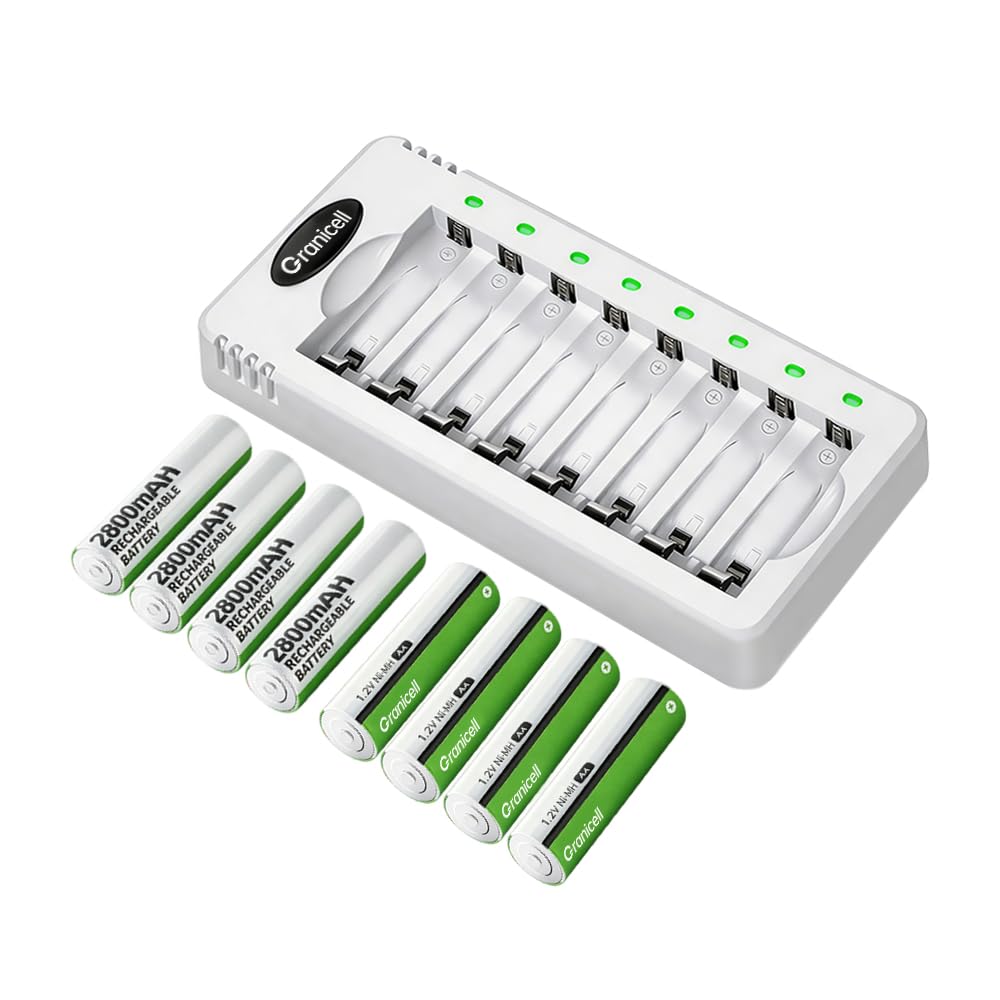
Granicell delivers a high-capacity NiMH entry with eight 2800mAh AA cells — the highest mAh rating in this comparison — paired with an 8-bay smart charger that uses chip-controlled safety shutoff. Each slot operates independently, supporting any mix of AA and AAA NiMH or Ni-CD cells from any brand. The charger communicates status per slot via bright LED indicators, red during charging and off when complete.
The Type-C USB input makes the charger flexible for travel and desk use, drawing power from any adapter, car charger, or power bank. Users consistently report that these batteries improve performance in high-drain toys — one review noted a toy train pulling six cars versus two with alkalines. The 1300-cycle rating per cell is competitive for the price tier.
The LED indicators are unusually bright, which may be distracting in a dark bedroom or media cabinet. Some users found the charger failed to properly identify and charge older Ni-CD cells. The storage case feels light compared to rigid-shell competitors. For high-drain device owners who burn through AA cells quickly, the 2800mAh capacity minimizes swap frequency effectively.
Why it’s great
- 2800mAh is the highest NiMH capacity in this roundup
- USB Type-C input for flexible power sourcing
- Independent slots accept any brand of AA/AAA NiMH
Good to know
- LED indicators are very bright in dark spaces
- Charger struggles with older Ni-CD cells
- Storage case feels less rigid than dedicated cases
6. BEVIGOR 8-Bay NiMH AA/AAA Combo
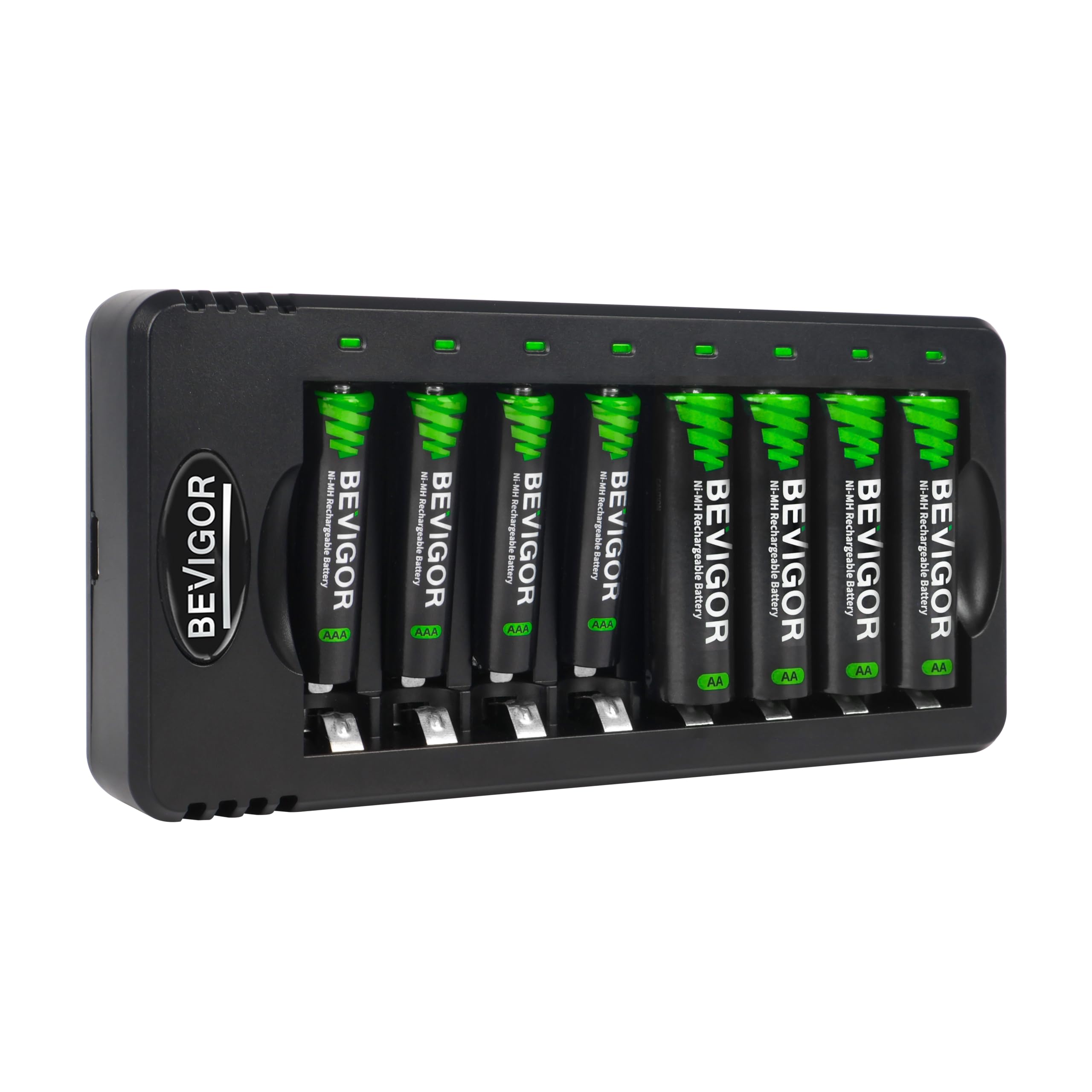
BEVIGOR offers a mixed-format pack with four AA 2800mAh cells and four AAA 1100mAh cells, making it the only entry here that includes both sizes in one purchase. The 8-bay charger accepts 1-8 cells in any mix of AA and AAA, with eight isolated circuits so each cell gets its own charge algorithm. Trickle-charge mode engages after the main cycle to keep cells topped up without overheating.
The low self-discharge design retains 80% capacity after three years of storage, which is respectable for the price point. The batteries are rated for up to 1500 recharge cycles. The charger uses red/green LED indicators per slot and carries FCC and UL certifications. Users report good performance in speedlights and other high-drain photography gear, with noticeably better longevity than a popular competitor brand.
The battery life, while good for the price, does not match premium NiMH cells in sustained high-drain use. The build quality of the charger feels entry-level compared to the Panasonic or RayHom units. For households that need to cover both AA and AAA devices — clocks, remotes, and toys — without buying separate kits, this combo solves a practical organizational problem.
Why it’s great
- Includes both AA and AAA batteries in one kit
- Trickle-charge mode maintains peak capacity
- Retains 80% capacity after 3 years in storage
Good to know
- Battery longevity is good but not class-leading
- Charger build feels entry-level
- Cycle rating of 1500 trails premium NiMH options
7. imuto Lithium 4AA + 4AAA with Integrated Case

Imuto takes a unique approach with an 8-slot charger that doubles as a storage case. The kit includes four AA cells at 3000mWh (roughly 2000mAh equivalent) and four AAA cells at 1300mWh, all lithium chemistry with constant 1.5V output. The integrated design means the charger case is the storage box — no separate organizer needed. The Type-C to Type-C cable is included, and a full charge of up to eight cells completes in about two hours.
The lithium chemistry supports up to 1600 recharge cycles per cell and a 12-year shelf life. The constant voltage output is particularly beneficial for devices that exhibit performance degradation with dropping voltage, such as motorized toys, electric toothbrushes, and VR grips. Users report excellent runtime in high-drain Roku remotes, lasting 6-8 hours versus standard rechargeables.
Individual cell longevity is inconsistent — some units report a single battery failing after a handful of recharges. Customer service has responded with replacements in documented cases. The charger case is compact, but the shared power bus means the charge speed slows when all slots are occupied simultaneously. For travelers or minimalists who want one small unit covering both AA and AAA needs, this form factor is hard to beat.
Why it’s great
- Charger doubles as a compact storage case
- Includes both AA and AAA lithium cells
- 2-hour fast charge via USB-C
Good to know
- Individual cell durability can be inconsistent
- Charge speed slows when all 8 slots are occupied
- Only 4 AA cells included — may need a second unit for high-consumption homes
FAQ
Can I recharge alkaline batteries in a NiMH or lithium charger?
Why do some of my devices stop working before the battery is empty?
Is it safe to leave batteries in the charger after they are full?
How do I know if my charger has independent slots or pairs them?
Final Thoughts: The Verdict
For most users, the aa rechargeable batteries and charger winner is the Panasonic Eneloop because the 2100-cycle cells and individual-slot charger deliver the best long-term reliability in a proven package. If you need constant 1.5V output for voltage-sensitive smart home cameras, grab the RayHom 12-Pack 3700mWh. And for a budget-conscious family covering both AA and AAA devices, nothing beats the BEVIGOR 8-Bay for its mixed-format convenience and low self-discharge storage.