
ASA (Acrylonitrile Styrene Acrylate) is the outdoor-workhorse polymer that refuses to yellow under relentless sun, shrugs off rain, and holds its shape when the dashboard hits 90°C — but only if you pick the right blend. The market is flooded with inconsistent spools that warp mid-print, clog your hotend, or arrive pre-wetted from poor packaging, turning what should be a durable functional part into brittle scrap.
I’m Min — the co-founder and writer behind Gadgets Feed. After analyzing hundreds of hours of print logs, customer failure reports, and batch-to-batch consistency data across the top ASA formulations on the market, I’ve distilled exactly which spools deliver on their UV and impact promises and which will waste your enclosure time.
This guide cuts through the marketing noise to rank the asa 3d filament spools that actually hold dimensional accuracy under real-world heat and sunlight exposures, so you can print with confidence the first time.
How To Choose The Best ASA 3D Filament
The ASA category lives in the tension between outdoor durability and printability. Unlike PLA, ASA demands an enclosed printer, a heated bed above 90°C, and a material that doesn’t absorb atmospheric moisture overnight. Choosing wrong means post-processing a cracked, delaminated part that failed before it ever saw sunlight.
Glass Fiber or Carbon Fiber Reinforcement
Standard ASA has decent UV resistance but mediocre stiffness and creep resistance under load. Adding chopped glass fiber (ASA-GF) or carbon fiber (ASA-CF) boosts the tensile modulus by 30-50%, reduces thermal expansion, and virtually eliminates warping on large flat surfaces. If you are printing functional brackets, enclosures, or parts that bear weight outdoors, reinforced ASA is not a luxury — it is the only formulation that holds tight tolerances past a few thermal cycles.
Vacuum Sealing and Moisture Sensitivity
ASA is hygroscopic. A spool left open for 48 hours in 50% humidity can produce popping sounds, surface pitting, and a 40% drop in interlayer adhesion. Reputable brands vacuum-seal each spool with desiccant and pre-dry for 24 hours before packaging. If you see a spool that arrives in a bag with a poor zipper seal or feels loose, expect week-long drying sessions at 80°C before it prints reliably.
Dimensional Tolerance and Consistency
The best ASA spools hold a diameter tolerance of ±0.02 mm across the entire 1 kg roll. Wider tolerances (±0.05 mm) cause inconsistent extrusion, under-extruded thin sections, and pressure-buildup clogs in Capricorn PTFE tubes. Advanced CCD-based diameter monitoring in manufacturing ensures the filament diameter remains constant even at spooling speeds — this is the spec that separates a smooth 20-hour print from a failed overnight job.
Quick Comparison
On smaller screens, swipe sideways to see the full table.
| Model | Category | Best For | Key Spec | Amazon |
|---|---|---|---|---|
| Siraya Tech Fibreheart ASA-GF | Premium Glass-Filled | High-impact structural parts | 10% glass fiber; HDT 92-97°C | Amazon |
| iSANMATE ASA Carbon Fiber | Carbon Fiber Reinforced | Rigid, low-layer-line prints | ASA-CF blend; nozzle 240-270°C | Amazon |
| ANYCUBIC ASA | Premium Unfilled | Consistent, reliable outdoor prints | ±0.02 mm tolerance; HDT 90°C | Amazon |
| SUNLU ASA Strong | Mid-Range Tough | Budget-friendly outdoor mechanical parts | AMS-compatible spool; 1.75 mm ±0.02 mm | Amazon |
| Creality HP ASA | Mid-Range High-Speed | High-speed printers up to 350 mm/s | Thermal stability up to 100°C | Amazon |
| Overture ASA | Entry-Level Value | First-time ASA users | Patented clog-free formula; ±0.02 mm | Amazon |
| Creator ASA | Budget Aesthetic | Decorative outdoor items | Burnt Titanium color; 1.75 mm | Amazon |
In‑Depth Reviews
1. Siraya Tech Fibreheart ASA-GF
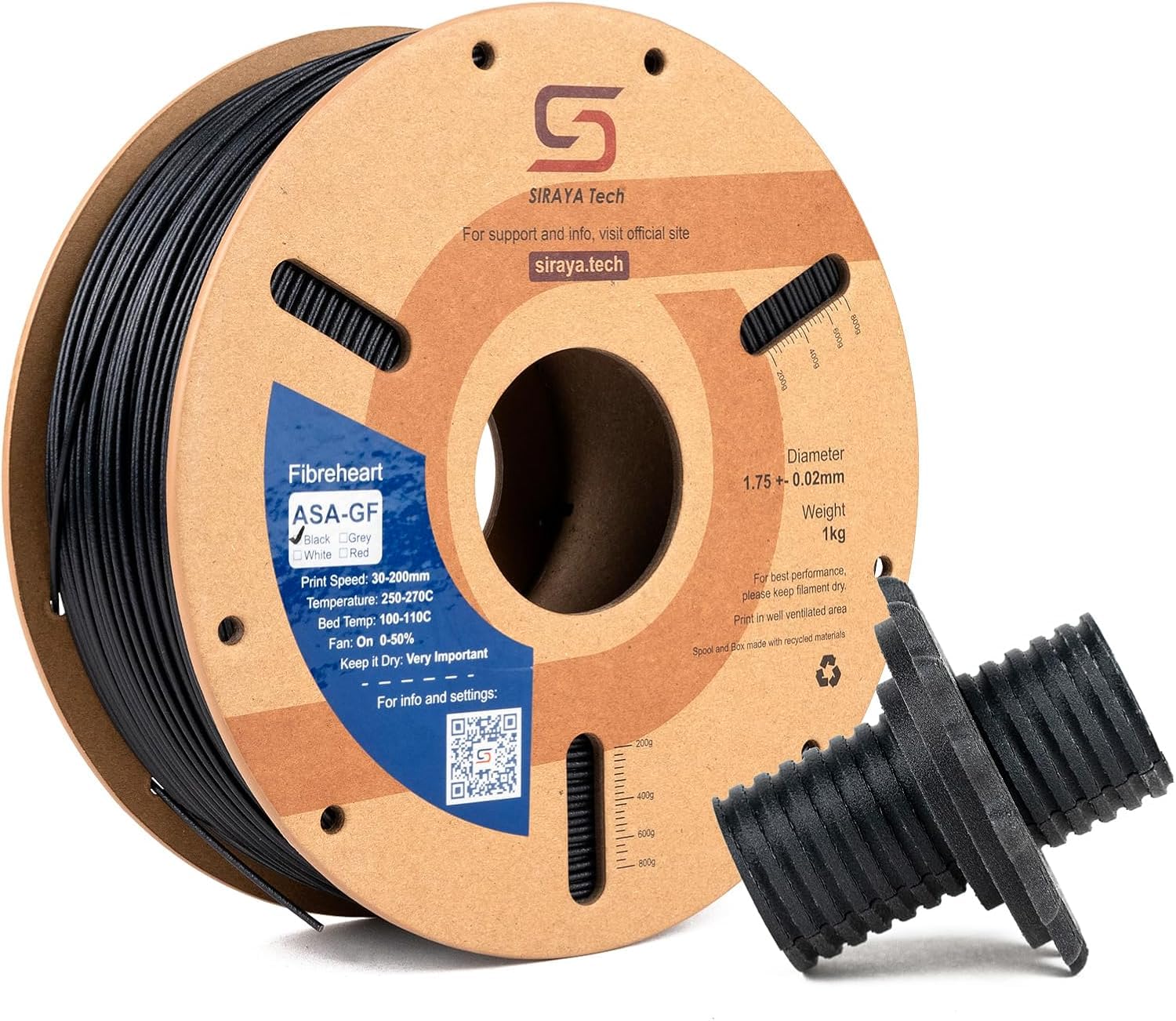
The Siraya Tech Fibreheart ASA-GF is the heaviest hitter in this lineup, packing 10% chopped glass fiber into an ASA matrix that delivers a glass transition temperature of 106°C and an HDT of 92-97°C at 0.45 MPa. Users report printing 30 cm parts with zero warping, snap-away supports that leave a clean matte black finish, and layer adhesion so strong that parts survive desert dashboard heat and occasional direct sun without sagging.
The glass fiber content makes this filament noticeably stiffer than unfilled ASA — it handles vibration and impact loads better than any standard blend, though a minority report brittle cracking under repeated shock if the print isn’t annealed. The recommended nozzle range is 250-270°C with a 100-110°C bed inside a 60-80°C enclosure. One user successfully used a PA6-CF profile at 320°C with excellent results, proving the material’s thermal tolerance ceiling.
The biggest caveat is spool tangling. Several verified reviews describe severe tangling that rendered the roll unusable after a quarter of the spool was consumed. The filament is also brittle when cold, so untangling requires patience. Despite the tangling risk, the Fibreheart’s strength and dimensional stability make it the best choice for structural outdoor parts that need to hold up year-round.
Why it’s great
- Glass fiber reinforcement boosts stiffness and impact resistance 30-50% over standard ASA
- No warping on large 30 cm flat parts even without perfect enclosure tuning
- Supports snap off cleanly with minimal surface post-processing
Good to know
- Several reports of severe spool tangling after 1/4 roll used
- Brittle cold filament makes manual untangling difficult and risky
- Requires a robust enclosed printer and high-temperature hotend (all-metal required)
2. iSANMATE ASA Carbon Fiber
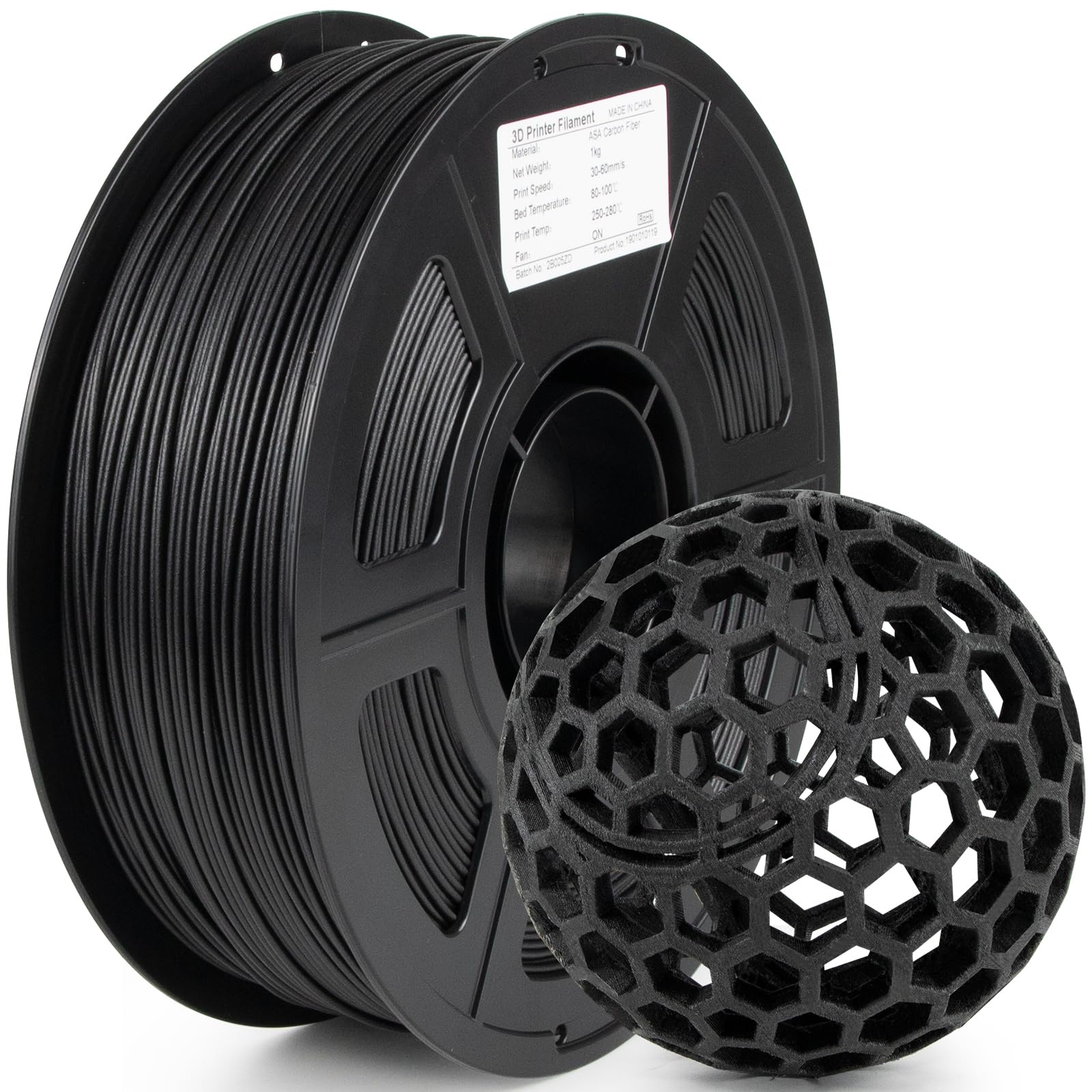
The iSANMATE ASA Carbon Fiber filament pairs the weather resistance of ASA with carbon fiber strands that reduce thermal expansion and produce a true matte black finish with a total darkness (TD) value of 0.1. Users consistently describe extrusion as smooth and consistent with no warping, excellent bed adhesion, and almost invisible layer lines at 265°C and 100°C bed temperature.
Uniquely among this test group, the carbon fiber formulation produces noticeably lower fumes than standard ASA. One review noted the glass-filled navy blue variant had a strong smell, while the carbon fiber black had almost none. The print speed range is 30-100 mm/s — slower than standard ASA, but the trade-off is superior surface quality. The spool itself had some wavy winding out of the box that didn’t affect print quality but raised an eyebrow.
The critical issue is high-temperature drying. The plastic spool can soften and bond to the filament when dried at 100°C for 6 hours, causing the filament to break during retraction. Users recommend transferring to a cardboard spool for lengthy drying sessions. One outlier 1-star report described micro-porosity that made parts crumble like chalk, but that appears to be a rare manufacturing defect the seller did not address.
Why it’s great
- Carbon fiber reinforcement produces virtually invisible layer lines and a premium matte finish
- Very low odor compared to standard ASA and glass-filled alternatives
- Excellent bed adhesion and no warping even without a perfectly sealed enclosure
Good to know
- Plastic spool can deform during high-temp drying (80-100°C), causing filament breakage
- Recommended print speed of 30-100 mm/s is slower than standard ASA
- One reported case of micro-porosity causing brittle, crumbling parts (isolated defect)
3. ANYCUBIC ASA

ANYCUBIC’s ASA hits the sweet spot between printability and outdoor durability. With a heat deflection temperature of 90°C and a dimensional tolerance of ±0.02 mm, it consistently produces smooth, strong layers that survive sun exposure, rain, and moderate impact. Users report flawless prints on the Anycubic Kobra S1 and S1 Max directly out of the box after a 3-hour drying session at 80°C.
The mechanical performance is excellent for an unfilled ASA — the material resists moderate impact forces without cracking or deforming, making it suitable for car accessories, plant pots, and garden tools that need to survive accidental drops. Stringing is minimal even without fine-tuned retraction, and the layer adhesion feels robust enough for light functional loads.
Drying discipline is essential. Several reviews stress that a minimum 3-hour dry at 80°C separates a flawless print from one with surface artifacts. The vacuum seal holds well, but any delay between opening and printing reintroduces moisture. The gray color is uniform and neutral, a practical choice for functional parts that don’t need flashy aesthetics.
Why it’s great
- Consistent ±0.02 mm diameter tolerance across the entire 1 kg spool
- HDT of 90°C outperforms PETG and ABS for hot-environment parts
- Low shrinkage reduces cracking and warping risk compared to generic ASA
Good to know
- Mandatory 3-hour drying at 80°C before printing, even from vacuum seal
- Print speed must be reduced below standard PLA settings for optimal layer adhesion
- Limited color selection compared to budget alternatives
4. SUNLU ASA Strong

SUNLU’s ASA Strong is the most popular mid-range option for good reason — it prints with the ease of PETG, has far less odor than ABS, and survives outdoor conditions with minimal degradation. Users report using it for Voron printer parts, house numbers, and garden accessories that have held up for months without yellowing. The third-generation white spool is designed to fit Bambu Lab AMS and AMS Lite units, a thoughtful touch for multi-material users.
The recommended nozzle range of 230-260°C and bed temperature of 80-120°C gives a wide sweet spot. Users on Voron, Ender 3, and Prusa MK3.5 report good results with an enclosure and a garolite plate. Bed adhesion is strong at 100-120°C, though minor warping was fixed by switching to a garolite surface. The filament produces a low, tolerable smell — noticeably less irritating than ABS.
Vacuum-sealing consistency is the weak point. Two out of five reviewed rolls arrived with air in the bag, indicating inadequate sealing at the factory. This means you need to budget drying time — typically 4-6 hours at 80°C — before the first print. Once dry, the filament extrudes smoothly with no clogging and excellent layer adhesion. The color lacks the grayish hue some cheap ASA formulations have, giving clean neutral blacks and whites.
Why it’s great
- AMS-compatible spool design works with Bambu Lab multi-material systems
- Very low odor compared to ABS, making it suitable for indoor enclosures
- Wide temperature window (230-260°C) simplifies tuning across different printers
Good to know
- Inconsistent vacuum sealing — some rolls arrive with air breaching the bag
- Requires drying and calibration (temp tower, flow, PA) before consistent results
- Bed adhesion may need a garolite plate for large prints at high bed temperatures
5. Creality HP ASA
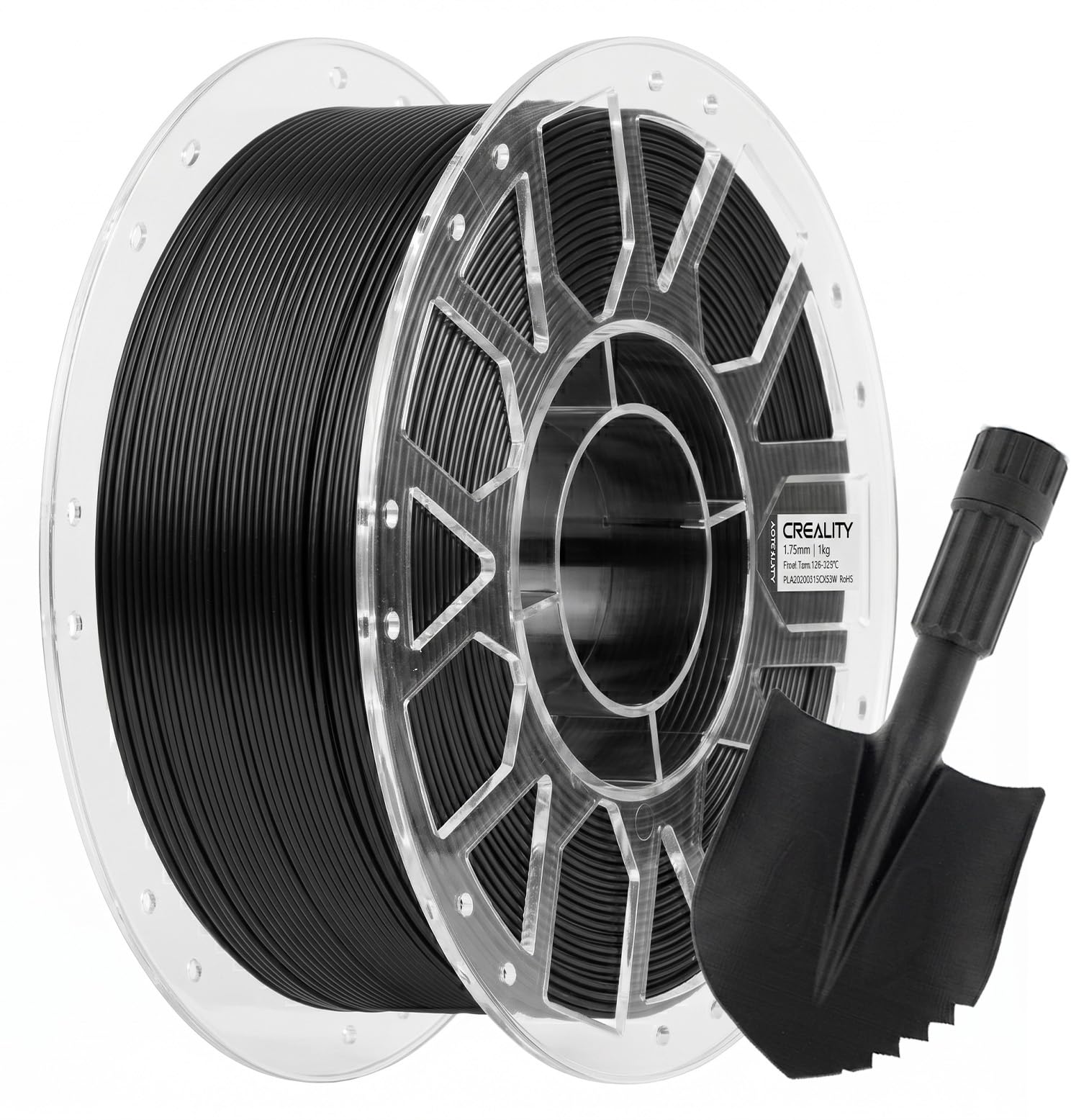
Creality’s HP ASA is unique in this list for being optimized for high-speed printing up to 350 mm/s. It is designed to maintain consistent extrusion without clogging or warping even at those velocities, a feat most ASA formulations cannot achieve. Users running Flashforge AD5X and Creality K1 series printers report perfect first layers with a 0.6 mm hardened nozzle straight out of the vacuum bag.
The thermal stability up to 100°C makes it suitable for under-hood automotive parts and electronics enclosures that get hot. Users who printed motorcycle accessories with it report the parts hold shape and color even after weeks of direct sun and rain exposure. The material needs drying — one hour at low heat was sufficient for one user — but prints well even without pre-drying if you catch it fresh from the seal.
A minor complaint concerns color marketing. One buyer purchased expecting a wood-grain finish based on the product image but received a solid color spool. The colors available are vibrant and consistent, but the listing imagery could mislead. The spool weighs 1.2 kg total with packaging, slightly heavier than standard 1 kg net spools, indicating thicker cardboard or a larger reel.
Why it’s great
- Optimized for high-speed printing up to 350 mm/s without warping or clogging
- Thermal stability up to 100°C suitable for automotive and hot electronics enclosures
- Consistent extrusion with minimal stringing and excellent color vibrancy
Good to know
- Product images may not accurately represent the actual filament color or texture
- Needs pre-drying for optimal results despite arriving vacuum sealed
- Higher print speed requires a printer with adequate hotend flow and an enclosure
6. Overture ASA
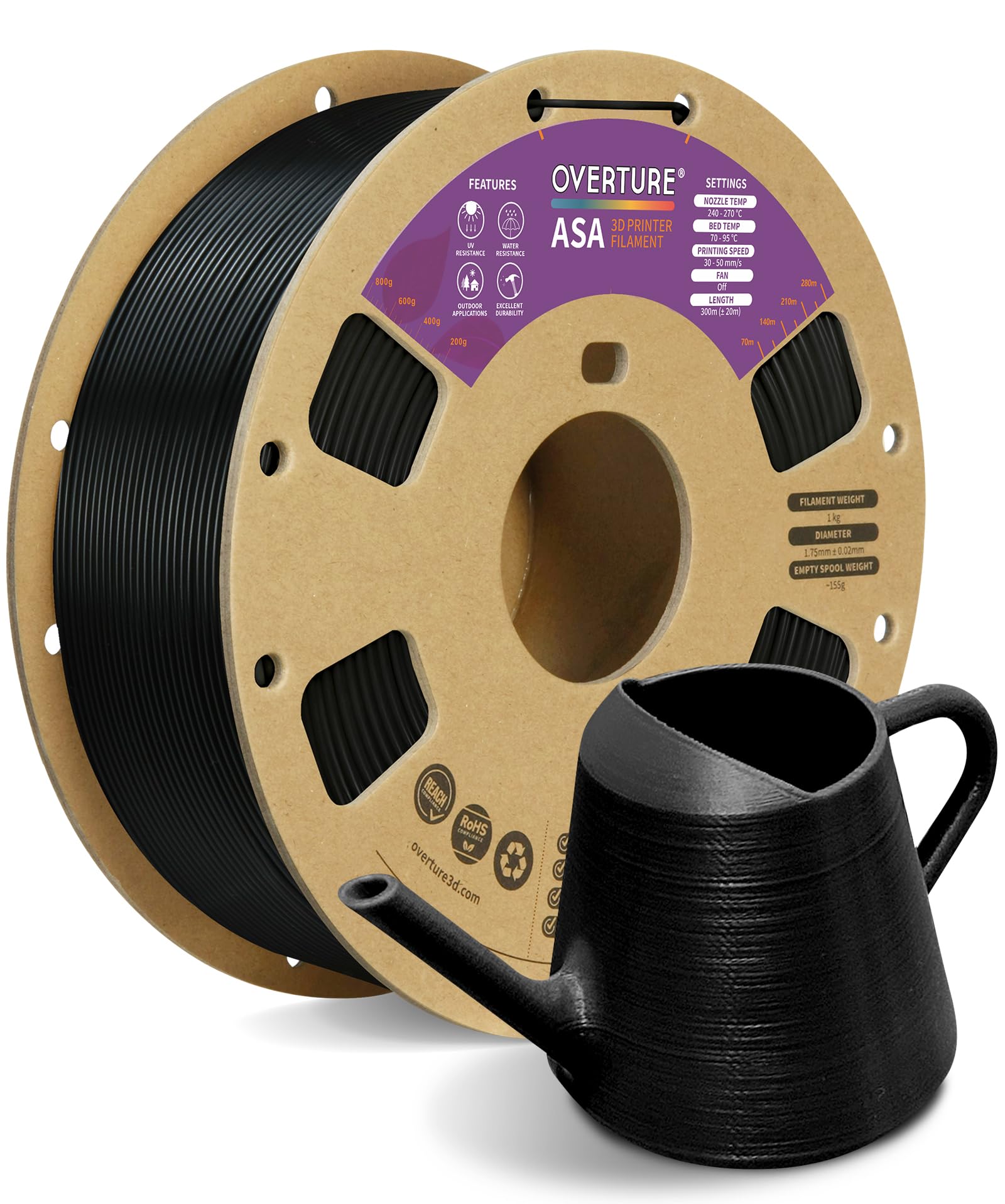
Overture’s ASA is many users’ first and only ASA because it works reliably across a wide range of printers — from entry-level Ender 3s to advanced Bambu Lab X1 Carbon — with zero clogs reported across dozens of reviews. The patented clog-free formula and 24-hour pre-drying before vacuum sealing make it the most forgiving ASA for users who don’t want to fight with moisture or inconsistent extrusion.
Print quality is described as fantastic with Orca Slicer defaults — clean overhangs, strong rigid parts, and no warping. The black color is deep and uniform. The odor is present but a carbon filter in the enclosure managed it well. Users specifically note that the layer adhesion is excellent, producing parts that feel very rigid and strong compared to typical PLA prints.
The 1-year shelf life for unopened spools is a nice safety net for occasional users who buy in bulk. The vacuum seal and resealable foil packaging maintain dryness effectively. The only downside is that the spool is a standard 1 kg — nothing fancy — and the color selection, while wide, doesn’t include specialty blends like fiber-reinforced variants.
Why it’s great
- Clog-free and bubble-free guarantee backed by verified user reports across many printers
- Pre-dried for 24 hours and vacuum sealed with resealable foil for long moisture protection
- Excellent layer adhesion and overhang performance with stock slicer profiles
Good to know
- Standard unfilled ASA — lacks the stiffness and impact resistance of glass or carbon fiber blends
- Spool is basic with no AMS-specific design
- Odor is present, requiring a well-ventilated enclosure or carbon filtration
7. Creator ASA Burnt Titanium

Creator ASA in Burnt Titanium delivers a striking iridescent color that shifts between bronze, purple, and blue depending on the viewing angle — a visual effect no other ASA in this list offers. Users love the aesthetic, describing it as beautiful and solid, though not fully opaque. It prints well at high speed with no clogs and good bed adhesion when glue is applied to the build plate.
The material feels strong like PLA+ after printing, which is decent for decorative outdoor items such as rain gauges and small garden markers. However, multiple reviews note the printed parts become brittle after cooling — they snap easily under stress. This formulation sacrifices impact toughness for color, making it unsuitable for functional mechanical parts that bear load.
A significant reliability issue emerged: the spool tangles after about halfway through the roll, causing print failures that require manual rewinding. This is a spooling quality problem rather than a material defect, but it will frustrate anyone printing overnight or in batches. The 3-month warranty is shorter than the industry standard, reflecting the brand’s confidence ceiling. Best used for small, visually driven projects where a unique color matters more than durability.
Why it’s great
- Stunning Burnt Titanium color shift not available from any other ASA brand
- Prints cleanly at high speed with minimal stringing and good layer adhesion
- Solid color saturation without the grayish tint of cheaper ASA formulations
Good to know
- Printed parts are notably brittle — not suitable for load-bearing or impact-prone applications
- Spool tangles after the halfway point, causing print failures that require manual rewinding
- Short 3-month warranty compared to 1-year standard from Overture and others
FAQ
Do I need an enclosure to print ASA filament?
How does ASA compare to ABS for outdoor use?
Can I print ASA on a glass bed without glue?
Is carbon fiber ASA harder to print than standard ASA?
Final Thoughts: The Verdict
For most users, the asa 3d filament winner is the ANYCUBIC ASA because it delivers reliable ±0.02 mm dimensional accuracy, a 90°C HDT, and consistent prints without the stringing or warping that plague budget alternatives. If you need the highest strength and stiffness for load-bearing outdoor parts, grab the Siraya Tech Fibreheart ASA-GF with its 10% glass fiber reinforcement and 106°C glass transition temperature. And for a budget-friendly workhorse that prints reliably across nearly every consumer 3D printer, nothing beats the Overture ASA with its patented clog-free formula and excellent pre-drying protocol.