
Our readers keep the lights on and my morning glass full of iced black tea. As an Amazon Associate, I earn from qualifying purchases.
Specs are compiled from manufacturer listings and verified buyer reviews and can change over time — please confirm the key details on the product page before buying.
Finding the right buffing compound for scratches is about matching the abrasive to the depth of the damage. Too mild a product will leave swirl marks and light scratches untouched, while a heavy-cut compound used carelessly can burn through your clear coat. This guide breaks down the real performance differences between nine proven formulas, so you can stop guessing and start restoring your paint.
I’m Min — the founder and writer behind Gadgets Feed. This guide is built by comparing the manufacturers’ published specifications and the patterns across verified customer reviews, so you get each pick’s real strengths and trade-offs instead of marketing spin.
You’ll learn which abrasive grade handles light swirls versus deep scratches, and how to pick a formula that won’t dust or dry out mid-pass. Use this to find the best buffing compound for scratches on your car’s specific finish.
Our Picks at a Glance

How To Choose The Best Buffing Compound For Scratches
Before you pick a buffing compound, ask yourself two things: how deep is the scratch, and how hard is your paint? Match the abrasive to the damage, and you will smooth the surface without adding new fine scratches (micro-marring). Get it wrong, and you either spend hours on a scratch that never fades or remove too much clear coat (the protective top layer of your paint).
Match the Grit to the Scratch Depth
The grit number tells you the size of the abrasive particles suspended in the cream. A lower number means bigger, more aggressive particles that cut fast; a higher number means finer particles that refine the shine. For deep scratches and sanding marks, you need a low-grit heavy cut. For light swirls and holograms, a fine or ultra-fine polish is the safer call.
Consider Working Time and Dusting
A compound that dries out after two or three passes forces you to work in tiny sections and reapply constantly. Formulas with a long buff cycle let you cover a full panel before the residue hazing over. Low-dusting compounds also save you cleanup time, because the dried abrasive does not scatter across the car and into your trim.
Know Your Paint Type
Modern clear coats are harder and more forgiving than the single-stage lacquer and enamel paints on older cars. Some aggressive compounds are designed specifically for rotary buffers and old-school finishes, while others are formulated to be safe on the latest energy-cured clear coats. Read the compatibility before you commit to a heavy cut.
Quick Comparison
| Model | Best For | Abrasive Grit | Size | Cut Type | Amazon |
|---|---|---|---|---|---|
| Griot’s Garage BOSS Correcting Cream★ Best Overall | Moderate swirls & light scratches | 120 | 16 oz | Medium Cut | Amazon |
| menzerna Super Finish Plus 3800Deep Gloss | Final gloss on dark paint | — | 8 oz | Finishing Polish | Amazon |
| Meguiar’s Professional M04 Heavy CutHeavy Cut | Heavy swirls & oxidation | 40 | 16 oz | Coarse Cut | Amazon |
| menzerna One-Step Polish 3in1 | One-step cut, shine & seal | — | 8 oz | Medium Cut + Seal | Amazon |
| Malco Super Duty Heavy Cut | Sand scratches on cars & boats | 800 | 32 oz | Heavy Cut | Amazon |
| Chemical Guys C4 & P4 Kit | Two-step correction at home | 2000 | 2 x 16 oz | Compound + Polish | Amazon |
| RUPES D-A Coarse | Hard clear coats & wet-sand marks | 1500 | 33.8 fl oz | Coarse Cut | Amazon |
| Jescar Correcting Compound | P1500 sanding marks, no dust | 1500 | 32 oz | Fine Cut | Amazon |
| Farécla G3 Premium Compound | Fresh paint & final finishing | 1500 | 1 kg | Fine Cut | Amazon |
In‑Depth Reviews
1. Griot’s Garage BOSS Correcting Cream
Our pick — over 4.5★ from 850+ verified ratings; the strongest balance of quality and price.
The crowd favorite that outlasts the competition through eight passes without drying out
You get the best mix of scratch removal and easy handling with this medium-cut cream. Its aluminum oxide abrasive (a common polishing grit) sits at a 120 grit number — coarse enough to remove light scratches and swirl marks, yet fine enough to leave your paint glossy instead of hazy. Buyers report it restored a 12-year-old black Acura to a mirror finish in four to five passes per panel.
The defining trait here is the extended buff cycle. Owners mention it lasts through 8 passes versus 2-3 for a rival brand, letting you work a full section before it dries. The high-lubricity formula spreads and wipes off easily, and dusting stays low enough that cleanup is a non-event. The 16-ounce bottle is also designed for easy pouring, a small detail that makes it less messy to use.
Its appeal stretches beyond cars too — it revived 40-year-old turntable acrylic covers and boat gel coat scratches, and one owner found it effective on self-healing paint. The trade-off shows up only on truly deep scratches, where you would need sanding first; this cream is not a miracle worker on damage that has already cut through the clear coat.
Why It Wins
- Long work time prevents premature drying on big panels
- Medium 120 grit safely removes swirls without marring clear coat
- Pairs with any orange pad for flexible cutting power
Where It Stops
- Not meant for deep scratches that need wet sanding first
- You’ll still want a wax or sealant afterward for protection
Grab it for: the DIY owner who wants one reliable medium-cut compound that handles most daily defects without the learning curve of a pro-grade system.
Think twice if: your paint already has deep scratches that have cut through the clear coat — those need sanding and a heavier cut first.
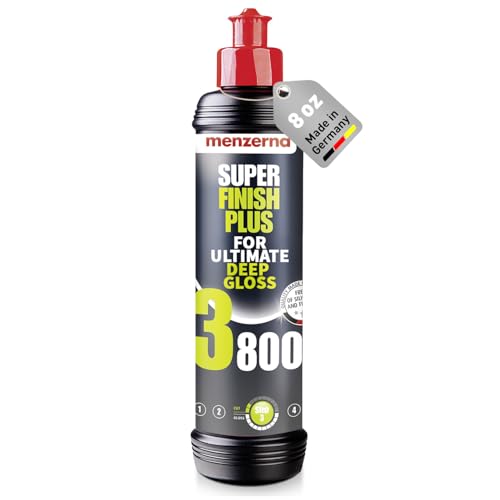
2. menzerna Super Finish Plus 3800
The final polishing step that removes holograms (buffer swirls) and fine scratches for a crisp finish
This 8-ounce bottle is for the final pass, not the first one. While heavier compounds remove the scratch, the Super Finish Plus 3800 removes the haze that heavy cutting leaves behind — the holograms (buffer swirls) and fine scratches that show up worst on dark paint. Customers note it wiped out holograms left by a rotary buffer on black paint when paired with a red jeweling pad, leaving a crisp result.
Weighing in at 8 ounces against the 16-ounce bottles above, it is a 2x smaller bottle, but its job is far more surgical. The long working time means the milky film stays workable until it turns slightly translucent, so you are never racing a drying product. The formula is silicone-free, which matters if you plan to top it with a sealant afterward — no silicone means better bonding for your protection layer.
It pulled double duty for one owner by removing scratches from a resin bathtub by hand, which shows how versatile the fine abrasive is. The honesty here is that it offers no paint protection on its own; it is a finishing polish, so you must follow up with wax or sealant. It also works best after a full decontamination, so this is an enthusiast’s product, not a quick-fix spray.
Best used as: the second step in a two-stage correction, turning a good compound job into a deep, glossy show finish on dark colors.
Keep in mind: this refines rather than removes — deep scratches need a cutting compound before this bottle ever touches the paint.
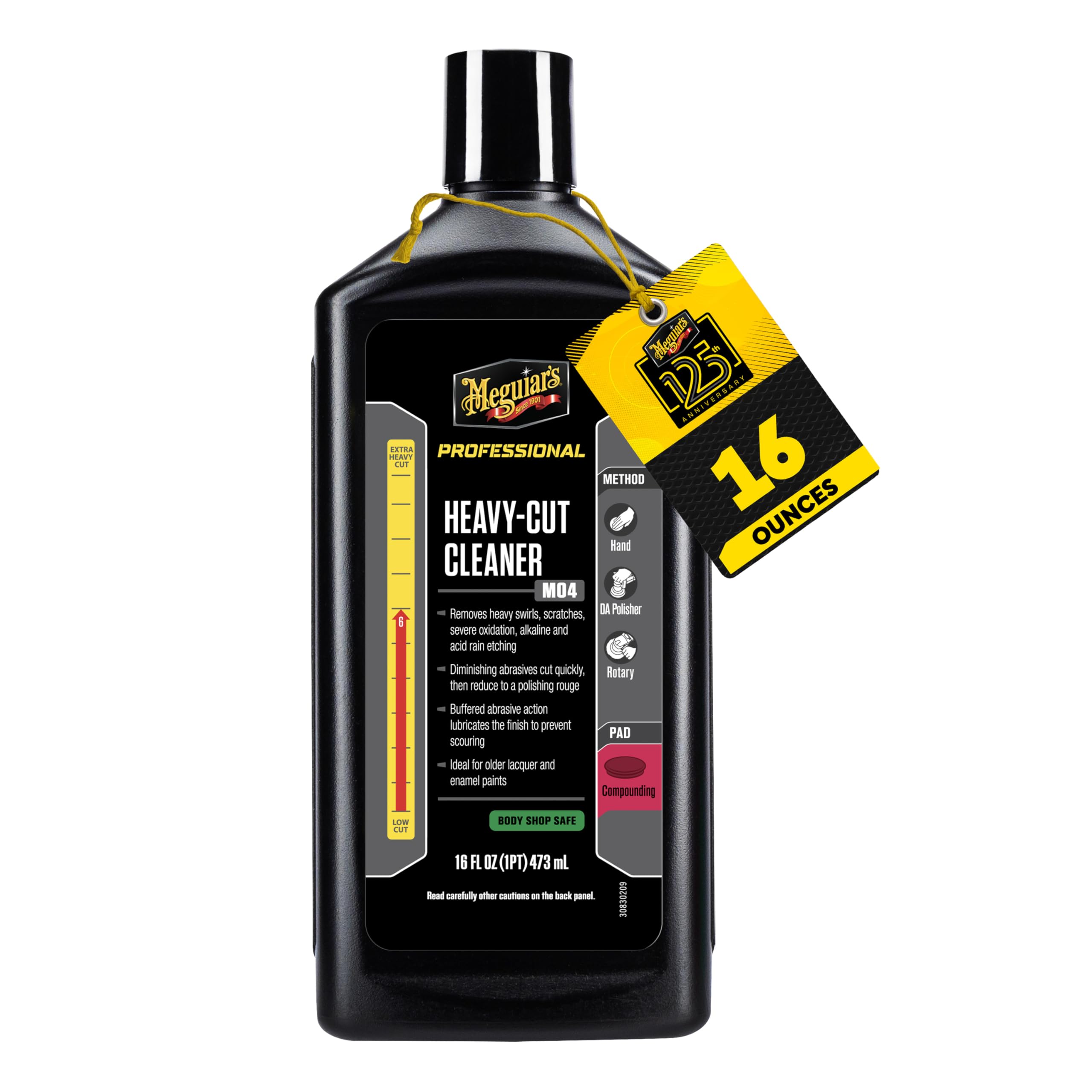
3. Meguiar’s Professional M04 Heavy Cut Cleaner
The roughest grit in this lineup for serious swirls, oxidation, and etching
When a standard scratch remover fails, reach for this bottle. At a 40 grit number, the M04 is the most aggressive compound in this guide — roughly three times coarser than the Griot’s 120 grit above. That cutting power handles heavy swirls, severe oxidation, and alkaline or acid rain etching (chemical stains on paint) that milder products cannot touch.
Despite the rough grit, reviewers point out it does not damage clear coat, with one owner noting it removed scratches that a dedicated scratch remover could not. The buffered abrasive action lubricates the finish to prevent scouring, and the formula cuts quickly before reducing to a buffing rouge (a fine polishing agent) that minimizes new swirls. Its balance is older lacquer and enamel paints, as well as clear coats, and it is body shop safe for rotary buffer use.
What stands out in the reviews is its versatility beyond cars — it cleaned up damaged drum set cymbals, jewelry, and even restored yellowed headlights. It is also effective on etch marks when paired with microfiber hand pads. The honest caveat: this is a heavy-duty tool, so it demands care and a follow-up polish to restore full gloss.
Built For
- Serious oxidation and etching that medium compounds leave behind
- Older lacquer and enamel single-stage paints
- Rotary buffer use in a body-shop workflow
Not For
- Light swirls where a finer compound is safer and faster
- Anyone without a follow-up polish step, since heavy cuts leave haze
Choose it when: your clear coat has deep defects and oxidation that lighter compounds simply cannot level, especially on older paints.
skip it if: you only have light wash swirls — the 40 grit is overkill and will strip more clear coat than necessary.
4. menzerna One-Step Polish 3in1
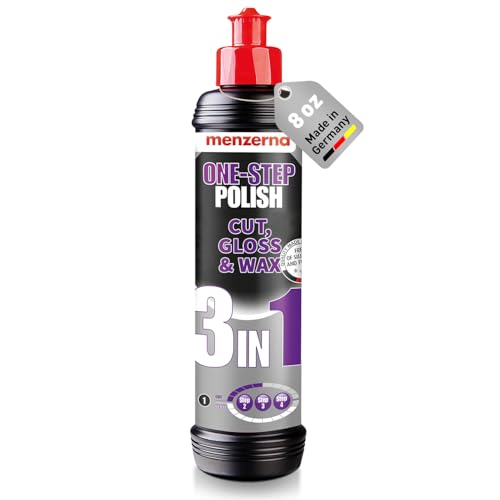
Cut, shine, and seal in one bottle for a fast revival of tired paint
This is the shortcut that actually works for everyday wear. The 3in1 combines a medium-cut polish, a finisher, and a carnauba-based wax sealant in a single 8-ounce bottle, so you can correct light scratches and swirls and leave a protective layer behind in one session. Shoppers say it leaving a mirror shine on a dark silver Tahoe using just two to three pea-sized dots per panel.
The real selling point is the carnauba wax layer it deposits, which repels water, dirt, and pollen and makes future washes easier. Because it serves as a sealant, it is ideal for reconditioning a used vehicle before selling it — one product bumps up the perceived value without a multi-step process. Its working time is generous, and owners note there is no dust or residue left on black rubber and plastic trim.
The honest limitation is its cutting power. It handles normal wear and light-to-medium scratches beautifully, but it is not a heavy correction tool. One owner who needed deeper cutting power found it was the wrong job for the bottle, though the same reviewer noted it was perfect when the clear coat was in better condition.
Perfect for: the owner who wants to refresh daily-driver paint in an afternoon without juggling separate compound, polish, and wax bottles.
Know the limit: deep scratches and heavy oxidation need a dedicated cutting compound before this 3in1 can do its finishing-and-sealing job.
5. Malco Super Duty Heavy Cut Compound
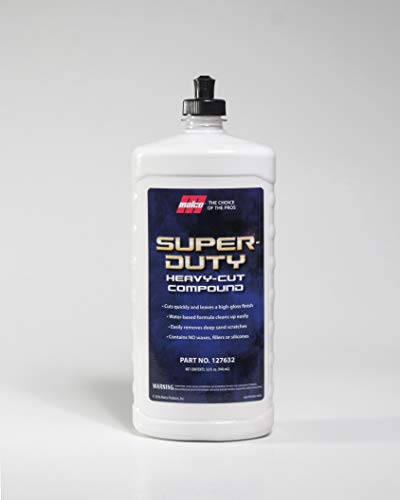
The U.S.-made workhorse that chews through sand scratches on cars and boats
This 32-ounce jug is pure muscle for paint correction, aimed squarely at heavy sand scratches and oxidation on both clear coat and gel coat surfaces. Its specialty is removing P1500 grit and finer sand scratches from any car, truck, or boat, which makes it a staple for cut-and-buff work after a respray. One owner doing a cut and buff on heavily oxidized paint said the difference from his previous brand was night and day.
The 800 grit number reflects wool-pad cutting power, and it is designed to work with a Malco 100% twisted white wool cutting pad. Buyers report it restored severely oxidized paint on a 2008 Honda Accord with an orbital buffer and wool pad, exceeding expectations when worked slowly with repeated passes.
There is a trade-off for that speed: if you overwork it, the residue becomes difficult to remove and needs a damp cloth. It also leaves behind 800-grit marks of its own, so it is not a one-step product — it demands a finer polish afterward to finish the job properly.
It Excels At
- Removing P1500 and finer sand scratches fast
- Working on clear coat, gel coat, and single-stage finishes
- Big 32-ounce size for long detailing sessions
Be Prepared For
- Residue that is tough to remove if you overwork it
- Needing a follow-up polish to clear its own fine markings
Reach for it when: you are cutting and buffing a fresh paint job or restoring badly oxidized gel coat, and you have a wool pad and rotary machine.
Look elsewhere if: your paint is a soft clear coat or you have no finer polish to follow up with — this cut leaves its own marks behind.
6. Chemical Guys C4 & P4 Paint Correction Kit
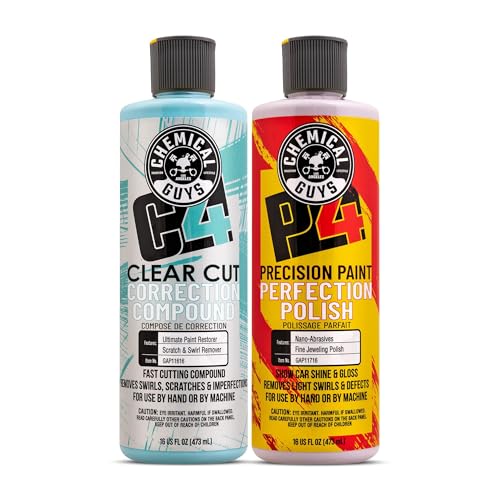
A complete compound-and-polish pair that walks you through full correction at home
This kit gives you both halves of the correction process in one box: the C4 Clear Cut compound for removing defects and the P4 Precision Polish for refining the paint to a high-gloss finish. Instead of guessing which bottle to buy, you get the matched pair that detailers use in sequence. The abrasive grade sits at an ultra-fine 2000 grit, which is notably finer than the heavy cutters in this guide and reflects its safe, beginner-friendly philosophy.
The results speak for themselves in the reviews. Owners mention removing 95% of off-road bush and tree scratches on a truck, including eight-year-old ones, and polishing a black boat to a mirror finish. It works on clear coat, single-stage, and ceramic-coated vehicles, and it is compatible with dual action, rotary, or hand application. One owner on a seven-year-old black truck found the results impressive when he followed the directions and worked unhurriedly.
The 2000 grit ultra-fine abrasive means it is not the fastest cutter on hard factory clear coats. A few owners found C4 cut less aggressively than expected on a hard Corvette clear coat, so heavy damage on rock-hard paint may need a more aggressive first step. There is also a clear consensus that you should follow with wax afterward for maximum depth.
Best for: the home enthusiast who wants a matched two-step system and is willing to work through the process panel by panel.
The catch: on very hard clear coats, C4’s ultra-fine cut may feel too gentle, so heavier defects might need a dedicated coarse compound first.
7. RUPES D-A Coarse High Performance Cut
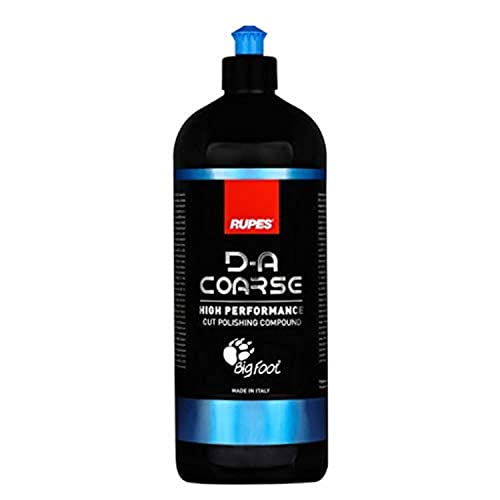
The pro detailer’s choice that corrects hard clear coats without a secondary polish
This is the compound that professional detailers keep reaching for when factory clear coat fights back. It removes defects and sand scratches up to 1500 grit quickly, and its durable lubrication system extends the polishing cycle for a longer working time. The 33.8-fluid-ounce bottle is the largest in this lineup by volume, and it is formulated specifically for random orbital and gear-driven orbital polishers.
The reviews are emphatic about its cutting speed. Another owner with 21 years of experience called it the best compound he had used, noting it removes fingernail-feel scratches on black paint without leaving swirls.
Its low-dusting formula reduces post-compound cleanup, which is a real time-saver on a full car. With a RUPES blue pad, it can remove any wet-sandable scratch while staying near-simple to use for reducing the learning curve. It is a premium product with a premium price, but for someone doing serious correction work, the speed and finish justify the cost.
Pro-Level Strengths
- Fast cut on hard clear coats, often skipping the polish step
- Low-dusting formula simplifies cleanup
- Removes wet-sandable scratches with a RUPES blue pad
Consider This
- Premium tier pricing reflects the pro-grade performance
- Best paired with a random orbital polisher, not hand application
Worth it for: the serious enthusiast or pro detailer working on hard clear coats who values speed and a refined finish in a single step.
Not the pick if: you plan to polish by hand — this is engineered for orbital machine use and shines there.
8. Jescar Correcting Compound
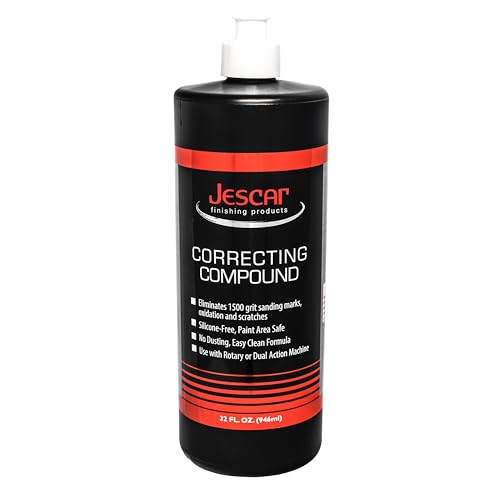
A dust-free formula that leaves paint looking like glass without powdering up
This 32-ounce compound is built around one standout trait: it does not dust. The advanced formula eliminates P1500 grit sanding marks on fresh paint while leaving no powdering, no haze, and no messy cleanup across your trim. It is suitable for all paint systems and fiberglass gelcoat, and it works with wool or foam pads on rotary or dual-action machines.
Customers note it achieving a glass-like finish on paint, with one owner calling it one of the best compounds he had ever used. The versatility is a big draw — it works on 1500 to 3000 grit sanding marks, removes holograms, and performs well on black paint. For beginners, the instructions are simple: use three pea-sized dots per two-by-two area and make three passes with medium pressure on a drill or dual-action polisher.
The premium blend of European abrasives delivers exceptional cutting performance, and being silicone-free makes it safe for body shops and all paint areas. The honest caveat is its price — opinions on value are mixed, with several owners saying the cost is steep even though the performance is genuine. It also benefits from a follow-up like a fine polish for an absolute show finish, though it gets most of the way there alone.
Standout feature: the dust-free, no-haze behavior keeps your work area clean while the fine 1500 grit handles sanding marks safely.
Weigh the cost: performance is top-tier, but the price draws mixed reviews, so it suits buyers who prioritize a clean workflow over budget.
9. Farécla G3 Premium Abrasive Compound

The trusted finisher that professional painters refuse to swap for anything else
This 1-kilogram bottle has earned a devoted following among people who finish paint jobs for a living. Its long-lasting, powerful cut delivers permanent results fast, and the formula is engineered to avoid dragging, staining, or hazing on fresh paints. The fine 1500 grit abrasive is safe on all modern paint systems, including the very latest energy-cured or hyper clear coats, which makes it a versatile finishing compound.
The reviews are unusually loyal. One owner says his husband, who finishes paint jobs and details, will not use anything else, and another calls it worth every cent for both single-stage and clear coat finishes. That kind of repeat buy-in from professionals speaks to consistent results bottle after bottle. It is clean in use and easy to wipe off, which keeps the finishing stage quick and frustration-free.
Its strength is finishing rather than heavy cutting. At a fine 1500 grit with a foam material type, it is the last step in a correction workflow, designed to perfect the surface after a heavier compound has done the heavy lifting. It is a premium product at a premium price, but for anyone who wants a reliable finisher that will not haze fresh paint, the loyalty it inspires is telling.
The professional’s choice: a fine 1500 grit finisher trusted by painters for a clean, haze-free finish on modern clear coats.
Plan the workflow: this is the finishing step, not the scratch remover — pair it after a heavier compound for deepest scratches.
Understanding the Specs
Grit Number & Cut Type
The grit number tells you the size of the abrasive particles in the compound. Lower numbers like 40 mean bigger particles that cut aggressively for deep scratches, while higher numbers like 2000 mean finer particles that refine the shine. A coarse or medium cut removes defects fast but leaves haze, so you need a fine or ultra-fine polish afterward to restore gloss.
Working Time & Dusting
Working time is how long the compound stays wet and workable before drying. A longer buff cycle lets you cover a full panel without the residue hardening, which is critical for efficiency. Dusting is the dried abrasive that scatters during buffing — low-dusting formulas keep your trim and jambs clean and cut down on cleanup time.
FAQ
What is the difference between a buffing compound and a polishing compound?
Will a heavy-cut compound damage my clear coat?
How do I know if a scratch is too deep for a compound?
Can I use these compounds by hand or do I need a machine?
What does the grit number on the bottle actually mean?
Why does my compound dry out and dust during buffing?
Is a one-step compound and polish worth it versus a two-step system?
Do I need to wax after using a buffing compound?
Final Thoughts: The Verdict
For the majority of shoppers, the clear winner for the best buffing compound for scratches is the Griot’s Garage BOSS Correcting Cream because its medium 120 grit and extended work time strike a strong balance between correction and ease of use. If you want a fast-cutting pro formula that can skip the polishing step on hard clear coats, grab the RUPES D-A Coarse. And for a matched two-step system that walks beginners through full correction at home, the Chemical Guys C4 and P4 Kit is the one to reach for.
How We Picked
We do not accept paid placement. Every pick is matched to a real buyer and a real use-case; we do not hands-on test units.
Sources & Methodology
Specifications: manufacturer listings and product documentation. Review insights: verified customer reviews, as of September 2026. Pricing: not shown on this page (it changes often); check the current price via the retailer link.
As an Amazon Associate, Gadgets Feed earns from qualifying purchases. This does not affect which products we feature.