
Our readers keep the lights on and my morning glass full of iced black tea. As an Amazon Associate, I earn from qualifying purchases.
Specs are compiled from manufacturer listings and verified buyer reviews and can change over time — please confirm the key details on the product page before buying.
For a 3-year-old, a bicycle is pure freedom — but the wrong pick turns that thrill into a wobbly, frustrating struggle. The real decision isn’t about colors or cartoons; it’s about whether your child learns balance first (on a no-pedal glider) or coordination later (on a pedal bike with training wheels). This guide breaks down the best 3 Year Old Bicycle options by how kids actually learn to ride, so you can match the bike to your child’s height, confidence, and the terrain you’ll ride on.
I’m Min — the founder and writer behind Gadgets Feed. This guide is built by comparing the manufacturers’ published specifications and the patterns across verified customer reviews, so you get each pick’s real strengths and trade-offs instead of marketing spin.
In short: balance bikes teach steering and gliding first, pedal bikes teach pedaling with training-wheel stability, and the right choice hinges on your child’s inseam and nerve — 3 year old bicycle picks that fit today and grow for tomorrow deliver the least tears and the most sidewalk smiles.
Our Picks at a Glance


How To Choose The Best 3 Year Old Bicycle
Picking a first bike depends on three things: your child’s height (not their age), whether they want to pedal immediately, and where they’ll ride. A bike that’s too tall makes a toddler scared; one that’s too heavy makes them dependent on you. Get the fit right and they’ll beg to go outside.
Balance Bike or Pedal Bike First?
Most toddlers learn to ride faster on a balance bike because they master steering and balance first, then transfer those skills to pedaling without ever needing training wheels. They master steering and balance first, then transfer those skills to a pedal bike without ever needing training wheels. If your 3-year-old is cautious or small for their age, a balance bike builds confidence at their own pace. If they’re tall, coordinated, and desperate for “big kid” pedaling, a 12-inch pedal bike with removable training wheels lets them start immediately and strips the wheels off later.
Get the Wheel Size and Seat Height Right
Wheel size matters less than seat height. A 12-inch wheel suits kids roughly 28 to 38 inches tall — the common 2-to-4 range — while a 14-inch wheel fits taller or older kids (typically 3 to 6) and gives more room to grow. The critical number is the seat’s lowest position: your child should be able to stand flat-footed with a slight bend in the knee. Check the seat-adjustment range, not the marketing age, before you buy.
Air Tires vs. Puncture-Proof
Air-filled rubber tires absorb bumps and grip grass, gravel, and dirt far better than foam or plastic, making them the choice for trail-riding families. The catch is maintenance: air tires need occasional inflation and can get flats. Puncture-proof airless tires eliminate flat-tire hassle entirely and roll smoothly on pavement, but they’re firmer on rough ground. Choose air for trails and comfort, airless for pure sidewalk simplicity.
Quick Comparison
| Model | Best For | Wheel Size | Seat Range | Weight | Amazon |
|---|---|---|---|---|---|
| Retrospec Cub★ Best Overall | Quality-first balance learning | 12-inch | 11″–14.5″ | 10 lb | Amazon |
| KRIDDO 2-in-1Best 2-in-1 | 2-in-1 trike-to-balance versatility | — | — | 4.8 kg | Amazon |
| Ridego 14″Roomy Growth Pick | Taller kids with room to grow | 14-inch | 14.2″–18.3″ | 4.23 kg | Amazon |
| Blue’s Clues 12″ | Character-obsessed pedal beginners | 12-inch | — | 17.4 lb | Amazon |
| bicystar 14″ | Real-tire balance on any terrain | 14-inch | 13″–21″ | 8.5 lb | Amazon |
| Retrospec Beaumont | Premium air-tire balance comfort | — | from 13″ | 9.3 lb | Amazon |
| Glerc Little Molly | Retro style with real brakes | 12-inch | 14″–17″ inseam | 19 lb | Amazon |
| cubsala BMX | Sturdy BMX-style pedal starter | 12/14-inch | — | — | Amazon |
| Dynacraft Barbie | Barbie-brand pedal excitement | 12/16/18-inch | — | 6.9 lb | Amazon |
In-Depth Reviews
1. Retrospec Cub Toddler Balance Bike
Our pick — over 4.5★ from 550+ verified ratings; the strongest balance of quality and price.
The puncture-proof glider that survives a year of rough play and still rolls smooth.
The Retrospec Cub is the balance bike that parents trust because it simply doesn’t give them reasons to worry. Its airless, puncture-proof tires mean there’s never a flat to fix and no pressure to check — just open the box, and it rolls across pavement, grass, and dirt paths without a hitch. The seat adjusts from 11 to 14.5 inches, so a 3-year-old who’s still growing gets several seasons out of one frame instead of outgrowing it in months.
At 10 pounds with a low-slung alloy steel frame, it’s light enough for a small rider to muscle around on their own while staying stable with a low center of gravity. Buyers report kids are cruising within a week of first sitting on it, and the rounded edges plus non-slip grips earn it the label of a safe first ride. It’s note the frame maxes out for taller toddlers — one family found the seat maxed by age 2.5 — so it’s ideal for the smaller end of the 3-year-old range.
Owners mention it’s survived “a year of rough use” and still feels sturdy, with simple assembly that takes under 15 minutes and even included stickers that keep kids engaged with their new ride. This pick earns the top spot because its build quality is the most-praised trait by a wide margin — owners consistently call it well-made, durable, and perfect for toddlers learning balance.
What Wins Parents Over
- Puncture-proof tires mean zero flat-tire maintenance
- Low frame lets little legs plant flat-footed with confidence
- Adjustable seat extends usable life across growth spurts
Who Should Size Up
- Seat maxes out around age 2.5–3 for taller toddlers
- Firm airless tires feel less cushioned on rough trails than air-filled ones
Reach for this if: you want a maintenance-free, durable balance bike for a smaller 3-year-old just learning to glide.
Look elsewhere if: your child is already on the tall side or you plan to ride mostly on bumpy trails where air tires cushion better.
2. KRIDDO 2-in-1 Tricycle and Balance Bike
Two bikes in one — a stable trike now, a balance bike later, no second purchase needed.
The KRIDDO 2-in-1 is the cleverest answer for parents who can’t decide between a trike and a balance bike. It starts as a tricycle with training wheels for stability and safety, then converts to a pure balance bike as your child gains confidence. The pedals tuck into a storage slot under the rear seat when you switch to balance mode, so there’s nothing to lose or misplace — a thoughtful detail that makes the transition genuinely easy.
Weighing just 4.8 kg, it’s noticeably lighter than most pedal bikes, and the tool-free seat and handlebar adjustments mean you can dial in the perfect height in seconds. Assembly is the standout feature here; the most-praised aspect is how straightforward it is to put together, with a helpful video guide. One family called it “easy to put together” and “perfect for our 2 year old grandson,” while another praised the quality build and how the design prevents any ankle or foot contact in balance mode.
The honest trade-off is the material: the tires are plastic rather than rubber, which drew criticism from some owners who expected softer, grippier wheels. For a toddler riding mostly on smooth pavement or indoors, this is a minor issue — the versatility of having two bikes in one outweighs it for most families.
Why It’s a Smart Buy
- Converts from trike to balance bike as skills grow
- Pedal storage slot prevents lost parts
- Quick-release, tool-free seat and handlebar adjustments
Consider This First
- Plastic tires lack the grip and cushion of rubber
- Best suited to pavement, not rough trails
Choose this if: you want one bike that grows from a stable trike into a balance bike without buying twice.
Think twice if: you need all-terrain capability — the plastic tires prefer smooth, hard surfaces.
3. Ridego 14 Inch Balance Bike
A featherlight 14-inch glider with real air tires and inches of growth room left.
The Ridego 14-inch is the pick for taller 3-year-olds who need more legroom than a 12-inch wheel provides. Its seat adjusts from 14.2 to 18.3 inches — a wide span that carries a child well past their fourth birthday — and the glass-reinforced nylon frame weighs just 4.23 kg while supporting up to 110 lbs. At that weight, it’s on par with the KRIDDO above but with the added durability of air-filled rubber tires that soak up bumps on grass, gravel, and pavement alike.
Owners consistently call it easy to assemble and perfectly sized, with one family noting it has “plenty of room for growth” and another describing it as looking like a higher-end glider. It’s a particularly strong choice for a timid or neurodivergent child who needs to warm up to the idea of riding — the no-pedal design lets them start by walking with the bike before ever lifting their feet. Assembly takes about 30 minutes with adult help, and while the instructions need some interpretation, the end result feels sturdy and well-made.
The durability feedback is genuinely mixed, which is the honest caveat here. Some customers note the composite frame breaks more easily than steel, though a company that refunded a customer fully after a wheel issue shows responsive support. For the price, the combination of air tires, low weight, and long seat range is tough to top.
The Big Strengths
- Air-filled tires grip and cushion on mixed terrain
- Lightest frame here at 4.23 kg with 110 lb capacity
- Long seat range fits kids from 3 up toward 6
The Honest Caveat
- Composite frame durability gets mixed owner reports
- 30-minute assembly with instructions that need deciphering
Best matched to: a taller 3-year-old or a child who needs time to build confidence before pedaling.
skip it if: you want the bulletproof simplicity of a steel frame that shrugs off hard falls.
4. Nickelodeon Blue’s Clues & You Kids Bike

The pedal starter with a working mailbox that makes toddlers desperate to ride.
For the child who’s obsessed with Blue’s Clues, this 12-inch pedal bike turns learning to ride into playtime. The handlebar includes a fun mailbox-style storage compartment and a Blue’s Clues & You! plate, so kids can “deliver” toys and treasures on every ride — a detail that owners say makes the bike genuinely notable. It’s built for ages 2 to 4 or riders measuring 28 to 38 inches tall, with a single-speed drivetrain that’s easy for small hands to manage.
Stopping is handled by a rear coaster brake — the intuitive pedal-backward brake that beginners grasp quickly — and the removable training wheels add stability while your child builds confidence. The bike arrives 80% assembled, so you’ll need basic tools and maybe 20 minutes to finish the job. Reviewers point out assembly is simple and fast, and the bike rides smoothly, with many grandparents noting how thrilled their 3-and-a-half-year-old grandson was at the reveal.
The recurring negative is missing parts in the box, which a handful of customers hit. It’s worth opening the box and checking everything before the birthday reveal, since the instructions don’t always match the bike exactly. At 17.4 pounds, it’s also the heaviest pick here — fine for a confident rider, but a smaller or wobbly child may find it hard to manage independently.
What Delights Kids
- Mailbox storage compartment sparks imaginative play
- Coaster brake is intuitive for beginner riders
- Removable training wheels grow with skill
Watch For
- Occasional missing parts in the box — check before gifting
- 17.4 lb weight is heavy for smaller toddlers
Ideal for: a Blue’s Clues superfan who’s ready to pedal and needs the motivation to practice.
Not ideal for: a timid or petite child who’d be overwhelmed by a heavier pedal bike.
5. bicystar 14 Inch Balance Bike
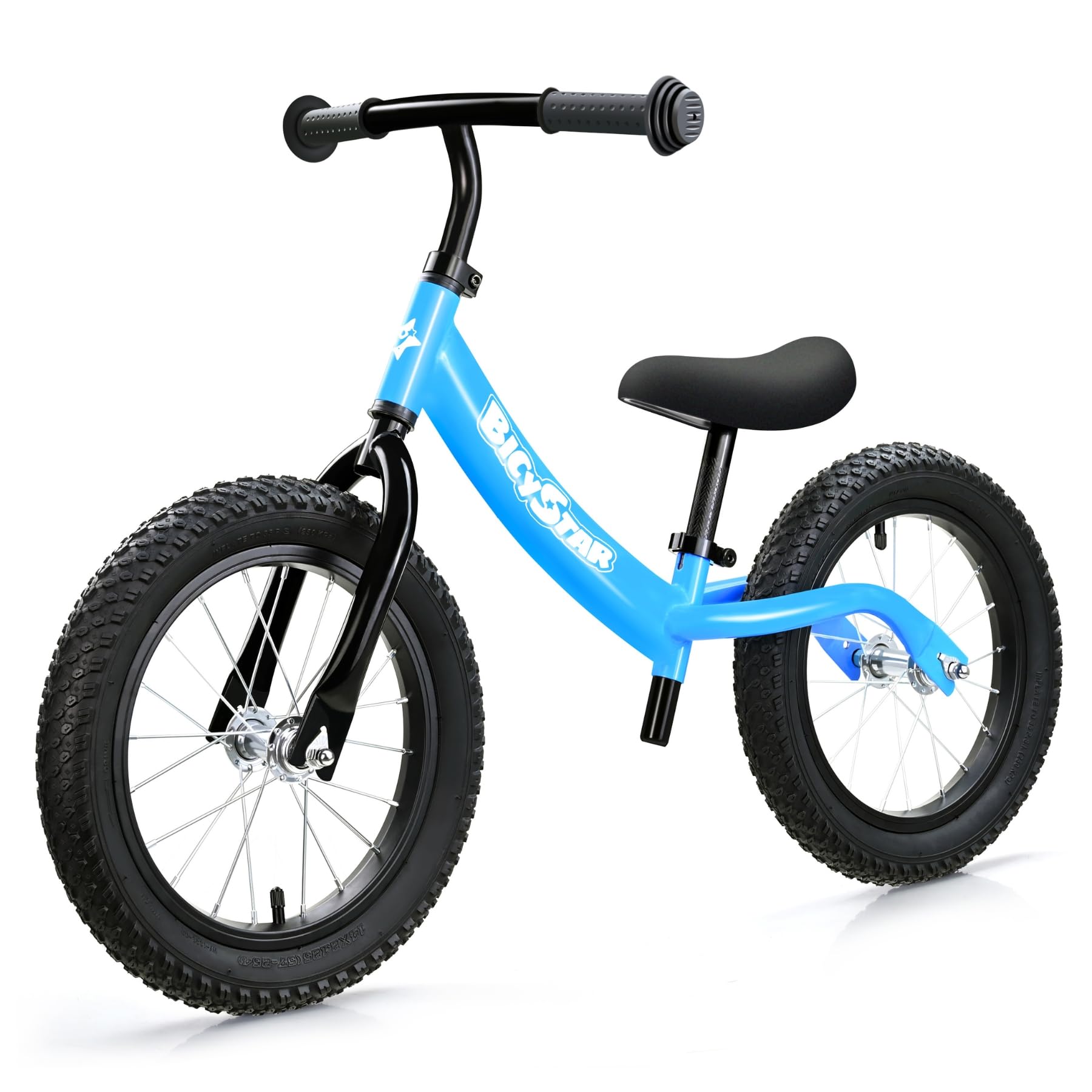
The air-tire balance bike that grips gravel outdoors and rolls smooth indoors.
The bicystar 14-inch is built for kids who’ll ride anywhere the sidewalk ends. Its inflatable rubber tires grip loose gravel and dirt far better than foam or plastic, and the deep anti-slip tread keeps rides steady on pavement too. The seat adjusts from 13 to 21 inches — the longest range on this list — fitting inseams from 13.5 to 22 inches, so a 3-year-old can grow into it for several solid years.
At 8.5 pounds with a wide carbon steel frame supporting 110 lbs, it’s sturdy yet light enough for a child to steer and even carry on their own. Owners rave about the quality — it’s the most-praised aspect by a wide margin — with assembly called quick and straightforward. One family noted their child with a club foot used it to build leg strength and balance, and another said their almost-3-year-old loves that “it’s affordable but has real tires” and is light enough for her to lift herself.
The main complaint is the lack of a rear footrest, which some kids miss for coasting, and a few owners found the seat and handlebars needed extra tightening to prevent slipping. The build also lacks brakes, which is normal for balance bikes but worth knowing before you buy. Backed by an 8-year frame warranty and 2-year tire warranty, this is the balance bike for families who plan to ride on real terrain.
Why It Stands Out
- Air tires grip grass, gravel, and pavement
- Seat range from 13″ to 21″ fits years of growth
- 8-year frame warranty shows long-term confidence
Small Gripes
- No rear footrest for coasting
- Seat and handlebars may need extra tightening
Grab this if: your family rides on trails, gravel, or grass and you want real-tire grip plus years of seat adjustability.
Pass if: your child prefers the feel of a footrest under their feet while gliding.
6. Retrospec Baby Beaumont Balance Bike

The cushioned air-tire glider with a charming basket that grows from age two up.
The Retrospec Baby Beaumont takes the trusted Retrospec formula and adds air-filled cushioning tires for a noticeably smoother ride. The wide, grippy treads handle sidewalks and grass with confidence, and the low step-through frame keeps little ones close to the ground for easy mounting and safe dismounting. At 9.3 pounds, it’s light enough for a 2-year-old to manage while strong enough to support up to 50 pounds of rider.
The adjustable seat starts at 13 inches and grows with your child, making this a bike a toddler can ride for a couple of years rather than a single season. Owners describe it as “the most adorable bike with room to grow,” with the little basket a favorite feature — though one family noted the faux leather straps holding it feel a bit cheap and may not last forever. Assembly is genuinely easy, with the tools included right in the box.
The price is the main hurdle here, sitting at the higher end of the balance-bike spectrum. You’re paying for the air-tire comfort and the polished Retrospec build, and for many families that’s worth it. A 2-year-old “loved it” so much that her family was “ready to do laps around the house bending over” — a sign the bike delivers the kind of enthusiasm that justifies the premium.
Comfort first: the air-filled tires deliver the cushioned, stable feel that makes this worth the premium over airless models.
Charm factor: the basket and retro styling make it a gift that delights — just treat the faux leather straps gently.
7. Glerc Little Molly Retro Cruiser Bike
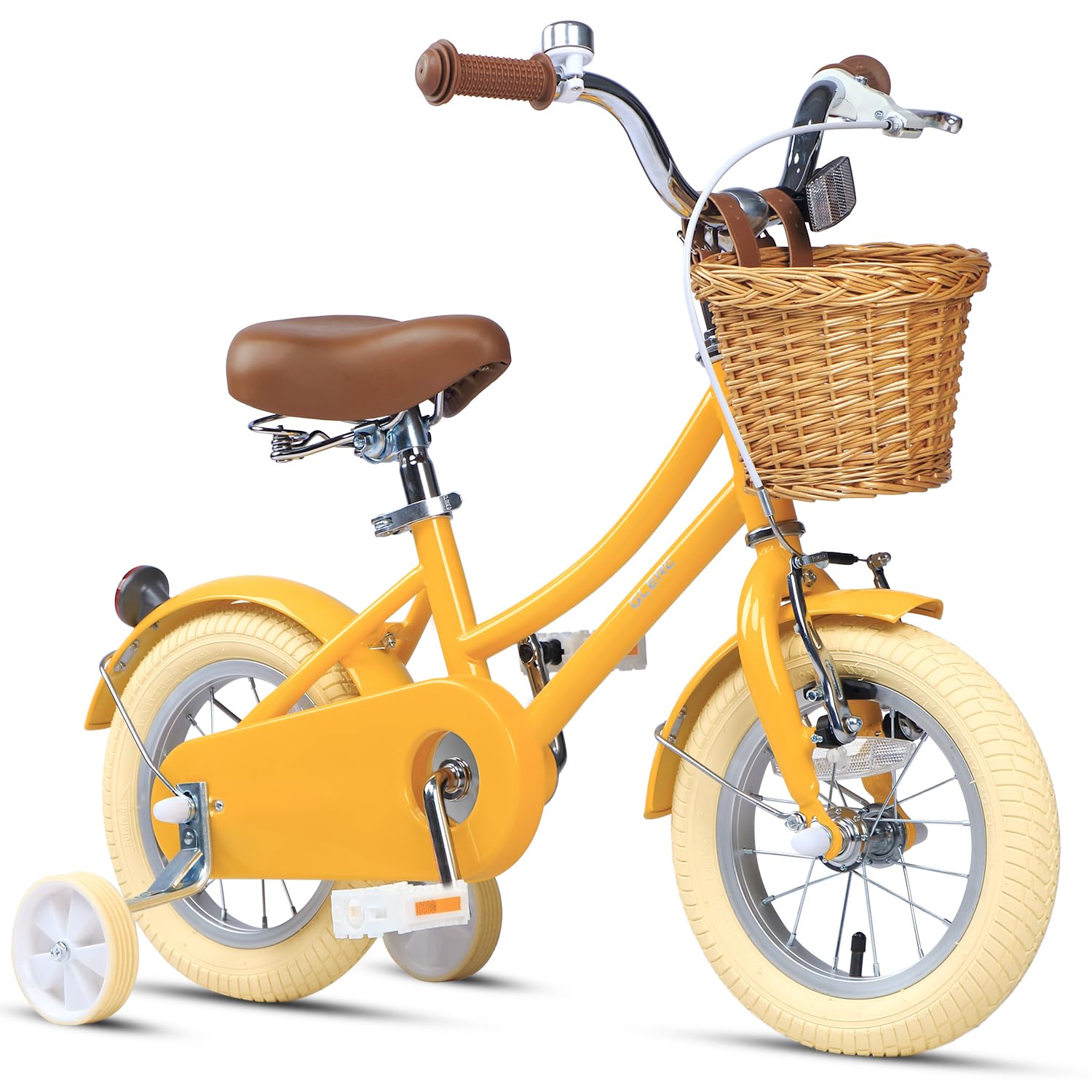
A vintage-style cruiser with a wicker basket and real hand brakes that looks like a boutique bike.
The Glerc Little Molly is the bike for the kid who wants to look like they’re riding down a boardwalk. Its vintage-style metal frame, brown faux leather saddle, wicker basket, and bell create a look that owners consistently call adorable and eye-catching — and the quality backs up the style. It’s fitted with short-travel aluminum brake levers plus a coaster brake, so a child gets real stopping power with either hand or foot, which is a genuine safety advantage over single-brake bikes.
This 12-inch model suits kids ages 2-4, heights of 34 to 38 inches, with an inseam of 14 to 17 inches. It arrives 85% pre-assembled, so most families finish the build in about 25 minutes with the included tools. Owners praise it as sturdier and better-looking than what you’d find at a big-box store, with one family saying it fits their 4-foot-1 child perfectly and is easier to ride than a previous bike.
At 19 pounds, this is a heavy bike, and the fit feedback is genuinely mixed — some find it perfect while others disagree, so measuring your child’s inseam is essential. A few owners also report issues with broken sprockets, though these are in the minority against a large base of satisfied customers. For the retro-loving family, this is the showpiece pick.
Style with substance: dual braking (hand levers and coaster) makes it one of the safest-feeling pedal bikes for beginners.
Size matters: at 19 lb it’s substantial — measure height and inseam carefully to avoid a heavy fit mismatch.
8. cubsala Kids BMX Style Bike
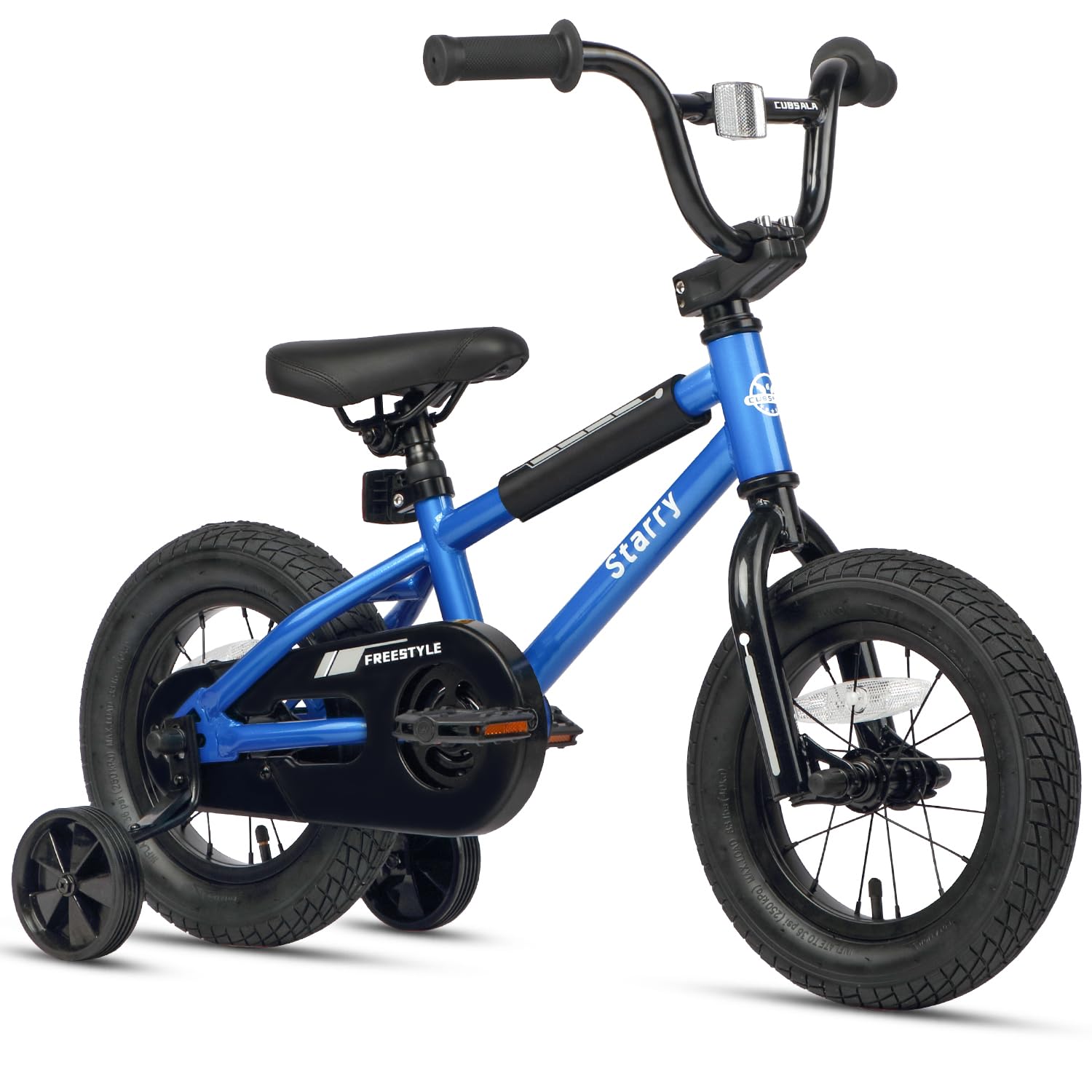
A high-tensile steel BMX that looks like a big-kid bike and takes a beating.
The cubsala BMX-style bike is the pick for the 3-year-old who wants to look cool while learning. The carbon steel frame is built for durability on rough surfaces, the wide tires provide slip-resistant traction, and the easy-to-use coaster brake is perfect for small hands that can’t yet squeeze a hand lever. It comes 85% pre-assembled, so most families finish setup in about 20 minutes with the included tools — assembly being among the most-praised aspects.
The 12-inch version fits ages 2-4 (heights 33-37 inches), while the 14-inch fits ages 3-5 (35-43 inches), so a taller 3-year-old might jump straight to the 14-inch for more growth room. Owners describe it as a “great first bike” that’s sturdy, stable on its training wheels, and looks like a much higher-end model. The adjustable seat and handlebars mean it can keep up with your child for a couple of years.
The honest complaints are minor but worth noting: some owners found the training wheels can work loose over time (worth a periodic check), and one noted the thin paint scratches easily to metal on impact. At this price tier, you’re getting a solid, well-built pedal bike that looks far more expensive than it is, backed by a limited lifetime warranty on the frame.
Built Tough
- High-tensile carbon steel frame with lifetime warranty
- 20-minute assembly with clear instructions and tools
- Coaster brake is simple and safe for small hands
Keep In Mind
- Thin paint can scratch to metal with hard falls
- Training wheels may need periodic re-tightening
Reach for this if: you want a tough, cool-looking pedal bike with training wheels that will survive rough play and look great doing it.
Look elsewhere if: your child is between sizes — measure their height against the wheel-size chart before choosing 12 or 14 inches.
9. Dynacraft Barbie Girls’ Bike

The Barbie-branded pedal bike that turns the first ride into a pink birthday moment.
Available in 12, 16, and 18-inch wheel sizes to span ages 3 through 9, the 12-inch version suits a 3-year-old just starting to pedal. The single-speed drivetrain keeps things simple, and the coaster brake means stopping is as natural as pedaling backward. At just 6.9 pounds, it’s remarkably light for a pedal bike, making it easy for a small rider to maneuver.
The heart of the appeal is the design, which owners consistently describe as “cool and pretty.” A three-year-old niece was reportedly “ecstatic” with her pink Barbie bike, and the included riding bag with a little puppy adds a delightful unboxing moment. Assembly is easy, and the quality of the build gets positive feedback, with one owner noting the modern design details make it feel special.
The durability feedback is more concerning here than elsewhere — some shoppers say broken training wheels and bent rims, and the value-for-money verdict is mixed. The warranty covers manufacturing defects for up to one year, which offers some confidence. This is a pick driven by brand excitement and lightweight design rather than rugged longevity, so it suits a careful rider or a family ready to replace a beloved first bike as the child grows.
Brand magic: the Barbie styling and included puppy make this the gift that gets screamed about on birthdays.
Careful rider only: the lightweight build and mixed durability reports mean it’s best for gentle pavement rides, not rough tumbles.
Understanding the Specs
Wheel Size (12-inch vs 14-inch)
Wheel size is the rough height gauge for kids’ bikes. A 12-inch wheel typically fits children 28 to 38 inches tall — the standard 2-to-4-year-old range — while a 14-inch wheel suits kids roughly 3 to 6 years old and provides more room to grow. The seat’s lowest height matters more than the wheel itself, so always check that your child can stand flat-footed over the frame with a slight knee bend. A 12-inch bike fits most 3-year-olds; a 14-inch is for the taller or older end of the range.
Seat Adjustment Range
The seat adjustment range tells you how long the bike will last before your child outgrows it. A range like 11 to 14.5 inches fits a smaller toddler now and a growing kid later, while a wider span like 13 to 21 inches can carry a child for several years. Look for the lowest seat setting first — if your child can’t touch the ground flat-footed at the lowest position, the bike is too tall regardless of the age on the box.
Air Tires vs. Puncture-Proof
Air-filled rubber tires absorb bumps and grip grass, gravel, and dirt far better than foam or plastic, making them the choice for trail-riding families. The trade-off is maintenance: they need occasional inflation and can get flats. Puncture-proof airless tires eliminate flat-tire hassle entirely and roll smoothly on pavement, but they’re firmer on rough ground. Choose air for comfort and terrain, airless for pure sidewalk simplicity.
Brakes for Beginners
Pedal bikes for toddlers typically use a coaster brake — you stop by pedaling backward — which is intuitive for small hands that can’t yet squeeze a hand lever. Some premium models add short-travel aluminum hand brake levers for extra stopping power. Balance bikes usually have no brakes at all, since kids stop by putting their feet down. If your child rides on hills, prioritize a bike with real brakes rather than relying on foot-stopping.
FAQ
Should my 3-year-old get a balance bike or a pedal bike with training wheels?
What size bike does a 3-year-old need?
Are air-filled tires better than puncture-proof tires on a kids’ bike?
How do I know if a bike is the right height for my child?
How long does a 12-inch kids’ bike last before being outgrown?
Do balance bikes teach kids to ride pedal bikes faster?
What’s the difference between a coaster brake and a hand brake for a toddler?
Are heavy kids’ bikes a problem for 3-year-olds?
Can a 3-year-old learn on a 14-inch bike instead of a 12-inch?
Is a 2-in-1 tricycle and balance bike worth it compared to buying one type?
Final Thoughts: The Verdict
For most families, the 3 year old bicycle winner is the Retrospec Cub because it combines puncture-proof convenience, a confidence-building low frame, and the most-praised build quality in its class. If you want the versatility of two bikes in one, grab the KRIDDO 2-in-1 to grow from trike to balance mode. And for real-tire grip on trails with years of seat adjustability, the bicystar 14-inch is the one to reach for.
How We Picked
We do not accept paid placement. Every pick is matched to a real buyer and a real use-case; we do not hands-on test units.
Sources & Methodology
Specifications: manufacturer listings and product documentation. Review insights: verified customer reviews, as of September 2026. Pricing: not shown on this page (it changes often); check the current price via the retailer link.
As an Amazon Associate, Gadgets Feed earns from qualifying purchases. This does not affect which products we feature.