
Our readers keep the lights on and my morning glass full of iced black tea. As an Amazon Associate, I earn from qualifying purchases.
Specs are compiled from manufacturer listings and verified buyer reviews and can change over time — please confirm the key details on the product page before buying.
When the power grid goes down or a storm rolls in, the last thing you want to discover is that your emergency stash tastes like cardboard. The right bug out food keeps you fed and functional when the grid fails. This guide compares real shelf life, servings, and calories across top-rated emergency food kits.
I’m Min — the founder and writer behind Gadgets Feed. This guide is built by comparing the manufacturers’ published specifications and the patterns across verified customer reviews, so you get each pick’s real strengths and trade-offs instead of marketing spin.
We’ve matched products on flexible criteria like long shelf life (typically 25 years, but at least 5 years), so a few picks aren’t the exact number searched but serve the same purpose. Here are the best bug out food options worth your money today, ranked by real-world value.
Our Picks at a Glance


How To Choose The Best Bug Out Food
Match the food to your scenario: a 72-hour car kit differs from a month-long family stockpile. A 72-hour kit for a car is a very different purchase than a 1-month family stockpile, and the specs that matter shift with each.
Match Servings to Your Household
Start with how many people you’re feeding and for how long. A “113-serving” bucket sounds massive, but if you’re feeding four people three meals a day, that’s roughly nine days of food. Count the servings against your family size before you commit, and remember that some brands count a “serving” as a small side dish, not a full meal.
Calories Are the Real Currency
An active adult needs roughly 2,000 calories a day, so check total calories, not just serving counts. An active adult needs roughly 2,000 calories a day to stay functional, so check the total calorie count, not just the serving number. Some kits deliver 1,250 calories per meal, while others hover around 200-250 per serving, which changes how long your stash actually lasts.
Freeze-Dried vs Dehydrated vs MRE
Freeze-dried meals rehydrate fast and keep their texture, making them the gold standard for taste. Dehydrated meals are lighter and often cheaper but need more water and time to cook. MREs (Meals Ready-to-Eat) come fully cooked with their own flameless heaters — no water or stove required, which makes them ideal for grab-and-go situations where you can’t boil anything.
Quick Comparison
| Model | Best For | Servings | Total Calories | Shelf Life | Amazon |
|---|---|---|---|---|---|
| Ameriqual 24ct MRE★ Best Overall | No-cook, ready-to-eat | 24 meals | ~1,250/meal | 5-7+ years | Amazon |
| Augason Farms 113-Serving KitBest Value | Long-term family stash | 113 | 22,940 | 25 years | Amazon |
| Legacy 32-Serving BucketTastiest Pick | Camping & car use | 32 | 12,440 | 25 years | Amazon |
| Augason Farms 72-Hour Kit | Short disaster window | 119 | 1,907/day per person | 25 years | Amazon |
| A&B MRE Bundle | Camping & training | 24 meals | 1,250/meal | 2025/2026 inspect | Amazon |
| Ready Hour Breakfast Bucket | Morning calories | 128 | 2,000+/day | 25 years | Amazon |
| Emergency Ration Bars | Ultra-portable backup | 40 bags | 36,800 | 20 years | Amazon |
| READYWISE 240-Serving | Big family stockpile | 240 | ~200-250/serving | 25 years | Amazon |
| Numanna Family Pack | Non-GMO daily meals | 144 | Not listed | 25+ years | Amazon |
In‑Depth Reviews
1. Ameriqual 24ct US Military Surplus MRE Meals Ready to Eat 2021 Inspect A+B Case Bundle
Our pick — over 4.5★ from 550+ verified ratings; the strongest balance of quality and price.
The grab-and-go case that feeds you without fire, water, or a single pot to wash.
You don’t need a stove, a pot, or even a water source with this one — each of the 24 meals includes a Flameless Ration Heater that fires up on its own. Buyers report the heaters “heat quickly/long enough for entree+side,” which means you get a hot meal in the middle of a blackout with zero prep work.
Owners consistently call these genuine military rations that taste great and hold up. At 40 pounds for the full case, this is the heavyweight of the list — a full 31.5 pounds heavier than the compact Legacy bucket — so it’s built for the car or garage, not a daypack. The inspection date runs through 2026, and properly stored MREs keep for 5 to 7 years or more.
Each meal kit packs an entree, sides, snacks, drink, dessert, and accessories — roughly 1,250 calories per meal, which is real fuel, not a snack. A few owners mention the baked goods run a bit dry, and the menu variety is excellent across Menus 1-24, so you won’t face the same entree twice in a row.
Why It Wins
- Flameless heaters mean hot food anywhere
- Real military surplus with rugged waterproof packaging
- 24 varied menus at ~1,250 calories each
Watch Out For
- Heavy at 40 pounds — car storage, not a backpack
- Heater performance gets mixed feedback
Grab this if: you want ready-to-eat meals that need no water, no stove, and no planning.
Think twice if: you’re backpacking — the weight alone rules it out for on-foot bug outs.
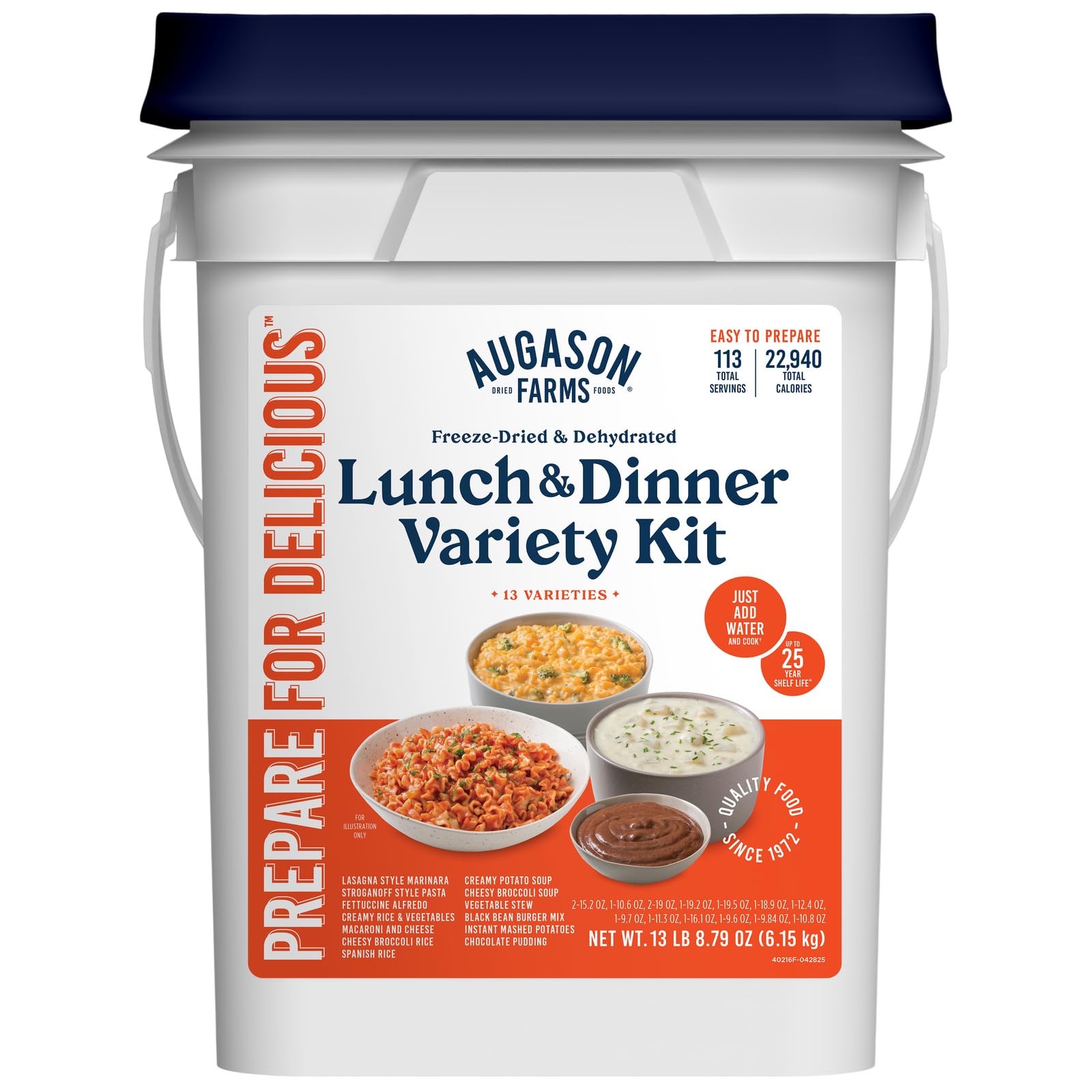
2. Lunch & Dinner Variety Kit Emergency Food Supply, 113 Servings, 25 Year Shelf Life
The lightweight bucket that hides a 25-year pantry in plain sight.
You get 113 servings and roughly 22,940 total calories in one 4-gallon pail — that’s more than three times the servings of the Legacy 32-serving bucket (113 vs 32) and 84% more calories on top. Customers note it’s “alot lighter to carry than originally thought,” and it ships in a plain box so no one can tell what’s inside.
Taste is what wins people over here — it’s the most-discussed positive, with owners trying a few meals on vacation and immediately ordering more. You get 13 meal varieties spanning lasagna marinara, fettuccine alfredo, mac and cheese, stroganoff pasta, and even chocolate pudding for a morale boost. Just add water and heat on a stove — no advanced cooking skills needed.
The honest trade-off: durability of the bucket itself gets mixed feedback, so treat the pail gently. But for a family stash that sits in a closet for years, the weight, the 25-year shelf life, and the sheer calorie count make this the smart money pick.
Calories per dollar: this is the volume king of the list — 22,940 calories of varied meals in a bucket that’s easy to hide and move.
The catch: the pail isn’t indestructible, so don’t stack heavy gear on top of it.
3. Legacy Food Storage 32 Serving Emergency Food Supply Bucket, 8 Entrees
The freeze-dried meals that kids actually ask for seconds of.
Let’s talk taste, because that’s the #1 thing buyers praise here — owners specifically called out the Pasta Primavera as “tasty and filling,” and one family’s picky toddler declared the Stroganoff “delicious.” That’s rare for survival food. The 32 servings add up to approximately 12,440 total calories across 8 entree options, all packed in a compact 8.5-pound bucket — the featherweight of this list at just over a fifth of the Ameriqual case’s 40 pounds.
Portion size is the second most-praised feature, with four servings per pouch feeling right for a family. The meals are freeze-dried, which means they rehydrate with better texture than dehydrated options, and the recipe omits added MSG, high fructose corn syrup, and trans fats. The 25-year shelf life comes from multi-serving Mylar pouches with oxygen absorbers inside a stackable bucket.
The preparation demands more effort than an MRE — you’ll need a pot, boiling water, and about 12-15 minutes of low heat. Some buyers found the four-serving portions too large and wished for single-serve pouches. This one’s ideal for car camping or home kitchenette use, not for eating on the move.
What Owners Love
- Genuinely tasty — kids ask for more
- Light 8.5-pound bucket, easy to move
- No MSG, HFCS, or trans fats
The Effort Trade-Off
- Needs a pot, stove, and 15+ minutes
- Four-serving pouches may be too big for one
Reach for this if: flavor matters and you have a way to boil water.
Look elsewhere if: you need no-cook meals for a true grab-and-go — this one demands a stove.
4. Augason Farms Four Person 72 Hour Emergency Food Supply

The three-day kit designed to feed four adults without the guesswork.
This bucket answers the most common preparedness question: “What do I need for the first 72 hours?” It’s engineered to sustain 4 adults for 3 days with 119 servings across 15 meal varieties. The math is built in — approximately 1,907 calories and 56 grams of protein per person per day, so you know exactly what each family member gets.
The meal lineup runs from oatmeal and pancake mix for breakfast to fettuccine alfredo, mac & cheese, and vegetable stew for lunch and dinner, plus pudding and whey milk to round it out. Just add water and heat — the same simple prep as the larger Augason kit, no skills required.
Buyers bought this for camping trips with kids and found the meals “fairly basic and nothing fancy but it tastes pretty good,” with the kids loving it. It’s a solid 25-year-shelf-life starter bucket that fits the classic disaster window, and the 13-pound weight keeps it manageable for car storage.
The 72-hour balance: you get pre-calculated calories and protein per person, so you can plan your family’s meals without doing any math.
Fairly basic: the meals are comforting but plain — don’t expect gourmet, expect reliable.
5. A and B bundle cases 2025, 2026 inspection. Meals Ready to Eat

Fresh-inspected surplus MREs that landed early and taste surprisingly good.
If you want the newest possible military rations, this is the one — the inspection dates run 2025 and 2026, meaning the pack dates are roughly three years prior and the food has decades of life ahead when stored cool and dry. Each of the 24 meals delivers 1,250 calories and arrives with its heater, so you can eat hot food with zero prep.
Freshness is the most-praised aspect here, with owners confirming nothing looks or tastes bad — one first-time MRE user found the Beef Ravioli “surprisingly palatable.” The bundle covers Menus A (1-12) and B (13-24), including vegetarian options. Buyers also noted the delivery arrived three days early, which is a nice touch when you’re stocking up.
The recurring gripe: heating performance is mixed, with some reporting heaters that don’t fire. It’s the same flameless-heater variability you see across all MREs, so it’s worth testing one before you rely on them in a real emergency.
Why It Stands Out
- Newest inspection dates — 2025/2026
- 1,250 calories per complete meal
- Menu variety with vegetarian options
Heads Up
- Some heaters arrive non-functional
- Case B runs spicy for some tastes
Best for: preppers who want the freshest possible surplus MREs with decades of shelf life.
skip it if: you’re relying on the heaters — test them early or carry a backup ignition method.
6. Ready Hour Breakfast Bucket (128 Servings)
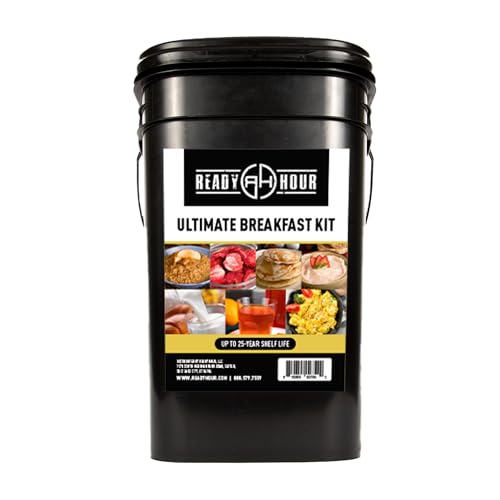
The morning-fuel bucket that delivers 2,000+ calories a day, no cooking skills needed.
Most emergency kits forget that you need to eat three times a day — this one starts with the most important meal. The Ready Hour Breakfast Bucket delivers over 2,000 calories every single day, with 128 servings across seven breakfast varieties like Maple Grove Oatmeal, Buttermilk Pancakes, and Scrambled Eggs. Some items need no preparation at all, which is a lifesaver when you’re low on fuel and water.
Food is sealed in quadruple-wrapped, resealable pouches with double-sized oxygen absorbers inside a flood-safe container. The 25-year shelf life lets you store it and forget it until needed. Buyers found it “simple to prepare and tastes good,” and one owner plans to work through it slowly on camping trips.
A handful of buyers raised concerns about chemical contamination in some products — worth reading the ingredient labels carefully. But for a dedicated breakfast supply that pairs with any dinner entree kit, this fills a real gap in your prep.
The morning fix: 2,000+ calories a day from a bucket that’s genuinely flood-safe and quadruple-wrapped.
Read the labels: a few owners flagged contamination worries, so check ingredients before relying on it long-term.
7. Emergency Food Ration Bars, Hard Tack, 30 Days Package

Pocket-sized energy rods that pack 36,800 calories into two tin boxes.
This is the pure-calorie play — no cooking, no water, no dishes. Two tin boxes hold 40 bags of pre-measured energy rods, each bag delivering 920 calories from 200g of food. Total that up and you get 36,800 calories, enough for up to 30 days for one person. That’s the most calorie-dense option on this list, and each 200g bag is small enough to slip into a clothes pocket.
These are survival rods made from wheat flour, sugar, and oil — think a dense, slightly sweet cookie rather than a meal. Buyers found them “super delicious” — almost dangerously so, since one owner admitted to snacking on them during movies rather than saving them for emergencies. The vacuum packaging keeps them fresh and crisp for up to 20 years in a cool, dry place, with no preservatives added.
The downsides: the tins arrive dented more often than not (product stays fine), and some reviewers point out the Chinese origin as a concern. One owner received tins dated 2024 expiring 2044 — a solid two-decade window. These work best as a backup layer to your meal kits, not as your primary food source.
Why It Works
- 36,800 total calories in a compact form
- Zero prep — open and eat anywhere
- 20-year shelf life, no preservatives
Know Before You Buy
- Tins often arrive dented in shipping
- Dry, crisp texture — not a gourmet meal
Reach for this if: you want a grab-and-go calorie reserve that fits in a backpack pocket.
Look elsewhere if: you want real meals — these are energy bars, not dinners.
8. READYWISE Emergency Food Survival Supply 240 Servings, 2 Buckets

The serious prepper’s stockpile with a split lid that doubles as a serving tray.
This is the big one — 240 servings of gourmet entrees and breakfast meals spread across two buckets, engineered for a full month of feeding. The quality is the most-praised aspect here, and buyers specifically noted the pasta and potatoes taste surprisingly good with no bitter aftertaste compared to other brands. The split bucket lid is a genuinely clever design — it gives quick access to pouches and doubles as a tray for your servings.
Each bucket offers up to 25 years of shelf life with a stackable design that fits a pantry or a bug out bag. Just add water for a hot meal. One Alaska buyer bought these before a 7.1 earthquake and credited them as essential for a two-week self-reliance window — real-world validation from an actual disaster.
The honest math: servings run roughly 200-250 calories each, so at 1,500 calories a day, the 240 servings last about 30-40 days — not the four months some expect. Plan for double servings if you’re active. The meals also need boiling water, so this is a home-storage kit, not a no-cook grab-and-go.
The Strengths
- 240 servings — serious long-term capacity
- Split lid doubles as a serving tray
- Quality praised — no bitter aftertaste
The Fine Print
- Only ~200-250 calories per serving
- Must cook in boiling water, not in the pouch
Best for: families prepping for a month-long disruption with access to a stove and water.
Not for: active bug-out scenarios — the calorie density is too low for heavy exertion.
9. Numanna Family Pack Emergency Food Storage Bucket – 144 Servings, 20 lbs
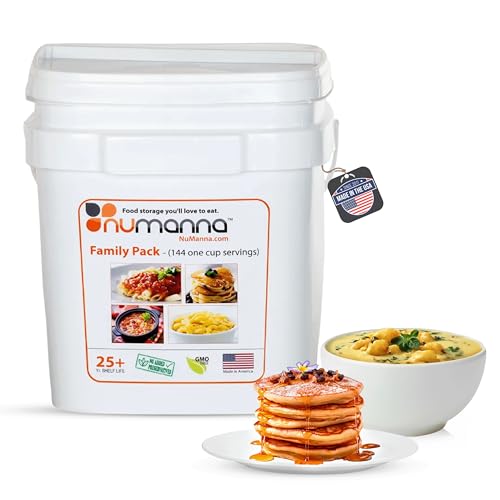
The non-GMO family stockpile with 17 different meals inside a stackable bucket.
Variety is the name of the game here — this Family Pack packs 144 total servings across 17 distinct meal types, from Sweet Habanero Chili with Pineapple to Mac n’ Cheese to Cheddar Broccoli Soup. That’s genuinely impressive variety for a single bucket, and it’s all non-GMO with no artificial flavors, preservatives, or chemicals. At 20 pounds, it’s a manageable lift compared to the 40-pound MRE case.
Every meal requires only water for preparation — no complex cooking under disaster conditions. The 25+ year shelf life means you can store it and forget it until needed. Taste is the most-praised aspect, with buyers calling it an “outstanding product” that puts “all the great kinds of food together.” The sturdy, stackable square bucket also fits into tight pantry spaces more efficiently than round pails.
One buyer hit a pouch with a hole that spilled contents, and several owners noted the bucket lacks a total calorie count on the box — you’ll need to calculate per package yourself. That’s a real planning annoyance, but not a dealbreaker given the variety and clean ingredient list.
Variety king: 17 meal types in one bucket beats every other kit on this list for daily eating interest.
Plan your math: no aggregate calorie count is printed on the box, so do the arithmetic before you rely on it.
Understanding the Specs
Shelf Life: 25-Year vs 5-Year
This is the first number to check. Buckets like the Augason Farms and READYWISE lines promise up to 25 years when stored in a cool, dry place — set-and-forget food. MREs are different: they’re fully cooked and shelf-stable for 5 to 7 years or more, with an inspection date rather than an expiration. If you want a true long-term stockpile, 25-year buckets win. If you want to rotate and eat what you store, MREs work better.
Calories vs Servings
Serving counts are marketing math — the real number is total calories. A “240-serving” kit from READYWISE delivers only ~200-250 calories per serving, so an active adult needs two or three to feel full. Compare that to MREs at 1,250 calories per meal or the ration bars at 920 calories per bag. Always multiply servings by per-serving calories and divide by your household’s daily needs to see how many days you actually bought.
Freeze-Dried vs Dehydrated
Freeze-dried meals (like Legacy) remove moisture while frozen, preserving texture and taste — they rehydrate fast and are the closest to a real meal. Dehydrated meals (like Augason Farms) use heat to dry food, which makes them lighter and often cheaper but they need more water and cooking time. For taste, freeze-dried wins. For weight and budget, dehydrated is the pick. Both hit similar 25-year shelf lives.
Flameless Heaters & Water Needs
Not all survival food needs a stove. MREs include Flameless Ration Heaters that activate with a little water — no fire required. Bucket meals like READYWISE need boiling water and a pot. Ration bars need nothing at all. Think about your bug-out scenario: if you can’t guarantee a heat source, lean toward MREs or bars. If you’re home with a working stove, buckets give you more variety per dollar.
FAQ
How long does bug out food actually last?
What is the difference between MREs and freeze-dried emergency meals?
How many servings do I need for a family of four?
Is 2,000 calories per day enough for survival?
Do I need to rotate my emergency food stash?
Can I eat emergency food without heating it?
What is the shelf life of military surplus MREs?
Is freeze-dried food worth the higher price per serving?
How much water do I need with emergency food?
Are emergency ration bars a complete food source?
Final Thoughts: The Verdict
The best bug out food for most people is the Ameriqual 24ct MRE case — it’s the only pick that feeds you hot, complete meals with zero water, zero stove, and zero cooking skills, and it’s backed by the strongest owner satisfaction on this list. If you want maximum calories per dollar for a family stash, grab the Augason Farms 113-serving kit at 22,940 total calories. And for the lightest, tastiest camping-ready option, the Legacy 32-serving bucket at just 8.5 pounds is the one to reach for.
How We Picked
We do not accept paid placement. Every pick is matched to a real buyer and a real use-case; we do not hands-on test units.
Sources & Methodology
Specifications: manufacturer listings and product documentation. Review insights: verified customer reviews, as of September 2026. Pricing: not shown on this page (it changes often); check the current price via the retailer link.
As an Amazon Associate, Gadgets Feed earns from qualifying purchases. This does not affect which products we feature.