
Our readers keep the lights on and my morning glass full of iced black tea. As an Amazon Associate, I earn from qualifying purchases.
Specs are compiled from manufacturer listings and verified buyer reviews and can change over time — please confirm the key details on the product page before buying.
A table saw is only as good as the gear you feed it. The stock blade that came with your saw is fine for rough framing, but it burns hardwood, shreds plywood, and the basic push stick is a finger-risking afterthought. The right accessories turn a frustrating saw into one that delivers glue-ready joints and safe, repeatable cuts.
I’m Min — the founder and writer behind Gadgets Feed. This guide is built by comparing the manufacturers’ published specifications and the patterns across verified customer reviews, so you get each pick’s real strengths and trade-offs instead of marketing spin.
From razor-sharp blades to push blocks that keep your digits intact, here is the definitive shortlist of table saw accessories that working woodworkers actually rely on day in and day out.
Our Picks at a Glance

How To Choose The Best Table Saw Accessories
You don’t need every accessory on the shelf—just the ones that match your most common cuts. If you mostly rip dimensional lumber for joinery, a dedicated rip blade and push block matter most. If you cut sheet goods, you need a blade that minimizes tearout and a featherboard for stability. Start with what makes your cuts safer and cleaner, then add from there.
Safety gear is non-negotiable
Kickback is the scariest thing a table saw can do, and it happens in the blink of an eye. A quality push block with a non-slip grip keeps your hands far from the blade while controlling the wood from above and beside the cut. Featherboards press stock firmly against the fence to prevent the board from shifting or climbing. Both are cheap relative to the cost of a table saw injury — and they make every cut feel more controlled.
Match the blade to the task
Blades are not one-size-fits-all. A rip blade has fewer teeth and a positive hook angle (the tooth’s face tilted forward) to plow through long grain fast. A crosscut blade has more teeth for a finer finish across the grain. A combo blade splits the difference. There’s also kerf — the width of the cut the blade makes. A thin kerf removes less material, meaning less waste and less strain on your motor, but it can flex in thick hardwood if your saw isn’t aligned well.
Quick Comparison
| Model | Best For | Teeth | Kerf | Weight | Amazon |
|---|---|---|---|---|---|
| Forrest Woodworker II★ Best Overall | Premium all-purpose precision | 40 | .125″ | 2.2 lb | Amazon |
| BOW PushPRO PP1Safety Upgrade | Ergonomic push stick | — | — | — | Amazon |
| POWERTEC FeatherboardsBest Value 2-Pack | Kickback prevention 2-pack | — | — | 1.65 lb | Amazon |
| MICROJIG GRR-RIPPER 2GO | Compact push block | — | — | 12.32 oz | Amazon |
| MICROJIG GRR-RIPPER+ | Full-size push block with SafeRip | — | — | — | Amazon |
| Freud LU87R010 Rip Blade | Heavy-duty ripping | 24 | .126″ | 1.9 lb | Amazon |
| Freud LM75R010 Glue Line | Thin kerf glue-line rips | 30 | .091″ | 16 oz | Amazon |
| Kreg Miter Gauge KMS7102 | Precision miter gauge | — | — | 6 lb | Amazon |
| INCRA MITER1000SE | Ultra-precise miter gauge | — | — | 8.3 lb | Amazon |
In‑Depth Reviews
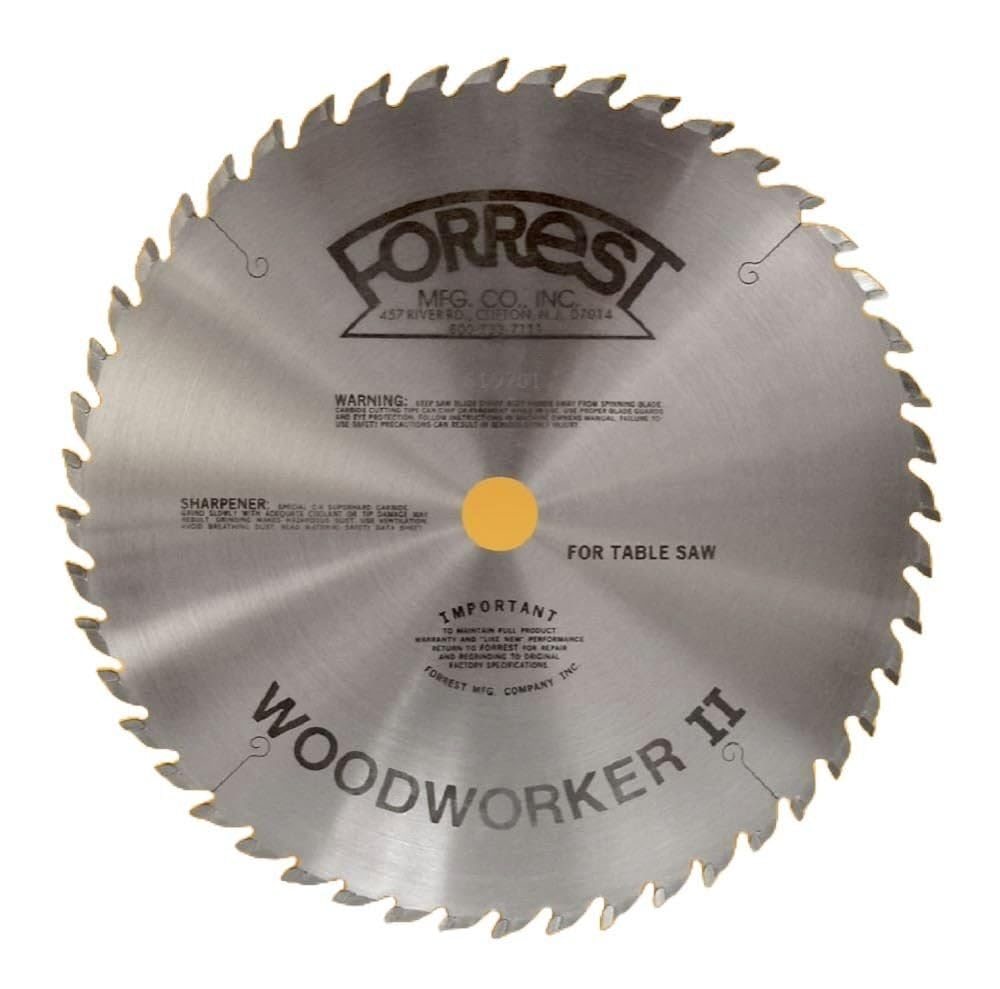
1. Forrest Woodworker II 10-Inch 40 Tooth Blade
Our pick — over 4.5★ from 800+ verified ratings; the strongest balance of quality and price.
The definitive blade upgrade that turns an average saw into a precision machine.
Woodworkers consistently rank this as a top-tier upgrade. The 40-tooth carbide tip with a 30-degree alternate top bevel (ATB — teeth angled alternately left and right for cleaner cuts across the grain) stops the blade totally for better pull control and eliminates bottom splintering on crosscuts. It’s not just about the clean cut, though. The.125-inch kerf (the width of material the blade removes) saves you 1/3 on wood loss with each pass, which adds up quickly when you’re working pricey hardwoods.
On an underpowered Milwaukee saw, buyers report it rips 8/4 walnut glue-ready and cuts 3-inch maple clean, with an 8-foot plywood cut landing within 1/128 of an inch — numbers that sound impossible for a stock blade. Rips on Sapele come out so clean that owners skip a dedicated rip blade entirely. The 2.2-pound weight reflects the heft of a blade built to stay true under load, and the carbide holds its edge far longer than cheaper options.
The honest trade-off is the price. It’s a premium investment, but the logic is simple: this blade gets resharpened, not tossed. The manufacturer’s resharpening service is the real value story here, turning a big one-time cost into a long-term tool that outlasts several cheap blades. The blade quality is what wins people over — it’s overwhelmingly the thing owners praise most.
What earns the hype
- Glue-ready rips on dense hardwoods without a separate rip blade
- 1/3 less wood waste per cut thanks to the.125″ kerf
- Razor-sharp teeth that leave glass-smooth edges
Consider before buying
- Premium price that makes sense only with resharpening in mind
- Overkill for occasional DIY users on a budget
Bottom line: The best upgrade you can make to any table saw, provided you’re ready to care for it and use the resharpening service.
Think twice if: You rarely cut hardwoods and just need a basic blade for plywood and softwood — a mid-range combo blade will do.
2. BOW Products PushPRO PP1 Push Stick
A push stick with a secure grip that keeps your hand safely away from the blade.
Most stock push sticks are skinny pieces of plastic that feel like an afterthought. This one is different. The high-density EVA tip (a firm rubber-like foam) conforms slightly to the wood, dampens vibration, and gives you a steady grip that prevents the stock from slipping mid-cut. At 17.5 inches overall, it keeps your hand a meaningful distance from the spinning blade during rips.
What makes this smart is the replaceable tip. After accidental blade contact, you swap the EVA tip instead of buying a whole new stick — and the soft tip avoids damaging your carbide blade teeth, unlike rigid plastic pushers. Owners mention it “feels more secure” than other sticks and note the rubberized head provides a genuine “sense of security” during use. It’s a safety tool that doesn’t slow down your workflow.
The build quality is the thing everyone raves about here. This is heavy-duty polymer, not flimsy injection-molded scrap. The ergonomic handle is comfortable for long sessions, and the modular design lets you adapt the grip to how you work. If you’ve been using the stick that came with your saw, this is the single most affordable safety upgrade you can make.
What wins people over: The quality is the top-mentioned aspect by far — owners consistently call it a well-made, comfortable tool that easily replaces both stock and homemade sticks.
Good to know: The EVA tip resists shedding, color bleed, and liquid absorption, so it holds up to repeated shop use.
Reach for this if: You want a genuinely safer, more comfortable push stick that protects your blade as much as your fingers.
Look elsewhere if: You prefer a full push block that controls the wood from above — this is a stick, not a block.
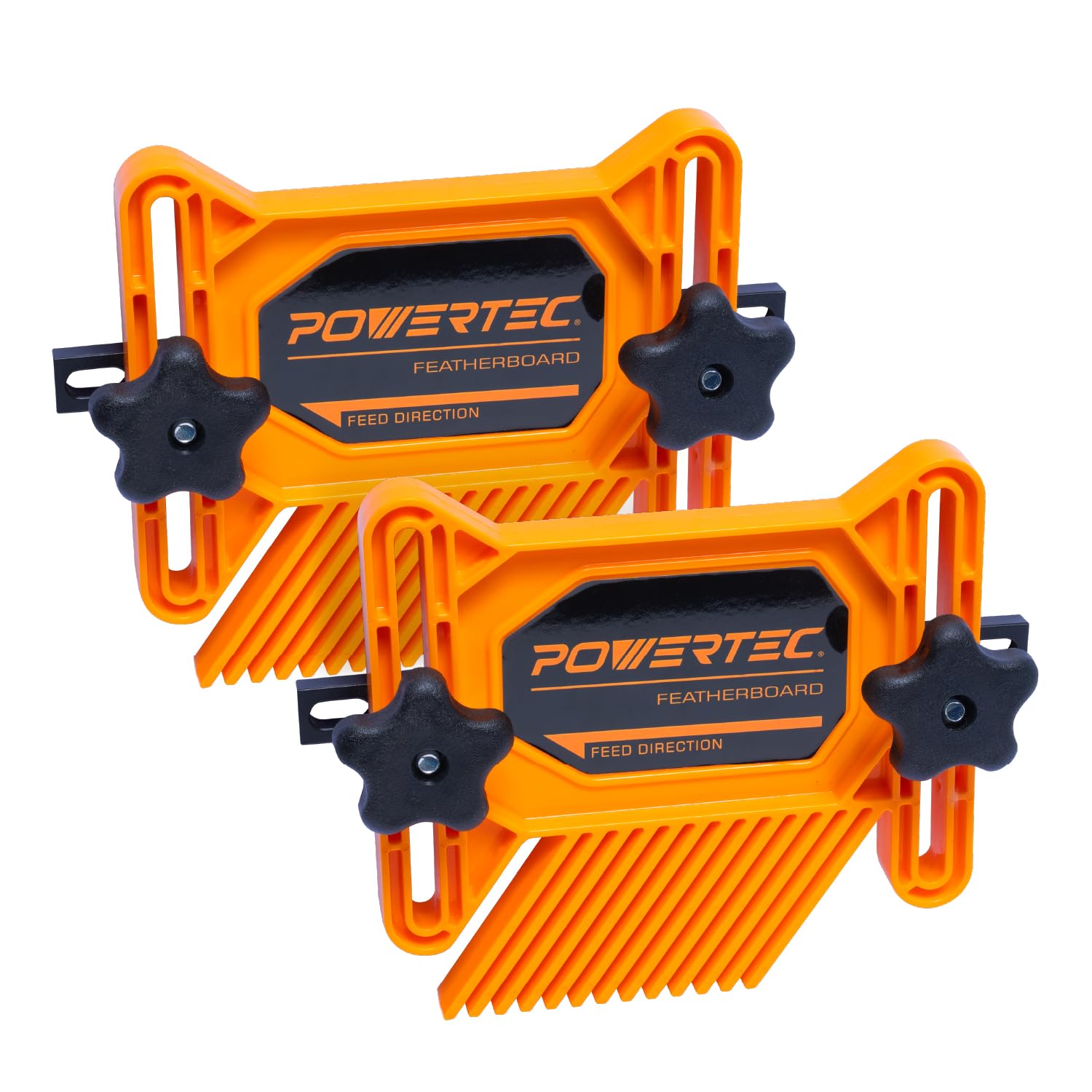
3. POWERTEC Tandem Featherboards
Two featherboards that hold stock firmly against the fence and dramatically reduce kickback.
Kickback happens when the wood shifts and gets grabbed by the blade, and a featherboard is the classic defense. This 2-pack uses a miter lock system with a reversible profile that works in both t-slots and miter slots, so it adapts to table saws, band saws, and router tables. The kit includes miter slot brackets for horizontal mounting, vertical mounting for 3-inch multi-tracks, and plastic spacers for stacking the boards.
The color-alert orange design makes them quick to spot and adjust, and the threaded 5-star knobs are easy to tighten — a real comfort for anyone with arthritis in their hands. Customers note a perfect fit for the DeWalt DWE7485 miter slot, and they enable repeatable, safe cuts even with small clearances. The dual-board setup lets you press stock down toward the table and in toward the fence at the same time.
At 1.65 pounds for the pair, these are light enough to move between tools easily but rugged enough for daily use. The quality and functionality are what owners praise most. The recurring note is that setup can be fiddly for tall, thin stock — the included small barrel spacers can cause instability, and some buyers swap in longer miter brackets for the best hold.
Owners love: The build quality and how well the pair work together across multiple tools in the shop.
Worth noting: The 5/16-inch T-bolts won’t fit 7/16-inch tracks without a little filing — check your slot size before you buy.
Grab this if: You want an affordable, versatile kickback-prevention setup that moves between your table saw and router table.
skip it if: You need a featherboard that locks into a non-standard oversized track without modification.
4. MICROJIG GRR-RIPPER 2GO Push Block

A fully assembled push block with extreme grip for ripping wide and thin strips safely.
This push block takes a different approach to feeding stock than a stick. Instead of just pushing from behind, the GRR-RIPPER uses a precision leg and tunnel system that feeds and controls both sides of the cut. That dual-sided control virtually eliminates kickback because the work-piece stays pinned to the table and fence through the entire pass — even on thin strips that would otherwise chatter and lift.
You get real leverage without the weight—this block tips the scale at just 12.32 ounces, so it’s easy to handle. The Green GRIP non-slip surface (a textured coating that stops slipping on flat surfaces) gives you strong gripping power. It arrives fully assembled, with a Color Code Index sticker for the rip fence scale, a clearance step, and dovetail grooves (slots that let you attach custom accessories). For longer cuts, you simply use two 2GO blocks together.
It’s a multipurpose tool that works on table saws, router tables, jointers, and band saws. The grip is what wins people over — owners are surprised by how hard it grips flat surfaces, and it’s credited with boosting confidence on small pieces. The quality is the most-mentioned positive, and the safety benefit makes it a fixture on the saw for many owners.
The standout: Grip and safety, in that order — owners repeatedly describe it as their favorite safety device on the table saw.
Consider: It’s compact, so for very large panels you’ll want a second unit paired for longer cuts.
Best for: Ripping thin and narrow stock safely, and for users who want a ready-to-use grip block without assembly.
Not for: Those who need maximum downward pressure on very thick slabs — the larger full-size version handles that better.
5. MICROJIG GRR-RIPPER+ with SafeRip Kit
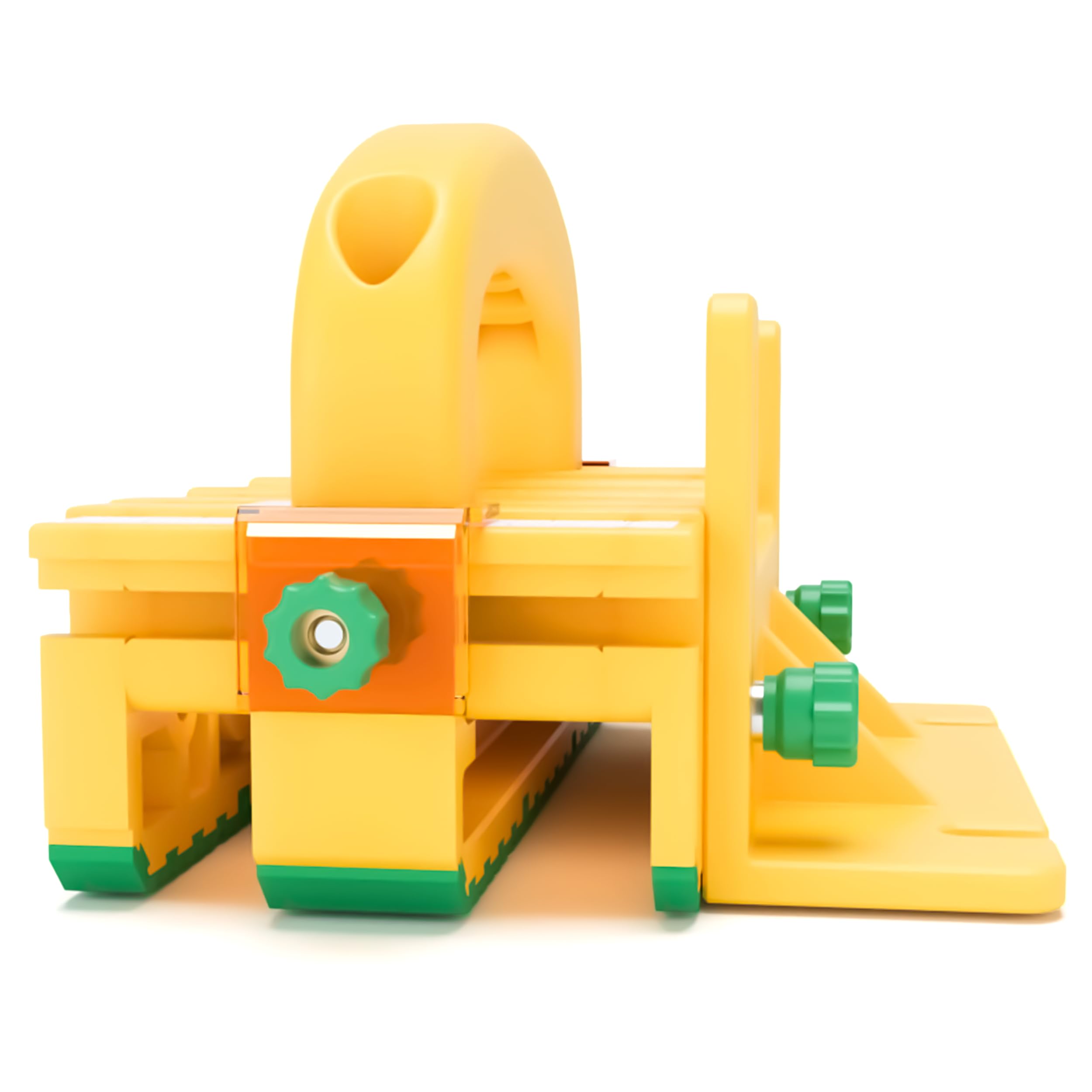
The fully adjustable 3D push block with SafeRip Kit for delicate cuts down to 1/4-inch stock.
This is the full-size evolution of the GRR-RIPPER idea. The SafeRip Kit included here prevents accidental blade contact, delivering faster and cleaner cuts on the table saw. The proven Green GRR-RIP grip surface holds confidently on everything from hardwoods to plywoods to plastics, even under challenging conditions, and it comes with a limited lifetime warranty protecting the grip against manufacturer defects.
The safety case is compelling: powerful downward, inward, and forward pressure produces cleaner cuts, prevents material burn, and virtually eliminates kickback. It’s a moving-blade guard that keeps your fingers well away from the teeth without sacrificing control. For the hard part of woodworking — cutting small pieces — this rips down to 1/4-inch by 1/4-inch material with what owners describe as surgical accuracy.
Safety is the thing owners mention most, and they mean it: “this tool will save your fingers and hands” sums up the sentiment. The grip gets high marks too, and it’s credited with making ripping wood much safer. Assembly is the one mixed point — some find it easy, others wish the instructions were clearer.
Why owners buy it: Safety first and functionality second — it works well on both table saws and router tables, and keeps small cuts stable.
The cost of entry: This is a premium push block, and assembly instructions could be better for first-time users.
Choose this if: You regularly cut small, delicate pieces and want the most capable, adjustable push block on the market.
Choose the 2GO if: You want the same grip in a lighter, cheaper, fully assembled package for general ripping.
6. Freud LU87R010 Heavy-Duty Rip Blade
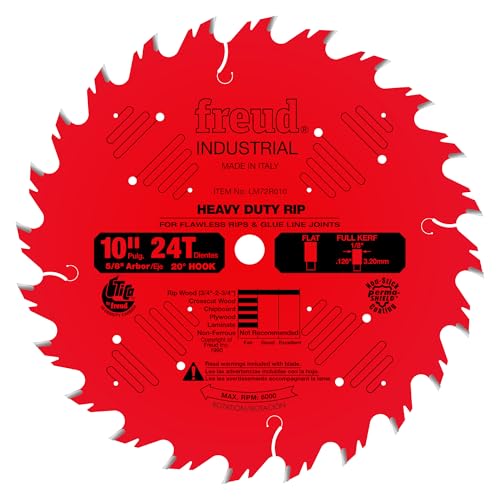
A commercial-grade rip blade that cuts smoothly at a price below premium brands.
If you rip a lot of hardwood, this is the blade to beat. With 24 teeth and an extra-large flat tooth design (FTG — flat-top grind, meaning each tooth is square across the top), it leaves a flat-bottomed cut that’s ideal for dados, rabbets, and half-lap joints. Buyers describe glue-ready edges that rival a jointer, meaning you can skip the sanding step entirely. The.126-inch kerf is a standard cut, and the 20-degree hook angle (the forward tilt of the tooth face) drives the cut with serious aggression.
The TiCo HI-Density Carbide blend is built for maximum performance, and the laser-cut anti-vibration slots reduce sideways movement in the cut, extending blade life and giving a splinter-free finish. The Perma-Shield non-stick coating reduces drag and protects against corrosion and pitch build-up. On curly maple, it outperformed a Diablo combo blade with a clean, near-jointed edge and minimal saw marks. It’s made in Italy, which owners note as a quality signal.
At 1.9 pounds, it’s slightly lighter than the Forrest, but don’t mistake that for less capability. The flat-bottom cut is the thing everyone raves about — it’s genuinely a “poor man’s dado” for joinery work. The honest trade-off: it’s loud, with a high-pitched whine that ear protection handles easily. Durability gets mixed feedback, with a few owners reporting teeth breaking off during heavy use.
The headline: Glue-line quality rips and flat-bottom joinery cuts at roughly half the price of premium blades.
Fair warning: Plywood crosscuts show some tearout — this is a rip specialist, not a general-purpose blade.
Grab it if: You need a dedicated rip blade for joinery and hardwoods but don’t want to spend premium money.
Look elsewhere if: You mostly crosscut plywood and need a blade that handles sheet goods cleanly.
7. Freud LM75R010 Thin Kerf Glue Line Rip Blade
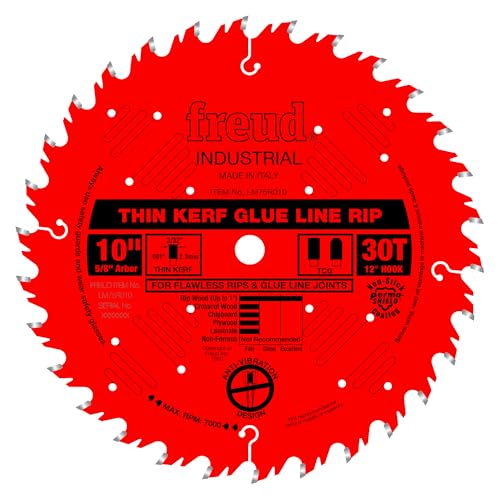
A thin-kerf glue-line rip blade that cuts faster and wastes less material.
For bookmatched panels and cabinet work, the quality of a glue-line rip matters more than any other cut you make. This blade delivers mirror-smooth, clean cuts that owners describe as flawless, even on critical bookmatched joints. The 30 teeth with a TCG grind (triple-chip grind — teeth alternating between flat and angled for a very durable edge) produce a finish so clean it’s reserved for fine work.
The.091-inch kerf is the story here. It’s significantly thinner than a standard kerf, which means less material removed, less friction, less burning, and less strain on your saw’s motor. On a contractor saw, reviewers point out it’s an excellent upgrade over the stock blade, cutting plywood and hardwoods beautifully with no burns or binding. It also performs notably well on bamboo.
At just 16 ounces, it’s the lightest blade here — almost half the weight of the Forrest. That’s because it removes less material per cut, making it an ideal match for underpowered saws. The blade quality is what owners praise most, and it’s credited with cutting “like butter” on glue-ups. The catch: a thin kerf demands precise saw alignment. Owners note it requires proper fence and blade tuning to minimize saw marks, and it’s best paired with a splitter to prevent the wood from pinching.
What wins people over: Blade quality and cut quality lead the praise — super smooth, straight cuts with no chipping at the end.
The catch: Thin kerf needs a well-tuned saw and a splitter to work flawlessly; it’s less forgiving of misalignment.
Best for: Furniture makers doing fine glue-line rips who want faster cuts and less waste without the premium-price tag.
Not ideal if: Your saw alignment is sloppy — you’ll see the saw marks that this blade can’t hide.
8. Kreg Precision Miter Gauge System KMS7102
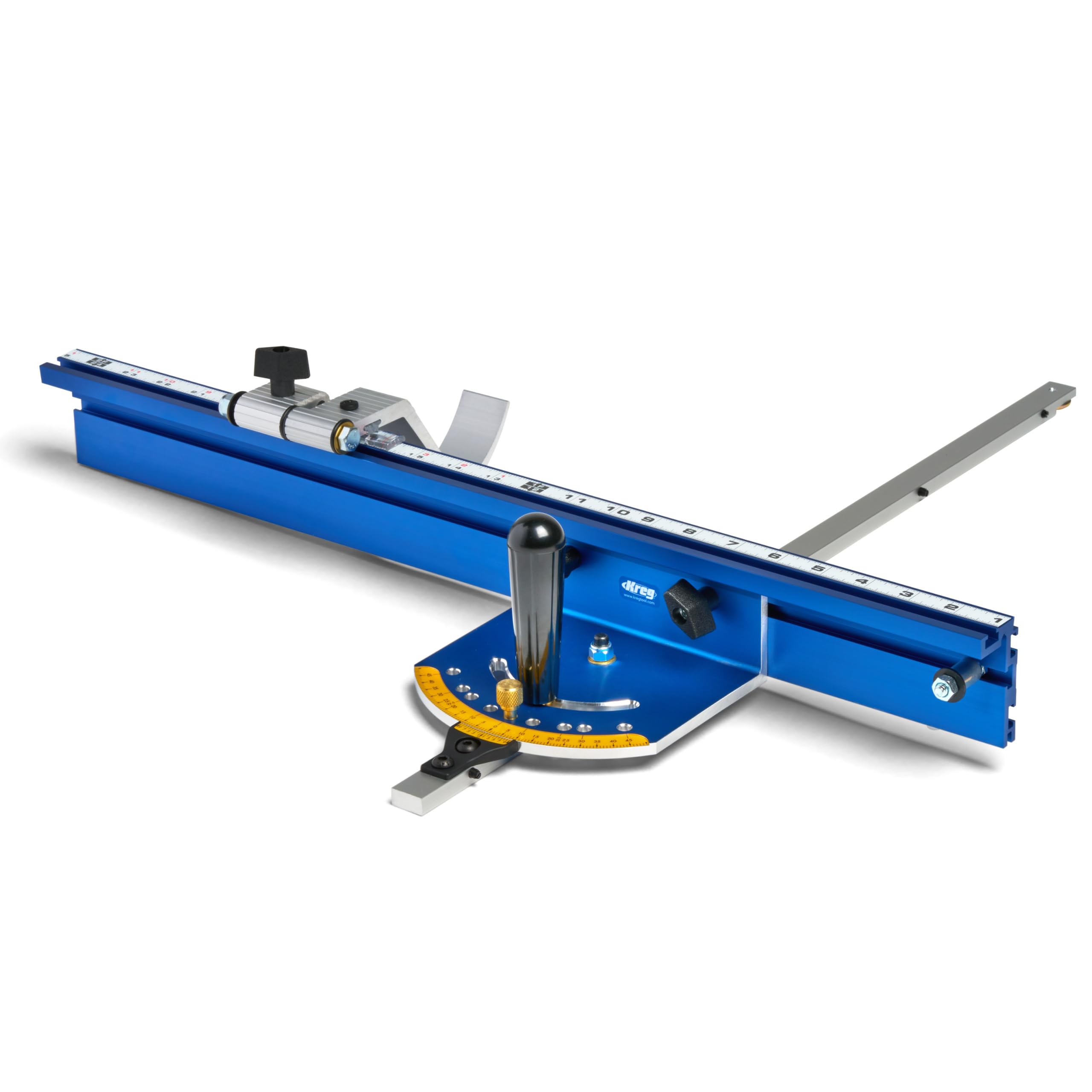
A factory-calibrated miter gauge with positive stops that outperforms stock gauges.
Stock miter gauges are notorious for slop and drift — you set 45 degrees, and by the fifth cut it’s 44.3. This Kreg system fixes that with a factory-calibrated design that locks angles securely with no drift. Positive stops at 0, 22.5, and 45 degrees give you audible, repeatable positions, and the long anodized aluminum fence provides a stable reference surface for your work-piece.
The adjustable bar fits snugly in the miter slot with zero play, and owners describe the accuracy as “gnat’s-eyelash” precise. It’s a 6-pound piece of heavy, well-machined gear that handles frequent use in a professional or DIY shop without flexing. For segmented turning and odd-shaped boxes, it’s earned a reputation as a go-to tool that rivals significantly more expensive gauges.
The precision is the thing everyone praises — accuracy is the most-mentioned positive, followed closely by overall quality. Assembly is required but straightforward, with factory calibration meaning minimal setup. The honest trade-offs: the stability gets mixed feedback, with some owners reporting wobble on smaller saws, and the fit is problematic for Craftsman models — check your saw’s miter slot compatibility first.
The thing owners rave about: Accuracy and repeatability — angles lock tight and stay put across many cuts.
Before you buy: Confirm it fits your saw; it doesn’t work with Craftsman models, and the bar can wobble on very small saws.
Choose this if: You want a solid, accurate miter gauge upgrade without jumping to the very top of the price range.
Think twice if: You have a compact saw with an 8.25-inch blade — the long fence can tip on small workpieces.
9. INCRA MITER1000SE Miter Gauge

A miter gauge with 41 indexed stops and a telescoping fence for atomic-clock precision.
This is the gold standard for repeatable angle cuts. The engraved stainless steel primary scale is backed by 41 laser-cut V-stops that lock into popular angles with extreme accuracy — you physically feel the detent as you rotate, so there’s no guessing whether you hit the mark. Owners describe the precision as “comparable to an atomic clock,” which is fitting for a tool designed to eliminate recalibration entirely.
The patented GlideLOCK miter bar has 6 expansion points that tighten to fit your slot with zero play. The 18-to-31-inch telescoping incremental fence handles everything from narrow strips to wide panels, and the Flip Shop Stop gives you fast, repeatable positioning. At 8.3 pounds, this is a serious piece of equipment that signals its capability the moment you lift it. It’s credited with eliminating miter gauge recalibration and speeding up cabinet work dramatically.
Accuracy is the thing owners mention most, with ease of use close behind. It consistently replaces crosscut sleds in shops because it’s dead-on precise and faster to deploy. The adjustability gets mixed feedback, though — the extension bar and stop can be fiddly, and the miter slot washers are small enough to catch on bandsaw blade slots. It’s not cheap, but for long-term investment, it’s considered well worth it.
The standout: Accuracy and ease of use — it eliminates recalibration and makes repeatable cuts easy.
The fine print: The miter bar is short, limiting depth to around 16 inches, and the fence can rotate off the table edge without the extension.
Reach for it if: You do fine joinery, cabinet work, or any project where perfectly repeatable angles are non-negotiable.
Consider the Kreg if: You want most of the precision for less money and don’t need the indexed stop system.
Understanding the Specs
Kerf and Hook Angle
Kerf is the width of the slot a blade cuts — the material it removes. A thin kerf (like the Freud’s.091-inch) removes less wood, wastes less material, and puts less strain on your motor, making it ideal for underpowered saws. Hook angle is the forward tilt of the tooth face; a steeper angle (like the rip blade’s 20 degrees) pulls the wood through aggressively for fast rips.
Tooth Count and Grind
Fewer teeth (24) rip fast and leave a roughish cut, while more teeth (40) give a smoother finish at slower feed rates. The grind matters too: ATB (alternate top bevel) teeth cut cleanly across the grain, FTG (flat-top grind) teeth leave flat-bottomed cuts perfect for dados, and TCG (triple-chip grind) teeth offer extra durability for tough materials.
FAQ
What is the difference between a rip blade and a crosscut blade?
Does a thin kerf blade save me money on wood?
Will a premium blade fit my saw?
Is a push block really safer than a push stick?
What does a featherboard actually do?
Will a miter gauge fit any table saw?
How long does a carbide saw blade last?
Can I use one blade for everything?
Final Thoughts: The Verdict
The clear winner for most shops is the Forrest Woodworker II — it’s the crowd favorite at 4.8 stars across more than 800 owners, and it delivers glue-ready cuts on hardwoods that other blades simply can’t match. If you want dedicated rip performance at a better value, the Freud LU87R010 is the one to reach for with its flat-bottomed, jointer-quality cuts. And for safety, the BOW PushPRO is the single most affordable upgrade you can make — a secure-feeling push stick that keeps your fingers clear of the blade.
How We Picked
We do not accept paid placement. Every pick is matched to a real buyer and a real use-case; we do not hands-on test units.
Sources & Methodology
Specifications: manufacturer listings and product documentation. Review insights: verified customer reviews, as of September 2026. Pricing: not shown on this page (it changes often); check the current price via the retailer link.
As an Amazon Associate, Gadgets Feed earns from qualifying purchases. This does not affect which products we feature.