
Our readers keep the lights on and my morning glass full of iced black tea. As an Amazon Associate, I earn from qualifying purchases.
Specs are compiled from manufacturer listings and verified buyer reviews and can change over time — please confirm the key details on the product page before buying.
Choosing a spinning wheel starts with one honest question: do you want the classic foot-powered rhythm of a treadle wheel, or the hands-free freedom of an electric spinner? Your answer depends on whether you will mostly spin at a dedicated table or want to take your yarn anywhere. This guide sorts through four very different wheels — from a 14-pound wooden workhorse to a 2.86-pound electric that fits in a tote — so you can match the machine to the way you actually spin.
I’m Min — the founder and writer behind Gadgets Feed. This guide is built by comparing the manufacturers’ published specifications and the patterns across verified customer reviews, so you get each pick’s real strengths and trade-offs instead of marketing spin.
Spin smarter with a thorough look at the mechanics, portability, and real-owner feedback behind the best spinning wheel options for beginners, hobbyists, and seasoned fiber artists alike.
Our Picks at a Glance
How To Choose The Best Spinning Wheel
Before you fall for a pretty finish, understand that a spinning wheel is a tool with three jobs: hold the fiber, twist it into yarn, and wind that yarn onto a bobbin. Every spec on this page — from flyer ratio to bobbin capacity — exists to make those three jobs easier in one specific situation.
Electric or treadle: which matches your body?
This is the deepest fork in the road. A traditional treadle wheel (like the Ashford Kiwi 3) uses your feet to drive the flyer, which means your hands stay free for drafting fiber. An electric spinner (like the Ashford E-Spinner or the compact household models) uses a motor, so you control speed with a knob or foot pedal but keep both hands on the yarn. If you have knee, ankle, or foot trouble, an electric spinner removes the physical effort entirely — that is a deciding factor for many older spinners or anyone recovering from an injury.
Flyer ratio: the spec that controls your yarn
The flyer ratio tells you how many times the flyer rotates for each turn of the drive wheel. A lower ratio like 5.5:1 gives you more control for thick, bulky yarns and for learning, while a higher ratio like 9.5:1 spins much faster — ideal for fine, delicate singles once you have the feel. A wheel with three speed whorls (like the Kiwi’s 5.5, 7.5, and 9.5:1) lets you switch ratios for different projects.
Bobbin capacity: how often you stop
A bobbin’s capacity decides how much yarn you can spin before you have to stop and change it. Small bobbins hold around 4 oz (120g), which is plenty for practice and samplers, but frustrating if you want to ply large batches. Jumbo bobbins with 8 oz (240g) capacity mean fewer interruptions and are a genuine upgrade for experienced spinners producing bigger quantities.
Quick Comparison
| Model | Best For | Drive Type | Weight | Bobbin Capacity | Amazon |
|---|---|---|---|---|---|
| Mini Electric Spinner (Purple)★ Best Overall | Total portability on a budget | Electric motor (800RPM) | 2.86 lbs | 4 oz (120g) | Amazon |
| Ashford Kiwi 3 | Traditional treadle beginners | Foot treadle | 14 lbs | 4.5 oz per bobbin | Amazon |
| Ashford E-Spinner 3 | Portable electric precision | Electric motor (70W) | Lightweight | 8 oz (225g) | Amazon |
| Electric Yarn Spinner Kit | Value-packed learning tool | Electric motor with foot controller | Compact | 4 oz (120g) or 8 oz (240g) | Amazon |
In‑Depth Reviews
1. Mini Electric Spinning Wheel – Purple (Forward/Reverse)
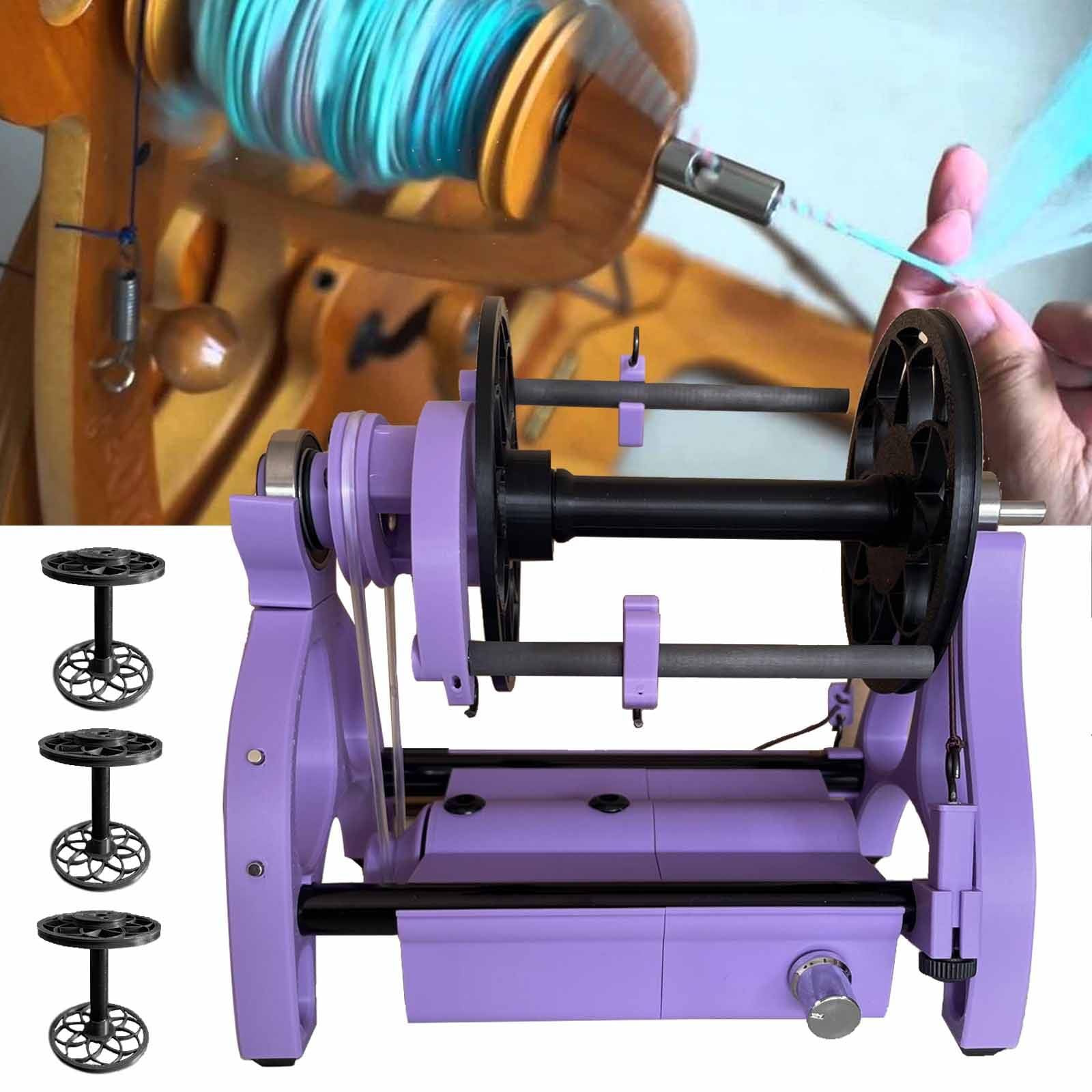
A 2.86-pound electric spinner that fits in a large purse and needs zero assembly.
If your definition of a spinning wheel is “something I can toss in a tote and spin with on the train,” this is the machine. At just 2.86 pounds and 11.81 x 11.81 x 11.81 inches, it is a fraction of the weight of the 14-pound Ashford Kiwi — a roughly 5x gap that makes it the most portable wheel in this lineup. Owners mention it is “quiet, micro-compact, fits in large purse/small tote,” which is exactly the flexibility this electric mini was designed for.
There is no assembly and no foot pedals — you screw on the bobbins, plug it in, and go. The motor is a steel-tube unit with large torque and a maximum speed of 800RPM, with a stepless speed knob so you can creep from slow practice speeds up to fast spinning. Two gears handle twist direction: first gear is Z-twist for single strands, second gear is S-twist for plying. The 12V safe voltage means you can run it from an external mobile power supply outdoors, which opens up spinning at a park table or campsite without a wall outlet.
Build-wise, it uses a 3D-printed body with 4 ball bearings and carbon fiber flyer arms to minimize wobble. Reviews note it is sturdy with a small footprint and good for beginners — one owner mentioned a small crack on the body that did not affect performance, and another had to replace an elastic band to get the bobbin spinning smoothly, then was “satisfied overall.” The hollow design is not just for looks; it lets you watch your colors build as you spin. The trade-off is capacity: bobbins hold just 4 oz (120g), so this is a sampler and travel wheel, not a production machine. Also, note that this product has attracted at least one heated accusation of copied design from a US small business — a controversy worth knowing about before you order.
Why it wins: class-leading portability and price — the lowest-cost electric spinner here that actually works from the start.
The honest limits: the 4 oz bobbin capacity and 3D-printed body mean this is for learning and travel, not high-volume spinning.
Grab this if: you want to test electric spinning cheaply, travel light, or spin outdoors with a power bank.
Think twice if: you plan to spin large batches or want a wheel with a proven brand pedigree and easy support.
2. Ashford Kiwi 3 Spinning Wheel Unfinished

The wooden treadle wheel that blends ease, sturdiness, and true portability for newcomers.
The Kiwi 3 earns the top spot because it solves the two fears most beginners have: assembly and learning curve. The wheel arrives unfinished (a New Zealand Beech hardwood you can stain or oil yourself), and buyers consistently report that the pilot holes are perfect and the instructions are clear enough to finish in under an hour. Once built, the smooth, quiet spin comes from a timber veneered MDF wheel riding on ball bearings, and the double treadles mounted on polyurethane hinges feel easy — a clear step up from single-treadle wheels.
For a traditional wheel, it is genuinely travel-friendly. At 14 pounds (about 5.5 kg of actual wheel), it is noticeably lighter than most floor wheels, and the folding treadles let you stash it in a closet or carry it to a retreat. Buyers report they “love” how easily it disassembles and stores, and one even hauls it along on trips. The built-in Lazy Kate (a stand that holds filled bobbins for plying) means you do not need to buy a separate accessory to ply your yarn.
You get three 90mm bobbins, each holding 4.5 oz of yarn, and a 3-speed whorl with 5.5, 7.5, and 9.5:1 flyer ratios. That range means beginners can start slow and thick, then move to the fast 9.5:1 setting for fine singles as their hands learn the rhythm. One proud beginner reported spinning fine singles within 24 hours of assembly — proof that the learning curve here is short, not steep. The main caveat is the unfinished wood: it needs a coat of wax, oil, or stain before heavy use, and a few owners note the inner spokes benefit from extra sanding for a silky finish.
What Owners Rave About
- Owners consistently praise the solid joints and sturdy feel of the build quality.
- easy double treadle action that beats single-treadle wheels for control
- Folding treadles and 14-pound weight make it the most portable traditional wheel here
What to Know Before You Buy
- The unfinished hardwood requires your own finish (oil, wax, or stain) before regular use
- Assembly, while easy, is still a DIY project — a YouTube guide helps first-timers
- At 14 pounds it is light for a floor wheel but far heavier than any electric spinner
Reach for this if: you want the authentic treadle experience with modern ease — it is the crowd-favorite first wheel for good reason.
Look elsewhere if: you cannot or prefer not to pump treadles with your feet, or you want zero assembly from the start.
3. Ashford E-Spinner 3 – Electric Yarn Spinner Lacquered
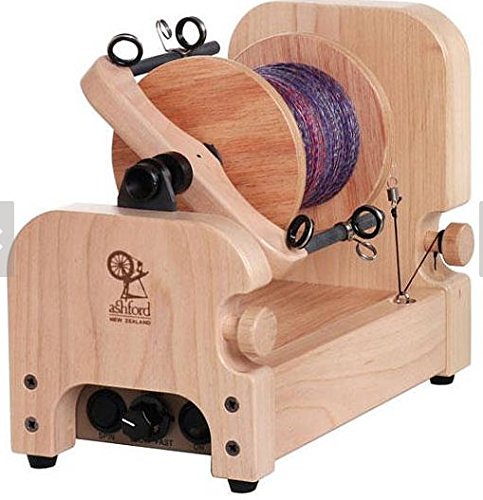
The electric spinner that pairs a silky 70W motor with jumbo bobbins and a padded carry bag.
This is the wheel for spinners whose bodies have retired from treadling but whose hands have not. The E-Spinner 3 runs on a 12-volt DC motor rated at 2.0 amps and 70 watts, and the defining feedback is how quiet and smooth it is. One very telling review comes from a spinner who learned in the early 1970s and developed a serious foot injury: after treadling became painful, this electric spinner let them keep spinning entirely — the kind of life-changing feedback no spec sheet can capture. Another veteran of 40 years reported their output tripled on day one because they could finally spin at full speed without foot fatigue.
Portability is the second headline. Ashford calls it their smallest, lightest electric spinner, and it ships with a padded carry bag with shoulder straps plus an on/off foot controller, so you can genuinely take it to a park, a workshop, or a friend’s couch. The jumbo bobbins hold 8 oz (225g) each — double the capacity of the compact electrics in this guide — which buyers love because “the bobbins really pack a lot” and they stop far less often.
Spinning detail is where Ashford’s industrial design shows. The sliding hook flyer and frictionless yarn guides keep the yarn running smoothly, the snap-in flyer bearing makes bobbin changes seconds long, and the soft-start motor ramps up gently instead of jerking your fiber. Included accessories are generous: 3 jumbo single-drive lacquered bobbins, a tensioned lazy kate, a wooden threading hook, a 15mm-to-10mm orifice reducer bush (so you can spin finer yarns), a Learn To Spin booklet, bottle of oil, and a 110v AC power cord. The orifice is 1.5cm (⅝”), which is comfortably sized for most hand-spun yarns. The only true drawback is the investment — this is the most expensive wheel here by a clear margin.
Who it rescues: spinners with foot, knee, or ankle limitations who refuse to give up the craft — this wheel removes the physical barrier entirely.
The trade-off: the premium price is real, but owners consistently describe it as worth it for the quiet power and jumbo bobbin capacity.
Your best pick if: you want a top-tier electric spinner with big bobbins, a carry bag, and the Ashford name behind it.
Who should pass: casual beginners who just want to test spinning cheaply — the compact electrics below cover that need for far less.
4. Electric Yarn Spinner Kit with Foot Controller & 3 Bobbins

A value-packed electric spinner that twists yarn and winds cakes, with a foot pedal for hands-free control.
This kit is the budget-friendly balance for hobbyists who want an electric spinner that also finishes the job. It is a 2-in-1 machine: it twists wool fiber into yarn, then switches to a yarn-winding function to make neat yarn cakes — so you get both a spinner and a winder in one compact footprint. The whole unit is just 7.1 x 5.5 x 6.7 inches, which buyers confirm is small enough to use comfortably even one-handed in bed. The foot controller is the key feature here — it pauses the machine when you lift your foot, freeing both hands for drafting, and the stepless speed knob handles direction and pace.
You get two capacity options: the classic version ships with three 9cm small spools at 4 oz (120g), while the upgraded model bumps to three 12cm large spools at 8 oz (240g). Buyers strongly advise the 8 oz version if you plan to ply — one owner found the 4 oz model too small for plying 4oz of singles into 2-ply yarn and wished they had ordered the yellow 8 oz model. The motor is quiet with soft start and foot control, and it uses a sliding hook flyer with frictionless yarn guides.
The box is genuinely generous: spare drive band, hooks, an Allen wrench, an orifice reducer, three bobbins, and wool samples to practice with. One owner ran it for 8 hours continuous without issues after fixing a bobbin over-tension problem. That said, the instructions earn the most negative feedback — owners describe them as vague, and several point to Dreaming Robots’ YouTube tutorials as the real manual. A few units arrived with defective bobbins, and one buyer found the return process frustrating. The quality and functionality receive the most praise, with value for money a close third.
What it nails: build quality and functionality — the two most-praised aspects — plus a parts kit that covers you for a long time.
The catch: skip it if you hate figuring things out alone; the sparse manual and occasional bobbin defect demand patience.
Best for: curious hobbyists who want an affordable electric spinner with a winder and don’t mind a little DIY troubleshooting.
Not ideal for: anyone who wants plug-and-play perfection right from the start.
Understanding the Specs
Flyer Ratio and Speed
The flyer ratio is the number of times the flyer (the U-shaped arms that twist your yarn) rotates for every single turn of the drive wheel. A low ratio like 5.5:1 spins slowly with high torque — perfect for bulky yarns and for building muscle memory. A high ratio like 9.5:1 spins fast, ideal for fine, delicate singles. A wheel with multiple whorls (like the Kiwi’s 5.5, 7.5, and 9.5) lets you change ratios for different projects. On electric spinners, this is replaced by a speed knob — either stepless (infinitely variable, like the mini electric’s 800RPM max) or a digital display.
Bobbin Capacity and Drive Type
Bobbin capacity is how much finished yarn one bobbin holds before you must swap it out. Small 4 oz (120g) bobbins are ideal for learning, travel, and samplers; jumbo 8 oz (240g) bobbins mean far fewer interruptions for big projects. Drive type is the bigger question: a foot treadle (like the Kiwi 3) keeps your hands free and gives you fine control, but requires legwork. An electric motor (like the E-Spinner’s 70W unit) removes that effort but tethers you to a power source or a hefty battery. Match the drive to your body and your most common spinning position.
FAQ
Why would I choose an electric spinning wheel over a traditional treadle wheel?
How much yarn can one bobbin hold before I have to change it?
What does the flyer ratio (like 5.5:1 vs 9.5:1) actually do?
Can I take a spinning wheel with me when I travel?
What is a Lazy Kate and do I need one?
How heavy is a spinning wheel really?
Is a 3D-printed electric spinner as durable as a wooden wheel?
What fibers can I spin on these wheels?
Final Thoughts: The Verdict
For the majority of shoppers, the spinning wheel winner is the Ashford Kiwi 3 because it delivers the authentic treadle experience with modern ease — a 14-pound hardwood wheel with folding treadles, three bobbins, and a triple-speed whorl that beginners genuinely master in under a day. If your feet or knees would rather not pump treadles, grab the Ashford E-Spinner 3, whose quiet 70W motor and jumbo 8 oz bobbins make it the premium electric choice. And for the lightest possible entry into spinning, the mini electric (purple) at 2.86 pounds is the one to reach for when every ounce and every dollar of the budget counts.
How We Picked
We do not accept paid placement. Every pick is matched to a real buyer and a real use-case; we do not hands-on test units.
Sources & Methodology
Specifications: manufacturer listings and product documentation. Review insights: verified customer reviews, as of September 2026. Pricing: not shown on this page (it changes often); check the current price via the retailer link.
As an Amazon Associate, Gadgets Feed earns from qualifying purchases. This does not affect which products we feature.