
Our readers keep the lights on and my morning glass full of iced black tea. As an Amazon Associate, I earn from qualifying purchases.
Specs are compiled from manufacturer listings and verified buyer reviews and can change over time — please confirm the key details on the product page before buying.
Choosing new 6×9 speakers is really about one honest question: do you want loud, clear, or both without wrecking your factory stereo’s output? This size is the workhorse of car audio, with genuinely great pairs at every budget. This guide focuses on which 6x9s are worth mounting in your doors, rear deck, or truck, based on specs that change what you hear.
I’m Min — the founder and writer behind Gadgets Feed. This guide is built by comparing the manufacturers’ published specifications and the patterns across verified customer reviews, so you get each pick’s real strengths and trade-offs instead of marketing spin.
Before you buy, one note on sizing: this list uses flexible matching for the 6×9 inch size, so a pick may be the nearest same-type size serving the same purpose. Whether you’re upgrading a sedan, truck, or classic car, finding the right 6 x 9 car speakers means matching your head unit’s power to the speaker’s efficiency.
Our Picks at a Glance


How To Choose The Best 6×9 Car Speakers
Your car’s stereo and your expectations decide which 6x9s you should buy. A speaker that sounds incredible on a 100-watt amplifier can sound thin or harsh on a factory head unit if the specs don’t match. Start by understanding the three numbers that shape everything you’ll hear.
Match RMS Power, Not Peak Power
Peak power is the flashy number on the box, but RMS (continuous power handling) is what a speaker can play all day without damage. If your factory stereo puts out 15 watts per channel, a speaker rated for 100 watts RMS will play fine but quietly. If you’re adding an amplifier, you want a speaker whose RMS rating is close to what the amp delivers, so you get clean volume without blowing anything.
Look For Higher Sensitivity
Sensitivity, measured in decibels (dB), tells you how efficiently a speaker turns power into volume. A speaker rated at 92 dB will play noticeably louder than one rated at 88 dB when both get the same wattage. If you’re sticking with a factory radio, a higher sensitivity number is your best friend because it makes the most of limited power.
Understand Frequency Response and Driver Count
Frequency response, written like 35Hz-20kHz, shows the range of sound a speaker can produce. Lower numbers mean deeper bass potential, while higher numbers mean extended highs. A 2-way speaker has a woofer and tweeter for decent coverage, while a 3-way adds a dedicated mid-range driver for stronger vocals. Both can sound great; the difference is in how detailed the midrange comes through.
Quick Comparison
| Model | Best For | RMS Power | Peak Power | Frequency Response | Amazon |
|---|---|---|---|---|---|
| Pioneer TS-6900PRO★ Best Overall | Midrange clarity and value | 100 watts | 600 watts | 31Hz – 16kHz | Amazon |
| Alpine SXE-6926SBest Value | Budget-friendly clarity | 45 watts | 280 watts | 40Hz – 20kHz | Amazon |
| Kenwood KFC-6966STop Performer | Easy installation and value | 90 watts/pair | 800 watts/pair | 35Hz – 20kHz | Amazon |
| Kenwood KFC-6966R | Punchy bass on a budget | 45 watts | 400 watts | 35Hz – 20kHz | Amazon |
| CT Sounds BIO-6X9-COX | Factory head unit upgrades | 100 watts/pair | 200 watts/pair | — | Amazon |
| Orion CB693 | Bass-heavy 3-way sound | 80 watts | 320 watts | 80Hz – 20kHz | Amazon |
| Pyle PLG69.8 | High-power component builds | 250 watts | 500 watts | 45Hz – 22kHz | Amazon |
| Infinity Reference 9632IX | Balanced, detailed audiophile sound | — | — | — | Amazon |
| Rockford Fosgate T1693 | High-output amplified systems | 100 watts | 200 watts | — | Amazon |
In‑Depth Reviews
1. Pioneer P.R.O. Series TS-6900PRO
Our pick — over 4.5★ from 700+ verified ratings; the strongest balance of quality and price.
The 6×9 that turns factory tin into warm, detailed midrange.
Pioneer built the TS-6900PRO for people who live in the vocals and guitars of their music, not just the bass. It handles 600 watts of peak power with a continuous 100 watts, so it shrugs off the abuse of a real amplifier while staying crisp at normal listening levels. The frequency response dips down to 31 Hz, which gives you a surprisingly deep foundation for a speaker that isn’t a subwoofer.
What wins people over here is the midrange. Owners describe it as the best sounding mids they’ve heard, especially when swapped in for other aftermarket brands, noting a huge jump in sound quality. It’s a 2-way design with an 88 dB sensitivity, meaning it stays efficient and clear even when your head unit isn’t pushing massive wattage.
These are not bass cannons, so plan for a subwoofer if you want deep lows. If you want window-rattling lows, you’ll need a subwoofer and amp to back them up, as owners of Chevy Silverado builds point out. Installation is straightforward in most vehicles, though some larger trucks may need a modified adapter to fit properly.
Why It Wins
- Exceptional midrange clarity that makes vocals feel live
- High 600W peak / 100W RMS handling for amp-ready builds
- Warm, detailed highs that catch notes factory speakers miss
Keep In Mind
- Not built for hard sub-bass without an amp and sub
- Large trucks may need an adapter for a clean fit
Your best bet if: you want rich, accurate midrange and plan to run an amp or a quality head unit.
Think twice if: you expect these to deliver heavy bass on their own.
2. Alpine SXE-6926S
The budget-friendly 6×9 that sounds anything but cheap.
Alpine’s SXE-6926S is proof that a smart pairing of a 45-watt RMS rating with a 280-watt peak can sound genuinely great for the money. Buyers report crisp sound with a nice bump to the bass when installed correctly, which makes these a fantastic first upgrade. They work straight off a factory head unit, so you won’t need to buy an amplifier to enjoy them.
The build uses a long fiber natural pulp woofer paired with a mylar foam tweeter to cover 40Hz to 20kHz. That range means you get solid lows and clear highs without harshness. Fit is a highlight too — owners have dropped them into Toyotas, Jeeps, and Pathfinders with minimal fuss, sometimes reusing factory screws.
Compared to the Pioneer above, the Alpine gives up power dramatically — 280 watts peak versus 600 watts, and 45 watts RMS versus 100 watts. That makes the Alpine the smarter choice for a stock stereo, while the Pioneer needs more amplification to shine. Durability is a concern, with a few owners reporting failures under heavy use.
What Shines
- Great value with surprisingly rich, clear sound
- Easy fit for many cars without heavy modification
- Runs cleanly off a basic head unit
Watch Out For
- Not built for high-power amplifier abuse
- Some units may not survive years of hard use
Reach for these if: you want a big sound upgrade without adding an amp.
Look elsewhere if: you’re planning a high-wattage system that will push them hard.
3. Kenwood KFC-6966S
The 3-way Kenwood that fits like factory and plays loud.
Kenwood’s KFC-6966S brings a 3-way design to the table, adding a dedicated mid-range driver alongside the woofer and tweeter for fuller vocals. With an 800-watt peak and 90-watt RMS per pair, it’s a strong middle-ground pick for anyone running a modest amp. The polypropylene cone and foam surround are built to stay stiff and durable, covering a deep 35Hz to 20kHz response.
Owners consistently praise how well these drop into stock locations, often keeping the factory grilles intact on cars like the Nissan Altima and even a 1978 Dodge Little Red Express. One buyer admitted expecting them to feel cheap, then found they “fit amazingly” and sound good, with installation taking about 30 minutes per pair once you handle the wiring.
The thing to know is the wiring. These come with standard connections, but some vehicles need a bit of re-soldering or new connectors to match, and a few owners note the included spacer rings aren’t the best quality. For the price, though, the sound and fit combination is hard to argue with.
Strong and simple: the KFC-6966S is the easiest “just works” 6×9 for a first-time installer.
Pick this up if: you want a simple 3-way upgrade that fits most cars without extra work.
Know before you buy: budget for a little wiring work and possibly better spacers.
4. Kenwood KFC-6966R Road Series

The road-series 6×9 that brings the boom without an amp.
Kenwood’s Road Series KFC-6966R is tuned for people who want physical bass from their 6x9s. With a 400-watt peak and 45-watt RMS rating plus a 35Hz-20kHz response, these produce a punchy low end that owners describe as unreal — even feeling the bass on their legs. It’s a 3-way design with a heavy-duty magnet and a shallow depth that makes installation easier in tight doors.
These are versatile too. They can work as front or rear speakers, and the grilles add protection. Owners have even used them in home stereo boxes, handling 200W RMS per channel flawlessly and filling a room with clear sound. The electro-dynamic tweeter keeps highs sharp while the polypropylene woofer and cloth cones handle the lows.
They’re not a perfect drop-in for every vehicle, so check fitment before buying. A 2002 Toyota Camry owner noted compatibility issues up front, and other installs needed a utility knife to trim door baffling. Some owners also find them lacking in power when compared to factory premium systems, so they’re best suited to standard stereos, not high-end factory audio.
What You Get
- Serious bass output for a 6×9 without an amp
- Shallow design that eases door installation
- Works well in cars or home speaker boxes
What To Expect
- May require trimming for some vehicle doors
- Not a power upgrade over premium factory speakers
Best for: anyone who wants that thump in the low end from a 6×9 on a stock stereo.
Skip if: you need a perfect factory-like fit with zero cutting.
5. CT Sounds BIO-6X9-COX

An easy factory swap that sounds surprisingly professional.
CT Sounds designed the BIO-6X9-COX specifically for people running factory head units or a basic multichannel amp. It’s rated at 50 watts RMS and 100 watts max per speaker, which adds up to 100 watts RMS and 200 watts max for the pair — enough to wake up your stock audio without demanding extra gear. The 4-ohm impedance keeps things compatible with most systems.
The real star is the silk dome tweeter paired with a polypropylene woofer in a single coaxial form factor. That combination delivers crisp highs that owners single out as amazing while keeping installation simple. The build quality earns professional-grade praise, with one owner swapping these in for a Kenwood set that arrived blown and finding the CT Sounds pair superior.
They’re not designed for extreme power, so keep them on factory or modest amps. One owner notes the RMS is low compared to their beefy setup, so they weren’t strong enough for a high-wattage build. For a clean, balanced factory upgrade at a friendly price, though, these deliver a nicely balanced tonal range.
Why It Works
- Crisp, clear highs from the silk dome tweeter
- Perfectly sized for a factory head unit upgrade
- Solid, professional-feeling build quality
The Limit
- Not built for high-RMS amplifier setups
- May sit tight in some factory locations
Grab these if: you want a quick, clean sound upgrade with no amp required.
Pass if: you’re building a loud, high-powered system.
6. Orion Cobalt CB693

The 3-way Orion that fills the rear deck with rich, warm sound.
The Orion CB693 is a 3-way speaker built around a butyl rubber surround and a precision polypropylene cone, which together keep bass punchy and mids warm without distortion. It handles 320 watts of peak power with an 80-watt RMS rating, backed by an 88 dB sensitivity that makes it efficient with factory power. The 80Hz-20kHz response leans into the low end, which owners love.
This is a favorite for rear deck installs, with owners calling it a perfect drop-in for the 2006 Buick Lucerne that brings the rear stage to life. The bass delivery for a 6×9 gets consistent praise, delivering strong midbass and clear highs without needing extra trunk equipment for daily listening.
Be ready for a bit of fit work in some vehicles. A 2014 Ram 2500 owner needed sound dampening to control vibration, and the bass-heavy tuning means mids and highs take a backseat if you like a bright sound. Durability is also a point of caution, with a few owners reporting blown units under hard use.
Strong Points
- Impressive bass weight for a 6×9 speaker
- Warm mids and clear highs in a 3-way design
- Efficient 88 dB sensitivity for stock stereos
Fair Warning
- Some vehicles need extra sound dampening
- A few units have failed under heavy use
A great match if: you listen to bass-heavy music and want a full rear deck sound.
Consider another if: you prefer a bright, treble-forward tuning.
7. Pyle PLG69.8 Eight-Way

A high-power Pyle built for custom boxes and serious builds.
The Pyle PLG69.8 is a serious piece of hardware for DIY audio fans. It carries a 500-watt peak and 250-watt RMS rating with a massive 120 oz. magnet structure, all in a yellow poly injected cone that stays stiff without adding weight. The 45Hz-22kHz frequency response and 3.55-inch mounting depth make it a candidate for custom enclosures, not just factory holes.
Owners who get creative with these are rewarded. A custom T-line box build produced audible bass down to 9Hz with great response, and the 0.5-inch neodymium dome tweeter handles highs cleanly. The 8-way design stacks a 2-inch polymer cone midrange and multiple super film tweeters alongside the main drivers for a wide soundstage.
Consistency is a concern, with some units failing on low-power systems. While some owners mention amazing sound with strong bass, others have had tweeters blow on a fairly low-power factory system, and fit can demand drilling or custom brackets in some trucks. The included speaker wire is also widely considered junk, so plan to supply your own.
Build Highlights
- Enormous 500W peak power handling
- Deep bass potential in custom enclosures
- High-temperature aluminum voice coil for durability
Build Cautions
- Some tweeters have blown on low-power systems
- Fit often requires custom brackets or drilling
Best for: experienced builders making custom boxes who want high power handling.
Not for: beginners expecting a bolt-in factory replacement.
8. Infinity Reference 9632IX
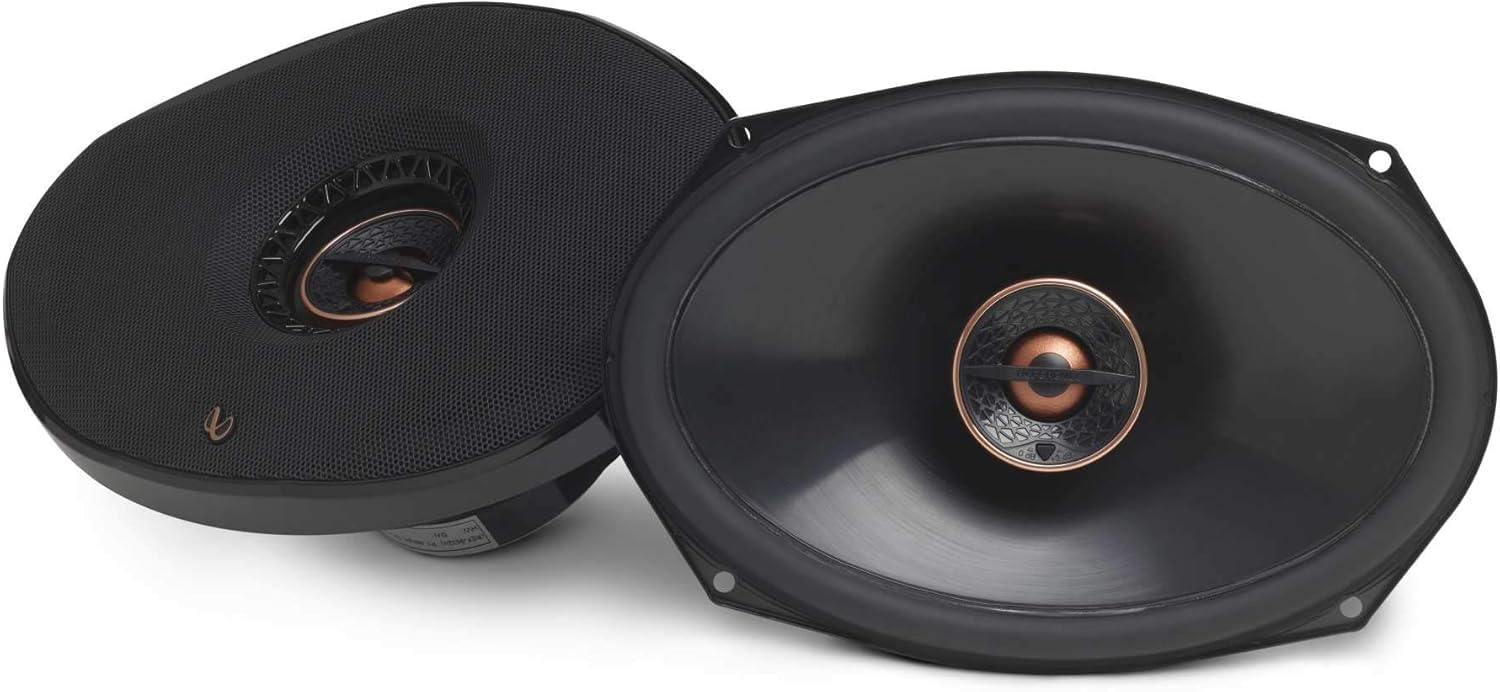
The audiophile 6×9 that balances bright and warm tones perfectly.
The Infinity Reference 9632IX suits you if you can hear the gap between a decent speaker and a truly refined one. Customers note the sound stays balanced between bright and warm tones, so music feels full and engaging. This 2-way design (a speaker with separate drivers for high and low frequencies) shines as a direct factory upgrade, delivering crisp highs and deep bass that tightens after a short break-in period.
One of the standout features is a tweeter on/off switch, which gives you control over how bright the highs sound. That flexibility makes it easy to dial in the perfect tone for your ear. Owners have dropped these into trucks like the 2002 Dodge Ram and the 2017 Ram 1500 with plug-and-play ease, often using the factory radio without any extra amp.
These want power to reach their full potential, so pair them with an amp. While they work on a factory stereo, adding a 100W-per-channel amp open up punchy bass and makes them truly sing. A few owners note the bass is more of a “bong” than a thump without that power, so plan your system accordingly.
Why It’s Special
- Excellent clarity across highs and lows
- Handy tweeter on/off switch for tone control
- Easy fit in many trucks and sedans
What It Needs
- An amplifier to fully open up its bass potential
- A break-in period before it sounds its best
Choose this if: you value balanced, detailed sound and don’t mind adding an amp.
Look past it if: you’re on a tight budget with no plans to amplify.
9. Rockford Fosgate T1693 Power

The flagship Rockford 6×9 that blasts clean and holds its own against subs.
The Rockford Fosgate T1693 is the premium statement here, rated at 100 watts RMS and 200 watts max for a 4-ohm load. It’s a 3-way full-range speaker designed as a high-powered OEM replacement, and owners confirm it can BLAST. Paired with a 400W amp, these deliver excellent full-range output that holds up against 12-inch subwoofers on 1500W without distortion.
What sets Rockford apart is the build. Integrated concealed crossovers and included adapter plates make installation cleaner, and the full 1-year warranty backs the famous Rockford build quality. Reviewers point out no distortion even at super high volume, with a strong bass response that makes you forget you’re listening to a 6×9 and not a sub.
The fit is the one thing to verify before buying. Some shoppers say the speakers don’t match their existing cutouts perfectly, with one noting they fit 2 of 4 screws in a 2016 Ram 1500 rear corner. They also lack deep low-end extension on their own, so a crossover to subs at 100Hz is recommended in larger spaces.
Why It’s The Top
- Exceptionally clean output at high volume
- 100W RMS rating handles serious amplifier power
- Concealed crossovers and adapter plates included
Before You Buy
- Fit isn’t guaranteed across all vehicles
- Deep bass needs a subwoofer crossover
Go all-in if: you’re building a loud, high-quality system and want a speaker that won’t flinch.
Think twice if: you need a guaranteed universal fit for a tight factory opening.
Understanding the Specs
RMS vs. Peak Power
RMS, or continuous power, is the number that tells you how much power a speaker can handle all day long without damage. Peak power is a marketing number that shows a brief maximum burst. When matching a speaker to an amplifier, focus on RMS — you want the speaker’s RMS to be close to the amp’s output so you get clean, powerful sound without blowing anything.
Sensitivity and Impedance
Sensitivity, measured in decibels (dB), shows how efficiently a speaker converts power into volume. A higher rating like 92 dB means louder output from the same wattage, which is ideal for factory stereos. Impedance, usually 4 ohms for car speakers, is the electrical load the speaker presents to the stereo — stick with what your vehicle is designed for to avoid overworking the amp.
FAQ
Will 6×9 speakers fit in my car’s factory locations?
Can I run 6×9 speakers off my factory stereo without an amplifier?
What’s the difference between 2-way and 3-way 6×9 speakers?
How much power do I need to drive 6×9 speakers well?
Do 6×9 speakers provide enough bass without a subwoofer?
What does the frequency response spec like 35Hz to 20kHz mean?
How do I install 6×9 speakers in my car?
What is a coaxial car speaker?
Why do some 6×9 speakers have a higher RMS rating than others?
Should I match 6×9 speakers with my vehicle’s original impedance?
Final Thoughts: The Verdict
For most drivers, the 6 x 9 car speakers winner is the Pioneer TS-6900PRO because its 100W RMS handling and legendary midrange clarity make it the most balanced, crowd-pleasing upgrade available. If you want a budget-friendly pair that runs clean on a factory stereo, grab the Alpine SXE-6926S. And for a bass-heavy sound without a sub, the Kenwood KFC-6966R is the one to reach for.
How We Picked
We do not accept paid placement. Every pick is matched to a real buyer and a real use-case; we do not hands-on test units.
Sources & Methodology
Specifications: manufacturer listings and product documentation. Review insights: verified customer reviews, as of September 2026. Pricing: not shown on this page (it changes often); check the current price via the retailer link.
As an Amazon Associate, Gadgets Feed earns from qualifying purchases. This does not affect which products we feature.