
Our readers keep the lights on and my morning glass full of iced black tea. As an Amazon Associate, I earn from qualifying purchases.
Specs are compiled from manufacturer listings and verified buyer reviews and can change over time — please confirm the key details on the product page before buying.
If you are bottling product in any real volume, you already know the pain: peeling, positioning, and smoothing labels by hand is a slow, error-prone bottleneck that eats your day. Automated labeling machines trade that tedious manual work for a system that wraps a label around a bottle in seconds, with repeatable accuracy that human hands struggle to match.
I’m Min — the founder and writer behind Gadgets Feed. This guide is built by comparing the manufacturers’ published specifications and the patterns across verified customer reviews, so you get each pick’s real strengths and trade-offs instead of marketing spin.
If you are moving from hand-labeling to a machine, you want one that pays for itself fast without a nightmare setup. This automated labeling machines shortlist covers small-batch and mid-size lines, balancing speed, ease, and the bottle shapes you actually run.
Quick Picks
- Hanchen Semi-Automatic Round Bottle Labeling — Best Overall
- Primera AP360 Label Applicator 74291 — Top Performer
- Primera AP362 Label Applicator — Front & Back Pick
- TAL-2100ER Electric Bottle Label Applicator — Durable Pick
- HayWHNKN Automatic Round Bottle Labeling Machine — High-Speed Pick
How To Choose The Best Automated Labeling Machines
Before you look at any specific model, you need to answer one question: how many bottles are you labeling per hour, and are they all the same shape? That single number filters out most of the market because these machines range from a semi-automatic unit you feed by hand to a fully automatic desktop line that guides bottles in for you.
The next question is bottle shape. Every machine we cover here is built for cylindrical containers — round bottles, cans, jars, and tubes. If your product comes in an oddly shaped or flat-front bottle, these applicators are not the right tool, and that fact alone will save you from a costly mismatch.
Match Speed to Your Real Volume
Speed is measured in bottles per minute (BPM), and the gap between models is huge. A semi-automatic unit might handle 20-40 bottles per minute, while a full automatic line can hit 200 bottles per minute. If you are a small enterprise doing a few hundred bottles a day, that top speed is wasted money — but if you are keeping pace with a filling line, the slow unit becomes the bottleneck. Buy for the volume you actually run today, not the volume you dream about next year.
Check the Label and Bottle Sizing Range
Every machine has hard limits on the label width and length it can feed, plus a range of bottle diameters it can wrap. A machine rated for a 4.7-inch bottle diameter will not grip a 6-inch jug, and a label longer than the machine’s feed path will jam or misalign. Measure your bottle, measure your label, and compare both against the spec sheet before you commit.
Understand the Sensor and Label Material
The label sensor is the brain that tells the machine where the label starts and stops. Most of these units use an optical eye (a light sensor that detects the gap between labels). Here is the catch: some sensors cannot see clear, gold, or silver labels, which is why one pick here warns those materials will not work without an extra part. If your labels are clear or metallic, confirm the machine handles them before ordering.
Quick Comparison
| Model | Best For | Speed | Max Bottle Diameter | Weight | Amazon |
|---|---|---|---|---|---|
| Hanchen Semi-Automatic | Entry-level value | 20-40 bottles/min | 4.7 inches | 21 kg | Amazon |
| Primera AP360 | Small-batch tinctures | Up to 1200/hour | Cylindrical & tapered | 16 oz | Amazon |
| Primera AP362 | Front & back labeling | Up to 1200/hour | Cylindrical | — | Amazon |
| TAL-2100ER | Durable build, US-made | 15-20 bottles/min | 5 inches | 44 lbs | Amazon |
| HayWHNKN Automatic | High-speed production | 200 bottles/min | 3.9 inches | 280 lbs | Amazon |
In‑Depth Reviews
1. Hanchen Semi-Automatic Round Bottle Labeling Machine

The budget-tier workhorse that brings automation to small companies without a six-figure budget.
The Hanchen earns its spot on price-to-capability: it lifts you from hand-labeling to a 20-40 bottles per minute semi-automatic pace, a huge output jump for a small business. An automatic optical eye sensor (a light beam that detects the label’s position) places each label accurately, so you waste less and re-label less.
Physically, this is a serious piece of kit: a pure aluminum alloy body, integrated forming, and a thickened swing arm that resists deformation. There is a paper receiving wheel inside that collects waste backing automatically, which saves you the messy cleanup. It also stays small enough to sit on a table or assembly line, so it fits into a modest workshop.
The trade-off is the documentation. Buyers report the instructions are incorrect and confusing — they do not match the machine’s parts. One owner summed it up: “Got to be careful. It loses alignment easily and will leave bubbles.” So the machine works, but expect a learning curve and manual alignment care. Also note the limits: labels must be 1 to 11.8 inches long and 0.5 to 5.9 inches wide, and the bottle must be a true cylinder with no protruding cap — gold, silver, or transparent labels are not supported.
Real-world verdict: A capable entry point that delivers genuine automation for the cost, as long as you are patient with setup and your bottles are simple round cylinders.
Reach for it if: You run a small enterprise labeling standard round bottles and want automation without a premium outlay.
Look elsewhere if: Your labels are clear or metallic, or your bottles have uneven surfaces — the spec sheet rules those out.
2. Primera AP360 Label Applicator 74291
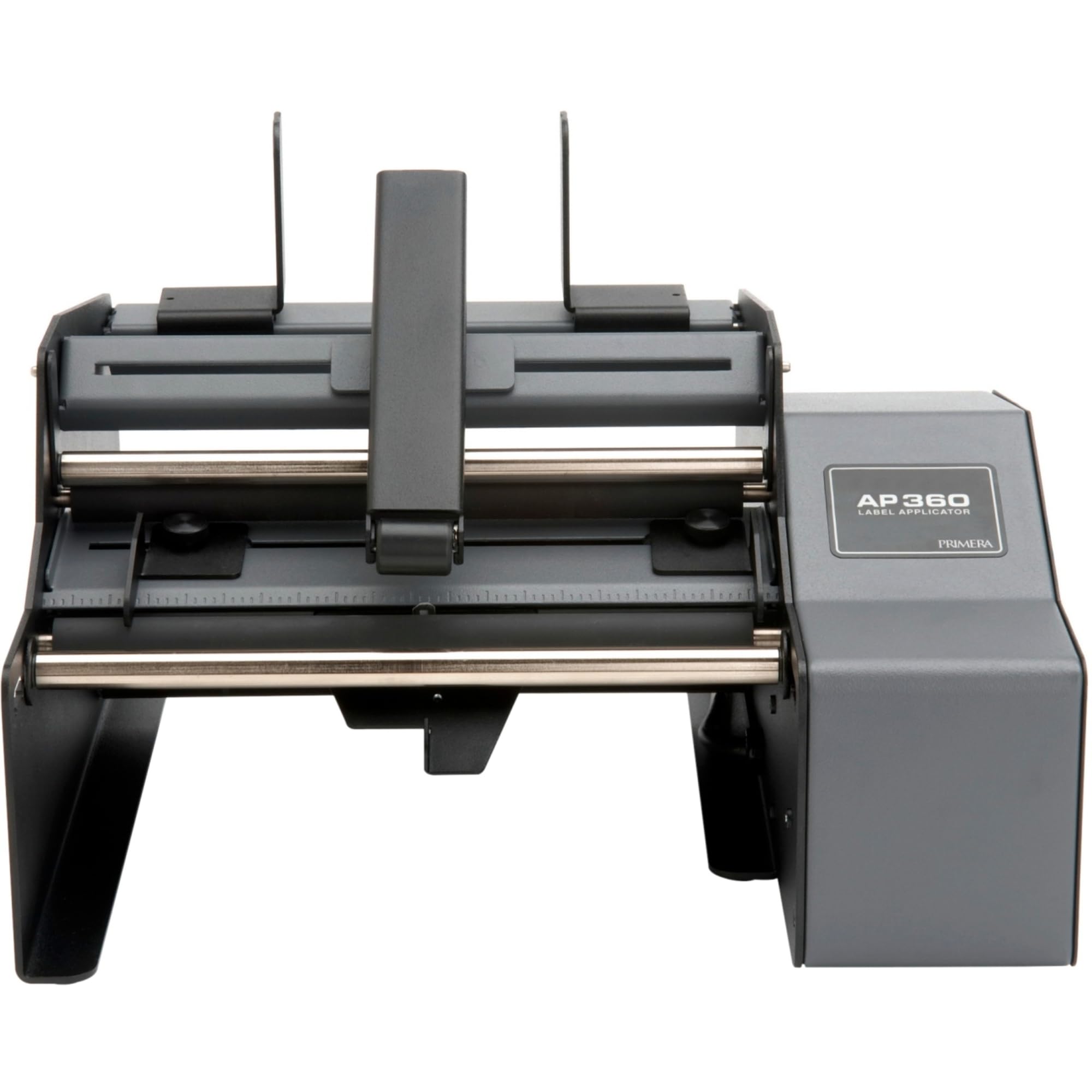
A fast, compact semi-automatic that shines when your bottles are small and your time is short.
The AP360 is all about speed per dollar. It applies labels at 5.3 inches per second — up to 1200 containers per hour — which is why Buyers upgrading from hand-labeling report an error rate of 0.5% versus 10% by hand.. That is the difference between a roll of wasted labels and a roll that all lands perfectly.
What wins people over is the versatility with bottle shapes. It handles cylindrical containers plus many tapered designs — bottles, cans, jars, and tubes. For a tincture or small-bottle operation, owners say large 16-32oz bottles need a slower rotation speed while small 1-8oz bottles run fine on defaults, and the setup is quick with near-complete assembly from the start.
There is honest nuance here. The judgment on ease of use splits down the middle, and owners mention bigger labels can misalign and need manual fixing now and then. One user captured the variability: “When it works, it’s great… a few perfect labels in a row, followed by a few with bubbles or wrinkles.” So it is fast and mostly reliable, but it is not a set-and-forget device for large-format labels.
What owners rave about
- Labels fast and saves real time — the reason most upgraded
- Clean, professional, bubble-free results on small labels
- Works with various bottle sizes including tapered containers
The honest catch
- Larger labels misalign and need manual redo
- Ease of use gets mixed reviews — some find it frustrating
Best suited to: Small-batch producers running mostly small bottles who want near-manual-level accuracy at automated speed.
Not ideal if: Your product is a wide or oversized container — that is where the alignment gremlins appear.
3. Primera AP362 Label Applicator

The labeler that can wrap one or two labels per bottle, built to keep pace with a filling line.
The AP362’s defining trick is that it applies one or two labels to the front and back of containers — a feature none of the other semi-automatics here offer. In a real production run, One reviewer noted bottling 1,800 750mL bottles flawlessly., keeping up with the filling line at up to 1200 containers per hour, with perfect quality and easy setup. That is the headline scenario this machine was made for.
It is also designed to pair naturally with a Primera LX-series label printer, so if you already print your own labels on that system, this applicator is the logical next step. The operation mode is semi-automatic, meaning a person feeds the bottle, but the machine does the wrapping work.
Here is the reality check. The machine has a known weakness with glass bottles that are not perfectly flat — one long-term owner reported label pull-off jams that persisted after two years despite tech support. Another found it finicky, with labels going crooked or shifting vertically and requiring constant adjustment. The recurring maintenance note is real too: Clean sticky roller residue with alcohol or acetone every 400-500 bottles. to keep it running smoothly.
The takeaway: A genuinely fast front-and-back labeler that impresses in mid-production use, but it demands consistent bottle quality and regular roller cleaning to earn its keep.
Grab this if: You need front-and-back labeling and your bottles are uniform, smooth cylinders.
Think twice if: Your glassware has any surface irregularity — that is where jams and misalignments creep in.
4. TAL-2100ER Electric Bottle Label Applicator

A Made-in-USA all-electric workhorse that owners say beats cheap imports on consistency.
The TAL-2100ER takes a different approach to control: you place the bottle in the carriage, step on a footswitch, and the unit wraps the label around the bottle. At 15-20 bottles per minute, it is slower on paper than the Primera units, but owners who have run multiple labelers call it superior — One owner who tried two Chinese machines said this one delivers perfect straight labels with smooth start and stop., and that the rewind feature (which rolls up the label backing) is essential for cellophane backing.
The build is the story here. It handles bottles from 1 inch to 5 inches in diameter, tops out at 5 inches of web capacity (the width of the label roll), and weighs 44 pounds — a solid, planted unit. Customers note Setup takes about 20 minutes., and the throughput math is stark: Hand-labeling took 10 seconds per bottle versus 3-4 seconds on this machine., with One owner pushed 500 bottles in an hour—a task that took a full day by hand..
There are real caveats. The machine is designed for opaque labels only — transparent labels require an additional Photo Eye (a light sensor) to be purchased separately from TAKE-A-LABEL. And the value judgment splits hard: some call it the best machine for the money, while a few report a bad experience with a defective replacement and unresponsive support. The setup also lacks a step-by-step video, which one owner said turned a 20-minute job into an all-day one.
Why it wins loyal owners
- Metallic BOPP labels apply cleanly without bubbles
- Made in the USA with a responsive seller
- Handles up to 5-inch bottle diameters
Where it stumbles
- Transparent labels need a separate Photo Eye part
- Setup instructions lack a step-by-step video
- Occasional unit arrives defective per a few owners
Choose it for: A durable US-built machine that applies metallic and opaque labels flawlessly at a steady pace.
Pass on it if: Your labels are clear — you will need to budget for an extra sensor before it runs.
5. HayWHNKN Automatic Round Bottle Labeling Machine

The full-auto desktop line that flies at 200 bottles per minute once you master its setup.
This is the only fully automatic pick here, and it earns its place by sheer throughput. The normal speed reaches 200 bottles per minute — ten times the pace of the semi-automatics — using a side-horizontal roller conveyor where bottles are automatically guided along an inclined chain. It handles full-circle and half-circle labeling on round plastic and glass bottles with diameters from 1.5 to 3.9 inches, and can even be equipped with a ribbon coding machine.
The controls are where the smarts live. You can adjust labeling speed, conveying speed, and bottle separation independently, plus raise or lower the labeling height for different bottle sizes. The three-bar adjustment structure uses the stability of a triangle to keep the whole frame rigid, and a photoelectric sensor automatically tracks and corrects the label so nothing is missed or wasted. Buyers also note it is much quieter than a machine running off a compressor.
The hard truth is the setup. Owners are unanimous that this thing takes serious tinkering — One owner called configuration “almost impossible,” while another said once lined up, “bottles fly out of it.” It is also a 280-pound machine, so you are not moving it around the shop casually. The customer support reputation is the biggest risk: a couple of reviewers point out getting a defective unit and facing refusals on refunds, which is a genuine concern at this price tier.
Bottom line: class-leading speed and quiet operation for a high-volume round-bottle line, but only if you have the patience to calibrate it and some luck with support.
Built for: High-volume production runs of standard round bottles where 200 bottles a minute actually matters.
Not for: Buyers who want plug-and-play setup — expect a real time investment before it runs right.
Understanding the Specs
Bottles Per Minute (BPM)
This is the throughput number that tells you how many containers the machine can wrap in 60 seconds. The spread is enormous: semi-automatics like the Hanchen run 20-40 BPM, while a full-auto unit like the HayWHNKN hits 200 BPM. Match this to your actual daily volume — a slow machine becomes a bottleneck on a fast filling line, but a fast machine is wasted money for a small batch operation.
Label Sensor and Optical Eye
The optical eye is a light sensor that finds the gap between labels on the roll so the machine knows when to cut and apply. This matters more than most buyers expect because some sensors cannot detect clear, gold, or silver labels — the Hanchen and TAL-2100ER both have this limitation. If your label material is transparent or metallic, confirm the machine’s sensor can handle it or budget for an extra part like the TAL’s Photo Eye.
FAQ
What is the difference between semi-automatic and fully automatic labeling?
Can these machines label clear or transparent labels?
What bottle shapes and sizes work with these machines?
How fast are these machines in real production?
Why do labels end up with bubbles or wrinkles?
How long does setup and calibration take?
Can these machines apply two labels to one bottle?
What maintenance do these labeling machines need?
Final Thoughts: The Verdict
For most small enterprises the automated labeling machines winner is the Hanchen Semi-Automatic because it delivers real automation and a strong aluminum build at a value the others cannot match. If you mainly run small bottles and want higher throughput, grab the Primera AP360. And for a durable US-made unit that handles up to 5-inch bottles cleanly, the TAL-2100ER is the one to reach for.
How We Picked
We do not accept paid placement. Every pick is matched to a real buyer and a real use-case; we do not hands-on test units.
Sources & Methodology
Specifications: manufacturer listings and product documentation. Review insights: verified customer reviews, as of September 2026. Pricing: not shown on this page (it changes often); check the current price via the retailer link.
As an Amazon Associate, Gadgets Feed earns from qualifying purchases. This does not affect which products we feature.