
Our readers keep the lights on and my morning glass full of iced black tea. As an Amazon Associate, I earn from qualifying purchases.
Specs are compiled from manufacturer listings and verified buyer reviews and can change over time — please confirm the key details on the product page before buying.
The integrated amplifier is the heart of a hi-fi system, determining whether your speakers sing or merely speak. A well-matched amp vanishes into the music, while a poor one colors every note. We evaluate 13 top integrated amps, from streaming hubs to tube classics, to help you match one to your speakers and listening style.
I’m Min — the founder and writer behind Gadgets Feed. This guide is built by comparing the manufacturers’ published specifications and the patterns across verified customer reviews, so you get each pick’s real strengths and trade-offs instead of marketing spin.
The crowd favorite here leans on pure analog muscle, but the real question is if you need streaming built-in or plan to keep it simple — that choice defines your perfect audiophile integrated amplifier.
Our Picks at a Glance

How To Choose The Best Audiophile Integrated Amplifier
An integrated amplifier combines the preamp (which selects your source and sets volume) and the power amp (which drives your speakers) into one box. Before you compare specs, you need to know your speakers’ sensitivity — measured in decibels (dB) — because that tells you how much power they actually need.
Match Power to Your Speakers,
A speaker rated at 87dB will play reasonably loud with just 45 watts, while a demanding tower might want 100 watts or more to breathe. High-efficiency speakers (90dB and up) are the perfect match for low-powered tube amps, which typically deliver 30–45 watts per channel.
Quick Comparison
| Model | Best For | Power | Weight | Phono Input | Amazon |
|---|---|---|---|---|---|
| Denon PMA-600NE★ Best Overall | Best Overall Value | 70W at 4 ohms | 18 pounds | Yes | Amazon |
| WiiM Amp UltraBest Streaming Hub | Streaming & Connectivity | 100W | 5.4 pounds | No | Amazon |
| Marantz PM6007Slim Analog Icon | Classic Analog Sound | 45W | 23.1 pounds | Yes | Amazon |
| NAD C 328 | Phono & Bluetooth Combo | — | 10.8 pounds | Yes | Amazon |
| Yamaha A-S701 | High-Current Power | 100W | 24.7 pounds | Yes | Amazon |
| Denon PMA-900HNE | Whole-Home Streaming | 85W x 2 | 8.3 pounds | Yes | Amazon |
| Yamaha A-S801 | Built-in DAC & USB | 100W | 26.7 pounds | Yes | Amazon |
| Cambridge CXA81 MkII | High-End Detail | 80W | — | No | Amazon |
| Willsenton R8 | Budget Tube Magic | 45W (Triode) | 57.3 pounds | No | Amazon |
| MUZISHARE X7 | Tube Versatility & Meters | 45W | — | Yes | Amazon |
| Yamaha R-N1000A | Networking & Room Correction | — | — | Yes | Amazon |
| Marantz Model 40n | Premium Streaming & Phono | 70W | 36.8 pounds | Yes | Amazon |
| Willsenton R800i | Reference Tube Purity | 30W | 105.6 pounds | No | Amazon |
In‑Depth Reviews
1. Denon PMA-600NE
Our pick — over 4.5★ from 550+ verified ratings; the strongest balance of quality and price.
A modern classic delivering warm, tube-like 1970s receiver sound at a sensible price.
The Denon PMA-600NE is the rare amp that wins over both vintage enthusiasts and newcomers. It delivers 70 watts into 4-ohm speakers — the measurement that shows real current muscle — and that output is what lets it bring 86dB/6Ω bookshelf speakers like the Elac Debut B5.2 to life with ease, getting very loud at just 20% volume with headroom to spare.
What makes it special is the Analog Mode button, which physically disengages the digital circuitry and Bluetooth to give you an undivided analog signal path — a feature straight from Denon’s 100-plus-year legacy of designing premium audio components. Owners say its 45W is plenty for 87dB speakers, and describe the sound as warm and rich, with airy treble and a deeper soundstage than they expected at this tier. The built-in DAC handles optical and coaxial inputs, while the phono input connects a turntable directly, making it a true all-in-one analog hub.
The recurring gripe is the volume control, which some find laggy and coarse, and the input-selector font is small and hard to read. These are ergonomic quibbles, not sound-quality problems — the consensus is that this amp outputs music in its purest form. If you pair it with an external power amp later, it’s flexible enough to grow with you; buyers report it drives DIY 15-inch woofer speakers well and integrates flawlessly with external amplification like the OSD XMP300 at 150W per channel.
analog warmth
- Sound quality is the top praise — it’s the first thing dozens of buyers single out
- Excellent value for money, with budget-conscious buyers calling it a steal
- Analog Mode switch genuinely improves purity for critical listening
modest power
- Volume control is a recurring mixed point — not smooth or precise enough for some
- A few wish for more Loudness or EQ options for tone shaping
budget audiophile: you want one box that handles vinyl, digital, and Bluetooth cleanly without chasing an app — this is the amp that sounds like a vintage receiver but behaves like a modern component.
power seekers: you need app-based streaming or multi-room audio, since this Denon keeps things gloriously simple and wired.
2. WiiM Amp Ultra
A featherweight streaming powerhouse that weighs a third of its rivals yet drives towers with ease.
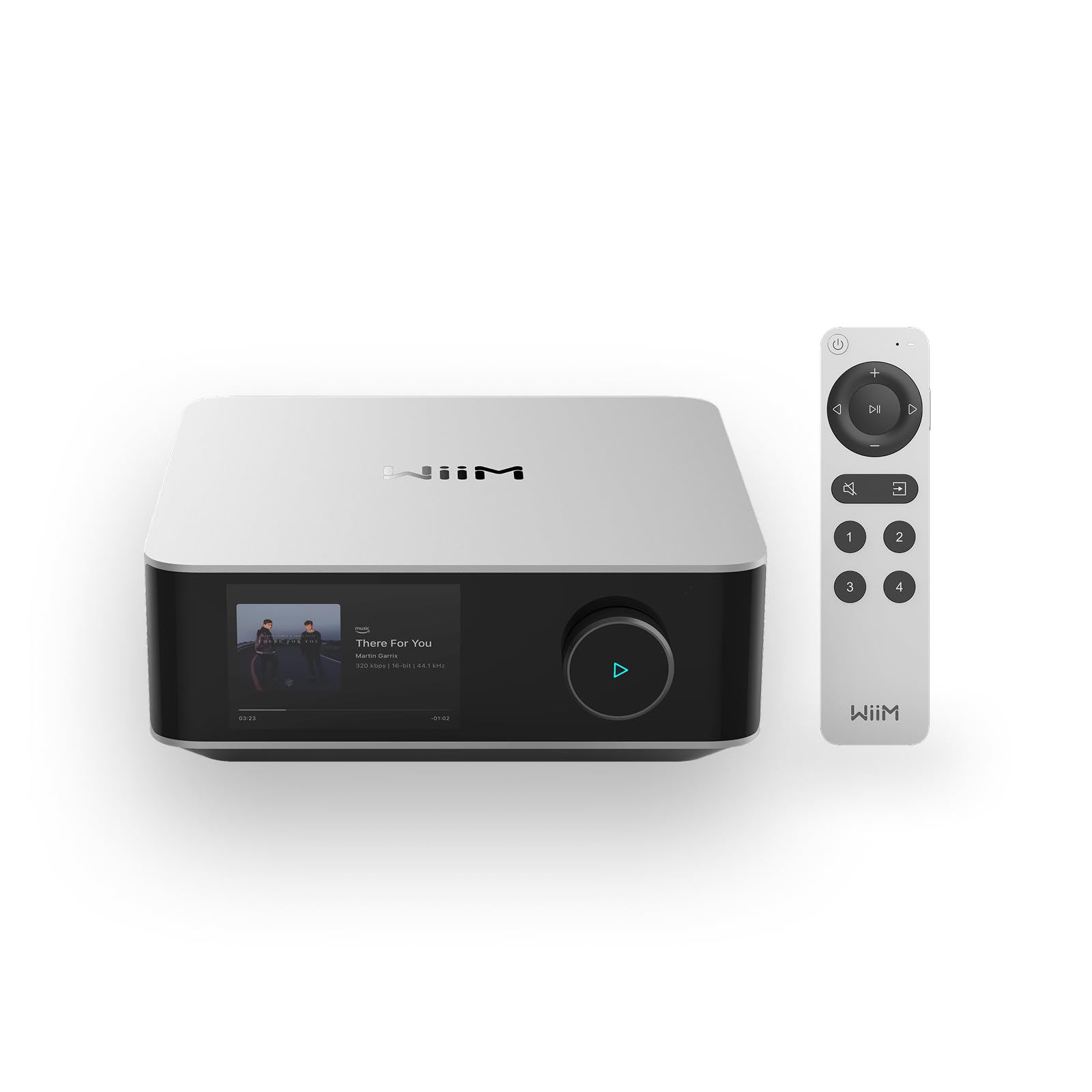
The WiiM Amp Ultra is a different kind of audiophile amp. At just 5.4 pounds, it’s remarkably light compared to the 18-pound Denon PMA-600NE — a 3.3x gap that makes it easy to place on a desk or shelf. But don’t let the weight fool you: this 100W amplifier powers up to four speakers with ultra-low distortion at -106 dB THD+N, and owners mention it drives the demanding Emotiva T2 (200W-rated) towers with punchy, clean sound.
Its defining feature is RoomFit Room Correction, which auto-calibrates the sound to your room and speakers for a balanced experience. Inside sit audiophile components: an ESS SABRE DAC and dual TI TPA3255 amps with PFFB tech for load-independent performance. Connectivity is next-gen — Wi-Fi 6, Bluetooth 5.3 with LE Audio, and HDMI ARC for smooth TV integration. The 3.5-inch glass-covered touchscreen displays album art and system settings, making it feel like a modern music appliance rather than a traditional amp.
The 3.5x weight advantage over the Denon means it’s the obvious choice for desktop setups or anyone who moves their gear. Streaming supports Spotify, TIDAL, Qobuz, Amazon Music, and is Roon Ready in up to 24-bit/192kHz quality. The smartphone app is excellent, letting you control EQ and subwoofer settings with precision. Customers note that the Bluetooth is limited to SBC/AAC codecs and it lacks AirPlay support, so iPhone users should stick to Wi-Fi streaming for best quality — which works flawlessly.
streaming hub: If your music lives in apps rather than on vinyl or CDs, this is the most complete and flexible streaming amplifier under any budget. The app control, room correction, and HDMI ARC make it the center of a modern, minimalist system.
lightweight build: you’re a purist who wants a heavy, traditional Class A/B amp — this is a Class D design, and while it sounds clean and punchy, it doesn’t offer the same analog warmth as the Denon or Marantz options.
3. Marantz PM6007
A slim-line aristocrat whose toroidal transformer and HDAM modules deliver easy musical finesse.
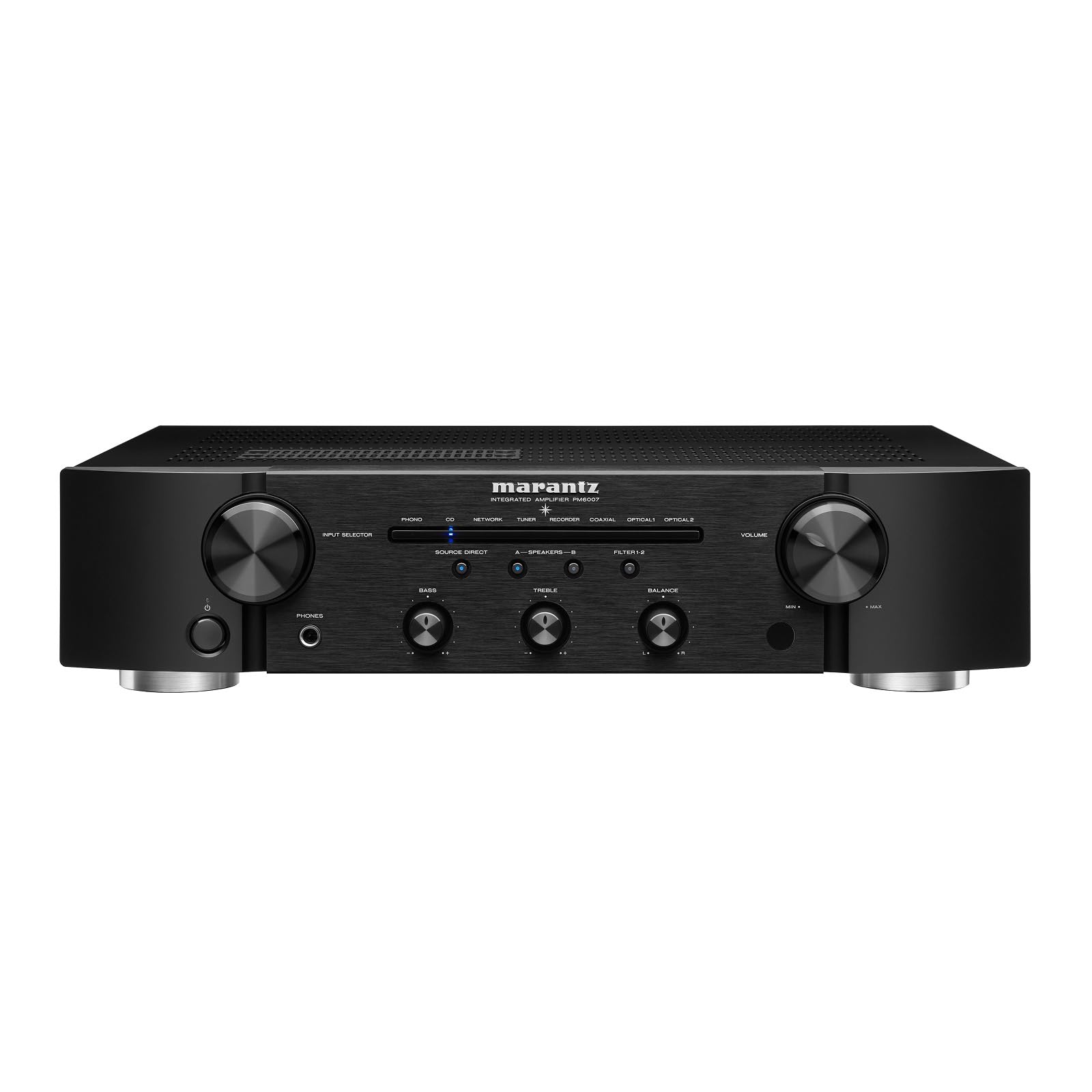
The Marantz PM6007 is built around a philosophy of musicality, not just power. Its 45 watts per channel might seem modest, but it drives speakers far above its rated output — reviewers point out it has no issues powering Vera VS05 speakers that officially require a 50-120 watt amp. The secret is a high-current power supply and advanced thermal compensation that gives it energy reserves beyond its 45W rating.
Marantz’s proprietary HDAM-SA3 modules replace standard op-amps with discrete amplifier circuits, delivering wider dynamic range and lower distortion. The result is what the brand calls “The Most Musical Sound” — a warm, spacious, liquid presentation that makes the PM6007 feel dramatically more expensive than it is. Inside, a toroidal transformer ensures clean power delivery, and the reference-class AK4490 DAC handles digital files up to 192-kHz/24-bit resolution with two selectable digital filter modes.
Connectivity covers nearly everything: five analog inputs, one coaxial, two optical digital inputs, speaker A/B switching, a subwoofer output, and a high-quality MM phono stage with FET circuitry for quiet vinyl playback. The build quality is the top praise from owners, who describe it as “a fantastic piece of equipment” and note the connections are clearly labeled. Some shoppers say crackling noise issues, though these appear to be unit-specific rather than a pattern — the majority find it silent and hum-free.
stereo purist: analog purists who want a compact, beautifully built amp that makes their turntable and CD player sound their absolute best — this is the soulful choice among the mid-range solid-state options.
connectivity needs: you need Bluetooth streaming built-in, because while it has none, it expects you to feed it quality sources.
4. NAD C 328

A compact all-rounder combining a serious phono stage, clean DAC, and Bluetooth in one slim chassis.
The NAD C 328 is designed for listeners who want one box that does nearly everything well. Its high-performance 24-bit/192kHz DAC uses variable modulation frequency to reduce distortion in all operating conditions, making digital files sound lifelike. The MM phono stage uses exact RIAA equalization with high overload margins and extremely low noise, plus an innovative circuit that suppresses infrasonic noise from LPs without compromising bass response.
This Class D amplifier rivals the performance of entry-level Class A/B designs like the Cambridge AM5, but with more power and efficiency. Buyers describe the sound as linear and clean, with one owner pairing it flawlessly with Dali Oberon 3 speakers and praising its crisp output and abundant power. The Bluetooth functionality lets you stream from your smartphone easily, making it a genuinely flexible hub for a smaller system.
There’s really nothing to dislike, per owners, though the remote is “a bit chintzy” and particular about aim, and one buyer reports intermittent Bluetooth drops despite resets. The optical and phono inputs work flawlessly for those who prefer wired connections. At just 10.8 pounds, it’s a compact choice that fits easily on a shelf, and its design philosophy of simplicity means you won’t need a manual to get started.
all-rounder: you want a genuinely compact amp that handles vinyl, digital, and wireless — a true budget-to-mid-range balance that punches well above its weight class.
aesthetic fans: the Bluetooth reliability is the one recurring complaint, so if wireless is your primary source, you may want to use the optical input instead.
5. Yamaha A-S701

A 24.7-pound brute-force amp that trades frills for pure, clean, high-current swing.
If your speakers are power-hungry, the Yamaha A-S701 is the no-nonsense answer. It delivers a genuine 100W plus 100W at 20 Hz-20 kHz with a low 0.019% THD — distortion so low it’s essentially inaudible. This is a traditional Class A/B amp with a heavy toroidal transformer, and it shows in the weight: at 24.7 pounds, it’s got the physical mass to back up its power claims. It easily drives vintage 6-ohm Polk Audio monitors, and buyers report it replaced an underpowered entry-level Marantz to finally awaken their 6-ohm Definitives.
What wins people over is the sound quality, especially its clarity at low listening levels — you get detail and definition even at whisper volumes, with no hum or noise floor. The CD and Pure Direct modes boost volume and clarity, and the variable loudness control at its ‘flat’ setting is ideal for critical listening. Digital audio inputs for TV and Blu-ray, plus gold-plated coaxial and TOSLINK optical inputs, make it easy to connect a television or streaming box. Speakers A, B, and A+B switching lets you run two sets of speakers or bi-wire a single pair.
Buyers consistently describe it as a superb integrated amp that handles both analog and digital sources with high quality. One owner chose it over the A-S801 precisely because they didn’t need a built-in DAC and preferred to upgrade externally later. It features auto standby after 8 hours, and a 1-year limited warranty backs the purchase. The honest trade-off is the input options — with just one phono input and no built-in DAC, it expects you to bring your own digital conversion.
raw output: This is the amp for speakers that need real current to sing — the Yamaha delivers clean, neutral power that never runs out of steam, making it the default choice for difficult loads.
basic features: you want a built-in DAC or streaming — this is a traditional, classically designed amplifier for analog purists.
6. Denon PMA-900HNE

A velvet-smooth Class A/B stage wrapped around whole-home streaming and voice control
The Denon PMA-900HNE is the bridge between old-school audio purity and modern multi-room convenience. It delivers 85W x 2 through Denon’s Advanced High-Current single push-pull circuit, delivering detailed, rich audio with effective bass and precise imaging. At just 8.3 pounds and 17.1 x 14.8 x 5.1 inches, it’s remarkably compact for its power class, fitting easily into a media console.
what separates it is HEOS built-in, which lets you stream the same song in all rooms or different songs in each, from Spotify, Pandora, TIDAL, and more via Wi-Fi, AirPlay 2, or Bluetooth. Voice control works through Alexa, Siri, or Google Assistant — change volume or skip tracks hands-free. Buyers describe the sound as “velvet smooth,” pairing beautifully with Klipsch RP-600M II speakers and taming their highs to silky smoothness, with tight bass and rich articulation.
Owners praise the phono input with MM/MC equalizer for vinyl playback — no preamp needed — and the ability to stream vinyl wirelessly to Denon Home speakers via the HEOS app. It supports MP3, ALAC, WAV, FLAC HD, and DSD formats from a USB drive or network. The three optical and one coaxial input handle CD players, Blu-ray, and TV audio, plus a subwoofer pre-out. Owners mention it’s a great mid-tier model, with a bit of heat output and the HEOS app being a bit clunky — but Spotify Connect works flawlessly with auto-wake.
wireless setup: you want Class A/B analog warmth but also need multi-room streaming and voice control — it’s the rare amp that does both without compromise.
tight budgets: you’re building a dedicated home theater system, since this is strictly a two-channel music amp, not an A/V receiver.
7. Yamaha A-S801

The 26.7-pound heavyweight whose built-in USB DAC turns your computer into a high-end source
The Yamaha A-S801 takes the muscular A-S701 platform and adds a serious USB DAC, making it the pick for computer-based audiophiles. It delivers a clean 100W plus 100W at 20 Hz-20 kHz with just 0.019% THD, and the USB DAC supports DSD at 2.8 MHz and 5.6 MHz, plus PCM up to 384 kHz/32-bit for WAV and FLAC files. This is a genuine reference-grade DAC that rivals dedicated units costing far more.
Buyers are emphatic: the USB input is the best source, eliminating the jitter that plagues RCA connections and rivaling a CD player in fidelity. One owner reports a huge detail and soundstage improvement upgrading from an old 35W amp to this 100W design. The clarity is “incredible” with Pure Direct engaged, inspiring lossless re-rips of entire collections. It uses Yamaha’s custom power transformer, 12,000 µF block capacitors, and extruded aluminum heat sinks for rock-solid power delivery.
The Class A/B amp sounds natural, clear, and transparent, with defined bass and an expansive soundstage. Connectivity includes gold-plated digital coax and TOSLINK optical, gold-plated analog inputs including phono, and speakers A/B/A+B switching. Buyers praise its versatility, noting the digital and analog input options make it a genuine all-rounder. The honest gripes are a stepped volume control that some find imprecise, no subwoofer out (a Y-splitter works around it), and a phono stage that’s merely adequate — the weak link in an otherwise superb package.
critical ears: digital audiophiles with large FLAC/DSD libraries on a computer — the USB DAC alone justifies the jump over the A-S701, regardless of your speakers.
casual listening: owners note a slightly boosted low end and cheap-feeling plastic knobs, so if you demand a dead-neutral response, audition it first.
8. Cambridge Audio CXA81 MkII

The British precision instrument that delivers lifelike piano and breathtaking separation from 80 carefully managed watts
The Cambridge Audio CXA81 MkII is a statement piece for listeners who demand reference-level detail. Its 80 watts per channel drive demanding speakers with ease, while the ESS ES9018K2M SABRE32 DAC provides genuinely reference-level digital-to-analog conversion. The Class AB amplification with a toroidal transformer delivers what owners describe as “soundstage heaven” — excellent representation of musical instruments and separation between them.
Customers note a huge upgrade from 1980s-era NAD gear, with lifelike piano sound and detail that emerges after about 10 hours of use. It powers Monitor Audio Silver 500 and KEF LS50 Metas with powerful, warm-neutral clarity, beating the Audiolab 6000A with richer presence and more authority. The balanced XLR inputs offer a premium connection path to sources like the CXN100 streamer, and the Bluetooth aptX HD input connects wirelessly to phones and the Alva TT V2 turntable.
Owners note it’s near-identical to the Marantz Model 50 but slightly more powerful, if a touch brighter and more fatiguing on long sessions. The digital inputs cover TOSLINK, coaxial, and USB Audio, making it exceptionally flexible, and it’s Roon Tested with a 2-year warranty. Honest feedback: the large remote lacks CD player control, and the Bluetooth is 4.2 (a 2014 standard) rather than 5.3, which means it can be unstable with newer computers — but over USB, it’s flawless.
transparent clarity: If your priority is hearing every layer of a complex recording with jaw-dropping clarity, the CXA81 MkII is the strongest solid-state contender in this list — it punches way above its price point.
lean bass: it’s not for casual background listening; this is a serious instrument for dedicated, focused music sessions.
9. Willsenton R8

The 57-pound hand-wired tube legend that delivers 3D soundstage warmth for a fraction of boutique-brand money
The Willsenton R8 is the gateway into serious tube audio. Built around four KT88 output tubes (with EL34 and 6550 compatibility), it delivers different sonic signatures depending on which tubes you install — a red selection button on the back switches between them. It’s purely hand-made with point-to-point welding, which explains its substantial 57.3-pound weight and the “built like a tank” comments from owners.
The sound is what draws people in: deep musicality, warm tube character, and a 3D soundstage that owners describe as breathtaking. It drives Sennheiser HD 650 headphones beautifully through the headphone output, and powers efficient speakers with ease — one owner drove 104dB Klipsch La Scalas with about 45W per channel in triode mode. The triode/ultra-linear switch lets you choose between soft, pure sound for vocals or open, unrestrained dynamics for large-scale music. Owners recommend a 100-300 hour run-in period, noting the sound stabilizes and improves dramatically after 100 hours.
Value is the overwhelming theme — owners call it “an audiophile experience for mid-fi money,” comparing it favorably to amps costing several times more. The stock KT88 tubes sound great, though tube-rolling to Gold Lion or Mullard options improve it further. The metal remote is hefty but has sharp edges and a painful battery-access design. Some note that reliability is a mixed bag, with occasional reports of tube failures, and the sound is more solid-state-like than expected until the tubes warm up — this is a hands-on product for tube enthusiasts, not a set-and-forget appliance.
tube lovers: you want the tube experience — the warm, liquid sound and the hobby of tube-rolling — without paying boutique prices.
low fuss: it needs a 100-hour burn-in before final judgment, and serious tube upgrades add cost; this is a tinkerer’s amplifier, not a plug-and-play receiver.
10. MUZISHARE X7
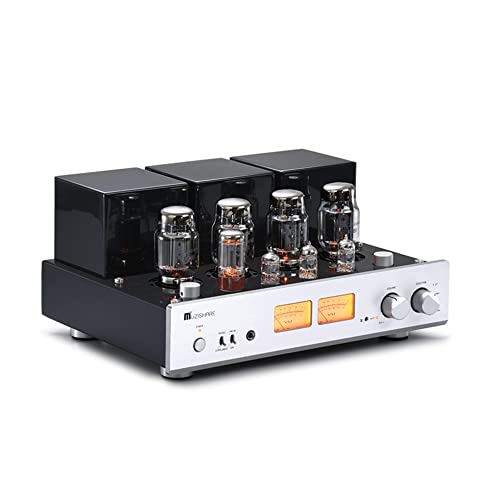
The glowing VU-meter tube amp that doubles as a phono stage, power amp, and headphone amp in one hand-wired chassis
The MUZISHARE X7 is for listeners who want the full tube experience with maximum versatility. It’s an integrated amplifier, a power amplifier (with preamp input), a headphone amplifier, and a phono amplifier all in one — you can connect a turntable directly and output to speakers. The hand-made point-to-point welding uses Japanese EI output transformers with a Z11 core toroidal power transformer, and the design uses 12AX7 and 12AU7 tubes for voltage amplification with KT88 tubes in AB1 push-pull configuration.
The two glowing VU meters are the visual centerpiece, a feature many owners say they’ve “always dreamed of.” Sound quality is the top praise — owners describe breathtaking imaging, warm mids, tight bass, and airy highs. The triode mode offers smooth, pure sound for vocals and strings, while ultra-linear mode opens up the sound for large dynamic music. The Japanese ALPS motor potentiometer provides smooth volume control, and a mute delay function protects your speakers for about 30 seconds at power-on.
Reviewers point out the X7 matches amps costing -5,000, especially after tube upgrades, and one runs it daily for two years with zero issues. The built-in MM phono stage is serviceable though not exceptional, and the headphone output works but isn’t the star. The bass response is strong without a subwoofer, and volume rarely needs to pass 12 o’clock even with tower speakers. The honest limitations: servicing is hard outside China, the manual is nearly useless, and bias adjustment requires working through the VU meters.
tinkerers: you want one tube amp that handles vinyl, line-level sources, and headphones, with the visual drama of VU meters and the flexibility of triode/ultra-linear switching.
reliability first: this is a hands-on tube amp — plan for the hobby of tube rolling and the occasional servicing challenge.
11. Yamaha R-N1000A

The network receiver that revives old speakers with high-res streaming and automatic room correction
The Yamaha R-N1000A is a network receiver that functions as a complete digital hub. Its ESS SABRE ES9080Q Ultra DAC delivers superior signal-to-noise performance for high-resolution streaming, while the built-in YPAO-R.S.C. (Reflected Sound Control) automatically calibrates the sound to your room using precision EQ. This is a significant feature — it analyzes your room’s acoustics and corrects for reflections that muddy the sound, giving you a more accurate presentation than any manual EQ can achieve.
Buyers praise its versatility, noting it “works well with both old and new content” and adds clarity to music. One owner revitalized a pair of old JBL 100 speakers, describing incredible sound with vinyl and CDs. The high-performance USB DAC supports DSD 11.2 MHz native playback and 384 kHz PCM, handling the most demanding digital formats. Connectivity is comprehensive: phono input for vinyl, HDMI for TV, optical and coaxial digital, USB, Bluetooth, and Ethernet/Wi-Fi for MusicCast multi-room streaming.
Shoppers say flawless MusicCast streaming with Spotify and Net Radio after a firmware update, and the receiver performs all advertised functions without issues. The phono stage handles vinyl admirably, and there’s plenty of power to drive 6-ohm speakers, including Heresy IV models. What it lacks are A/V receiver movie features — no separate dialog volume or bass management via remote — so it’s firmly a two-channel music machine. Tone controls are adjustable and work with YPAO, and Pure Direct bypasses everything for the purest signal path.
streaming brain: If you want a single component that streams high-res audio, corrects for room acoustics, handles vinyl, and connects to your TV, the R-N1000A is the most complete package here. The YPAO room correction is the standout feature that justifies the premium.
featherweight feel: you’re building a home theater — this is a music-first component, not a full A/V receiver.
12. Marantz Model 40n

The 36.8-pound luxury statement that wraps high-res streaming, HDMI ARC, and a phono stage in Marantz’s signature warmth
The Marantz Model 40n is the digital-age reimagining of the integrated amplifier, preserving the luxurious analog feel and the rich, warm, spacious sound the brand is known for. Every component is carefully selected, tested, and validated by the Marantz Sound Master, ensuring what they call “The Most Musical Sound.” The proprietary HDAM (Hyper Dynamic Amplifier Modules) outperform standard op-amps in speed and response, preserving every detail and nuance of the music.
At 70 watts per channel, it’s “possibly slightly underrated” per owners, with plenty of power for movies and music alike. The HDMI ARC connection links your TV with a single cable, giving streaming devices and game consoles the depth and dimensionality of Marantz sound. High-res streaming supports PCM up to 384 kHz/32-bit and DSD 5.6 MHz from Spotify, AirPlay 2, Tidal, TuneIn, and Bluetooth, letting you hear the difference in high-res files. A high-performance MM phono stage connects your turntable directly.
Owners are unequivocal: it’s “unbelievably good,” with sound quality, high-end design, and inputs all earning top marks. One buyer replaced a 10-year-old Harman Kardon amp, drawn back to Marantz after loving one in college in the 1970s, and found the 40n exceeded expectations. It’s the musical heart of a whole-home system, streaming to a single room or synchronizing across every HEOS-enabled device. If this is your first serious venture into audio, owners say it “will blow you away” — provided you have speakers that do it justice. The 36.8-pound weight reflects the substantial build quality and the toroidal transformer that delivers clean, stable power.
design connoisseur: you want a no-compromise single box that does streaming, vinyl, and TV audio at a genuinely high level, with the build quality and resale value of a heritage brand.
value shoppers: the warmth and musicality are the defining traits — if you prefer a perfectly neutral, analytical sound, audition it against the Cambridge or Yamaha alternatives first.
13. Willsenton R800i

The 105.6-pound single-ended Class A titan that rivals equipment costing three times as much
The Willsenton R800i is the most serious amplifier in this lineup — a single-ended Class A design using 845 output tubes that delivers approximately 30 watts per channel. This is a pure, uncompromising design that enthusiasts compare to McIntosh, Krell, and Manley at a fraction of the cost. At 105.6 pounds, it’s the heaviest amp here, a physical statement of the massive transformers inside: two high-end EI single-ended output transformers and independent high-efficiencytoroidal power transformers, all using Z11 iron cores.
The sound is described as an “audiophile’s revelation” — expansive soundstage, deep bass, and lifelike midrange and vocals. The 845 tubes deliver a smooth, refined character that excels with human voice and chamber music, while the 30W per channel is ample for high-efficiency speakers. Buyers report they never push the volume past 10 o’clock, and the amp drives Martin Logan XT 100B electrostatic speakers with stunning clarity — stock tubes performing 10x better than a Peachtree 500AMP and 2x better than a heavily modified Yaqin competitor.
The build is aviation-grade aluminum with an ALPS potentiometer, German speaker posts, and hand-welded point-to-point construction. Power-on high-voltage delay and mute delay (about 30 seconds) protect your speakers. This is a single-ended Class A design — a topology known for its transparency and purity, though it runs hot and demands efficient speakers above 90dB. Owners mention it’s ideal for chamber music and sparse recordings, not for hard rock at concert volumes. The recurring caveat involves an engineering nuance around capacitor longevity that some owners address with simple upgrades, and a need for more published engineering data — but the consensus is that this amp delivers reference-level tube sound that would cost + if built in the US.
endgame hunters: If you have efficient speakers and want the purity of single-ended Class A tube sound — the most musical, lifelike presentation available — this is the pinnacle of the list, and a genuine bargain against US-made alternatives.
first-timers: you have high-efficiency speakers (90dB+) and a dedicated listening room — this is a specialty instrument, not a general-purpose receiver, and it demands respect for its heat output and speaker matching.
Understanding the Specs
Watts Per Channel
The wattage rating tells you how much power an amp can deliver to your speakers. But it’s not the whole story — a high-current design like the Denon PMA-600NE at 70W into 4 ohms can drive difficult speakers better than a nominally more powerful amp with a weak power supply. Match the amp’s power to your speakers’ sensitivity (measured in dB) — efficient speakers above 90dB need far fewer watts than demanding towers rated in the mid-80s.
Class A/B vs Class D vs Tube
The amplification topology dramatically affects sound character. Class A/B amps (Denon, Marantz, Yamaha) use traditional transistor circuits that run warm and sound natural — they’re the classic audiophile choice. Class D amps (WiiM, NAD) are highly efficient and run cool, perfect for compact designs. Tube amps (Willsenton, MUZISHARE) use vacuum tubes that add a warm, liquid harmonic richness many listeners adore — but they run hot, need efficient speakers, and require periodic tube replacement.
FAQ
How many watts do I need for my speakers?
What is the difference between an integrated amplifier and a receiver?
Do I need a separate phono preamp for my turntable?
What is a DAC and why does it matter?
What is tube rolling and do I need to do it?
What is a phono input and do I need one?
What is HDMI ARC and why would I want it on an amplifier?
What is room correction EQ and how does it work?
What is the difference between triode and ultra-linear mode on a tube amp?
Can I connect a subwoofer to an integrated amplifier?
Final Thoughts: The Verdict
For most people, the audiophile integrated amplifier winner is the Denon PMA-600NE because it delivers the most musical, versatile performance at the most accessible tier — a true crowd-pleaser that sounds like a vintage receiver while handling modern sources. If you want a streaming-first, app-controlled system that disappears into your decor, grab the WiiM Amp Ultra — its room correction and 100W of clean power make it the smartest modern choice. And if your heart is set on the warm, liquid magic of tubes, the Willsenton R8 is the value king that open up the hobby without the boutique price tag.
How We Picked
We do not accept paid placement. Every pick is matched to a real buyer and a real use-case; we do not hands-on test units.
Sources & Methodology
Specifications: manufacturer listings and product documentation. Review insights: verified customer reviews, as of September 2026. Pricing: not shown on this page (it changes often); check the current price via the retailer link.
As an Amazon Associate, Gadgets Feed earns from qualifying purchases. This does not affect which products we feature.