
Our readers keep the lights on and my morning glass full of iced black tea. As an Amazon Associate, I earn from qualifying purchases.
Specs are compiled from manufacturer listings and verified buyer reviews and can change over time — please confirm the key details on the product page before buying.
Before you buy a boat motor, ask yourself one honest question: how do you actually use your boat? If you’re easing along a bass lake at trolling speed, you need electric thrust measured in pounds. If you’re trying to plane a loaded jon boat to a fishing spot, you need gasoline horsepower and a prop that bites. This guide covers both worlds — the precise electric trolling motors that let you creep up on structure, and the gas outboards that get you across the water fast. You’ll see which motors fit which hulls, what 45 pounds of thrust really feels like on the water, and where your money actually goes.
I’m Min — the founder and writer behind Gadgets Feed. This guide is built by comparing the manufacturers’ published specifications and the patterns across verified customer reviews, so you get each pick’s real strengths and trade-offs instead of marketing spin.
From foot-pedal bow units to wireless remote trolling motors and gas-powered tiller outboards, these are the best boat motors for a calm day of fishing without the guesswork.
Our Picks at a Glance


How To Choose The Best Boat Motors
First, decide between two very different machines. Electric trolling motors move you at fishing speeds — usually under 5 mph — and run off a 12V or 24V deep-cycle battery (a battery designed to be drained and recharged repeatedly). Gas outboards generate real horsepower and push a hull fast enough to plane, but they need fuel, oil mixing, and more maintenance. Choose electric for slow, quiet trolling; choose gas for fast travel and planing.
Thrust: the electric motor’s real spec
Electric trolling motors list thrust in pounds — this is the pulling force the prop generates. A 45 lb thrust unit suits a 14-foot v-bottom aluminum boat in calm water, buyers report. A 62 lb thrust motor comfortably handles a bigger jon boat and pushes through current with more authority. The general rule is more boat weight and more wind demand more thrust, and a heavier motor also draws more battery current, so match the thrust to the hull instead of buying maximum power blindly.
Shaft length and mounting position
Bow-mount motors sit on the front deck and steer with a foot pedal, which frees your hands for casting. They need a longer shaft — 36 to 57 inches — because the bow sits higher off the water. Transom-mount motors clamp to the back and use a tiller handle; their shorter shafts suit jon boats, inflatables, kayaks, and small fishing boats. Measure the rise from your mounting point to the waterline so the prop stays submerged in waves without dragging.
Gas outboard: matching horsepower to hull
Gas outboards list engine displacement in cubic centimeters, which predicts torque. A 169cc 2-stroke rated around 12 hp suits a small jon boat or inflatable and delivers an honest cruising speed. A 246cc 18 hp unit pushes a 14-foot v-hull near 25 mph, owners mention. Remember that 2-stroke motors need oil mixed into the fuel — break-in ratios like 25:1 for the first hours, then 50:1 after that, are common for these engines.
Quick Comparison
| Model | Best For | Thrust / HP | Shaft Length | Weight | Amazon |
|---|---|---|---|---|---|
| Minn Kota Edge Bow-Mount★ Best Overall | Foot-pedal control on freshwater | 45 Lb | 36 In | 18 lb | Amazon |
| Newport X-Series 55lbSaltwater Pick | Transom trolling on saltwater | 55 Lb | 36 In | 23 lb | Amazon |
| Newport L-Series 62lbExtra Thrust | Bigger jon boats, higher thrust | 62 Lb | 40 In | 23 lb | Amazon |
| AQUOS Haswing 65lb Brushless | Lightweight transom efficiency | 65 Lb | 35.5 In | 9 kg | Amazon |
| Minn Kota Endura Max | Transom trolling with long runtime | 55 Lb | 42 In | — | Amazon |
| COFECO 18HP Outboard | Gas power for jon boats | 18 HP | Short Shaft | 101.5 lb | Amazon |
| AQUOS Haswing 55lb Remote | Bow mount with wireless control | 55 Lb | 48 In | — | Amazon |
| BJTDLLX 12HP Outboard | Budget gas power on small hulls | 12 HP | Short Shaft | 27 kg | Amazon |
| awolsrgiop 18HP Long Shaft | Long-shaft gas power | 18 HP | Long Shaft | 28 kg | Amazon |
| Garmin Force | High-tech bow mount with GPS | 5 HP | 57 In | 109.1 lb | Amazon |
| Lowrance Ghost | Ultra-quiet brushless trolling | 97/120 Lb | 47 In | 38.56 kg | Amazon |
In-Depth Reviews
1. Minn Kota Edge Bow-Mount Electric Trolling Motor
Our pick — over 4.5★ from 350+ verified ratings; the strongest balance of quality and price.
The classic foot-pedal bow mount that turns hands-free fishing into a habit
This is the motor that anchors at the front of the boat, so you steer with your foot and keep both hands on your rod. The heel-toe foot pedal handles speed and constant on/off, and a built-in directional indicator on top of the head keeps you oriented without looking back at the transom. Five speed settings let you dial in the exact crawl you want.
The 45 lb thrust figure is honest for a 14-foot v-bottom — customers note exactly that: “Motor has great power for a 14ft v-bottom.” Owners call it the best value for the money and praise the build quality and easy installation, noting it arrives with the mounting hardware included. It even ships with a Power Prop (a propeller designed for heavy vegetation), plus the prop pin, nut, and washer, so you can push through thick cover the day it arrives.
The trade-off is positioning. Buyers emphasize you need the correct quick-release plate for your specific bow, and the battery wires run only about 3 feet, which can be short if your battery sits far back. It is a freshwater motor, so keep it off saltwater. At 18 pounds with a 36-inch shaft, it’s manageable to lift on and off the deck by yourself.
Owners Applaud
- Quality is the most-praised trait by far — 42 buyers call it out as solidly built
- Installation is genuinely plug-and-play when the quick-release plate is correct
- The 61.5 hp listed figure is a parse quirk; the real draw is 45 lb of thrust on a 36-inch shaft
Know Before You Mount
- Battery leads are short — about 3 feet — so plan your battery placement
- Freshwater only; do not run it where salt spray reaches the shaft
- Steering while engaging throttle takes a little practice on the foot pedal
Reach for it if: you fish from a bow deck and want your hands free for casting all day.
Think twice if: your battery sits more than a few feet from the bow — you will need to extend the power wires.
2. Newport X-Series 55lb Thrust Transom Trolling Motor
A corrosion-resistant transom troller with an honest battery meter built in
Saltwater is brutal on metal, so Newport builds this one with corrosion-resistant hardware and a fiberglass composite shaft (a shaft that won’t rust or corrode). The 55 lb thrust figure moves a small boat with real confidence — reviewers point out: “Moves my Sun Dophin American 12 at 4 MPH using a Lithium Battery.” On a 16-foot jon boat with two people and gear, owners say it handles wind and moss without complaint.
The integrated LED battery indicator is the feature that keeps you from getting stranded — you glance at it mid-day instead of guessing. Five forward speeds and three reverse speeds handle precise positioning around docks and weeds, and the ergonomic telescoping tiller handle adjusts the mount angle and depth for a custom fit.
The catch is that a noise level under load is mixed in the owner community, and a few report the speed jump from 4 to 5 feels extreme. At 23 pounds with a 36-inch shaft, it’s heavier than comparable transom units. It works with both lithium and lead-acid 12V deep-cycle marine batteries, though the battery is not included, and the 0.83 hp figure reflects the electric rating rather than a gas comparison.
Balanced verdict: power and battery life lead the praise — 35 owners highlight the power, and battery life is the second-most-praised trait at 17.
Who should pass: anglers needing dead-silent operation at full throttle will find the vibration and noise level distracting.
3. Newport L-Series 62lb Thrust Transom Trolling Motor
The 62-pound workhorse that pushes heavier hulls without the noise
When a 55 lb troller feels underpowered, this 62 lb unit is the step up. Compared to the X-Series above, the L-Series carries roughly 38% more thrust, and that extra muscle shows on bigger boats — shoppers say it pushes 19-foot hulls and moves 600-plus pounds of boat and gear quickly. The 8-speed motor gives you 5 forward and 3 reverse settings, with a top speed around 4.25 mph depending on hull shape and current.
It ships with a 60A manual reset circuit breaker, which is included in the box — a genuine safety plus. The stainless steel, magnesium, and zinc hardware is built for both fresh and saltwater. A 40-inch shaft and 6-inch telescoping tiller handle make it adaptable across jon boats, inflatables, and small fishing skiffs. Buyers report it running silently on a 16-foot flats boat and staying efficient on the battery.
The honest limits: the battery LED indicator is recessed and hard to read in bright sunlight, and the durability conversation is mixed after hard saltwater use, with one long-term owner seizing the motor after four years of weekly abuse and zero maintenance. Its 23-pound weight matches the X-Series, so lifting it onto the transom is a two-hand job every trip.
Built For
- Reliability is the most-praised trait — 41 owners highlight dependable operation
- More thrust than the X-Series at the same 23 lb carry weight
- Includes the 60A circuit breaker in the box
Watch Out For
- Battery LEDs are recessed and nearly unreadable in direct sun
- Hard saltwater abuse without maintenance will eventually seize it
Choose this if: you pilot a 16- to 19-foot hull and need more pull than a 55 lb unit can give.
skip it if: you demand a readable battery gauge in full sunlight — you will want an external meter.
4. AQUOS Haswing 12V 65lb Brushless Transom Trolling Motor

The brushless unit that doubles your run time and sheds the dead weight
Brushless motors are the quiet upgrade in trolling, and this Haswing shows why. The 65 lb thrust unit weighs only 9 kg (about 20 pounds), owners say it runs about half the weight of a comparable 62 lb Newport, and that weight saving plus brushless efficiency translates into real battery life — one owner reports 10 hours of trolling used just 60% of a 100Ah battery (a battery that delivers 100 amp-hours of capacity). Another says it doubled their run time versus a 6-year-old 55 lb Minn Kota.
The stepless forward and reverse speed control is the standout daily feature — no clicks between gears, just a smooth infinite dial from idle to full. Owners note max speed hits about 4.25 mph at 50% throttle on a pedal kayak. A 3-level LED battery indicator helps you plan your fishing time, and 10 tilting positions plus a 15.7-inch folding handle extension make it adaptable.
The catch: one owner reports severe electromagnetic interference that disrupts a fish finder even on separate power. And the circuit breaker is not included, so you must buy one separately. It’s rated for both salt and fresh water, and The 0.8 hp is an electric rating, not gas-comparable power.
Efficiency proof: motor quality leads the owner praise at 23 mentions, with power second at 17.
Reality check: if you run a sensitive fish finder at the transom, verify interference tolerance before committing.
5. Minn Kota Endura Max Transom Trolling Motor

Transom trolling with a battery-saving brain and a 42-inch reach
The Endura Max’s defining spec is Digital Maximizer technology — the maker claims it extends run time up to 5x longer on a single charge by drawing only the power your speed setting actually needs. That translates directly to all-day fishing, and owners on inflatables confirm the energy-saving function allows exactly that. At 55 lb thrust on a 42-inch shaft, it reaches deeper transoms than shorter units.
A 6-inch telescoping tiller handle with finite forward and reverse speed adjustment gives precise control, and the 10-position lever lock bracket lets you pivot and secure the angle fast. The Power Prop is designed for heavy vegetation, so you can punch through weed beds without stalling. The composite shaft is built to resist flexing season after season.
One unavoidable reality: a single owner reports a terrible screeching noise, though the broader experience is quiet operation. The push-to-test battery meter is a simple button rather than a continuous readout — you check it manually. It’s a freshwater motor, and The 5.27 hp is an electric rating, not gas-comparable power.
Why Owners Stay
- Motor quality tops the praise at 24 mentions, power second at 17
- Digital Maximizer is the real battery-life story for day-long trips
- 42-inch shaft suits deeper transoms and bigger hulls
The Fine Print
- Battery meter is push-to-test, not a live gauge
- A rare owner hit a screeching noise — inspect the prop hub on arrival
- Freshwater only
Best for: freshwater anglers who want one charge to cover a full day on the water.
Look elsewhere if: you need a continuous battery readout — this one makes you press a button.
6. COFECO 2-Stroke 18HP Outboard Motor
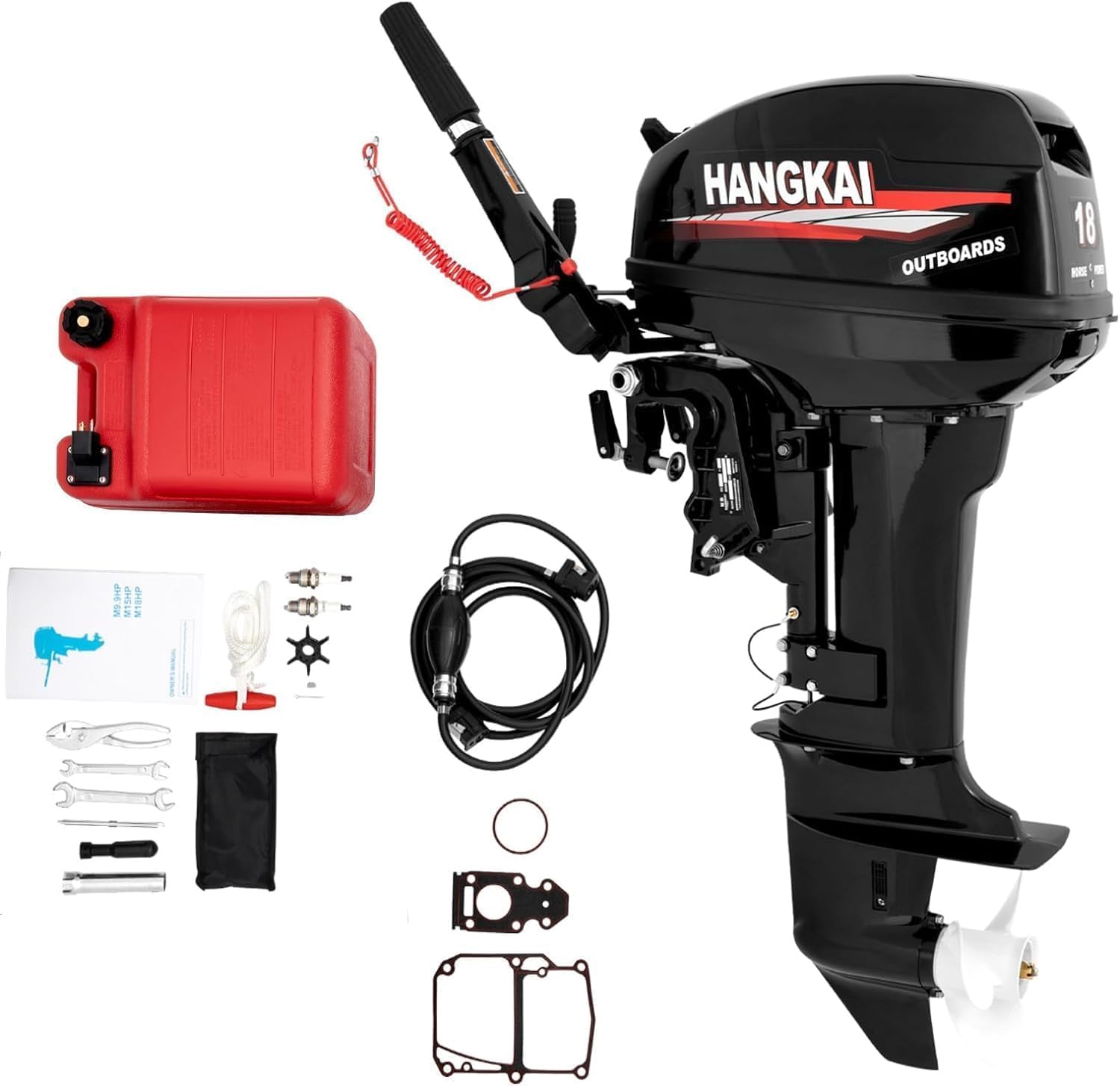
A 246cc gas outboard that turns a jon boat into a planing machine
This is the gas world’s answer to the electric trollers above — it’s not for creeping; it’s for getting there. The 2-stroke 18hp engine with a 246 cubic centimeter displacement pushes a 14-foot jon boat to 23-25 mph, owners mention, which is a completely different experience from 45 lb of trolling thrust. It’s built for inflatables, kayaks, dinghies, canoes, and small jon boats — anything that needs real speed.
Owners describe starting reliably on the second pull and smooth shifting into forward and reverse. One owner ran 60 gallons of fuel through it with only a spark plug change after break-in, calling it well-made. The 101.5-pound weight is the honest trade-off — this is a heavy unit to lift onto a transom, so plan for two people or a hoist.
The 90-day warranty is short, and customers note shipping damage is a real risk with the cowl and pull-start mechanism. The included 24-liter fuel capacity gives decent range. Note that the “4 Stroke” wording in the headline conflicts with the listed 2-stroke specification — the technical data says 2-stroke, and that is what you should expect for oil mixing.
Performance verdict: motor quality leads the praise at 16 mentions, with real-world performance second at 10.
Plan ahead: expect to mix 2-stroke oil and budget for potential shipping damage on arrival.
7. AQUOS Haswing 12V 55lb Bow Mount Trolling Motor with Wireless Remote

A bow-mount troller you steer from anywhere on the boat — or the shore
This bow-mount troller frees you from the tiller with wireless control. The wireless remote fits in your palm, clips to a lanyard around your neck, and controls speed and direction from up to 164 feet away — so you can steer from the bow, the stern, or even the bank while you position the boat. It’s rated for boats up to 2,750 pounds, which covers most bass boats and pontoons under 19 feet.
The variable speed control is the efficiency story — smoother adjustments use less power and stretch your battery. The cruise control holds your desired speed so you focus on fishing, though you may need to correct direction manually in wind or current — this is not spot lock. A 180-degree rotation pushes the boat in reverse. The 48-inch aluminum alloy shaft fits a range of bow heights, and the ergonomic lifting handle makes it easier to carry.
Owners praise the remote as genuinely easy to operate and the motor as powerful enough to stop or turn a boat in tight places. The honest gaps: there is no quick-release plate and no foot control — you depend entirely on the remote — and the durability conversation is mixed, with one owner reporting brittle plastic over time. The remote recharges via USB cable when needed.
Loved For
- Functionality tops owner praise at 12 mentions, with performance second at 10
- 164-foot remote range frees you from the tiller entirely
- 48-inch shaft clears higher bow decks
Limits To Know
- No spot lock — you manually correct for wind drift
- No foot pedal or quick-release plate included
- Remote failure means no steering at all
Pick this if: you value hands-free control from anywhere and fish mostly calm water.
Consider another if: you need spot-lock anchoring in current — the remote can’t hold position for you.
8. BJTDLLX 2-Stroke 12HP Outboard Motor

A 169cc gas outboard sized right for small inflatables and jon boats
This 12hp engine steps down from the 18hp COFECO above, and that matters if your hull is a lightweight inflatable or a small jon boat that doesn’t need maximum thrust. The 169 cubic centimeter displacement delivers an honest cruising speed, and reviewers point out it pushes a jon boat at an acceptable pace. The water-cooling system keeps the motor from overheating on longer runs.
Starting is the standout — owners describe it firing within the second or third pull, with the CDI ignition system making cold starts reliable. The 6.34-gallon external fuel tank keeps you on the water longer between fills. A silencer brings a quieter ride than a raw 2-stroke, and the flameout switch on the handle gives you an instant stop. Three gears — forward, neutral, reverse — with throttle control let you cruise at a steady speed.
The fuel reality is the catch: owners note this engine needs leaded gas that can be hard to find, and 2-stroke oil mixing with a break-in period is mandatory. Weighing 27 kg, it’s lighter than the bigger gas units but still a firm two-hand lift. The listed durability is mixed, so treat it well and it should treat you well.
Value read: motor quality leads owner feedback at 12 mentions, with real performance second at 9.
Fuel warning: verify leaded gas availability in your area before you commit to this engine.
9. awolsrgiop 2-Stroke 18HP Long Shaft Outboard

The long-shaft 18hp gas motor that reaches deeper transoms
Long shaft means deep transom, and this 246cc 18hp outboard is built for hulls where a short shaft would leave the prop skimming. Shoppers say a genuine 16.5 mph on a 14-foot aluminum deep-V, and the motor starts on the first pull from the start. A maximum load capacity of 2,204 pounds tells you how much boat and gear it can handle, though heavier loads naturally slow the top speed.
The 6.34-gallon fuel tank pairs with a streamlined three-blade propeller for efficient cruising, and an anti-swirl plate reduces wave turbulence that would wet your clothes. A 20-inch non-slip handle gives you a solid grip, and 360-degree steering plus forward, neutral, and reverse gears gives full directional control. The red stop button kills the engine in seconds.
The critical preparation detail: this motor ships without gear oil — the listing states this clearly — so you must add gear oil before the first water run, unlike the BJTDLLX above which ships pre-filled. Fuel mixture is 25:1 for the first 50 hours, then 50:1 after. At 28 kg, it carries similar weight to the shorter 18hp unit but with the longer shaft for deeper hulls.
Strong Points
- Performance is the top owner praise at 10 mentions, quality second at 5
- Genuine planing speed on a 14-foot v-hull
- 360-degree steering for precise low-speed maneuvering
Pre-flight Checklist
- Ships dry — you must add gear oil before first use
- Strict 25:1 then 50:1 fuel mix for break-in
- Long shaft suits deep transoms only; verify your hull
Choose for: deep-V hulls and jon boats where you need that extra shaft reach to keep the prop submerged.
Double-check: you are comfortable adding gear oil on day one — this one genuinely ships dry.
10. Garmin Force Trolling Motor 57″

The connected bow mount where GPS anchoring meets whisper-quiet drive
This bow mount integrates smoothly with Garmin chartplotters for GPS anchoring. The 57-inch stainless steel shaft clears tall bow decks, and the wireless foot pedal keeps the front deck clean — no cables running across your casting platform. Owners specifically love how quiet the motor runs and how easily it stows, calling the wireless pedal a genuine setup improvement.
The defining capability is the GPS integration — the Force works with your Garmin screens for spot anchoring and hands-free boat control. Owners describe it as efficient with good runtime, and the rugged mount plus corrosion-resistant stainless steel construction is built for hard use. The 5 hp electric rating positions it as a serious mover.
The catch is honest: it’s heavy at 109.1 pounds, so owners say get help to move it. One owner notes the Spot Lock drifts about 20 feet despite calibration, and another needed a factory shaft replacement — though Garmin support replaced it overnight at their cost. The main power cord can also run short if your batteries sit mid-ship, so plan battery placement carefully.
Integration verdict: if you already run Garmin sonar and want a clean, GPS-anchored front deck, this is the natural fit.
Commitment check: at 109 pounds with a drifting Spot Lock in some units, this demands a strong mount and realistic expectations.
11. Lowrance Ghost Freshwater Trolling Motor
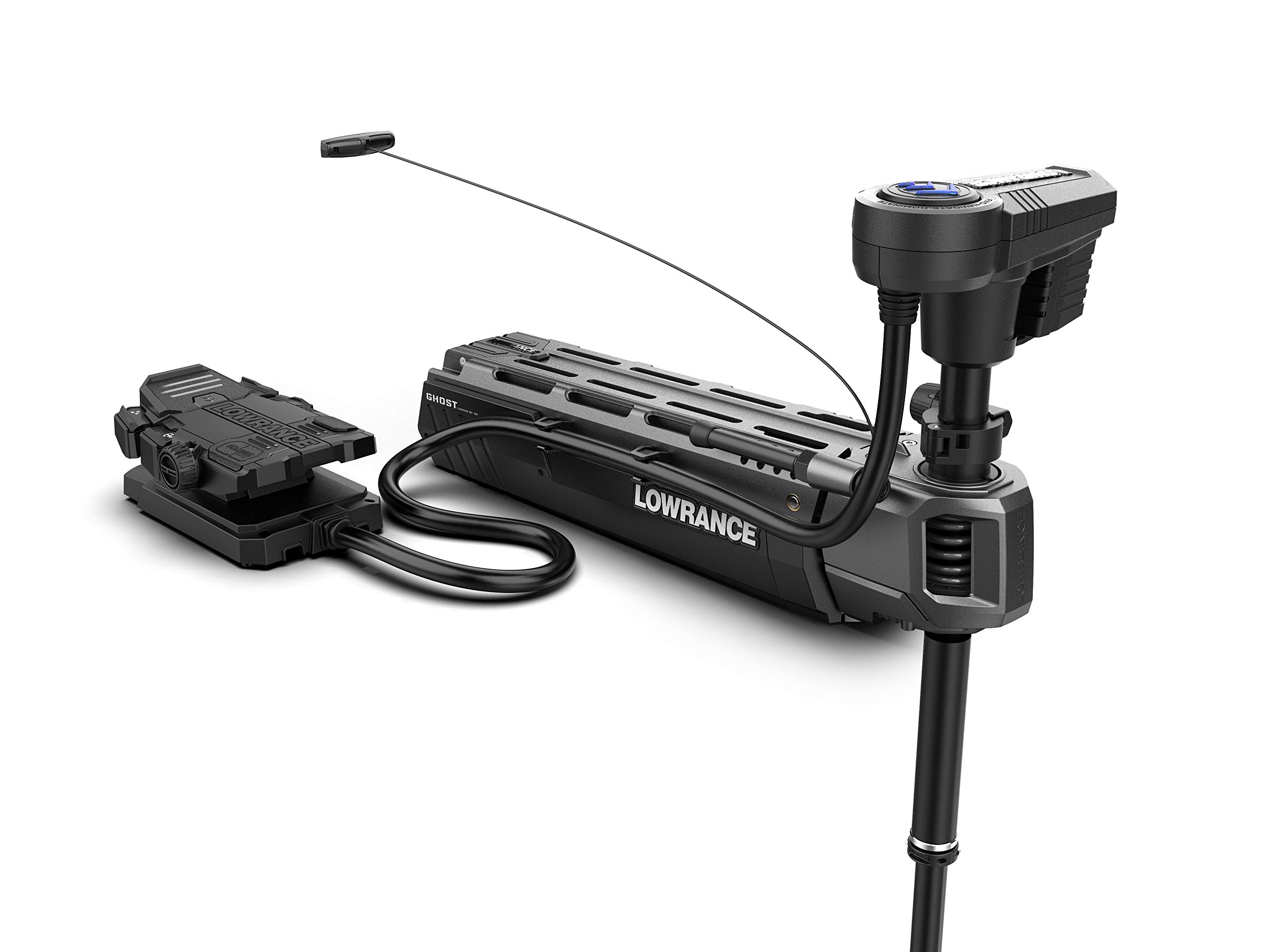
A brushless bow mount engineered for silence and zero sonar interference
The Ghost’s brushless motor is engineered for near-silent operation. Its brushless motor runs so quietly that fish will never hear you coming, and critically, it emits zero electromagnetic interference — the thing that ruins sonar returns on other electric motors. The HDI nosecone transducer gives you Lowrance CHIRP sonar and DownScan Imaging from the start, with an upgrade path to Active Imaging 3-in-1 adding SideScan.
Spot lock is this motor’s party piece — buyers report it works perfectly and holds position accurately, with one owner logging over 16 hours of runtime on a single charge. The configurable foot pedal includes shortcut buttons, battery level, and Anchor/Heading mode, and you can program keys to drop a waypoint or trigger your Power-Pole shallow-water anchor.
The build quality draws direct praise — owners call the pedal superior to the Garmin’s and note the 3-in-1 nosecone is worth the upgrade. After 4 years and 10,000 hours of testing, Lowrance claims exceptional reliability. Its premium price sparks debate, but owners who value silence and spot lock call it worth it. A minor direction indicator inaccuracy and poor support response were noted by a single owner.
The Highlights
- Performance is the most-praised trait — 13 owners call it exceptional
- Spot lock is the second-most-praised feature at 7, and owners say it holds
- Zero EM interference keeps your fish finder crisp
The Honest Trade-offs
- Premium price tag — owners openly debate whether it justifies the cost
- Built for freshwater; not rated for saltwater use
- Direction indicator can be inaccurate from the factory
Reach for it if: you run Lowrance sonar and demand silent, interference-free trolling with rock-solid spot lock.
Look elsewhere if: your budget won’t stretch to a premium bow mount — the Haswing remote unit covers the basics for a fraction of the cost.
Understanding Thrust and Power
Thrust pounds for electric motors
Electric trolling motors list thrust in pounds — this is the pulling force the prop generates at full speed. A 45 lb unit suits a small aluminum v-bottom, while a 55 lb unit handles a loaded 16-foot jon boat, and 62-65 lb units push 19-foot hulls or heavy loads through current. Heavier thrust draws more battery current, so match the thrust to your boat weight instead of buying the biggest number blindly.
Horsepower and displacement for gas
Gas outboards list horsepower and engine displacement in cubic centimeters. A 169cc engine delivers around 12 hp, suitable for small inflatables, while a 246cc engine produces 18 hp and can plane a 14-foot v-hull. Displacement predicts low-end torque, and 2-stroke engines need oil mixed into the fuel — typically 25:1 for the first 50 hours, then 50:1 after the break-in period.
FAQ
What is the difference between a bow mount and a transom mount trolling motor?
How much thrust do I need for my boat?
What is the difference between a brushed and brushless trolling motor?
Can I use a freshwater trolling motor in saltwater?
What battery do I need for a 12V electric trolling motor?
What is the difference between 2-stroke and 4-stroke outboards?
What does the shaft length of a trolling motor actually affect?
What is spot lock on a trolling motor and do I need it?
How do I break in a new 2-stroke outboard motor?
Can a gas outboard replace an electric trolling motor?
Will a transom trolling motor fit my kayak or inflatable?
What is the real difference between the Newport X-Series and L-Series?
How do I choose between a foot pedal and a wireless remote trolling motor?
How heavy are these motors and can I lift them alone?
Final Thoughts: The Verdict
For most freshwater anglers running a bow deck, the boat motors winner is the Minn Kota Edge because it pairs the classic foot-pedal control with honest 45 lb thrust and the most owner-praised build quality in this list. If you need saltwater-safe transom trolling, grab the Newport X-Series 55lb for its corrosion-resistant hardware and smooth 8-speed control. And for anglers who want GPS anchoring with silence, the Lowrance Ghost is the premium pick that holds position and keeps your sonar clean. Match thrust or horsepower to your hull’s weight and size for the best on-water experience.
How We Picked
We do not accept paid placement. Every pick is matched to a real buyer and a real use-case; we do not hands-on test units.
Sources & Methodology
Specifications: manufacturer listings and product documentation. Review insights: verified customer reviews, as of September 2026. Pricing: not shown on this page (it changes often); check the current price via the retailer link.
As an Amazon Associate, Gadgets Feed earns from qualifying purchases. This does not affect which products we feature.