
Our readers keep the lights on and my morning glass full of iced black tea. As an Amazon Associate, I earn from qualifying purchases.
Specs are compiled from manufacturer listings and verified buyer reviews and can change over time — please confirm the key details on the product page before buying.
Every parent knows the moment: your baby smacks a button, something pops or spins, and their face lights up with pure wonder. That moment is cause and effect in action — the foundation of how babies learn that their hands can change the world. The best picks here reward a press with a pop, a pull with a spin, or a pound with a roll, all while building hand strength and focus.
I’m Min — the founder and writer behind Gadgets Feed. This guide is built by comparing the manufacturers’ published specifications and the patterns across verified customer reviews, so you get each pick’s real strengths and trade-offs instead of marketing spin.
The right cause and effect toys turn a simple press into a joyful pop, building motor skills with every satisfying reaction.
Our Picks at a Glance


How To Choose The Best Cause And Effect Toys
Cause and effect toys reward your child’s action with a visible or audible result — a pop-up animal, a spinning windmill, or a ball rolling down a ramp. Choosing well means matching the action required to what your baby’s hands can actually do right now.
Match the action to the age and skill level
A 6-month-old can often press a large, flat button or push a sun on top, while a 12-month-old has the finger strength to twist knobs or flip switches. Pick a toy with one clear, easy action for younger babies — pressing is the natural first skill — and look for multiple actions like push, pull, twist, and turn once your child approaches their first birthday.
Think about the reaction type: sound, light, movement, or all three
Battery-powered toys add lights and songs that hold attention longer, but wood-and-mechanics toys teach the same lesson with zero volume. Some parents want the quiet option for car rides or naptime. Check whether a toy has a volume-off or quiet mode if you plan to use it in calm settings.
Quick Comparison
| Model | Best For | Action Type | Age Range | Material | Amazon |
|---|---|---|---|---|---|
| Skip Hop Corn Spinner★ Best Overall | First pop-and-spin fun | Push to spin | 6 mo – 2 yr | Plastic | Amazon |
| Fisher-Price Smoothie MakerBest Value | Pretend play with songs | Press, slide, sort | 9 mo – 3 yr | Plastic | Amazon |
| SMALL FISH Wooden SticksQuiet Classic | Quiet, portable learning | Insert, sort | 12 mo – 4 yr | Wood | Amazon |
| Tovol Zerky Dino Pop Up | Press-and-pop simplicity | Press, twist, pull | 12 mo – 3 yr | Plastic | Amazon |
| STAPAW Pop Up & Piano | Two-sided variety | Flip, press, play keys | 12 mo – 3 yr | Plastic | Amazon |
| WOWOHAGE Pop Up & Hammer | Hammering and reaction games | Press, pound | 12 mo – 6 yr | ABS Plastic | Amazon |
| Vanplay Wooden Ball Drop | Natural-wood track racing | Hammer, watch roll | 12 mo – 8 yr | Wood | Amazon |
| Stay Fun Ball Drop & Car Ramp | Light-up ball and car racing | Hammer, launch | 12 mo – 5 yr | Plastic | Amazon |
In‑Depth Reviews
1. Skip Hop Press & Spin Baby Toy, Farmstand What’s Poppin Corn Spinner
Our pick — over 4.5★ from 550+ verified ratings; the strongest balance of quality and price.
The crowd favorite popcorn spinner that turns a tiny push into a bouncing, satisfying show.
At just 12 ounces, this toy is light enough for young babies to hold, yet it earns a top spot because one simple action — pushing the smiling sun on top — sets off a chain of corn cobs bobbing and popcorn bouncing. The immediate visual feedback lets a 9-month-old instantly link their press to the popcorn’s bounce. With a recommended age of 6 months to 2 years, it grows with your child from watching to pressing on their own.
The hands-down highlight is the popcorn feature: kids love watching the corn spin around and the pieces pop up as the cobs bob. The sound is satisfying without being obnoxiously loud, a point parents repeatedly praise because it means playtime isn’t a headache. The farm design is cute enough that it often becomes a favorite, and some owners note their toddler even learned to say “pop” while playing — a tiny language win that comes purely from the toy’s cause-and-effect loop.
It has also proven tough. Reports describe it surviving being thrown and used as a hand rest while a baby pulls up to stand, with no sign of damage. Across 572 happy owners this sits at 4.9 stars, and the only recurring wish is for more popcorn pieces inside — a small ask for a toy that already delivers so much.
What wins kids over
- Lightweight 12-ounce build is easy for small hands to grab and carry
- Push-to-spin action teaches cause and effect instantly
- Satisfying sound stays pleasant, not piercing
- Survives being dropped, thrown, and used to pull up to stand
The small trade-off
- A few wish it shipped with more popcorn pieces
- One action type means older toddlers may rotate it out sooner
The pick for first-time poppers: If your baby is 6 months to 2 years old and you want one toy that nails the cause-and-effect lesson with zero battery fuss, this is it.
Look elsewhere if: You want switch, knob, and key variety — this one is a dedicated push-and-spin toy.
2. Fisher-Price Baby & Toddler Toy Laugh & Learn Counting & Colors Smoothie Maker
A pretend blender that turns snack prep into a counting, color-sorting lesson with lights.
Press the two buttons and this toy blender lights up and plays over 25 songs, sounds, and phrases that teach colors and counting from 1 to 10. It even packs a cause-and-effect moment: slide the lever and the 5 included fruit and veggie pieces spin inside, so your child sees their own hand movement create motion. The lid opens for put-and-take play, too — a natural way for a baby to practice dropping pieces in and dumping them out again.
What stands out next to the pop-up toys above is how much longer the play lasts. Owners describe toddlers folding this into imaginary kitchen play, blending it right alongside their full play kitchens. The volume earns consistent praise — it is noticeably quieter than many musical toys, and it keeps working even after some rough throwing around. The small, light fruit pieces are easy for little hands to carry and sort.
With a 4.7-star average across 476 owners, the recurring theme is that kids genuinely love it and parents appreciate the educational layer. If your child is past the “just press one button” stage and ready for pretend play, this adds counting and color recognition on top of the cause-and-effect core.
Why it earns its spot
- 25+ songs and phrases teach colors and counting 1-10
- 5 play pieces drop in for sorting and put-and-take play
- Volume is quieter than most musical toys
- Slide lever makes ingredients spin for a clear action-result link
Before you buy
- Reports note this toy has a delicate structure compared to solid pop-up toys
- Some say the pieces are small enough to lose under furniture
Best for little chefs: A 9-month-old to 3-year-old who loves the kitchen and needs songs plus sorting practice.
Consider instead if: Your child still needs pure press-and-pop simplicity without multiple pieces.
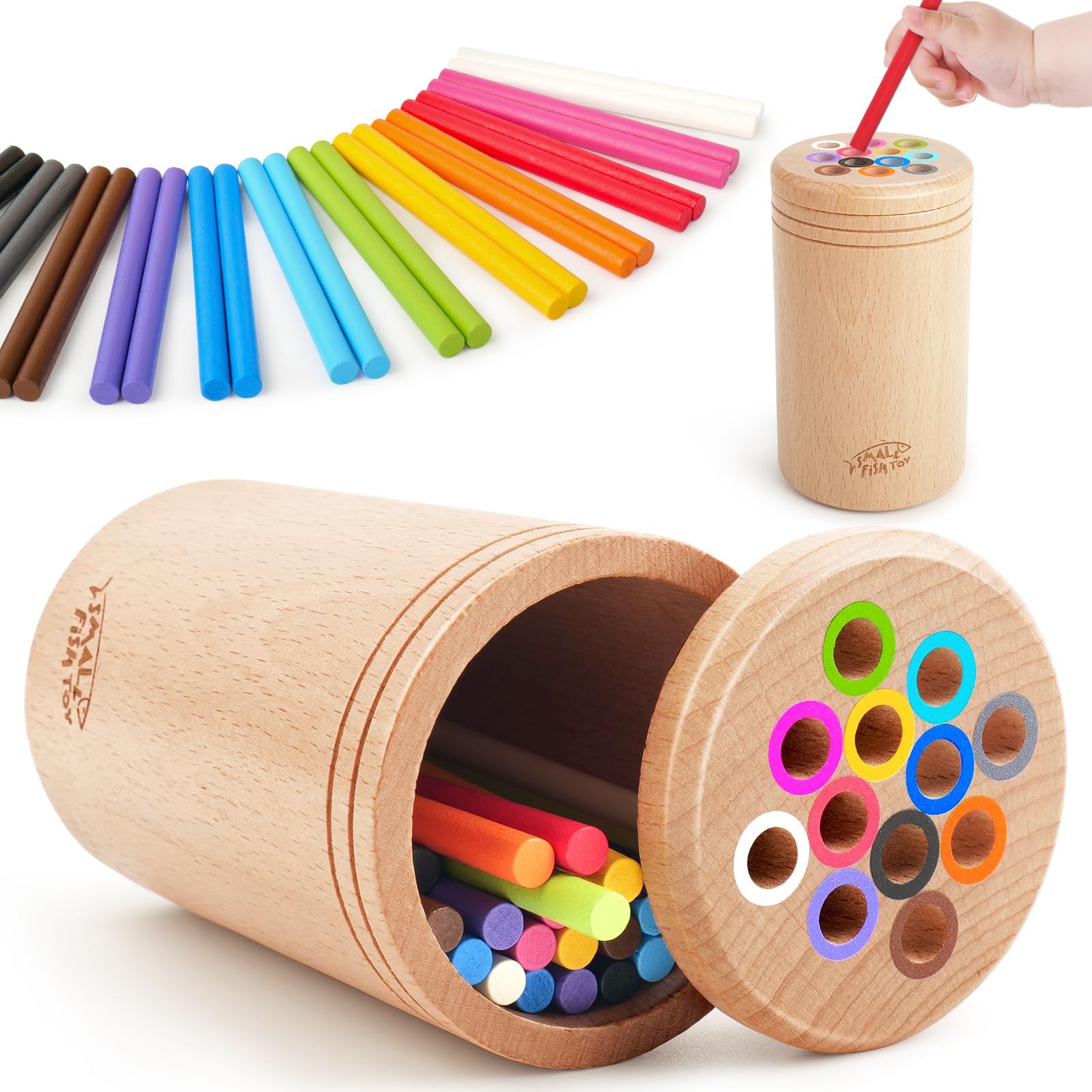
3. Montessori Toys for 1 2 Year Old Solid Wood Fine Motor Toy for 12 Month Old
The silent wooden dropper that teaches object permanence through 24 colorful stick drops.
This one swaps every light and sound for a quieter lesson: your toddler pushes one of 24 colorful wooden sticks through a hole, watches it fall, and learns that objects still exist even when out of sight — a concept called object permanence. The lid is designed to be easy for a baby to open alone, so the drop, dump, and repeat cycle becomes self-directed play. The whole tube is carved from a single hollowed beech log, giving it smooth edges and a sturdy feel that plastic toys rarely match.
The portability is a real edge over the electronic picks above. Everything slides into a canvas drawstring bag, so it travels to church, restaurants, or the car without needing batteries or volume control. Parents describe toddlers sitting quietly with it during services, engaged in the repetitive drop-and-dump rhythm. The color sorting and counting layer means a 2-year-old and even a 4-year-old find different ways to play — one dumps and repeats while an older sibling matches colors.
Across 775 owners it holds a 4.5-star rating, with the top praise going to how well it holds attention and builds fine motor skills. The honest caveat: the lid sits on top rather than locking, and sticks can jam if pushed in past halfway at an angle — minor quirks in an otherwise beautifully simple learning toy.
The quiet strengths
- 24 wooden sticks build color recognition, counting, and grip
- Hollowed beech log has smooth, safe edges
- Canvas bag makes it the easiest pick to travel with
- Teaches object permanence without any noise
What to know
- The lid is not secured — it just sits on top
- Sticks can jam if too many are pushed in at once
Reach for this if: You want a battery-free, quiet toy that travels well and teaches color sorting plus object permanence side by side.
skip it if: Your child needs lights, sounds, or a more active pop-up reaction to stay engaged.
4. Pop up Toys for Age 1-3, Cause and Effect Toy for 12 Months and Up
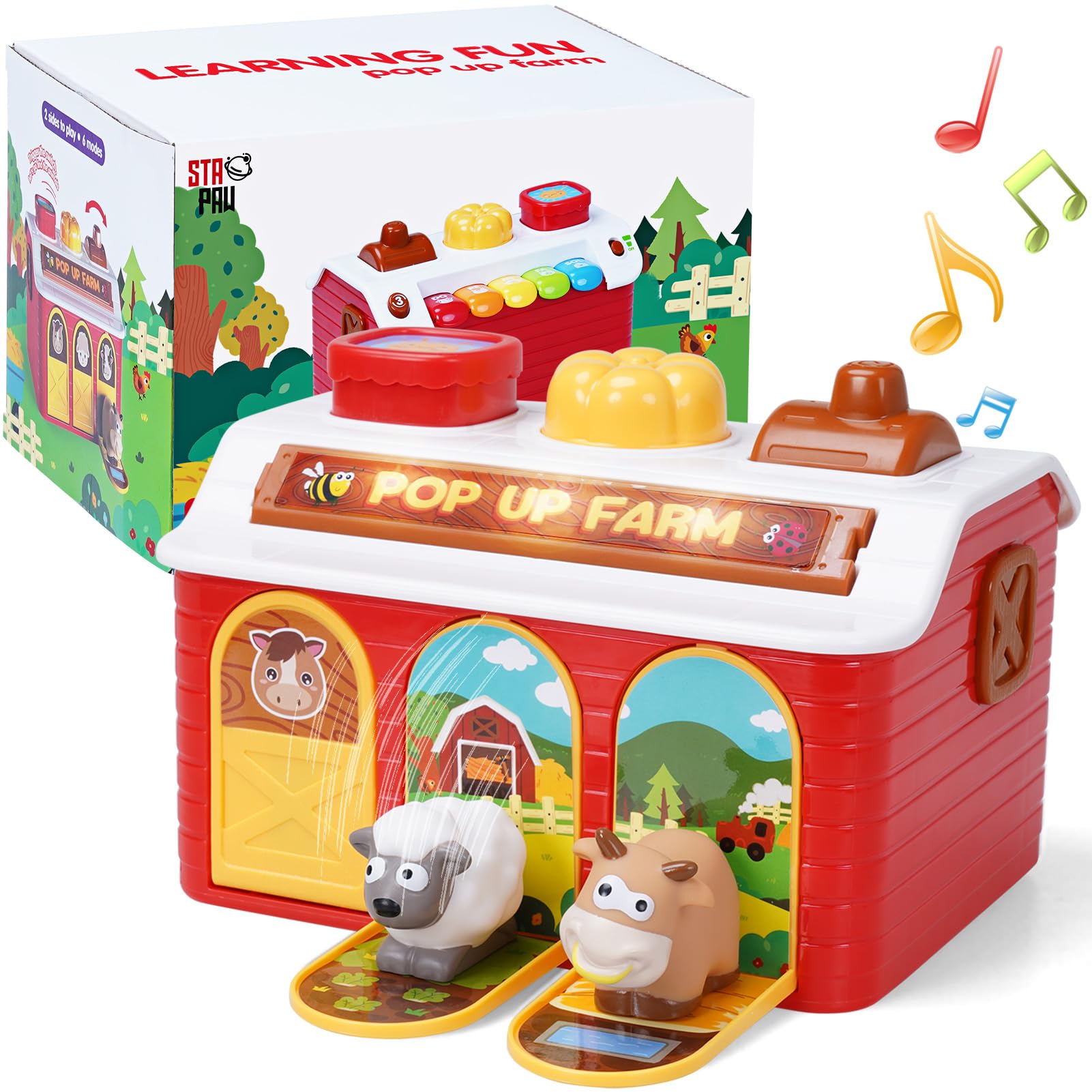
Two toys fused into one — a three-switch pop-up side and a five-key piano side.
This is the toy that keeps giving because one side never exhausts its novelty before the other side starts. The left side has 3 animal popper switches, each with a light between the button and its animal — flip the switch, the light comes on, and the animal pops up. The right side is a 5-key piano with animal faces printed on the keys, ready for your child to pick out tunes or trigger animal sounds. Your toddler can work one side, the other, or both at once.
What makes this smarter than a single-action pop-up is the 3-mode button that changes both sides together. Learning Mode names the animals, Game Mode turns the lights into a find-the-animal game that builds focus, and Quiet Mode keeps the pop-up and light action going with the sound off — perfect for car seats and naptime. The piano side offers 3 sound modes of its own: 5 musical notes, random music clips, or 5 animal sounds matched to each key’s printed face.
Owners of 10-month-olds to 17-month-olds consistently call it a favorite, noting the moving and noise options keep kids busy far longer than a basic pop-up. The middle turn button takes more finger strength than the side switches, so very young toddlers may need help there. At a 4.6-star average, the main story is durable fun that holds attention for months, not weeks.
Two sides, twice the play: Whether your child is in a popping mood or a music mood, this toy follows — and Quiet Mode means you are not hostage to the soundtrack.
The one snag: The center dial asks for more dexterity than small hands may have yet, so early play often centers on the easier side switches.
5. Baby Cause and Effect Pop Up Animal Toys for 1 Year Old Boy Girl with Light
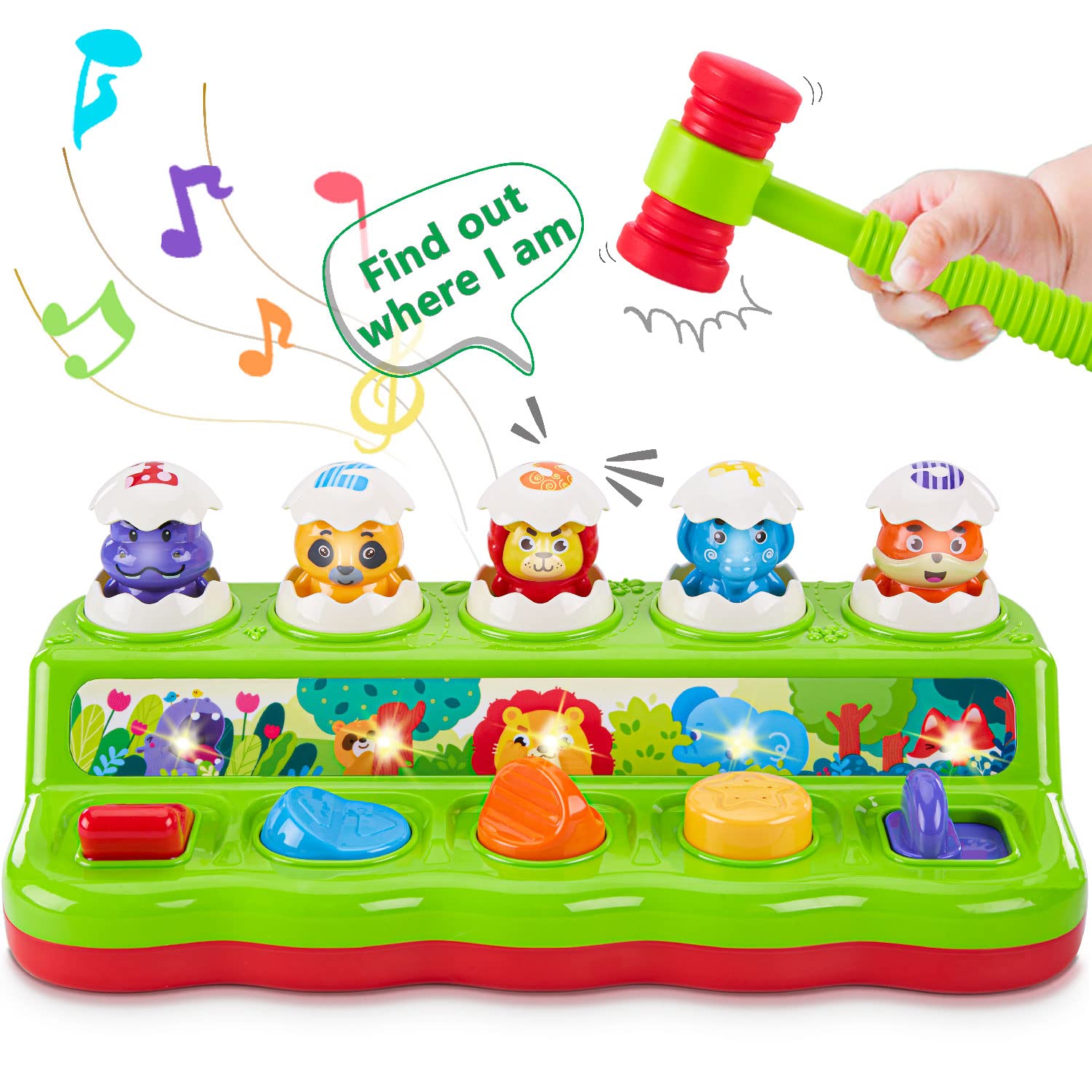
A whack-a-mole style pounder with a soft rubber hammer made for tiny fists.
Most pop-up toys ask for a gentle press, but this one invites real pounding — and the hammer head is rubber instead of plastic, so repeated whacks will not wear out the toy’s numbers or hurt the furniture nearby. Kids pound the figures down, watch them pop back up, and learn the lesson through bigger, more physical movement. The bright colors, animal characters, lights, and sounds give immediate tactile, auditory, and visual feedback that babies find hard to resist.
Beyond the hammer, a game mode asks toddlers aged 1 to 3 to track a moving light and quickly press the matching button — a concentration and reaction challenge that grows with your child. A do-not-disturb mode lets you silence the volume entirely while keeping the visual pop-up action, so you control the noise. The build is BPA-free ABS with rounded edges, and owners describe it as sturdy enough for rough play and light enough to carry along.
The rare toy that genuinely outlasts the “new toy” phase — some parents report it becoming their child’s most-played item, with one toddler reaching for it far more than anything else in the bin. It needs 3 AA batteries that are not included. At 4.7 stars across 391 owners, the only real prep is buying batteries before gift-giving.
A pounder with staying power: The rubber hammer, tracking game, and quiet mode make this the most versatile active pick for high-energy toddlers.
Plan ahead: Three AA batteries are required and not included, so grab a set before wrapping it up.
6. Vanplay Montessori Ball Drop Toys for 1 2 Year Old Boy Girls Birthday Gifts
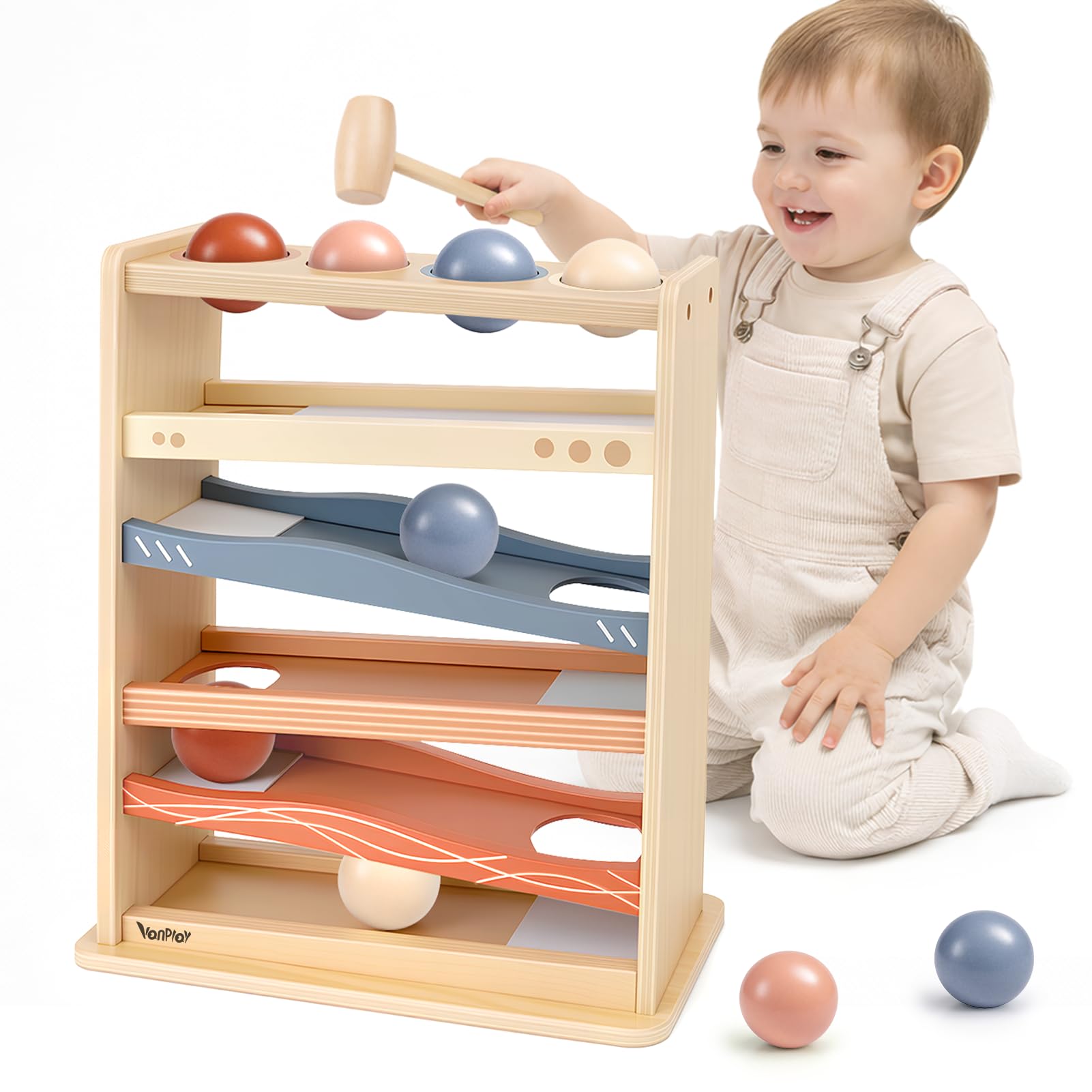
An all-wood hammer-and-race-track set in calm neutral tones that speed balls down four lanes.
Pound one of the 4 colorful balls with the included hammer, and it launches from the top starting point down one of 4 continuous race tracks for your child to follow with their eyes. The wood construction with water-based paint gives it a natural feel and a longer design life than plastic, and it arrives fully assembled so it is ready to play the moment the box opens. The quiet “thunk” of wood on wood is gentle on adult ears compared to electronic toys.
The open-ended nature stands out next to the button-driven toys above. Because balls roll at slightly different speeds and angles, toddlers stay engaged watching the race repeat, and the take-turns hammering format naturally builds sharing and communication when siblings play together. Owner feedback even notes its appeal for speech and occupational therapy settings, with the simple action being easily understood by kids who need clear, predictable results.
It holds a 4.3-star rating across 921 owners, and the honest caveat is durability-related: a few units arrived with cracked paint on the balls on day one, and the base can tip if a child hammers with force off-center. Most owners find it a sturdy, silent winner — just supervise the first few sessions to gauge how rough your little one plays.
The natural appeal
- All-wood build with quiet, gentle sound
- 4 separate race tracks for visual tracking practice
- Fully assembled right from the start
- Turn-taking play builds communication skills
Watch for
- Some units arrived with cracked ball paint
- Base can tip if hammered hard off-center
Best for wood-loving families: If you want a quiet, natural-material alternative to beeping plastic that still delivers a clear hammer-to-roll cause and effect.
Think twice if: Your toddler tends to hammer far off-center — the base needs a flat, steady surface to stay put.
7. 2-in-1 Ball Drop & Car Ramp Race Track Montessori Toy for Toddlers Ages 1-5
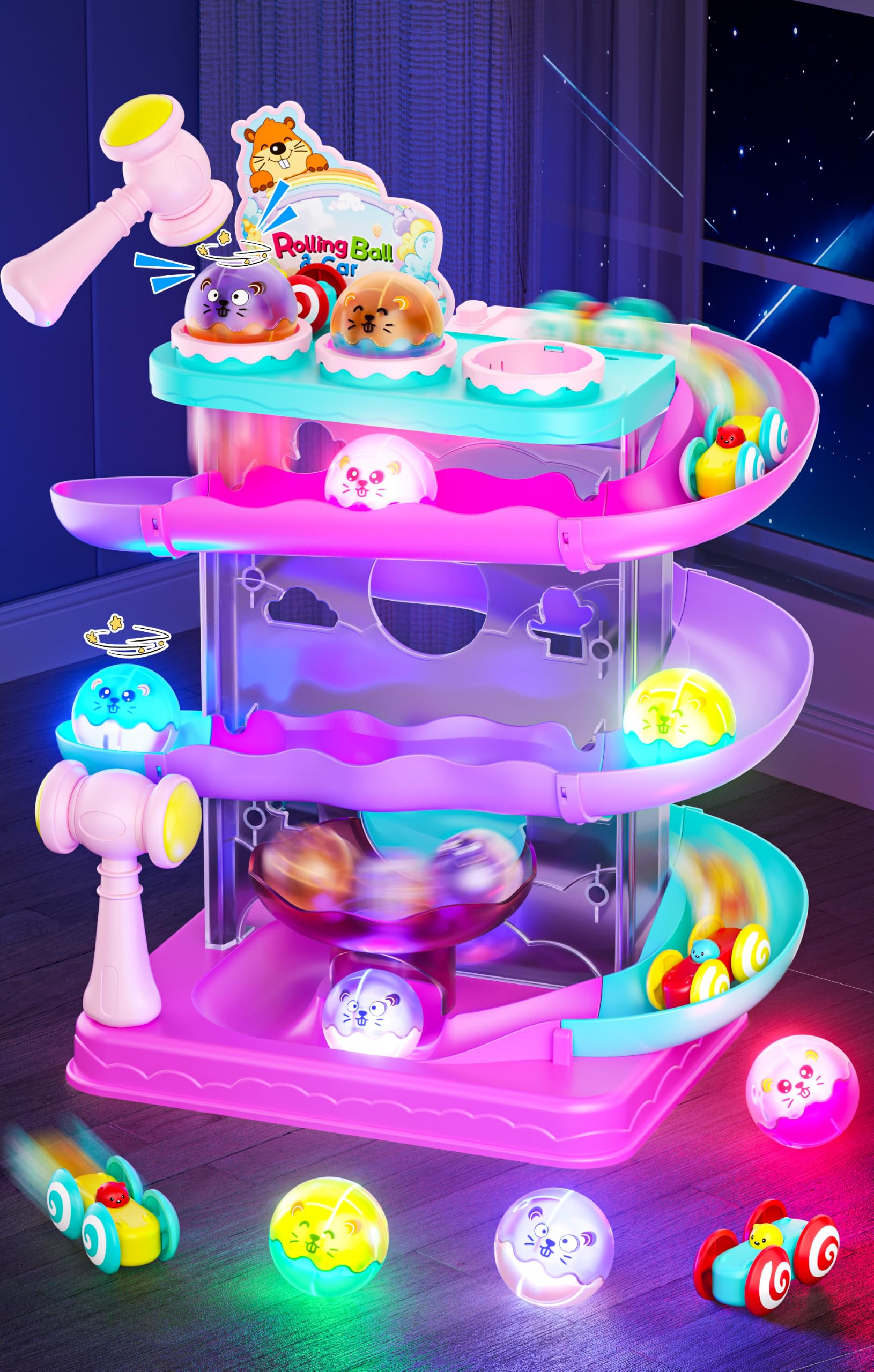
Three colorful track layers where light-up balls and mini race cars zoom down together.
This toy earns its keep with pure spectacle: knock a ball from the top with the hammer and it lights up as it speeds down 3 layers of differently colored tracks, while 3 mini racing cars launch and race alongside. Watching the flashing ball’s trajectory is the visual-tracking workout, and the dual ball-plus-car action gives your toddler two reasons to keep coming back. The hammer pound, the launch button, and the roll all create distinct cause-and-effect moments in one compact tower.
Assembly is genuinely painless — buyers report building it in under 3 minutes, with batteries included so it works immediately from the start. A 19-month-old obsessed with this toy reportedly ignores the TV for it, which tells you the light-up balls and cute cars have real pull. The whole structure stands about 12 inches tall, a compact footprint that fits a playroom corner without dominating it.
Across 654 owners it holds a 4.6-star average, and the top theme is how hard kids plays with it. The honest mixed notes: some report balls eventually stop lighting up, and a few find the cars smaller than expected — plus the hammer can feel unnecessary to kids who prefer pushing balls down directly. Buy it for the light-up race appeal, and accept that occasional rough handling may shorten the flashing lifespan.
The crowd-pleasing racer: Light-up balls plus mini cars on three track levels make this the most visually notable pick for toddlers who love motion.
Know the limits: The light-up balls are the magic, but a few owners mention that magic fading over time with heavy use — so treat the tower gently.
8. Tovol Zerky Cause and Effect Pop Up Dinosaur Toddler Toy for 1 Year Old

Four dinosaur pop-ups with different button shapes that train press, twist, and pull skills.
Where many pop-up toys use one identical button, this one gives each of its 4 dinosaur figures a differently shaped button — so your toddler learns that pressing, twisting, and pulling each produces a different pop. A rotating eye adds a second busy element for little hands. At just 12.3 ounces and running on zero batteries, it is the lightest, most portable way to get the pop-up lesson, perfect for tossing in a bag for travel.
It is built from ABS plastic and designed for kids over 12 months, with button sizes shaped for small hands. Parents describe a 9-month-old happily opening and closing the tops even before fully mastering the press, which means the toy finds a way to engage across a wide age span. One durability report describes it surviving drops down the stairs and off furniture without a crack — a genuinely tough little build.
With a 4.6-star average across 333 owners, the main praise centers on how well it holds attention and supports Montessori-style learning. The honest mixed feedback: some find the buttons require more force than expected, and a few call the overall quality cheap-feeling even as most call it well-made for the money. If you want a no-battery, no-light dinosaur popper, this delivers the core lesson with admirable simplicity.
The simple strengths
- 4 different button shapes teach press, twist, and pull
- Battery-free 12.3-ounce build is highly portable
- Survived drops down stairs in owner testing
- Rotating eye adds a second fine-motor activity
Expect this
- Some buttons demand more finger force than tiny hands have yet
- A few owners found the plastic less premium than the price suggests
Best on a budget: A battery-free dinosaur popper that delivers the full press-to-pop lesson and travels well for the lowest entry cost.
Reconsider if: Your child’s fingers are still very new — the varied button resistance may frustrate before it teaches.
Understanding the Specs
Action type matters more than you think
Cause and effect toys train different muscles depending on the action. Pressing builds finger strength, twisting develops wrist rotation, and hammering engages the whole arm. A toy with multiple action types — like a pop-up with press, twist, and pull buttons — naturally exercises more skills than a single-button design, so match the action count to your child’s age and interest span.
Feedback: sound, light, or motion
Every cause and effect toy needs a clear reward for the child’s action. Some use lights and songs, which hold attention longest but add volume; others use pure motion like spinning or rolling, which teaches the same lesson silently. Think about where the toy will live — a quiet wooden dropper suits church or car rides, while a light-up racer is built for living-room play where a little noise is fine.
FAQ
What age should I introduce cause and effect toys?
Are battery-powered cause and effect toys better than wooden ones?
How do I know if a toy’s buttons are too hard for my baby?
What is the difference between cause and effect toys and Montessori toys?
Why do cause and effect toys help with language development?
Can a cause and effect toy be used for tummy time?
How long do cause and effect toys typically keep a baby entertained?
Are hammer toys safe for a 1-year-old?
What should I do if the light-up balls in a track toy stop working?
Final Thoughts: The Verdict
For most families, the cause and effect toys winner is the Skip Hop Corn Spinner because its single push-to-spin action teaches the lesson instantly for babies as young as 6 months, and its satisfying sound and tough build keep it a favorite through age 2. If you want pretend play plus counting and color songs, grab the Fisher-Price Smoothie Maker. And for a quiet, battery-free option that doubles as a travel toy, the SMALL FISH wooden stick dropper is the one to reach for.
How We Picked
We do not accept paid placement. Every pick is matched to a real buyer and a real use-case; we do not hands-on test units.
Sources & Methodology
Specifications: manufacturer listings and product documentation. Review insights: verified customer reviews, as of September 2026. Pricing: not shown on this page (it changes often); check the current price via the retailer link.
As an Amazon Associate, Gadgets Feed earns from qualifying purchases. This does not affect which products we feature.