
Our readers keep the lights on and my morning glass full of iced black tea. As an Amazon Associate, I earn from qualifying purchases.
Specs are compiled from manufacturer listings and verified buyer reviews and can change over time — please confirm the key details on the product page before buying.
If you want an alarm that still calls you when the Wi-Fi drops or the power dies, you need a system that talks over the cellular network instead of a landline. The best pick here is the Blaupunkt SA 2900, a self-installed kit that uses a GSM SIM card for alerts and offers 18 hours of emergency battery power. This guide breaks down nine cellular alarm systems, explaining what each one does well, where they fall short, and which fits your home or office.
I’m Min — the founder and writer behind Gadgets Feed. This guide is built by comparing the manufacturers’ published specifications and the patterns across verified customer reviews, so you get each pick’s real strengths and trade-offs instead of marketing spin.
With no landline required, a cellular alarm system keeps your home monitored over mobile networks, sending SMS and call alerts straight to your phone no matter where you are.
Our Picks at a Glance


How To Choose The Best Cellular Alarm System
Before you buy, match the system’s network technology to the mobile coverage in your area, so your alarms actually reach you. Most kits use a SIM card that connects to older 2G or 3G networks, while newer models support 4G or combine Wi-Fi with a cellular backup—a connection that keeps working even if your home internet goes down.
Check the SIM card and network bands
Every cellular alarm needs a SIM card, and most do not include one. You’ll need to check that your carrier still supports the network frequency the system uses, since some older 2G and 3G bands are being shut down. If you are in a rural area with weak signal, look for a system with a longer rated range or an external antenna option so your sensors can reliably reach the main control panel.
Count the sensors for your actual layout
A kit is only as good as its coverage. Think about how many doors and windows you need to protect on the ground floor, and how many rooms need a motion detector to catch movement in a hallway or living area. Some kits come with extra accessories like RFID cards that let you arm and disarm without a key, or remote controls with an SOS button for emergencies, so consider which extras matter for your household.
Quick Comparison
| Model | Best For | Connectivity | Siren Loudness | Kits Contents | Amazon |
|---|---|---|---|---|---|
| Blaupunkt SA 2900★ Best Overall | Reliable standalone GSM | GSM | Integrated | Motion + Door Sensor + Remote | Amazon |
| AGSHOME Auto DialAuto-Dial Pick | No-contract auto dialing | 3/4G GSM | 2 Wired Sirens | 99 Zones + 7 Wired | Amazon |
| XUK 24-PieceLarge Home Pick | Large home coverage | WiFi + 4G/GSM | 120dB | 5 PIR + 10 Door Sensors | Amazon |
| PGST 24Pcs | App control + tamper proof | WiFi + 4G | 110dB | Multi-sensor kit | Amazon |
| D1D9 24pcs | Budget-friendly wide kit | 4G + WiFi | Wired Siren | 12 Door + 5 Motion | Amazon |
| RenseCum 24-Piece | Touchscreen simplicity | WiFi + 2G/4G | Integrated | 24 Count Kit | Amazon |
| XUK 4G/GSM/Wi-Fi | Voice control + triple network | WiFi + 4G/GSM | 100dB+ | PIR + Door Sensors | Amazon |
| TUGARD 13 Pieces | Wi-Fi + GSM combo | WiFi + GSM/2G | 120dB | 4 Door + 2 Motion + Camera | Amazon |
| TUGARD WiFi+GSM Camera | Camera + dual network | WiFi + GSM/2G | 120dB | 4 Door + 2 Motion + Camera | Amazon |
In‑Depth Reviews
1. Blaupunkt SA 2900 Smart GSM Wireless Alarm System
Our pick — over 4★ from 90+ verified ratings; the strongest balance of quality and price.
The serious DIYer’s GSM hub that dials you directly, no internet or contract required.
This Blaupunkt starter set works as a true standalone cellular alarm, not a Wi-Fi gadget in disguise. It runs on a GSM module (a chip that connects to mobile networks) with its own SIM slot, so it places calls and sends SMS alerts over the mobile network—no home internet required. A built-in microphone lets you listen in to check what is happening on site. The system expands up to 30 devices, so you can grow from the included motion sensor and door or window sensor to a fuller setup over time.
A rolling code protects the radio signals from being copied and replayed, which is a real safeguard against tech-savvy intruders. If someone cuts power, an 18-hour emergency battery supply keeps the alarm on duty, and sabotage attempts — like removing the unit — trigger automatic SMS reports. Owners consistently praise the loud siren and solid GSM reception, though the included accessories are pricey to expand and a few note the manual can be confusing across its language versions.
Buyers report it is a “Good GSM alarm, many config options for price,” and that it works without an internet subscription, relying purely on the SIM for alerts. Setup is genuinely plug-and-play after you insert a SIM, which is not included, and the free app handles arming and disarming from your phone. The crowd favorite here holds a 4.4-star score from nearly 100 owners, which is more than respectable for a niche device like this.
What wins people over
- Expandable to 30 devices for growing coverage
- 18-hour emergency battery keeps watch during outages
- Rolling code blocks signal replay attacks
Fair trade-offs
- Optional sensors carry a high price tag
- SIM card required but not included
Reach for this if: you want a dependable core cellular alarm you can expand room by room without any monitoring contract.
Keep in mind: expansion sensors are pricey, so budget for growth before you commit.
2. AGSHOME Security Alarm System 99+7 Zone
A no-contract auto-dialer with room for up to 99 wireless zones and a loud siren.
The AGSHOME panel is built around pure GSM auto-dialing, with no monthly fees and no security company in the middle — you just pay your cell provider for the SIM. When a sensor triggers, the panel places calls to preset numbers or sends SMS alerts. You can set up to 6 groups of preset alarm phone numbers plus 2 help SMS numbers, and a 10-second voice recording plays when a call is answered.
This system supports up to 99 wireless defense zones and 7 wired zones, with 5 scheduled arm or disarm groups, so it scales far beyond a single apartment. Two wired sirens can cover different-sized houses. The GSM frequency is 850/900/1800/1900MHz, which is designed to work worldwide, and a T-Mobile SIM is confirmed compatible. What owners appreciate most is the straightforward installation — many report getting fully set up in about 20 minutes with pre-programmed sensors.
The main panel is a compact 7.3 x 1.2 x 5.3 inches, so it mounts unobtrusively on a wall. Battery operation keeps it alive when the adapter loses power, and the loud siren gets the deterrence job done.
Straightforward value: metal remotes, 20-minute install, and reliable SMS or call alerts make this the pick if you want maximum zone capacity without paying for a monitoring plan.
Choose it if: you need room for nearly unlimited sensors across a large property and want no monthly contract.
Think twice if: you want app control with an easy visual interface — this one leans on physical keypads and remote controls.
3. XUK WiFi Wireless Alarm System 24pcs
A 24-piece kit with a 4.3-inch touchscreen built for big homes and multi-story layouts.
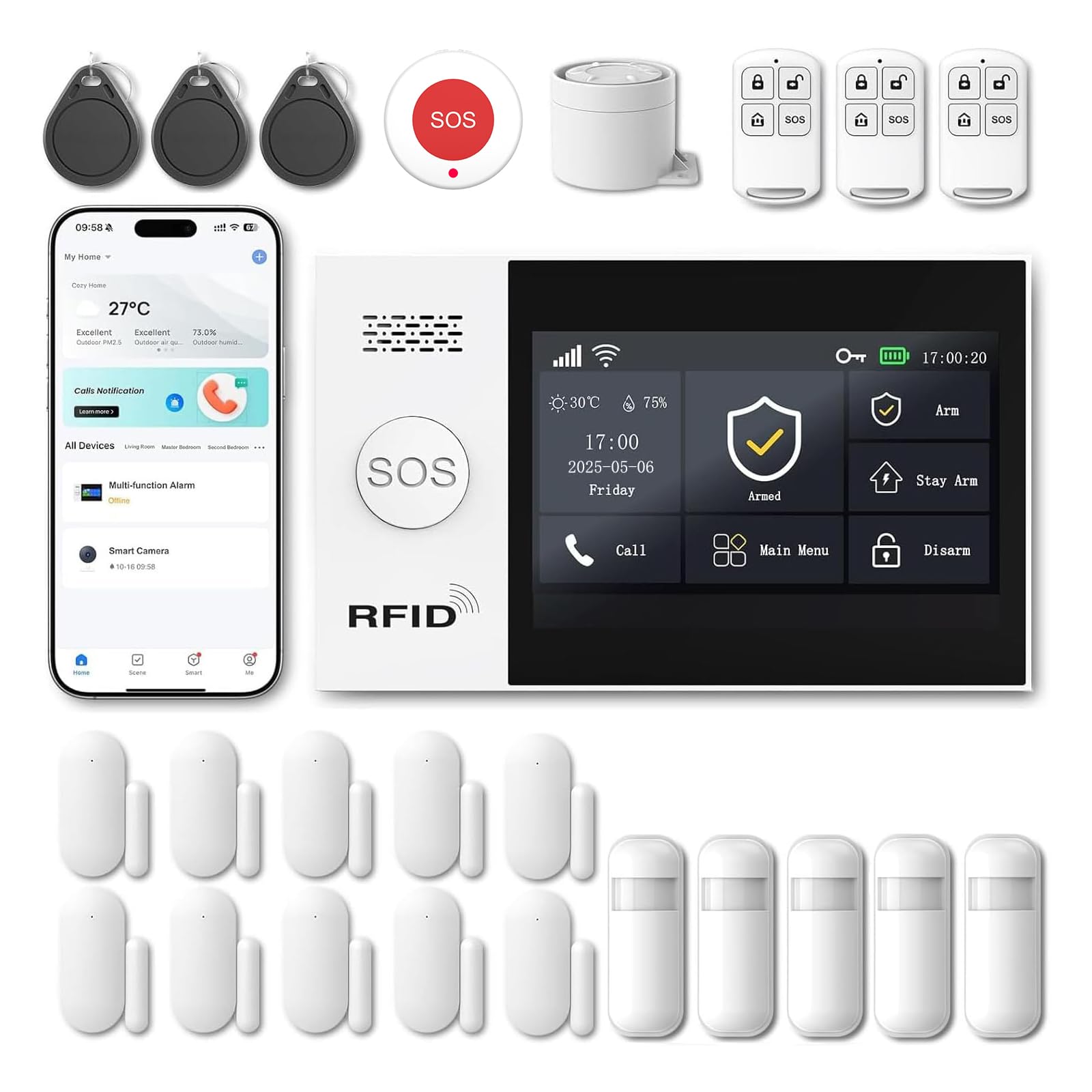
This XUK kit is among the most complete packages in this list, with a central unit that uses a 2.4GHz Wi-Fi and 2G or 4G connection (5G not supported), so you get cellular backup when your internet drops. It includes 5 PIR motion detectors (passive infrared sensors that detect body heat), 10 door and window alarms, a 120dB siren, an SOS emergency button, 3 remote controls, and 3 RFID keychains (tap-to-arm tags)—enough to cover nearly every entry point in a large home from the start.
The defining feature is the 4.3-inch color touchscreen, which replaces the usual keypad with a clear display of system status, time, and alerts. It supports up to 100 sensors and 10 RFID keychains, with a multilingual menu designed to be usable by children and older adults. SMS notifications and voice intercom need a SIM card, which you supply, and the whole kit claims a 10-to-15-minute installation with no wiring.
Voice control works with Alexa and Google Assistant, letting you arm or disarm hands-free. An integrated battery backup keeps the system running through blackouts, and tamper alerts fire if someone tries to remove a sensor. Buyers repeatedly praise the quick setup and full phone app control, but the most common discussion centers on mixed reliability—a few owners mention false alarms or a siren that triggered during setup and needed unplugging to stop.
Whole-house coverage: the sheer accessory count plus the touchscreen interface makes this the strongest candidate for a larger property or multi-story home.
Best for: tech-savvy homeowners who want app and voice control over a full sensor spread without a monthly bill.
Look elsewhere if: you want the most simple to use setup—some owners found the siren behavior during first-time configuration frustrating.
4. PGST Alarm System for Home Security 24Pcs
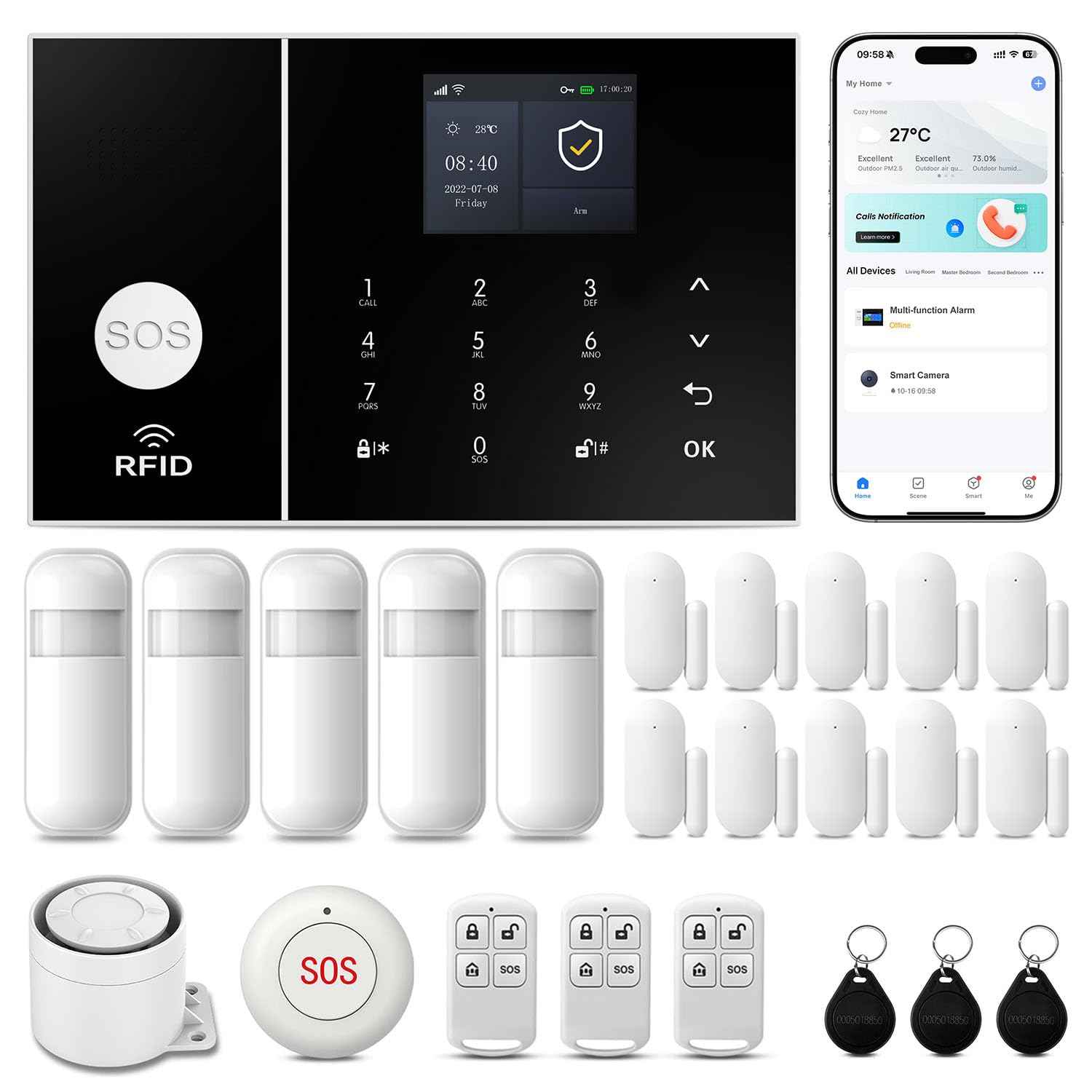
An app-first system with physical tamper detection and a color-screen main unit.
The PGST kit pairs 2.4GHz Wi-Fi with an optional 4G SIM slot for phone call and SMS alarm functions, with no monthly fees after activation. what separates it is the physical tamper-proof design—if someone forcibly removes a sensor, the system demands a security code to disarm while automatically pushing phone, SMS, and app alerts. That is a meaningful layer of protection most budget kits skip.
The main unit’s color screen shows system status, weather, and date across 10 international languages. Alarms fire at over 110dB when a door magnetic sensor or motion detector is tripped, and you can add more PGST sensor accessories with custom naming for easy identification. A compact emergency SOS device and a remote with the same function make it practical for elderly family members or children at home.
Customers note precise motion detection and strong range, with an internal battery that lasts days on a cable charge when mains power fails. The catch is sensor compatibility — this hub works with 443 MHz type sensors, not generic Wi-Fi motion or door sensors, so you are tied to the PGST ecosystem for expansion. Signal jammers can defeat any of these systems, which one review noted honestly.
Why it stands out
- Tamper removal triggers alarm and alerts
- Internal battery keeps it alive for days without mains
- Custom sensor naming via app
Know before buying
- Only works with 443 MHz sensors, not generic Wi-Fi ones
- Dual-app setup can be confusing at first
Ideal for: renters or homeowners who want tamper alerts and app control and are fine staying inside one sensor ecosystem.
Consider another if: you already own Wi-Fi sensors you hoped to reuse — they will not pair here.
5. D1D9 24pcs Wireless DIY Home Burglar Alarm System
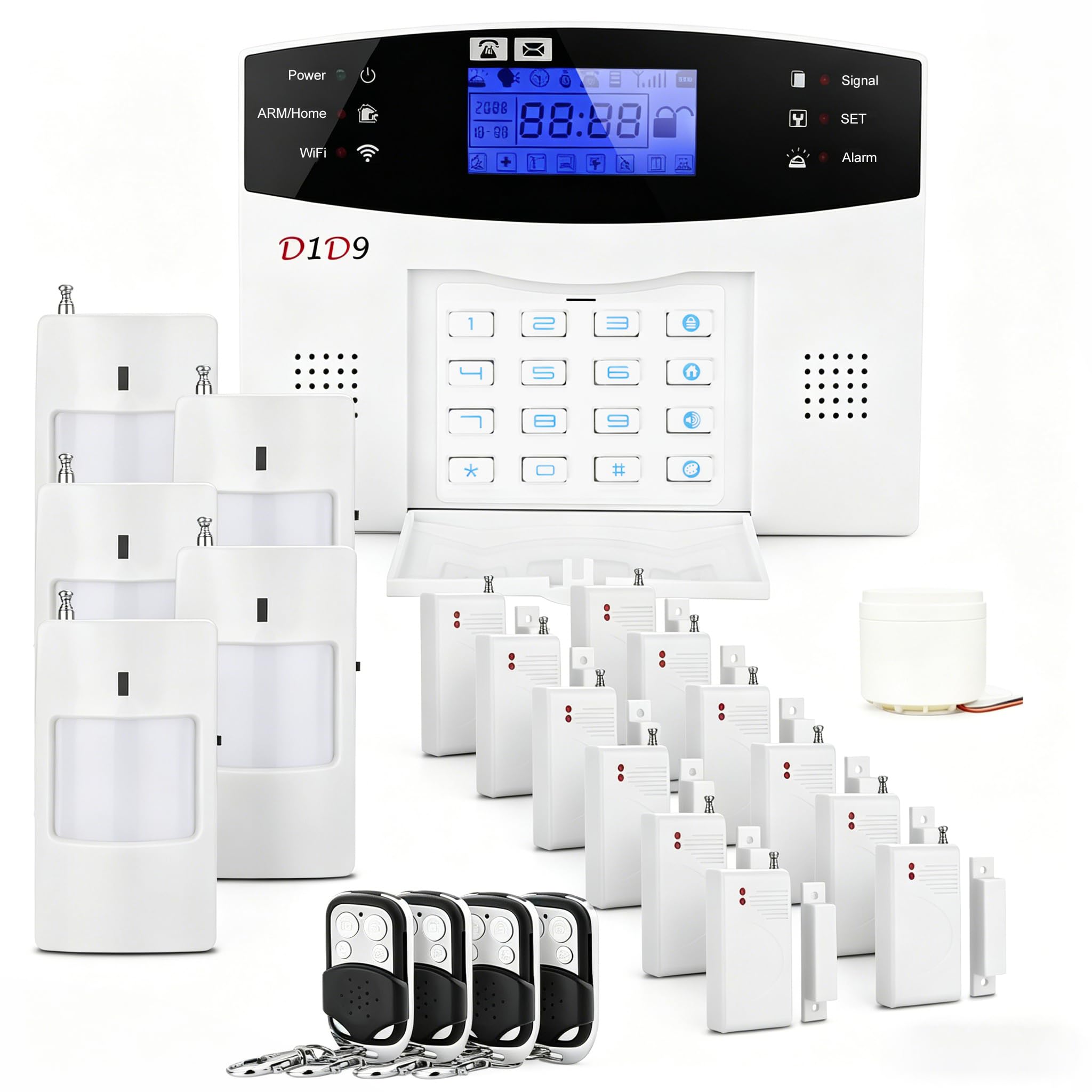
A wallet-friendly 24-piece bundle that fits 30-minute peel-and-stick installs.
The D1D9 kit delivers a huge accessory count at a budget-friendly price point, covering the essentials a typical family or small office needs: door and window sensors, motion detectors, a remote control, and a siren. It connects over 4G and Wi-Fi, so you can check in and get real-time alerts from anywhere through the app. No professional installation is needed — the peel-and-stick design means most people finish in about 30 minutes.
The 80-meter maximum sensor range is among the better figures in this category, and the system lets you add more sensors or integrate with other smart devices as your needs grow. A multi-scenario design suits homes, offices, vacation properties, and elderly care, with a focus on no monthly fees. One owner running a shop found the motion detection sensitive enough to trigger on crawling bugs, which they treated as a quirk rather than a flaw.
Where this kit shines is pure value: the battery backup, timers, bypass, and emergency call features cover the core alarm functions at a fraction of premium-system cost. The main trade-off some owners hit is reliability over time — a few report the remote siren becoming intermittent, and the batteries are included as a gift but will need replacing on your own dime eventually. Setup is generally called easy, with the widest praise reserved for the simple install.
Value verdict: for the price of a single premium sensor elsewhere, you get a whole-house kit that alerts your phone over 4G — hard to argue with the math.
Pick this if: you are on a budget and want maximum sensor coverage with peel-and-stick simplicity.
Manage expectations: the wireless siren has been the occasional weak link, so test it thoroughly on day one.
6. RenseCum Alarm System for Home Security 24-Piece
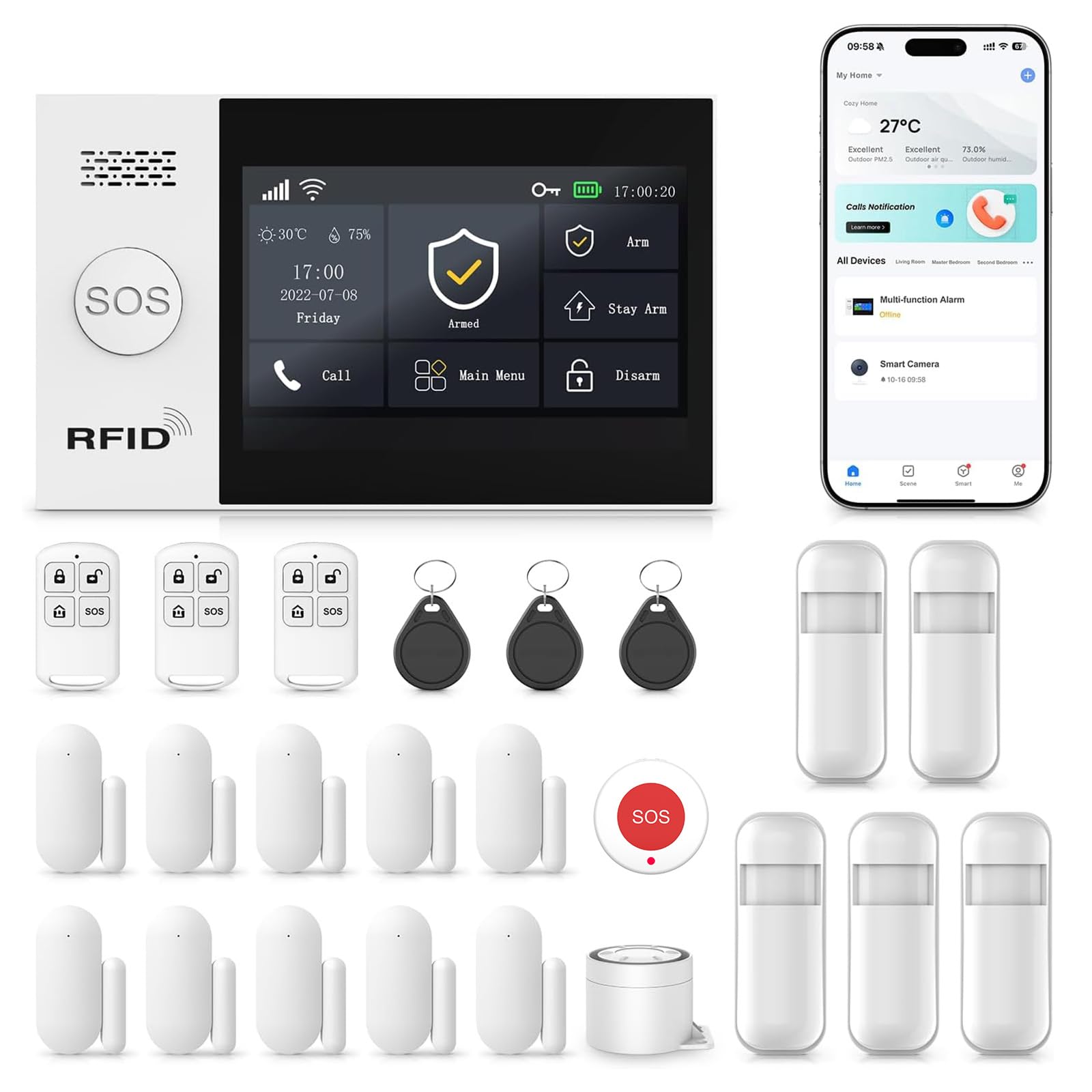
A family-friendly touchscreen alarm where access comes pre-paired straight from the box.
This RenseCum kit is engineered for households where not everyone is tech-savvy, starting with a 4.3-inch color touchscreen where you simply tap Arm or Disarm. The multilingual menu and clear status display make it approachable for kids and older adults alike. The real convenience is that all accessories arrive factory-pre-paired, so tuning a new sensor is a three-step menu process with no manual pairing headaches.
Connectivity runs dual Wi-Fi on 2.4GHz plus 2G or 4G cellular (5G not supported), so you still get SMS, voice call, or app alerts even if your home network fails. A GSM card is needed for the cellular path, but there are no subscriptions or hidden fees. The SOS feature is well covered — a one-press button sits on the base station, the remote, and a dedicated SOS button, making it genuinely useful for monitoring elderly parents.
The 24-count bundle includes the monitor, key ring remotes, sensors, and a USB cable with charging plug. Owners praise the easy setup and how well it works on either a cell plan or Wi-Fi, with one noting a SIM card good for six months of data keeps the cellular path alive cheaply. The honest caveat is that a few buyers found the setup harder than expected and returned it for lack of clear guidance, so patience with the app matters.
Simplest full-kit route: the pre-paired accessories and tap-to-arm touchscreen remove most of the friction that trips up buyers on other systems.
Great match for: families wanting an easy touchscreen hub with an SOS lifeline for elderly members.
skip it if: you learn best from videos — some owners found written app guidance insufficient.
7. XUK 4G/GSM/Wi-Fi Alarm System, 24-Piece Kit
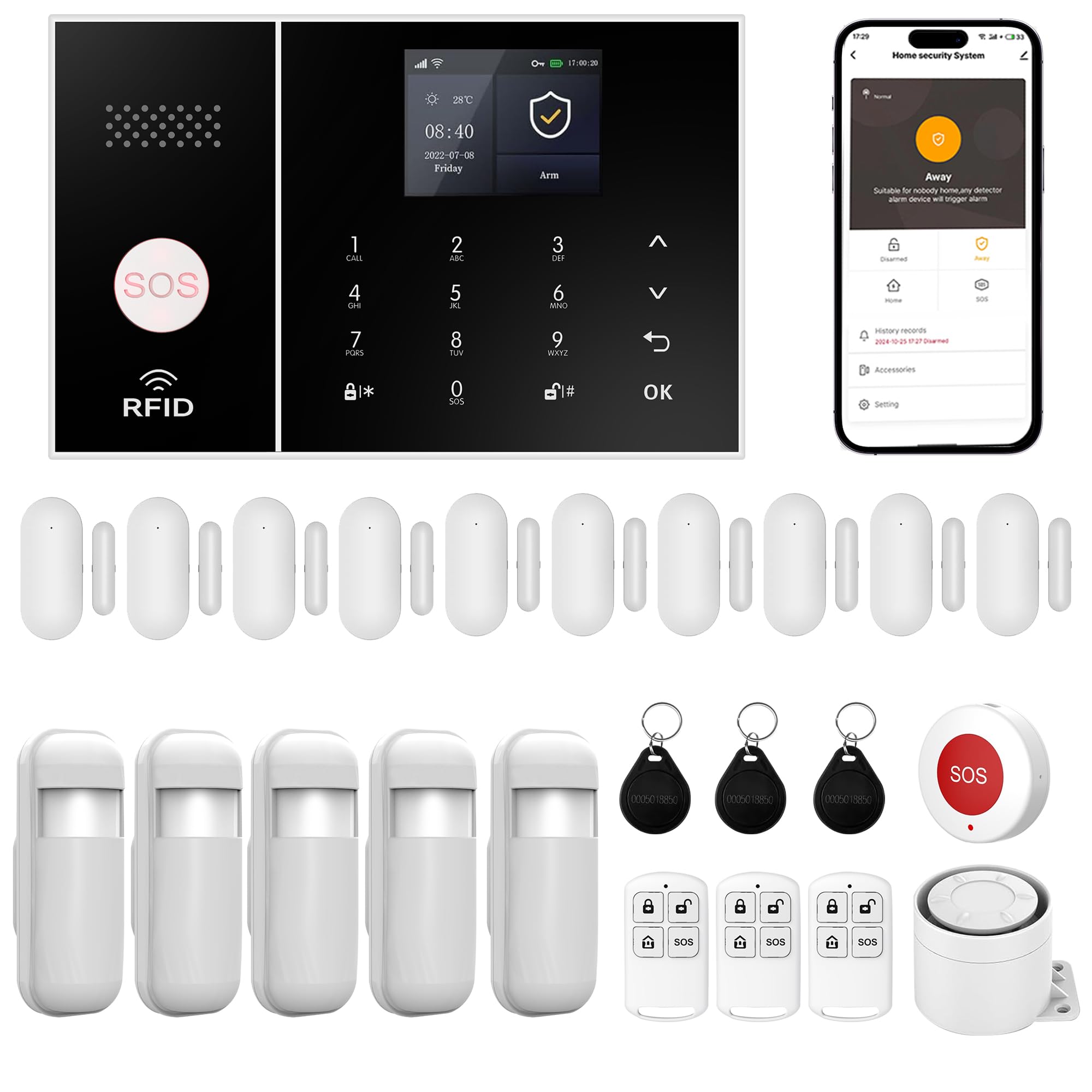
A triple-network alarm with a wide-angle PIR and hands-free Alexa commands.
This XUK kit spreads protection across three connection paths — 2.4GHz Wi-Fi plus 4G and GSM cellular — so alerts keep flowing through app, SMS, or phone call even when Wi-Fi is down. The PIR motion sensor covers a 110-degree detection angle out to an 8-to-12-meter range, while door sensors watch entry points, making it suitable for houses, apartments, and garages.
Armed with Alexa and Google Assistant voice control, you can arm or disarm by speaking, which slots neatly into a smart-home routine. The kit also includes a modern touchscreen panel, RFID tags, and remote controls, plus a one-touch SOS and a siren rated at 100dB or louder. A built-in backup battery and tamper protection keep the system honest during power outages, and sensor batteries are reported to last a long time between changes.
The 24-piece set is expandable and covers motion, doors, and app control in one buy, at a price that lands in the mid-range of this category. What owners consistently highlight is the fast alert delivery and the sturdy build across the components. Setup does require some patience — sensor pairing can involve trial and error, and placement is fiddly to avoid false triggers, but the triple-network reliability earns steady praise from those who finish configuring it.
Where it leads
- 110-degree PIR detects a broad room area
- Wi-Fi plus 4G and GSM keeps alerts flowing
- Alexa and Google Assistant voice commands
Where it asks patience
- Sensor pairing takes trial and error
- Instructions are thin for first-time buyers
Best suited for: smart-home owners who want voice control and a genuine cellular fallback on a mid-range budget.
Be prepared for: a configuration curve — the payoff is a sturdy, fast-alerting system once it is dialed in.
8. TUGARD Wireless Home Alarm System 13pcs
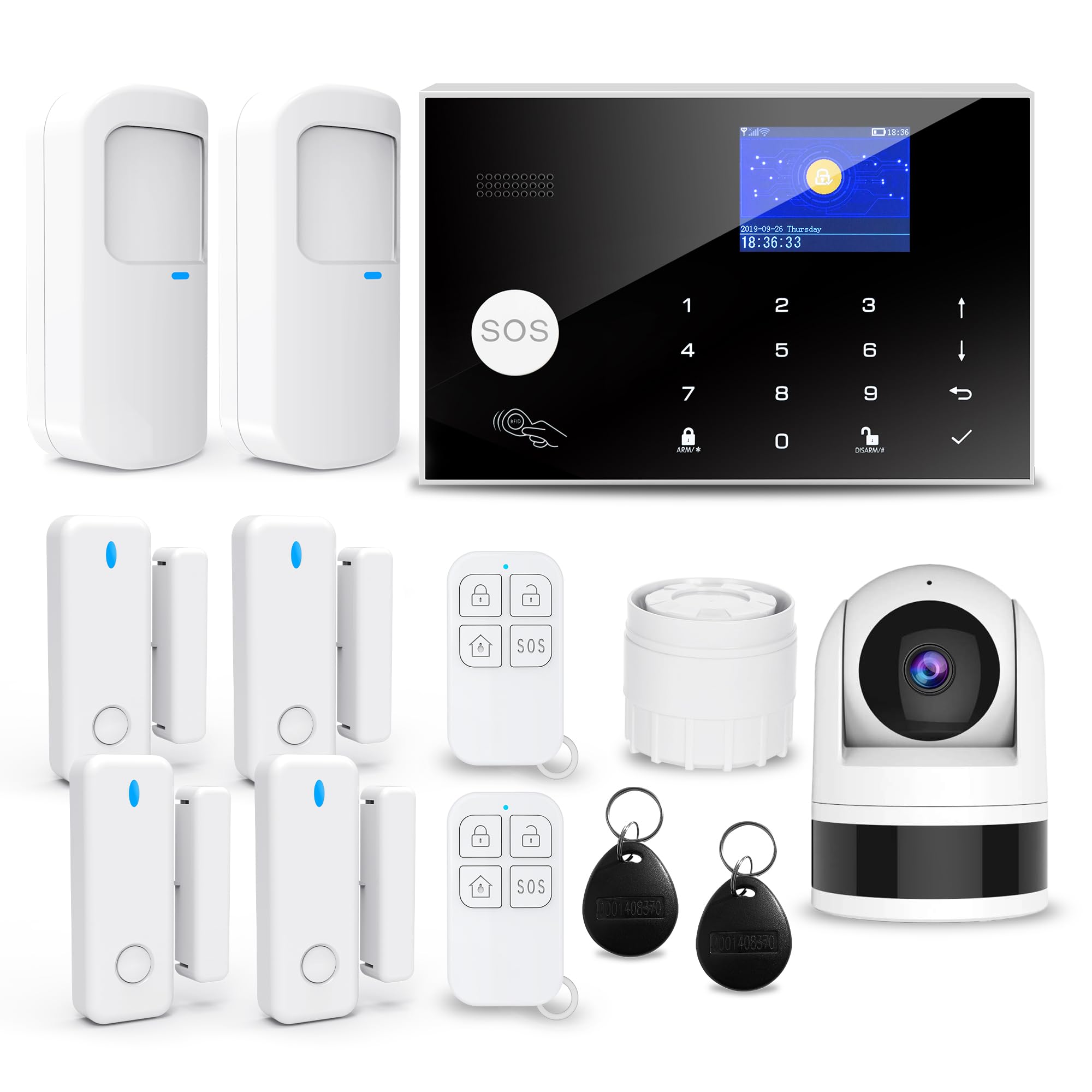
A no-contract 13-piece starter kit that pairs GSM with a 2.4-inch IPS color screen.
The TUGARD kit covers the essential alarm bases in one box: a control panel host, a surveillance camera, infrared sensors, SOS buttons, door sensors, remote controls, keyboards, and buzzers. It runs on both GSM 2G and Wi-Fi, and it supports up to 100 sensors and 10 remote controls, so you can build out coverage as your layout demands.
Its 2.4-inch color IPS screen shows a real-time status bar with data and clock, and multilingual menus plus voice commands make daily use straightforward. Remote arming and disarming work through the Tuya Smart app, and compatibility with Alexa, Google Home, and Siri Shortcuts adds voice control convenience. An SOS button on the remote can call preset numbers in an emergency, and the system records up to 20 seconds of alarm and voice messages.
The appeal here is a no-subscription setup where the SIM card path and app alerts work together. Reviewers point out it “hooks up to your phone” without needing a contract and is easy to move between properties. The recurring challenge is that pairing remotes and setting up the RFID cards is genuinely difficult without a step-by-step video — written instructions alone left some owners frustrated, even though the hardware itself feels solid.
Balanced starter: you get a camera, siren, and a full sensor spread for the price, with the main friction living in the learning curve rather than the hardware.
Right for: first-timers who want a complete kit with both app and SMS alerts and are comfortable troubleshooting.
Not for: anyone who expects true plug-and-play — budget time for the pairing process.
9. TUGARD Home Security System with Camera
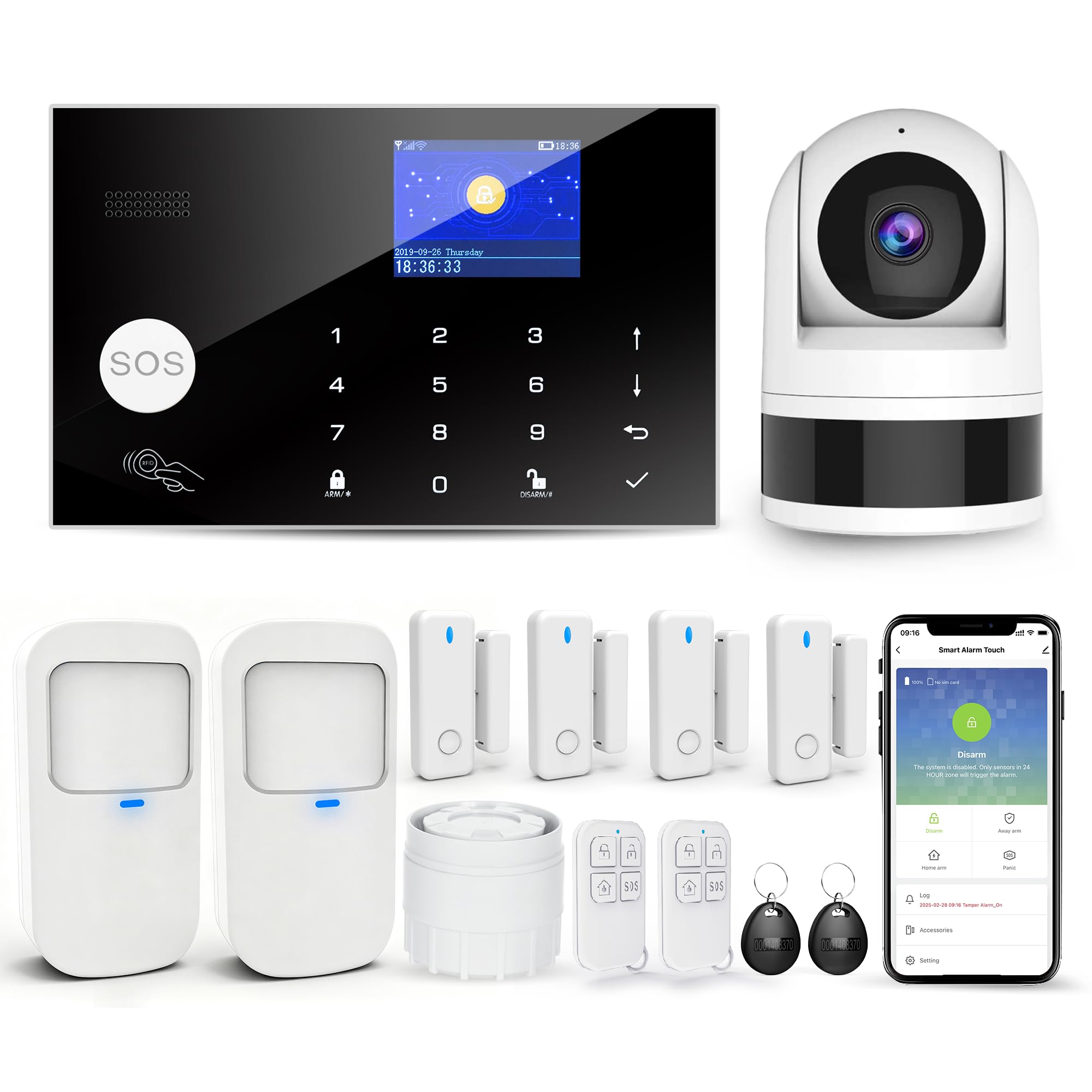
A 13-piece kit that folds a 1080P auto-tracking camera into a dual-network alarm.
This TUGARD kit stands out by bundling a custom-designed camera with the alarm network, giving you a 200W high-definition sensor with 1080P night vision and human detection with auto-tracking. When the camera spots a person, it can follow movement and push real-time alerts to the Tuya app, which turns a typical alarm system into something closer to a security camera setup. The camera also works with Alexa and Google Home.
On the alarm side, the panel runs dual 2.4GHz Wi-Fi and 2G GSM, with a 2.4-inch TFT color touchscreen and menus across 11 languages. It supports up to 100 wireless zones, 10 remote controls, and 10 RF cards, plus 2 wired zones. An alarm fires at 120dB when a sensor trips, and you get app push, SMS, and voice monitoring paths so the alert reaches you even with no internet. The 13-piece set includes 4 door or window sensors, 2 motion sensors, 2 RFID cards, 2 remotes, and the siren.
The panel measures 7.08 x 4.5 x 0.86 inches, and the maximum rated range is 10,000 centimeters (about 328 feet), giving you generous flexibility for sensor placement. Owners who got it running praise the coverage and confidence, though a few report the SIM card function did not work on their network while everything else was fine, and the assembly is not as plug-and-play as the listing suggests.
The camera edge: if visual verification matters to you, the auto-tracking 1080P night-vision camera gives this kit a capability the pure-alarm rivals lack.
Choose it for: combining entry alerts with a live camera feed in one no-subscription package.
Verify before buying: confirm your carrier still supports 2G GSM, as that SIM path proved unreliable for some owners.
Understanding the Specs
Network Bands and SIM Compatibility
The single most important spec is which cellular network the panel supports—2G GSM, 3G, or 4G. A system that only works on 2G is useless if your carrier has shut down that band, so always check the frequency list against what your provider still runs. If you want automatic alerts that place a phone call or send an SMS, the panel needs a SIM card from a provider with coverage at your address; many kits confirm specific carriers like T-Mobile work, but none include the SIM.
Sensor Range and Expandability
Sensor range tells you how far a door or motion detector can sit from the main panel and still reliably report. Walls and metal objects cut range in practice, so a rated 80-meter or 100-meter figure often means 20-30 meters of real-world reach through a house. Check the maximum number of zones or sensors a panel accepts — systems range from a 30-device limit up to 99 wireless zones — so your kit can grow if you later protect a garage or second floor.
FAQ
Does a cellular alarm system need Wi-Fi to work?
Why do GSM alarm systems require a SIM card that is not included?
Will a 2G GSM alarm work on modern 4G or 5G networks?
How loud should the siren be to deter an intruder?
How many door and motion sensors do I need for my home?
What is the difference between Wi-Fi and cellular home alarm systems?
Can I install a cellular alarm system without professional help?
How long does the backup battery last during a power outage?
Can I control the alarm system with Alexa or Google Home?
Final Thoughts: The Verdict
If you want one dependable pick, the cellular alarm system winner is the Blaupunkt SA 2900 because it delivers dependable GSM calling, an 18-hour emergency battery, and rolling-code protection in an expandable package. If you want maximum zone capacity plus auto-dialing on a budget, grab the AGSHOME Auto Dial. And for a large home needing both a touchscreen and a 120dB siren with cellular backup, the XUK 24-piece kit is the one to reach for.
How We Picked
We do not accept paid placement. Every pick is matched to a real buyer and a real use-case; we do not hands-on test units.
Sources & Methodology
Specifications: manufacturer listings and product documentation. Review insights: verified customer reviews, as of September 2026. Pricing: not shown on this page (it changes often); check the current price via the retailer link.
As an Amazon Associate, Gadgets Feed earns from qualifying purchases. This does not affect which products we feature.