
Our readers keep the lights on and my morning glass full of iced black tea. As an Amazon Associate, I earn from qualifying purchases.
Specs are compiled from manufacturer listings and verified buyer reviews and can change over time — please confirm the key details on the product page before buying.
Running 8-gauge wire usually means wrestling a stiff, springy snake that fights you around every corner of a boat, RV, or solar setup. The good news: a properly flexible 600V 8G cable turns that chore into a calm, one-person job. This guide breaks down the nine best options by how they bend, what they resist, and which project each one truly fits.
I’m Min — the founder and writer behind Gadgets Feed. This guide is built by comparing the manufacturers’ published specifications and the patterns across verified customer reviews, so you get each pick’s real strengths and trade-offs instead of marketing spin.
Whether you’re rewiring a trolling motor or extending a battery bank, the right 600v 8g flexible wire makes the difference between a clean install and a frustrating afternoon.
Our Picks at a Glance
How To Choose The Best 600V 8G Flexible Wire
Before you click buy, know that not all 8 AWG wire is the same. The “flexible” part of the name depends on how the copper strands are built, and the outer jacket determines where you can safely run it. Check these three things first to avoid a costly mismatch.
Strand Count and Flexibility
Higher strand counts make the cable more flexible, so check the strand number in the specs before ordering. A fine-stranded wire with hundreds of tiny strands feels like rope and can handle constant movement, while a coarse 10-strand conductor stays stiffer and suits fixed runs. Check the strand number in the specs before you order.
Jacket Material and Environment
The jacket material determines where you can safely run the wire. PVC is a general workhorse, but for hot engine bays or freezing decks you want EPDM or silicone that shrugs off extreme temperatures. Marine and outdoor projects need a jacket that resists oil, water, and sunlight so the wire doesn’t crack after a season.
Conductor Coating
Bare copper is cheaper but corrodes in salt air and moisture. Tinned copper resists oxidation, making it the default for boats and damp areas. For marine environments, tinned copper is worth the extra cost.
Quick Comparison
| Model | Best For | Conductor Type | Length | Voltage Rating | Amazon |
|---|---|---|---|---|---|
| NOVINO 8/2 Marine Wire★ Best Overall | Boat and RV wiring | Tinned Stranded Copper | 10 FT (2 Conductor) | 600V | Amazon |
| Taukealugs Battery Cable KitBest All-In-One Kit | Battery cable replacement | Tinned OFC Copper | 20 FT (2 x 10 FT) | 600V (Heat Shrink) | Amazon |
| WindyNation Welding Cable KitBest for Battery Banks | Battery banks and solar | Pure Annealed Copper | 20 FT (2 x 10 FT) | 600V | Amazon |
| CAROL SOOW 8/3 Cord | Portable power cords | Stranded Bare Copper | 10 FT (3 Conductor) | 600V | Amazon |
| Bghdas SOOW 8/4 Cable | Generator hookups | OFC Stranded Copper | 6 FT (4 Conductor) | 600V | Amazon |
| MMOBIEL Silicone Wire | High-heat applications | Tinned Copper (1650 strands) | 32.8 FT (2 x 16.4 FT) | 600V | Amazon |
| YDDECW SOOW 8/4 Cable | Industrial portable power | OFC Stranded Copper | 10 FT (4 Conductor) | 600V | Amazon |
| AC/DC Welding Cable | DC circuits and appliances | Class K Annealed Copper (168 strands) | 40 FT (2 x 20 FT) | 600V | Amazon |
| Carol 8/4 SOOW Cord | Permanent industrial installs | Fine-Stranded Pure Copper | 50 FT (4 Conductor) | 600V | Amazon |
In-Depth Reviews
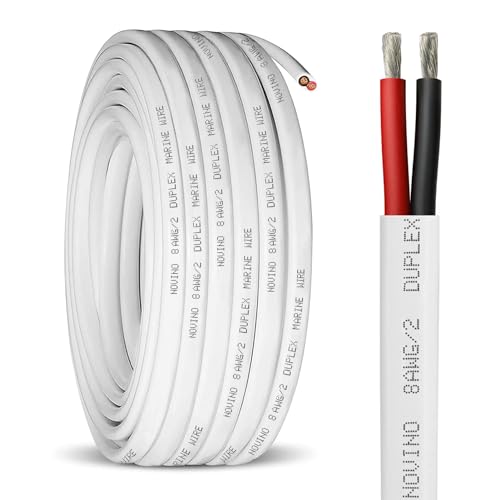
1. NOVINO 8/2 Marine Grade Duplex Wire
Our pick — over 4.5★ from 350+ verified ratings; the strongest balance of quality and price.
A two-conductor boat cable that carries 600V and shrugs off saltwater corrosion.
If your project lives near water, this NOVINO duplex cable is the reference point. It pairs a red and black 8 AWG conductor inside one flat white PVC jacket, built for pontoon boats, bass boats, trailers, fish finders, and solar inverter runs. The whole assembly is tinned and stranded, which stops corrosion before it starts while keeping the cable workable through tight spaces.
This wire meets UL 1426, SAE, and ABYC standards, so it can handle open flame, heat-shock, and abrasion in harsh marine settings. The insulation is rated to 600V at 105 degrees C dry and 75 degrees C wet, giving you a real safety margin in hot engine compartments. If you are powering a bilge pump, buyers report that this 8 AWG is overkill for a 2000 gph pump, but as one put it: “a bit of overkill but better than underkill.”
The crowd is nearly unanimous that this is a heavy-duty, well-protected cable that delivers on its marine promise. The rare complaint surfaces over time as some lengths turning brittle after extended use, which is worth remembering for permanent outdoor installs.
marine-grade corrosion resistance
- Genuine tinned copper that resists corrosion in salt air
- Thick outer sleeve owners say is tougher than Romex
- Multi-standard certified for marine and harsh environments
stiff in cold weather
- Stiff when cold and takes effort to bend into tight corners
- A few owners mention the jacket hardening after long outdoor exposure
saltwater pick: you need a 2-conductor, marine-trusted run for a boat, trailer, or solar project that has to outlast the seasons.
check flexibility: your install demands extreme flexibility in freezing temperatures; the jacket is protective more than it is pliable.
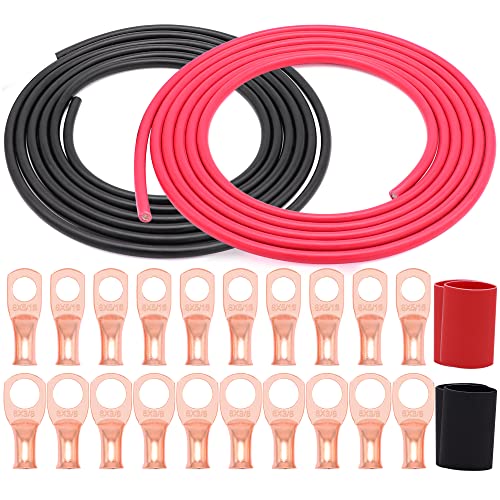
2. Taukealugs 8 AWG Battery Cable Kit with Lugs & Heat Shrink
This kit turns a spool of wire into finished battery cables in one afternoon.
This Taukealugs set is for the person who wants a complete solution, not just a roll of copper. You get two 10-foot lengths of 8 AWG tinned, oxygen-free copper cable (one red, one black) plus 10 lugs in 3/8″ size and 10 more in 5/16″, alongside 20 pieces of 3:1 adhesive-lined heat shrink tubing. Everything you need to crimp and seal professional cable ends is already in the box.
The wire itself is UL1015 and CSA Ft1 VM-1 listed, with a high strand count tinned conductor for low resistance and corrosion protection. The PVC insulation shrugs off moisture, flame, acid, alkali, oil, and gasoline — a serious advantage inside an engine bay. Owners found it “just the right size and flexibility” for rebuilding mower battery cables.
A little honesty about the fit: some customers note the lugs run slightly large, closer to a 6 AWG fit than a true 8 AWG, so they need a flat crimp to bite properly. It’s a minor nuisance, not a dealbreaker, and the flexibility earned solid marks across the board — though it isn’t quite as supple as genuine welding lead.
battery installs: you want one order that includes wire, terminals, and heat shrink so nothing is missing on installation day.
crimp tool needed: the lug sizing; if you have a 6 AWG project these terminals will seat much more naturally.
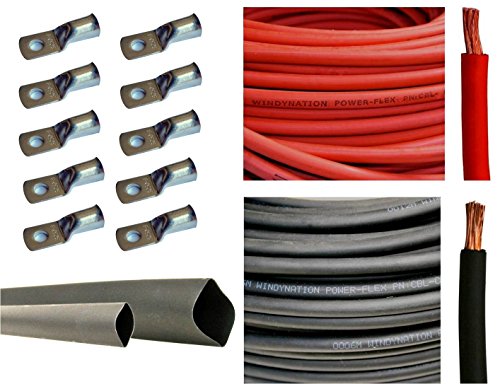
3. WindyNation 8 AWG Welding Cable Kit
A welding-style cable with ultra-fine strands that flex like rope for battery banks.
WindyNation builds this cable for the solar and battery-bank crowd who need to snake wire between mismatched batteries. The 8 AWG pure copper conductor is fully annealed per ASTM standards, and its high strand count is the secret to that “super flexible” feel that dominates the feedback. The tough, solvent-resistant EPDM jacket keeps it safe in engine bays and outdoor cabinets alike.
The kit bundles two 10-foot leads (black and red) with 10 tinned copper lugs and 3 feet of heat shrink, so it slots straight into a parallel-battery project. Owners building “various sizes of parallel cables for my solar battery bank” found it “just what I needed,” and the included terminals and shrink wrap saved a second shopping trip. It’s a 600V-rated cable with a temperature range on the heat shrink of -55 to +125 degrees C.
Terminal connectors drew the only real criticism — described as fine but not the star of the show — while the wire itself earned near-universal praise for quality and flexibility. If you’re wiring solar batteries, this is the kit that fits the job.
custom lengths: anyone making custom-length parallel cables across different battery sizes in a solar bank.
add ends yourself: the lugs aren’t as premium as the cable, so pair them with a proper ratcheting crimper for the cleanest connection.
4. CAROL SOOW 8/3 Portable Power Cord

A three-wire SOOW cord that bends tight for welders, compressors, and generators.
This CAROL cord is a three-conductor workhorse for anyone running high-amp portable tools. It carries three 8 AWG conductors — black, white, and green — inside a black thermosetting EPDM jacket rated to 600V and good from -40 degrees C to +90 degrees C. The insulation is color-coded so you can wire up a proper grounded plug in minutes.
The construction is built for abuse: fully annealed stranded bare copper per ASTM B-174, with a nominal jacket that shrugs off oil and moisture while staying water-resistant. Owners highlight the flexibility for tight bends, calling it ideal for routing power cords to welders and compressors. One thing to note: this 8 AWG and larger size isn’t UL or CSA listed as a full SOOW type, though those handling it call that technicality overkill for the job it does.
For an extension cord feeding a generator or heavy compressor, the owners’ math is simple — this 8 AWG beats thinner 10/3 by carrying current with far less loss. It’s a 10-foot section, so buy the length you actually need for the run.
shop power: making your own grounded extension cord for high-draw tools that live outdoors.
weight matters: the thick insulation means a sharp bend radius, so don’t force it around corners tighter than a fist.
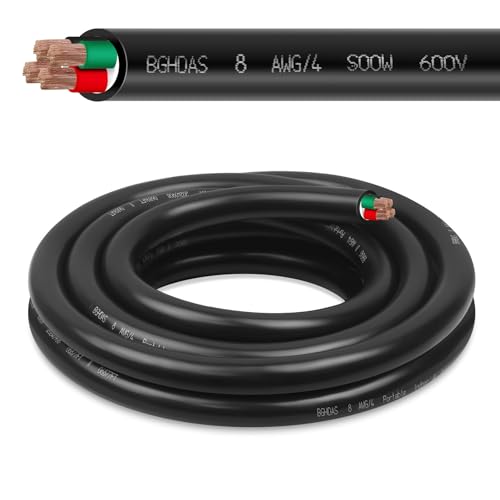
5. Bghdas 6ft SOOW 8/4 Power Cable
A six-foot 4-conductor jumper for generators, lights, and EV chargers that won’t quit.
When you need a short, tough extension between a generator and whatever it feeds, this Bghdas cable answers. It’s a 6-foot, 4-conductor 8 AWG SOOW cord — meaning the jacket resists solvents, oil, and water — built for industrial, commercial, and outdoor power distribution. The stranded oxygen-free copper (OFC) conductors boost corrosion resistance and heat handling over plain copper, which matters in harsh environments.
The 18.5mm diameter cable suits portable lighting, pumps, motors, and temporary event power. Owners call it good quality and note it arrives exactly as ordered, with fast shipping. The package includes a single cable with no ground wire, so it’s not a 4+1 type — check your application before ordering to confirm the conductor count matches your plug.
For a short, heavy-duty link that has to survive oil, water, and chemicals on a work site, this is a clean solution. It’s portable, flexible enough to route, and rated for the abuse SOOW cords are known to take.
tight spaces: a compact, 4-wire link between a generator or charger and equipment that gets moved around.
measure run: there’s no ground conductor in this build, so confirm your plug needs only the four wires.
6. MMOBIEL 8 AWG Silicone Wire (32.8 ft)

Silicone insulation and 1650 strands make this the easiest 8 AWG to route by hand.
If routing wire through a vehicle or appliance is your nightmare, this MMOBIEL cable is the cure. Its inner core packs 1650 individual strands — an absurdly high count that makes the 8 AWG (8.37mm²) tinned copper conductor feel almost like fabric. The thick silicone rubber jacket adds to the softness, so you can guide it through tight firewall gaps and along body panels without a fight.
The silicone jacket laughs at heat: rated from -60°C to 200°C (-76°F to 392°F), it survives engine bays and welding duty where PVC would melt. Each 10-meter spool (32.8 ft total per color pair) carries a 600V rating, and the tinned copper resists corrosion for long service life. Owners used it for electrode cables on a spot welder and routing 12VDC to a radio power strip with ease.
The trade-off: silicone’s softness means the jacket isn’t armored for heavy abrasion, and one critical owner found the strands too fine for rough handling, fraying like a shaving brush when stripped. Treat it gently at the strip point and it’s a joy to work with — just don’t drag it across sharp metal edges.
hot environments: your run goes through hot, cramped spaces where no other 8 AWG will bend or survive the temperature.
budget check: the soft silicone needs a steady hand when stripping so the ultra-fine strands don’t fray apart.
7. YDDECW 10ft SOOW 8/4 Power Cable
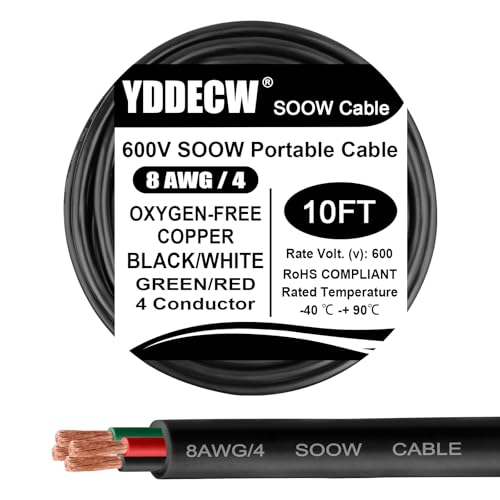
Ten feet of four-conductor SOOW with a jacket built to survive industrial punishment.
For serious portable power jobs, the YDDECW cable is a longer, four-wire option. Each of its 4 conductors uses 186 thin copper strands, so you get the flexibility owners praise for routing without sacrificing current capacity. The outer PVC jacket is 1.4mm thick, with 1mm of PVC around each conductor, so it resists oils, acids, water, and chemicals in mining, marine, and construction settings.
Voltage is rated at 600V, and the oxygen-free copper (OFC) construction improves corrosion resistance and heat absorption compared to standard copper. Owners appreciated that the multi-strand wires “absorbed solder quickly” and stayed easy to handle when routing, confirming the flexible feel. It’s a 10-foot section suited for motor leads, portable lights, and battery chargers.
The honest caveat: a few owners note the outer sleeve feels more like vinyl than the rubber of other 8-gauge cords, raising a question about long-term durability. Functionally it works as wire should, and the price and fast shipping won praise — just know the jacket texture differs from pricier variants.
multi-circuit jobs: a 10-foot, 4-wire power run to motors, chargers, or portable lighting in demanding environments.
length limits: the outer sleeve is vinyl-like rather than soft rubber, which changes the feel if not the function.
8. AC/DC Wire 8 Gauge Welding Cable (40 ft)
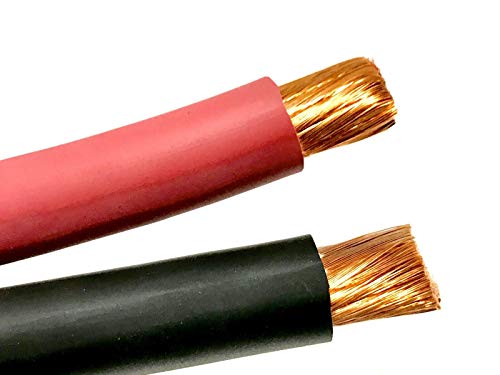
A 40-foot DC run of Class K copper that stays flexible from fridge to truck battery.
This AC/DC wire is the answer when you need a long, uninterrupted DC run — like powering a refrigerator from a solar controller or wiring a DC/DC charger into a heavy truck. You get 20 feet of black plus 20 feet of red 8 AWG cable, each built with 168 strands of highly flexible, annealed copper in a Class K 30 AWG configuration. That’s the same construction used in welding lead, which is why owners describe it as extremely flexible and easy to route.
The jacket uses a flexoprene-style insulation that owners say is far more supple than standard 8 AWG, with one noting it’s “much more flexible than other 8 AWG wire I had previously used.” It is SAE J 1127 rated, 600-volt rated, and resists ozone, sun, weather, and chemicals, making it a solid fit for RV and automotive DC systems. The 40-foot combined length lets you cover long chassis runs in one clean pull.
Buyers consistently confirm it’s real copper that performs, whether feeding a DC fridge or an inverter. The one quibble: the insulation is thicker than normal, so standard wire cutters struggle — a razor knife handles it cleanly.
long runs: your DC project means routing 40 feet of flexible, weatherproof 8 AWG across a vehicle or solar setup.
storage space: the thick, flexible jacket, which needs a razor knife rather than heavy-duty cutters to strip cleanly.
9. Carol 50′ 8/4 SOOW Cord

A 50-foot, four-conductor Carol cord with a rugged CPE jacket for permanent industrial installs.
This Carol cord is the heavy lifter for anyone who needs a full 50 feet of permanent, four-wire power. Its 8/4 SOOW construction uses a durable CPE jacket — a tough chlorinated polyethylene shell — that resists oil, solvents, and abrasion while meeting UL62 standards. The fine-stranded pure copper inside delivers strong conductivity, and owners confirm it stays flexible and durable even after a year of constant use.
Rated for 600V and temperatures up to +90°C, this cable handles extreme conditions without breaking down. The thick internal wrapping and overall build quality drew consistent praise, with buyers calling it heavy duty and noting the appearance looks excellent. It was a perfect match for wiring an outlet for an electric vehicle charger, proving its mettle in a high-demand permanent application.
Two things to expect: a fresh length may carry a strong smell from the casing for a while, and one buyer mistook it for 6 AWG on arrival — so double-check the gauge before you cut. This is also sold as a bulk spool at 50 feet, making it the choice for planned, longer installations rather than quick patching.
fixed installations: a serious, long-term 4-wire installation where UL62 compliance and a rugged jacket are non-negotiable.
bend radius: the casing can smell strong when new, and the 50-foot bulk format isn’t for small, quick jobs.
Understanding the Specs
What “Strand Count” Means for Your Back
Every flexible cable is actually a bundle of thin copper wires twisted together. A low strand count (like 10) makes the cable stiff and springy, perfect for fixed runs that never move. A high strand count (hundreds to over a thousand) allows the wire to bend easily and handle repeated flexing without breaking — think of it like a rope versus a solid metal rod.
Decoding Jacket Materials (PVC, EPDM, Silicone)
The jacket is the rubber or plastic shell protecting the copper. PVC is a general-purpose, budget-friendly option. EPDM is a synthetic rubber that resists oil, water, and extreme temperatures, making it the standard for portable cords (SOOW). Silicone is the most flexible and heat-resistant of the bunch, handling engine-bay heat that would melt others, but it’s softer and needs gentler handling.
Tinned vs. Bare Copper
Bare copper is cheaper but corrodes over time in salt air or moisture. Tinned copper has a thin tin layer on each strand that blocks oxidation. If your wire will live on a boat, near the ocean, or in any damp environment, tinned copper is the choice that keeps connections clean for years.
Understanding SOOW Rating
SOOW stands for Service, Oil, and Water resistant. It’s a designation for portable cords designed to be dragged around, flexed, and exposed to the elements. The rubber jacket provides excellent abrasion resistance and stays flexible in cold weather, which is why it’s the standard for extension cords, generator power, and industrial tools. It’s built to be handled, not just hidden in a wall.
FAQ
Is a higher strand count always better for flexibility?
Can I use this 600V wire in my car or boat?
What is the difference between a 2-conductor and a 4-conductor cable?
Why is tinned copper recommended for outdoor use?
Can this wire handle engine bay heat?
What size lugs and heat shrink do I need for 8 AWG wire?
Is a welding cable the same as a battery cable?
Can I use this wire to make an extension cord for my generator?
Why does my wire have a strong smell when I unbox it?
Final Thoughts: The Verdict
If you want one dependable pick, the 600v 8g flexible wire winner is the NOVINO Marine Wire because it combines marine-grade tinned copper, UL 1426 certification, and a proven track record as the crowd favorite for boats and harsh environments. If you want the ultimate in flexibility for tight engine bays or extreme heat, grab the MMOBIEL Silicone Wire. And for a complete, ready-to-crimp battery cable solution, the Taukealugs Kit is the one to reach for.
How We Picked
We do not accept paid placement. Every pick is matched to a real buyer and a real use-case; we do not hands-on test units.
Sources & Methodology
Specifications: manufacturer listings and product documentation. Review insights: verified customer reviews, as of September 2026. Pricing: not shown on this page (it changes often); check the current price via the retailer link.
As an Amazon Associate, Gadgets Feed earns from qualifying purchases. This does not affect which products we feature.