
Our readers keep the lights on and my morning glass full of iced black tea. As an Amazon Associate, I earn from qualifying purchases.
Specs are compiled from manufacturer listings and verified buyer reviews and can change over time — please confirm the key details on the product page before buying.
If you are hunting for a 24V LiFePO4 battery, you have already felt the pain of lead-acid: the dead weight, the sagging voltage on a long troll, the slow top-end on your cart. Lithium iron phosphate (a chemistry that stores energy safely and recharges thousands of times) fixes all of that, but only if you pick the right capacity and protection for your rig.
I’m Min — the founder and writer behind Gadgets Feed. This guide is built by comparing the manufacturers’ published specifications and the patterns across verified customer reviews, so you get each pick’s real strengths and trade-offs instead of marketing spin.
You want a 24V LiFePO4 battery (a lithium iron phosphate pack that stores power for trolling motors, golf carts, or solar setups) that actually fits your daily energy use. The LOSSIGY is the top pick for trolling and carts because it has the most owner reviews, the Elefast offers the best value per amp-hour, and the VEVOR gives you the most expandable capacity for home solar. buying the best 24v lifepo4 battery means matching amp-hours to your daily draw, not just grabbing the biggest number.
Our Picks at a Glance
How To Choose The Best 24V LiFePO4 Battery
Buying a 24-volt (a nominal system voltage for mid-size gear) lithium iron phosphate pack is a multi-year decision. You want enough stored energy for a full day on the water or off-grid, plus a management system that will not let the cells get damaged. This section covers the three checks that matter most before you click buy.
Amp-Hours Decide Your Runtime
The amp-hour (Ah) rating tells you how much energy the pack holds. A 100Ah battery at 24V holds 2560 watt-hours (a watt-hour is one watt used for one hour), which powers a typical trolling motor for many hours. If you fish hard all day or run a fridge, step up to 140Ah or 200Ah so you are not rationing power by dusk.
The BMS Is Your Safety Net
Every quality pack has a battery management system (BMS), an internal controller that cuts power to prevent overcharge, over-discharge, and short circuits. Look for a high amp rating on the BMS (like 100A or 200A) — it must exceed what your motor or inverter will draw. Cold protection matters if you fish in winter; a good BMS stops charging below freezing to protect the cells.
Size, Weight, and Expansion
Lithium weighs a fraction of lead-acid — a 100Ah 24V pack often lands around 42 pounds versus over 100 pounds for the lead equivalent. Measure your compartment first, because some “compact” packs still need a bracket trimmed to fit. If you plan to grow a solar bank later, confirm the battery supports parallel and series connections so you can add identical units.
Quick Comparison
| Model | Best For | Capacity | Weight | Peak Current | Amazon |
|---|---|---|---|---|---|
| LOSSIGY 24V 100Ah★ Best Overall | Trolling & Golf Carts | 100Ah (2560Wh) | 42.5 lb class | 400A | Amazon |
| Elefast 24V 100AhBest Value | Value & Solar | 100Ah | 42.5 lb | 300A | Amazon |
| Dyness 24V 100AhCold Weather Pick | Cold Weather | 100Ah (2560Wh) | 21.8 lb | 100A cont. | Amazon |
| BtrPower 24V 140Ah | Heavy Draws | 140Ah (3584Wh) | 41 lb | 100A cont. | Amazon |
| PYXMGSHMY 24V 140Ah | Compact 140Ah | 140Ah (3584Wh) | 40.3 lb | 100A cont. | Amazon |
| XZNY 24V 100Ah | Compact Fit | 100Ah (2560Wh) | 41 lb | 300A | Amazon |
| Wattcycle 24V 100Ah | Longevity | 100Ah (2.56kWh) | 44 lb | 100A cont. | Amazon |
| VEVOR 24V 200Ah | Solar Banks | 200Ah (5120Wh) | 76.5 lb | 100A cont. | Amazon |
| Dumfume 24V 314Ah | Whole-Home Backup | 314Ah (8038.4Wh) | 112.44 lb | 200A cont. | Amazon |
In-Depth Reviews
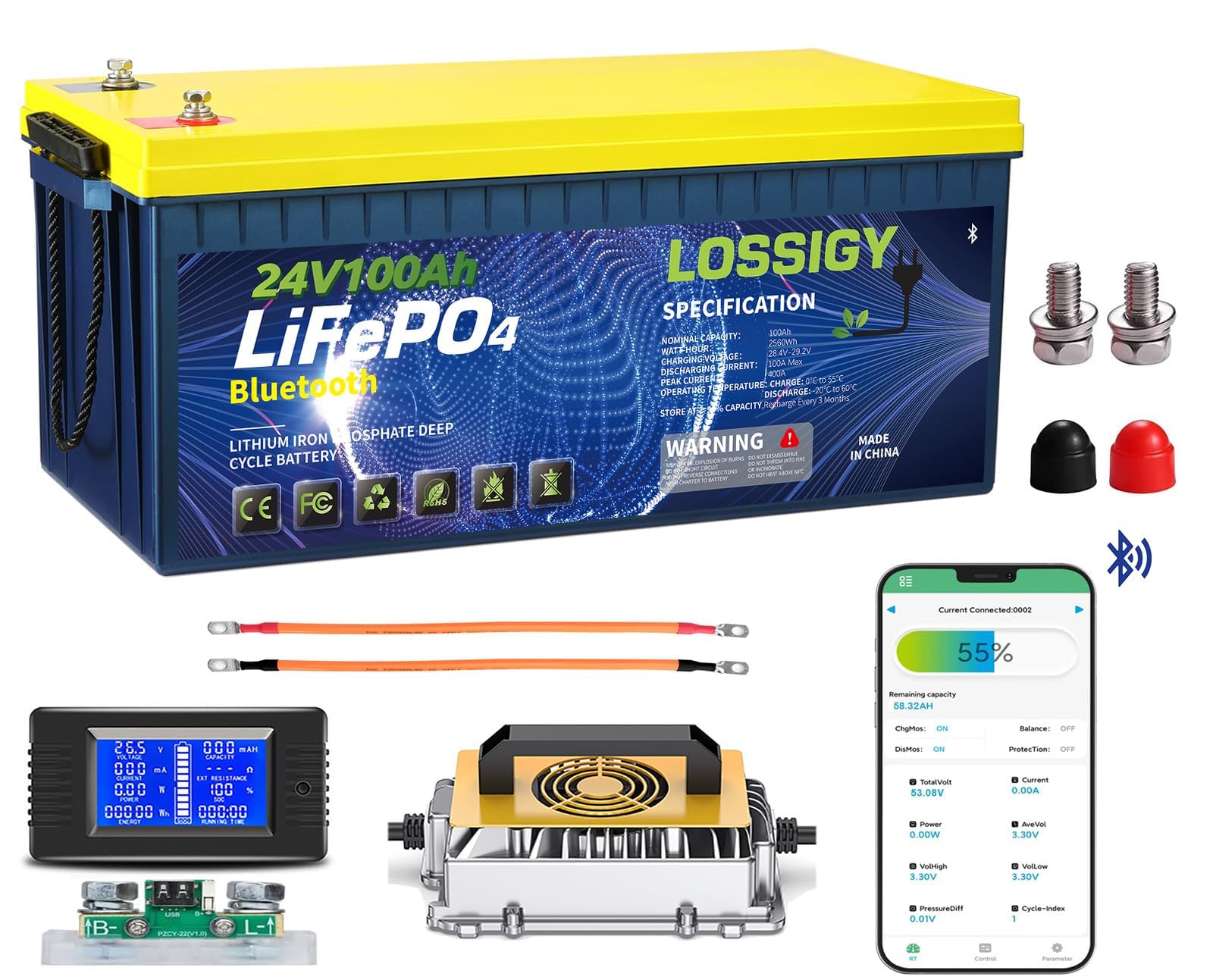
1. LOSSIGY 24V 100Ah with Charger
Our pick — over 4.5★ from 100+ verified ratings; the strongest balance of quality and price.
The cart and trolling favorite that shaves hundreds of pounds off your rig.
The LOSSIGY 24V 100Ah earns its top spot because it saves you serious weight: golf cart buyers report swapping six 6-volt lead batteries for this single 24V pack and losing roughly 200 pounds. The same install added about 4 miles per hour of top end and stronger hill climbs. Its internal 100A BMS (a protection circuit that guards the cells) and 400A peak current rating handle the sudden surge of a trolling motor or a cart climbing a grade without tripping. With 4.7 stars across 100+ owners, it has the broadest approval here.
It ships as a full kit: the battery, a 29.2V 15A smart charger, and a separate monitor display that sits on your dash so you can watch state of charge at a glance. Owners mention the Bluetooth app tracks capacity accurately, with one user seeing about 70% remaining after five to six trips against river currents. The 2560W output (a measure of sustained power delivery) is enough for daily cart laps and extended trolling sessions.
The honest caveats: the add-on monitor is not waterproof, so keep it inside the cabin rather than exposed to spray. Some cart installs need small metal brackets trimmed or a frame weld to fit the new footprint, and the 8.11-inch depth is taller than some older trays. One owner also recommends a 12V converter if you still need to run 12-volt accessories alongside it.
Why owners love it
- Massive weight cut — around 200 lb lighter than a 6x6V lead setup on a cart
- Comes with a smart charger and a separate live monitor display
- Peak current of 400A handles motor startup surges cleanly
Before you buy
- Monitor unit is not waterproof, so mount it inside
- Some carts need small brackets cut or a frame weld for a true drop-in fit
Reach for this if: you run a 24V trolling motor or a 36V golf cart and want the most proven, best-reviewed upgrade path with a charger included.
Look elsewhere if: your compartment has less than 8.11 inches of depth, since this pack sits taller than some of the compact rivals on this list.
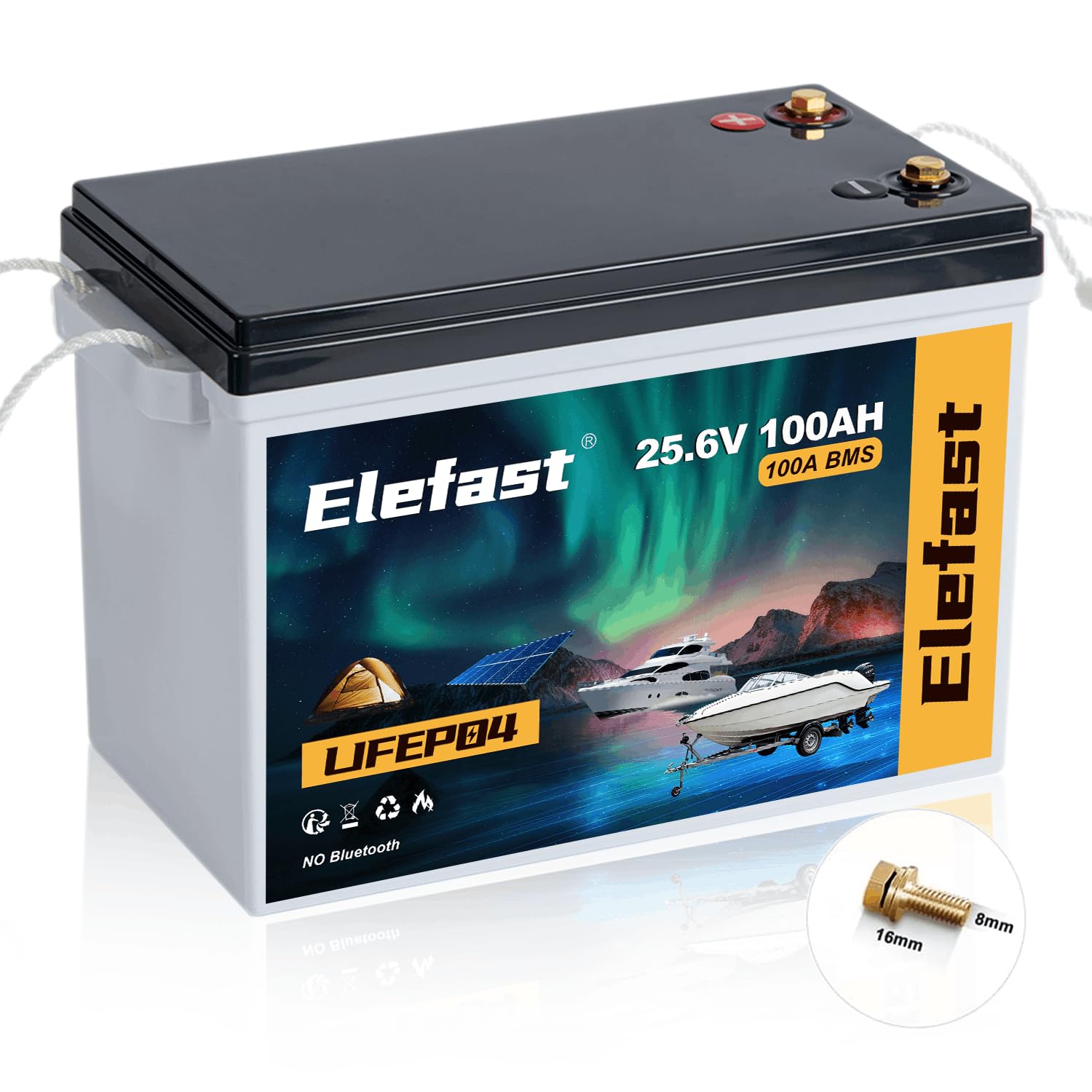
2. Elefast 24V 100Ah
The budget-friendly powerhouse that tests over its rated capacity.
If value is your priority, the Elefast 24V 100Ah delivers more than it promises: customers note the 100Ah pack tested at 103Ah (amp-hours, the measure of stored energy), over its spec. It weighs 42.5 lb versus about 52 lb for the lead setup it replaced, so you feel the difference every time you lift it into a boat. The A+ grade cells (the quality tier of the internal lithium cells) and built-in 100A BMS make it a strong pick for a 24V trolling motor; one owner ran a 70 lb thrust motor for 11 hours on a single charge.
The BMS also handles a 300A inrush current for one second — that brief surge when a motor first spins up — and can sustain a 1.2C discharge for up to three minutes without cutting out. It supports 2S4P wiring, so you can expand a 2560Wh single battery into a 20480Wh bank for a solar home system, connecting up the voltage (series) and capacity (parallel) as you grow. Shipping is fast, with one buyer reporting arrival in five days and a responsive support team for controller settings.
The caveat is compatibility: a few owners found their solar charge controller did not immediately recognize the battery and needed settings adjusted. There is no Bluetooth, so you check voltage with a meter rather than a phone app. The 5-year after-sales service and UL, IEC, and CE safety certifications provide backup if you hit a setup snag. Skip this one if you want app-based monitoring or a plug-and-play solar hookup.
The strong points
- Tested capacity came in at 103Ah, above the 100Ah rating
- 42.5 lb weight is a clear step down from lead-acid setups
- 5-year after-sales service with fast email support
The trade-offs
- Some solar controllers need a settings tweak to recognize it
- No Bluetooth monitoring — voltage checks need a meter
Grab it if: you want maximum amp-hours per dollar for trolling, fishing, or a small solar bank and do not need phone-app monitoring.
Think twice if: your charge controller is older or finicky, because you may need to configure it manually before the battery delivers full power.
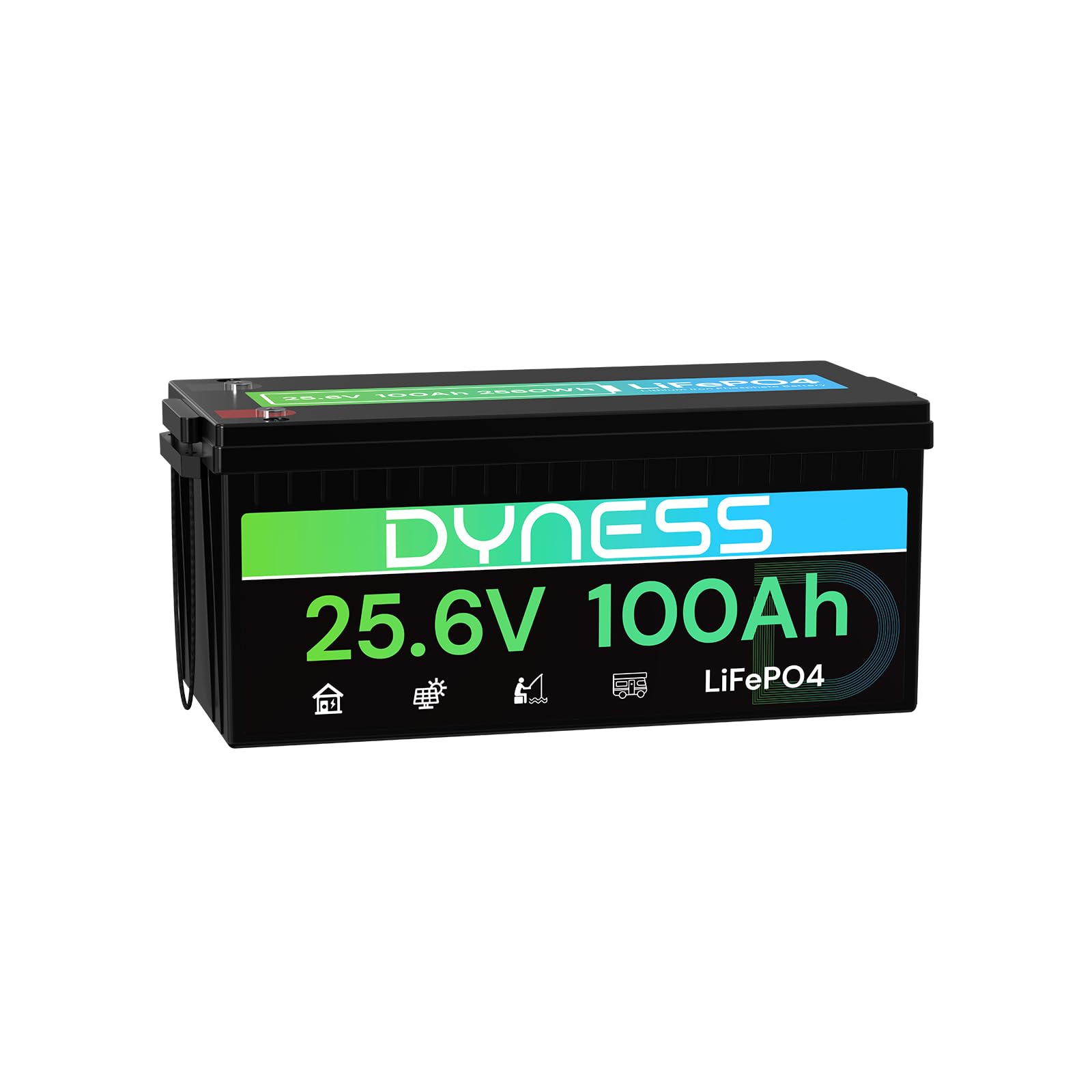
3. Dyness 24V 100Ah
The featherweight that shrugs off freezing mornings for winter anglers.
At just 9.9 kg (about 21.8 lb), this is the lightest 100Ah pack in the lineup — a number that matters when you lug it from truck to dock in the dark. It is built around A+ grade cells, and the 25.6V nominal rating (the resting voltage of the lithium chemistry) feeds a 100A smart BMS with an advanced low-temperature cutoff. That cold protection is the whole story for ice fishermen: the BMS will not let the pack charge below freezing, which is what damages lithium cells, so a winter trip does not shorten its life. Owners confirm it holds a charge through the season, with one running an 80 lb thrust trolling motor hard for five days before recharging.
The Dyness 24V 100Ah trades its low weight for a larger footprint: at 8.11 inches deep, 20.9 inches wide, and 8.54 inches tall, it is longer and flatter than the compact Elefast and XZNY units, so measure your tray before ordering. It supports up to a 4P2S connection, letting you build a 51.2V 400Ah bank of 20.48kWh for home solar storage. But it is not meant for engine starting or golf cart use, so skip it if you need high-drain bursts.
Owners running it on an 18-foot pontoon report over four hours of continuous trolling and spot-lock with no issues, and the 5-year manufacturer warranty plus responsive support team covers you if a unit arrives faulty. One buyer had a failed first unit; support walked them through troubleshooting and shipped a replacement promptly, which is the kind of after-sales reality that matters for a durable good.
What stands out
- Ultra-light 9.9 kg frame is the easiest to carry of this group
- Low-temperature cutoff protects cells during winter fishing
- Holds a charge well — one owner ran an 80 lb thrust motor hard for 5 days
Know the limits
- Wide 20.9-inch footprint may not fit narrow battery trays
- Not intended for golf carts or engine starting
Best for: the cold-weather angler or off-grid camper who needs a light, freeze-safe pack for trolling and solar storage.
pass on it if: you are converting a golf cart or need the narrowest possible fit — this one is wide and explicitly not for that duty.
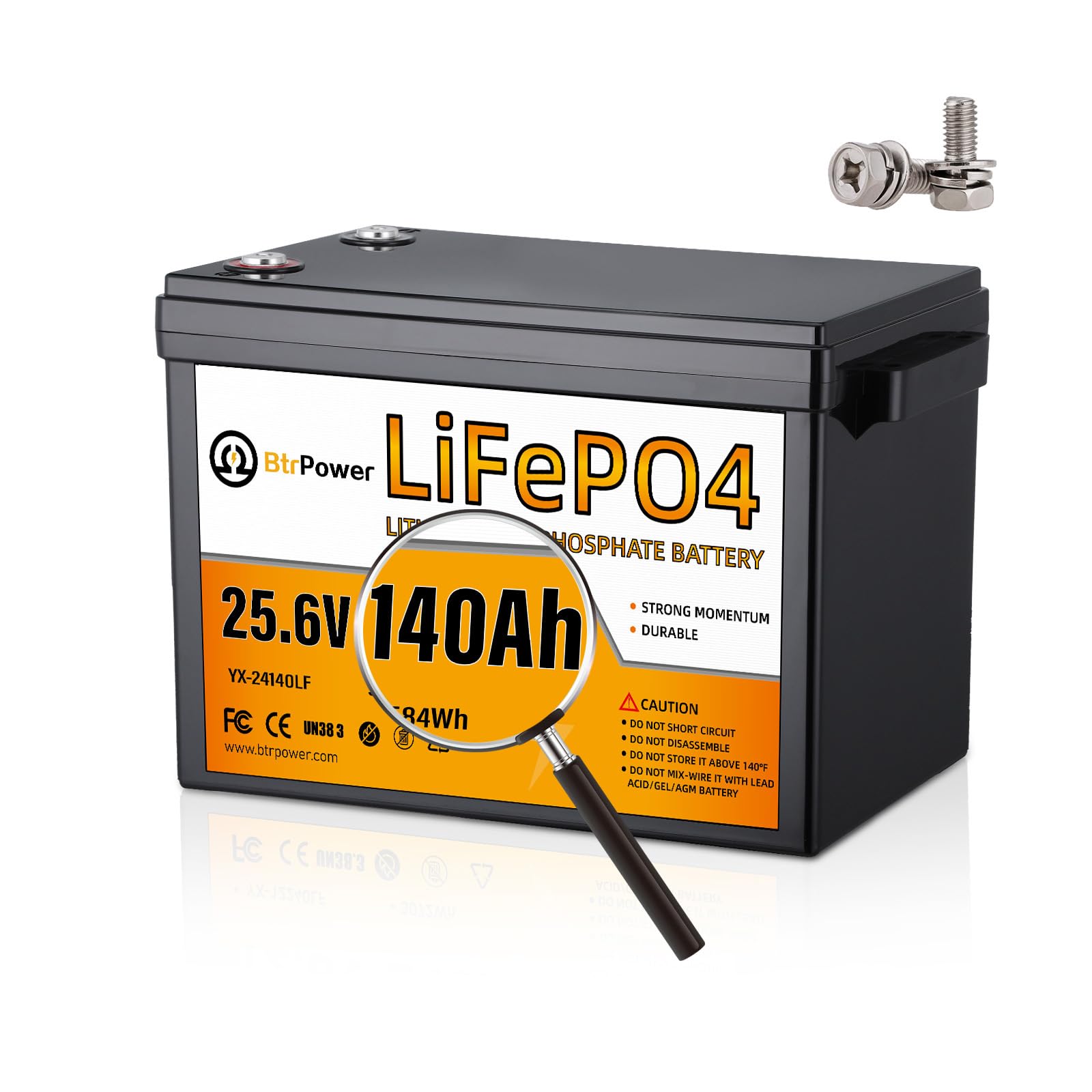
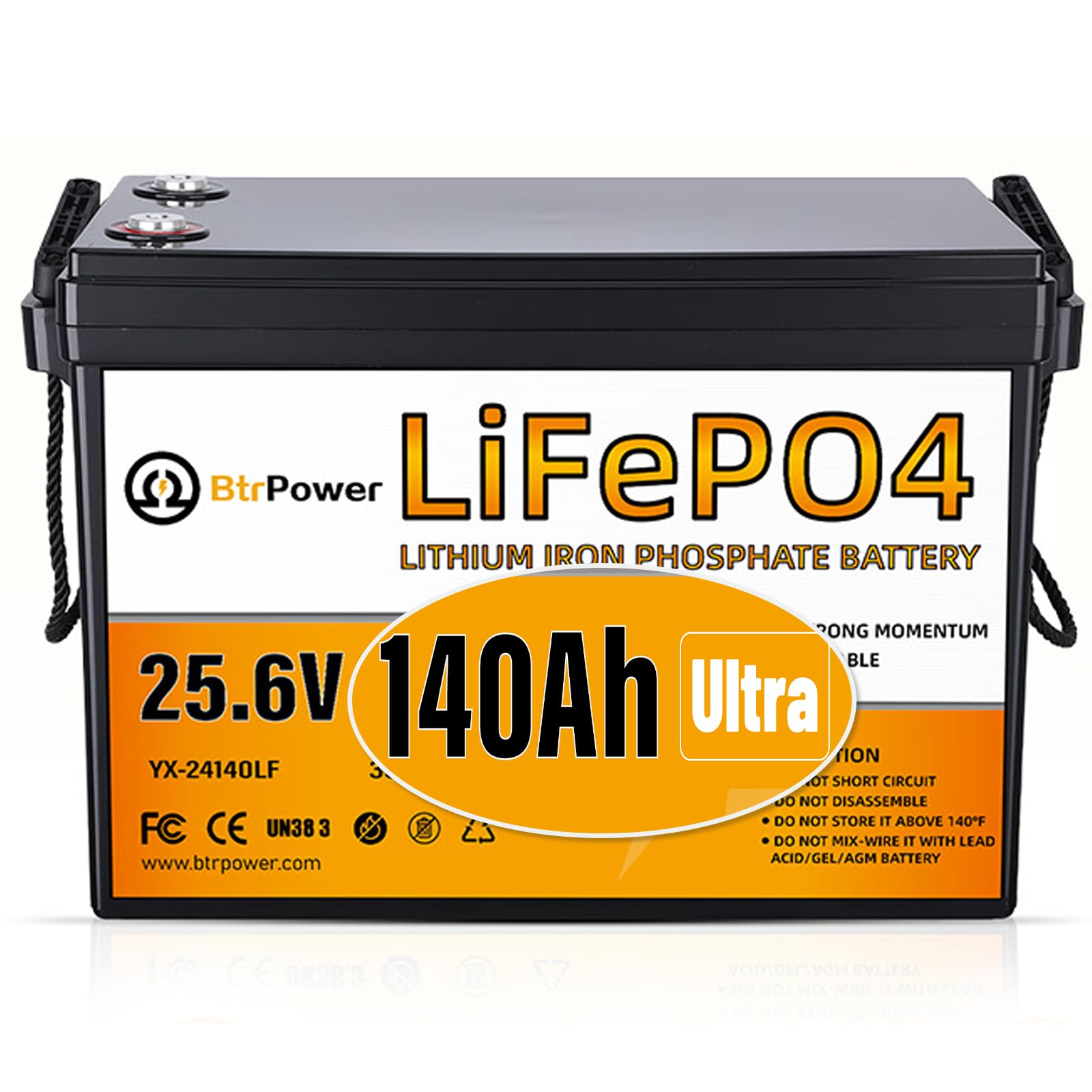
4. BtrPower 24V 140Ah
The high-capacity workhorse that keeps heavy loads running nonstop.
Step up from 100Ah to 140Ah and you gain 3584Wh of stored energy, enough for owners to report powering a trolling motor for 12-plus hours and running a continuous server load alongside a 3000-watt inverter. The built-in 100A BMS adds high-temperature cutoff protection, and the M8 terminal (a standard 8mm bolt connection) makes wiring straightforward. At 41 lb, it is about one-third the weight of a comparable lead-acid bank, so wheelchair users and boaters slide it into tight compartments with far less strain than the old dual 12V setup.
The brand claims Grade A cells hold 80% capacity after 3,000 deep cycles, and you can wire two in series for 48V or four in parallel for more capacity. The chemistry also means no water maintenance and a low self-discharge rate, so it sits through the off-season without babysitting. One owner has run theirs for six months on a solar charger, DC charger, and inverter combo with no issues.
The recurring negative is the battery-life column — most owners are thrilled with how long it holds a charge, but a few report a unit stopped taking a charge after about eight months of use. That is the sort of outlier that matters when you are buying a durable good, and the 1-year warranty is shorter than the 5-year terms on the Elefast or Dyness, so weigh that coverage against the bigger capacity.
Why it pulls ahead
- 3584Wh capacity powers a trolling motor for 12+ hours
- 41 lb weight is roughly one-third of the lead-acid equivalent
- M8 terminals and series/parallel flexibility for system growth
What to weigh
- A few owners saw a unit fail to charge after around 8 months
- 1-year warranty is shorter than several rivals offer
Pick it if: you need the extra reserve of 140Ah for long trolling days, a wheelchair, or an inverter-backed setup and prioritize capacity over warranty length.
Pass if: warranty coverage is your deciding factor — the 1-year term here trails the 5-year packs above.
5. PYXMGSHMY 24V 140Ah
The space-saver that fits mowers and kayaks without sacrificing 3584Wh.
Some jobs will not take a long, wide pack, and that is exactly who this is for. At 13.38 by 7.48 by 10.4 inches and 40.3 lb, it squeezes into a Ryobi riding mower after a minor bracket tweak, and the same footprint serves a 36 lb kayak trolling motor. The 3584Wh output is the same as the BtrPower above, but in a body that is described as around one-third lighter than the lead-acid it replaces. The built-in 100A BMS and IP65 waterproof housing (meaning it resists water jets, so marine spray is not an instant death sentence) make it viable for open boats.
Field performance is steady: a kayak angler reports drawing 6.5A max and 3.2A at low speed with no capacity loss after three hours of trolling, and the charge stayed above 80% after several mows on a half-acre lot. The pack supports up to 4P2S wiring for a 28.67kWh maximum system, covering most off-grid and solar expansion plans. Owners praise the 5-year service on the 100Ah sibling, but this 140Ah unit carries a shorter 12-month warranty, so check that before buying.
The honest gripes: some reviewers point out the battery fails after about 13 months of heavy use, which is a real longevity question mark for a daily-driver mower or boat. And one owner flagged an advertising tactic where the “upgrade” listing cost more for what was arguably the identical battery — a reason to double-check the exact listing you add to cart. A 48V charger is required if you wire two in series, which is an extra cost to budget.
The fit-first strengths
- Compact footprint slides into mowers, kayaks, and tight boat compartments
- 40.3 lb with 3584Wh — the same power in a smaller body
- IP65 waterproof housing suits marine spray
Watchpoints
- Some owners saw failure after roughly 13 months of use
- 12-month warranty is on the short side for this class
Choose this for: a riding mower, kayak, or tight boat bay where a standard 140Ah pack will not physically fit.
Reconsider if: you want a long warranty — at 12 months, it does not match the 5-year protection on the Elefast and Dyness.
6. XZNY Compact 24V 100Ah
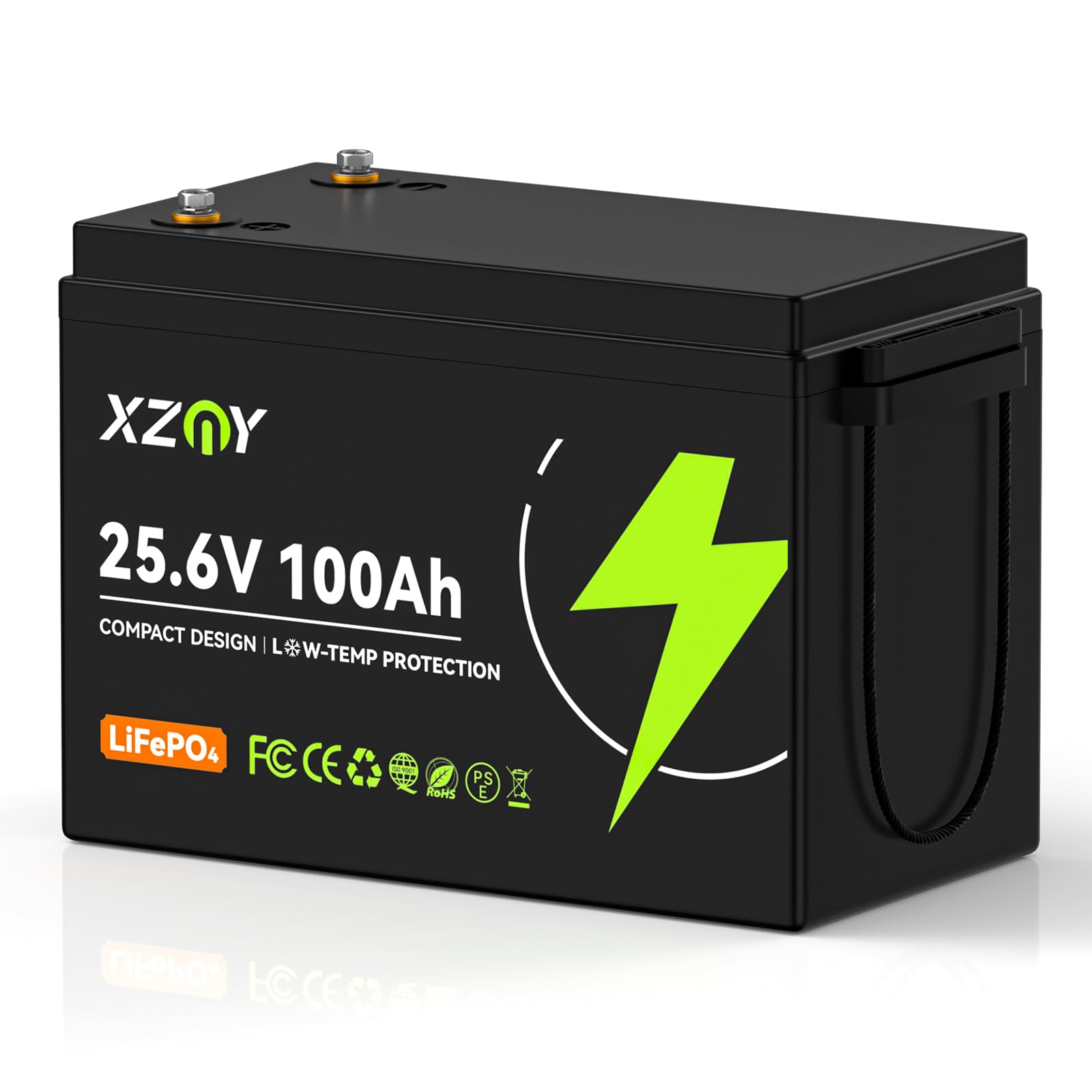
The 30 percent smaller pack that still delivers a full 100Ah day.
Space is the enemy on a modern boat, and this one fights it directly: the XZNY is built 30% smaller than the standard 24V 100Ah battery and 33% smaller than two 12V 100Ah batteries wired together. That lets it drop into a 2025 Lund 1650 Rebel compartment — the owner had to cut one handle off to make it fit, but it fit where a standard pack would not. The trade-off for the tight footprint is that you lose the extra connection wires and the balancing headaches of running two 12V packs in series.
The BMS is where this one earns its keep. It cuts off charging at 32°F (your standard freezing point) and stops discharging at -8°F, so a hard winter fishing session will not damage the cells. It also delivers a continuous 100A charge and discharge current with a 300A peak for five seconds, and a maximum output of 2560W — enough for a 24V 70-100 lb thrust trolling motor. The 3-year replacement warranty stands out—one owner with a BMS charging issue got a replacement unit shipped after months of use.
Shoppers say the compact frame and lighter weight make it far easier to handle than the two heavy 12V batteries it replaces, and it held charge through a week of heavy trolling in wind. The honest mixed note is performance longevity — most units run flawlessly, but a few report a pack stopped working after about two months, which support typically resolves under that 3-year replacement promise. Its UL certification and IP67 rating (dust-tight and immersion-proof) let it handle a wet boat floor.
What wins people over
- 30% smaller than standard 100Ah packs for tight compartments
- Charging cuts off at 32°F, protecting cells in winter
- 3-year replacement warranty with responsive support
The trade-off
- A few units stopped working after about two months before being replaced
- You may need to trim a handle or bracket for the tightest fits
Reach for it if: a standard 100Ah pack will not fit your bay and you want cold protection plus a real 3-year replacement promise.
Look elsewhere if: you cannot tolerate the small risk of an early failure, even with support standing behind the 3-year swap.
7. Wattcycle 24V 100Ah
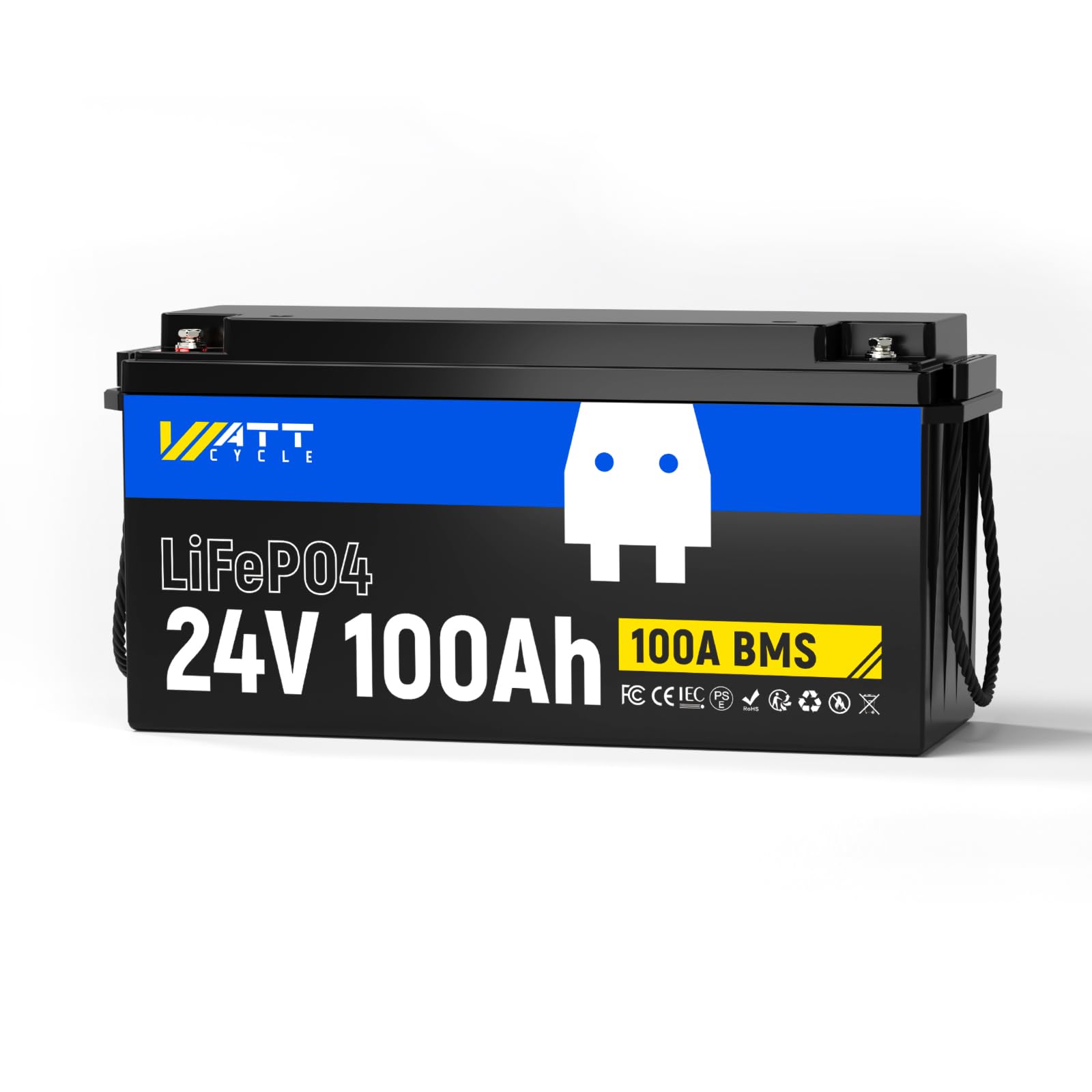
The 10 year warranty pack built for buyers who want to install once and forget it.
Most batteries in this class come with a 5-year warranty; the Wattcycle doubles that to a 10-year term, which tells you a lot about how confident the maker is in the cells. The 100Ah pack stores 2.56kWh and is rated for up to 15,000 full charge-discharge cycles under optimal conditions. The built-in 100A BMS disconnects the circuit if current exceeds 100A, protecting the pack from overcurrent damage before it can hurt the cells.
At 44 lb and 19 by 6.6 by 9.4 inches, it is a longer pack than the compact XZNY, but owners use it to power trolling motors and recharge power stations with strong results. The Bluetooth-connected version is the one buyers recommend, since the app shows real-time state of charge and battery health from your phone. One owner has used it twice to power a trolling motor and was pleased with how the app tracks status at any moment.
The realistic caveats: there is no low-temperature cutoff listed, so winter charging is a question mark for ice fishermen, and you pay return postage if the size does not fit your compartment, so measure the 19-inch length before ordering. The 15,000-cycle rating is the brand’s claim, not yet proven by a large owner base, but the 10-year warranty is the longest legal protection here.
The long-game strengths
- 10-year warranty is the longest protection here by double
- Bluetooth app gives live state-of-charge and health tracking
- Rated up to 15,000 cycles for daily-use longevity
What to verify
- 19-inch length needs a true measurement before you order
- No low-temperature cutoff mentioned for winter charging
Buy it if: you want phone-app monitoring and are willing to pay extra for a 10-year warranty that outlasts every rival here.
Steer clear if: you fish in freezing conditions — without a stated cold cutoff, this is not the winter pack the Dyness or XZNY is.
8. VEVOR 24V 200Ah
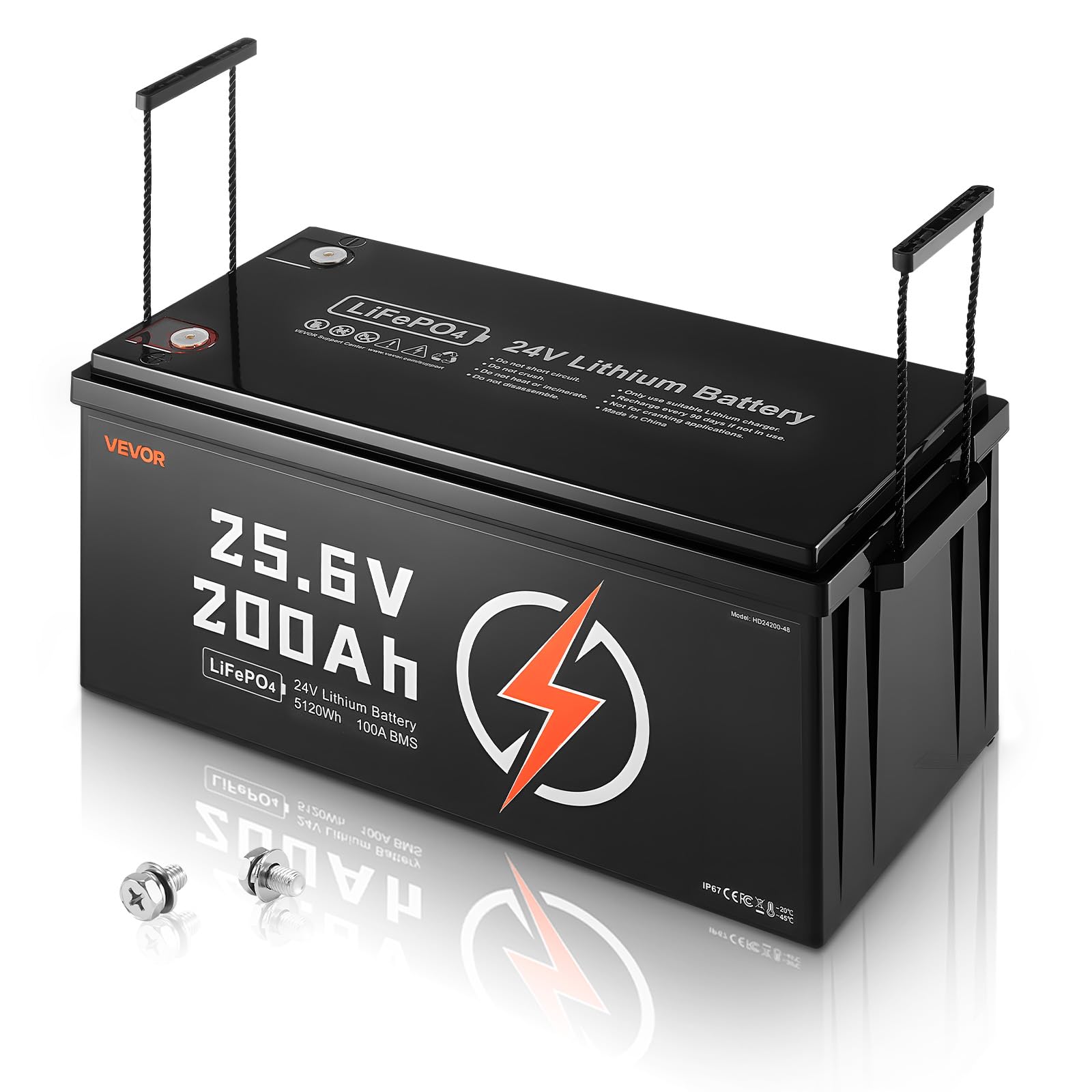
The expandable 200Ah energy vault that refills fully in five hours.
Double the capacity of a 100Ah pack and you get 5120Wh of stored energy — enough that one owner describes it as a server-rack battery in a 24V package, showing 5.3kWh on first charge. This is the pick for a solar home or serious off-grid cabin where you want a dependable backup core. It expands up to 20.48kWh, which covers most whole-home solar plans.
Live usage backs up the numbers: an owner’s mother has run one for over eight months with zero issues and is already buying a third, while another praises how well-packed and blemish-free the unit arrived via FedEx. At 76.5 lb, it is the heaviest 24V pack here, but you trade that heft for twice the energy of a 100Ah unit; in many solar racks, the extra weight is a non-issue since the battery sits in place for years. The 9.65 by 20.47 by 8.66-inch footprint is built for a rack or tray, not a boat compartment.
The trade-off is versatility: this is a solar and backup battery first, not a trolling-motor pack you will haul in and out of a boat each weekend. The low-temperature protection is listed, which helps cold-climate solar installs, but the weight makes it a set-and-forget component rather than a portable one. With a 4.9-star average across a small owner base, the reviews are glowing but not yet voluminous, so consider that this is a newer, less-proven model than the LOSSIGY at the top of this list.
The expansion advantages
- 5120Wh capacity with expansion up to 20.48kWh for solar homes
- Full recharge in about 5 hours for quick turnaround
- 4000+ cycle rating with low-temperature protection
The honest limits
- 76.5 lb weight makes it a fixed installation, not a portable pack
- Small owner base so far, so long-term reliability is less proven
Choose it for: a solar array, home backup, or cabin where you want 5120Wh of reliable, expandable storage that sits in place.
Pass if: you need a portability you will lift weekly — at 76.5 lb, this one stays mounted.
9. Dumfume 24V 314Ah
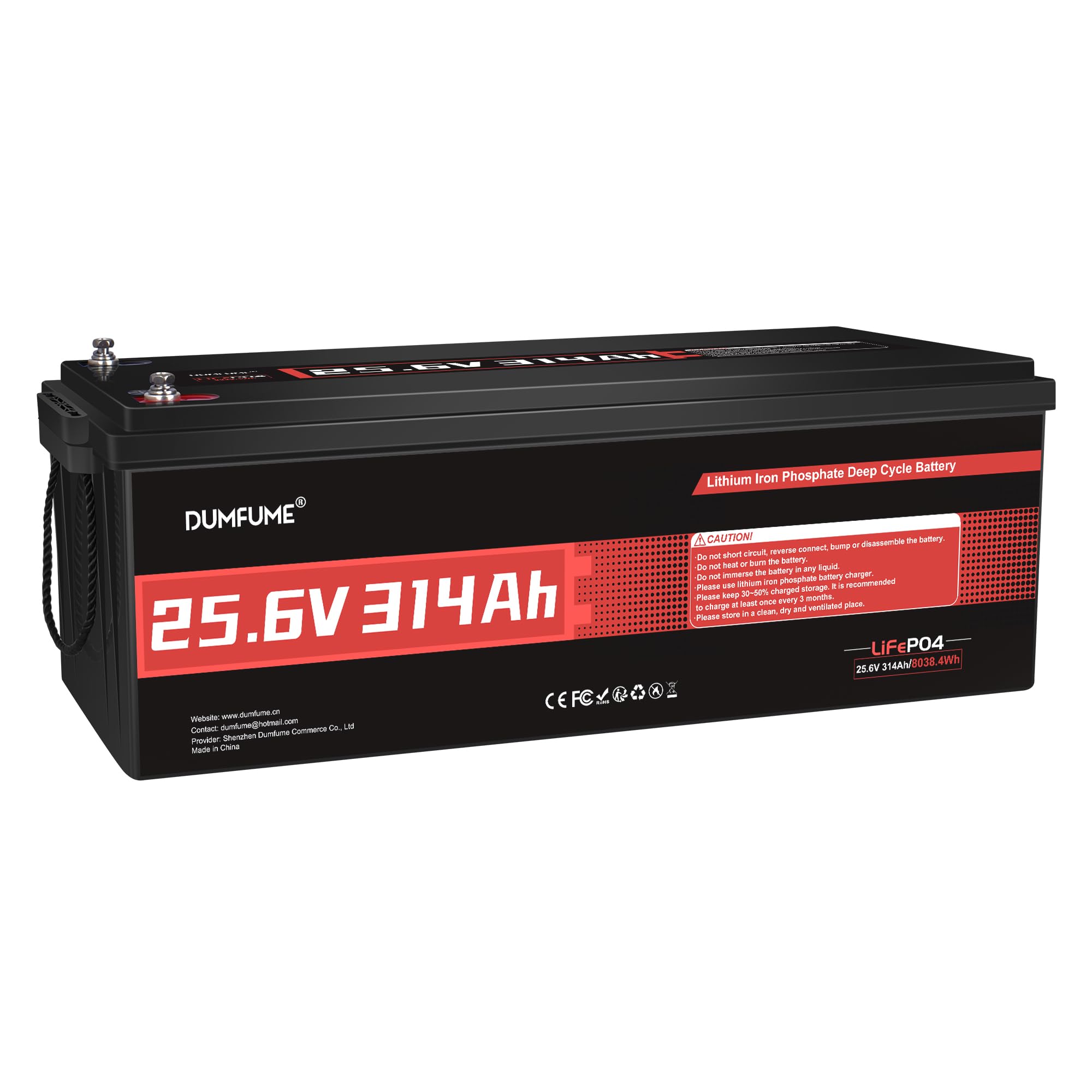
The 8kWh monster that runs a diesel heater and inverter for three straight days.
This is the largest single battery on the list, packing 8038.4Wh into a 314Ah (the usable capacity rating) body that weighs 112.44 lb. Owners describe running a diesel heater and a 2500-watt inverter for three consecutive days off one charge, and another notes it has bigger capacity than server-rack batteries without needing Bluetooth or communication ports. The 200A BMS is double the protection of most rivals here, and the IP65 waterproof rating plus flame-retardant ABS case make it safe for indoor and outdoor installation alike.
The cold protection is genuinely useful for year-round setups: charging stops below 32°F, but it keeps discharging down to -4°F, so a winter cabin can still draw power when the mercury drops. The low self-discharge rate of under 3% per month means it holds its charge through long storage periods, and the recommended 40-100A charge current lets you refill in hours from solar, a generator, or an AC charger. With 2S4P wiring you can connect two in series (51.2V) and four in parallel (1256Ah) for a 64kWh+ energy bank.
The price is premium — this is the most expensive single unit here — and the weight means it is a permanent installation, not something you move. One owner had a battery fail in under a year and reported serious difficulty reaching warranty support, a real caution flag for a purchase this large; the majority of owners, however, report flawless performance and strong value for the capacity. It is not meant for golf carts or engine starting, so keep it in the solar or backup role it is built for.
The massive upsides
- 8038.4Wh capacity runs heavy loads for days on end
- 200A BMS with charging cutoff at 32°F and discharging to -4°F
- Self-discharge under 3% per month for long storage
The serious caveats
- 112.44 lb makes it a fixed install only
- One owner reported a failure under a year with difficult warranty support
Reach for it if: you are building a whole-home solar or backup system and need maximum single-pack capacity with heavy-duty 200A protection.
Think carefully if: you want an established after-sales track record — the warranty support experience on this unit has been inconsistent.
Understanding the Specs
Amp-Hours and Watt-Hours
Amp-hours (Ah) tell you how much charge the battery holds, like the size of a fuel tank. Watt-hours (Wh) multiply that by the voltage to show total energy — a 100Ah 24V battery delivers 2560Wh. For real life: a trolling motor drawing 25A will run about four hours on a 100Ah pack before you should recharge.
The BMS and Cold Protection
The battery management system (BMS) is the internal brain that protects cells from overcharge, over-discharge, and short circuits. Look for a BMS amp rating that exceeds your motor or inverter draw. Low-temperature cutoff stops charging below freezing, which prevents permanent cell damage in winter use.
FAQ
Will a 24V LiFePO4 battery drop into my existing 24V trolling motor setup?
How long will a 24V 100Ah battery run my trolling motor?
Can I connect multiple 24V batteries together for more capacity?
What does the BMS amp rating actually do for me?
Is it safe to charge a LiFePO4 battery in freezing weather?
How much weight will I save switching from lead-acid?
Can I use a 24V LiFePO4 battery in my golf cart?
How long does a 24V LiFePO4 battery actually last?
What charger do I need for a 24V lithium battery?
Are these batteries waterproof enough for a boat?
Final Thoughts: The Verdict
For most buyers, the 24v lifepo4 battery winner is the LOSSIGY 24V 100Ah because it pairs the strongest owner consensus (4.7 stars across a broad base) with a full kit — battery, smart charger, and monitor — and a 400A peak current that handles the hardest motor surges. If you want the best raw value per amp-hour, grab the Elefast 24V 100Ah, which tested over spec at 103Ah for a budget-friendly price. And for a solar home or whole-cabin backup, the VEVOR 24V 200Ah is the one to reach for — its 5120Wh capacity and 4000+ cycle rating make it a dependable, expandable energy core. Measure your compartment, match the amp-hours to your daily draw, and confirm the BMS covers your peak current; do that and any of these nine will outlast the lead-acid rig you are leaving behind.
How We Picked
We do not accept paid placement. Every pick is matched to a real buyer and a real use-case; we do not hands-on test units.
Sources & Methodology
Specifications: manufacturer listings and product documentation. Review insights: verified customer reviews, as of September 2026. Pricing: not shown on this page (it changes often); check the current price via the retailer link.
As an Amazon Associate, Gadgets Feed earns from qualifying purchases. This does not affect which products we feature.