
Our readers keep the lights on and my morning glass full of iced black tea. As an Amazon Associate, I earn from qualifying purchases.
Specs are compiled from manufacturer listings and verified buyer reviews and can change over time — please confirm the key details on the product page before buying.
The real question for backpacking solar isn’t wattage—it’s whether the panel earns its place in your pack. You’re trading grams for grams of battery, and a panel that can’t top up your phone or power bank on a cloudy ridge is just dead weight. This guide sorts the chargers that actually deliver usable power on the trail from the ones that look great in a product photo.
I’m Min — the founder and writer behind Gadgets Feed. This guide is built by comparing the manufacturers’ published specifications and the patterns across verified customer reviews, so you get each pick’s real strengths and trade-offs instead of marketing spin.
For anyone heading off-grid, the right backpacking solar chargers balance weight, conversion efficiency, and ruggedness so your devices stay alive without slowing you down.
Our Picks at a Glance


How To Choose The Best Backpacking Solar Chargers
Backpacking solar panels are a balancing act. The heavier and bigger the panel, the more power it can pull from the sun—but the more it weighs you down on the climb. The trick is to match the panel to what you actually carry: a phone, a GPS, a small power bank, maybe a camera. Before you buy, know what you’re charging, because a laptop or a large power station needs a different panel than a phone does.
Start With Real-World Efficiency, Not Just Watts
The wattage number on the box is the theoretical maximum. On the trail, a panel’s conversion efficiency decides how much of that sunlight actually becomes electricity in your device. Panels in this class range from about 22% up to over 25% efficiency—numbers that matter most in weak sun, under clouds, or when the panel isn’t perfectly angled. A panel with a higher efficiency will keep topping up your phone when a lower-rated panel has already given up.
Weigh the Panel Against Your Battery Bank
For backpacking, weight is the silent killer of good intentions. A 25W panel that folds to the size of a tablet and weighs just over a pound is a different animal than a 40W rigid panel that needs its own pack space. Also keep in mind that most foldable panels cannot store electricity—they produce power only when connected to a device and placed in direct sun. Think of the panel as a charger for your power bank, not a replacement for it.
Check the Ports and the Water Rating
Look for USB-C output alongside the older USB-A. Plugging into a USB-C port usually means faster, more modern charging for today’s phones. On the durability side, check the IP rating—IP67 and IP68 panels survive splashes and light rain, but the junction box with the ports is almost always the weak spot. Every panel here expects you to keep the connectors themselves out of the water.
Quick Comparison
| Model | Best For | Max Power | Efficiency | Weight | Amazon |
|---|---|---|---|---|---|
| 30W Portable Solar Panel★ Best Overall | Value & speed | 30 watts | 24% | 2.4 lbs | Amazon |
| FlexSolar 25WCompact Pick | Ultralight travel | 25 watts | 23.2% | 1.2 lbs | Amazon |
| SinKeu 40W FoldableVersatile Pick | Power stations | 40 watts | 22% | 3.3 lbs | Amazon |
| SOLUPUP 30W | Backpacking balance | 30 watts | 23%+ | 2.4 lb | Amazon |
| BigBlue 25W Ultra-Light | Featherlight use | 25 watts | 25.4% | 0.84 lbs | Amazon |
| BigBlue 30W | Small power stations | 30 watts | 24.7% | 1.76 lbs | Amazon |
| BigBlue 28W High-Efficiency | Crowd-tested reliability | 28 watts | 25.4% | 1.5 lbs | Amazon |
| Ryno Tuff 21W | Rugged simplicity | 21 watts | 22%-25% | ~1 lb | Amazon |
| LUMOPAL 60W | High-output basecamps | 60 watts | 23.5% | 3.42 lb | Amazon |
In-Depth Reviews
1. Luvknit 30W Portable Solar Panel Charger
Our pick — 4.5★ from 750+ verified ratings; the strongest balance of quality and price.
The sweet-spot panel that covers phones, banks, and most basecamp needs while staying affordable.
The headline here isn’t just the 30 watts—it’s the 24% conversion efficiency that pulls power even when the sun isn’t at its peak. That efficiency shows up in a very specific way: In direct sun, it can fully charge a 5000mAh phone in about 2 hours.. In practice, buyers report it is light at 2.4 lbs and folds down to 11.6″ x 6.5″ x 1.77″, which makes it a natural fit for a backpack or an emergency kit.
Real-world testing shows the connectors matter as much as the cells—this panel is clearly engineered to avoid the finicky connection problems that plague cheaper units.
There’s a catch, though: the 30W panel doesn’t include an Apple Lightning cable, so you’ll need to bring your own for older iPhones.
The Wins
- Charges a phone in about 2 hours in direct sun (a solid real-world claim)
- High 24% efficiency for weak-light conditions
- Smart IC tech, LED indicator, and overcurrent protection for safe charging
- IP67 waterproof rating for weather resistance
The Watch-Outs
- Not for laptops or power stations—stick to phones and banks
- Connection box is not waterproof despite the IP67 rating
- An occasional unit has a flimsy stand
The Smart Money: It’s the best overall for backpackers who need a dependable 2.4 lb panel that won’t demand a second mortgage.
Think Twice If: You plan to charge a laptop or power station underwater… the panel is IP67, but the ports are not.
2. FlexSolar 25W Portable Solar Panel
A featherweight 25W companion that clips to your pack and disappears until you need it.
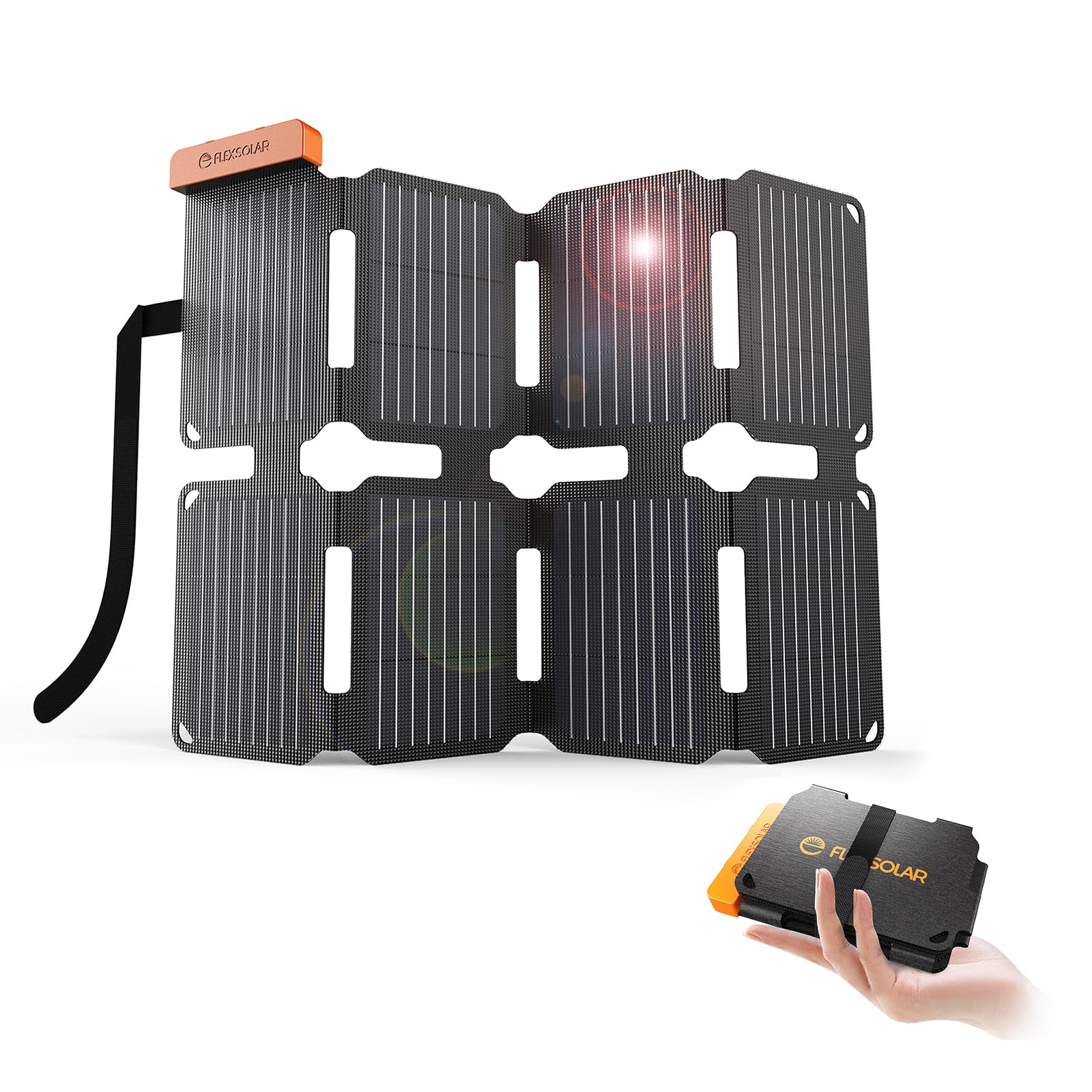
When you’re counting every ounce on the trail, the FlexSolar 25W earns its spot because it folds down to 7.7 x 5.1 inches and weighs just 1.2 lbs—smaller than most tablets—so it slips into your pack without adding bulk. It comes with its own carabiner system, letting you clip it to your backpack or tent in seconds, and the reinforced elastic strap holds it steady while you hike. Owners mention it still charges on cloudy days, and one reviewer even used it to power phones during a 7.4-magnitude earthquake outage, so you can rely on it when the grid fails.
The MPPT technology (a smart controller that boost energy harvest, even in partial shade) helps this panel punch above its weight. The dual USB-A and USB-C ports deliver simultaneous 5V/3A power to two devices. The IP67-rated components are built to handle dust and the occasional dunk in up to 1m of water for 30 minutes—though the fixed strap and included carabiners mean you’re ready to hang it and walk away.
Customers note an occasional unit with a finicky folding mechanism, so handle the hinges with care.
What You Gain
- Ultra-portable 1.2 lbs size that fits most packs
- Works in partial shade thanks to MPPT tech
- IP67 rating against dust and water immersion
The Trade-Off
- 25W is less than the 30W panels if you carry a power-hungry device
- Some owners find the folding hinge feels delicate
Reach for it when: You’re a gram-counter who wants a reliable, shade-tolerant panel clipped to your pack.
Look elsewhere if: You charge a laptop—25W won’t cut it.
3. SinKeu 40W Foldable Solar Panel Charger
The power-station bridge that 40 watts and ten DC tips turn into a camp-wide charging hub.
The included 10 DC adapters make it compatible with the majority of portable power stations and solar generators on the market. It offers 3 output ports: 1 DC output (18V/2.27A Max), 1 USB-C, and 1 USB QC3.0, so you can charge your phone, iPad, camera, GPS, and power bank all in one session. It folds to 13.3 x 11 x 2 inches and weighs 3.3 pounds, so it’s more basecamp than ultralight.
The 22% conversion efficiency is a touch lower than the 24% panels above, but the advantage here is the sheer versatility of the DC output. Owners note it holds a charge for 7 hours after a full sun session. The TIR-C technology identifies your devices and tune charging speed while protecting against overloading.
Reviewers point out it’s compact and convenient, but the power output is a recurring theme—it may not have enough wattage to charge most large portable power stations from empty. The USB-C port is the one to use for modern devices; the USB-A port lacks USB-C’s fast-negotiation protocol, so some newer phones charge slower.
The Strengths
- Charges a wide range of devices including small power stations
- 10-in-1 connector for broad compatibility
- Water-resistant and easy to clean
The Limits
- At 3.3 lbs, it’s heavy for long backpacking trips
- Some owners find it underpowered for large power stations
- The USB-A port feels dated compared to USB-C on other panels
Best for the car camper who needs one panel to feed a cooler, a camera, and a couple of phones.
Not for the ultralight who counts every pound in their pack.
4. SOLUPUP 30W Foldable Solar Charger
A rugged 30W panel that shrugs off a lake dunk and still charges your gear.
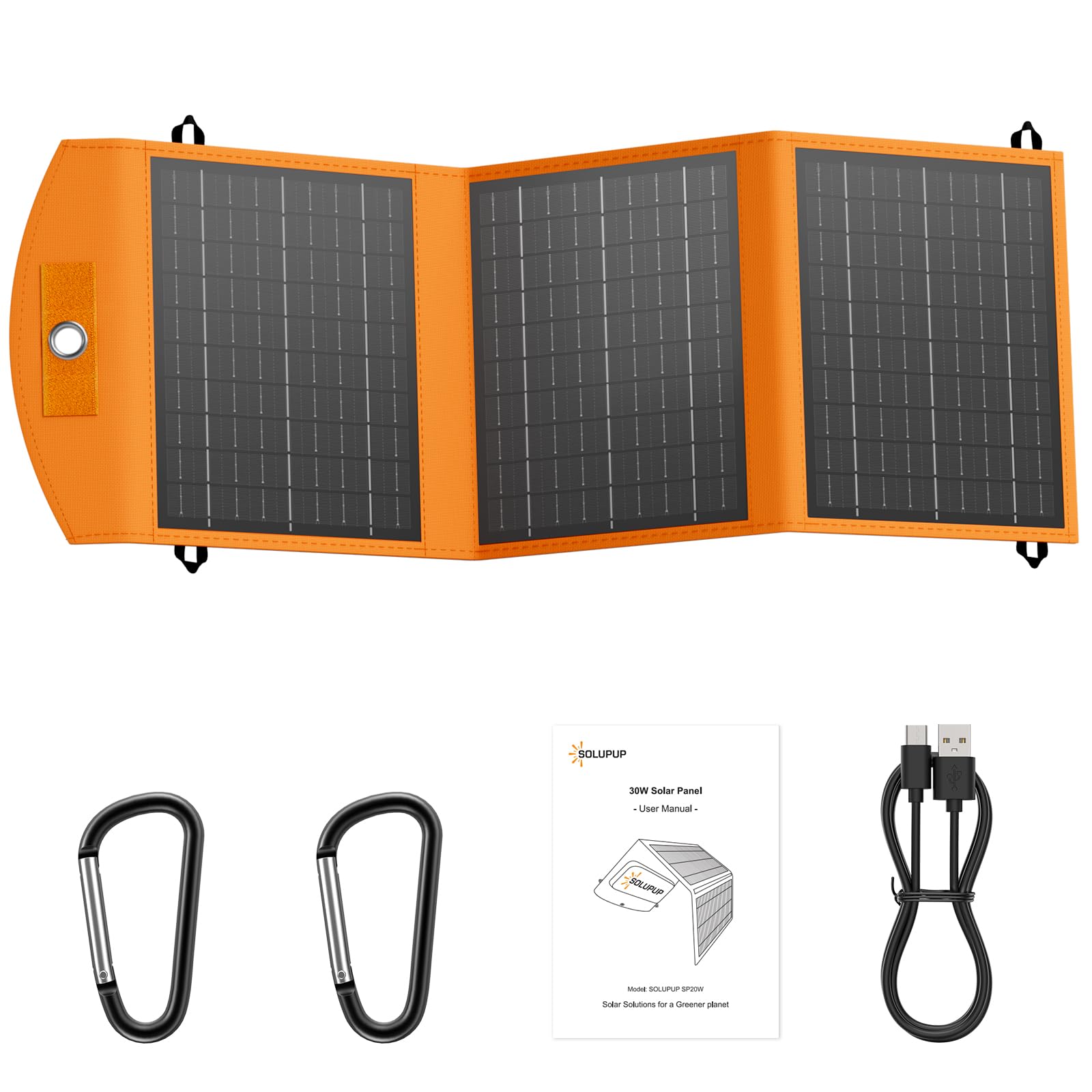
The SOLUPUP 30W grabs attention for one standout reason: it survived a lake submersion and still charged. That kind of real-world toughness comes from the high-efficiency monocrystalline silicon tech with a 23%+ conversion rate and an IPX5 waterproof rating that shrugs off rain and dust. It weighs 2.4 lb and folds to a compact 10.63 inches, matching the 30W class but with a tough, clipboard-sized build that’s easy to set up anywhere. The dual USB-A and Type-C ports (5V/3A, 15W max) let you charge two devices at once.
Buyers have used it for hurricane power outages and One owner reported it charged a drained 5000mAh battery in 3 hours on a sunny day.. The auto-optimization function reconnects automatically when sunlight is restored after a cloud passes, so you don’t have to babysit it. Owners praise the value—it’s under half the cost of comparable panels.
It’s a solid all-rounder, but it weighs about the same as the top pick while delivering slightly less efficiency. Some owners note it gets warm during charging—keep your phone in the shade while the panel soaks up the sun.
Why It Wins
- Proven to survive water exposure (IPX5)
- 23%+ efficiency for faster charging
- Adjustable stand and carabiners for hands-free use
Where It Falls Short
- 15W max per session is less than the 24% panels
- Some owners find it heavier than expected for its size
Grab it for: A reliable, waterproof 30W panel that won’t break the bank.
skip it if: You’re chasing the highest efficiency rating for cloudy trail days.
5. BigBlue 25W Ultra-Light Portable Solar Panel

The lightest meaningful panel here—0.84 lbs of pure charging efficiency for the ultralight purist.
For the backpacker who weighs their spoon, the BigBlue 25W is the lightest real charger on this list at just 0.84 lbs, folding down to the size of an iPad at 4.65 x 6.42 x 1.38 inches. It uses premium N-type solar cells without front metal lines, which capture more sunlight and maintain a conversion efficiency of up to 25.4%—the highest efficiency tier in this roundup. That means it keeps producing usable power when other panels are struggling.
It’s built with an IP68 rating, so it endures splashes, spills, and light rain—the panel itself is tough, though the ports need care. Buyers used it on backpacking trips and an Everest Base Camp hike, noting it recharges a small battery pack quickly and got 19 watts in direct sunlight on the trail.
Performance reviews are mixed on peak output—some report a max of 14W in full sun rather than the 25W advertised. But for topping up a phone or a small 10,000mAh power bank (which it charged in about 6 hours of sun), it’s an efficient, pack-friendly tool.
The Perks
- Astonishing 0.84 lbs weight for an ultralight pack
- Top-tier 25.4% conversion efficiency
- IP68 water and dust resistance
The Catch
- Real-world output can fall short of the 25W label
- Charger for Apple devices not included
The ultralight’s choice—the best watts-per-ounce ratio for a thru-hiker who charges small devices.
Look elsewhere if: You need to feed a tablet or camera battery quickly in peak sun.
6. BigBlue 30W Portable Solar Panel with DC Output

A high-efficiency 30W with a DC port for topping off small power stations on the trail.
The BigBlue 30W is the panel for backpackers who also carry a small power station. Beyond the fast-charging USB-A and PD 20W USB-C ports, it offers a DC 5521 output (17.4V/1.73A Max) that’s compatible with small power stations—a feature you rarely see at this weight. It hits an efficiency of up to 24.7% and weighs 1.76 lbs, folding to 7.95 x 12.12 x 1.46 inches. The PVDF surface provides up to 95% light transmittance, so more of the sun’s energy reaches the cells.
Shoppers say it’s the perfect companion for topping off a Bluetti or 200Ah battery in a trailer, and it’s been used to max out the solar input on an older Goal Zero Yeti X500. The DC output is the standout—it’s an uncommon but genuinely useful bridge between a portable panel and a small power station.
As with most panels, the junction box with the ports is not waterproof, even though the panel carries an IP68 rating for splashes and rain. Some buyers report the power output varies more than they’d like depending on shadows, so you’ll want to track the sun with this one.
The Advantages
- Versatile DC 5521 output for small power stations
- High 24.7% conversion efficiency
- Lightweight 1.76 lbs for a 30W panel
The Drawbacks
- Junction box isn’t waterproof despite IP68 rating
- Unstable built-in legs—some owners prop it up
Choose it for: Off-grid setups where a small power station is part of the kit.
Be mindful: The DC port adds value, but the flimsy stand means you’ll rig your own angle.
7. BigBlue 28W High-Efficiency Solar Panel Charger

The most-tested 28W in the category, trusted on cloudy ridgelines from Juneau to festival fields.
The BigBlue 28W is the veteran of this category, and the review volume speaks to that. It folds to just 11 x 6 x 1.4 inches and weighs only 1.5 lbs—compact enough for a tight backpack—yet pushes a 25.4% conversion efficiency that makes it a top performer in low light. It charges dead phones even under cloud cover; owners mention One owner reported it took a dead OnePlus 7 Pro from zero to 16% in 41 minutes under clouds., and Another kept a 10,000mAh power bank charged daily at a music festival..
The upgraded triple-port layout (dual USB-C and one USB-A) delivers a maximum output of 5V/3A per port, collectively hitting 5V/4.8A for simultaneous multi-device charging. The shadow-free surface design with advanced N-type solar cells offers superior low-light efficiency. The LED light glows solid blue when charging properly—your cue to relax and let it work.
Customers note this is a great unit for hiking and beach days. The performance is reliable if not lightning-fast, and it’s note the USB junction box isn’t waterproof.
The Strengths
- Proven to charge in cloudy conditions
- Ultra-portable at 1.5 lbs
- Triple-port setup for multiple devices
The Weak Spots
- Charges reliably but not fast in direct sun
- Not sufficient for laptops or large power stations
For the crowdsourced hiker who wants a trusted, widely-reviewed panel for cloudy trails and festivals.
Adjust expectations on peak sun speed—it’s a steady charger, not a sprint.
8. Ryno Tuff 21W Portable Solar Charger

A canvas-clad 21W workhorse that shrugs off drops and dust on a multi-day trek.
If you beat up your gear, the Ryno Tuff 21W is built for the abuse. The panel is covered in 600D PVC waterproof canvas—the whole thing weighs about a pound and folds into a 6″ x 12″ rectangle. It survived a fall from a moving vehicle without damage, and owners have used it on 5-day mountain treks where it charged 4 phones and 2 power banks over the trip. The durable build earns near-universal praise, and the included carabiner and reinforced rings make it easy to hang on a pack or tent.
It uses X-series sunpower solar panels with a high conversion rate of 22%-25%, compared to the 16%-18% of most panels. The output ports hide in a protective pocket where you can store devices while charging. Each USB port delivers up to 2.4 amps with a maximum of 3 amps when both are working. It works best as a power bank charger—owners found One owner found it took a 10,000mAh bank to full by 1pm on a sunny day..
The cable included is Micro USB, which feels dated. The brand plants a tree via the National Forest Foundation with every purchase.
The Strengths
- Nearly indestructible 600D PVC canvas build
- 22%-25% conversion efficiency
- Dual 2.4A USB ports with a protective pocket
The Trade-Offs
- 21W is lower-powered than most rivals here
- Comes with a Micro USB cable instead of USB-C
Reach for this if your gear takes a beating and you value a lifetime warranty over peak wattage.
pass on it if you need USB-C fast charging for modern phones.
9. LUMOPAL 60W Foldable Solar Panel Charger
The only 60W class panel here—built for basecamps and CPAP batteries, not ultralight grams.
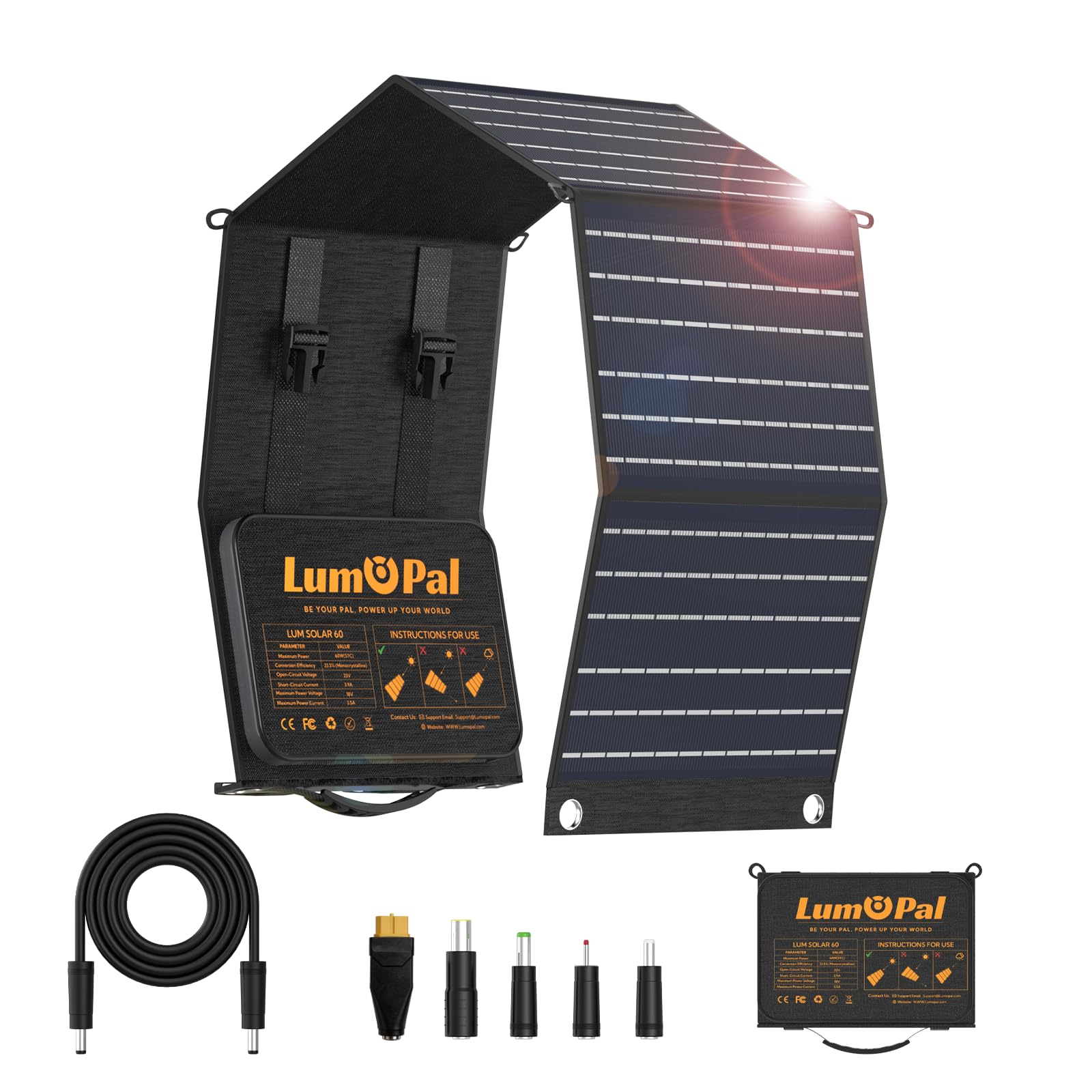
When your charging list includes a CPAP battery, a laptop, or a 300W power bank, the LUMOPAL 60W is the heavyweight answer. It delivers up to 60W via 2 QC3.0 USB-A ports (22W Max each), 1 PD USB-C (60W Max), and an 18-20V DC port. The 23.5% high-efficiency monocrystalline silicon cells fold down to just 6.7 x 9.5 inches and weigh 3.42 lb. When folded, it can withstand pressures of up to 176 lb, so it defies bumps in your pack.
Reviewers point out One owner charged a 33,800mAh battery to 85% by late morning in direct sun., and The same owner reported the battery fully charged by 1pm even with clouds rolling in.. Others charge a CPAP battery in 2-3 hours on sunny days. The IP65 waterproof panel, waterproof nylon fabric, and waterproof zip are all backed by a 12-month warranty.
The catch is that this is a premium-priced 60W class panel, and some shoppers say the real output tops out around 39-40W in ideal afternoon sun, rather than the full 60W. It’s also heavier and larger than standard 60W panels from other brands, so it’s best reserved for basecamp rather than a fast-moving summit bid.
The High Points
- 60W output for laptops, CPAP, and large power banks
- High 23.5% efficiency for cloudy days
- Can withstand 176 lb of pressure when folded
The Downsides
- 3.42 lb weight is heavy for backpacking
- Real-world output may top out below the 60W label
- No built-in kickstand—you’ll need to prop it up
Best for basecamp and vehicle camping where the weight is fine and the 60W throughput justifies the space.
Skip it for a thru-hike or summit push—a lighter 25-30W panel serves better.
Understanding the Specs
Wattage vs. Real-World Output
The wattage number on a panel is its theoretical maximum in perfect, overhead sunlight. On a real trail with clouds, shade, or a poor angle, you’ll often see half that. A 30W panel that converts 24% of sunlight will beat a 40W panel at 22% in weak light—so don’t chase the biggest number alone. Look at the efficiency rating to understand how the panel actually performs in the conditions you’ll face.
Conversion Efficiency
This percentage tells you how much of the sunlight hitting the panel actually becomes electricity. Panels in this category span about 22% to over 25%. The higher the number, the better the panel performs in weak sun, under clouds, or when it’s not perfectly angled. The top-tier panels here hit 25.4% efficiency; the entry-level units sit around 22%. For a backpacker who charges in the early morning or late afternoon, that gap is meaningful.
FAQ
Can I charge my phone directly from a solar panel while hiking?
What does the IP68 or IP67 waterproof rating actually mean?
Will a 30W panel charge my laptop or a large power station?
How long does it take to charge a 10,000mAh power bank?
Do these solar panels store electricity for later?
What is the difference between USB-A and USB-C on these panels?
How much weight do these panels add to my backpack?
Can I charge my devices on a cloudy day?
Final Thoughts: The Verdict
For most people, the backpacking solar chargers winner is the Luvknit 30W Portable Solar Panel because it pairs a strong value with a fast 24% conversion rate and a proven track record among owners. If you want a lighter option for the trail, grab the BigBlue 25W Ultra-Light at just 0.84 lbs with a top-tier 25.4% efficiency rating. And for charging power banks, laptops, or a CPAP battery at basecamp, the LUMOPAL 60W is the one to reach for when raw power beats pack weight.
How We Picked
We do not accept paid placement. Every pick is matched to a real buyer and a real use-case; we do not hands-on test units.
Sources & Methodology
Specifications: manufacturer listings and product documentation. Review insights: verified customer reviews, as of September 2026. Pricing: not shown on this page (it changes often); check the current price via the retailer link.
As an Amazon Associate, Gadgets Feed earns from qualifying purchases. This does not affect which products we feature.