
Our readers keep the lights on and my morning glass full of iced black tea. As an Amazon Associate, I earn from qualifying purchases.
Specs are compiled from manufacturer listings and verified buyer reviews and can change over time — please confirm the key details on the product page before buying.
When the lights go out, the real question is whether your sump pump keeps running and your fridge stays cold. A battery charger and inverter combo does double duty: it pulls power from your battery bank to run your appliances, and it tops that battery back up when the grid is alive. Top models switch to battery power in under 20ms, so your appliances keep running without a noticeable blip.
I’m Min — the founder and writer behind Gadgets Feed. This guide is built by comparing the manufacturers’ published specifications and the patterns across verified customer reviews, so you get each pick’s real strengths and trade-offs instead of marketing spin.
A charger-inverter combo keeps your lights and fridge running during an outage and recharges the battery when power returns. This guide to the battery charger and inverter market shows you which models actually deliver, based on real specs and owner feedback.
Our Picks at a Glance

How To Choose The Best Battery Charger And Inverter
First, match the unit to your battery bank’s voltage (the electrical pressure, measured in volts). A 12V unit cannot run on a 24V bank, and vice versa. Then, add up the wattage (power draw) of everything you will run at once — a sump pump, a few lights, a fridge — and pick an inverter rated above that total, so you have headroom for the extra surge when motors start.
Match the output wave to your devices
Pure sine wave output mimics the clean power from your wall socket. That keeps delicate gear like televisions, computers, and variable-speed pumps running smoothly without hum or interference. Cheaper modified sine wave units can work for simple resistive loads, but sensitive electronics may buzz or behave erratically.
Understand charger current and battery recovery
The charger’s amp rating determines how quickly your battery recovers after an outage. A higher charge current (in amps) refills your battery faster after an outage. If you run a heavy load like a sump pump for hours, a 25A or 40A charger brings the battery back much sooner than a sluggish 10A one, so you are ready for the next storm.
Quick Comparison
| Model | Best For | Power Output | Battery Voltage | Charge Current | Amazon |
|---|---|---|---|---|---|
| SUMRY Hybrid Solar Inverter Charger★ Best Overall | Off-grid solar with high wattage | 3600W | 24V | 100A AC | Amazon |
| Ampinvt 1200W Pure Sine Wave InverterBest for Backup | UPS backup for electronics | 1200W | 12V | 0–15A | Amazon |
| OLTEANP 1500W Sump Pump Backup | Basement flood protection | 1500W | 12V | 25A | Amazon |
| VIOPUMPO 2500W Backup System | Bigger pumps and longer runtimes | 2500W | 12V | 25A | Amazon |
| SunGoldPower 3000W Hybrid | Solar priority off-grid setups | 3000W | 24V | 40A AC | Amazon |
| Renogy 2000W Inverter Charger | RVs and boats | 2000W | 12V | 4-stage charger | Amazon |
| SunGoldPower 5000W UL1741 | Whole-house solar backup | 5000W | 48V | 100A max | Amazon |
In-Depth Reviews
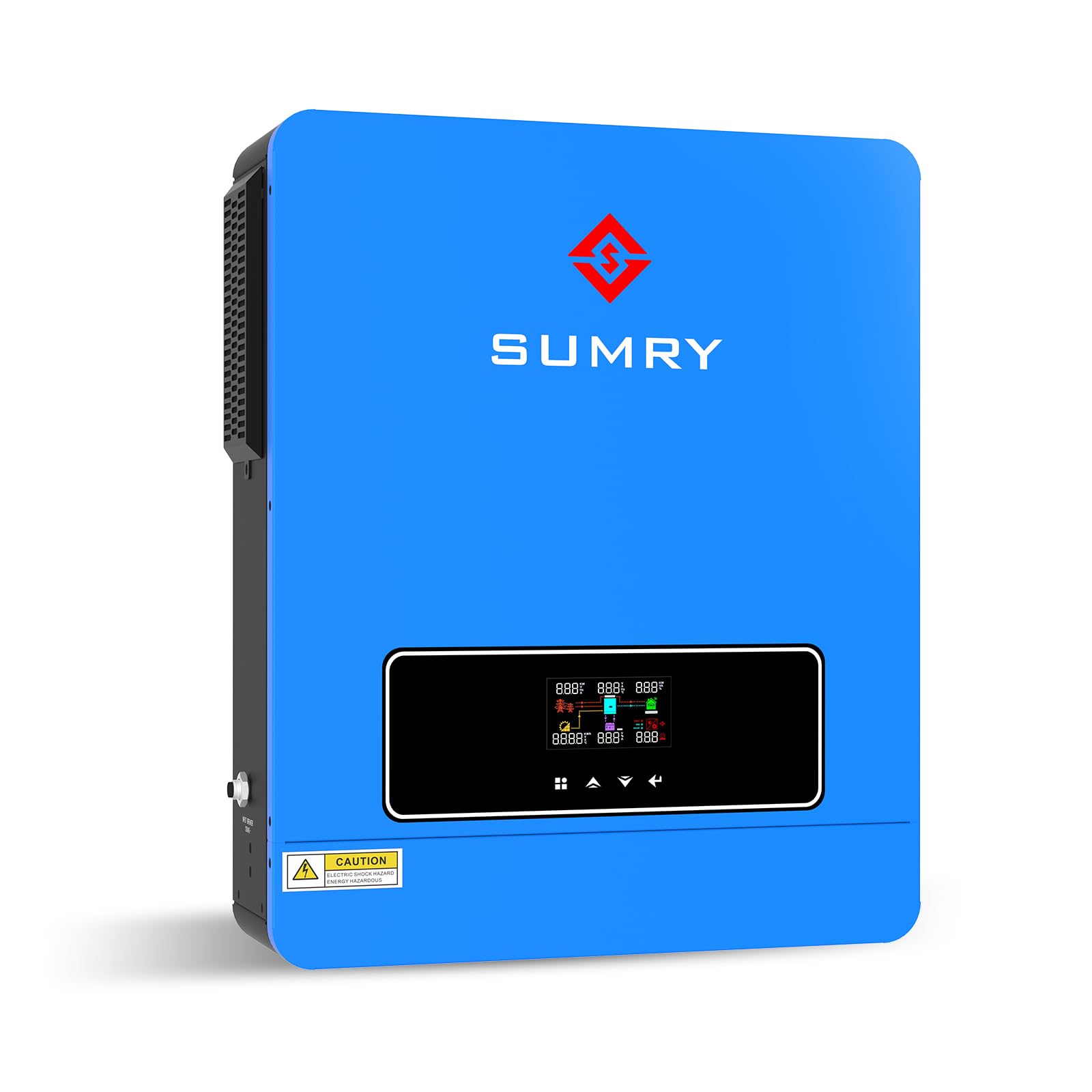
1. SUMRY Hybrid Solar Inverter Charger 3600W
Our pick — over 4.5★ from 150+ verified ratings; the strongest balance of quality and price.
This 3600W inverter combines solar and AC charging in one unit for versatile power management.
It’s a true all-in-one: 3600W continuous (7200W surge) inverter, 120A MPPT solar controller, and 100A AC charger. In a workshop or home, it automatically draws from solar, grid, or your 24V battery bank as needed.
It accepts 24V batteries across AGM, Gel, Lead-acid, Lithium-ion, and LiFePO4 chemistries, so it plays nice with whatever bank you already run. Buyers report the price is what won them over compared to a Victron inverter of similar capacity, calling it “great” with more features for the money. The onboard LCD display lets you adjust charging current and watch input and output status in real time.
The catch is the PV input needs to exceed 120V to run loads without a battery, so this leans toward setups with a proper solar array and a battery connected. At 8.5 kg with dimensions of 13.8″L x 4.3″W x 16.5″H, it is a substantial piece of gear that needs a shelf or wall space. Multiple protections — overload, overheat, over current, and short circuit — back up the daily operation.
Why It Earns the Top Spot
- Triple power input: solar, AC, and battery in one housing
- 7200W peak handles motor start-up surges
- Silent cooling fans keep the noise down
Who Should Think Twice
- Requires 24V battery bank, not 12V
- Battery needed to avoid grid power draw
Best for: Off-grid homes and workshops wanting solar plus AC charging in one box.
Not for: Anyone running a 12V system or expecting to skip a battery entirely.
2. Ampinvt 1200W Pure Sine Wave Inverter
A quiet UPS-style guardian with sub-17ms switchover that keeps your electronics alive when the grid drops.
This 1200W pure sine wave inverter doubles as a battery charger and AC auto-transfer switch, making it a natural UPS replacement for a fireplace blower, router, and computer gear. The switchover happens in under 17ms, fast enough that a GFCI plug does not trip and your loads never drop out.
What draws people in is the flexibility: charge current adjusts from 0 to 15A, with a 0A setting that turns charging off entirely. Five working modes — AC priority, battery priority, generator, ECO, and unattended — let you decide whether the unit runs from the grid or your 12V battery. Owners mention running a 100Ah LiFePO4 in AC Priority mode for 3 hours with no charge drop, and the pure sine wave output keeps sensitive electronics humming cleanly.
At 19 pounds with dimensions of 10″L x 5.1″W x 12.2″H, it is heavy enough that mounting to studs is the recommended approach. The recurring gripe is the fan, which runs constantly and loudly enough to hear upstairs, so plan to house it in a separate room or garage. This is a stationary backup champion, not an RV companion — the 15A max charge current is too slow for the 30-50A an RV bank typically wants.
At a glance: Fast, reliable UPS-style switching with clean sine wave output at a 1200W rating.
The honest trade-off: The always-on fan noise and modest 15A charge current limit it to fixed home backup duty.
3. OLTEANP 1500W Sump Pump Battery Backup
Basement flood insurance that switches to battery power instantly and recharges itself when the storm passes.
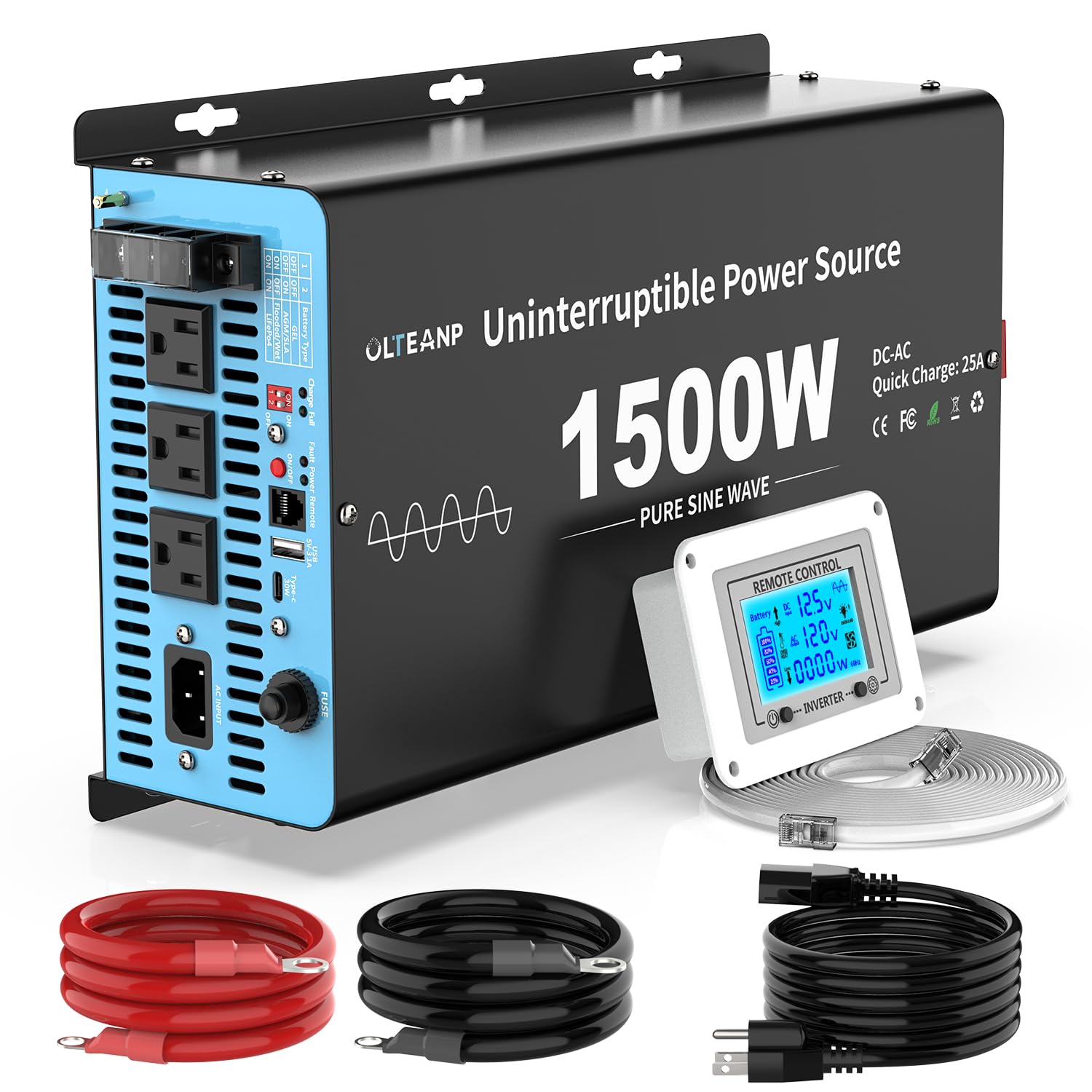
Built specifically for the flooded-basement nightmare, this 1500W pure sine wave system automatically transfers from grid to a 12V deep-cycle battery the moment utility power fails. With a built-in 25A multi-stage smart charger, it tune battery performance and extends lifespan through overcharge, overload, short circuit, low voltage, and overheat protection.
It includes 3 AC outlets plus a USB port and Type-C port, so you can also charge phones and run small essentials during an outage. The battery itself is not included, but it accepts LiFePO4, AGM, GEL, and Flooded deep-cycle batteries.
You can check battery voltage, load level, and operating mode at a glance on the LCD remote controller (a small screen you can mount away from the unit). The metal housing lets you wall-mount it or set it flat. One honest caveat: if the battery fully drains, the unit switches off and needs a manual power-on once AC power returns. A 12-month warranty with 24/7 customer support helps, since this device may sit in a basement for years.
What Stands Out
- 25A multi-stage charger recovers the battery fast
- 3 AC outlets plus USB and Type-C ports for essentials
- Works with LiFePO4, AGM, GEL, and Flooded batteries
The Real Limitation
- Manual restart needed after a full battery drain
- Battery sold separately adds to total cost
Reach for this if: You want a purpose-built sump pump guard that is easy to install and monitor.
Look elsewhere if: You expect completely hands-off auto-restart after a deep discharge.
4. VIOPUMPO 2500W Sump Pump Backup System

A 2500W brute that runs bigger pumps longer, with a built-in 25A charger that keeps your battery topped up.
When a 1500W unit is not quite enough, this 2500W pure sine wave system steps up for larger sump pumps and longer runtimes. It carries a built-in 25A battery charger that supports fast charging and trickle charging for deep-cycle lithium and AGM batteries, with overcharge protection designed to extend battery life rather than cook it.
Owners describe the installation as straightforward — no extra wiring, just connect the AC and DC cables, plug the pump into the AC socket, and it is ready. The high-definition LCD remote shows voltage, power, and battery charge status clearly, and buyers appreciate being able to check on the system from a distance. The setup is rated as easy and fast, with several noting it takes just a few minutes using a simple video guide.
The fan, however, is the trade-off: it runs quite often and is notably noisy, so this is not a unit for a living space. Charging speed also draws a mild complaint as slow, though the unit otherwise earns high marks for reliability during outages and flawless battery charging. A 12-month warranty backs every order, and the fixing holes let you lay it flat or mount it on a wall.
What wins people over: Reliable instant switching, clean pure sine wave output, and a charger that maintains the battery flawlessly.
The catch: The fan noise is real, and the charge rate is not the fastest on this list.
5. SunGoldPower 3000W DC 24V Pure Sine Wave Inverter

A solar-first workhorse that powers a shop or koi pond for months while keeping the grid as a safety net.
For those building a solar setup on a 24V bank, this 3000W inverter pairs an 80A MPPT solar charger with a 40A AC battery charger, so the sun does the heavy lifting and the grid backs it up. It delivers clean pure sine wave output and switches to battery within 10ms if the mains or generator drops, so your electronics never blink.
Four charging modes — AC priority, solar priority, only solar, and mains plus solar hybrid — give you real control over whether you burn sunshine or grid power. Owners running off-grid for months report it handles 1500W loads continuously, powering a workshop and koi ponds with solar priority charging and grid backup. The LCD/LED display shows system data and operating status at a glance, with optional WiFi or GPRS remote monitoring sold separately.
Build quality earns consistent praise, with buyers calling it sturdy and noting it never gets hot. Setup can be fiddly — some found it easy, others needed online research to nail the parameters, and one flagged that changing voltage settings resets the charge current to zero. At 15.5 pounds with dimensions of 15″L x 11″W x 3.9″H, it is a relatively light unit for its class, suited to off-grid cabins, vans, and workshops.
Core Strengths
- 80A MPPT pulls maximum power from solar panels
- 10ms UPS transfer protects sensitive electronics
- US-based customer support praised by owners
Setup Notes
- Programming parameters can be confusing for beginners
- WiFi monitoring module costs extra
Best for: Off-grid solar owners with a 24V bank who want the sun to charge first and the grid as backup.
Consider alternatives if: You want plug-and-play setup without diving into configuration menus.
6. Renogy 2000W Pure Sine Wave Inverter Charger

A campervan favorite from Renogy that runs your everyday appliances on a 12V bank with a 6000W surge cushion.
Renogy brings its solar ecosystem reputation to this 2000W pure sine wave inverter charger, delivering continuous power with surges up to 6000W for those moments a motor or compressor first kicks on. It works across GEL, AGM, SLA, FLD, CAL, and LI battery types, which is the kind of flexibility RV and boat owners appreciate when their bank chemistry varies.
The built-in 4-stage charger — bulk, boost, float, and equalization — automatically brings batteries to 100% capacity, taking the guesswork out of the charging cycle. Conversion efficiency sits above 90%, and the LCD display plus auto transfer switch make it a genuine grid-or-battery setup. Owners running it in campervans report solid performance over years of mostly 12V use, and the customer support team gets credit for walking through repair steps even after accidental damage.
The honest picture is more mixed than the top picks: some customers note it turning off unexpectedly, and the default high charge current can trip a generator breaker until you dial it down. The unit also draws about 1.5A DC from the battery at idle and runs noisy, so it is not the most efficient or quiet option. At 51.1 pounds with dimensions of 20.1″L x 11.2″W x 7.6″H, it is a hefty piece that demands real mounting space.
Best angle: A capable RV inverter with 4-stage charging and a strong brand ecosystem behind it.
The trade-off: Reliability feedback is split, and the idle draw plus noise make it less ideal for tight, quiet spaces.
7. SunGoldPower 5000W DC 48V UL1741 Solar Inverter

A 48V powerhouse that can run a whole house off solar and scale up to 30kW by linking six units together.
If you want to power an entire home, not just one pump, this 5000W DC 48V inverter (rated for 5000 watts of continuous output at 48 volts DC) carries UL1741 certification (a safety standard for grid-tied inverters). It includes a 100A combined solar-plus-AC charger and supports up to a 5500W, 500V PV array (the solar panel setup). Reviewers point out running eight circuits in a house through a critical load panel, with the unit taking over the moment the sun hits the panels.
The parallel capability is the standout: link six units for up to 30kW of power output, with 120V single phase, 120V/240V split phase beyond two units, and 208V 3-phase support beyond three. A loaded motor capacity of 4HP means it starts air compressors, bench grinders, and bandsaws without throwing alarms, and the 10ms UPS transfer protects computers and televisions through brief grid dips.
Battery charging covers 48V AGM, Gel, Flooded, and Lithium chemistries with a 40-60V charging range and an RS485 port for BMS communication. Four charging modes and four output modes give advanced users serious control over whether they burn solar, utility, or battery power. The noise level draws mixed feedback — some call it very quiet, one reports a loud buzzing — so placement matters. It requires 120-450V solar input, so low-voltage panels will not work without a boost.
Why It Is the Endgame
- UL1741 certified for grid-tied and off-grid safety
- Scalable to 30kW with parallel linking
- Starts 4HP motors without nuisance shutdowns
Things to Plan For
- Needs 120-450V solar input, so low-voltage panels fail
- Terminal access is tight with no strain relief
Step up to this if: You want whole-house backup with room to grow into split-phase or 3-phase power later.
Start smaller if: You only need to keep a single pump or fridge alive during outages.
Understanding the Specs
Continuous vs. Peak Wattage
Continuous wattage is what the inverter delivers non-stop, like the 3600W on the SUMRY or the 1200W on the Ampinvt. Peak wattage is the short burst it can handle when a motor first starts — the SUMRY jumps to 7200W peak, and the Renogy surges to 6000W. Always size the continuous rating above your total running load, and keep peak in mind for that first-second draw.
Amps and Battery Voltage
The voltage rating — 12V, 24V, or 48V — must match your battery bank exactly, because a 24V inverter will not run on a 12V battery. Amp-hours (like the 100Ah LiFePO4 batteries owners pair with these units) tell you the battery’s energy capacity, while the charger’s amp rating (15A, 25A, 40A, or 100A) tells you how fast it refills that bank after an outage. Higher amp chargers restore your battery’s capacity sooner, so you’re ready for the next outage.
FAQ
What is the difference between pure sine wave and modified sine wave inverters?
How do I know if I need a 12V, 24V, or 48V inverter?
Will a battery charger and inverter combo work with a LiFePO4 battery?
How long will a battery backup run my sump pump during an outage?
What does the auto transfer switch do?
Can these units charge the battery while also powering my appliances?
What is MPPT solar charging and why does it matter?
How noisy are these inverter chargers when running?
Final Thoughts: The Verdict
For most people, the clear battery charger and inverter winner is the SUMRY Hybrid Solar Inverter Charger. It packs a 3600W inverter, a 120A MPPT solar controller (a device that tune solar panel output), and a 100A AC charger into one box, at a value owners say beats the big-name competition. If you need dedicated basement flood protection, the OLTEANP 1500W Sump Pump Backup is purpose-built for that, with a 25A fast charger. For whole-house solar power, the SunGoldPower 5000W supports parallel connection up to 30kW, so you can scale up. The crowd favorite — the SUMRY — holds a strong 4.6-star score from over 170 owners, making it the safest bet for most setups.
How We Picked
We do not accept paid placement. Every pick is matched to a real buyer and a real use-case; we do not hands-on test units.
Sources & Methodology
Specifications: manufacturer listings and product documentation. Review insights: verified customer reviews, as of September 2026. Pricing: not shown on this page (it changes often); check the current price via the retailer link.
As an Amazon Associate, Gadgets Feed earns from qualifying purchases. This does not affect which products we feature.