
That buttery, silver-halide grain and the tactile thwack of a mechanical shutter are sensations no digital sensor has ever replicated. The 35mm film cameras of the 1990s hit a rare sweet spot — they packed in useful autofocus, built-in flashes, and program modes without fully surrendering to the plastic, disposable mindset of the decades that followed. Whether you crave the quiet precision of a manual classic or the one-handed grab-and-shoot convenience of a point-and-shoot, the right 90s body will define your entire analog experience.
I’m Min — the co-founder and writer behind Gadgets Feed. This guide is the result of cross-referencing over a hundred verified buyer reports, weighing zone-focus systems against phase-detect autofocus, and researching the build quality and lens ecosystems that actually separate a keeper from a shelf-weight.
After countless hours of digging through real-world feedback and spec sheets, I’ve narrowed the field to the strongest options available right now for anyone searching for a best 90s film camera that actually delivers on its promise.
How To Choose The Best 90s Film Camera
A 90s film camera isn’t just a nostalgia purchase — it’s a tool with real mechanical and optical DNA that differs wildly between a plastic-bodied point-and-shoot and a full-metal SLR. The right choice depends on how much control you want, your tolerance for used electronics, and whether you value portability over lens flexibility.
Manual SLR vs. Autofocus SLR vs. Point-and-Shoot
Manual SLRs like the Pentax K1000 give you total creative command but demand you meter and focus every frame yourself — excellent for learning exposure. Autofocus SLRs such as the Canon Rebel 2000 or EOS Kiss bring 7-point phase-detect AF and multiple program modes, making them faster for everyday shooting. True 90s point-and-shoots are compact but often have slower contrast-detect AF and fewer options to override their auto-exposure.
Light Meter and Shutter Accuracy
A dead or drifting light meter is the single most common failure in renewed 90s bodies. Always verify that the meter responds to changing light (covering the lens should move the needle or LED). Shutter speeds should sound crisp at 1/1000s and consistent at 1/2s — any hesitation or drag indicates decaying lubricant that will only worsen.
Lens Mount and System Compatibility
Canon’s EF mount (Rebel series) offers the widest selection of affordable autofocus lenses today, including modern USM glass. The Pentax K mount is robust but manual-focus-only on the K1000. If you want to adapt vintage glass, stick to a body with a mechanical linkage (FD on the AE-1, K mount on Pentax) rather than the more electronic EF system.
Quick Comparison
On smaller screens, swipe sideways to see the full table.
| Model | Category | Best For | Key Spec | Amazon |
|---|---|---|---|---|
| Pentax 17 | Half-Frame | Budget film savings with 72 shots per roll | 25mm f/3.5 lens, zone-focus, 6 zones | Amazon |
| Canon AE-1 | Manual SLR | Vintage handling with shutter-priority AE | 50mm f/1.8 FD lens, TTL metering | Amazon |
| Pentax K1000 | Manual SLR | Pure mechanical reliability with no battery dependence | 50mm f/2 prime lens, all-mechanical | Amazon |
| Canon Rebel 2000 | Autofocus SLR | Fast 7-point AF with full program modes | 28-80mm EF zoom, auto wind/rewind | Amazon |
| Canon EOS Kiss | Autofocus SLR | Lightweight walkaround with ISO up to 3200 | 35-80mm EF zoom, 30s max shutter | Amazon |
| Halina Tegra AF290 | Point-and-Shoot | Ultra-compact retro carry with wide angle | 28mm f/2.8 lens, contrast AF | Amazon |
| KODAK Snapic A1 | Point-and-Shoot | Budget-friendly entry with glass lens | 3-element glass lens, 2-zone focus | Amazon |
In‑Depth Reviews
1. Pentax 17 Half-Frame 35mm Camera

The Pentax 17 is not a true 90s relic — it is a brand-new camera engineered from the ground up with a 90s-inspired design language. What makes it remarkable is the half-frame format: it captures two vertical 17mm x 24mm images on a single 35mm frame, giving you 72 exposures per 36-exposure roll. The 25mm f/3.5 lens (37mm equivalent) is coated with Pentax’s HD coating, the same treatment used on their high-end SLR glass, delivering noticeably sharper results than budget point-and-shoots.
The zone-focus system splits distance into six clearly marked zones, from macro to infinity, which means no hunting through a viewfinder — just set it and shoot. The magnesium alloy top and bottom plates give the body a dense, premium feel that contrasts sharply with the hollow plastic of most 90s compacts. The manual film advance lever recreates that tactile satisfaction of winding the frame, and the quiet shutter is genuinely discreet for street photography or candids.
Real-world feedback highlights the film savings: one roll of Portra 400 becomes two rolls of usable images. The trade-off is that each half-frame image is smaller, meaning lower resolution when scanning, but sharp enough for social media and 4×6 prints. Users report the zone-focus takes a few rolls to internalize, and the fixed lens means no wide or telephoto options. At its price point it straddles premium, but the build quality and lens performance justify it for anyone who shoots regularly.
Why it’s great
- 72 shots per 36-exposure roll halves your film cost
- HD-coated lens delivers superior contrast and sharpness
- Magnesium alloy construction feels premium and durable
Good to know
- Half-frame format limits scan resolution compared to full-frame
- Zone-focus can be imprecise for critical close-ups without practice
- Fixed 25mm lens cannot be swapped or zoomed
2. Canon AE-1 35mm SLR with 50mm f/1.8

The Canon AE-1 is the camera that taught a generation how to shoot in manual. Originally released in 1976 but produced well into the 80s, the renewed copies you find today often pair the chrome-top body with a 50mm f/1.8 FD lens that is sharp, fast, and cheap to replace. The shutter-priority auto-exposure mode lets you dial in a speed and let the camera set the aperture — a helpful bridge between point-and-shoot simplicity and full manual control.
The TTL metering system is center-weighted and surprisingly accurate for its age, though it relies on a single 6V silver oxide battery (4LR44) that is still easy to find. The all-metal body gives it a heft that feels substantial in hand — about 590g with the lens attached. The FD lens mount means you can use a vast library of Canon’s vintage glass, from the cheap 28mm f/2.8 to the legendary 85mm f/1.2, all adapted with no electronic limitations since the AE-1 is fully mechanical except for the meter.
Buyers consistently report that renewed units from reputable refurbishers arrive in near-mint condition with working meters, though the shutter speeds should be tested from 1/1000s down to bulb immediately. The camera has no autofocus, no program mode, and no built-in flash, so it is a commitment to the manual process. But for those who want the look of a 90s movie prop and the versatility of interchangeable FD lenses, this is the definitive analog SLR.
Why it’s great
- Shutter-priority AE is intuitive and fast for street shooting
- Huge selection of affordable FD-mount lenses available
- Metal construction easily outlasts plastic contemporaries
Good to know
- No autofocus — full manual focus only
- Light meter requires a rare-ish 4LR44 battery
- Shutter accuracy can drift on units without recent CLA
3. Pentax K1000 Manual SLR with 50mm Lens

The Pentax K1000 is the textbook definition of a student film camera, and for good reason: it is fully mechanical, requires no batteries to operate the shutter, and features a simple match-needle light meter that teaches the exposure triangle by force. The renewed units usually come with a 50mm f/2 prime lens — a solid, sharp standard that offers a natural field of view and decent low-light capabilities thanks to the f/2 maximum aperture.
Because the camera has zero electronics beyond the meter, there is almost nothing to fail. The all-metal body and cloth focal-plane shutter are robust enough to survive decades of use if stored properly. The Pentax K mount is one of the most widely produced lens mounts in history, giving you access to thousands of lenses from Takumar to modern Sigma and Tamron glass, all adaptable without any electronic contact issues.
Buyers should immediately test the light meter by pointing the camera at a bright lamp and then into a dark corner — the needle should move across the full range. A dead meter is a common issue on second-hand units, though even with a dead meter the camera is still fully usable with an external meter or the Sunny 16 rule. The lack of a built-in flash means you will need a hot-shoe unit, adding bulk, but the reward is a camera that will outlive its owner with minimal maintenance.
Why it’s great
- Fully mechanical shutter works without any battery
- Massive K-mount lens ecosystem at low prices
- Match-needle meter is a pure learning tool for exposure
Good to know
- No autofocus, no program modes, no built-in flash
- Light meter dies on many second-hand units — test immediately
- Heavier than plastic SLRs at roughly 650g with lens
4. Canon Rebel 2000 SLR with 28-80mm Lens
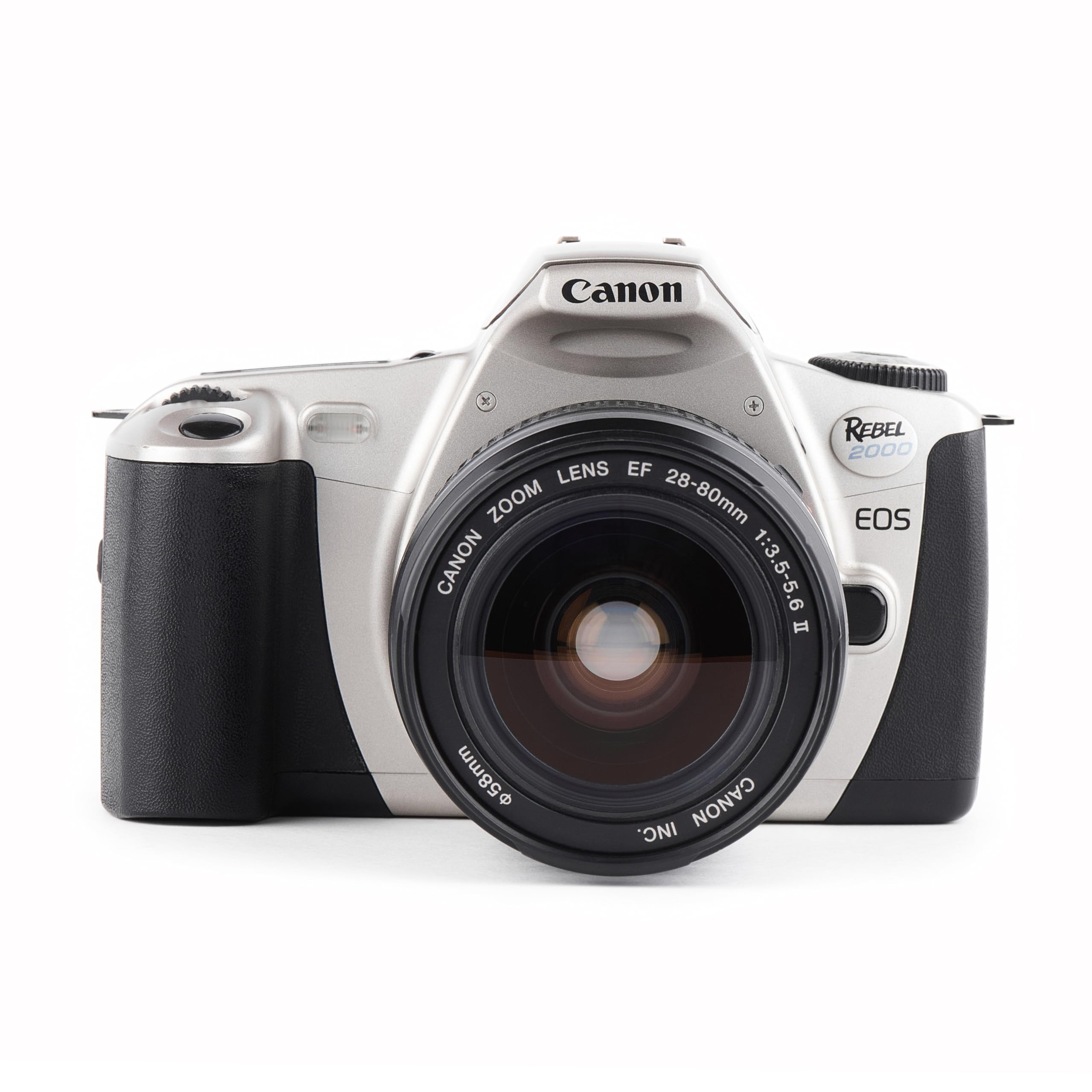
The Canon Rebel 2000 (EOS 300 in Europe) is a definitive 90s autofocus SLR that brings genuine speed to analog photography. Its 7-point autofocus system is fast and decisive in good light, and the 35-zone evaluative metering means you can hand it to a beginner and get properly exposed frames every time. The included 28-80mm f/3.5-5.6 EF zoom is not optically remarkable, but it covers a useful walkaround range from moderate wide-angle to short telephoto.
The body is lightweight polycarbonate over a stainless steel chassis — not premium, but durable enough for everyday carry. The camera supports four exposure modes: Program AE, aperture priority, shutter priority, and full manual, plus a built-in pop-up flash with red-eye reduction. Automatic film loading, advance, and rewind mean you can shoot a roll without ever touching the film spool, and the LCD panel on top provides clear feedback on remaining frames, battery life, and flash status.
Crucially, the Rebel 2000 uses the Canon EF mount, which means compatibility with every EF and EF-S lens Canon ever made — including modern STM and USM lenses that will autofocus and meter without any adapter. The catch is that the viewfinder is small and dim compared to an AE-1 or K1000, and the plastic build can feel hollow. Renewed units sometimes arrive with battery corrosion or a sticky shutter button, so buy from a seller with a solid return policy.
Why it’s great
- 7-point phase-detect AF locks on faster than any manual focus
- EF mount works with 30 years of Canon lenses including modern glass
- Auto wind, rewind, and flash make it a true grab-and-go device
Good to know
- Polycarbonate body feels less premium than metal SLRs
- Viewfinder is small and not very bright for manual focusing
- Battery corrosion is common on older units — inspect before buying
5. Canon New EOS Kiss with 35-80mm Lens

The Canon New EOS Kiss — sold as the Rebel G in North America — is one of the lightest autofocus SLRs Canon ever built, weighing only about 340g for the body alone. This makes it an ideal walkaround camera for travel, hiking, or any scenario where carrying a heavier metal body would get old by lunchtime. Despite the light weight, it retains a metal lens mount and solid construction that has held up well over 30 years.
The autofocus system uses a single wide-area AF point, which is less precise than the 7-point system on the Rebel 2000 but perfectly adequate for most everyday shooting. The camera supports program, aperture priority, shutter priority, and full manual modes, and the built-in pop-up flash works reliably for fill light or low-light situations. The 35-80mm f/4-5.6 EF zoom lens bundled is not fast, but it is compact and produces decent results stopped down to f/8.
Buyers consistently praise the battery life, with many reporting a single 2CR5 lithium cell lasting through multiple rolls over months of use. The LCD screen is clear and easy to read, and the intuitive button layout means you can change settings without taking your eye from the viewfinder. The main downsides are the single-point AF (which can hunt in low contrast) and the noisy film advance motor that draws attention in quiet settings. For a lightweight, reliable daily shooter with full lens compatibility, this is a top contender.
Why it’s great
- Body-only weight under 350g — one of the lightest SLRs ever
- EF mount works with every Canon EF/EF-S lens ever made
- Battery lasts for many rolls on a single 2CR5 cell
Good to know
- Single AF point is slower and less accurate than 7-point systems
- Film advance motor is noticeably loud
- No dedicated ISO override dial — must enter menu
6. Halina Tegra AF290 Point and Shoot

The Halina Tegra AF290 is a compact 90s-style point-and-shoot that packs a 28mm f/2.8 wide-angle lens into a small, retro-styled body. For street photography and architecture, the wider field of view captures more context than the standard 35mm or 38mm lenses found on most point-and-shoots of the era. The contrast-detect autofocus system is not lightning fast, but it is consistent in daylight conditions and yields sharp results when the subject is within 2-3 meters.
The camera runs on 2x AA batteries, which is convenient compared to obscure lithium cells. The built-in flash fires automatically in low light, and the sliding lens cover doubles as the power switch. The zone-focus dial on the lens lets you override the AF and set distance manually for creative control or faster shooting. The 28mm f/2.8 aperture is reasonably fast for a compact, giving you usable results in dim interiors without flash.
Buyer feedback is mixed on reliability: some units arrive with jammed focus dials, sticky paint, or film shredding issues. This camera is a gamble on the second-hand market, and the price should reflect that risk. When it works, it delivers a genuinely retro look with good color rendering from the multi-coated glass. The plastic body feels light and a bit cheap, but the wide-angle perspective is unique enough at this price tier to justify the risk for adventurous shooters.
Why it’s great
- 28mm f/2.8 wide-angle lens offers a unique perspective
- Runs on standard AA batteries, easy to replace anywhere
- Manual zone override lets you focus creatively
Good to know
- Quality control is inconsistent — some units arrive broken
- Plastic build feels cheap and can suffer paint issues
- Contrast AF can struggle in low contrast or low light
7. KODAK Snapic A1 35mm Camera
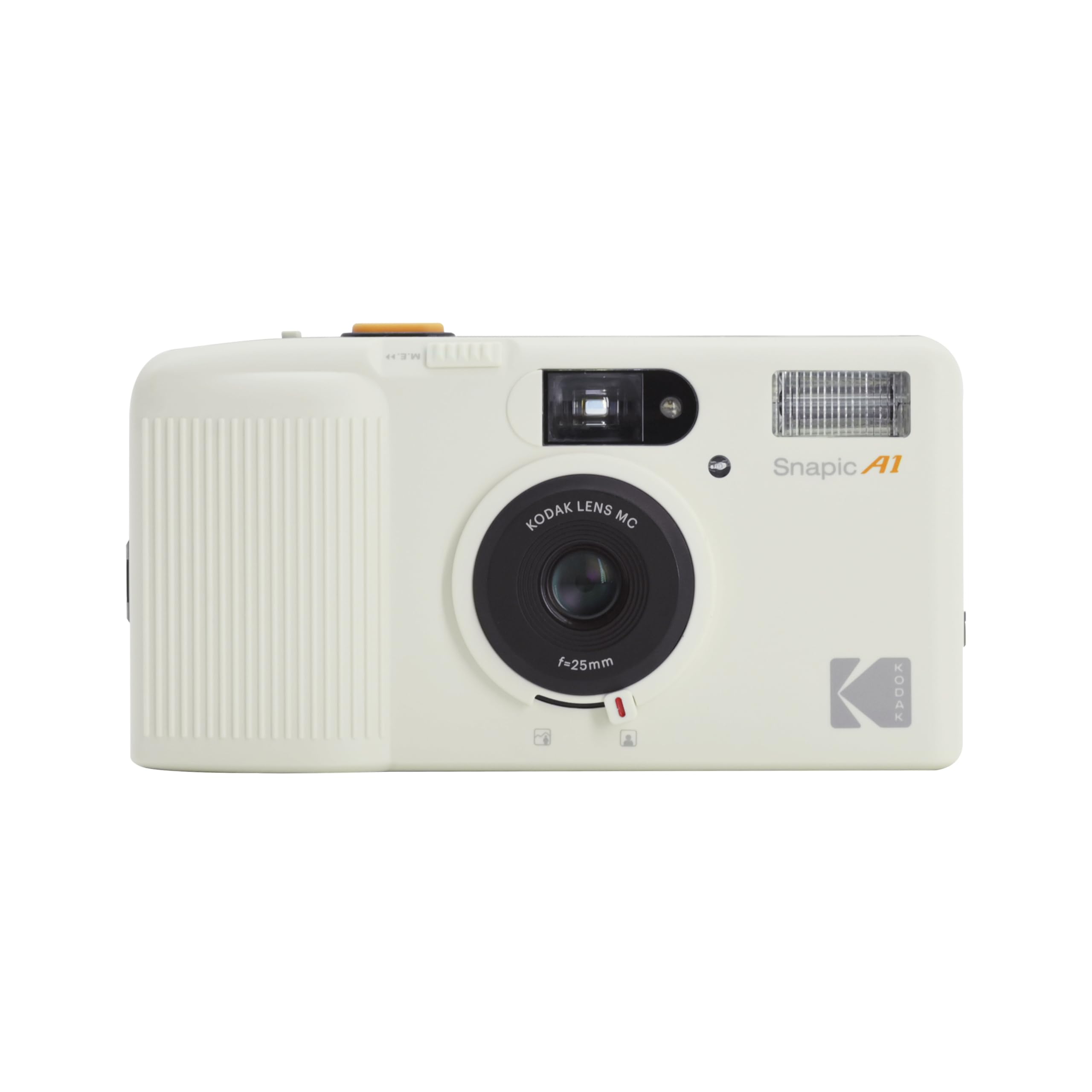
The KODAK Snapic A1 is a modern reimagining of the 90s point-and-shoot, built around a 3-element glass lens that produces noticeably sharper images than the plastic lenses found on disposable cameras and ultra-budget point-and-shoots. The 2-zone focus system lets you switch between standard and portrait distances, and the built-in auto flash includes red-eye reduction — a genuinely useful feature for indoor social shots. At just 117g, it is the lightest camera in this roundup, easily slipping into a jacket pocket.
The multiple exposure feature lets you blend two scenes on a single frame, unlocking creative double-exposure shots without needing a darkroom trick or a complicated manual wind. The camera is fully automatic — drop in a roll of 35mm film (Kodak Gold 200 is the recommended pairing), pop in a AAA alkaline battery, and shoot. The lack of any manual controls means the Snapic A1 is best suited for beginners or as a low-stakes everyday shooter, not for photographers who want to dial in exposure.
Buyers report that the auto-exposure system biases toward underexposure in backlit scenes, and the flash button on the front is easy to press accidentally. Night shots without flash are essentially unusable. However, for bright daylight use with a standard color negative film, the 3-element glass lens delivers a clean, warm aesthetic that digital phone filters cannot quite replicate. It is a fun, fuss-free camera at the budget end of the spectrum.
Why it’s great
- Glass lens produces sharper images than plastic-lens competitors
- Double-exposure function is creative and easy to use
- Ultra-light at 117g — truly pocketable
Good to know
- Auto-exposure underexposes in backlit scenes
- Flash button is prone to accidental presses
- No manual controls — fully automatic only
FAQ
Which 90s film camera has the best autofocus system for action shots?
Is a half-frame camera like the Pentax 17 worth it over a standard 35mm SLR?
How do I check if a renewed 90s SLR has a working light meter?
Final Thoughts: The Verdict
For most users, the best 90s film camera winner is the Pentax 17 because it combines a genuinely sharp HD-coated lens with the half-frame format that saves real money on film while delivering that tactile analog experience. If you want the all-metal manual classic with interchangeable FD lenses, grab the Canon AE-1. And for a lightweight do-everything autofocus SLR that uses modern EF glass, nothing beats the Canon Rebel 2000.