
Our readers keep the lights on and my morning glass full of iced black tea. As an Amazon Associate, I earn from qualifying purchases.
Specs are compiled from manufacturer listings and verified buyer reviews and can change over time — please confirm the key details on the product page before buying.
Your reef tank loses water to evaporation every day, and an ATO (auto top-off system — a small sensor-and-pump setup) replaces that water automatically, so your salinity stays stable whether you are at work or on vacation. The core decision is sensor type: optical sensors read water level with light and are fast and precise, while float switches are mechanical, simple, and can stick or fail over time. Here are 9 of the most popular units on the market, weighed by sensor reliability, pump durability, and real owner experiences, so you can pick the one that won’t dump your reservoir into your sump at 3 a.m.
I’m Min — the founder and writer behind Gadgets Feed. This guide is built by comparing the manufacturers’ published specifications and the patterns across verified customer reviews, so you get each pick’s real strengths and trade-offs instead of marketing spin.
Reef tanks live or die by stable salinity, and the right ato for reef tank is what protects your corals and fish from evaporation-driven swings while you are away from the glass.
Our Picks at a Glance

How To Choose The Best ATO For Reef Tank
Buying an ATO is really an exercise in risk management — every unit adds water automatically, and the difference between a great one and a frustrating one is how gracefully it handles failure. Before you buy, understand the few specs that separate a set-and-forget system from one that becomes a recurring headache.
Sensor Type: Optical vs. Float
Optical sensors use an infrared beam to detect the water’s surface, which makes them instant, accurate to a millimeter, and immune to the salt creep that can eventually jam moving parts. Float switches are cheaper and mechanically simple, but the plastic arm and hinge can collect salt or debris over months and stick in the “on” position — the classic cause of a silent flood. For a reef where a small salinity swing stresses corals, the precision of optical is usually worth seeking out.
Safety and Redundancy
The best systems ship with more than one line of defense. A secondary high-level sensor can cut power before water reaches the tank rim, while a dry-run sensor stops the pump when your reservoir runs empty so it never burns out. Look for units that also time their refills — if the pump runs suspiciously long, a smart controller should alarm and shut down instead of pumping your whole bucket into the tank.
Pump Power and Placement
Lift height and flow rate tell you whether the pump can actually push water from your reservoir up into a sump. A nano unit with a short head works fine when the reservoir sits level with the tank, but a taller stand or a basement-level bucket needs more lift. Also check where the sensor mounts — slim optical probes fit rimless tanks and small sumps far more gracefully than bulky float brackets.
Quick Comparison
| Model | Best For | Sensor Type | Lift Height | Dry-Run Shutoff | Amazon |
|---|---|---|---|---|---|
| LAZYBONE AQUA ATO★ Best Overall | Compact, single-piece reliability | Triple Optical | Not stated | Yes | Amazon |
| Useek ATOBest Value | Value and quiet operation | Infrared | Not stated | QST monitor | Amazon |
| ATET ATOQuietest Pick | Near-silent micro pumps | Dual Optical | 2.5 meters | QST monitor | Amazon |
| MagTool ATO | Balanced feature set | Dual Optical | 8.2 feet | Yes | Amazon |
| FZONE ATO | Controller-rich safety features | Dual Optical | 2 meters | Yes | Amazon |
| Kamoer ATO One 2 SE | Enthusiasts wanting modular sensors | Dual Optical | 1.5 m height diff | Yes | Amazon |
| JBJ Nano ATO | Legacy brand for small tanks | Dual Optical | 7.2 ft | Not stated | Amazon |
| DIGITEN ATO-19 | Budget-friendly float switch | Dual Float | 78.74 inches | No | Amazon |
| DIGITEN ATO19-1 | Entry-level float switch | Dual Float | Not stated | No | Amazon |
In-Depth Reviews
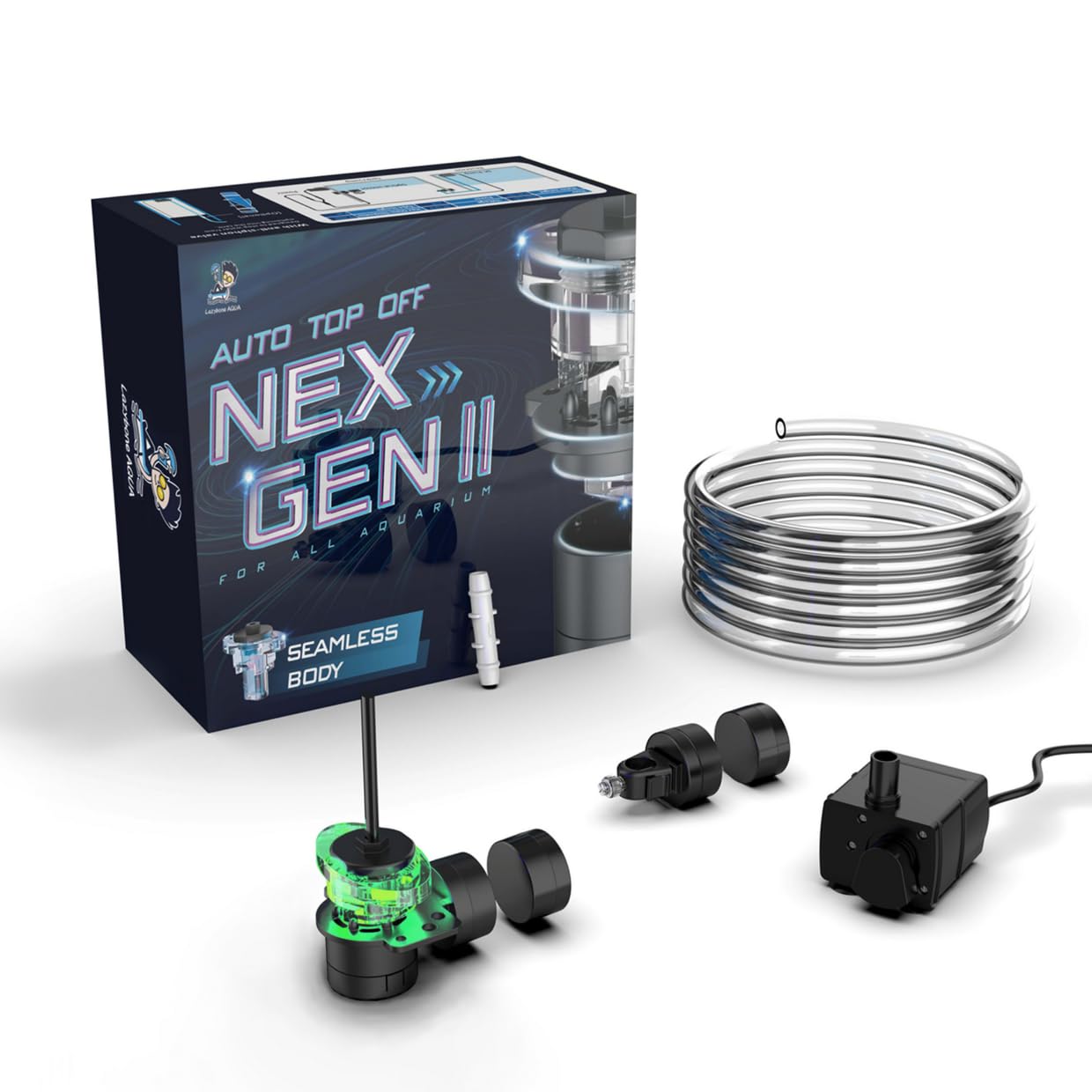
1. LAZYBONE AQUA Saltwater Auto Top Off
Our pick — over 4★ from 150+ verified ratings; the strongest balance of quality and price.
The single-piece probe that turns the whole controller into one tiny sealed unit
Most ATOs come in two or three separate boxes — a controller here, a sensor there — but LAZYBONE fuses the full controller into a single compact probe. The one-piece, double-layer sealed body is the whole point: no external box means fewer parts, fewer salt-creep pathways, and fewer failure points over the months of wet, salty service a reef tank demands.
That probe carries triple optical sensors plus an AI adaptive algorithm that learns your tank’s evaporation rate and adjusts refill timing automatically. For you, that translates to fewer unnecessary pump cycles, which is exactly what extends pump life. The custom pump pulls from a lower reservoir level to grab the last usable water, and it auto-shuts off if the water runs out, while a high-level sensor cuts power to prevent floods.
Buyers report weeks of quiet, stable operation, calling it a must-have for automated top-offs. Owners consistently cite reliability as the top reason they recommend this unit. The 2-year probe and 1-year pump warranty, plus responsive aquarist support, add unusual protection at this price. On the durability side, one owner reported a plug shorting after weeks of use and causing smoke damage, so treat the included power supply with care and use a quality power strip.
What Owners Love
- Runs for weeks without issues, keeping water level stable and quiet
- Compact sealed probe fits tight spaces and resists salt creep
- Strong dry-run and overflow protection for confidence
Honest Trade-Offs
- At 0.96 kg it is the heaviest unit here — 2.4x the weight of the Useek
- A rare but serious report of a power plug shorting after extended use
Best fit for: nano and rimless reef keepers who want a discreet, low-part-count system they can trust for weeks of stable salinity.
Look elsewhere if: you demand a proven long track record — this is a newer design with a shorter owner history than the established brands.
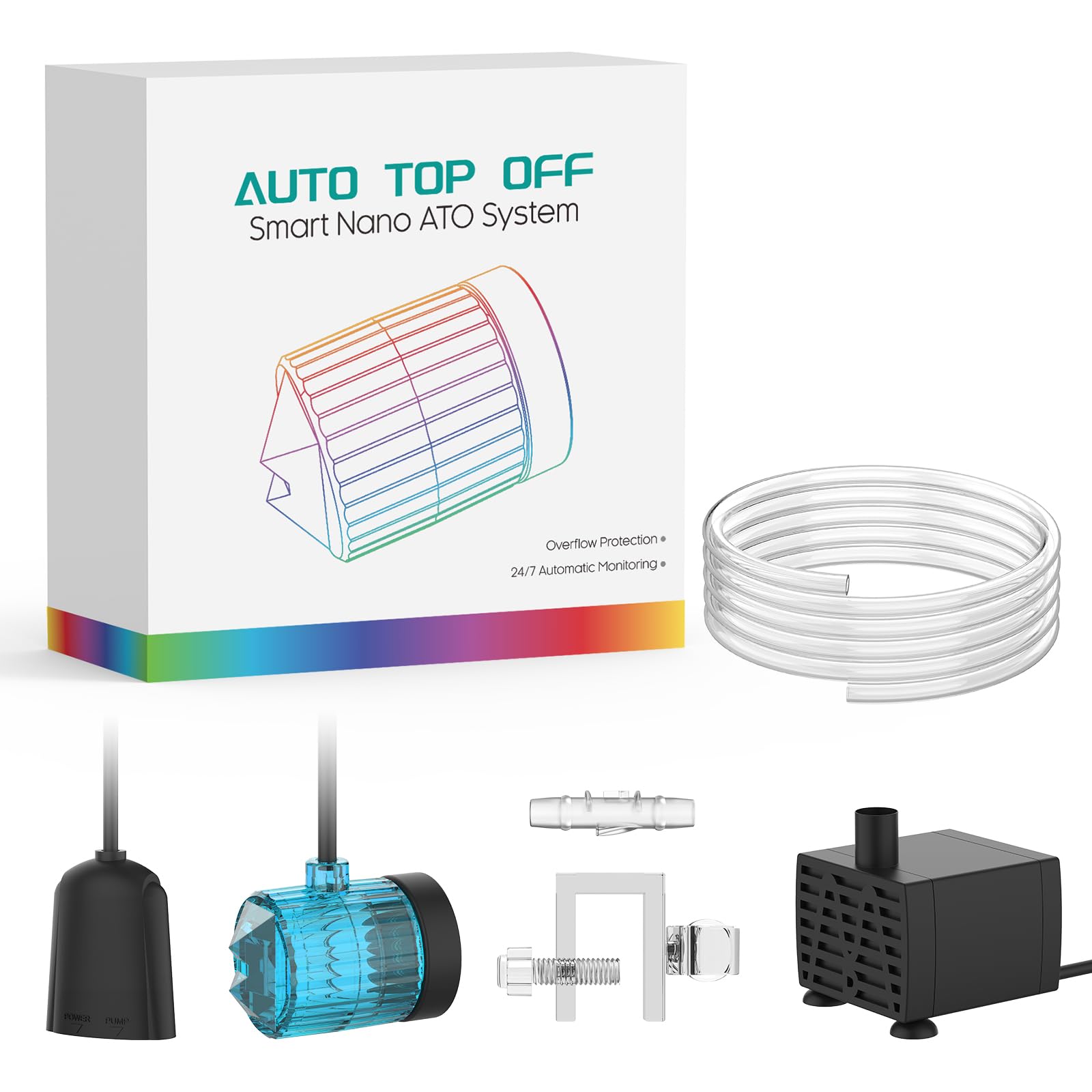
2. Useek Auto Top Off System
The featherweight that disappears into a sump while holding salinity steady
At just 0.4 kg, the Useek is the lightest system in this lineup — less than half the weight of the LAZYBONE above — and its sensor is only 0.7 inches in diameter. That tiny footprint lets it slide into rimmed or rimless tanks and tight sumps without dominating the space or clashing with your aquascape.
Owners praise this unit most for its build quality: the build feels solid, the pump runs quietly, and the water level stays impressively consistent. It uses QST real-time protection (a system that calculates your ideal fill time) and stops the pump if refilling takes 6 times longer than expected — a safeguard against overfilling, dry running, and sensor malfunctions that gives a layer of insurance those float-switch budget units simply lack.
Owner feedback splits on longevity. Plenty of owners mention flawless, set-and-forget performance, but one owner’s sensor failed after 2 months, causing non-stop filling that drained a 5-gallon bottle and ran the pump dry. That is the recurring gripe with this one: the electronics can be hit-or-miss over time. The 2-year warranty and mostly positive owner reports make this the value pick for optical precision on a budget.
Owner consensus: the thing everyone raves about is build quality, with water level stability close behind — it genuinely exceeds expectations for the price.
The honest catch: sensor longevity is the one weak spot, so keep an eye on fill patterns during the first few months.
Perfect for: budget-conscious reefers who want a compact, quiet, quality-feeling unit with solid anti-overflow logic.
Think twice if: you cannot tolerate any risk of a sensor failure — several owners had units fail after a couple of months.
3. ATET Auto Top Off System
A nano optical sensor so quiet you will forget the pump is even running
The defining feature of this unit is its near-silent micro pump, rated under 20dB — quieter than a whisper, per the maker — so it will not disturb a bedroom tank or a home office setup. Despite the “micro” label, it moves a healthy 74GPH at up to 2.5 meters of lift, which covers most sump-to-tank runs with room to spare.
Functionality is what owners single out most, and the praise is consistent: it is easy to install, keeps water level stable, and the dual optical sensors respond quickly. The 0.79-inch nano sensor with 1mm precision sensing is billed for everything from desktop nano tanks to larger displays, and the plug-and-play setup means no tools and no technical skills needed.
This unit is the middleweight optical option in this list, and for small aquariums it gets strong recommendations. Durability reports skew positive, but the hose clip requires thick tank walls—one buyer with thin glass couldn’t secure it. If you run a nano reef or a smaller sump and value silence above all, this is a compelling choice next to the heavier LAZYBONE above.
Why it stands out: the sub-20dB pump is the quietest claim in this lineup — ideal if noise bothers you or your tank sits near a living area.
What to check: the mounting clip wants thicker glass, so measure your tank wall before you buy.
Reach for this if: you keep a small or nano reef and want an ultra-quiet, optical-sensor system that installs in minutes.
Look elsewhere if: your tank or sump has very thin glass walls that the included clip may not grip.
4. MagTool Auto Top Off System

Dual optical sensors with a sophisticated algorithm that learns your tank before it tops off
MagTool’s differentiator is a controller that assesses your tank size on startup and calculates the required refill time before running the pump. That is a smarter layer of protection than a simple on-off float — the system sets safeguards based on how much water your tank actually needs, which reduces the risk of an accidental overflow from a miscalibrated fill.
The hardware backs up the brain. Two high-precision optical sensors — one to trigger replenishment, one dedicated to overflow prevention — keep the water level stable, and the included 12V DC pump pushes 74GPH at an 8.2-foot head. That lift height is among the best in this group, beating the FZONE’s 2-meter rating shown below, so it handles taller sump stands and ground-level reservoirs comfortably.
Ease of use and value for money are the two things owners praise most, with many installing it in about 10 minutes. The sensor probe is just 0.8 inches, so it fits rimless and rimmed tanks alike, and the package includes the anti-siphon check valve and 1.5-meter pipe you need. Some customers note pump failures within weeks or months, and sensor responsiveness is mixed—test it thoroughly early on.
Strong Points
- Startup algorithm tailors refill time to your actual tank size
- 8.2 ft lift handles tall stands and distant reservoirs
- Dual optical sensors give genuine redundancy against overflow
Watch Outs
- Pump durability is inconsistent — some units fail after a few weeks
- Sensor responsiveness draws mixed owner feedback
Best for: reefers with taller setups who want smart, calculated refills and a complete accessory kit from the start.
Who should skip it: anyone who cannot risk an early pump failure — test yours hard during the return window.
5. FZONE Aquarium ATO with Controller

A controller-first ATO with QST2.0 logic and a one-click resume after a dry reservoir
FZONE takes the opposite approach from the all-in-one LAZYBONE: a sleek external controller that keeps the clutter off the tank. Owners praise its effectiveness most, and the QST2.0 tech (an upgraded protection system) is the reason — it stops the pump and triggers an alarm if refilling exceeds 3 times the preset limit, and it also detects sensor issues and low reservoir levels. That triple-threat protection is the strongest safety story in this lineup.
The optical sensor measures just 0.79 inches, with dual sensors spaced 0.1 cm apart that maintain water level within 0.6 cm — precise enough for tanks with wave fluctuation under 1 cm. The quiet micro pump flows 74 gallons per hour at up to 2 meters of lift, and the controller lets you start, pause, or resume the system with a single FZ button. If the reservoir runs dry, the system beeps red and one click resumes it after you refill — a genuinely useful feature for busy keepers.
Owners praise the straightforward setup—clean routing through a drilled hole with no constant tweaking. The external controller adds a polished feel that some rival kits lack. On the flip side, auto shut-off behavior draws mixed feedback — some reviewers point out the system needing constant resets, and a smaller number describe an overflow event that dumped a reservoir. The 2-year warranty and responsive support are real pluses if you hit a snag.
What Makes It Stand Out
- QST2.0 alarms on overrun, sensor issues, and low reservoir
- Water level held within 0.6 cm by tightly spaced dual sensors
- Sleek external controller with one-click resume
Consider This
- Auto shut-off draws mixed owner feedback on reliability
- A minority report overflow events, so initial calibration matters
Perfect fit: tech-minded reefers who want a controller with clear alerts, precise level control, and easy resume after a dry bucket.
Think twice if: you want a system that is flawless from the start — a minority of shoppers say reset loops.
6. Kamoer New ATO One 2 SE

A modular, upgrade-minded ATO with three sensor roles and a water refill timeout alarm
Kamoer treats the ATO as a system you can extend. The One 2 SE runs three distinct sensor roles: S1 is the optical level sensor (uses light to detect when to refill), S2 is an optional sensor for the refill bucket to prevent it running short, and S3 is the optical overflow guard. If S3 detects a problem, the timeout alarm fires to stop water level overflow due to sensor failure — a safeguard that directly addresses the most feared ATO failure mode.
The visual status panel is refreshingly clear: green for power, blue while filling, red for alarm. That instant readability is a small pleasure compared to cryptic blinking codes on other units. The maker also upgraded the original submersible pump to a new anti-dry version and swapped in a more responsive optical sensor, both aimed at cutting the faults that plagued earlier generations.
Buyers report the reliability is what wins them over, with several noting it outperforms pricier European brands at a fraction of the cost. It is quiet and fast — one setup pushes a cup of RO water in seconds for a 90-gallon reef. The honest caveats: pump durability has a concerning streak, with one owner’s pump burning up in three weeks, and another suffered a cracked hose that leaked into a power strip. Installation demands care — the height difference between bucket and tank should not exceed 1.5 meters, and the bucket should sit lower than the display tank.
Owner verdict: this is the unit people reach for when they want German-brand performance without the German-brand price.
The fine print: follow the sensor placement diagram exactly and keep the bucket below the tank — misinstallation causes malfunctions.
Best for: reefers who like modular, upgradeable gear with a clear status panel and a strong timeout alarm.
skip it if: you want a grab-and-go system — this one rewards careful installation and setup.
7. JBJ Nano ATO Advanced

A long-running nano favorite with dual optical sensors and a 7.2 ft pump head
JBJ is a recognized name in reef gear, and this Nano ATO carries the brand’s reputation into the small-tank corner. The package bundles the Nano ATO controller, a JT-160 DC pump, a mounting kit, and a power supply, so there is nothing else to hunt down. It uses dual optical level sensors — no floats to stick, just instant light-based detection of the water surface.
In spite of the “nano” name, the JT-160 pump reaches a 7.2 ft head at 74 gallons per hour, which is more lifting muscle than many full-size units manage. That makes it surprisingly capable for a compact system, and the flange mounting gives it a secure, low-profile attachment on the tank or sump wall.
Feedback splits hard along a durability line. On the positive side, owners praise it for running flawlessly for months in biocube and lagoon setups, holding water level without over or under filling; one nano reef keeper ran theirs for 2 years straight in a 16-gallon tank. On the negative side, an equal number describe pumps that performed horribly or stopped working entirely after a few months. The 3.4-star average across 67 ratings is the lowest in this group, so this is a brand-trust purchase — buy it if you value the JBJ ecosystem, and check the pump early.
Why it endures: for owners who get a good unit, it is a set-and-forget champion that holds level flawlessly for years.
The honest split: pump reliability is the deciding factor — some units are flawless, some fail fast.
Reach for it if: you want a legacy-brand nano ATO with strong lift and a clean, all-included kit for a small reef.
Look elsewhere if: you are not prepared to risk a pump that may need replacing within months.
8. DIGITEN Smart Auto Top Off System

A dependable dual-float workhorse that keeps sump levels steady for very little money
If you are on a tight budget and want a straightforward, mechanical ATO, this DIGITEN model is the classic entry point. It relies on two float switches instead of optical sensors — the second float only kicks in if the first fails, which is a smart redundancy for a design this simple. When water drops below the minimum level, the pump activates; when it reaches the maximum, power cuts.
The plug-and-play package includes the pump and an ETL-listed power adapter, with no moving parts in the controller to fail. Quality and ease of use are what owners praise most, and several use it across multiple tanks for water changes and drip acclimation, not just top-offs. The 5-watt pump moves 0.88 GPM at up to 78.74 inches of lift, which suits standard sump setups fine.
The honest limitations start with the float mechanism itself. Because floats are mechanical, salt creep and debris can eventually cause sticking — and some owners mention the bottom float failing, leading to flooding. The pump also draws mixed reviews, with one owner finding it burned out within a week when pushed too hard filling a reservoir, while others run it fine for standard tank top-offs. For a reef where you want maximum reliability, the optical units above are safer; for a freshwater display tank or a sump on a strict budget, this delivers genuine value.
The Upside
- Genuinely plug-and-play with pump and ETL adapter included
- Dual float gives backup if the primary switch sticks
- Low cost makes it painless for multi-tank setups
The Downside
- Mechanical floats can jam with salt creep over time
- Reports of bottom float failures and some weak pumps
Best for: budget keepers running freshwater tanks or simple sumps who want an easy, replaceable ATO.
Look elsewhere if: your reef demands the precision and salt-creep immunity of an optical sensor.
9. DIGITEN Auto Top Off System ATO19-1

The minimalist relay-controlled float system for reefers watching every dollar
This is the stripped-down sibling in the DIGITEN family — a relay-controlled double-float design that does exactly one job: keep the water level in range. When the level drops below the lowest point, the pump fires; when it reaches the high mark, it shuts off. A second float provides backup if the first one fails, and the integrated relay protects both the pump and the switch from power surges.
The controller integrates a stable circuit to protect the water pump and level switch more effectively than a raw switch would. It is marketed across aquariums, sumps, coral reef tanks, and more, and the included water pump makes it workable from the start. The one-year warranty is a reasonable safety net at this price tier.
Owner feedback here is notably polarized. Some call the quality excellent and say it works fine, but the reliability aspect is mixed — a substantial group reports the unit stopping after about two weeks. Pump complaints recur, with one owner noting water would not rise even 8 inches from the reservoir bottom. And if you run it in the main tank rather than a sump, expect to add a snail guard, since a snail tripping the switch can overflow the tank. This is an entry-level float system best treated as a starter or backup, not a long-term reef cornerstone.
What it does well: the integrated relay design is genuinely protective of the pump and switch for a budget unit.
What to expect: reliability is a coin flip for some owners, so have a backup plan or buy with easy returns in mind.
Best for: first-time ATO buyers who want to learn the ropes on a cheap, simple float system.
Who should skip it: reef keepers with valuable livestock who need dependable long-term performance from day one.
Understanding the Specs
Optical vs. Float Sensors
Optical sensors bounce an infrared beam off the water surface to detect the level instantly and precisely. They have no moving parts, so salt creep cannot jam them, but they need clean glass to stay accurate. Float switches are mechanical arms that rise and fall with the water; they are cheaper and simpler but can stick over time as salt and debris build up, which is the classic cause of an overflow.
Dry-Run and Overflow Protection
Dry-run protection cuts pump power when the reservoir empties, sparing the pump from burning out. Overflow protection usually means a second high-level sensor that shuts everything down before water reaches the tank rim. Smart controllers add a timed fill — if the pump runs longer than expected, they alarm and stop, catching a sensor failure before it becomes a flood.
FAQ
How does an ATO actually keep my reef salinity stable?
What is the difference between an optical sensor and a float switch ATO?
Can I use a freshwater ATO on my saltwater reef tank?
What does dry-run protection do and why does it matter?
Why do some ATO reviewers mention RODI water incompatibility?
How high can an ATO pump lift water from my reservoir?
What size reservoir do I need for my ATO?
Can I leave my reef tank unattended with an ATO running?
How often do ATO sensors need cleaning?
Final Thoughts: The Verdict
For most reef keepers, the ato for reef tank winner is the LAZYBONE AQUA because its integrated single-piece probe design removes the external boxes and connection points where most ATOs fail. If you want the proven reliability of a modular optical system at a friendlier cost and a featherlight 0.4 kg footprint, the Useek is the smart value grab. And when silence matters more than anything — a tank in your bedroom or home office — the ATET near-silent sub-20dB pump is the one to reach for; just confirm your glass is thick enough for its mounting clip.
How We Picked
We do not accept paid placement. Every pick is matched to a real buyer and a real use-case; we do not hands-on test units.
Sources & Methodology
Specifications: manufacturer listings and product documentation. Review insights: verified customer reviews, as of September 2026. Pricing: not shown on this page (it changes often); check the current price via the retailer link.
As an Amazon Associate, Gadgets Feed earns from qualifying purchases. This does not affect which products we feature.