
Our readers keep the lights on and my morning glass full of iced black tea. As an Amazon Associate, I earn from qualifying purchases.
Specs are compiled from manufacturer listings and verified buyer reviews and can change over time — please confirm the key details on the product page before buying.
Choosing a workhorse 24-70mm zoom always sparks the same debate: do you pay a fortune and haul the extra weight for an f/2.8, or does a constant f/4 lens cover 90% of what you actually shoot? This guide compares the three best f/4 options across the Nikon Z, Canon EF, and Sony E mounts so you can match one to your camera system and your real shooting habits.
I’m Min — the founder and writer behind Gadgets Feed. This guide is built by comparing the manufacturers’ published specifications and the patterns across verified customer reviews, so you get each pick’s real strengths and trade-offs instead of marketing spin.
You want a 24-70mm f/4 lens that fits your camera mount, keeps your shots steady, and maybe lets you focus close. This guide breaks down the top options for full-frame mirrorless and DSLR shooters, so you can pick the one that matches your gear and your style.
Our Picks at a Glance
How To Choose The Best 24-70mm F/4 Lens
The 24-70mm f/4 class sits between a basic kit zoom and a heavy, pricey f/2.8 pro lens—it is lighter and easier on your wallet. Before you choose, three things matter most: your camera mount, if you need image stabilization (a system that reduces blur from shaky hands) inside the lens, and how often you shoot close-up subjects.
Match the mount before anything else
This is the non-negotiable first step. The Nikon Z lens only fits Nikon Z mirrorless bodies like the Z6 or Z7 series. The Canon EF lens is built for Canon DSLRs with an EF mount — and for mirrorless Canon bodies only with an adapter. The Sony E-mount lens pairs with Sony full-frame mirrorless cameras. A lens from the wrong system physically will not mount, so your camera body narrows the list to exactly one pick below.
Stabilization: in the lens or in the body
Handheld shots at 70mm on an f/4 lens need help in low light, and that help comes as image stabilization. Some lenses carry their own optical stabilization — Canon calls it IS, Sony calls it OSS — which steadies the viewfinder and helps any body. Nikon’s Z f/4 instead relies on the camera’s built-in 5-axis VR and adds a control ring you can customize. If you shoot video handheld or in dim interiors, stabilization should move up your priority list.
Sharpness wide open vs. across the frame
An f/4 lens is usually at its sharpest when stopped down a little, but you will shoot it wide open often. Pay attention to where buyers report softness: some lenses are brilliant in the center and only soften in the extreme corners at 24mm, while others hold edge-to-edge clarity at f/4. Owners mention the best performers here are sharp edge-to-edge at f/4 with only a slight dip in the middle of the zoom range.
Quick Comparison
| Model | Best For | Mount | Weight | Close Focus | Amazon |
|---|---|---|---|---|---|
| Nikon NIKKOR Z 24-70mm f/4 S★ Best Overall | Nikon Z shooters wanting top sharpness | Nikon Z | About even split with Canon | Standard zoom range | Amazon |
| Canon EF 24-70mm f/4L IS USM | EF users who want macro and IS | Canon EF | 600 g | 0.7x macro mode | Amazon |
| Sony 24-70mm f/4 Vario-Tessar T FE OSS | Sony E owners who want light weight | Sony E | 426 g | 1.32 ft (0.4 m) | Amazon |
In-Depth Reviews
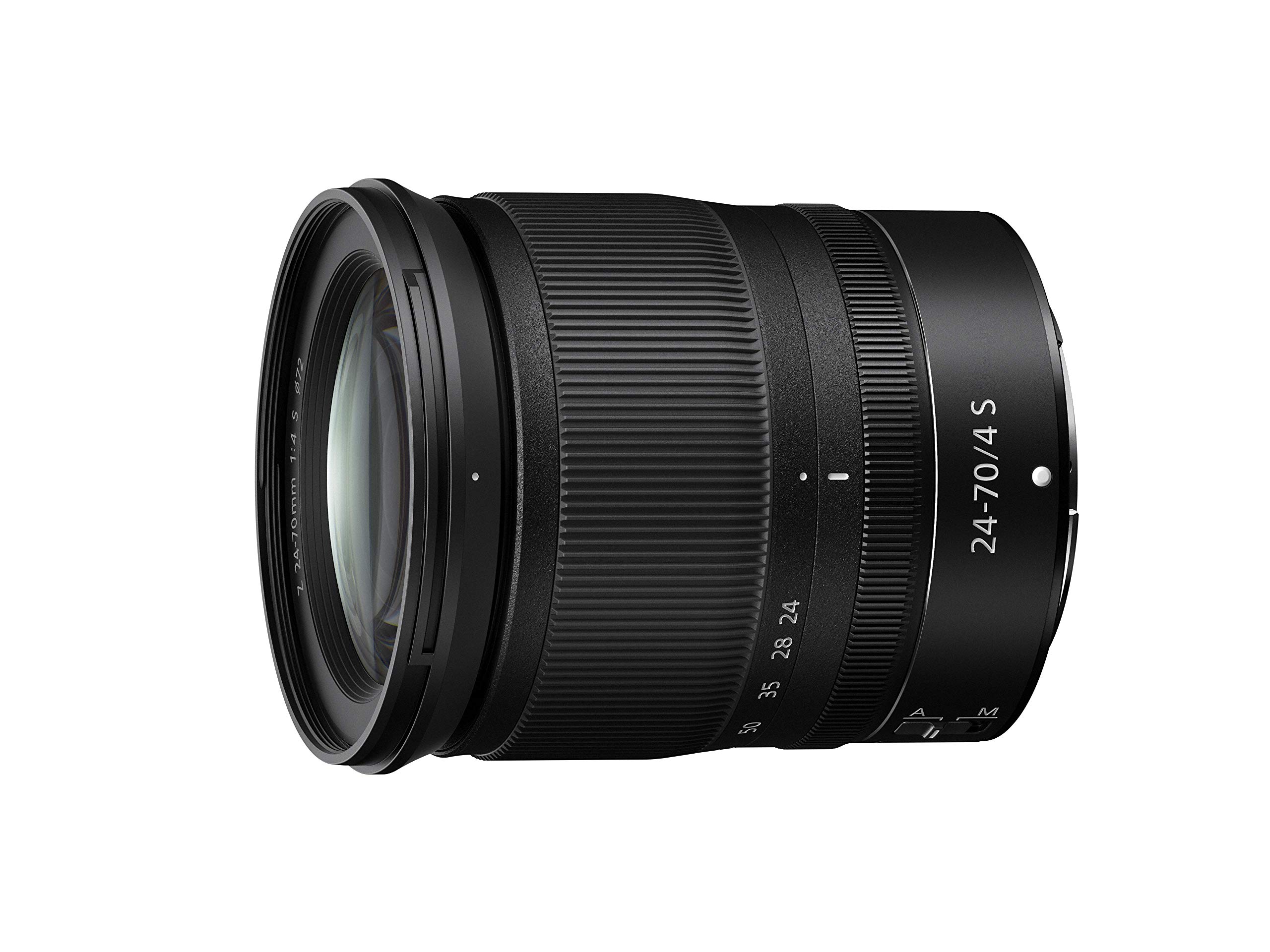
1. Nikon NIKKOR Z 24-70mm f/4 S
Our pick — over 4.5★ from 200+ verified ratings; the strongest balance of quality and price.
The sharpest all-rounder Nikon Z owners can mount without switching to the heavier 2.8.
Nikon engineered this lens around the Z system’s larger mount and shorter flange distance, and the payoff is a new optical formula that customers note delivers extreme sharpness across the entire frame with virtually no distortion. Owners who came from faster glass say things like “haven’t missed the 2.8 at all” — a strong signal that the f/4 aperture is rarely the limit in real shooting.
Video shooters get a lot here: the focusing is smooth and silent, and the lens leans on the camera’s 5-axis dual-detect optical VR to steady handheld footage. A new customizable control ring lets you assign aperture or exposure compensation without taking your eye from the viewfinder, which suits both photo and film work. It covers the classic 24-70mm range from wide-angle to short telephoto, making it a true general-purpose companion.
Reviewers point out this lens is “a bit heavy for the size,” yet they still call it “a perfect lens,” and the crowd consensus lands it at 4.6 stars—the highest score on this list. If you want the longest zoom reach over peak optical quality, note that owners deliberately picked this over a 24-120mm because they valued image quality and build more.
What wins people over
- Extreme sharpness across the frame with virtually no distortion, per Nikon’s new optical formula
- Smooth, silent focusing plus 5-axis dual-detect optical VR for steady video
- Constant f/4 keeps exposure consistent as you zoom
What to weigh first
- Heavier than its size suggests, a recurring owner note
- No built-in lens stabilization — it relies on the Z body’s VR
- Only worth it if you shoot a Nikon Z mirrorless body
Reach for this if: you own a Nikon Z6 or Z7-series body and want the sharpest all-purpose zoom that still rides light enough for daily carry.
Look elsewhere if: you need the extra reach of a 24-120 or refuse to carry any lens that feels heavier than its shell suggests.
2. Canon EF 24-70mm f/4L IS USM

A compact L-series zoom that hides a real macro mode inside a walk-around shell.
Canon’s L-series build means it resists dust and water, so you can keep shooting in rain or sand, and it uses two aspheric and two UD (ultra-low dispersion, a glass type that cuts color fringing) elements to keep images sharp across the zoom range. Buyers describe it as “excellent build, weather-sealed, sharp edge-to-edge at f4,” noting it performs best at 24mm and 70mm with only a slight dip at 50mm. At 600 g, it is the heaviest of the three, but that L-series body is why it feels so solid.
The a neat extra is a full macro mode reaching 0.7x magnification, triggered by a one-touch switch at the telephoto end. That lets one lens cover both everyday shooting and close-up detail work, which is rare in this class. For handheld low-light shots, image stabilization works up to 4 shutter speed stops, and Hybrid IS compensates for both angular and shift-type camera shake — a feature that matters specifically during macro work. On the low-light front, buyers are mixed: the autofocus is fast and accurate in good light but focus lock and tracking degrade in dim conditions, so treat this as a daylight walk-around, not an event lens.
Sharpness at f/4 holds its own against much pricier glass — at f/5.6 owners find it as sharp as the 24-70mm f/2.8 II while staying smaller and lighter. The recurring praise centers on lens quality and image quality, and reviewers who bought used “Good” units report they arrive performing like new at a fraction of the cost.
Versatile by design: the 0.7x macro mode plus 4-stop image stabilization make this the only pick here that doubles as a close-up lens.
One honest caveat: low-light autofocus is the weak spot buyers flag, so keep it for daytime, travel, and macro — not dim event work.
Grab it if you shoot Canon EF and want one lens that handles landscapes, portraits, and true close-ups without a second lens in the bag.
Think twice if your work happens in dark venues where fast, reliable autofocus is non-negotiable.
3. Sony 24-70mm f/4 Vario-Tessar T FE OSS
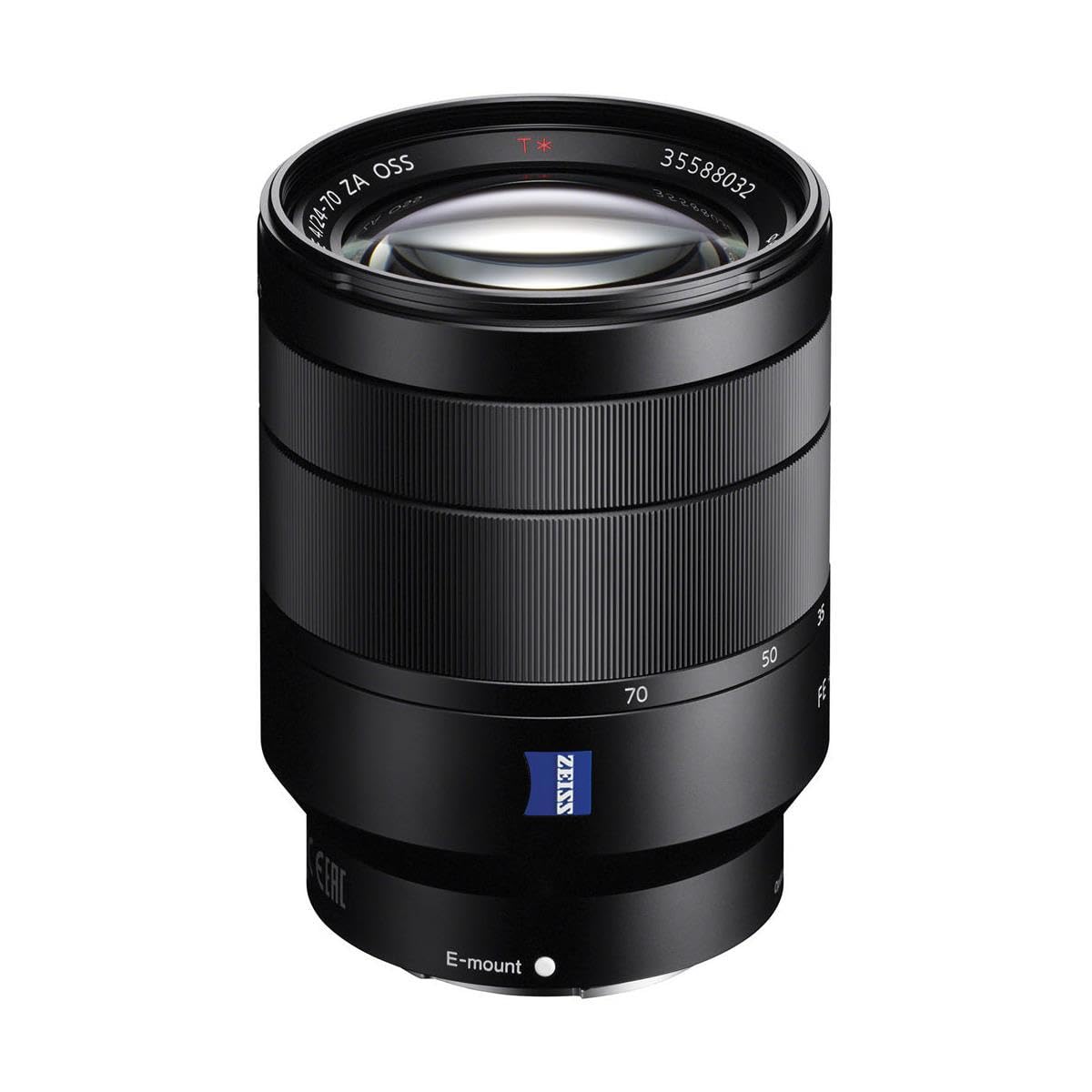
The featherweight full-frame zoom that makes the Sony A7 system feel truly portable.
At 426 g, this Sony undercuts the Canon above by a meaningful margin — it is roughly 41% lighter, a gap you feel after a full day of walking. The weight loss does not cost you stabilization: built-in Optical SteadyShot (OSS) steadies handheld video and low-light stills, which is exactly why the video crowd on the A7s praises it for clear, handheld footage. The angle of view spans 84° to 34° on full-frame, giving you the same wide-to-short-telephoto flexibility as the others here.
The ZEISS T anti-reflective coating (a layer that cuts lens flare and ghosting) minimizes flare, and shoppers say colors come out saturated and contrasty with that signature Zeiss look. Sharpness follows a clear pattern: it is superb from 28-55mm and rivals fixed Zeiss prime lenses in that middle range, while the extreme corners soften slightly at 24mm wide open—but at 70mm it sharpens up nicely by f/5.6. For landscape and travel shots stopped down to f/8 or f/11, this lens performs beautifully, and the autofocus is fast and silent in good light.
The recurring owner note is about the autofocus personality: brilliant in some situations but with reported focus-pull issues in others, especially in low light. It also has a drive-by-wire focus ring that video professionals with follow-focus rigs find unusable — a real consideration if you pull focus manually. Owners still call it a fantastic lens for the travel photographer, and the value argument is strong since it delivers most of the f/2.8 experience at roughly half the price and half the size.
What earns the praise
- Lightest of the three at 426 g — a full-day carry that disappears in the bag
- Built-in OSS steadies handheld video and stills
- ZEISS T coating delivers saturated, contrasty color with minimal flare
Where it slips
- Soft extreme corners at 24mm wide open; sharpens by f/5.6 at 70mm
- Mixed autofocus feedback, with focus pulls reported in some conditions
- Drive-by-wire focus ring is not usable with a follow-focus rig
Best for the Sony A7 owner who wants a light, stabilized travel zoom with gorgeous Zeiss color and does not need corner-to-corner perfection at 24mm wide open.
Not for manual-focus videographers pulling focus by hand or anyone who shoots wide open at 24mm and demands razor-sharp corners.
Understanding the Specs
Constant f/4 aperture
A constant aperture means the maximum opening stays at f/4 whether you shoot at 24mm or 70mm. That keeps your exposure consistent as you zoom, so video clips and burst sequences do not suddenly darken or brighten mid-shot. It also means the lens lets in less light than an f/2.8, which is the main reason these lenses are lighter, smaller, and more affordable.
Image stabilization (IS / OSS / VR)
Stabilization counteracts the tiny shakes from your hands so you can shoot at slower shutter speeds without blur. It matters more on an f/4 lens because the smaller aperture already lets in less light. Canon builds it into the lens as IS, Sony as OSS, while the Nikon Z lens relies on the camera body’s 5-axis VR instead — so check which system your body supports.
Macro and close focus
Close focus distance and magnification ratio tell you how near you can get and how large the subject appears on the sensor. A 0.7x macro mode, like the Canon offers, lets you fill the frame with small objects such as flowers, watches, or product details. Standard zooms without a macro mode typically focus farther away, so check this spec if close-up work is part of your routine.
Edge-to-edge sharpness
Sharpness is rarely uniform across the frame. Many zooms are crisp in the center but soften toward the corners, especially at wide apertures and the wide end of the zoom. Buyers report some f/4 lenses here hold edge-to-edge clarity at f/4, while others need stopping down to f/5.6 for clean corners — a real difference if you shoot landscapes where edges matter.
FAQ
Will a Nikon Z 24-70mm f/4 lens fit my Canon or Sony camera?
Is an f/4 lens too slow for indoor or low-light shooting?
What is the real difference between f/4 and f/2.8 in a 24-70mm lens?
Does the Canon EF 24-70mm f/4L really work as a macro lens?
Which of these lenses is best for video work?
How much does each lens weigh, and does it matter?
Are these lenses weather-sealed for outdoor shooting?
Will a full-frame 24-70mm lens work on a crop-sensor camera?
How sharp is each lens at f/4 wide open?
Final Thoughts: The Verdict
The crowd favorite here is the 24-70mm f/4 lens from Nikon — the NIKKOR Z 24-70mm f/4 S — because it pairs the highest owner score with extreme edge-to-edge sharpness and Z-system video features. If you shoot Canon EF and want one lens that also does true 0.7x macro, the Canon EF 24-70mm f/4L IS USM is the versatile value pick. And if you carry your Sony A7 all day and refuse extra weight, the Sony 24-70mm f/4 Vario-Tessar T FE OSS at 426 g is the lightest stabilized companion of the three.
How We Picked
We do not accept paid placement. Every pick is matched to a real buyer and a real use-case; we do not hands-on test units.
Sources & Methodology
Specifications: manufacturer listings and product documentation. Review insights: verified customer reviews, as of September 2026. Pricing: not shown on this page (it changes often); check the current price via the retailer link.
As an Amazon Associate, Gadgets Feed earns from qualifying purchases. This does not affect which products we feature.