
Our readers keep the lights on and my morning glass full of iced black tea. As an Amazon Associate, I earn from qualifying purchases.
Specs are compiled from manufacturer listings and verified buyer reviews and can change over time — please confirm the key details on the product page before buying.
If you shape stones, a cabbing machine is the leap from a noisy, dusty trim saw to a clean, wet workstation that turns rough rock into a glossy, jewelry-ready cabochon in one sitting. The right one does the grinding and polishing for you — the wrong one leaves you fighting vibration, splash, and wheels that sit too close to work safely. This guide sorts out which of the top machines deserves your bench space.
I’m Min — the founder and writer behind Gadgets Feed. This guide is built by comparing the manufacturers’ published specifications and the patterns across verified customer reviews, so you get each pick’s real strengths and trade-offs instead of marketing spin.
Before you spend on a cabbing machine, you need to know which one fits your stones, your bench, and your budget. The right choice depends on three things: how many wheels it runs, how fast the motor spins, and how heavy it sits on your workbench. Here are four proven models, each built for a different kind of work.
Our Picks at a Glance
How To Choose The Best Cabbing Machine
Picking a cabbing machine means deciding how much stone you shape, where you work, and how fast you want results. The specs that matter are the wheels, the motor, and the water system — get those three right and your cabbing becomes a calm, clean hobby instead of a messy struggle.
Wheel Size and Count Set Your Workflow
You will shape and polish your stone on diamond wheels, and the grit (the coarseness of the diamond surface) gets finer as you move from rough shaping to final shine. A six-wheel setup like the CabKing gives you dedicated hard wheels for grinding and soft wheels for the final shine, so you work down the line without swapping discs. An eight-inch wheel gives you more surface contact, which helps on larger stones, but you may need to change discs between stages. Decide first: do you want a permanent multi-wheel station, or a single flat lap you reconfigure for each step?
Motor Speed and Weight Control the Finish
Speed is about control, not just power. A machine that runs at a fixed 1800 rpm suits steady, consistent grinding, while a variable-speed motor that reaches 3400 rpm lets you slow down for delicate edges and speed up for bulk removal. Weight matters even more than you think — a 62-pound bench machine stays put when you lean into a stone, whereas a 13-pound portable unit may require a firm hand. Match the weight to your workspace: permanent bench, or tuck-away tabletop.
The Water System Keeps Stone and Wheels Alive
Cabbing generates heat and dust that ruin both your stone and your diamond wheels. A clean, adjustable water flow keeps the surface cool and washes away debris, but the delivery matters. Look for drains that don’t collapse and a system that avoids cross-contamination between grits. Some machines ship with simple pumps, others with independent sprays on each wheel — the easier it is to control and clean, the more you will actually enjoy using it.
Quick Comparison
| Model | Best For | Wheel Size | Speed (rpm) | Weight | Amazon |
|---|---|---|---|---|---|
| CabKing 6″ Complete System★ Best Overall | All-in-one bench station | 6 inch | 1800 | 62 pounds | Amazon |
| Hi-Tech Diamond 8″ All-U-Need | Versatility & portability | 8 inch | 800–3400 | 13 pounds | Amazon |
| Hi-Tech Diamond 8″ Slant Cabber | Glass & crystal work | 8 inch | 800–3400 | 15 pounds | Amazon |
| VEVOR 6″ Cabbing Machine | Budget-friendly beginners | 6 inch | 1800 | 57 pounds | Amazon |
In‑Depth Reviews
1. CabKing 6″ Cabbing Machine
Our pick — over 4.5★ from 300+ verified ratings; the strongest balance of quality and price.
The heavy-duty bench anchor that turns raw preforms into polished cabs in about 15 minutes.
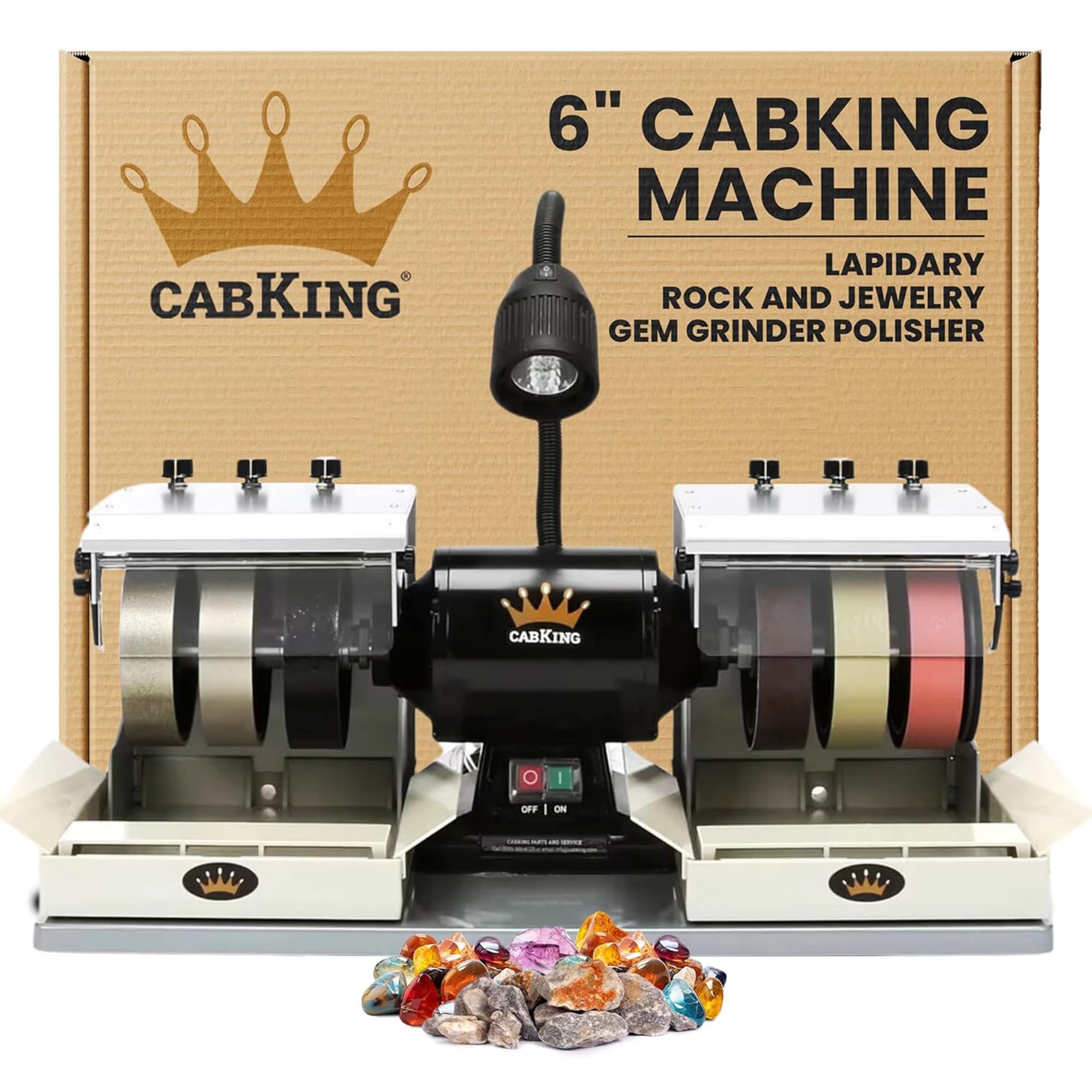
This is the machine you bolt down and treat as the heart of your workshop. It runs six 6-inch diamond wheels on a 1/4 hp motor that spins at a steady 1800 rpm, and it weighs a hefty 62 pounds so it stays dead still while you work. Because it ships as a complete kit, the box alone replaces a pile of separate orders — you get two diamond electroplated wheels, four resin wheels, a 360# full face diamond lap, canvas polishing pad, diamond paste, LED lamp, water pump, stone trays, splash guards, hand rests, goggles, and an apron all at once.
The smartest part is the water delivery. Instead of one shared spray that drags grit from wheel to wheel, the CabKing gives you an adjustable, clean water system with independent flow over each wheel. That means no cross-contamination between your grinding and polishing stages, which is exactly what protects a finished face from being scratched by coarse dust. Buyers report going from a preform to a polished cab in about 15 minutes, and the flat lap screws onto the back so you can handle larger rocks that won’t fit the front wheels.
It is not a machine for a small apartment or a flimsy table — 62 pounds and a 12″D x 13.5″W x 12″H footprint demand a proper bench, and it is built for 115V electrical systems only. The drain hoses are the one soft spot; a few owners note they can collapse or bow, though that is a minor fix with common irrigation elbows. For anyone serious enough to make cabbing a regular craft, this is the complete, quiet, ready-to-run workstation that earns its reputation — It holds a 4.8-star average across 300+ owner reviews.
What wins people over
- Six dedicated wheels mean you move from grind to polish without swapping discs
- Clean water system prevents grit cross-contamination between stages
- Complete kit — lamp, pump, trays, goggles, and apron all included
- Quiet 1800 rpm direct-drive motor that handles small and large stones
Fair trade-offs to know
- 62 pounds needs a permanent, sturdy bench — not a portable pick
- Drain hoses can collapse and may need replacing with firmer fittings
- Built for 115V regions only, so it won’t suit 220V workshops
Best for: The dedicated lapidary hobbyist or small-scale jeweler who wants a full, ready-to-run station and values a clean, isolated water system over portability.
Think twice if: You need to tuck your machine away between sessions — this 62-pound bench unit is a permanent resident, not a closet occupant.
2. Hi-Tech Diamond 8″ All-U-Need

A featherweight 8-inch flat lap that pairs variable speed with genuine portability for mixed stone and metal work.
If your bench space is precious or you want one machine that does rocks, gems, enamels, and metals, the All-U-Need is the flexible middle ground. It spins an 8-inch wheel — a 33% larger surface than the 6-inch CabKing — yet weighs just 13 pounds, a 4.8x weight difference that makes it genuinely easy to lift on and off a table. The key here is the variable-speed motor: it adjusts from 800 up to 3400 rpm, which is 89% more top-end speed than the CabKing when you want aggressive shaping.
The kit arrives with four electroplated diamond discs (180#, 325#, 600#, and 1200#), a Tech-11 polishing pad, and 14,000 mesh diamond paste, so you can run a full shaping-to-polish cycle on quartz, agate, jasper, or even softer metals. The 1/2″ arbor means you can swap in other compatible backing plates to extend what the machine will do. Owners describe the movement as smooth and the operation as quiet, and the rust-resistant ABS plastic body keeps cleanup simple — a quick wipe and you are done.
The honest trade-off is that this is a single-disc flat lap, not a six-wheel production line. You change discs between grit stages instead of sliding along a row of wheels, and the mixed durability feedback in the reviews suggests you should treat the plastic body with care rather than lean on it hard. The splash is real too — owners advise raising the face plate or you will end up wet. It is the right call for the hobbyist who values control, easy storage, and one machine that crosses into metal and enamel work.
Why it fits so many benches: The 800–3400 rpm range gives you delicate control for final edges and raw speed for bulk removal, all in a 13-pound body that stores in a closet.
Where it asks for patience: Swapping discs between grit stages slows a production run, and the splash needs a raised face plate — a small habit, not a flaw.
Reach for this if: You work a variety of materials — stones, metals, enamels — and want one portable machine that covers them all without dominating your bench.
Look elsewhere if: Your goal is high-volume cabbing where a dedicated wheel for every grit stage keeps the pace fast.
3. Hi-Tech Diamond 8″ Slant Cabber
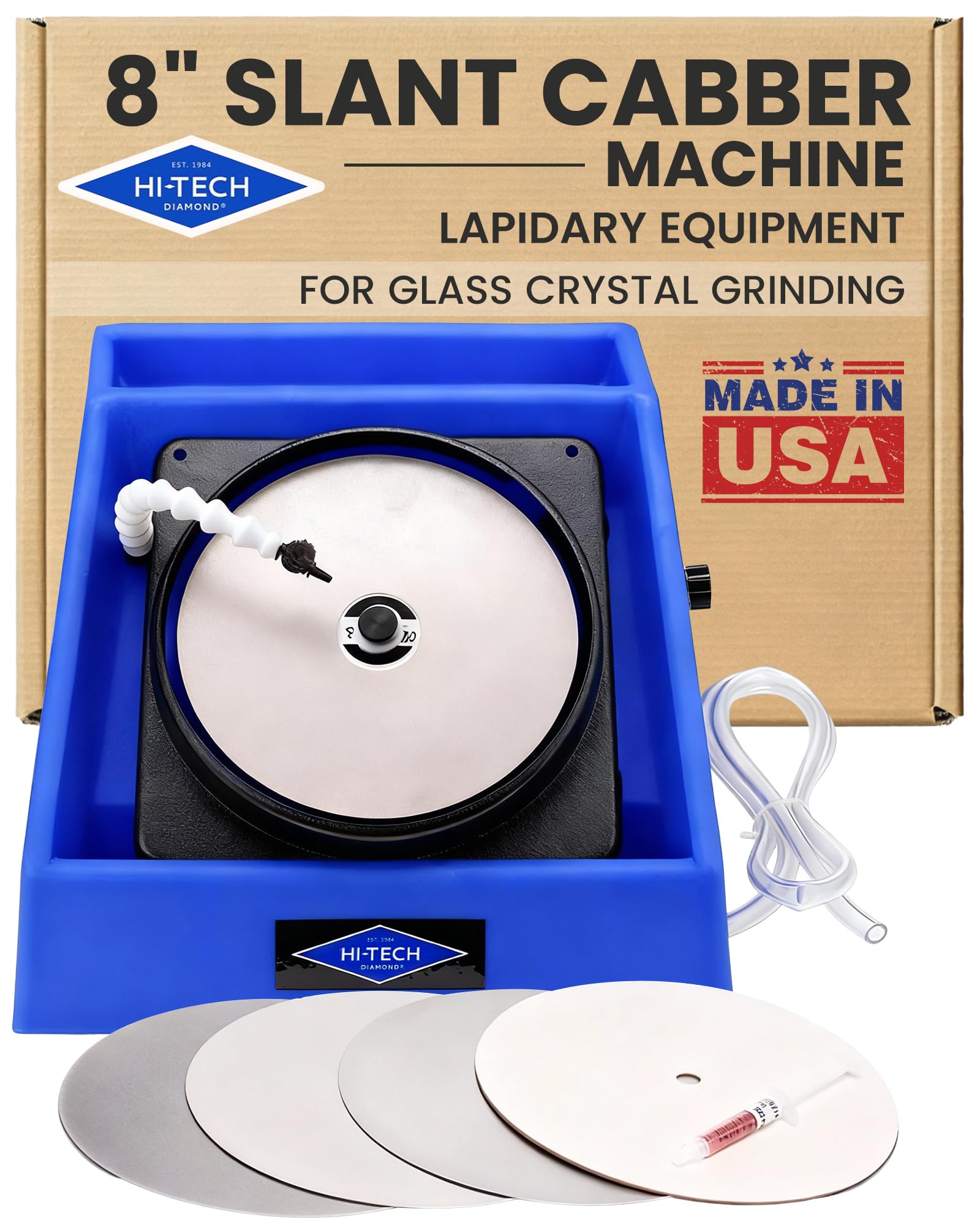
The slanted, space-saving cabber that brings flat-lap glass finishing down to a hobby budget.
This one is built for a specific job: grinding and polishing glass and crystal with a comfortable, visible work angle. The defining feature is the slanted work surface, which tilts the work toward you so you can actually see the contact point instead of hunching over a flat table. It holds up to one quart of water in a built-in reservoir for wet grinding, and at just 12 to 15 pounds with an 11″D x 15″W x 11″H footprint, it fits easily on a tabletop or mobile cart.
Like its flat sibling, the Slant Cabber runs a 1/4 hp direct-drive motor with variable speed from 800 to 3400 rpm on an 8-inch wheel. The kit stacks four electroplated diamond discs — 360#, 600#, 1200#, and 3000# — plus a Tech-11 polishing pad, diamond paste, and two backing plates. That fine 3000# grit is what lets glass and crystal reach that clear, glossy finish without the need for a costly dedicated flat-lap machine.
What owners love most is the access it grants: it allows coldworking that would otherwise demand a much more expensive machine, and the disc quality earns praise right from the start. The body is cross-link polyethylene, which keeps it light but means you are not getting the mass of a cast-metal station — and with a smaller review base, long-term durability is less proven. Buy it for glass, crystal, and gemstone work where the slanted ergonomics and fine-grit finishing make a real difference.
The angle is the advantage: A sloped deck and quart-capacity reservoir give you clear sightlines and steady water flow for delicate glass and crystal work.
Know before you buy: It is lighter than a bench station, so heavier pressure on stiff materials will test the polyethylene frame.
Grab it for: Glass artists and crystal workers who want flat-lap results — that 3000# disc and slant deck make fine finishing feel easy.
Skip it for: Heavy rough-shaping of large hard rocks, where a heavier, multi-wheel station holds steadier.
4. VEVOR 6″ Cabbing Machine
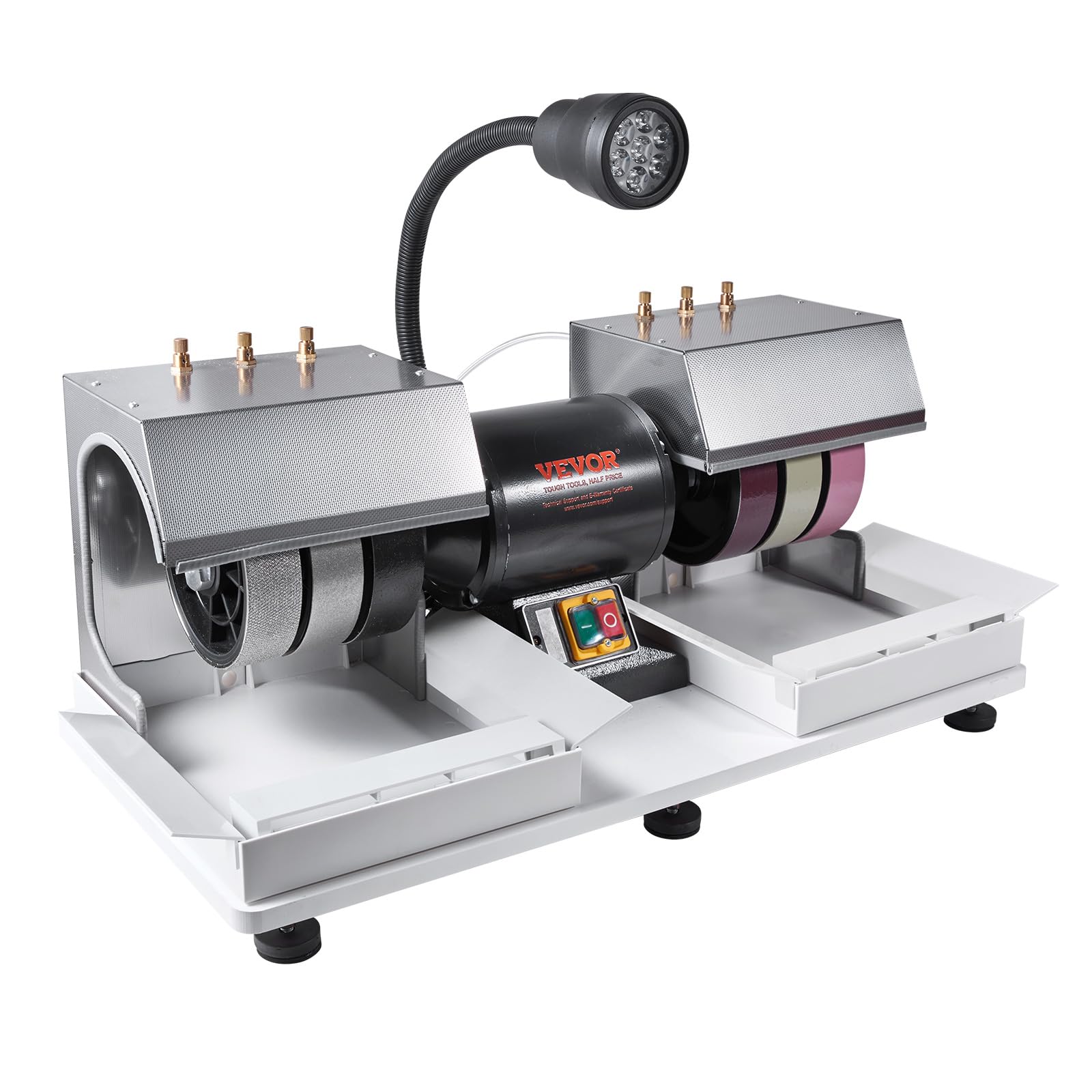
A 57-pound full six-wheel rig that opens the door to serious cabbing without the premium price tag.
If the price of a top-tier cabber has been the only thing holding you back, the VEVOR is built to change that math. It gives you six 6-inch diamond wheels plus a diamond lap for the full rough-to-polish journey, all driven by a 1/4hp motor at 1800 rpm on a 110V system. The 304 stainless steel case resists fingerprints and wipes clean easily, and the adjustable top lamp throws light right where your stone meets the wheel.
VEVOR keeps the core workflow familiar: independent water control on each wheel with a simplified drain, so you can avoid running the wheels dry and keep cleanup fast. Owners who stepped up from a tumbler found it fun and effective right away, with several report cutting stones within 30 minutes of unboxing. The included accessories — cutting modules, a water pump, and import/export pipes — mean there is very little to buy separately before your first cab.
What the economy price buys you is honesty about the build. The most consistent complaints are vibration during operation, wheels mounted close enough that you can accidentally clip the adjacent one, and some fit issues like a drip tray hole that needed re-drilling. The motor can also run hot, so treat it as a learner-friendly station rather than a 24/7 production tool. For the budget-conscious beginner who wants to confirm cabbing is their craft before investing in a premium machine, this delivers real capability at an entry-level cost.
The value equation
- Six 6-inch wheels plus a lap cover the whole grind-to-polish process
- Independent water flow on each wheel prevents dry-running damage
- Stainless steel case stays clean and resists fingerprints
- Most owners are cabbing within 30 minutes of setup
Cost-conscious realities
- Vibration during operation is the most common owner gripe
- Wheels sit close — be careful not to bump the neighboring disc
- A few units arrive with minor fit flaws like misaligned drain holes
Best value play: The budget-minded beginner who wants a full six-wheel setup to learn on and confirm this hobby before spending on a premium machine.
Not the pick for: Demanding daily production — vibration and a hot-running motor make it better for steady hobby use than marathon sessions.
Understanding the Specs
Wheel Diameter and Grit Sequence
The wheel size (6 or 8 inch) sets how much stone surface you contact per pass — larger wheels remove material faster but take more space. The grit order matters more: a good machine walks you from coarse shaping (like 180#) down to fine polish (1200# or higher), so you never scratch a finished face with coarse dust. More wheels mounted at once means fewer disc swaps during a run.
Motor Speed and Machine Weight
Speed is measured in rpm (rotations per minute) and controls how aggressively you remove material. A fixed 1800 rpm motor gives steady, predictable grinding, while a variable-speed motor reaching 3400 rpm lets you slow down for delicate edges. Weight keeps the machine planted — a heavier unit resists the push-and-pull of shaping, while a lighter one suits tabletop and travel use.
FAQ
What is the difference between a 6-inch and an 8-inch cabbing machine?
Is a variable speed motor worth paying for?
Why does machine weight matter so much for cabbing?
How important is the water system on a cabbing machine?
Can one machine grind rocks, glass, and metals?
How long does it take to shape a cabochon from start to finish?
What accessories should come with a complete cabbing kit?
Is a cabbing machine the same as a flat lap machine?
How much bench space does a cabbing machine need?
What voltage do cabbing machines require?
Final Thoughts: The Verdict
Across the board, the cabbing machine winner is the CabKing 6″ Complete System because its six-wheel layout, clean water isolation, and complete kit make it the most ready-to-run workstation for serious hobbyists. If you want variable speed and portability for mixed stone and metal work, grab the Hi-Tech Diamond 8″ All-U-Need. And if glass and crystal are your focus, the Hi-Tech Diamond 8″ Slant Cabber brings flat-lap finishing to a compact, slanted deck. Budget-minded beginners eyeing the VEVOR 6″ get a full six-wheel rig at an entry-level cost — the CabKing leads with a 4.8-star owner score, but the VEVOR makes the craft accessible when price is the barrier.
How We Picked
We do not accept paid placement. Every pick is matched to a real buyer and a real use-case; we do not hands-on test units.
Sources & Methodology
Specifications: manufacturer listings and product documentation. Review insights: verified customer reviews, as of September 2026. Pricing: not shown on this page (it changes often); check the current price via the retailer link.
As an Amazon Associate, Gadgets Feed earns from qualifying purchases. This does not affect which products we feature.