
Our readers keep the lights on and my morning glass full of iced black tea. As an Amazon Associate, I earn from qualifying purchases.
Specs are compiled from manufacturer listings and verified buyer reviews and can change over time — please confirm the key details on the product page before buying.
If you are shopping for a 10 inch bass speaker, you already know the struggle: finding one that sounds deep and loud but actually fits where you need it. This guide breaks down the very best options, from shallow-mount subs that slide under a seat to high-excursion drivers that shake the whole car. We compare raw power, real-world sound quality, and the honest trade-offs of each so you can pick the right one for your vehicle or home setup.
I’m Min — the founder and writer behind Gadgets Feed. This guide is built by comparing the manufacturers’ published specifications and the patterns across verified customer reviews, so you get each pick’s real strengths and trade-offs instead of marketing spin.
We’ve matched the top sellers on power, fit, and value to reveal which 10 inch bass speaker is worth your money and which ones miss the mark.
Our Picks at a Glance


How To Choose The Best 10 Inch Bass Speaker
Before you buy a subwoofer, you need to match three things to your setup: how much clean power it can handle, how deep it can physically mount, and its impedance rating.
Match RMS power to your amplifier
Peak power is a marketing number; RMS is the wattage a sub can handle continuously. If your amp delivers more RMS than the sub is rated for, you risk blowing it. If it delivers far less, you might not get the bass you want.
Check mounting depth before you fall in love
A standard 10-inch sub needs around 5 to 7 inches of mounting depth behind it. If you drive a truck or a car with tight trunk space, a shallow-mount sub with a reduced depth is the practical answer.
Decide on single or dual voice coil
Each voice coil has an impedance, usually 4 ohms. Dual voice coil subs offer wiring flexibility (2, 4, or 8 ohms) so you can match a wider range of amps, which can mean getting more clean power from what you already have.
Quick Comparison
| Model | Best For | Max / RMS Power | Impedance | Mounting Depth | Amazon |
|---|---|---|---|---|---|
| Pioneer TS-A2500LS4★ Best Overall | Tight spaces behind seats | 1200W / 300W | 4Ω SVC | Shallow | Amazon |
| CT Sounds Bio 10Best Value | Budget-friendly punch | 800W / 400W | Dual 4Ω | 4.69″ | Amazon |
| KICKER CompC CWCS104Top Performer | Hard-hitting performance | 600W / 300W | 4Ω SVC | 4-13/16″ | Amazon |
| NVX ESW104 | Small sealed enclosures | 500W / 250W | 4Ω SVC | Shallow-fit | Amazon |
| BOSS CH10DVC | High-power builds on a budget | 1500W / — | Dual 4Ω | 4.63″ | Amazon |
| Seventour HR-DTSUB | Deep excursion on a budget | 1200W / 600W | Dual 4Ω | 7.08″ | Amazon |
| KICKER Comp 43C104 | Reliable stock replacement | 300W / — | 4Ω SVC | Standard | Amazon |
| Pioneer TS-A250D4 | Factory system upgrades | 1300W / 400W | Dual 4Ω | 5.875″ | Amazon |
| Dayton Audio UMII10-22 | High-end, musical bass | — / 600W | Dual 2Ω | Deep | Amazon |
In‑Depth Reviews
1. Pioneer A-Series TS-A2500LS4 Shallow-Mount 10″ Subwoofer
Our pick — over 4.5★ from 500+ verified ratings; the strongest balance of quality and price.
The tight-space specialist that squeezes real bass behind seats without gutting your trunk.
If your vehicle simply has no room for a tall sub box, this Pioneer shallow-mount driver is the answer. Its slim form is built to install behind or under seats, yet it still carries a 1200W max / 300W nominal power rating, so you are not giving up output just to save space. The 85 dB efficiency means it turns amplifier power into sound rather than heat, which helps a modest amp sound bigger than it is.
What wins people over consistently is the balance of sound. Owners running it in small sealed enclosures report no distortion and foam that feels genuinely durable. The crowd favorite — 4.6 stars across 500+ owners — backs that up. The catch: one buyer found the 4-ohm single voice coil design only “mediocre” at transferring power outside the car, so it is more about feel inside the cabin than rattling windows from the curb.
Buyers report that when paired with a Pioneer amp delivering 300W RMS (continuous power), this sub is “impressively loud” with good sound quality. That real-world feedback is why it earns the top spot here — it delivers far more output than its small size suggests, as long as you feed it clean power.
What buyers love
- Shallow mount fits under seats and behind panels where full-size subs won’t go
- Punchy, distortion-free bass in small sealed enclosures
- Strong build quality with a durable foam surround
The trade-offs
- Lacks the extreme output for outside-the-car bass contests
- Single voice coil limits wiring flexibility
Reach for it if: you need genuine bass and your install space is measured in inches.
Look elsewhere if: you plan to chase maximum SPL numbers — this one is about clean, musical depth.
2. CT Sounds Bio 10″ Dual 4-Ohm Subwoofer
The budget bruiser that takes real power and keeps its composure when pushed.
This CT Sounds driver swings well above its price with a 400W RMS / 800W max rating and a 2.4-inch 4-layer copper voice coil built to handle heat. A low carbon iron zinc bottom plate and an advanced air cooling system keep it stable during long listening sessions. It is the rare budget sub that owners mention can handle a lot of power without flinching.
The thing everyone raves about is the sound-to-dollar ratio. Owners dropped it in a 1 cubic ft ported box with a JL Audio JX200 and reported clean output with no distortion — even as the glue warmed up. Another praises it for a small Kei van with a modest 100W amp, calling it clean and pristine. At 4.69 inches of mounting depth, it is friendlier to shallow spots than most full-size drivers.
The honest caveat: it needs power to truly move. On very low wattage it stays weak, so do not expect window-rattling output from a tiny amp.
Why it wins
- 400W RMS handling in a budget-friendly package
- Shallow 4.69″ mounting depth fits many stock locations
- Advanced cooling keeps it stable under load
Know before you buy
- Output is limited if your amp delivers low wattage
- Not designed for extreme SPL competition builds
Best for: anyone wanting maximum clean bass per dollar on a mid-power amp.
skip it if: you only have a weak head-unit-powered signal — it will sound thin.
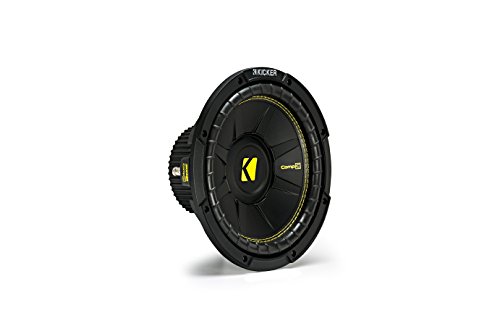
3. KICKER CompC CWCS104 Single Voice Coil 4-Ohm
The hard-hitter that punished its own enclosure — that is how much force it puts out.
The signature yellow stitching and ribbed polyurethane surround tell you this is a serious KICKER driver before you even power it up. Rated at 600W peak / 300W RMS, it carries a high-temp voice coil, perimeter venting for heat management, and a stamped steel basket built for abuse. With 86.2 dB sensitivity and a 30-500 Hz response, it covers deep lows and punchy highs with equal ease.
One owner ran two of these off a small Jensen amp pushing just 120 watts per channel, and reported the subs “pound so hard they busted open the box.” Even with modest power, you get KICKER’s signature punch. Another reviewer called it a smooth upgrade for a factory Audi B&O system, saying it matches the stock sound while adding real depth.
The main thing to respect is its appetite: it wants a proper sealed or ported enclosure to shine. Give it a flimsy box and it may well destroy it.
Serious output: delivers hard-hitting, high-performance bass that feels closer to competition gear than to a stock replacement.
Respect the box: this driver generates real force — a well-built enclosure is not optional, it is mandatory.
4. Dayton Audio UMII10-22 Ultimax II 10″ DVC Subwoofer

The audiophile’s sub that reveals the musicality hidden inside your bass tracks.
This is a different breed of 10-inch sub. The woven carbon fiber cone is rigid yet lightweight for quick, accurate response, while a large aluminum shorting cap keeps inductance linear to minimize distortion. A dramatic ±20 mm xmax — how far the cone can travel — delivers deep, powerful bass, and the 4-layer 2-1/2″ flat wound voice coil handles up to 600W RMS.
Owners describe it as “very musical bass” with far more refinement than mainstream brands. One running it in a 29Hz-tuned box says it “absolutely digs the lows,” chasing chest-feel bass rather than sheer SPL. Another has been running it 8 months in an infinite baffle setup with no mechanical noise. The dual spiders keep the cone perfectly linear even at extreme excursion.
The trade-off: this driver is tune for compact sealed enclosures or tuned vented designs — it is not a drop-into-any-box solution. And with dual 2-ohm coils, you need an amp stable down to 1 ohm to use them in parallel, which not every mono block supports.
Audiophile-grade depth: the low-end extension and low distortion make it the pick for listeners who feel bass, not just hear it.
Demands respect: its excursion and 600W RMS rating require a properly built enclosure to perform and survive.
5. Pioneer A-Series TS-A250D4 10″ Subwoofer

The factory-system transformer that turns a so-so stock setup into something you actually feel.
The TS-A250D4 is the deeper-mounting sibling to our top pick, and it trades a little space for more muscle. With 1300W max and 400W nominal power, the Glass-Fiber & Mica Reinforced IMPP cone delivers detailed bass with high rigidity. The dual 4Ω voice coils give you wiring options at 2Ω, 4Ω, or 8Ω, making it easy to match almost any amplifier.
This is the sub for upgrading factory systems. Multiple owners have swapped it into 2024+ Ford Mustang B&O setups with straightforward modifications, describing it as a far better performer than the stock unit. One called it a “simple upgrade” that sounds dramatically cleaner than a rival sub at a similar price. With a recommended 1.0 cu. ft. vented or 0.7 cu. ft. sealed enclosure, Pioneer has done the homework on box sizing for you.
At 74 dB efficiency, it is not the loudest-per-watt driver here, so it wants a solid amplifier behind it. Fit in tight factory spots can also require minor trimming, so budget some install patience.
Why it stands out
- Dual 4Ω coils allow 2, 4, or 8Ω wiring flexibility
- Strong 400W RMS with a rigid IMPP cone
- Proven as a popular factory B&O system upgrade
The fine print
- 74 dB sensitivity means it needs decent amp power to get loud
- Factory installs may need minor enclosure modifications
Grab it for: turning a weak factory sub location into a genuinely good-sounding spot.
Think twice if: you want maximum volume from a tiny, low-power amplifier.
6. KICKER Comp 43C104 10″ Subwoofer

The stock-replacement legend that keeps thumping years after install — one owner ran theirs for 8 years.
The Comp is the subwoofer equivalent of a trusty pickup truck: unglamorous, dependable, and ready to work. Rated at 300W peak with a 30-500 Hz frequency response and 86.2 dB sensitivity, it wakes up easily even on modest amplifier power. It is the sensible upgrade path for anyone replacing tired factory drivers.
What makes it special is the easy authority. One owner replaced their old Kicker Comps after roughly 8 years of service and reports the new pair “THUMP” — on the same amp and box. Another dropped the 10-inch version into a 2009 Jeep Wrangler JK and found it fits flush with clean, well-sealed workmanship. It delivers powerful bass without requiring a massive amp.
With only 300W peak (maximum momentary power), this is not the sub for SPL (sound pressure level) competitions or ear-splitting volume wars. Instead, it is built to sound great and last, backed by KICKER’s reputation for reliability — so you can enjoy deep bass for years without worrying about blowing it.
Built to last: real-world customers note years of dependable bass, making it a sound long-term investment for daily drivers.
Modest ceiling: if you are chasing extreme loudness, the CompC or a higher-wattage option suits you better.
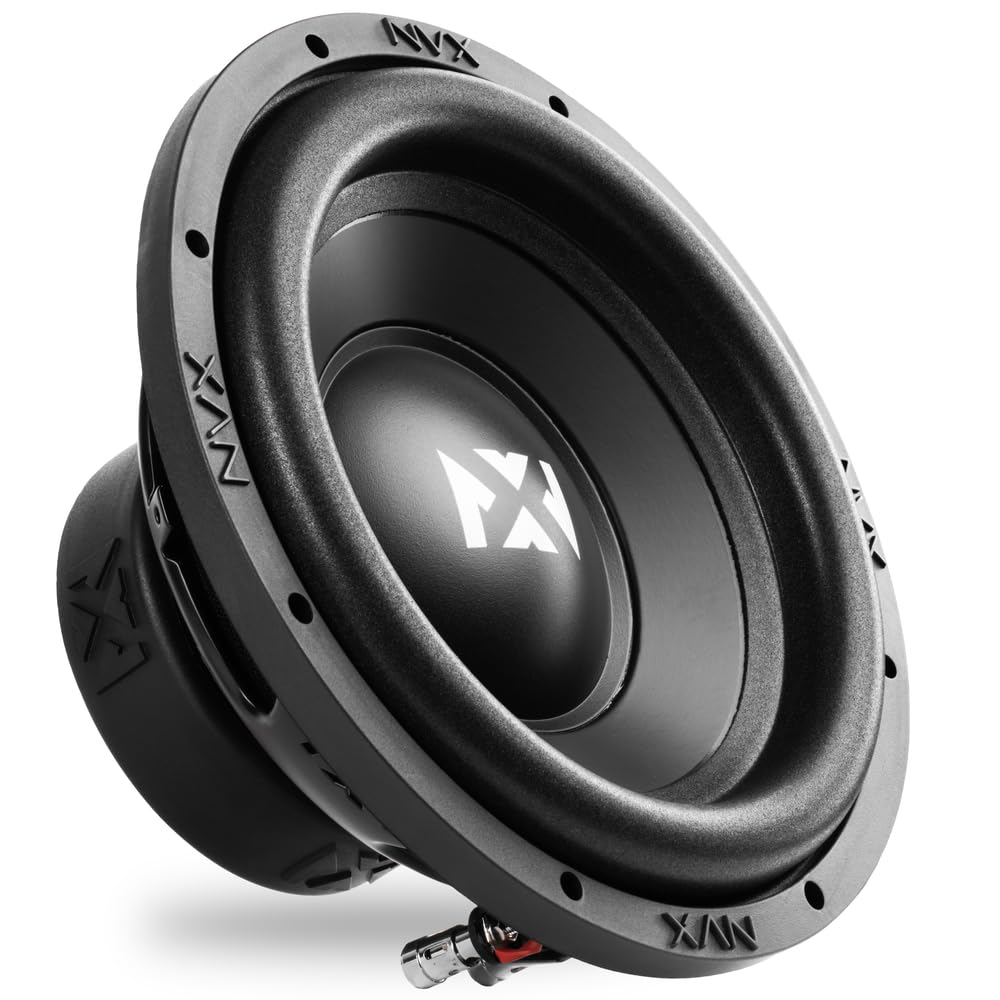
7. NVX ESW104 E-Series 10″ Subwoofer
The versatile underdog that shines in everything from a Tesla to a home theater.
The NVX E-Series sub may carry modest numbers — 500W peak and 250W RMS — but it holds a serious resume. It has been used in an SUV wall build, home audio, a sealed box in an Accord, and even dropped straight into a Tesla Model 3’s OEM sub enclosure. Reviewers point out the T/S parameters match factory enclosure specs so well it replaces the stock unit with crisp, louder output.
The engineering is where it punches up. A 1.5″ high-temperature copper voice coil with aluminum former, a stamped steel vented basket, and a 46 oz. ferrite magnet keep it cool and durable. The high-roll foam surround and pressed paper cone deliver precise sound with minimal distortion.
Shoppers say: “This sub is awesome… Sounds crisp louder and better than OEM.” The catch is that it needs a matched amplifier to truly come alive — at least one owner pushed a clip hard enough to trip their amp into protection mode.
What impresses
- Excellent value with surprising clean output for the size
- Versatile across car, SUV, and home theater builds
- Strong 46 oz. magnet and vented basket for cooling
Worth noting
- 250W RMS means it is not built for massive SPL
- Needs clean, matched power — avoid clipping
Perfect for: replacing a factory sub or warming up a modest aftermarket system.
Not for: those chasing competition-level decibels from a basic enclosure.
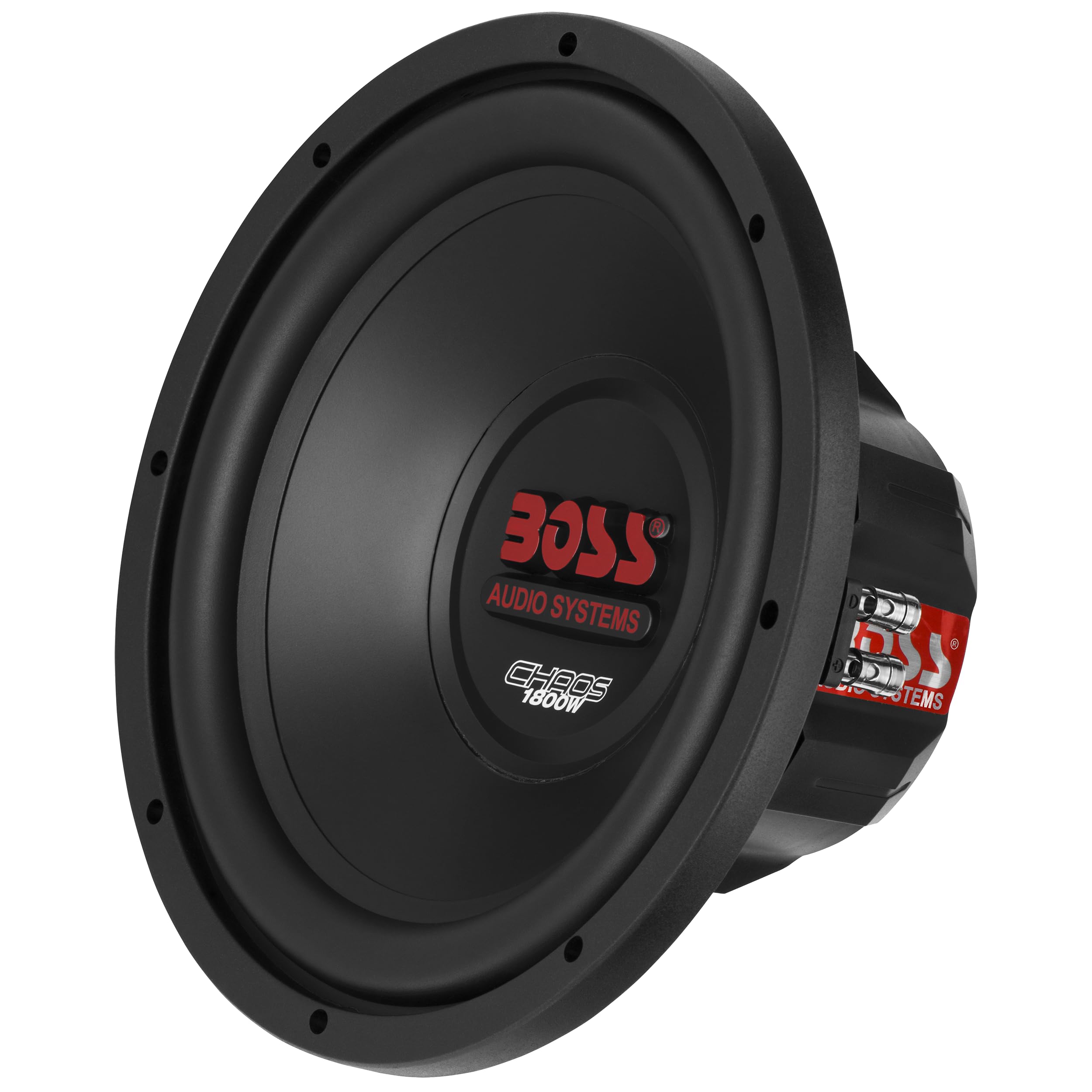
8. BOSS Audio Systems CH10DVC Chaos Series Subwoofer
The big-number budget sub for bassheads who love a deep thump without a deep wallet.
The CH10DVC leads this list in headline wattage — 1500W max from a 3x gap versus the NVX’s 500W peak. It pairs that with a 2-inch voice coil, a polypropylene cone, and a rubber surround for a smooth, hard-hitting character. At 7.72 lbs and 4.63 inches of mounting depth, it is also surprisingly friendly to standard enclosures.
Owners who respect the power limits are thrilled. One ran a sealed, non-ported enclosure and called it great-sounding, noting the included 3-year platinum warranty. Another bought 12 units across builds and reported none blown at high volume — the key being matching it with a proper amp and keeping gain in check.
But the data is honest about who this is not for. The biggest concern in returns centers on wattage claims and durability — some report the voice coil burning when pushed beyond its real limits. If you send 1000 real watts to a driver rated at high peak numbers, you will find its actual ceiling fast.
The upside
- Massive 1500W max power at a budget-friendly price
- Light 7.72 lb weight for easy handling and mounting
- 3-year platinum warranty through Amazon
The honest catch
- Real-world power handling is far below the peak rating
- Durability issues appear when pushed beyond its true limits
Pick this if: you want maximum depth for minimum money and will treat the wattage rating with caution.
Pass it by if: you plan to feed it serious power — that is where the problems start.
9. Seventour HR-DTSUB 10″ Dual 4-Ohm Subwoofer

The excursion monster that dives deep into sub-bass frequencies most budget subs never reach.
The Seventour HR-DTSUB is all about low-end reach — its frequency response extends from 28 Hz down to 20 Hz territory in sealed boxes. Dual 40 oz. high-strength magnets and a huge “mega roll” surround support serious cone travel (x-max) that lets it play deep and low with authority. Its 600W RMS / 1200W peak ratings put it near the top of the budget class on paper.
Early owners were shocked at the depth. One ran it in a 2.3 cu ft box for 6-8 months and praised its reliability, while another compared its sound favorably to a Kicker CVR, a far more expensive driver. The 7.08″ mounting depth rewards anyone with room for a proper enclosure.
The honest problem is consistency. A small but real group reports the driver failing early — one stopped working after just 8 days at a modest 200W RMS. Many also say the RMS rating is optimistic, feeling closer to 500W real-world. This is a high-value gamble that rewards careful power matching.
Deep and punchy: exceptional low-frequency extension and punchy highs make it a standout for sub-bass lovers on a budget.
Variable quality control: some units fail early, so treat the power ratings as optimistic and break it in gently.
Understanding the Specs
RMS vs. Peak Power
Peak power is a marketing claim — the absolute maximum a speaker can theoretically survive in a split second. RMS (Root Mean Square) is the power a subwoofer can handle continuously without damage. When you match a sub to an amplifier, always compare RMS numbers so the amp can drive the sub cleanly without overpowering it.
Voice Coil Impedance (Ohms)
Impedance, measured in ohms, tells you how much electrical resistance the sub presents to your amplifier. A single voice coil (SVC) offers one fixed impedance, usually 4 ohms. A dual voice coil (DVC) gives you two coils to wire in parallel or series, offering more flexibility to match your amp’s rated output for maximum clean power.
FAQ
What is the difference between a shallow-mount and a standard 10-inch subwoofer?
Should I buy a single voice coil or a dual voice coil subwoofer?
What size enclosure do I need for my 10-inch subwoofer?
Is the wattage rating on the box what the subwoofer actually handles?
Can I install a subwoofer in my factory enclosure?
What does sensitivity (dB) mean and why does it matter?
How important is “breaking in” a new subwoofer?
Will a 10-inch subwoofer work well for home theater?
Final Thoughts: The Verdict
For most people, the winner of the 10 inch bass speaker category is the Pioneer TS-A2500LS4 because it delivers genuine, clean bass in a shallow-mount design that fits vehicles where a full-size sub simply cannot go. If you want the best raw value with a proven following, grab the CT Sounds Bio 10 for its impressive RMS handling. And for those chasing audiophile-grade, distortion-free lows at high excursion, the Dayton Audio UMII10-22 is the one to reach for.
How We Picked
We do not accept paid placement. Every pick is matched to a real buyer and a real use-case; we do not hands-on test units.
Sources & Methodology
Specifications: manufacturer listings and product documentation. Review insights: verified customer reviews, as of September 2026. Pricing: not shown on this page (it changes often); check the current price via the retailer link.
As an Amazon Associate, Gadgets Feed earns from qualifying purchases. This does not affect which products we feature.