
Our readers keep the lights on and my morning glass full of iced black tea. As an Amazon Associate, I earn from qualifying purchases.
Specs are compiled from manufacturer listings and verified buyer reviews and can change over time — please confirm the key details on the product page before buying.
You need to know which 12-volt solar setup with a battery is worth buying for your RV, shed, or emergency plan. The real fork in the road is simple: a do-it-yourself kit you wire together, or a portable power station you plug into and go. This guide explains both, so you can match the choice to your situation.
I’m Min — the founder and writer behind Gadgets Feed. This guide is built by comparing the manufacturers’ published specifications and the patterns across verified customer reviews, so you get each pick’s real strengths and trade-offs instead of marketing spin.
Whether you are outfitting a camper or prepping for outages, this breakdown of the 12v solar panel with battery options focuses on capacity, charging speed, and real-world reliability to help you choose with confidence.
Our Picks at a Glance


How To Choose The Best 12V Solar Panel With Battery
Your first decision is between two product styles: a fixed kit with separate panels, a battery, and a charge controller that you connect yourself, or an all-in-one portable power station with a foldable panel. Kits usually offer more raw capacity for the money; power stations win on convenience and safety.
Match the battery to the job
Battery capacity is measured in watt-hours (Wh). A small station holds about 192Wh, which covers phones and a laptop. A larger unit with over 2,000Wh can run a mini fridge for hours. The bigger the number, the more devices and the longer they run before you need sun again.
Panel wattage sets your refill speed
The solar panel’s wattage tells you how fast it tops up the battery in full sun. A 40W panel is best for small daily top-ups; a 200W panel can refill a large battery in a day. What owners often miss is that low light cuts output sharply, so cloudy-day charging will always be slower.
Quick Comparison
| Model | Best For | Rated Output | Battery Capacity | Solar Input | Amazon |
|---|---|---|---|---|---|
| Anker SOLIX C200 DC★ Best Overall | Compact travel power | 200W | 192Wh | 60W | Amazon |
| ZeroKor 100W GeneratorBudget Champion | Emergency basics on a budget | 100W | 146Wh | 40W | Amazon |
| ExpertPower 200W KitDIY Pick | DIY off-grid projects | 200W | 12V 20Ah | 200W | Amazon |
| ECO-WORTHY 200W Starter | First-time RV solar install | 600W inverter | 12V 50Ah | 200W | Amazon |
| BLAVOR 1600W | Home backup with built-in panel | 1600W | 1024Wh | 40W built-in | Amazon |
| BLUETTI Elite 200 V2 | High-efficiency large capacity | 2600W | 2073.6Wh | 200W | Amazon |
| VTOMAN Jump 1500X Kit | Whole-outage home backup | 1500W | 2376Wh | 110W | Amazon |
| ECO-WORTHY 7.168KWH | Full-RV off-grid living | 3000W inverter | 7.168kWh | 780W | Amazon |
In-Depth Reviews
1. Anker SOLIX C200 DC Portable Power Station and 60W Solar Panel
Our pick — over 4.5★ from 200+ verified ratings; the strongest balance of quality and price.
A pocket-sized powerhouse that keeps a Starlink mini running all day without breaking a sweat.
What wins people over here is the battery life. The 192Wh pack delivers up to 200W, and buyers report it keeps a Starlink mini at 100% battery all day while the panel feeds in around 54W. That is the same station pulling only 22-25W, so you end the day exactly where you started.
It is small enough that Anker claims it is 39% smaller than similar stations, and the whole kit folds into a neat case for transport. The 60W panel refills the battery in about 4 hours of full sun, which owners confirm. If you plug into a wall outlet instead, you reach 80% in just 50 minutes — a nice fallback when clouds roll in.
Ports are plentiful, with a 140W two-way USB-C plus two more USB-C and two USB-A connections. The LiFePO4 battery chemistry is backed by a 3-year warranty, and buyers describe the build as solid and premium. Just note the included shoulder strap is sold separately, and this unit refuses to work with Anker SOLIX PS30 or other 5V~3A USB-C panels.
The 5-device hub: Between the 140W USB-C, a 100W USB-C, a 15W USB-C, and two 12W USB-A ports, you can charge phones, laptops, and a drone at once, which is why owners call it a workhorse during outages.
Reach for this if: you need a compact, carry-anywhere station for off-grid weekends, truck camping, or keeping a Starlink mini and phones alive.
Look elsewhere if: you plan to run a fridge or any appliance over 200W, because this is built for devices and small electronics, not heavy loads.
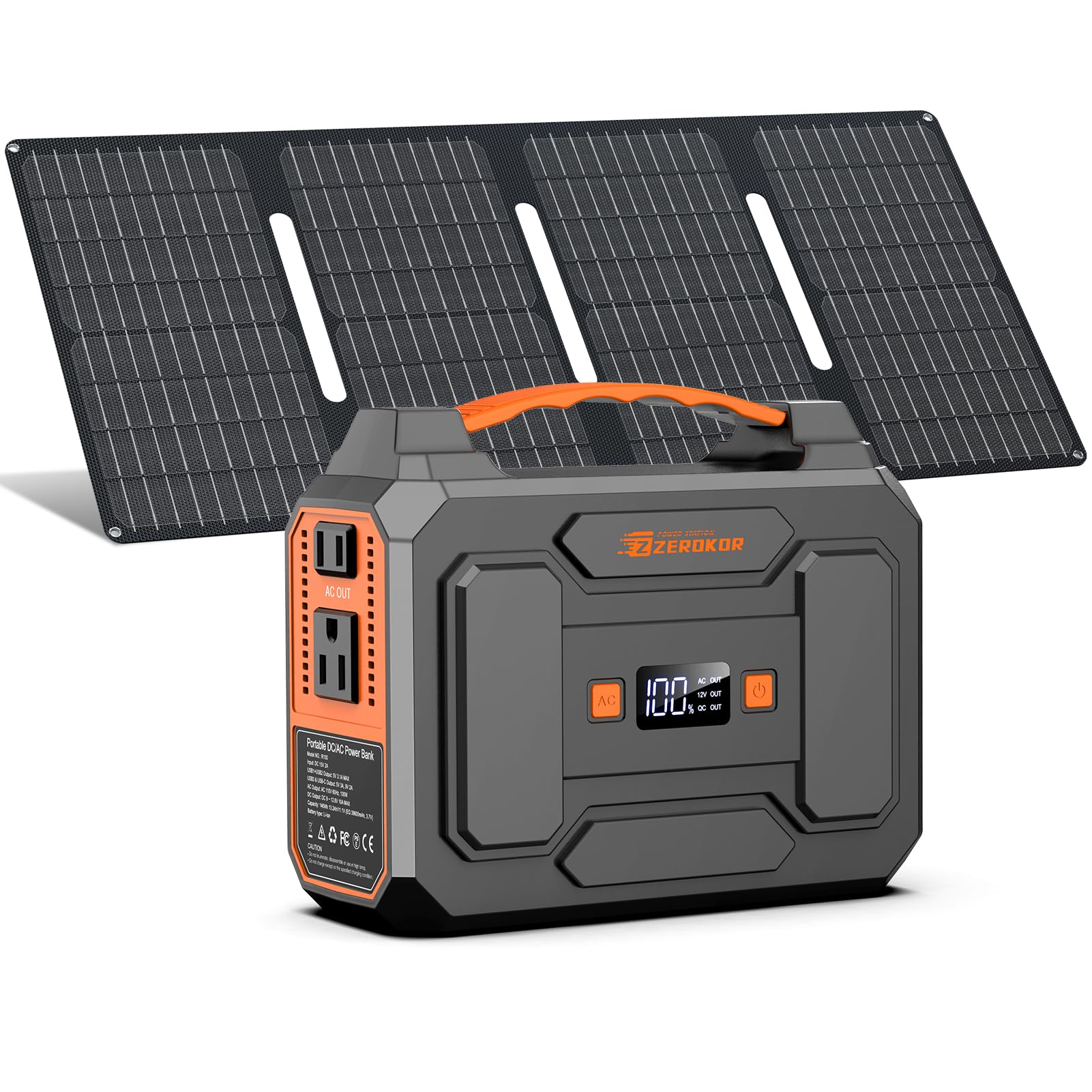
2. Portable Power Station with 40W Solar Panel, 100W Solar Powered Generator (ZeroKor)
The entry-level kit that ran a card payment terminal, scanner, and cash drawer for a full ten-hour shift.
Owners have proven this one in real retail situations. Owners mention it powered their Square terminal, barcode scanner and cash drawer for 10 hours and still had 50% left — a strong endorsement for small-business or market-stall use. The 146Wh lithium battery pushes out up to 100W through two AC outlets, which covers phones, tablets, and laptops.
The included 40W monocrystalline panel reaches a 22.8% conversion efficiency, and the built-in smart chip recognizes devices to boost charging speed. You also get a flashlight with SOS mode, which makes this a sensible emergency-kit companion. The whole thing weighs just 3.3 pounds, so it travels easily.
Here is the honest trade-off. Reliability feedback is genuinely mixed and this is where you must temper expectations: some units arrived with a faulty solar adapter, and a smaller share stopped holding a charge after a couple of months of light use. The manufacturer recommends keeping the battery between 60% and 80% and recharging it every half month if not in use, so treat it as a daily-use item and it behaves better.
Why it earns its keep
- Genuine AC outlets for a 100W ceiling, not just USB
- Quality and easy portability win the most praise from owners
- Clear display plus a flashlight with SOS for power cuts
Where it cuts corners
- Avoid anything over 100W, especially heat-generating gear like hair dryers or coffee makers
- Some owners hit a defective solar adapter or premature failure, so buy with a return plan
- It needs regular charging to stay healthy, not long-term shelf storage
Best for: a first solar kit for car camping, emergency phone charging, or running a small till setup that never pulls more than 100W.
skip it if: you want something you can ignore for months, because this battery needs periodic use to hold its charge and avoid self-protection shutdown.
3. ExpertPower 200W 12V Solar Power Kit with 12V 20Ah LiFePO4 Battery
A wired kit that lit up a barn right from the start, with panels and battery meant to live outdoors.
This is a true fixed installation kit, not a portable station. You get two 100W monocrystalline panels, a 12V 20Ah LiFePO4 battery, and a 20A PWM charge controller. Owners say it is easy to install without help, and one buyer runs a wildlife pond motor off it, appreciating that the controller arrives already programmed.
The LiFePO4 battery is rated for 2500 to 7000 cycles with a 10-year lifetime, and its built-in Battery Management System guards against overcharge, deep discharge, and overheating. A low-temp cut-off stops charging below 23°F, which protects the battery in winter. The controller auto-detects 12V and 24V systems and adjusts its charge profile to the temperature.
The recurring complaint is the controller itself. Some owners call it unreliable, and a few wish the instructions were written out rather than picture-only, since getting a human on the phone proved difficult. Panel performance and battery storage drew no such criticism, so the weak link is identifiable and replaceable if it gives you trouble.
A project, not a plug-in: This is for a shed, barn, or small workshop where you can mount rigid panels and run cables, not for carrying power around with you.
Choose this if: you want a permanent off-grid power source for a structure and you are comfortable doing basic wiring yourself.
Think twice if: you expect a plug-and-play experience, because you are on the hook for mounting the panels and hooking up the controller, and the controller is the part most likely to disappoint.
4. ECO-WORTHY 200 Watt 12V Complete Solar Panel Starter Kit for RV Off Grid
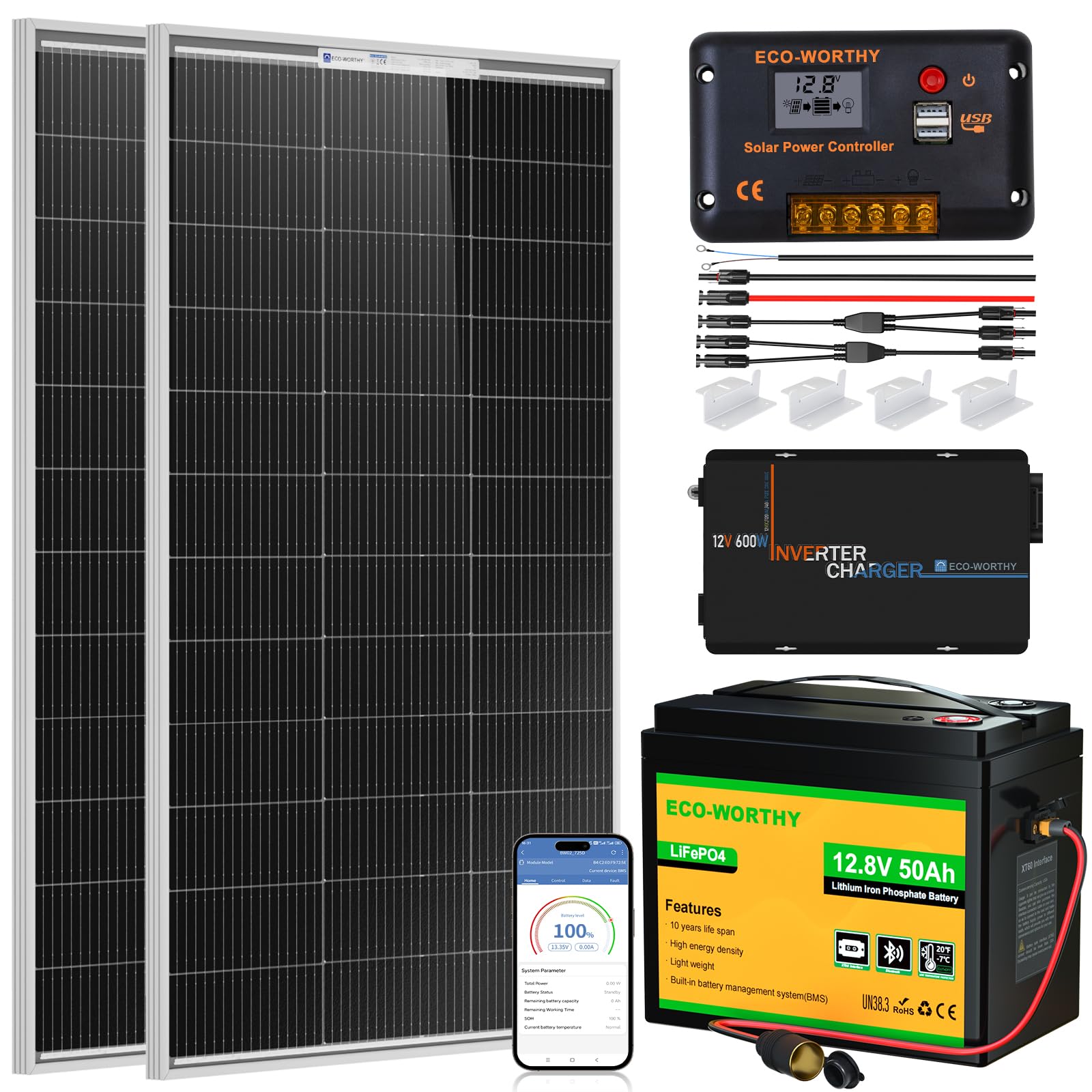
The beginner-friendly RV starter kit with a 50Ah battery and inverter combined into one tidy system.
What newcomers appreciate most is that this is a complete system. The 200W of N-Type panels feeds a 12V 50Ah LiFePO4 battery through a 30A charger, and a 600W pure sine wave inverter turns that stored power into household-style AC. The maker claims an 800Wh daily output based on 4 hours of sunlight, and owners describe it as a great entry point into solar for a camper.
Real-world use leans toward the lighter side of loads. Customers note it runs LED lights, charge controllers, a vent, and even a mini fridge on DC through a whole summer without draining the battery. The N-Type cells also perform well in low light, and one buyer found the panels durable enough to survive hail and storms. Installation proved much easier than expected, with one owner finishing a shed setup in about 3 hours.
The honest caveat is that reliability is mixed. Some units worked well while others stopped within a week, and winter performance drops off noticeably — owners say the fridge may need days off unless you have full sun. This reads as a fair-weather starter system rather than a year-round full-time van solution.
What makes it beginner-friendly
- Complete kit: panels, 50Ah battery, 30A charger, and 600W inverter included
- Panels held up through hail and storms for one owner
- Runs DC essentials like lights and a vent all summer
What to expect realistically
- Winter output is marginal, and the fridge may need to shut off on cloudy days
- Reliability of individual units varies, with some failing within a week
- Instructions are minimal, so a better online manual helps
Choose this for: a first RV or shed solar setup where you want one box of parts and gentle DC loads.
Not for: full-time van living or heavy AC appliances, since cold weather and cloudy stretches will test its limits quickly.
5. BLAVOR Portable Power Station 1600W with Built-in Solar Panel, 1024Wh LiFePO4
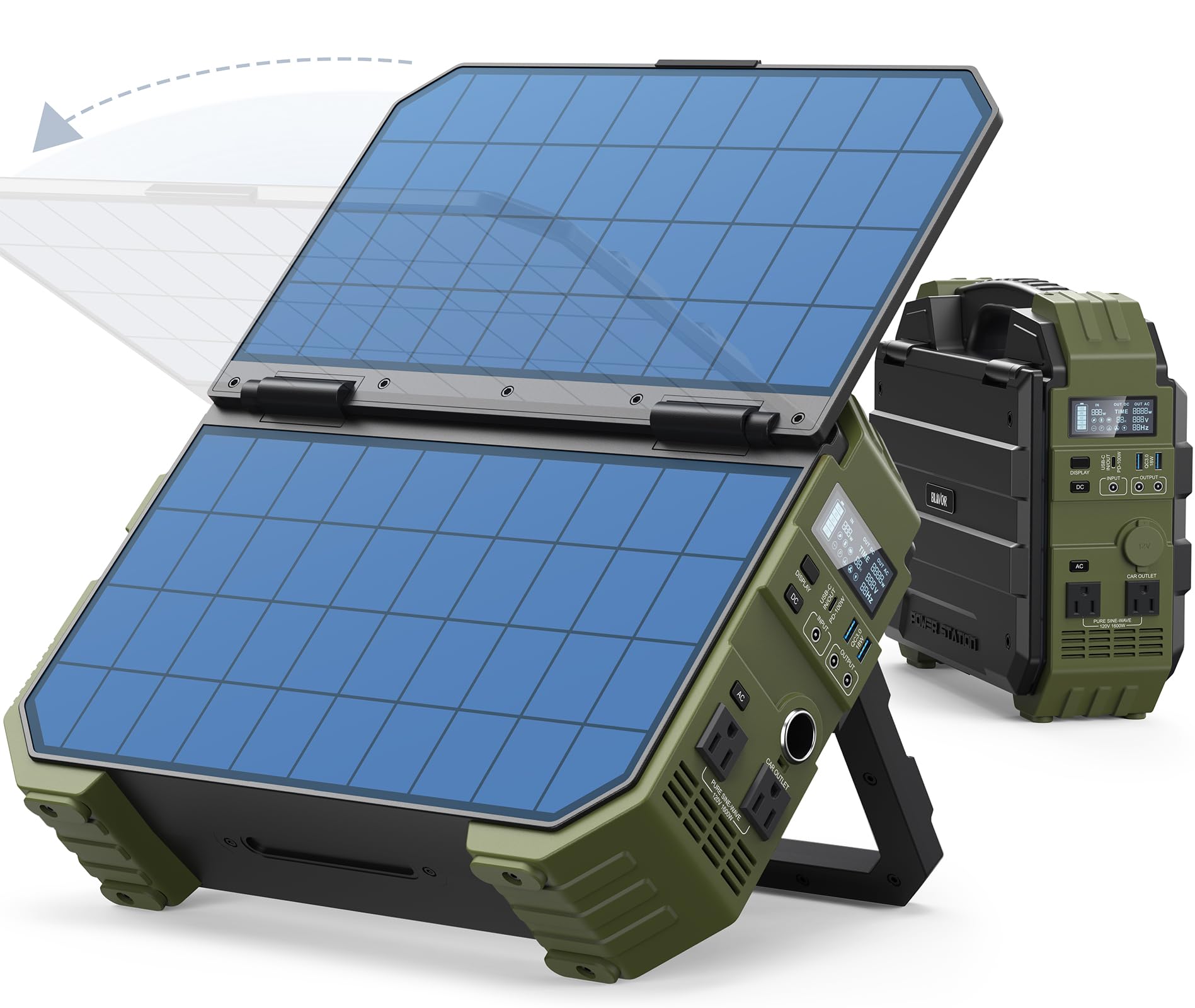
A rugged all-in-one with a foldable 40W panel built right into the case, ready for a cabin or blackout.
You get fuel from sunlight without lugging a separate panel, because a foldable 40W solar panel (40 watts of power output) is built into the top—a feature that is genuinely rare. Reviewers point out the whole design feels rock-solid, with heavy-duty plastic and sturdy hinges, and the maker notes it won a 2022 German IF Design Award (an international design prize). The suitcase-style body weighs 26 pounds and has a fixed carry handle, so you can grab it and move it like a piece of luggage.
Under the hood sits a 1024Wh LiFePO4 battery rated for over 3500 charge cycles, which the maker says is more than 10 years of daily use. It delivers a 1600W rated output with a 3200W surge, and owners confirm it runs a 26 cubic foot fridge for about 5 hours. The 100W USB-C port supports two-way fast charging for laptops, and eight outlets keep several devices running at once.
The main caveat is that the built-in panel is a trickle, not a tap. Owners measured roughly 30W from it in December, so it is best treated as a maintenance charge. For real refills, buyers recommend attaching an external 200-260W panel, which the station accepts. One owner also suggested a filter cloth on the intake to keep dust out.
The trade-off to know: the built-in solar is slow, which is why this unit shines brightest as a home-backup battery that can also top itself up slowly in the sun.
Best for: glamping, cabins, and home outage backup where you want one sturdy box with solar built in and no loose panels to set up.
Consider carefully if: you want fast solar-only recharging, because the built-in 40W panel alone will not refill 1024Wh quickly on a short trip.
6. BLUETTI Elite 200 V2 Solar Generator with 200W Solar Panel, 2073.6Wh
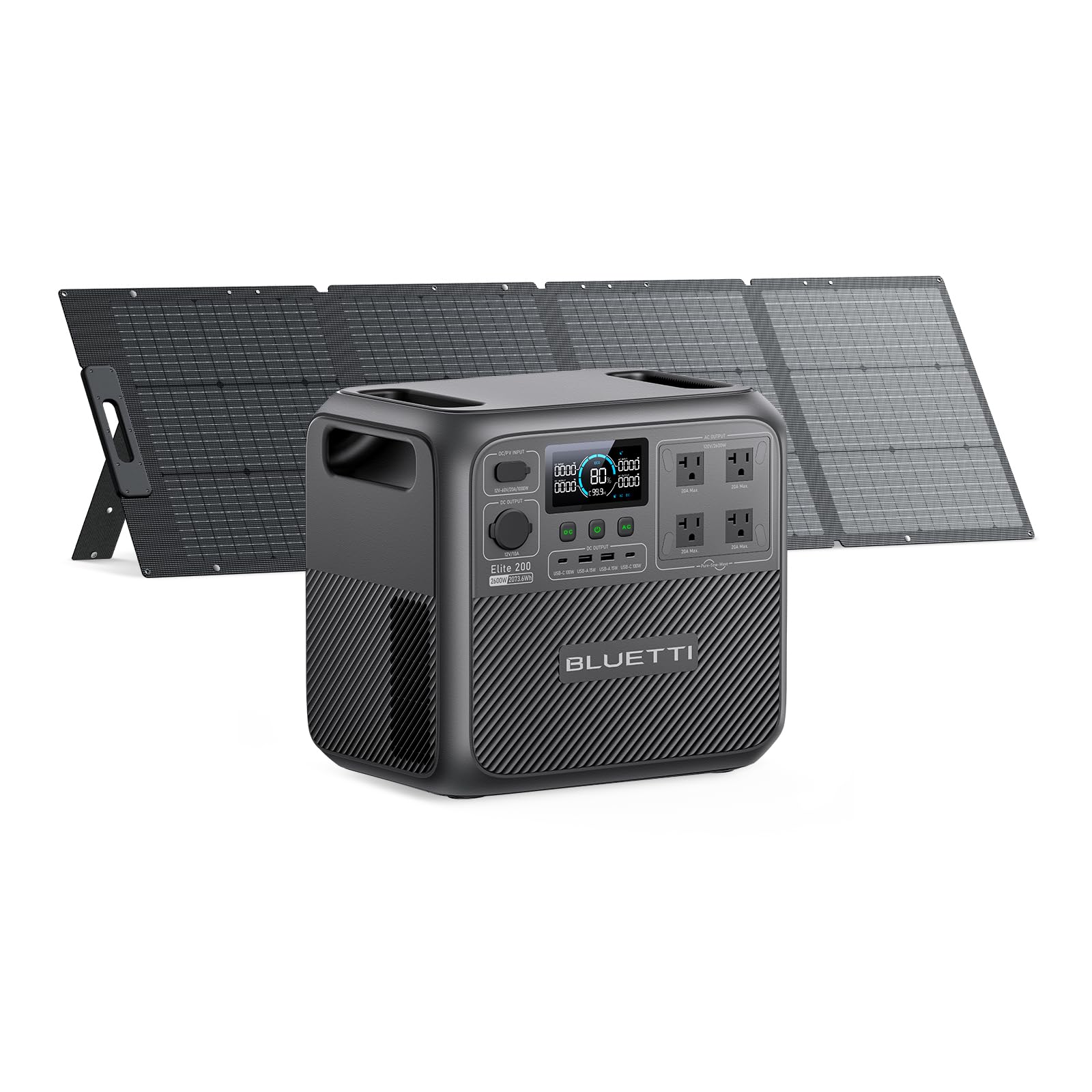
A high-capacity station with the industry’s most efficient standby draw, keeping more power for your gear.
This one leads on efficiency. BLUETTI’s advanced energy management system trims standby consumption to just 10W, which it claims is 3 times lower than similar stations. That matters: less idle drain means a 120V 60W fan running 3 hours a day can last 11 days on a full charge, which the maker says is 13% longer than comparable products.
Inside is a 2073.6Wh battery with what BLUETTI calls the industry’s first CNAS-certified automotive-grade LiFePO4 pack, rated for over 6,000 cycles and a 17-year lifespan. It pushes 2600W of continuous AC power and up to 3900W in power lifting mode, so refrigerators, hair dryers, and coffee makers are all fair game. The included 200W panel fully recharges it in 13.5 hours of sun, or 0-80% in 50 minutes from dual AC and DC wall charging.
Owners who paired it with the BLUETTI alternator charger ran appliances for two months straight in a camper minivan, and another found it handled a hot plate load without complaint. The app shows charge status and time. The fair warning is weight: at 53.4 pounds, this is not a carry-on, and shoppers say it is heavy to move around.
Choose this if: you want maximum runtime per watt-hour, a 17-year battery lifespan, and enough AC power for real kitchen appliances during outages.
Reconsider if: portability is your priority, since 53.4 pounds makes this a set-it-down-once station rather than something you haul daily.
7. VTOMAN 2376Wh Portable Power Station with Extra Battery and 110W Solar Panel
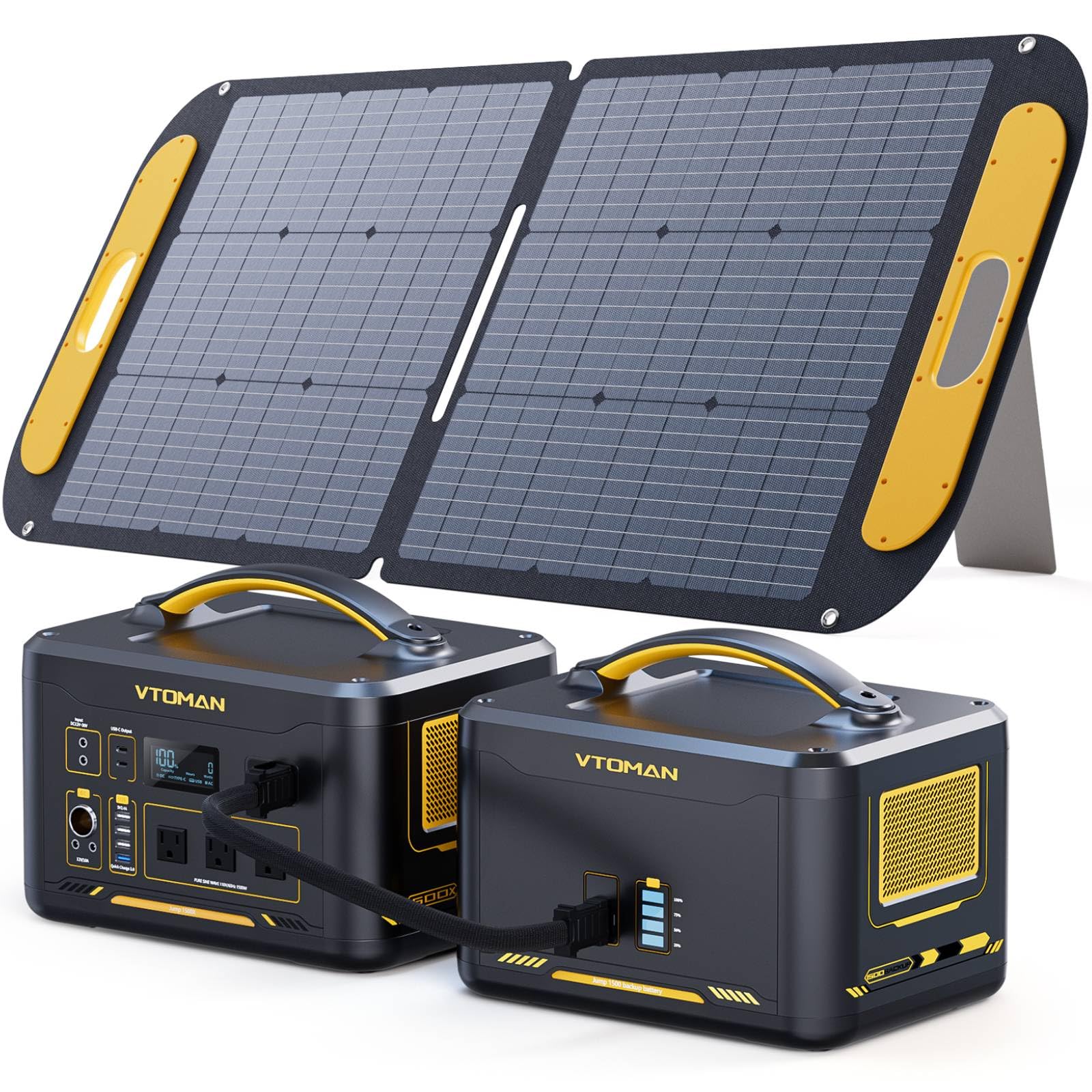
A three-piece bundle that expands from 828Wh to 2,376Wh, so you can run whole sections of your home off-grid.
What makes this kit different is the bolt-on extra battery. The VTOMAN Jump1500X station holds 828Wh on its own, and the matching extra battery multiplies total capacity to a hefty 2376Wh. Owners took it off-grid for six months with zero issues, charging daily even under partial clouds, and one unit survived Hurricane Helene while keeping essentials alive.
Power delivery is clean and strong: three 110V pure sine wave AC outlets push 1500W continuous and 3000W peak. VTOMAN’s V-Beyond tech can even run selected resistive appliances rated between 1500W and 3000W, like space heaters and coffee makers, by regulating voltage. Buyers report it powers a mini fridge for over 5 hours on half a charge, with no capacity loss after 7 months of use.
The included 110W solar panel uses monocrystalline cells with up to 23% conversion efficiency, plus an MPPT controller that handles compatible 12-30V input. The panel has two adjustable kickstands for ground setup and four holes for hanging. The honest points: owners say the extra battery is needed for multi-cloudy-day fridge use, and the unit is heavy. Note it also ships in three separate packages, which arrive on different days.
Why the crowd loves it
- Tested in real storms, surviving Hurricane Helene while powering essentials
- Scalable capacity from 828Wh to 2376Wh with the included extra battery
- Outstanding customer service when a defective port needed replacement
What owners flag
- Multi-cloudy-day fridge use really wants the extra battery attached
- It is heavy to move, so plan where it lives
- The kit arrives in three separate shipments on different days
Grab this if: you need whole-outage home backup that can run a fridge, CPAP, lights, and phones for days, and you value proven storm resilience.
Hold off if: you want a single compact box, because the three-piece design and its weight are built for stationary home duty, not daily lugging.
8. ECO-WORTHY 7.168KWH 800W Solar Panel Kit for RV Off Grid Complete System
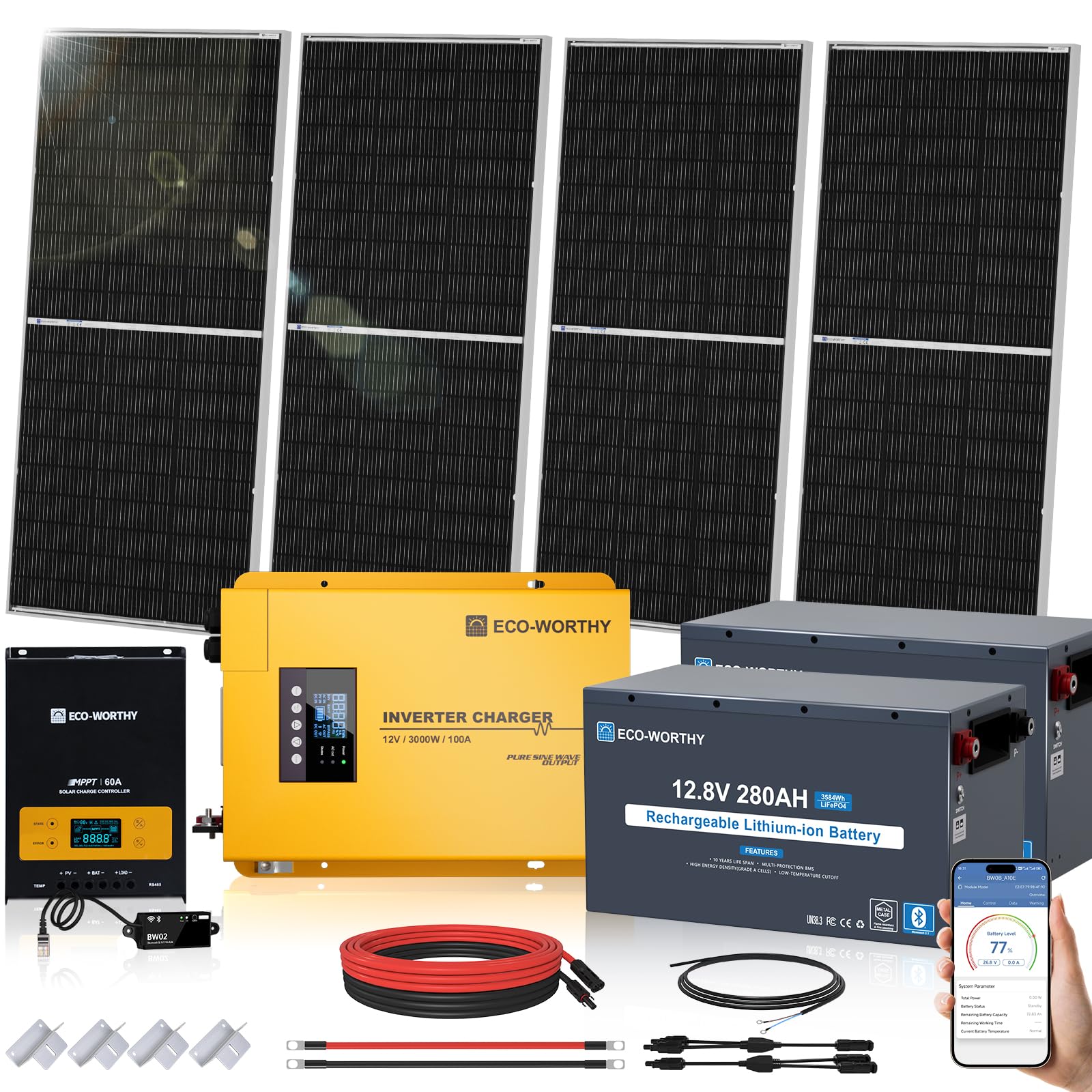
The heavy-artillery kit that can store 7.168kWh and run almost everything in an RV, including the AC.
This is the top of the food chain. It bundles 4 panels rated at 195W each for 780W total, two 12.8V 280Ah lithium batteries, a 12V 3000W inverter charger, and a 60A MPPT controller with Bluetooth. The maker claims 4 hours of sunlight per day generates 3.2kWh, and the batteries store up to 7.168kWh — enough to power 99% of RV appliances, air conditioners included.
The panels are bifacial, meaning they capture reflected light too, with 25.2% high-efficiency cells. Owners who completed the build say it runs their camper easily and stays above 40% battery even on cloudy days. One buyer called it simple plug-and-play, running AC off the 3000W inverter, though they needed wire extensions because some leads ran short.
The catch is assembly. It ships in many separate parcels, and some buyers hit missing parts, no labels, and no written directions, leaving them a month into the project. The maker intends a “4-step novice-friendly” install, but in practice you want basic wiring skills. Good news: on cloudy days it still charges fairly fast, and the Bluetooth module lets you monitor without walking to the controller.
The scale to expect: with 7.168kWh of storage and a 3000W inverter, this is designed to replace grid power for an entire RV, not to top up a phone.
Pick this if: you are building a serious off-grid RV or cabin and want the capacity to run air conditioning and full kitchens without a generator.
Pass if: you want a quick weekend install, because the parts arrive separately and owners mention you are on your own for some of the assembly logic.
Understanding the Specs
Watt-Hours vs. Amp-Hours
Watt-hours (Wh) tell you total energy storage; amp-hours (Ah) at 12V is another way to say it. A 12V 20Ah battery stores about as much as a 240Wh station. Portable stations advertise Wh, while DIY kits often say 12V and Ah. Compare on the same unit to judge which really holds more.
MPPT vs. PWM Controllers
A charge controller manages power flowing from panel to battery. MPPT (Maximum Power Point Tracking) pulls more usable energy, especially in low light, and suits bigger panels. PWM is simpler and cheaper but wastes some panel output. Kits with 200W+ of panels usually pair best with an MPPT controller.
FAQ
What can a 192Wh portable power station like the Anker SOLIX C200 actually run?
How long does a 100W AC outlet station take to recharge from a 40W solar panel?
Is a LiFePO4 battery worth choosing over a standard lithium one?
Can a 200W DIY solar kit run a full-size refrigerator?
What does the amp-hour rating on a 12V battery mean for daily use?
Do solar kits with a built-in panel like the BLAVOR recharge fast enough for daily use?
How many devices can a large 2376Wh power station charge at once?
What size solar system do I need to run RV air conditioning?
Final Thoughts: The Verdict
For most buyers, the 12v solar panel with battery winner is the Anker SOLIX C200 DC because it pairs genuine portability with proven real-world stamina, keeping a Starlink mini at 100% all day on a 192Wh pack. If your priority is whole-home outage backup, grab the VTOMAN 2376Wh kit. And for full-time RV off-grid living with air conditioning, the ECO-WORTHY 7.168kWh system is the one to reach for.
How We Picked
We do not accept paid placement. Every pick is matched to a real buyer and a real use-case; we do not hands-on test units.
Sources & Methodology
Specifications: manufacturer listings and product documentation. Review insights: verified customer reviews, as of September 2026. Pricing: not shown on this page (it changes often); check the current price via the retailer link.
As an Amazon Associate, Gadgets Feed earns from qualifying purchases. This does not affect which products we feature.