
Our readers keep the lights on and my morning glass full of iced black tea. As an Amazon Associate, I earn from qualifying purchases.
Specs are compiled from manufacturer listings and verified buyer reviews and can change over time — please confirm the key details on the product page before buying.
If you want movie rumble, game-shaking explosions, and music with actual depth, a 2.1 speaker system is the honest upgrade from your monitor’s or TV’s thin built-in sound. The “2” gives you left and right channels for stereo separation, and the “.1” is a dedicated subwoofer that handles the low frequencies your ears feel as much as hear. This guide breaks down the nine best systems right now, from compact desk sets to premium living-room soundbars, so you can match the right one to your room and your habits.
I’m Min — the founder and writer behind Gadgets Feed. This guide is built by comparing the manufacturers’ published specifications and the patterns across verified customer reviews, so you get each pick’s real strengths and trade-offs instead of marketing spin.
Great 2.1 speaker systems differ wildly in power, size, and connectivity, and choosing wrong means wasted money. The 2.1 speaker system that fits a dorm desk won’t fill a living room, so we’ve separated the best by use case, power, and features.
Our Picks at a Glance


How To Choose The Best 2.1 Speaker System
Before you click buy, focus on three things: where you’ll place it, how loud you need it, and what devices you’ll plug in. A system that excels at a desk job can feel weak across a large living room, and the opposite is also true.
Match Power and Subwoofer Size to Your Room
Subwoofer driver size (the big speaker cone inside the bass box) is your first clue to output. A 6.5-inch driver, like the one in our top pick, delivers punchy, feelable bass for a bedroom or medium den. An 8-inch driver pushes deeper for larger open spaces. Power, measured in watts, tells you headroom — more watts means cleaner sound at higher volumes without distortion, not just louder noise.
Check Your Connections Before You Commit
For a TV, you want HDMI ARC or optical for the cleanest digital signal. For a computer, USB or USB-C often bypasses a poor quality built-in sound card for a cleaner signal. Nearly every system here includes a 3.5mm aux input as a universal fallback, and Bluetooth is standard across most for phone streaming. Look for the specific ports your devices actually have.
Quick Comparison
| Model | Best For | Power Output | Subwoofer Size | Key Connections | Amazon |
|---|---|---|---|---|---|
| Klipsch ProMedia 2.1★ Best Overall | Overall PC & Gaming Audio | 200W Peak | 6.5″ | 3.5mm, Control Pod | Amazon |
| Edifier S360DBPremium Pick | Premium Hi-Res Listening | 155W RMS | 8″ | Optical, Coaxial, Bluetooth | Amazon |
| JBL Bar 2.1 Deep BassCinema Power | Cinematic TV Sound | 300W Max | 6.5″ | HDMI, Optical, Bluetooth | Amazon |
| Samsung HW-B550F | Samsung TV Integration | — | Wireless | HDMI, Bluetooth | Amazon |
| ULTIMEA Poseidon M30 | App-Controlled Value | 240W Peak | Wireless | HDMI ARC, Optical, Bluetooth 6.0 | Amazon |
| Creative Pebble X Plus | Compact Desk Setup | 30W RMS / 60W Peak* | Compact | USB-C, Bluetooth 5.3, AUX | Amazon |
| Bluedee 2.1 Speakers | Multifunctional WFH Desk | 80W Peak | Dedicated | Bluetooth 5.4, USB-C, AUX | Amazon |
| FIFINE AmpliGame A22 | RGB Gaming Rig | — | Dedicated | Optical, Bluetooth, USB-C | Amazon |
| Logitech Z313 | Budget Desk Basics | 50W Peak / 25W RMS | Compact | 3.5mm, Wired Control | Amazon |
In-Depth Reviews
1. Klipsch ProMedia 2.1 THX Certified Computer Speaker System
Our pick — 4.5★ from 11,500+ verified ratings; the strongest balance of quality and price.
The legendary desktop setup that justifies its cult status with room-shaking authority.
The Klipsch ProMedia 2.1 earns its gold-standard status with 200 watts of peak power and a 6.5-inch side-firing subwoofer that delivers physical, room-filling bass. Its THX certification guarantees accurate sound reproduction, so movies and games play back exactly as mastered. Klipsch’s exclusive MicroTractrix Horn Technology in the satellites directs sound precisely at your ears for efficient, detailed output.
One buyer notes that at one-third volume it “vibrates walls,” underscoring the immense headroom available. Owners consistently report it outperforms far pricier setups, with one even finding it superior to the professional PA system it replaced. The satellites are sturdy, though the speaker cones are fragile if you poke them, so treat the exposed drivers with care. It’s a wired system that connects via a 3.5mm input, with a handy control pod giving you main volume and subwoofer gain knobs, plus a headphone jack for private listening.
The primary honesty check here is the lack of a power switch. The system stays in standby with a bright green LED, so you’ll either need to unplug it or cover the light if it bothers you in a dark room. For a TV, the bass can overwhelm dialogue, so you’ll want to keep the subwoofer gain low. This is a system built for the PC gamer, music lover, or movie fan who wants professional sound quality without needing a separate amplifier.
What Makes It Legendary
- 200W peak power output for room-filling volume
- THX certified with horn-loaded satellites for precise imaging
- 6.5″ side-firing ported subwoofer delivers deep, physical bass
- Easy plug-and-play setup with a convenient control pod
Things To Know
- No power switch, leaving a bright green LED always on
- Wired-only connection via 3.5mm aux
- Delicate speaker cones require cautious handling
- Bass can be overpowering for TV dialogue at default settings
Pick this up if: you’re a PC gamer or music fan who wants genuine high-fidelity sound and physical bass at a desk.
Think twice if: you need a power switch or remote control, or you strictly want a soundbar form factor for a TV.
2. Edifier S360DB Bluetooth Bookshelf Speaker System
A premium, amplifier-free bookshelf system that brings true hi-fi depth to a living room.
The Edifier S360DB is the system you choose when you’ve outgrown plastic desktop speakers. It outputs a genuine 155 watts RMS (continuous power, not just peak), driving two bookshelf speakers and an 8-inch subwoofer for deep, tight bass that fills a large room. It supports Hi-Res audio for higher bit depth and sample rates of 96 kHz or higher, meaning it reveals detail in your music that lesser systems smudge over. You get wood-cabinet speakers, which look and sound more refined than typical plastic satellites.
What makes it versatile is its built-in Texas Instruments TAS5754M amplifier, so there’s no need for an outside receiver; just plug into a source and play. It offers a range of connections — PC, AUX, optical, coaxial, and Bluetooth 4.1 with Qualcomm aptX for CD-quality wireless sound. A dedicated remote handles volume and input switching, and the subwoofer connects wirelessly for flexible placement. Owners who upgraded from other systems report a full, even sound with clear separation and punchy bass, describing it as a clear step up from soundbar setups.
The catch is the round remote control, which multiple users find hard to orient in the dark. Sound quality has mixed feedback in the review data; while many praise its clarity and build, others find certain tracks lack punch. The Bluetooth is version 4.1, which is older than what you’ll find on budget options in this list, though aptX keeps the quality high for compatible phones. This is the pick for the discerning listener who values instrument separation and natural tone over sheer wall-shaking volume.
The High-End Appeal
- 155W RMS total power with a separate 75W amp for the subwoofer
- 8-inch subwoofer with wireless connection for deep bass
- Hi-Res Audio certified for detailed, high-fidelity playback
- Multiple inputs including optical, coax, and Bluetooth aptX
What To Consider
- Round remote is notoriously difficult to use by feel
- Sound signature is debated; not universally loved for heavy bass
- Premium tier pricing places it above casual budgets
- Static hum can occur in PC mode when the source is off
Perfect for: the music purist who wants an amp-free 2.1 setup in a large living space and values instrument clarity.
Not ideal for: those who primarily want to rattle walls with sub-bass or who dislike managing a finicky remote.
3. JBL Bar 2.1 Deep Bass (MK2)
A soundbar with serious muscle, turning your living room into a theater with 300 watts.
The JBL Bar 2.1 Deep Bass lives up to its name with a massive 300W of total system power and a dedicated 6.5-inch wireless subwoofer. You place the sub anywhere in the room without an audio cable, and it produces deep, thrilling bass that shakes the sofa. It supports Dolby Digital decoding, giving you an authentic cinematic experience from your couch. The soundbar itself is sleek, and the wireless sub auto-pairs for a clean setup.
Owners say the bass beats much older high-end systems, and three adjustable levels (Low/Mid/High) let you tune output without distortion. Bluetooth is built-in for streaming music from your phone or tablet when you’re not watching TV. Setup is straightforward via HDMI or optical connections, and the included remote is intuitive with a clear display. Reviewers call it a fantastic value that transforms TV audio with clear mids, highs, and effective lows.
You get a compact subwoofer that slides into an entertainment center easily, but it may not pressurize a very large open-plan room as hard as bigger models. A few early owners reported receiving dead-on-arrival units due to poor packaging, though replacements generally worked well. There’s no built-in Dolby Atmos support (a height-based surround format), but many owners find the rich JBL Surround Sound adequate without it.
Why It Roars
- 300W max power output for loud, distortion-free sound
- 6.5″ wireless subwoofer provides deep, adjustable bass
- Built-in Dolby Digital for cinematic audio
- Easy HDMI or optical connection with auto-pairing sub
Watch Out For
- Reports of occasional dead-on-arrival units due to shipping
- Lacks Dolby Atmos virtual height effects
- Bass can be finicky on certain rock tracks, occasionally muddying
Reach for this if: you want a soundbar form factor with true theater-style power for movies and TV in a medium-to-large room.
Look elsewhere if: you’re a bass-head who plays complex rock at loud volumes, or you need Dolby Atmos height channels.
4. Samsung B-Series Soundbar HW-B550F

Smart soundbar that adapts to what you watch and pairs flawlessly with Samsung TVs.
The Samsung HW-B550F is a 2.1-channel soundbar with a wireless subwoofer, designed to be an intelligent add-on for your TV, especially if you own a Samsung. Its headline feature is Adaptive Sound, which recognizes the type of content you’re watching and automatically adjusts the audio to produce clear voices and detailed sounds. If dialogue is your priority, the Voice Enhance Mode automatically amplifies voices so you don’t miss a word. For extra punch, Bass Boost adds deeper, fuller sound to your favorite action scenes.
Setup is remarkably simple, with owners reporting the subwoofer auto-pairs in about 20 minutes, and the system works smoothly with Samsung TVs over HDMI (a single cable for audio and video). It also supports DTS Virtual:X, which creates multi-directional spatial audio from all around you without needing rear speakers. The included remote is a common point of praise and frustration; some find it intuitive, while others describe the thin volume strip as unreliable and difficult to click. Because this is a 2025 model, it represents Samsung’s current feature set at a compelling price point.
There are two recurring complaints to weigh. First, the remote design is polarizing — some owners find it cheap and finicky. Second, while many report reliable operation, a portion of owners have had issues with the wireless subwoofer not working or intermittent connectivity drops. The sound quality is generally well-loved, with owners calling it a movie-theater experience that’s a huge improvement over TV speakers and a fantastic value. If you want a smart, TV-centric system with excellent dialogue clarity and expandable to true surround later, this is a strong candidate.
Smart Sound Advantage: Adaptive Sound and Voice Enhance modes automatically tune audio for clear dialogue and detailed effects, making this a hands-off pick for TV and movie fans. For a Samsung TV owner, the integration is practically smooth.
The Trade-Off: The remote control is a sore spot for many, described as a thin volume strip with unreliable clicks — you may find yourself favoring the app or TV remote instead.
Best if: you want a soundbar that tune itself for TV content and plan to connect it to a newer Samsung TV.
skip it if: you primarily listen to music and need deep, consistent bass, or if you are sensitive to a finicky remote.
5. ULTIMEA Poseidon M30 Sound Bar with Wireless Subwoofer
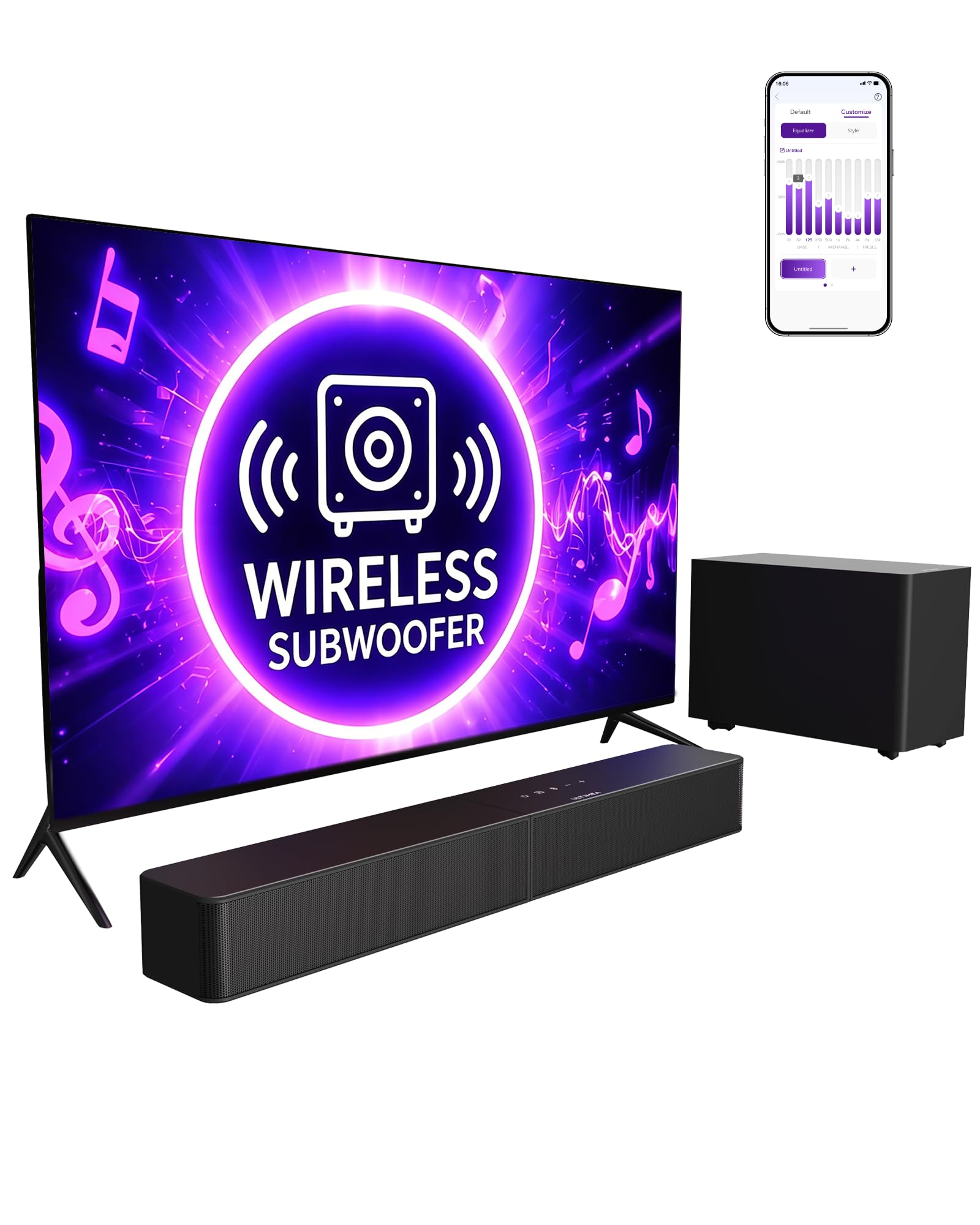
A budget soundbar with a deep feature set, including app EQ and a wireless sub you can place anywhere.
The ULTIMEA Poseidon M30 punches far above its price class, delivering up to 240W of peak power with a frequency response of 45 Hz–18 kHz. Its wireless subwoofer connects without audio cables, so you have the freedom to place it anywhere in your room for the best bass response. The soundbar uses Mica-reinforced drivers that increase rigidity and reduce distortion for cleaner, more accurate sound. It also features VoiceMX technology, which uses advanced DSP algorithms to isolate and boost the vocal range of 120 Hz–6 kHz so dialogue stays clear.
This system is incredibly feature-rich. The Ultimea App gives you a 10-band equalizer with 121 preset EQ matrices, letting you fine-tune audio for movies, music, or games, plus OTA updates. Connectivity is modern, with HDMI ARC, optical, and upgraded Bluetooth 6.0 for fast, stable streaming with lower latency. Owners rave that it outperforms pricier brand-name models, even beating their previous Samsung soundbars. The compact size and easy setup are consistent highlights, and the wireless subwoofer is considered a major plus, producing punchy, deep bass that fills a room.
The trade-offs are minor but worth noting. Bluetooth works well for some, but other buyers report occasional connection hiccups. The volume control receives mixed reviews; the remote is functional, but many find the app to be the more intuitive way to navigate settings and presets. If you want a modern, app-driven soundbar with flexible placement and voice clarity that rivals pricier models, this delivers exceptional value.
Why It’s a Steal
- 240W peak output with a 45 Hz–18 kHz frequency range
- Wireless subwoofer for flexible room placement
- App control with 10-band EQ and 121 presets
- Modern Bluetooth 6.0 for low-latency streaming
Minor Gripes
- Bluetooth reliability is inconsistent for some users
- Remote control is less intuitive than the app interface
- Night mode is tied to volume control
Reach for this if: you want a budget-friendly soundbar with premium app tuning and flexible subwoofer placement.
Not for: purists who prefer a physical remote and won’t use an app, or who need multiple HDMI inputs.
6. Creative Pebble X Plus 2.1 USB-C Speakers

Sphere-shaped desk speakers that hide surprising punch and clean USB-C digital audio.
The Creative Pebble X Plus is the space-saving champion of this list, packing an upgraded 2.75-inch driver in each spherical satellite and an all-new compact subwoofer. from the start, it delivers up to 15W RMS and 30W peak power. Plug it into a 30W or higher USB PD adapter (not included), and it amplifies to a hefty 30W RMS and 60W peak, giving you serious headroom for a desktop setup. This makes it a flexible system that can go from subtle background music to genuinely loud gaming sessions.
Connectivity is a highlight. You can use USB for pure digital audio, which bypasses the potentially poor sound card in your PC, stream wirelessly via Bluetooth 5.3, or use a universal 3.5mm aux input. It also has dual communication ports for a headset and microphone, letting you quickly switch to private listening. The design is sleek with a matte finish and customizable RGB lighting, offering up to 16.8 million color combinations with six presets. Owners describe the sound as clean and balanced with a surprisingly powerful subwoofer for its size — some even compare it to far pricier systems.
The main limitation is the cable length. The speaker cables are permanently attached and on the short side, with a max separation of about 4 feet, which can restrict stereo imaging if you have a wide desk. The subwoofer uses passive radiators, so it lacks the very deepest sub-bass of larger units, and it needs wall power for the amplifier to reach its best performance. This system is ideal for an office or dorm room where desk space is precious and you want great sound without a massive footprint.
Compact Strengths
- Amplified mode reaches up to 30W RMS and 60W peak with a USB PD adapter
- USB-C digital input for clean audio, bypassing PC sound cards
- Compact spherical design with customizable RGB lighting
- Headphone and mic ports for easy private listening
Space-Saving Limits
- Permanently attached speaker cables limit placement flexibility
- Compact subwoofer lacks the deepest bass of larger models
- Requires wall power to reach peak performance
Ideal for: students or home-office workers with limited desk space who want a big, clean sound from a tiny, stylish package.
Consider alternatives if: you have a sprawling desk setup and need to place speakers more than 4 feet apart.
7. Bluedee Computer Speakers with Subwoofer
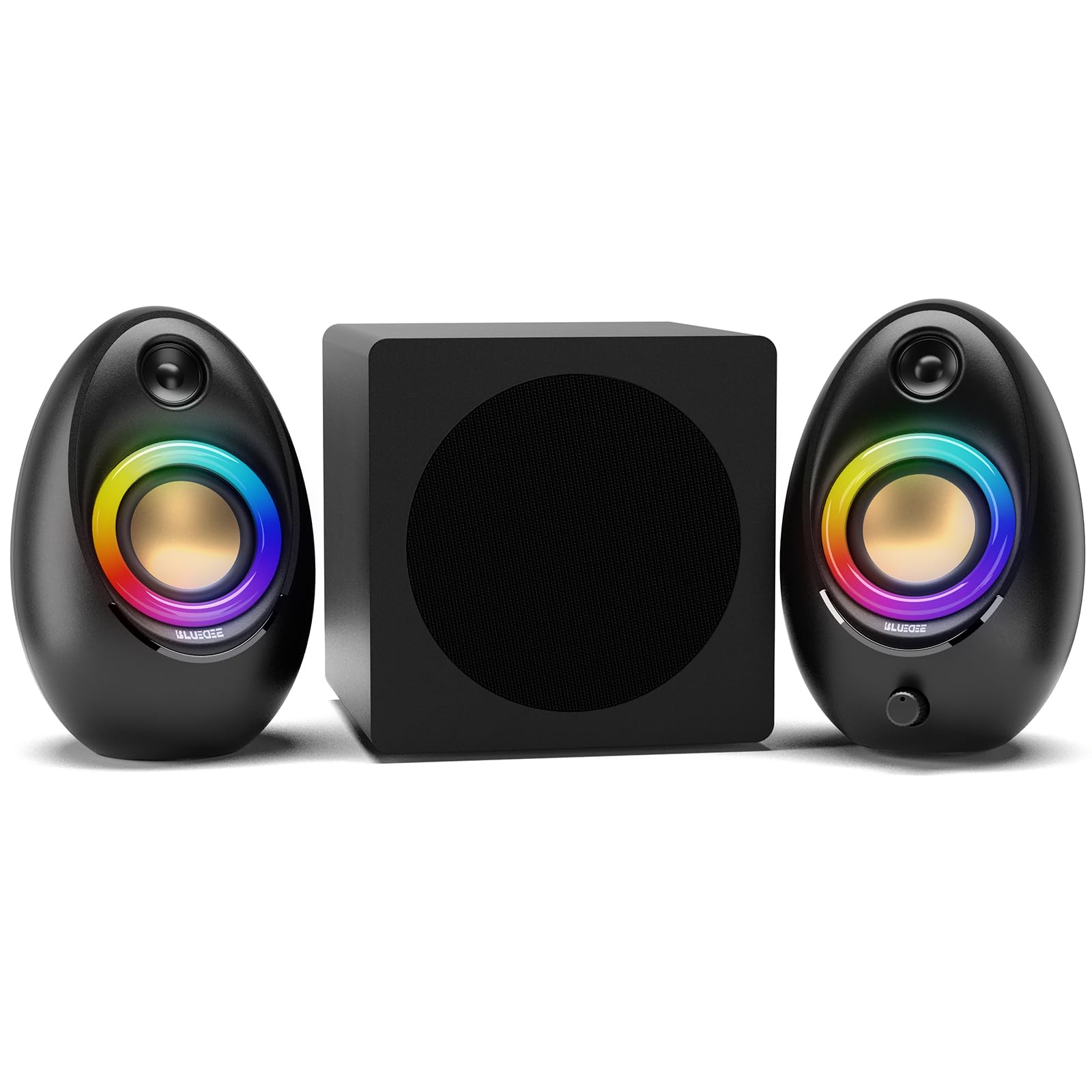
A versatile 80W desktop setup with modern Bluetooth 5.4 and an all-in-one control knob.
The Bluedee 2.1 speakers bring a clean, modern aesthetic to your desk with an independent bass unit that keeps deep lows separate so your satellite speakers stay clear for vocals. It’s powered by 80W of peak output and uses built-in DSP tuning (a digital processor that shapes the audio) to reduce distortion and harsh highs, giving you smoother, more comfortable sound for work-from-home and everyday listening. The compact subwoofer delivers deep, punchy bass without muddying the midrange.
Connectivity is genuinely versatile. You can use them as Bluetooth speakers via Bluetooth 5.4, or connect them with USB-A, USB-C, or a 3.5mm aux cable for a plug-and-play setup with desktops, laptops, and home office gear. The Bluetooth range extends to 10 meters, giving you freedom to move around. An all-in-one control knob lets you adjust volume, play or pause audio, change lighting effects, and switch modes. Owners praise the sound quality, noting it’s crisp even at high volume with strong bass, and call it a fantastic value that easily outperforms built-in laptop speakers and even some expensive stereos.
The honest caveats are small. The egg-shaped satellite speakers are prone to rolling on narrow surfaces, so they need a stable, flat spot. When Bluetooth is disconnected, the LED flashes until you unplug the system, which can be distracting in a dark room. Sound can distort at very high volumes on bass-heavy tracks, so there are limits to how loud you can push it. For most desk use, though, this is a rock-solid, reliable system that owners say holds up perfectly even after a year of constant use.
Desk-Friendly Wins
- 80W peak power with DSP tuning for clean, balanced audio
- Modern Bluetooth 5.4 with a 10-meter wireless range
- Multiple connections via USB-A, USB-C, and 3.5mm aux
- One-knob controls all volume, playback, and lighting
Small Quirks
- Egg-shaped satellites can roll on narrow surfaces
- LED flashes when Bluetooth is idle until unplugged
- Distortion appears at very high volume on bass-heavy tracks
Go for it if: you want a reliable, great-sounding desk system with flexible wired and wireless connections.
Pass if: you need to place speakers on a narrow shelf or monitor stand where the rounded design could be unstable.
8. FIFINE AmpliGame A22 2.1 Gaming Speakers
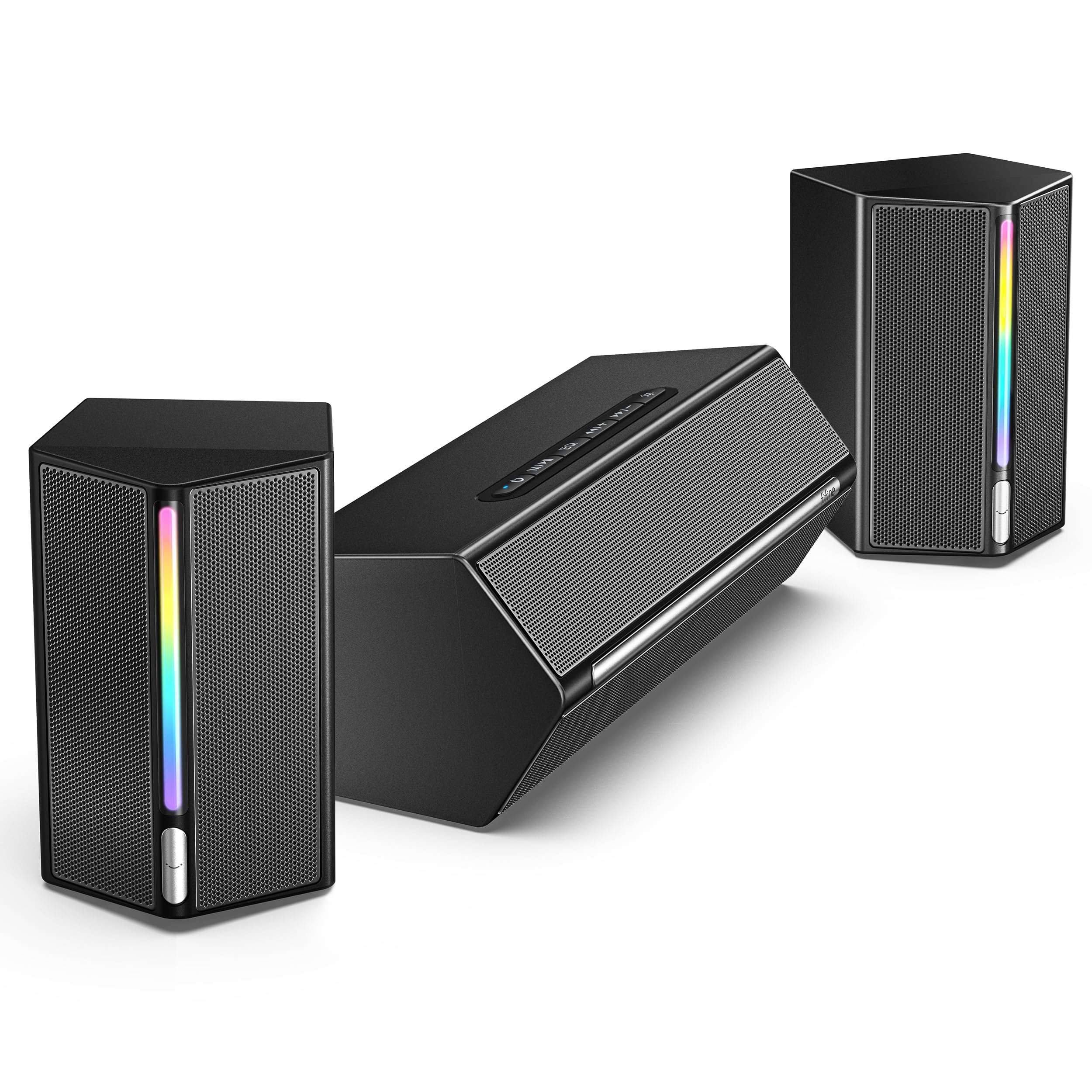
Dynamic RGB that syncs to your game audio, with four connection modes for any rig.
The FIFINE AmpliGame A22 is built for gamers who want their desk to light up in sync with their gameplay. The system features RGB lighting that pulses and shifts with your music or game audio, offering 18 different dynamic lighting modes including audio-sync, breathing, and color cycle. A long press on the control turns the lights off completely when you want a dark, focused room. Beyond the flash, the AC-powered drivers deliver clear treble and deep bass so explosions have weight and footsteps are accurately placed in the soundscape.
You get more connection options than most gaming systems: OTG (a direct digital connection from your phone or PC), optical for digital audio from a TV, AUX for analog, or Bluetooth for wireless convenience. Top-mounted buttons give you easy control over volume, music playback, and a dedicated EQ button that cycles through Game, Movie, and Music modes, each tuned for its content. Owners find the satellites compact, with replaceable Type-C cables, and praise the clear sound, calling it a solid, compact solution for daily use.
The honest feedback is that sound quality is mixed in the review data. While some owners love it, others report issues, including occasional units with no sound output or persistent buzzing unless using the optical input. One owner noted Bluetooth lag of 180ms, which can be noticeable in games and movies. Some also felt the advertised cable lengths were shorter than stated. The value is generally praised, but the system is better suited for PC use where the button controls are accessible, since the lack of a remote makes it awkward for TV use. This is a solid choice if the RGB aesthetic is a must-have and you connect via optical or USB.
The Gamer Appeal
- RGB lighting with 18 modes, including audio-sync
- Four connection options: OTG, optical, AUX, and Bluetooth
- Dedicated EQ button cycles through Game, Movie, and Music modes
- Satellites use replaceable Type-C cables
The Catch
- Sound quality is inconsistent; some units have buzzing issues on non-optical inputs
- Bluetooth lag can be noticeable at around 180ms
- No remote, so volume control is limited to the central unit
Choose this for: a dedicated PC gaming setup where you want audio-reactive RGB and don’t mind using the on-unit controls.
Look elsewhere if: you need a remote for couch distance, or you want guaranteed reliability across all input types.
9. Logitech Z313 2.1 Multimedia Speaker System

The affordable entry into 2.1 sound that proves you don’t need to spend much for balanced audio.
The Logitech Z313 is the perfect starting point for anyone moving beyond tinny laptop speakers without wanting to spend a fortune. This 2.1 system delivers 50W peak / 25W RMS power, which is plenty for a desktop or small room, and it provides enhanced bass from a compact subwoofer. The satellites are small, measuring just 5.76 inches high, so they slip easily onto any desk or bookshelf. Logitech tunes the system for balanced acoustics, meaning it handles music, movies, and games competently without favoring any one type of audio.
Setup is dead simple — you connect any device with a headphone jack using the 3.5mm input, and use the wired control pod to manage volume and connect your headset. The included pod gives you a physical volume dial, which buyers specifically praise as a huge upgrade over previous sets without one. The system runs on an AC power adapter, so you don’t have to worry about batteries. Owners consistently describe the sound as “plenty of power” and “decent” for such a budget-friendly price, praising the mids and highs as particularly clear. One buyer called them “amazing for the price” and noted they take up very little space, making them an ideal first speaker system.
The trade-off is inherent to the budget tier. You get good, clean sound, but you won’t get the deep, wall-vibrating bass or the high-end detail of pricier systems. The subwoofer is compact, so it tightens up the low end but doesn’t deliver thunderous output. The build is functional plastic, not premium. This is the smart pick for a student, a guest room, or a secondary monitor setup where you just want solid, reliable audio without fuss.
Budget Strengths
- 50W peak / 25W RMS power for a full-range, balanced sound
- Compact satellite design, only 5.76 inches high, fits any desk
- Wired control pod offers easy volume adjustment
- Works with any device with a 3.5mm headphone jack
Budget Limits
- Compact subwoofer lacks thunderous, deep bass extension
- No Bluetooth — requires a wired connection
- Plastic build is functional, not premium
Ideal for: first-time buyers or secondary setups where you need clean, reliable 2.1 sound at the lowest cost.
Step up if: you crave physical, room-shaking bass or need wireless Bluetooth streaming.
Understanding the Specs
Understanding Wattage: Peak vs. RMS
You’ll see two numbers. Peak power is the absolute maximum a speaker can handle for a split second, which marketing loves. RMS (Root Mean Square) is the continuous power it can sustain — this is the honest spec for loudness and headroom. A system with higher RMS generally plays cleaner at higher volumes without distortion.
The Role of the Subwoofer
The “.1” in 2.1 handles bass frequencies below what the satellite speakers can produce. A larger driver with a bigger cabinet moves more air, creating deeper, more physical bass. A “ported” subwoofer uses a vent to enhance output, while a “passive radiator” model uses a secondary cone for similar effect in a smaller space. Wireless subs offer flexible placement.
FAQ
What does 2.1 channel mean in a speaker system?
Is a soundbar with a subwoofer the same as a 2.1 system?
Can I connect a 2.1 speaker system to my TV?
What is the difference between peak and RMS power?
Is Bluetooth good enough for a 2.1 speaker system?
Why is there a hissing or buzzing sound from my speakers?
Do I need a sound card or amplifier for a 2.1 system?
How important is the subwoofer size for bass response?
What is a DSP and why does it matter in a 2.1 speaker system?
Can I upgrade my 2.1 soundbar with rear speakers later?
Final Thoughts: The Verdict
For most people, the 2.1 speaker system winner is the Klipsch ProMedia 2.1 because it delivers the most balanced combination of legendary sound quality, THX certification (a rigorous audio standard for accurate playback), and 200W of peak power at a price that undercuts far less capable competitors. If you want premium, amplifier-free hi-fi with deep 8-inch bass for a living room, grab the Edifier S360DB. And for a compact desk that still fills a dorm room with clean sound, the Creative Pebble X Plus is the one to reach for.
How We Picked
We do not accept paid placement. Every pick is matched to a real buyer and a real use-case; we do not hands-on test units.
Sources & Methodology
Specifications: manufacturer listings and product documentation. Review insights: verified customer reviews, as of September 2026. Pricing: not shown on this page (it changes often); check the current price via the retailer link.
As an Amazon Associate, Gadgets Feed earns from qualifying purchases. This does not affect which products we feature.