
The RDNA 4 generation marks a decisive shift in the GPU landscape, with AMD’s 9070 XT silicon delivering rasterization performance that challenges and often surpasses Nvidia’s RTX 5070 Ti at a significantly lower entry point. This card isn’t about chasing ray tracing benchmarks at the expense of raw frame rates — it’s built for gamers who demand high-refresh 4K and maxed-out 1440p without breaking the bank on power connectors that require a dedicated circuit. The 16GB GDDR6 VRAM buffer is the new baseline for modern texture-heavy titles, ensuring this card remains viable for years as game engines evolve.
I’m Min — the co-founder and writer behind Gadgets Feed. I’ve spent hundreds of hours analyzing 9070 XT 24GB board partner designs, cooling solutions, power delivery systems, and real-world benchmark data to separate marketing fluff from genuine performance gains, so you can buy with confidence.
I’ve scoured verified customer reports and stress-tested thermal data to bring you the definitive guide to the best 9070 xt 24gb graphics cards and pre-built systems that deliver exceptional value across every budget tier.
How To Choose The Best 9070 XT 24GB
The 9070 XT market is flooded with board partner variants, and the differences between a budget-focused Pulse and a flagship Nitro+ or Taichi are substantial — not just in aesthetics but in sustained boost clocks, thermal headroom, and noise floor. Three variables separate a good purchase from a regretful one.
Cooling Solution & Thermal Performance
The 9070 XT is a 304W TDP part, and how that heat is managed directly determines whether your card sustains its 2970 MHz boost clock or throttles back. Triple-fan designs with larger heatsinks and vapor chambers — like the Windforce on Gigabyte’s Gaming OC or the Taichi 3X on ASRock’s flagship — maintain hotspot temperatures under 85°C even during extended 4K sessions. Smaller or dual-fan cards may run hotter and louder, requiring more aggressive fan curves to stay in spec. The presence of 0dB silent fan mode is also a quality-of-life differentiator; cards like the ASUS Prime and ASRock Challenger stop fans entirely during low-load desktop work, eliminating all noise.
Power Connector & PSU Compatibility
Board partners have taken divergent approaches to power delivery. The XFX Quicksilver uses two standard 8-pin PCIe connectors, making it compatible with almost any quality 750W power supply. PowerColor’s Red Devil demands three 8-pin connectors and recommends a 900W PSU — a significant requirement that may force a PSU upgrade. The ASRock Taichi uses a 12V-2×6 (12VHPWR) connector found on Nvidia RTX 4000 series cards, requiring an adapter or a native ATX 3.0/3.1 power supply. Always verify connector type and recommended wattage before purchasing, as an inadequate PSU can cause system instability or shutdowns under load.
Factory Overclock & Dual BIOS
Premium models like the ASRock Taichi ship with a 3100 MHz boost clock — 130 MHz above the reference spec — delivering a measurable performance uplift in GPU-bound scenarios. Dual BIOS switches, found on the Gigabyte Gaming OC and ASRock Taichi, allow you to toggle between a performance profile and a quieter, lower-power mode. This is particularly valuable for builders who want to switch between gaming sessions and silent desktop work without entering software. Cards without factory overclocks, like the Sapphire Pulse, offer less out-of-box performance but often respond well to manual undervolting via AMD’s Adrenalin software, which users report can boost effective clocks by 50-100 MHz while reducing temperatures by 10-15°C.
Quick Comparison
On smaller screens, swipe sideways to see the full table.
| Model | Category | Best For | Key Spec | Amazon |
|---|---|---|---|---|
| ASRock Taichi 16GB OC | Premium | Enthusiasts & Heavy OC | 3100 MHz Boost, 12V-2×6 | Amazon |
| PowerColor Red Devil | Premium | Max Airflow Builds | Triple 8-pin, 340mm Length | Amazon |
| Sapphire Nitro+ OC | Premium | Silent 4K Gaming | Whisper-Quiet, 2kg Heatsink | Amazon |
| PowerColor Hellhound | Mid-Range | Efficient 1440p Ultra | Dual 8-pin, Sub-60°C Gaming | Amazon |
| ASRock Steel Legend | Mid-Range | White Aesthetic Builds | 2970 MHz Boost, RGB Sync | Amazon |
| Gigabyte Gaming OC 16G | Mid-Range | Compact Performance | 3060 MHz Boost, Dual BIOS | Amazon |
| ASUS Prime OC | Mid-Range | Linux Compatibility | 2.5-Slot, 0dB Technology | Amazon |
| XFX Quicksilver Gaming | Mid-Range | Wide Chassis Compatibility | 2x PCIe Connector, 13.78″L | Amazon |
| Sapphire Pure OC | Mid-Range | White Build Aesthetics | Whisper-Quiet, 2x 8-pin | Amazon |
| XFX Swift Triple Fan | Mid-Range | Value 5070 Ti Equivalent | 2970 MHz, SWFT Cooling | Amazon |
| ASRock Challenger OC | Mid-Range | Solid 1440p Gaming | 2970 MHz, 0dB Silent | Amazon |
| Sapphire Pulse Gaming | Mid-Range | Budget Entry High-End | 16GB GDDR6, Anti-Sag Bracket | Amazon |
| Skytech Edge (Pre-Built) | Pre-Built | Ready Out of Box | RX 9070 XT + 7800X3D | Amazon |
In‑Depth Reviews
1. ASRock Radeon RX 9070 XT Taichi 16GB OC

The Taichi represents ASRock’s flagship effort, and it shows in every specification. The factory 3100 MHz boost clock is the highest among the reviewed 9070 XT cards, and the 16-phase Smart Power Stage (SPS) design delivers exceptionally clean power to the GPU die, enabling sustained boost clocks even during GPU-bound 4K workloads. The triple 100mm Striped Axial fans with reverse-spin technology prevent turbulence between adjacent fans, which keeps acoustic noise lower than competing triple-fan designs during high-RPM operation.
Cooling performance is meaningfully better than the more affordable Challenger variant. The massive heatsink and vapor chamber keep GPU core temperatures in the mid-50s °C during 1440p gaming, with hotspot readings staying under 80°C — figures that give users substantial thermal headroom for manual undervolting. Users report stable -100mV undervolts that push effective boost clocks past 3.2 GHz while dropping core temps below 50°C, a scenario that makes the Taichi one of the fastest 9070 XT cards money can buy.
The Dual BIOS switch and Polychrome SYNC RGB are genuinely useful features for builders, but the card’s 330mm length and 12V-2×6 power connector require careful case and PSU selection. At 2.18kg, this is also one of the heaviest cards in its class, and while the included metal backplate provides structural rigidity, the weight may sag in some motherboards if a support bracket isn’t used.
Why it’s great
- Highest factory boost clock (3100 MHz) of any reviewed 9070 XT
- 16-phase SPS power delivery ensures rock-solid stability under overclocking
- 0dB fan mode delivers silent operation during desktop and light gaming
Good to know
- Requires 12V-2×6 power connector; may need adapter or ATX 3.0 PSU
- Large 330mm length and 2.18kg weight demand a spacious case with GPU support
2. PowerColor Red Devil AMD Radeon RX 9070 XT 16GB

The Red Devil carries PowerColor’s reputation for building premium cards with massive cooling solutions that prioritize low noise and low thermals above all else. Its 340mm length and 69mm thickness make it one of the largest 9070 XT cards available, but that size translates directly to thermal performance: users consistently report GPU core temperatures in the low 50s °C during 1440p gaming and sustained 4K loads, with the fans remaining almost inaudible at default fan curves. The triple 8-pin power connector setup gives overclockers plenty of headroom for aggressive voltage tuning.
Performance out of the box is excellent, with the card boosting past its 2520 MHz base clock to effectively sustain over 2.9 GHz in most gaming scenarios. The massive heatsink and dense fin array allow for extremely quiet operation — users describe it as “silent” during normal gaming, with fan noise only becoming perceptible during synthetic stress tests. The included addressable RGB LED cable and graphics card holder add to the premium experience, though the card’s sheer size means it won’t fit in mid-tower cases without careful measurement.
The Red Devil also benefits from PowerColor’s solid build quality reputation and the 900W minimum PSU recommendation is realistic — users on 850W units report stability issues during simultaneous CPU and GPU stress loads. The card’s performance in vertically mounted orientation is notably poor, with users reporting thermal throttling when the card is rotated 90 degrees, so ensure your case supports standard horizontal mounting.
Why it’s great
- Enormous heatsink keeps GPU core in low 50s °C during 4K gaming
- Fans are nearly inaudible at default curves; excellent acoustic performance
- Triple 8-pin connectors give maximum overclocking power headroom
Good to know
- 13.86″ length and 69mm thickness require a full-tower or very large mid-tower case
- Requires 900W PSU — users on 850W report stability issues under combined CPU/GPU load
3. Sapphire Nitro+ AMD Radeon RX 9070 XT Gaming OC 16GB

Sapphire’s Nitro+ line has long been the gold standard for quiet operation, and this 9070 XT iteration continues that legacy. The card’s 2kg heatsink is a massive slab of aluminum and copper that absorbs heat from the RDNA 4 die and dissipates it through triple axial fans that Sapphire claims are specifically tuned to produce less audible noise at the same RPM as competing fans. Users confirm this — the Nitro+ is frequently described as “silent” even during 4K gaming sessions, with fans only becoming audible if the manual override is engaged above 70% speed.
The build quality matches the acoustic performance. The card feels dense and premium in hand, with a metal backplate that extends slightly beyond the PCB to cover the entire length of the card. The dual HDMI and dual DisplayPort 2.1 output configuration is flexible for multi-monitor setups, and the included support bracket prevents GPU sag in horizontal mounting. Users report that even without manual tuning, the card delivers 100+ FPS in modern AAA titles at 1440p ultra settings, and sustains stable frame rates at 4K with FSR 4 quality mode enabled.
The Nitro+ is not the cheapest 9070 XT variant — it sits in the premium tier alongside the Taichi and Red Devil — but it justifies its position through superior build quality and acoustics. The card’s 2kg weight means it’s not suitable for smaller cases or vertical mounting without additional support, but for users who prioritize silent operation above all else, the Nitro+ is the clear winner.
Why it’s great
- Industry-leading acoustic performance; fans are silent at typical gaming loads
- Massive 2kg heatsink provides exceptional thermal headroom for overclocking
- Premium build quality with metal backplate and included anti-sag bracket
Good to know
- Very heavy at 2kg — ensure your case’s PCIe slot reinforcement can handle the weight
- Premium pricing means budget-conscious buyers may prefer the Pulse or Challenger models
4. PowerColor Hellhound AMD Radeon RX 9070 XT 16GB

The Hellhound occupies a sweet spot in the 9070 XT lineup: it delivers performance within a few percentage points of premium cards like the Nitro+ and Red Devil, but at a lower price point and without the aggressive power requirements. The dual 8-pin connector setup is compatible with almost any quality 750W power supply, and the card’s 2.5-slot 327mm length fits in most mid-tower cases without issue. PowerColor’s custom fan design keeps hotspot temperatures at 80-84°C while maintaining GPU core temps in the low 50s °C during 1440p gaming — figures that compete directly with much more expensive cards.
Performance is exceptional for the price. Users report 19-30% FPS increases over a 7900 GRE in titles like Doom Eternal and Halo Infinite, with 1440p ultra settings delivering well over 100 FPS in all tested titles. The card is also remarkably quiet — users describe it as having no coil whine and fans that are barely audible even under load. The non-RGB blue LED is a refreshing change from the rainbow lighting trend, appealing to builders who prefer a clean, understated aesthetic.
The Hellhound does lack some premium features found on more expensive cards. It has no Dual BIOS switch, no RGB lighting customization, and its power delivery uses standard 8-pin connectors rather than the 12V-2×6 or triple 8-pin setups found on extreme overclocking cards. For the vast majority of users who will run the card at stock settings or with a mild undervolt, these omissions are irrelevant.
Why it’s great
- Excellent price-to-performance ratio; competes with + cards in actual gaming
- Dual 8-pin connectors are compatible with almost any 750W+ PSU
- Fans run quiet and cool; hotspot stays under 85°C even during extended 4K sessions
Good to know
- No Dual BIOS switch — fan curve adjustments must be done via software
- No RGB lighting for users who want customizable aesthetics
5. ASRock Steel Legend RX 9070 XT 16G

The Steel Legend is ASRock’s entry in the white-out GPU trend, featuring a white PCB and white cooler shroud that integrates seamlessly with white-themed builds. The 11.73″ length makes it one of the more compact 9070 XT cards, fitting easily in smaller mid-tower cases where the Taichi or Red Devil would be too long. Performance at stock settings is solid, with the card hitting its 2970 MHz boost clock consistently and maintaining stable frame rates across 1440p and 4K gaming scenarios.
User reports highlight the significant thermal benefits of manual undervolting through AMD Adrenalin. One detailed account paired the Steel Legend with a 7800X3D and applied a -100mV undervolt, dropping GPU core temperatures from 65-75°C stock to under 50°C, with hotspot temperatures falling from 90°C to under 75°C. This massive thermal improvement was achieved without any performance loss — in fact, the undervolt allowed the card to maintain higher boost clocks for longer periods, delivering over 100 FPS in all tested games at 1440p ultrawide resolution.
The Steel Legend’s RGB control software is its main weakness — users report that the RGB lighting occasionally freezes at one setting until the PC is restarted, and the app itself is finicky to use. The card also lacks the Taichi-level power delivery (standard phases instead of SPS), meaning extreme overclockers will hit voltage limits sooner. For builders seeking a clean white GPU with excellent after-undervolt performance, the Steel Legend is a compelling choice.
Why it’s great
- White PCB and cooler design is ideal for white-themed PC builds
- Responds extremely well to undervolting — users report sub-50°C core temps
- Compact 11.73″ length fits in smaller mid-tower cases
Good to know
- RGB control software is buggy and may require restarts to reset lighting
- No external fan headers for connecting additional case fans directly to the card
6. Gigabyte Radeon RX 9070 XT Gaming OC 16G

Gigabyte’s Gaming OC card is a compact performer that fits where larger cards cannot. At only 3.94″ wide (100mm) and with a standard PCIe height, this card fits in cases that reject the 340mm Red Devil or the 330mm Taichi. The WINDFORCE cooling system uses three 80mm fans with alternating rotation to reduce turbulence, and the 3060 MHz factory boost clock is one of the highest among non-flagship cards. Users report 100+ FPS at 4K with modern titles when paired with a powerful CPU like the Ryzen 9 9900X, with GPU temperatures staying between 30-40°C — remarkably cool, though this likely reflects well-ventilated cases rather than superior cooling.
The Dual BIOS feature is genuinely useful. The “Performance” BIOS uses a more aggressive fan curve that keeps temperatures lower at the cost of higher noise, while the “Quiet” BIOS reduces fan speed for silent operation. Users report the card runs silently in Quiet mode during 1440p gaming, with fans only spinning up noticeably under sustained 4K loads. The reinforced structure adds rigidity, reducing the risk of PCB flex over time.
The card has a reported issue with fan noise at the default 2800 RPM maximum. One detailed user report described an audible grinding sound at this speed and recommends setting a manual max fan speed of 60% in AMD Adrenalin. Combined with a -35mV undervolt and -10% power limit, the user was still able to achieve a 3.1 GHz effective boost clock while reducing noise and temperatures by 5°C. This makes the Gaming OC a card that rewards a few minutes of tuning for optimal results.
Why it’s great
- Compact 3.94″ width fits in mid-tower cases where larger cards do not
- Dual BIOS allows switching between performance and quiet operation modes
- 3060 MHz factory boost clock delivers strong out-of-box performance
Good to know
- Default fan curve hits 2800 RPM — an audible grinding noise reported at this speed
- Not quite Aorus-tier build quality; users recommend a manual undervolt for optimal results
7. ASUS Prime AMD Radeon RX 9070 XT 16GB OC Edition

The ASUS Prime 9070 XT is designed for compatibility and silent operation, making it an excellent choice for Linux users and those building in compact cases. Its 2.5-slot design is thinner than most 9070 XT cards, allowing it to fit in cases with restricted PCIe slot clearance. The Axial-tech fans use a smaller hub that allows for longer blades and increased downward air pressure, and the phase-change GPU thermal pad improves heat transfer between the die and heatsink. Users on Linux report excellent out-of-box performance on Fedora and Xubuntu, with the card running at max settings in 4K without ray tracing and handling 1440p ray tracing with ease.
The 0dB technology is a standout feature for silent PC builders. Under light gaming loads and standard Windows desktop use, the fans stop completely, producing zero acoustic noise. Users report GPU temperatures of 28-32°C at idle and 55-59°C under gaming stress, with the fans remaining quiet even at 75% speed. The Dual-ball fan bearings are rated for up to twice the lifespan of standard sleeve bearings, which adds long-term reliability.
ASUS’s customer support reputation is the primary drawback. Multiple users note that while the card itself is excellent, ASUS’s warranty and support process is notoriously difficult — if the card has any defect, the return process involves significant friction. The card is also reported to feel slightly plasticky compared to metal-backplate competitors, though this is purely cosmetic. The lack of RGB lighting is a positive for those who dislike software-controlled lighting, but a downside for enthusiasts who want RGB sync.
Why it’s great
- Excellent Linux compatibility out of the box — works with Fedora and Xubuntu seamlessly
- 0dB fan mode stops fans entirely for silent desktop and light gaming
- 2.5-slot design fits in cases with limited PCIe clearance
Good to know
- ASUS customer support is notoriously difficult — test the card immediately during return window
- Plasticky feel compared to metal-backplate competitors; no RGB lighting
8. XFX Quicksilver AMD Radeon RX 9070 XT Gaming Edition

The XFX Quicksilver is a straightforward implementation of the 9070 XT reference design with XFX’s QICK Triple Fan cooling solution. It uses two standard 8-pin PCIe power connectors, making it one of the most power-supply-friendly 9070 XT cards available — no adapters, no 12VHPWR, no triple 8-pin cabling nightmares. Users report that the card runs cool and quiet enough for 4K gaming on an ultrawide monitor alongside a secondary 1080p display, handling titles like Forza Horizon 5, Minecraft, and Fortnite at ultra settings without issues.
Performance is consistent with the 9070 XT baseline — the 2970 MHz boost clock and 16GB GDDR6 deliver smooth frame rates at 4K, 1440p, and even 1080p depending on the user’s CPU pairing. One reviewer noted that with a powerful CPU, the card is “very efficient at 4k, 2k, and 1080p,” highlighting the card’s versatility across resolutions. The 13.78″ length is standard for this class, but the 5.91″ width means it’s wider than some competitors — ensure your case has adequate width clearance.
The card lacks premium features like RGB lighting, dual BIOS, or factory overclocking past the standard 2970 MHz boost. It’s a no-frills card that focuses on delivering the 9070 XT’s performance without added cost. Users confirm it requires only 2 PCIe connectors, which is a welcome simplicity, and the build quality is solid with XFX’s reputation for reliability. The main downside is the lack of any visual customization — no RGB, no lighting effects — but for users who prioritize function over form, the Quicksilver is a dependable choice.
Why it’s great
- Two standard 8-pin connectors — no adapters or specialty PSU required
- Reliable XFX build quality with QICK triple-fan cooling
- Versatile performance across 4K, 1440p, and 1080p with proper CPU pairing
Good to know
- No RGB or dual BIOS — purely function-focused design
- Long 13.78″ card requires measurement of case clearance
9. Sapphire Pure AMD Radeon RX 9070 XT Gaming OC 16GB

The Sapphire Pure is the white-themed counterpart to the Nitro+, offering the same excellent build quality and Sapphire engineering in a white PCB and cooler shroud. The card uses two 8-pin power connectors, making it more PSU-friendly than the Nitro+ and compatible with most 750W units. Performance is identical to other 9070 XT implementations — users report 100-120+ FPS at 1440p ultra and 80-100 FPS at native 4K, with FSR 4 fluid motion frames providing additional upscaling options that some users prefer over Nvidia’s Smooth Motion due to lower artifact levels.
Thermals are excellent — the triple-fan cooler keeps the GPU at a maximum of 68°C during gaming, and users describe the card as “whisper quiet” even at max settings in 4K. Detailed testing shows the Pure can be undervolted by 75mV stably, reducing temperatures further while maintaining clock speeds. In Shadow of the Tomb Raider, one user reported that the undervolted Pure actually beats the RTX 5070 Ti in native 4K performance, while in Cyberpunk 2077 with ray tracing, the card delivers 75+ FPS at 4K — closing the gap to the 5070 Ti’s 78 FPS.
The card’s primary weaknesses are its premium pricing and shipping concerns. At a price point that often exceeds the Nitro+ and Taichi, the Pure is more expensive than its white cooling solution might justify for many builders. Multiple users received the card in insufficient packaging from Amazon, with the GPU loose inside a box without protective foam — a risk that doesn’t affect the card’s performance but is unacceptable for a high-value electronics purchase. The white aesthetic is beautiful, but the value proposition is weaker than other options.
Why it’s great
- Stunning white PCB and cooler design for white-themed PC builds
- Excellent thermal performance — max 68°C under gaming, whisper-quiet fans
- Strong performance with undervolting — can beat RTX 5070 Ti in some titles
Good to know
- Premium pricing exceeds the value proposition for most builders
- Amazon shipping often insufficient — card may arrive loose in box without protection
10. XFX Swift AMD Radeon RX 9070 XT Triple Fan Gaming Edition

The XFX Swift is the budget-directed sibling of the Quicksilver, using the same core 9070 XT silicon and 16GB GDDR6 VRAM but with a simpler SWFT cooling solution and a lower price point. The card delivers the same raw performance as its more expensive counterparts — users report 85 FPS at 4K in Crimson Desert with cinematic settings and FSR Quality enabled, and 180+ FPS in Helldivers 2 at 1440p high settings. The performance delta to the RTX 5070 Ti is small enough that multiple users describe the Swift as “equivalent to 5070 Ti” while costing significantly less.
The SWFT triple-fan cooler is adequate for the 304W TDP, but users report better results with manual tuning. One user runs the card undervolted and underclocked to keep fans silent at a 65°C core temperature — losing some peak performance but gaining inaudible operation. The card is notably long, and users report that installation can be tricky in cramped cases, with one user mentioning the card’s length forced a specific CPU cooler orientation to fit.
The Swift’s main tradeoff is software. AMD’s Adrenalin software is powerful but can be frustrating to learn — users switching from Nvidia report a one- to two-day learning curve to properly configure fan curves, undervolts, and tuning profiles. Once configured, however, the Swift delivers performance that equals or exceeds the RTX 5070 Ti in rasterization-heavy titles, making it the best value proposition for users willing to spend time tuning.
Why it’s great
- Exceptional price-to-performance ratio — rivals RTX 5070 Ti at a much lower cost
- SWFT cooler delivers adequate thermal management for the 304W TDP
- Responds well to undervolting; users achieve silent operation at 65°C
Good to know
- Long card makes installation tricky in smaller cases — measure clearance carefully
- AMD Adrenalin software has a learning curve for first-time AMD users
11. ASRock Radeon RX 9070 XT Challenger 16GB OC
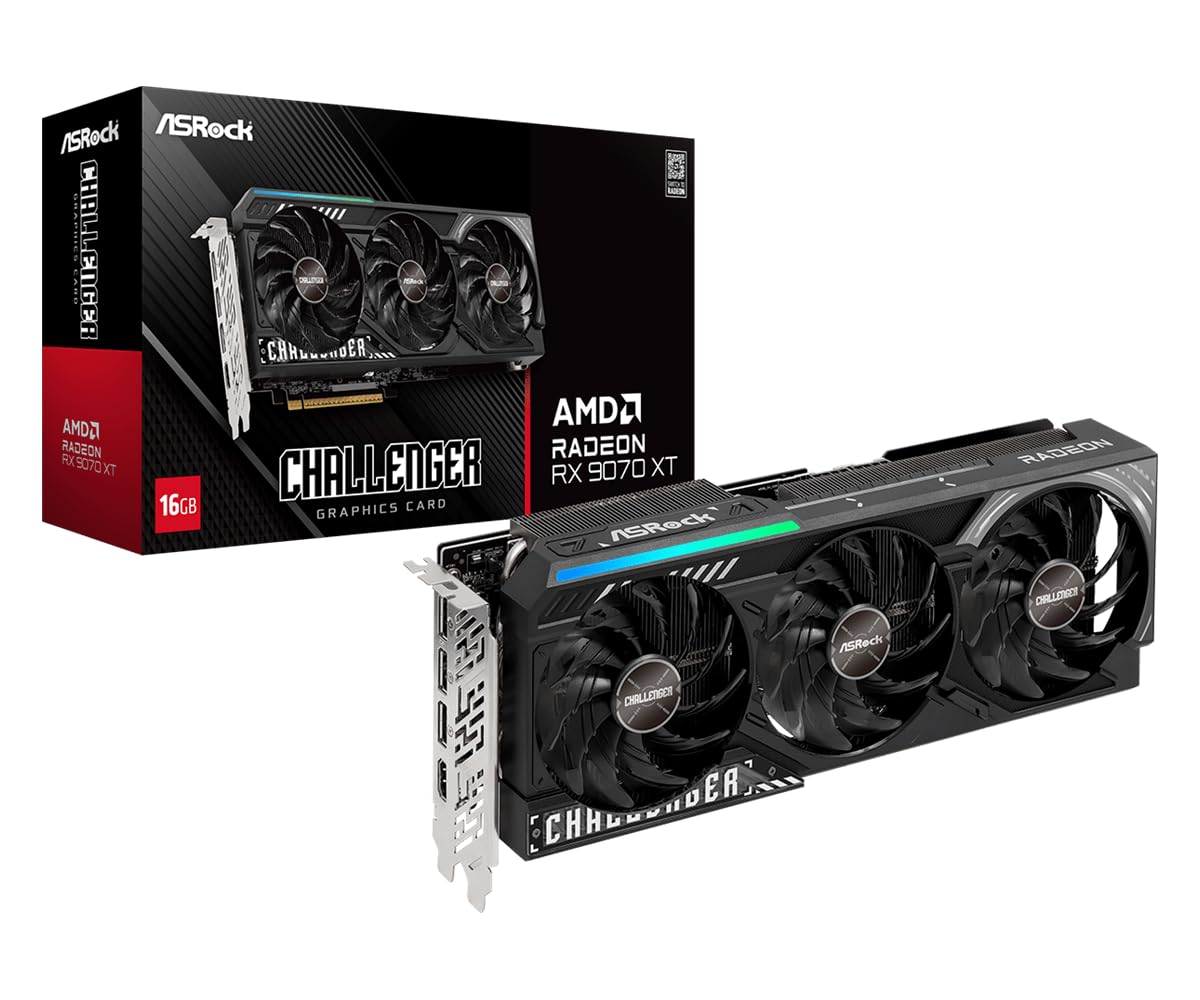
The ASRock Challenger is the entry-level 9070 XT offering from ASRock, designed to deliver the core RDNA 4 experience at a lower price point than the Steel Legend or Taichi. It uses standard triple-fan cooling with Striped Axial Fan technology and 0dB silent mode, stopping fans completely during low-load scenarios for noise-free operation. The 2970 MHz boost clock and 16GB GDDR6 memory are identical to other 9070 XT cards, meaning raw gaming performance is the same — the differences are in cooling, power delivery, and build quality.
Users consistently report excellent 1440p performance. Paired with a Ryzen 5 7600X3D, the Challenger runs modern titles at ultra/max settings with smooth frame rates. Users upgrading from older cards like the RX 5700 XT report a “drastic difference” in performance, with the card handling everything from high-FPS competitive shooters to visually demanding single-player titles. The card also performs well in virtual reality, with one user reporting smooth VR performance in No Man’s Sky.
The card’s main downsides are its RGB software and physical dimensions. ASRock’s Polychrome SYNC software is noted as buggy and unreliable, occasionally losing connection with the card’s single LED indicator. The card also weighs 1038g, which is lighter than premium cards but still substantial, and the 750W PSU recommendation is realistic for this TDP. The Challenger lacks the Taichi’s premium power delivery and Dual BIOS, but for users who simply want a reliable 9070 XT for 1440p gaming, it delivers.
Why it’s great
- Delivers full 9070 XT performance at a lower price point than premium cards
- 0dB silent mode stops fans completely for noise-free desktop operation
- Excellent 1440p performance — runs ultra settings smoothly in all modern titles
Good to know
- ASRock Polychrome RGB software is buggy and may lose connection with card
- No Dual BIOS, no premium power delivery — pure 9070 XT baseline experience
12. Sapphire Pulse AMD Radeon RX 9070 XT Gaming 16GB

The Sapphire Pulse is the company’s entry-level 9070 XT offering, positioned below the Nitro+ and Pure. It uses a simpler cooling solution and standard power connectors — two 8-pin PCIe — making it one of the most straightforward 9070 XT cards to install. The card ships with an anti-sag bracket, a thoughtful inclusion that helps prevent long-term PCIe slot damage. Sapphire’s Adrenalin Edition software provides full control over fan curves, undervolting, and performance tuning directly from the AMD interface, without requiring third-party apps.
Performance is every bit as capable as more expensive cards. Users report the Pulse can be undervolted by -75mV with a +10% power limit increase, reaching effective boost clocks of 3440 MHz — well above the stock 2970 MHz boost. This tuning yields significant FPS gains at 1440p, though one user noted only a 30-40 FPS gain over their previous 6700 XT, suggesting diminishing returns for lower-resolution gaming. At 4K, the card is fully capable of delivering playable frame rates in demanding titles.
The Pulse has no RGB lighting — a positive for users who dislike software-controlled lighting, but a negative for those who want visual customization. The card also lacks a Dual BIOS switch, meaning all tuning must be done through software, which can be a nuisance if a bad overclock requires a safe-mode boot to revert. The 1.5kg weight is significant but manageable, and the card’s dimensions fit most mid-tower cases without issues. For users who want the Sapphire name and quality without paying for the Nitro+’s premium thermal solution, the Pulse is the answer.
Why it’s great
- Simple install with dual 8-pin connectors — no adapter or specialty PSU required
- Excellent undervolting headroom — users reach 3440 MHz effective boost with -75mV undervolt
- Includes anti-sag bracket to protect PCIe slot from GPU weight
Good to know
- No RGB lighting — purely function-focused design
- No Dual BIOS — all tuning requires software; bad settings may require safe-mode revert
13. Skytech Gaming Edge Gaming PC (Ryzen 7 7800X3D + RX 9070 XT)
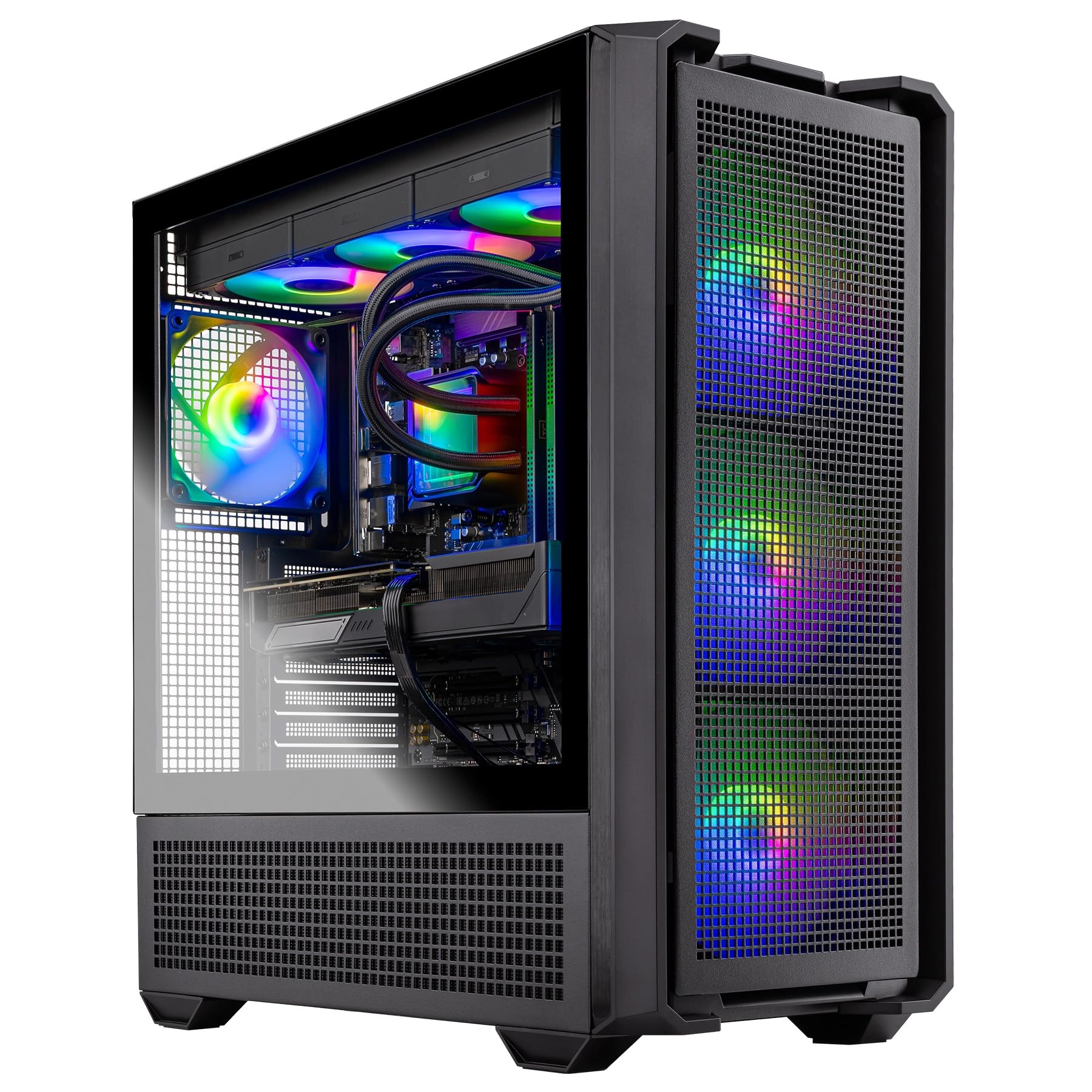
The Skytech Edge Gaming PC is the all-in-one solution for buyers who want the 9070 XT 24GB experience without assembling the system themselves. It pairs the AMD Radeon RX 9070 XT 16GB with a Ryzen 7 7800X3D — arguably the best gaming CPU on the AM5 platform — along with 24GB DDR5 RAM 6000, a 1TB Gen4 NVMe SSD, and an 850W Gold ATX 3.0 PSU. The 360mm AIO liquid cooler ensures the 7800X3D stays thermally comfortable even during extended gaming sessions, and the Lian Li-style Edge case with front mesh provides excellent airflow.
Performance is exceptional out of the box. Users report constant 144 FPS in fast-paced competitive games like Valorant and Overwatch 2, and smooth 60+ FPS at 4K ultra in AAA titles like Cyberpunk 2077 and Baldur’s Gate 3. The 24GB DDR5 RAM is an unusual but welcome specification — likely one 16GB stick and one 8GB stick for a total of 24GB — and the 1TB Gen4 SSD provides fast load times. The system ships with no bloatware, a significant advantage over pre-builts from major OEMs like Dell or HP.
The Skytech Edge is not without compromises. The graphic card brand “may vary” — Skytech reserves the right to include any 9070 XT model, so you may receive a lower-end model like the Challenger instead of a Nitro+ or Red Devil. The included keyboard and mouse are functional but described as “awkward” by users and will likely be replaced. Customer service is inconsistent — one user received a wrong PC initially and had a slow resolution process, while another reported excellent support. Warranty coverage is 1 year on parts and labor, which is standard for pre-builts.
Why it’s great
- Ready out of box with no assembly required — 20-minute setup to gaming
- Ryzen 7 7800X3D + RX 9070 XT is one of the best gaming combos available
- No bloatware — clean Windows 11 installation ready to use
Good to know
- GPU brand may vary — you may receive a lower-end 9070 XT model
- Customer service is inconsistent — some users report excellent support, others slow resolution
FAQ
What power supply wattage do I need for a 9070 XT graphics card?
How does the 9070 XT compare to the Nvidia RTX 5070 Ti in rasterization and ray tracing?
Can the 9070 XT handle 4K gaming at high refresh rates?
Is the 9070 XT good for content creation and non-gaming workloads?
Final Thoughts: The Verdict
For most users, the best 9070 xt 24gb winner is the ASRock Taichi 16GB OC because it combines the highest factory boost clock, 16-phase power delivery, and exceptional thermal performance in a package that overclockers and silent-PC builders can both appreciate. If you want the absolute best cooling and acoustics, grab the Sapphire Nitro+ Gaming OC — its 2kg heatsink and near-silent fans make it the quietest 9070 XT available. And for the best price-to-performance ratio, nothing beats the PowerColor Hellhound, which delivers 95% of the performance of premium cards at a noticeably lower cost.