
Our readers keep the lights on and my morning glass full of iced black tea. As an Amazon Associate, I earn from qualifying purchases.
Specs are compiled from manufacturer listings and verified buyer reviews and can change over time — please confirm the key details on the product page before buying.
When the grid goes down, the difference between a minor inconvenience and a crisis is often just a question of wattage. A 5000 watt solar generator is the bridge between running a few phone chargers and keeping your fridge, lights, and internet alive for days on end.
I’m Min — the founder and writer behind Gadgets Feed. This guide is built by comparing the manufacturers’ published specifications and the patterns across verified customer reviews, so you get each pick’s real strengths and trade-offs instead of marketing spin.
These seven heavyweights each bring something distinct to a home backup strategy. This guide breaks down the 5000 watt solar generator options by real-world capacity, true output, and the honest limitations owners encounter.
Our Picks at a Glance

The Right Way To Choose A 5000W+ Solar Generator
Before you scroll through specs, start with a list of what you must keep running during an outage. A fridge might draw 700W when the compressor kicks on but only 150W while idling. A sump pump needs a big surge to start.
Understand Wattage vs. Capacity
These are two different numbers that buyers often confuse. Wattage (W) is the instantaneous power a unit can push out at one moment — enough for a hair dryer or a well pump. Capacity (Wh) is the total energy stored, like the size of a fuel tank. A 5000W unit with only 2kWh will run a space heater for a short time, while a 5120Wh unit gives you hours of runtime.
Match Voltage to Your Home’s Needs
Most large appliances like dryers, ovens, and central air conditioners need 240V, not the standard 120V from a wall outlet. Check if your chosen generator supports dual voltage (120V/240V) so you aren’t stuck unable to power a 240V well pump or dryer when the grid goes dark.
Consider Solar Input and Charging Speed
Your generator’s ability to recharge from solar depends on its solar input limit and voltage range. A higher solar input (measured in watts, like 6400W) means you can connect more panels and recharge faster during the day. Also check if the unit supports AC, generator, or car charging for cloudy days.
Quick Comparison
Your buying decision hinges on three things: how much instant power you need, whether you prefer one portable unit or a modular rack system, and how fast you want to recharge from solar. The table below compares the key specs side-by-side so you can see the differences at a glance.
| Model | Best For | Battery Capacity | AC Output | Max Solar Input | Weight | Amazon |
|---|---|---|---|---|---|---|
| Anker SOLIX F3800★ Best Overall | Whole-home backup with EV charging | 3.84kWh (expandable) | 6,000W continuous (12,000W max with 2 units) | — | 132.3 lbs | Amazon |
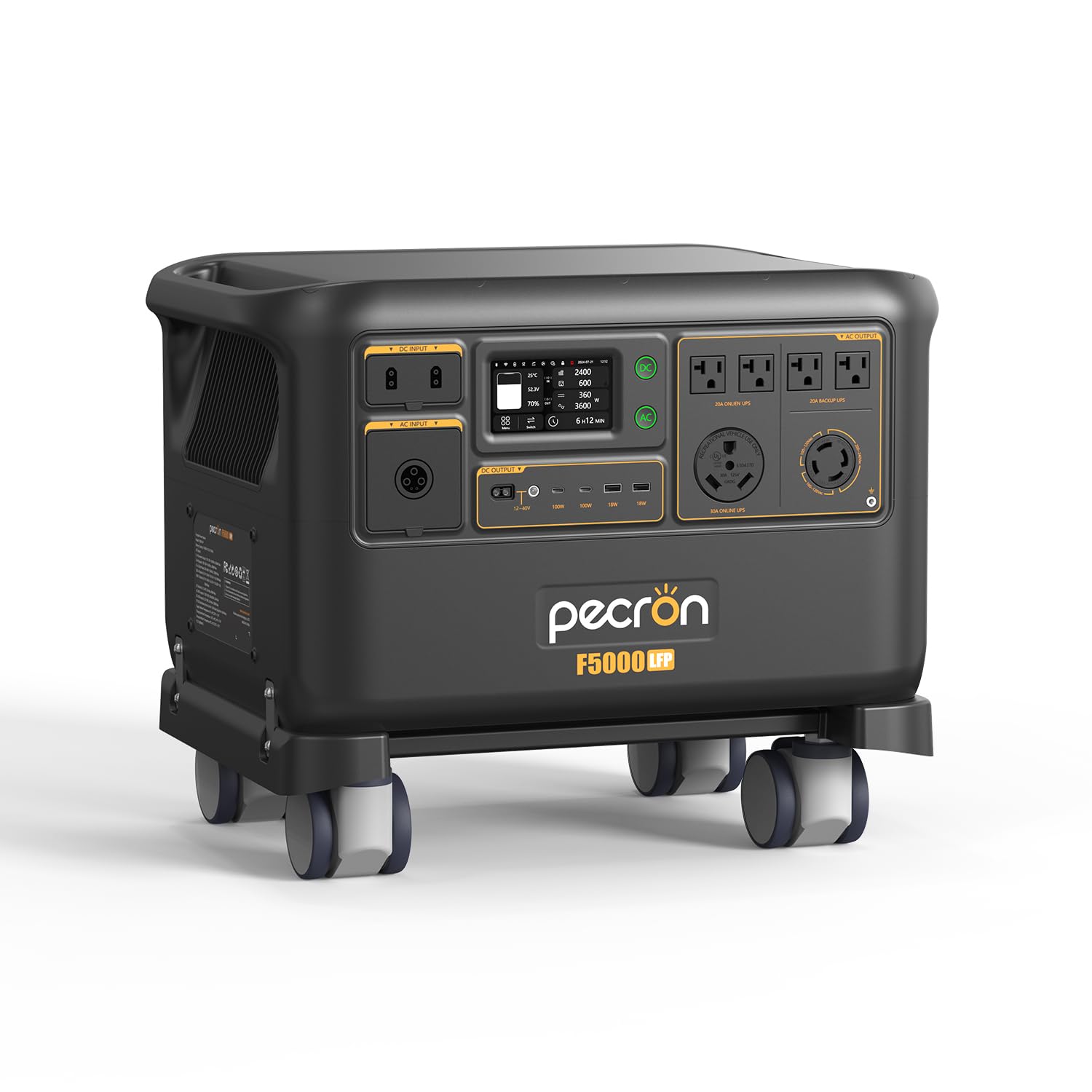
| PECRON F5000LFPPowerhouse Pick | Massive solar input and UPS protection | 5120Wh (expandable to 35.8kWh) | 7200W AC output | 6400W | 123.9 lbs | Amazon |
| Jackery Solar Generator 5000 Plus | Long-duration, expandable home backup | 5040Wh (expandable to 60kWh) | 7200W rated (14,400W surge) | up to 4000W | 134.5 lbs | Amazon |
| EF ECOFLOW DELTA Pro Ultra | High power output and expandability | 6144Wh (expandable to 90kWh) | 7200W output (21.6kW max) | — | 70.9 lbs (battery) | Amazon |
| OSCAL PowerMax 6000 | Fast charging with included panels | 3600Wh | 6000W (9000W surge) | 2400W | 100.3 lbs (45.5 kg) | Amazon |
| Jackery Solar Generator 5000 Plus (with Panels) | Ready-to-run solar bundle | 5040Wh (expandable to 60kWh) | 7200W rated (14,400W surge) | up to 4000W | 145 lbs | Amazon |
| ECO-WORTHY 48V Home Backup | Permanent rack-mounted installs | 5120Wh | 5000W AC (10000W peak) | — | 130 lbs | Amazon |
In‑Depth Reviews
Anker SOLIX F3800 Power Station with Expansion Battery and 400W Solar Panel
Our pick — 4.5★ from 300+ verified ratings; the strongest balance of quality and price.
The whole-home anchor that can even top off your electric vehicle in a pinch.
Most portable stations tap out at 120V, but the F3800’s 120V/240V and 6,000W AC output means you can plug in your dryer, oven, or well pump directly. It goes further than any appliance though — the NEMA 14-50 port lets you charge an EV at 6,000W without extra grounding gear.
The base 3.84kWh capacity covers a family’s needs for a day, but the magic is in the expansion. You can add up to 6 battery packs to reach 26.9kWh, or stack another F3800 and 12 battery packs for a two-week emergency reserve. Pair it with the Smart Generator 5500 and it auto-starts when you need it.
Owner experiences point to real-world strain: during a 6-hour outage with modest loads, the battery dropped from 100% to 66% while lights, a fridge, and a radon motor stayed on. The bundled 400W solar panel is the weaker link — buyers report real-world output tops out around 218W even in full mid-day Texas sun, falling short of its 400W promise.
The solar MPPT controller is tune for Anker’s own panels, and reaching the max 2400W solar intake takes careful matching. The app is widely praised as clear and easy to use, and the 5-year warranty plus 10-year lifespan backed by EV-class LFP batteries offers serious long-term confidence.
Whole-Home Muscle
- Runs 240V appliances like dryers and EV chargers with 6,000W AC output
- Modular expansion reaches 26.9kWh for multi-day outages
- No grounding accessories needed for direct EV charging
Honest Trade-Offs
- Bundled 400W solar panel typically delivers around 218W in real sun
- Maximizing solar intake requires pairing with Anker-specific panels
- At 132.3 lbs, this is a two-person lift for setup
Reach for this if: you need 240V home backup and want one expandable system that can charge an EV or run RV appliances without a separate unit.
Look elsewhere if: you plan to rely almost entirely on solar recharging, since the controller’s performance with third-party panels is inconsistent.
PECRON F5000LFP Power Station
A solar-hungry titan that swallows 6400 watts of panel power to refill its 5120Wh cell in record time.
If your whole goal is to recharge from the sun as fast as physics allows, this is the pick. The F5000LFP handles a 6400W total solar input across two ports — a 16.0x gap over the Anker’s bundled panel’s rated intake — so a serious rooftop array or ground-mount setup can bring it back to full quickly.
With a 7200W AC output and dual voltage (120V/240V), it’s a genuine home system. Owners regularly run a washer, dryer, and dishwasher from it, and the 6 AC outlets include one 7200W monster for heavy-duty kit. The UPS function routes power through two 20A and one 30A 0ms online outlets, so WiFi, aquariums, and CPAP machines never blip during a transfer.
That ambition comes with some growing pains. The most-discussed reliability concerns include solar charge controller issues and firmware lockouts, with support resolving some via OTA updates. The unit’s low 30dB noise output during operation is a thoughtful touch for CPAP users at night.
Its expandability up to 35.8kWh and three recharge methods (AC, solar, generator) make it a flexible foundation, though the 123.9 lb frame with detachable cart requires planning for placement.
Solar Champ: with 6400W intake capability, this dramatically outperforms the 400W-rated input of the Anker F3800 for pure solar recharging speed.
Support Matters: the reliability reports are real, but so is the responsive OTA-fix support that resolved the documented firmware lockout cases.
Jackery Solar Generator 5000 Plus Portable Power Station
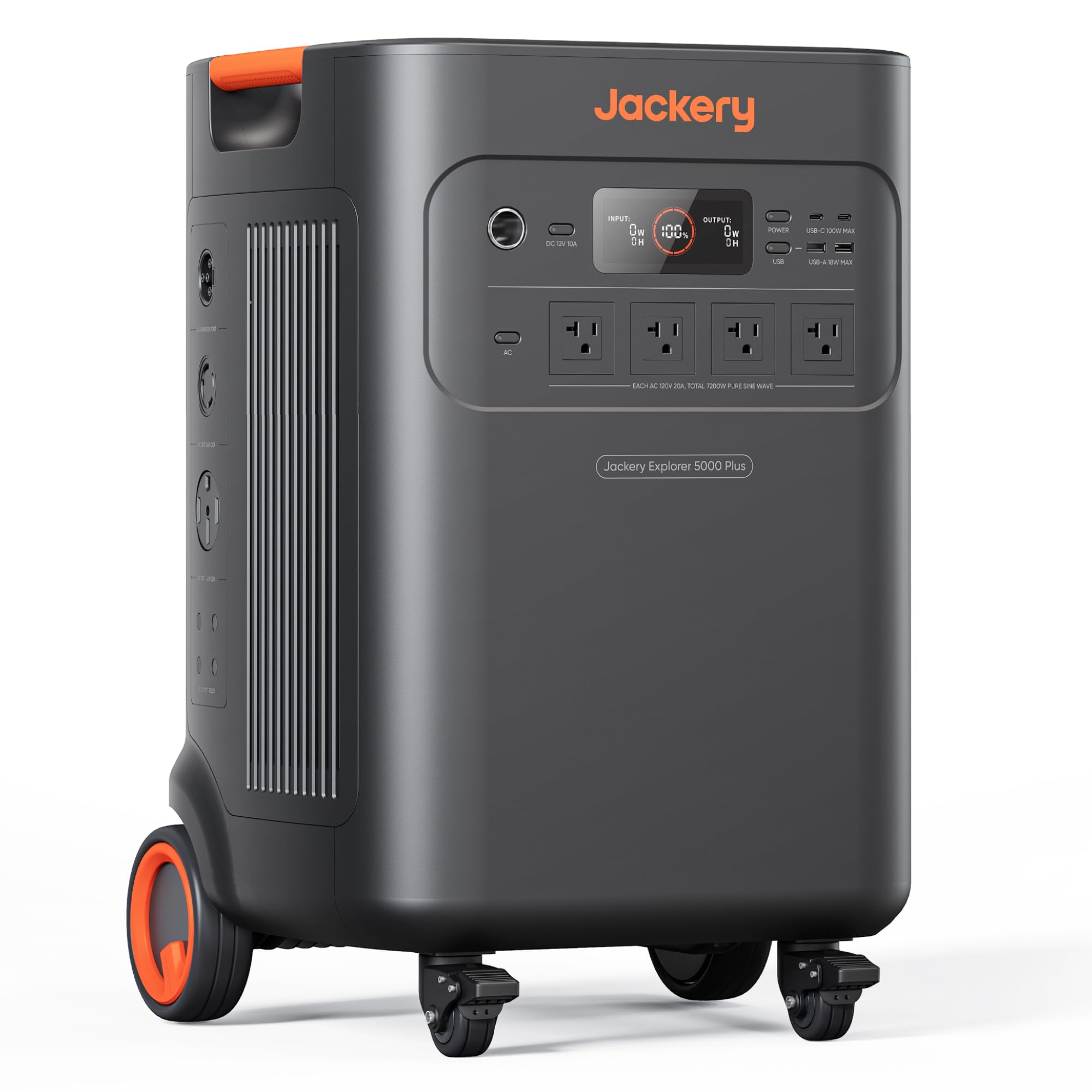
A reputation-driven workhorse that runs a 5-ton AC and scales to 60kWh when the lights go out.
Jackery brings its well-earned trust to the big leagues with this 5040Wh unit rated for 7200W of continuous power and a 14,400W surge. That headroom means a 5-ton AC unit or a water heater starts without tripping, and the 120V/240V split handles both standard circuits and large appliances.
The expandability to 60kWh — enough for an extended outage, not just overnight — makes it a true whole-home candidate. Pairing it with the 60A Smart Transfer Switch powers up to 12 circuits at 120V or 6 at 240V automatically. The LiFePO₄ cells and ChargeShield 2.0 technology are rated for up to 11 years of daily use.
Owners find the build solid and the power delivery reliable for all outlets, but battery life draws the most mixed feedback. Some report losing over 30% of charge per day when WiFi is left connected in UPS mode — a real consideration for a backup unit that sits idle.
On the flip side, one owner noted that a WiFi-equipped unit that stays on will drain, while the “backup-only” mode avoids the drain but introduces a 5-second switchover instead of instant UPS. Plan for this by disabling idle-battery drains if you aren’t using live monitoring.
Expansion Ready
- 7200W rated power handles the heaviest home appliances with 14,400W surge
- Expandable up to 60kWh for week-long outages
- Smart Transfer Switch protects up to 12 essential circuits
The Catch
- WiFi standby mode can drain over 30% of the charge per day on idle units
- Basic app with slow updates reported by long-time owners
Ideal for: buyers who want a trusted brand, huge surge capability for motor-driven appliances, and a clear path to 60kWh without changing platforms.
skip it if: you need true 0ms UPS protection or plan to leave the unit in standby mode for months; the battery drain in that state is a genuine issue.
EF ECOFLOW DELTA Pro Ultra 6144Wh Power Station

The scalable stack that runs a 3-ton AC and recharges its 6144Wh battery in just 2 hours.
You can triple this system’s inverters for an incredible 21.6kW AC output — a 20% headroom jump over the ECO-WORTHY’s 10000W peak — but even a single 7200W setup runs a 3-ton central air conditioner. The base 6144Wh battery delivers roughly two days of essential power, scaling to 90kWh for over 30 days of backup for a typical household.
The recharging speed is a genuine standout: one battery reaches full in 2 hours via AC, outpacing the 6kWh class. Beyond outlets, you can charge from EV piles, solar, or a standard generator, and the EcoFlow app lets you prioritize specific circuits to stretch backup time further.
Owners mention this unit delivers strong value, calling it a cheaper alternative to a Tesla Powerwall at roughly half the cost while providing nearly double the capacity. It connects easily to transfer switches and third-party solar panels, and its online UPS (uninterruptible power supply, which switches to battery instantly) with a 0-ms transfer time keeps sensitive electronics like computers safe during outages.
One of the quieter wins is acoustic: all fans stay off for the first half hour of outputting 2000W, so a home office or bedroom stays silent during the critical early minutes of an outage.
Expandable Core: the 21.6kW max output (triple the inverter) and 90kWh ceiling make this the most future-proof base unit here for serious off-grid ambitions.
Buyer Note: support experiences vary; while warranty replacements were honored for a faulty unit, some customers note inconsistent compatibility answers and frustration over a missing printed manual on a high-ticket item.
OSCAL PowerMax 6000 Solar Generator with 3x200W Solar Panel
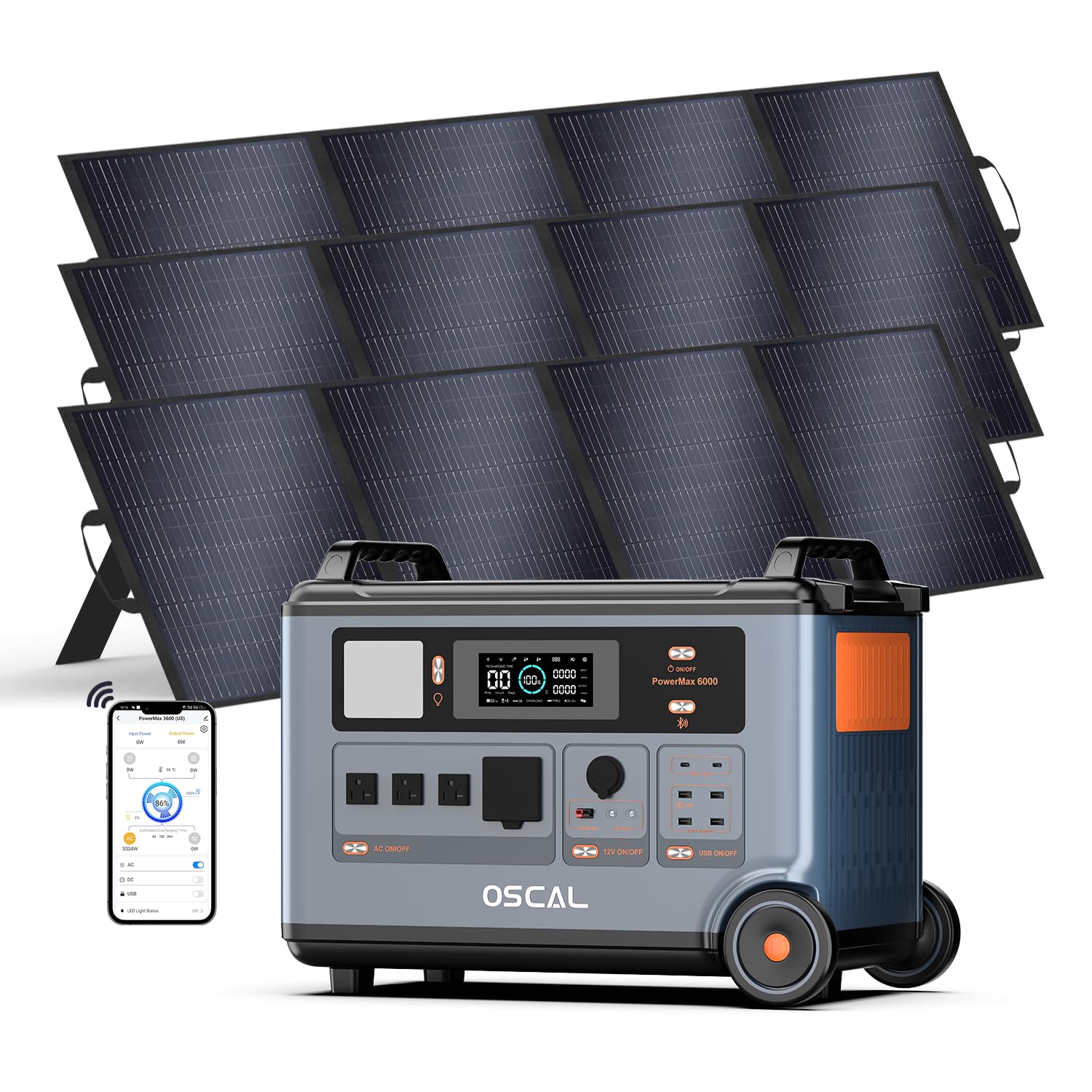
A complete three-panel kit that refills from empty to full faster than most rivals can manage.
This is the rare bundle that arrives with 3x200W solar panels included, ready to capture the sun on day one. The 2200W bi-directional inverter means AC charging is remarkably quick — going from 0% to 100% in about 1.44 hours with 2200W AC input, while 2400W of solar input keeps things moving off-grid.
At 3600Wh, this is the smallest capacity in this tier, but the 6000W output (9000W surge) still powers most whole-home essentials. The 120V/240V dual-voltage output and 14 outlet sources give you flexibility to connect multiple devices during an outage. The EPS function switches to battery backup within 5-8 ms, keeping network equipment and computers online through brief grid hiccups.
The build quality earns the most mentions from owners, who describe a solid chassis and clear display. The eight-layer BMS protects against overcharge, over-discharge, and temperature swings, while the LiFePO4 cells are rated for up to 3500 cycles.
The recurring criticism is connectivity — the bundled three-panel configuration limits you to connecting just one panel to the generator at a time, which feels like a missed opportunity for a kit sold with three.
Ready from the start
- Charges 0-100% in roughly 1.44 hours with 2200W AC input
- Includes 3x200W solar panels for immediate off-grid use
- Quiet operation and a clear display noted by owners
Connectivity Hurdle
- The generator allows only one of the three bundled solar panels to connect at a time
- At 3600Wh, capacity is smaller than the 5120Wh-plus rivals in this class
Choose this for: the fastest AC recharge in the class and a true all-in-one kit that works immediately, with panels included for a reasonable starting price.
Think twice if: you rely on daily solar cycling; the three-panel connectivity limit cuts your potential solar harvest in this configuration.
Jackery Solar Generator 5000 Plus and 500W Panels

The turnkey Jackery bundle pairs its 5040Wh powerhouse with 500W of folding solar for instant off-grid readiness.
This is the “just add sunlight” version of the Explorer 5000 Plus. The station itself offers 7200W rated power (14,400W surge) and supports both 120V and 240V, good for a 5-ton AC or a tankless water heater. The bundled 500W solar panels fold out neatly and feed up to 4000W of combined input to refill the pack in about 2 hours on a good day.
The core appeal here is the complete ecosystem: one box brings the 5040Wh LiFePO₄ station, solar panels, and all cables, so you aren’t hunting for compatible accessories. Expandability remains a headline feature — this single unit scales to 60kWh by adding batteries, giving you genuine week-long home backup.
Owners value the reassurance of being ready for emergencies, noting the unit retains its charge well during storage. The LiFePO₄ (lithium iron phosphate, a long-lasting battery chemistry) cells and ChargeShield 2.0 technology are rated for up to 11 years of daily use, so you can treat this as a decade-long investment rather than a short-term fix.
The honest caveats are quality control and support. Some reported shipments arriving in rough condition, and in one notable case a missing cable and manual led to a frustrating replacement process. The 145 lb total weight also demands a two-person carry into place.
True Bundle Convenience
- Includes 500W of solar panels and all cables for immediate setup
- 7200W output with 14,400W surge handles the largest home appliances
- Expandable to 60kWh for sustained outage coverage
Setup Watch-Outs
- Some units ship with signs of prior use or missing accessories, and support responses vary
- At 145 lbs with panels, plan for a two-person move
Perfect for: buyers who want a single-order solar generator bundle without piecing together panels, cables, and a station separately — and who value Jackery’s brand longevity.
Consider elsewhere if: your priority is the lowest total cost for a complete solar kit, since bundling panels here pushes you toward the premium end of this list.
ECO-WORTHY 48V Home Backup Power, 5120Wh LiFePO4 Battery, AC 5000W Inverter
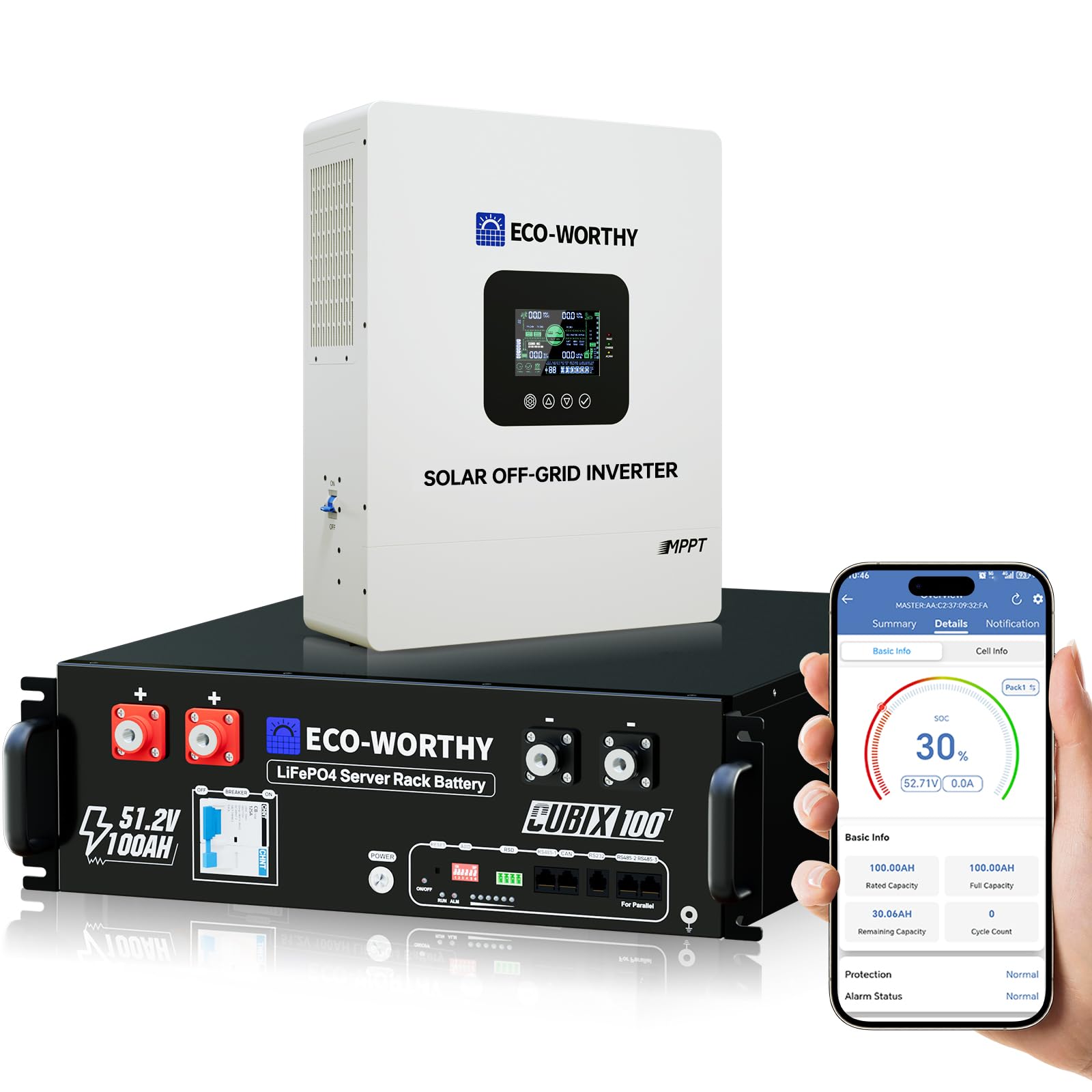
A rack-mounted, expandable 5120Wh system and 5000W pure sine inverter for permanent home installation.
This is a fundamentally different animal from the portable towers above: a 48V server-rack battery and separate 5000W MPPT inverter designed for a dedicated install spot, not a rolling cart. The split design lets you place the 130 lb battery in a garage or utility closet and wire it into your home’s critical circuits.
The 3-in-1 inverter packs a 5000W pure sine wave output, a 100A MPPT charge controller, and a max 100A battery charger into one unit. AC output lands at 5000W with a 10000W peak — a 44% lower continuous rating than the PECRON’s 7200W, but plenty for most appliances. The PV input range of 120–500V DC gives solar installers real flexibility in panel configuration.
Expandability is the headline here. Up to 6 inverters can run in parallel for 30kW of AC output, and up to 32 batteries stack to a massive 163.84kWh. When two or more inverters are paralleled, the system supports 120V/208V/240V output for bigger loads.
Safety credentials stand out: the battery and inverter passed UL1973 & UL1741 tests by Intertek and meet California Energy Commission standards. The built-in CAN/RS485 interfaces enable closed-loop communication with leading integrated solar inverters, plus Bluetooth and WiFi monitoring through the ECO-WORTHY app.
Reviewers praise the build quality and durability, noting strong resistance to wear, but one documented case involved an inverter (the component that converts battery power to household electricity) failing with a fan error before support replaced it after an email exchange. That is a reminder to purchase from a seller with reliable customer service.
Built for Scale: the 163.84kWh ceiling and 30kW parallel output potential far exceed any portable tower here, making this a proper home-energy foundation.
Fair Warning: this is a permanent, wired system — not a grab-and-go portable. Plan for installation, and be prepared for more setup complexity than plug-and-play towers.
Understanding the Specs
Wattage vs. Watt-Hours
Wattage (W) is the maximum power flow at an instant, and it determines which appliances you can start. A 6000W output can run most dryers and AC units. Watt-hours (Wh) is the total energy tank. A 5120Wh unit powers a 500W fridge for roughly 10 hours. For outages, bigger Wh is almost always better.
Running Watts vs. Surge Watts
Motors — from fridges to well pumps — draw a huge burst of power to start spinning, then settle into a lower running load. Look for a generator’s surge figure (e.g., a 5000W unit with a 10000W peak) to avoid a tripped breaker every time the compressor kicks in.
FAQ
Can a 5000W solar generator run a whole house?
Will a 5000W generator run a 240V well pump or dryer?
How long will a 5120Wh generator keep a refrigerator running?
How fast can a solar generator recharge from panels?
Can you run a solar generator indoors?
What is the difference between a solar generator and a traditional gas generator?
How long does a LiFePO4 battery last in a solar generator?
Can I charge my electric vehicle with a solar generator?
Final Thoughts: The Verdict
If you want one dependable pick, the 5000 watt solar generator winner is the Anker SOLIX F3800 because it combines genuinely useful 6,000W AC output, the EV-charging capability, and modular expansion in a single trusted package. If your priority is recharging from solar panels as fast as possible, the PECRON F5000LFP accepts a staggering 6400W of solar input. And for a permanent, rack-mounted home installation that scales to 163.84kWh, the ECO-WORTHY 48V system delivers UL-tested safety and closed-loop communication with third-party solar inverters.
How We Picked
We do not accept paid placement. Every pick is matched to a real buyer and a real use-case; we do not hands-on test units.
Sources & Methodology
Specifications: manufacturer listings and product documentation. Review insights: verified customer reviews, as of September 2026. Pricing: not shown on this page (it changes often); check the current price via the retailer link.
As an Amazon Associate, Gadgets Feed earns from qualifying purchases. This does not affect which products we feature.