
Our readers keep the lights on and my morning glass full of iced black tea. As an Amazon Associate, I earn from qualifying purchases.
Specs are compiled from manufacturer listings and verified buyer reviews and can change over time — please confirm the key details on the product page before buying.
Finding a game that truly shines with just the two of you is harder than it looks. Many popular titles feel flat or awkward at a two-person count, which is why a dedicated two-player design matters so much. The best options here are built from the ground up for head-to-head tension, so every turn is a direct conversation with your opponent.
I’m Min — the founder and writer behind Gadgets Feed. This guide is built by comparing the manufacturers’ published specifications and the patterns across verified customer reviews, so you get each pick’s real strengths and trade-offs instead of marketing spin.
Each pick below is vetted for genuine two-player depth. If you are hunting for the board and card games for 2 players that will actually earn repeated table time, this breakdown separates the enduring classics from the one-time novelties.
Our Picks at a Glance



How To Choose The Best Board And Card Games For 2 Players
The gulf between a game that merely allows two players and one that is perfectly balanced for two is the most important distinction you can make. A game designed for a larger group often has downtime or unbalanced interactions when played with only two. The best two-player games create a tight, push-and-pull dynamic where your choices directly impact your single opponent.
Match the thinking weight to your mood
Before you buy, decide the mood you want: a light, chatty game like Spirits of the Wild for a relaxed evening, or a deeper duel like Targi that rewards focus and repeated plays. That choice narrows your options fast, so you don’t end up with a brain-burner on a night you wanted to unwind.
Consider the real playtime, not the box average
Manufacturer estimates like “30 minutes” are a starting point, but your first few games will take longer as you learn the rules and card interactions. Think about how long you actually enjoy sitting at the table. If you have a 20-minute window before bed, a sprawling 60-minute campaign game will collect dust. The beauty of strong two-player designs is that most run between 30 and 45 minutes, meaning you can often fit in two or three rounds in an evening.
Check for variable setup and replayability
A game you play once and understand completely loses its appeal fast. Look for mechanics that change the board or available cards each session. Randomized card pyramids, different animal boards, or multiple city decks are the features that keep a game feeling fresh dozens of plays later. This unpredictability is what separates a one-time novelty from a lasting favorite.
Quick Comparison
| Model | Best For | Playtime | Core Mechanic | Age Range | Amazon |
|---|---|---|---|---|---|
| 7 Wonders Duel★ Best Overall | Intense Civilization Strategy | 30 Minutes | Card Drafting | Ages 10+ | Amazon |
| Spirits of the WildBest Chill Pick | Relaxing Light Strategy | 20 Minutes | Tile/Stone Placement | Older Kids/Adults | Amazon |
| TargiTop Performer | Classic Worker Placement | 60 Minutes | Worker Placement | Ages 12+ | Amazon |
| Azul Duel | Head-to-Head Tile Placement | 30-45 Minutes | Tile Placement | Ages 8+ | Amazon |
| Everdell Duo | Competitive or Co-op Play | 45 Minutes | Engine Building | Ages 10+ | Amazon |
| Splendor Duel | Fast Gem-Collecting Battles | 30 Minutes | Card Acquisition | Ages 10+ | Amazon |
| Patchwork Americana | Quick Puzzle-Style Play | 30 Minutes | Tile Laying Puzzle | Ages 8+ | Amazon |
| Caper Europe | Thematic City-Hopping Heists | 30 Minutes | Card Drafting | Ages 10+ | Amazon |
| Guess Who? Harry Potter | Family Deduction Fun | Quick Play | Deduction | Ages 6+ | Amazon |
In‑Depth Reviews
1. Asmodee 7 Wonders Duel
Our pick — over 4.5★ from 9,500+ verified ratings; the strongest balance of quality and price.
The gold standard for two-player duels, offering a fresh puzzle every match.
The defining feature here is the card pyramid that sits between you and your opponent. Cards are laid out in a structured pyramid with roughly half face-down, creating a constant gamble as you reveal new options and deny them from your rival. This setup ensures you are always balancing the cards you covet against the cards you must block, making every decision a tightrope walk over two distinct choices.
You can win 7 Wonders Duel in three entirely different ways: invade your opponent’s capital with military might, monopolize scientific advancement, or simply build the city with the most victory points by the end. That variety means no two games feel the same, and a losing position in one path can pivot into a winning strategy in another. Its 4.8-star average from thousands of owners reflects quick, brainy fun for ages 10 and up.
The illustration and component quality are part of the appeal. As buyers report, the game features “fast gameplay, beautiful illustrated cards with simple symbols,” which lowers the barrier to entry while keeping the strategy deep. At roughly 30 minutes a session, it is the rare game that is easy to table on a weeknight yet deep enough to stand up to hundreds of plays over time.
Why It Wins
- Three distinct paths to victory keep games tense and unpredictable.
- Randomized pyramid setup with face-down cards boosts replayability.
- Quick 30-minute sessions are easy to fit into a weeknight.
Who Should Pause
- Moderate learning curve with many card types and tokens to absorb.
- Some owners note cards are smaller, which affects readability slightly.
Reach for this if: you want a head-to-head strategy classic that stays fresh after dozens of matches. It is the definitive pick for ages 10 and up.
Look elsewhere if: you’re seeking a super-light game for players who dislike learning new mechanics.
2. Mattel Games Spirits of the Wild: Awakening
A gorgeous, low-pressure date night game that rewards smart stone placement.
This is the game for evenings when you want playful competition without the mental exhaustion of a heavy eurogame. Play is built around collecting stones from a bowl and offering them to animals in the specific formations they want, with special iridescent Spirit Stones capable of doubling your points. The tactile experience is genuinely lovely—there is real satisfaction in the weight of the stones, the cloth bag, and the wooden bowl.
What prevents it from becoming boring is the sheer variety packed into the box. With 30 double-sided animal boards, the game plays differently each time you pull it off the shelf, and it easily earns its reputation as a favorite for couples and families. The inclusion of 12 action tiles and a coyote figure that blocks you from giving more stones to a specific animal adds just enough player interaction to keep both of you engaged in each other’s turns.
The catch is the component quality. A few owners note the card stock is flimsy, with edges that show wear and tear after repeated sessions, so sleeving the cards is a smart move if this becomes a staple. It is easy to teach in about 3 minutes and plays in roughly 20 minutes a round, making it an ideal option for casual gamers or children as young as 8 who want to join in.
The Vibe: A “chill” game that looks beautiful on the table and plays quickly. It is not a brain-burner—and it isn’t meant to be, which is exactly why couples adore it.
Best for: date nights and family evenings where you want conversation along with your competition. The tactile stones and pretty art make it an instant crowd-pleaser.
Think twice if: you demand premium, lasting card stock or want a deeply thinky strategy epic.
3. Thames & Kosmos Targi
A deep, satisfying worker-placement duel that fans of the genre swear by.
Targi is the pick for players who want the depth of a modern classic with a surprisingly compact footprint. The game revolves around placing your tribesmen, or Targi, on the intersections of a 5×5 grid of cards, where you claim the advantages of both adjacent cards simultaneously. This dual-action mechanic creates constant, agonizing decisions as you try to seize the best resources while blocking your opponent from doing the same.
The core setup uses 16 fixed border cards around 9 variable center cards, which means the board changes every single game. This variety is the engine behind its lasting appeal, and it has earned a Board Game Geek rating of 7.6 and a spot in the publication’s Top 100 ranking. The game also offers a solo variant if you ever want to practice your strategy alone, a nice bonus that few two-player duels include.
Owners mention finishing a game in under 45 minutes, despite the 60-minute box estimate. Some say they play it three times a week since purchase and then gifted it to their retired parents—so the couples’ favorite reputation holds up.
Strong Points
- Unique worker-placement grid creates tense, tight decisions.
- Compact box and wooden pieces make it portable.
- Includes a solo variant and a 3×4 display scoring system for depth.
Trade-Offs
- Recurring gripe is a single Tribe card enabling one-sided gold conversion; many house-rule it out.
- Some component quality issues with token differentiation.
Who it beats: casual filler games on depth-per-square-inch, offering more strategy in a small box than most rivals.
Who it doesn’t: players who want a gentle, luck-based game or those bothered by slightly rough token quality.
4. Azul Duel

The beloved Azul system, stripped down and sharpened for one-on-one play.
If you already love the mosaic-building puzzle of the original Azul, this Duel edition refines that magic into a two-player-only experience. The gorgeous resin-like acrylic tiles are still the heart of the game, and the 75 included tiles keep the satisfying tactile clack that made the original famous. The artwork draws inspiration from traditional Chinese shadow theatre, giving the table a striking, elegant presentation.
Built exclusively for two, this game delivers pointed player interaction—far more direct than the original, which could feel chaotic with more people. Games run 30 to 45 minutes, so you can often chain multiple rounds in one evening. The included 5 factories and 18 dome-plates add just enough structure to keep scores tight.
The honest trade-off is the physical quality of the boards and the tower. While the tiles themselves are praised as high quality, multiple owners point out that the boards feel flimsy, and the tower can be fragile. Complexity is also noted as a mixed bag—the rules take practice to master, and the winning strategy is not immediately obvious on the first play. But for many, that learning curve is precisely what makes it interesting to return to.
Why It Shines
- Excellent balance of strategy and luck keeps games engaging.
- High replayability with variable setups and scoring opportunities.
- Stunning visual presentation on the tabletop.
The Catch
- Boards and tower are flimsier than the tiles deserve.
- Learning curve is steeper than the light “pick and place” first impression suggests.
Reach for this if: you’re a fan of beautiful, tense tile-laying and want a true two-player face-off that rewards repeated plays.
Pass if: you are unwilling to handle slightly fragile cardboard components.
5. Everdell Duo
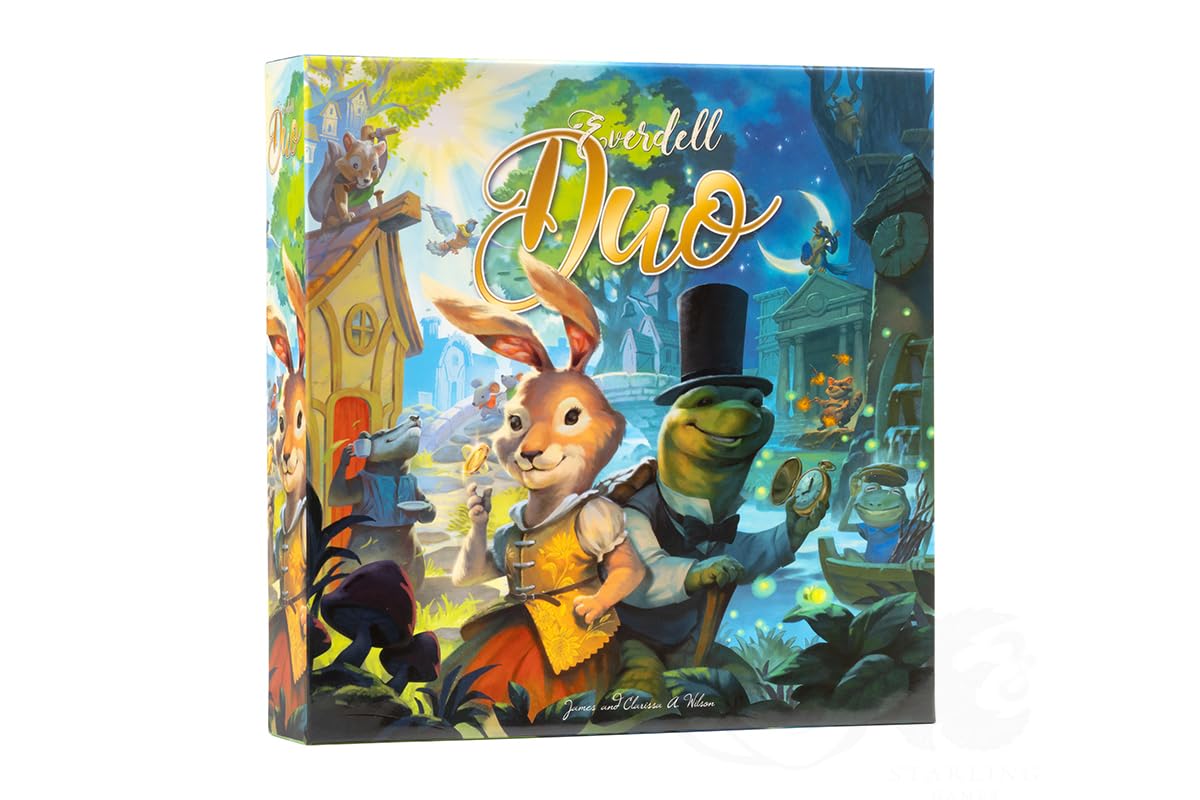
The rare two-player game that lets you team up or face off in the same box.
Most two-player games force direct competition, but Everdell Duo lets you team up. This standalone woodland classic plays with 1 or 2 players: build competing critter cities against each other, or join forces in a full co-op mode to tackle the 15-chapter campaign together. For couples who enjoy shared puzzle-solving, that co-op campaign is a standout reason to pick this over 7 Wonders Duel.
The gameplay is a streamlined engine-building affair with strategic yet approachable mechanics. You are placing cards and gathering resources to build out your woodland city, and the components are genuinely lovely to handle. Owners repeatedly mention the high quality of the tactile pieces, describing them as “satisfying to the touch” and fun to fidget with while waiting for your turn. The cute critter artwork is a consistent point of praise.
Game sessions typically run about 45 minutes, which is a touch longer than some rivals but worth it for the flexibility. The main criticism leveled at the game is the rulebook, which some find poorly organized, and the box itself arrives without inserts or organizers—just several plastic bags—which feels a bit cheap for the premium price point. A first-player rule adds a fun strategic wrinkle that keeps the opening round interesting.
Standout Feature: The co-op 15-chapter campaign transforms this from a simple duel into a shared adventure, a rarity in the two-player space. It is a perfect date-night puzzle game.
Best for: couples who want the option to build a city together rather than always fighting over the same one.
Warning: if you value production polish, the lack of box inserts and a clunky rulebook might bother you.
6. Splendor Duel
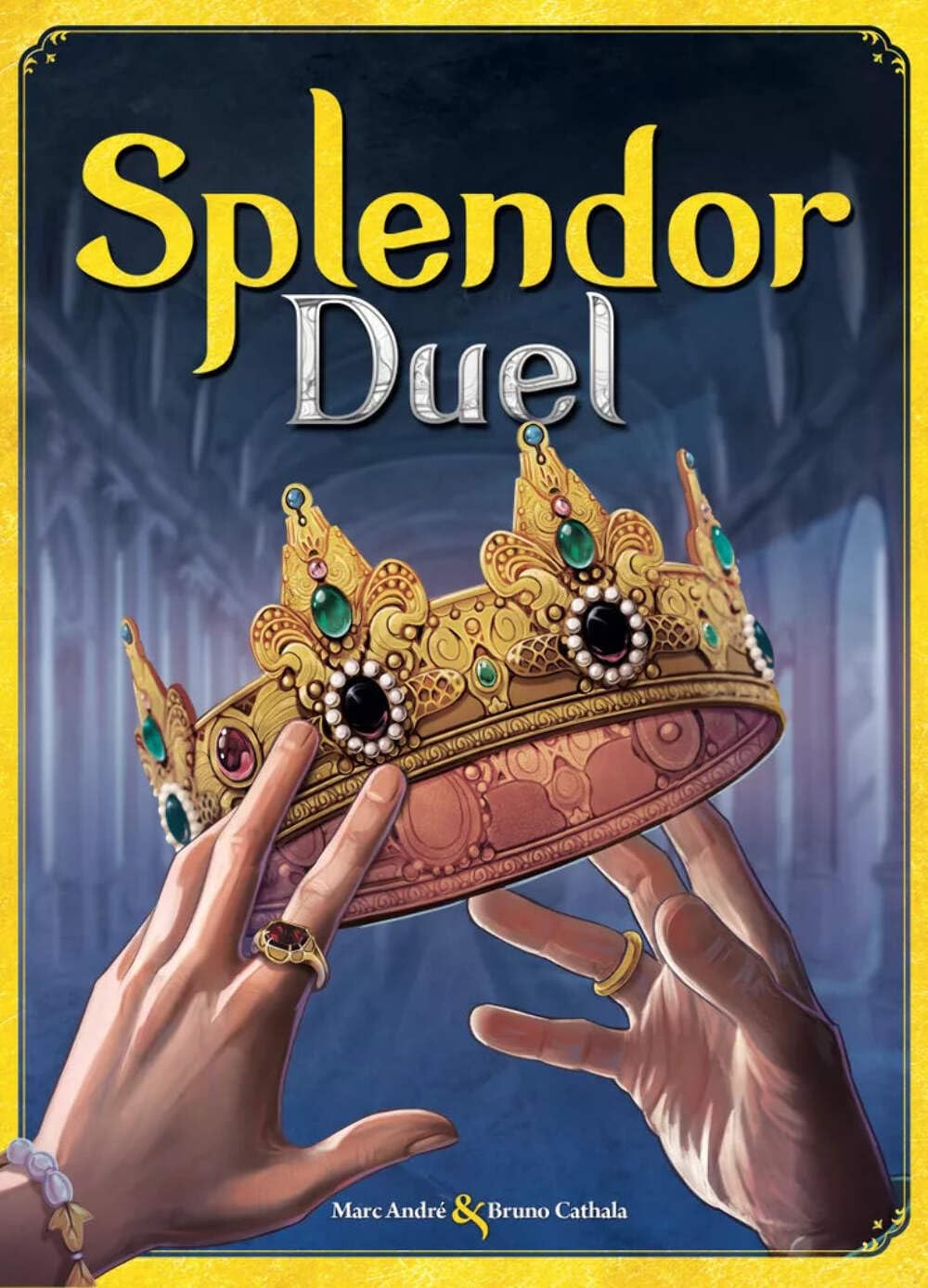
A faster, sharper version of the Splendor classic built strictly for two.
Splendor Duel takes the elegant gem-collecting system of the original Splendor and rewires it specifically for head-to-head tension. Instead of just racing to collect prestige points, you now have multiple win conditions to watch, including a Pearl token mechanic and special powers that add layers of strategy absent from the base game. Fans consistently report that this Duel version is more fun than the original Splendor when played with two.
The game is a masterclass in “simple to learn, hard to master.” The rules are easy to grasp in a single round, yet the branching strategic paths keep it interesting across dozens of plays. With an average playtime of just 30 minutes, it is accessible to both casual gamers and experienced enthusiasts. Its compact size (measuring just 5.11 x 7 inches) makes it a brilliant travel companion, fitting easily into a backpack for trips.
The most persistent complaint is the physical size of the cards. The poker-sized deck is noticeably smaller than what many gamers prefer, with owners noting the tiny cards can be difficult to see clearly. It is a minor ergonomic gripe in an otherwise excellent package—and one that many couples find entirely acceptable given how regularly the game hits the table. The included components of 67 jewel cards, 25 plastic gem tokens, and 3 privilege scrolls offer plenty of variety.
What Works
- Multiple win conditions keep games tense and unpredictable.
- Compact design is perfect for home or travel.
- High-quality components with beautiful artwork.
What to Know
- The small card size is a recurring mixed point among owners.
- Strategy depth is lighter than heavier duels like Targi.
Pick this up if: you want a quick, portable, and endlessly replayable duel that is easy to teach friends or family.
Select another if: you prefer full-size cards or want a heavier strategy experience.
7. Patchwork Americana

Uwe Rosenberg’s legendary quilting puzzle, now dressed in patriotic Americana flair.
Patchwork Americana Edition wraps the acclaimed two-player formula in a red, white, and blue theme celebrating US quilting traditions. There is no drafting or secret scoring—just you and your opponent taking turns buying different-sized patches to fill your individual 9×9 game boards. The tension comes from balancing which patch you want versus which patch you must grab to deny your opponent.
The strategic depth is deceptive. Every patch you buy costs buttons and time, and you must tune your layout perfectly to boost your score with no empty spaces left behind. The included 5 special patches and single special tile add wrinkles to the strategy, while the 50 button tiles serve as your in-game currency. This is a game that is easy to teach but offers layers of spatial reasoning that keep couples coming back for more.
Owners consistently call it a “go-to” two-player game, praising it as short, simple, yet genuinely strategic. The rules are easy to grasp, unlike many strategy games with dense rulebooks. One hurdle: the included instructions have room for improvement, with at least one owner needing outside help to understand the flow—so watch a quick tutorial video alongside the rulebook for a smooth first play.
Appeal
- Easy to teach and quick to play, yet deeply strategic.
- The puzzle-like spatial element offers a unique mental challenge.
- All-red, white, and blue components add charm for Americana fans.
Limitations
- The rulebook has room for improvement in clarity.
- Not ideal for players seeking high player interaction.
The Final Verdict: A top-tier abstract puzzle where you and your opponent craft quilts against each other. It’s a staple for a reason—compact, clever, and endlessly replayable.
8. Caper Europe

A stylish, fast-paced heist game with gorgeous art and clever drafting.
Caper Europe stands out on the shelf with its stunning 1950s-inspired heist artwork, but it is the gameplay that keeps you returning. This is a card-drafting game where you send thieves to claim key locations across Europe, equipping them with gear and outwitting your opponent to control the best spots. The visual quality and wooden components give the game a premium feel that owners frequently praise.
The clever design element is the four distinct European city decks, each offering unique strategies and replay value. One city might reward stealthy thieves while another emphasizes heavy gear, meaning the optimal strategy shifts every time you swap decks. A compact 8.5 x 8.5 inch box with custom trays keeps everything organized and quick to set up, making it ideal for travel—some couples have even brought it on their honeymoon.
Owners consistently highlight the game’s balance of depth and simplicity. It is relatively simple to learn, plays in about 30 minutes, and offers meaningful back-and-forth tension. The one consistent criticism is the rulebook, which several buyers find poorly written and unclear, though the game board includes helpful reminders that mitigate the issue. If you can push past the initial rules hurdle, the underlying game is considered a true gem for couples by those who play it regularly.
Why It’s Great
- Stunning artwork and high-quality production value.
- Four city decks offer excellent variety and replayability.
- Compact box with custom trays is travel-friendly.
The Catch
- Rulebook is frequently criticized as unclear.
- Learning curve is slightly steeper than the simple premise implies.
Reach for this if: you value aesthetic beauty and want a game that looks as good as it plays. The varied city decks keep it fresh session after session.
Think twice if: you prefer pristine official rules over figuring things out as you go.
9. Guess Who? Harry Potter Edition

The classic deduction game gets a magical makeover perfect for younger players.
When the goal is playing with kids rather than competing at a strategy level, this Harry Potter twist on Guess Who? fits the bill. The set includes two double-sided character sheets with 48 Hogwarts characters and magical creatures, so you ask questions like “Does your character use a wand?” or “Does your magical creature fly?” Owners love that you can play as “people” or “non-people” characters, letting you mix up the challenge.
The game’s appeal lies in its accessibility. Designed for kids aged 6 and up, it is a fantastic way to build deductive reasoning skills while having fun, making it ideal for preschoolers and young elementary schoolers. The frames are easy to load, and the fold-up cases make storage and travel easy. For a parent who is also a Potterhead, it is a wonderful way to introduce the wizarding world to a new generation of fans.
The main point of mixed feedback is the character variety itself. While the great mix of characters earns praise, some owners wish there were more options to choose from. The core gameplay is a matter of taste—deduction games are quick and fun, but they have less strategic depth than the other picks here, which is entirely appropriate for the younger target audience. It shines as a family game night staple and a fantastic “first board game” for budding witches and wizards.
Family Appeal: Quality is reasonable for the price, the art is engaging, and the beginner difficulty level is spot-on for children aged 6 and up. It is a great gift that sparks repeat play.
Best for: Harry Potter fans with young kids who want a light, screen-free activity for playdates or family nights.
Note: Dedicated adult duos looking for deep strategy will want one of the more complex picks above.
Understanding the Specs
Playtime vs. Depth
Look at the estimated playing time as a signal for weight. A 20-30 minute game like Spirits of the Wild is usually lighter and more casual, while a 60-minute title like Targi typically indicates a deeper strategic commitment. The real playtime often stretches longer on the first few sessions, so factor in a learning curve when you plan your game night.
Core Mechanics
The mechanic dictates the kind of tension you will feel. Worker placement (Targi) means fighting over the same spaces, card drafting (7 Wonders Duel, Caper Europe) means choosing from shared options, and tile placement (Azul Duel, Patchwork) means spatial planning. Matching the mechanic to what you enjoy is the quickest way to guess if you will like a game.
FAQ
Is 7 Wonders Duel better than Splendor Duel for two players?
Can I play Everdell Duo cooperatively with my partner?
How long does a typical game of Targi last?
What age is the Guess Who? Harry Potter Edition suitable for?
Is Azul Duel easy to learn for beginners?
Are the components in Caper Europe high quality?
Which two-player game is best for a relaxing evening?
Is Patchwork a good option for kids?
Final Thoughts: The Verdict
For most duos, the ultimate board and card games for 2 players pick is the 7 Wonders Duel because it delivers the most engaging strategic depth per minute of play, backed by a 4.8-star average across thousands of owners. If you want a lighter, beautifully tactile option for relaxed evenings, grab Spirits of the Wild. And for a flexible option that lets you team up rather than always compete, the Everdell Duo is the one to reach for.
How We Picked
We do not accept paid placement. Every pick is matched to a real buyer and a real use-case; we do not hands-on test units.
Sources & Methodology
Specifications: manufacturer listings and product documentation. Review insights: verified customer reviews, as of September 2026. Pricing: not shown on this page (it changes often); check the current price via the retailer link.
As an Amazon Associate, Gadgets Feed earns from qualifying purchases. This does not affect which products we feature.