
Our readers keep the lights on and my morning glass full of iced black tea. As an Amazon Associate, I earn from qualifying purchases.
Specs are compiled from manufacturer listings and verified buyer reviews and can change over time — please confirm the key details on the product page before buying.
Yellowed edges, brittle corners, and faded ink — that is what happens to ordinary paper after a few years in a box. The fix is acid-free paper, which resists the chemical breakdown that causes yellowing and brittleness. For resumes, photo archives, or art prints, the right acid-free sheet preserves your work as long as the ink does.
I’m Min — the founder and writer behind Gadgets Feed. This guide is built by comparing the manufacturers’ published specifications and the patterns across verified customer reviews, so you get each pick’s real strengths and trade-offs instead of marketing spin.
Shop with confidence for the best acid free paper that protects your prints, keeps colors true, and resists yellowing for years to come.
Our Picks at a Glance


How To Choose The Best Acid Free Paper
Acid-free paper prevents the yellowing and embrittlement that destroy ordinary sheets over time. Choose a sheet by matching its weight, fiber, and finish to your specific project.
Match the Weight to the Task
Paper weight is the first fork in the road. Light sheets around 24 lb are everyday printing stock, fine for documents but flimsy for a card. Medium 65 lb cover stock behaves like thin cardboard — stiff enough for photo mounting and die-cutting without jamming most home printers. Heavy 150 GSM cotton paper is a completely different animal, closer to a watercolor pad, and often needs the manual feed tray.
Fiber and Finish Change Everything
The fiber source determines the feel and durability. 100% cotton makes a soft, textured sheet that resists yellowing far better than wood pulp. “Rag” cotton is the gold standard for archives. The finish matters too — smooth finishes take ink and adhesive evenly, while cold-pressed textured sheets hold watercolor washes beautifully. Translucent options like vellum and glassine serve a different job entirely: protecting art underneath while staying readable.
Know What “Acid-Free” Actually Means Here
Some acid-free paper is also buffered, meaning it contains an alkaline reserve that neutralizes acids it touches — invaluable for wrapping old photos or manuscripts. Unbuffered sheets are pure and safe for delicate items. The real trap is assuming the label makes it archival-grade for every use. Buffered sheets neutralize acids on contact, extending the life of photos and manuscripts.
Quick Comparison
| Model | Best For | Weight | Sheet Count | Fiber / Finish | Amazon |
|---|---|---|---|---|---|
| Hamilco White Cardstock★ Best Overall | Crafting & die-cutting | 65 lb Cover | 25 | 98 Bright White, Smooth | Amazon |
| Lineco Interleaving TissueArchival Favorite | Archiving photos & manuscripts | 7 lb | 100 | Translucent, Buffered | Amazon |
| Southworth Cotton Resume PaperProfessional Pick | Resumes & certificates | 32 Lb | 100 | 100% Cotton, Textured | Amazon |
| Strathmore Vellum Paper | Translucent printing | 30 lb | 50 | Translucent, Recyclable | Amazon |
| Epson Velvet Fine Art Paper | Fine art prints | 10 ml | 20 | 100% Cotton Rag, Velvet Matte | Amazon |
| Hammermill Premium Laser Paper | Color-intensive business docs | 28 lb | 500 | Smooth, Ultra-bright | Amazon |
| Borden & Riley Glassine Roll | Protecting paintings in storage | 25 lb | 20 Yards | Glassine, Transparent | Amazon |
| Cheericome Vintage Parchment | Themed events & letters | 100 gsm | 200 | Smooth, Double-Sided Print | Amazon |
| Wanderings Deckle Edge Cotton | Handmade invitations & art | 150 GSM | 50 | Recycled Cotton, Cold-Pressed | Amazon |
In-Depth Reviews
1. Hamilco White 65lb Cover Cardstock
Our pick — over 4.5★ from 950+ verified ratings; the strongest balance of quality and price.
A 65 lb cover stock that cuts cleanly for die-cutting and feeds through most home printers.
This is the pick most owners end up framing as their daily driver for scrapbooks and die-cutting. It is a 65 lb cover stock (that is 176 GSM, or noticeably stiffer than a standard sheet of printer paper) cut to the scrapbook-standard 12″ x 12″ square. The 98 bright white tone and smooth finish on both sides mean ink and adhesive grab evenly, which is exactly what you want when layering photos and journal cards.
What wins people over is the quality — the word “quality” dominates owner feedback, with dozens of buyers singling it out. The sheets do not crack when folded, and they cut cleanly whether you use scissors or a Cricut machine. Budget-conscious crafters report it performs like pricier brand-name cardstock for less, and it fits neatly into plastic memory-book sleeves without bulging.
Printers are covered too. The 65 lb weight is light enough to feed smoothly through most inkjet and laser machines — just switch your printer setting to “cardstock” or “heavy paper” mode. Each pack of 25 arrives shrink-wrapped with a rigid cardboard backing to prevent bent corners in transit.
What Crafters Rave About
- Praise for sturdy, non-cracking stock that takes die-cutting and inking well
- Heavier than everyday paper yet still printer-friendly
- Smooth dual-sided finish for clean layering
Worth Knowing
- A 25-sheet pack goes fast for big projects
- 12″ x 12″ format won’t fit a standard letter-size printer tray
The right call if: your world is scrapbooks, photo albums, and die-cutting machines, and you want a sturdy square sheet that behaves.
Look elsewhere if: you only print standard 8.5″ x 11″ documents — this square format is built for craft layouts, not the office tray.
2. Lineco Buffered Acid-Free Interleaving Tissue
Ultra-thin, buffered sheets that slide between precious pages so nothing smudges, smears, or fades.
Lineco is a name museums and archives have trusted for preservation, and this tissue carries that same DNA into your home. Each sheet is a mere.001 inch thick and translucent, so you can identify a photo or document underneath without lifting the tissue and exposing it to air or oils from your fingers. The 8.5″ x 11″ pre-cut size drops straight into standard storage boxes.
The defining feature here is the buffering — an alkaline reserve that neutralizes acids and stops acid migration from one item to the next. For heirlooms this matters enormously. People trust this paper to protect between the leaves of an unpublished manuscript they call priceless, and to keep fresh autographs from smudging onto the photo opposite them. Storage capacity is the most-discussed plus, with owners using it to layer large photographs and old artwork safely.
It is also lignin-free, meaning no wood-derived acids will develop as it ages. The trade-off is a niche use case: this is not a paper you write on or print on. It is a barrier you place between valuables, and it does that one job exceptionally well.
Perfect interleaving: the translucent, acid-free and lignin-free tissue is a must for separating prints and fragile textiles, from bridal gowns to heirloom documents.
Fair caveat: the resealable packaging is adequate but not meant for long-term sheet storage — decant sheets into an archival box.
3. Southworth 100% Cotton Resume Paper
A 32 lb 100% cotton sheet that gives resumes a sturdy, textured feel.
The resume is the one document in your professional life that gets handled by dozens of people — make it memorable with a 32 lb, 100% cotton sheet. Cotton fibers give it a soft, subtle texture and a sturdy hand that screams quality the moment someone picks it up. Each sheet is acid-free and lignin-free to resist yellowing, so your application stays crisp white even if it lingers in a hiring manager’s folder.
What wins people over is how resume-ready it is — it is by far the most-mentioned strength, with dozens of owners singling it out for cover letters and certificates. The 100% recycled, 100% cotton construction prints beautifully on laser, inkjet, and copiers, holding up even to heavy typewriter use. Owners describe it as far heavier and higher quality than competitors claiming heavier weights, noting prints come out clear and legible with no smudging.
The honest catch: this sheet carries a watermark, a classic cotton-paper hallmark that some buyers love and others find distracting for front-and-back printing. If your document is one-sided correspondence, it reads as elegant; if you need a blank canvas for double-sided color, consider the texture carefully.
First-impression winner: as owners put it, “so far best resume/certificate paper I’ve found on amazon” — a textured, sturdy sheet that feeds smoothly through inkjets.
Heads-up: the watermark is intentional cotton-paper tradition, but pick a plain sheet if you need perfectly clean double-sided prints.
4. Strathmore Laser Vellum Inkjet Paper

A translucent vellum that adds depth to layered wedding invites and cards.
Vellum is the paper that lets light play through it, and Strathmore’s translucent version delivers that effect in a printer-friendly 8.5″ x 11″ sheet. It is a favorite for wedding invitations, where an elegant overlay printed with names sits atop a card behind it, and for Bible journaling where the translucence creates visual layers. One owner described how candlelight shone through the vellum, which tells you exactly the mood this paper creates.
The 30 lb sheet is made for high-quality laser printing, and it is acid-free, chlorine-free, and recyclable — a rare trifecta for specialty stock. What wins people over is versatility, with owners using it for tracing, luminaries, and quilling card inserts alongside the wedding circuit. Side-by-side, it outperforms a direct competitor for tracing and laser work with less curling and smearing.
The catch is printer temperament. It shines on high-quality laser machines and HP Laserjets, but some home inkjets and lower-fuser-temperature Brother printers can smear the toner. Owners who hit this simply use a straight-through paper slot or a copy shop’s professional unit for flawless results.
Why It Wins
- Genuinely translucent with crisp, clean print results on quality lasers
- Acid-free, chlorine-free, and recyclable specialty stock
- Dries fast with no curling on compatible machines
Printer Caution
- Smudging on some lower-temperature laser printers
- May need the manual feed slot on finicky inkjets
Reach for this if: you love layered paper crafts, candlelit luminaries, or tracing — anywhere translucence adds elegance.
Be aware: results depend on your printer’s fuser temperature, so test a sheet before a full invitation run.
5. Epson Velvet Fine Art Paper

A museum-grade cotton rag sheet that makes inkjet art prints look like original watercolors.
This is the paper you reach for when a print needs to feel like a genuine art object. Epson’s Velvet Fine Art paper is a 100% cotton rag with an acid-free base and a bright white 98-brightness surface engineered for excellent color reproduction. The velvet-matte finish gives prints a soft, textured look — owners describe finished pieces as resembling watercolor originals, with crisp details and vivid, near-original colors.
Paper quality is the runaway most-praised aspect here, with well over two hundred owners singling it out. The sheet is substantial and thick, with a velvety feel that makes it perfect for professional products and gallery-style prints. It is designed for enhanced 1440 dpi printing, so high-resolution images hold every fine detail. Inkjet compatibility is strong, performing beautifully on Epson, Canon, and other quality printers.
The caveats are real but narrow. The paper is heavy — one owner’s printer only accepted up to 300 grams, and this sheet exceeds that — so check the maximum paper weight your machine allows. Some owners also note a slight cream tint rather than pure white, which suits fine art but may surprise if you expect bleach-white. The 20-sheet pack is a premium purchase, justified by what lands on the page.
Print quality, redefined: thick, vibrant, and velvety — owners say results look like watercolor originals, with color and texture worth the premium.
Your printer check: confirm the maximum sheet weight your machine accepts, because this stock runs heavy.
6. Hammermill Premium Laser Print Paper
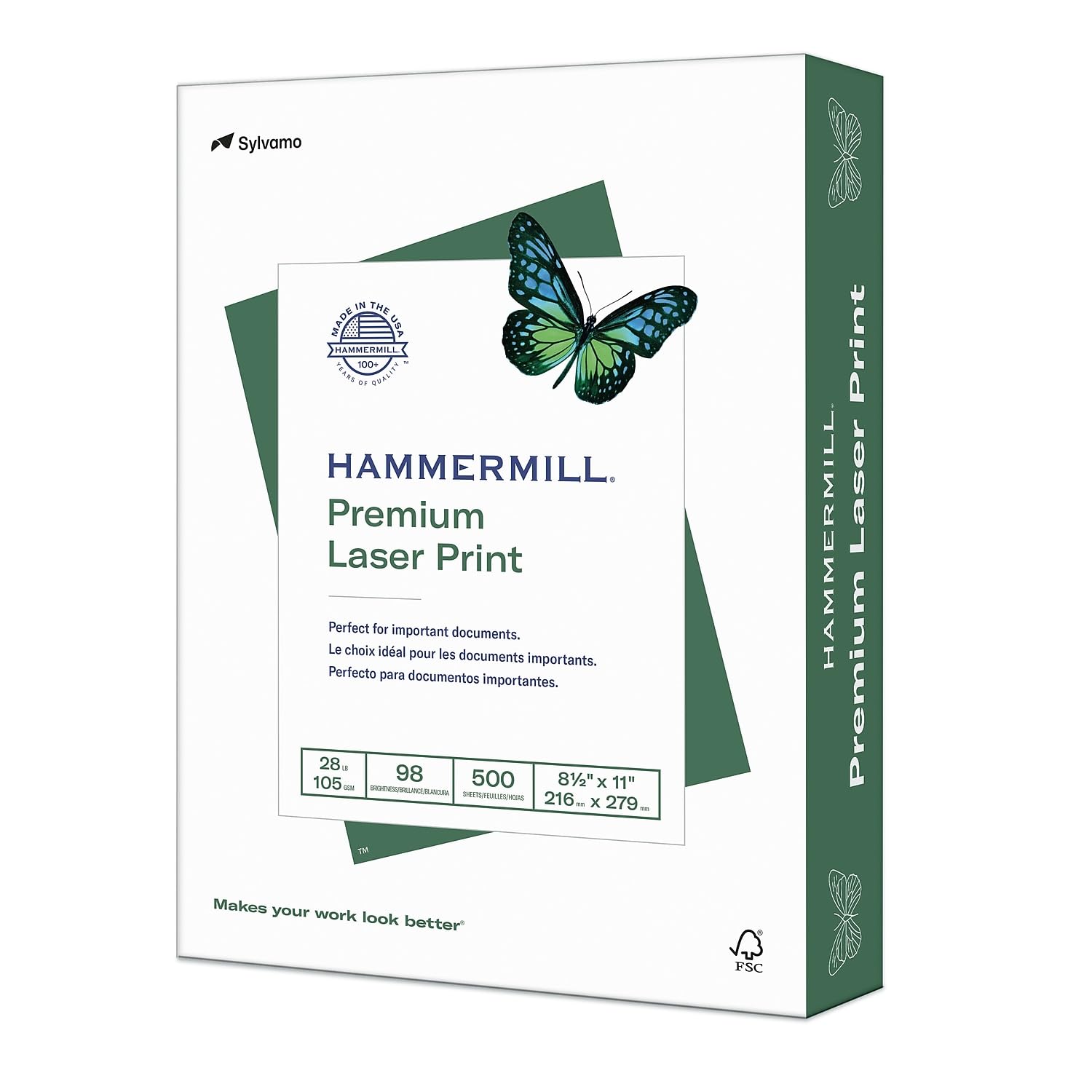
The 500-sheet ream that upgrades every office document to a noticeably smoother, richer finish.
Most office paper is an afterthought; this one is a conscious upgrade. Hammermill’s Premium Laser Print runs 28 lb heavy with an ultra-smooth finish that holds up to 2400 dpi resolution, which translates to sharper text and richer color on everything from client proposals to full-color presentations. It is acid-free, so the sheets resist yellowing over years in a filing cabinet rather than turning brittle and brown.
What wins people over is the value — owners rave about getting this much premium feel per ream, with the smooth, luxurious surface being the most-praised trait after price. It runs flawlessly through Officejet and Laserjet models alike, and the 98 brightness makes colors and images stand out. Durability impresses too: the sheet is not flimsy and does not crack when folded, which is why it is a go-to for calendar makers who need sharp, wrinkle-free pictures.
The brand backs it with a 99.99% jam-free guarantee, promising no more than one jam in 10,000 sheets on high-speed digital equipment or they replace the purchase. It is FSC certified and made in the USA. The only hiccup buyers report is packaging — an occasional ream wrapper arrives open in the box, the paper itself in good shape.
The Everyday Winner
- Ultra-smooth 28 lb sheet with bright 98 brightness for standout color
- 500 sheets per ream at a value that earns the most owner praise
- Acid-free and resistant to yellowing and cracking
Minor Note
- Shipping wrapper can occasionally arrive open, with paper intact
The smarter office buy: if you print proposals, calendars, or anything color-critical daily, this is the ream that makes ordinary jobs look sharper.
skip it if: you need cotton texture or a translucent specialty sheet — this is a premium everyday stock, not an archival art paper.
7. Borden & Riley #25G Glassine Paper Roll

A long roll of slick, transparent protection for paintings and prints headed into storage or a move.
When you have to wrap artwork for a move or tuck originals into long-term storage, ordinary tissue is a gamble — ink and paint can transfer or leave ghostly impressions. Glassine is the answer: a smooth, dense, translucent paper that is resistant to air, water, and oily materials. This 25 lb roll measures 12″ wide by 20 yards long, giving you ample sheet to cut for pieces of any size.
Art protection is what owners praise most, right after the value. People use it to interleave and wrap oil and water-based paintings, and it lays flat straight off the roll, cutting cleanly with a knife and mat. Because the surface is so slick, it keeps paint from sticking to it — essential for protecting pastel artworks and even irreplaceable decades-old Cibachrome prints. Owners find it easy to wrap pieces just like a Christmas package, creating a solid base layer of protection.
One honest note from the maker: glassine is not recommended for wrapping oil or acrylic paintings over long periods, since cured paint can adhere if not fully dry. For active moves and short-term interleaving it is superb; for a permanent gallery wrap on fresh oils, look elsewhere.
The move-day lifesaver: owners mention no color transfer or bubble impressions on water and oil paintings during relocation — slick, clean, and easy to cut.
Know the limit: this is for interleaving and short-term protection, so do not store freshly painted oils wrapped in it for months.
8. Cheericome Vintage Antique Letterhead Paper

Two hundred aged-look sheets that give letters, scrolls, and invites an authentic antique vibe.
Some projects need to feel old — a pirate treasure map, a wedding invitation with character, a scroll for a themed event. This parchment-style paper delivers that instantly with a vintage color and antique pattern printed on both sides. It is light enough in tone for ink to stand out and stay readable, but dark and textured enough to look authentically aged through oxidation rather than dirty.
Appearance is what owners praise most, and it is easy to see why — the aged look reads as elegant, not grimy, which is a fine line most parchment papers miss. At 100 gsm, it is a heavy-weight stationery that avoids ink bleed-through, and the light color suits fountain pens, gel pens, highlighters, and pencils alike. The unpunched sheets also slip into ring binders or discbound planners for period-style journaling.
It prints cleanly on both inkjet and laser printers, which makes it a versatile base for resumes, announcements, and crafting. The color is the debate — some owners find it darker or greyer than the photos suggest. If you want a lighter antique tone, test a sheet first, because the vintage wash varies across batches.
The Vintage Charm
- Authentic aged look — owners say it appears oxidized, not dirty
- 200 double-sided sheets at a budget-friendly per-sheet cost
- Ink and laser compatible with no bleed-through
Shade Check
- Color runs darker or greyer than photos for some buyers
- Preprinted pattern means it is not a blank parchment sheet
The right fit: themed weddings, scrolls for tabletop games, announcements, and old-world letters where character matters more than pure white.
Consider twice if: you need a clean blank sheet for professional printing — the vintage tint is the whole point here.
9. Wanderings Handmade A4 Cream Deckle Edge Paper

Handmade cotton sheets with ragged deckle edges that make invites feel like heirlooms from another century.
This is paper with a story. Each of the 50 A4 sheets is handmade one at a time by artisans using techniques passed down since 14th-century India, sun-dried and cold-pressed from 100% recycled cotton. The result is a soft, textured, cream sheet with naturally ragged deckle edges — the hallmark of true handmade paper. Owners describe it as evoking 18th-century rag paper, soft yet sturdy, folding well and cutting easily for bookbinding.
Quality earns the most owner praise here, and the craftsmanship shows. Externally treated with a plant-based sizing solution, the 150 GSM cotton surface holds watercolor, acrylic, ink, charcoal, and colored pencils beautifully, yet it also takes fountain pens and printed ink. It is acid-free, chemical-free, and tree-free, so your creations retain their vibrancy for years. People love it for newspaper-style wedding invites, period documents, and even gluing pages into Bibles as decorative note sheets.
It does print through most home inkjet and laser machines, but you must feed it one sheet at a time through the manual tray. The deckle edges also mean prints come out with organic, non-uniform borders rather than machine-trimmed edges — part of the charm, but worth knowing before a precise layout.
Handmade soul: owners call it beautiful and thick, and say it feels like genuine 1800s cotton rag — soft, textured, and evocative of antique documents.
Practical note: plan for single-sheet manual feeding and expect lovely but irregular deckle edges on every print.
Understanding the Specs
Paper Weight: GSM vs. Pounds
Paper weight is measured two ways, and they are not interchangeable. “GSM” (grams per square meter) is the metric standard — a 65 lb cover cardstock equals 176 GSM, while a light tissue sits around 7 lb. The “lb” rating is older and depends on the base size of the sheet, so a 65 lb cover stock is much stiffer than a 65 lb text paper. For buying, translate everything to GSM mentally: under 100 GSM is everyday paper, 100-200 GSM is cardstock weight, and above 200 GSM is board territory that may need manual printer feeding.
Acid-Free vs. Buffered vs. Lignin-Free
These three labels do different jobs. “Acid-free” means the paper starts with a neutral or alkaline pH, so it resists yellowing and embrittlement. “Lignin-free” means it lacks lignin, the wood component that creates acids as it breaks down. “Buffered” goes one step further — the sheet contains an alkaline reserve (usually calcium carbonate) that actively neutralizes acids it contacts, making it ideal for wrapping old photos or manuscripts that may already carry acid. For most writing and printing, acid-free is enough; for interleaving heirlooms, buffered is the safer play.
FAQ
What is the difference between acid-free and archival paper?
Is 65 lb cardstock the same as 65 lb printer paper?
Will heavy acid-free paper feed through my home printer?
What is buffered acid-free tissue used for?
Is vellum paper acid-free?
Will a watermark on cotton resume paper affect double-sided printing?
Can I use glassine paper to store oil paintings long-term?
What paper weight is best for scrapbooking and die-cutting?
What does 100% cotton paper do that wood-pulp paper cannot?
Will vintage parchment paper look the same in person as in photos?
Final Thoughts: The Verdict
The acid-free paper worth building a craft room around is the Hamilco 65 lb Cardstock — it pairs a sturdy, die-cut-friendly sheet with a crowd-pleasing track record that makes it the safest starting point for most projects. If your priority is protecting heirlooms, grab the Lineco Buffered Tissue to keep photos and manuscripts safe from acid migration. And for documents that need to impress, the Southworth 100% Cotton Resume Paper turns a simple resume into a tactile statement of quality. Match the sheet to the job — and your work will look right for years, not months.
How We Picked
We do not accept paid placement. Every pick is matched to a real buyer and a real use-case; we do not hands-on test units.
Sources & Methodology
Specifications: manufacturer listings and product documentation. Review insights: verified customer reviews, as of September 2026. Pricing: not shown on this page (it changes often); check the current price via the retailer link.
As an Amazon Associate, Gadgets Feed earns from qualifying purchases. This does not affect which products we feature.