
Our readers keep the lights on and my morning glass full of iced black tea. As an Amazon Associate, I earn from qualifying purchases.
Specs are compiled from manufacturer listings and verified buyer reviews and can change over time — please confirm the key details on the product page before buying.
You unbox a 6-inch duct hose, pull it over your fan or vent collar, and it collapses when bent, tears when stretched, or leaks air at every seam. The right hose holds its shape and seal, so you can match it to your exact run—dryer vent, grow tent, AC line, or bathroom fan—without frustration.
I’m Min — the founder and writer behind Gadgets Feed. This guide is built by comparing the manufacturers’ published specifications and the patterns across verified customer reviews, so you get each pick’s real strengths and trade-offs instead of marketing spin.
Understand the differences between bare aluminum and insulated 6 AC Hose options, then match the length and layer count to your project before you buy.
Our Picks at a Glance


How To Choose The Best 6 AC Hose
Every 6-inch duct hose moves air, but its build determines whether it lasts a season or years. Ask yourself three questions: how long is the run, does the path have sharp bends, and does the air need to stay hot or cold while it travels?
Non-Insulated vs. Insulated Ducting
Bare aluminum hose is the workhorse: it is thinner, cheaper, and easier to bend around obstacles, which makes it the go-to for dryer vents, grow-room exhaust, and short AC runs inside a wall. Insulated duct wraps that aluminum core in a layer of fiberglass or glass wool, which keeps conditioned air at its temperature over longer distances and muffles the sound of rushing air. If your run passes through a hot attic or a cold crawlspace, that extra wrap earns its keep; if the hose lives entirely inside a conditioned room, bare aluminum usually does the job for less.
The Layer Count Tells You the Truth
Manufacturers advertise a three-layer or four-layer build, and it matters. A typical design stacks an inner aluminum foil for fire resistance, a thermoplastic or PET (a tough plastic) middle layer to stop cuts and tears, and a steel-wire helix that keeps the tube from collapsing. Buyers report that hoses with a solid PET layer slide over rigid pipes without ripping, while cheaper single-foil versions tear at the crimps when stretched.
Diameter Is Not Negotiable
Many buyers get caught here: a hose labeled 6 inches can measure 6.3 inches on the outside, and that extra fraction decides if it seals onto your fan collar or flops loose. Match the duct size to the fan or fitting diameter for a tight, leak-proof connection — if your port is exactly 6 inches, look for a hose whose outside diameter lands close to that mark, not a third of an inch over it.
Quick Comparison
| Model | Best For | Length | Outside Diameter | Wall Build | Amazon |
|---|---|---|---|---|---|
| AC Infinity 6-Inch Aluminum★ Best Overall | All-around runs and grow tents | 25 feet | 6 inches | 4 layer | Amazon |
| HVAC Premium 6-Inch AluminumBest Value | Mobile home and A/C ductwork | 25 feet | 6 inches | Air-tight core | Amazon |
| Hon&Guan 6-Inch Air DuctLightproof Pick | Lightproof grow-tent setups | 16 feet | 6.3 inches | 3 layer, PVC outer | Amazon |
| InfiniPower 6-Inch Aluminum | Noise reduction on fan systems | 25 feet | 6 inches | 3 layer | Amazon |
| VIVOSUN 6-Inch Ducting | Dryer and exhaust versatility | 25 feet | 6 inches | Multi-layer | Amazon |
| SunStream 6-Inch Ducting | Budget-friendly basic venting | 25 feet | 6 inches | Foil and steel wire | Amazon |
| Rubber-Cal Insulated Flex | Portable AC temperature retention | 25 feet | 6.02 inches | Insulated rubber | Amazon |
| VEVOR R-6.0 Insulated Duct | Long ceiling runs needing insulation | 25 feet | 8.19 inches | R-6.0, fiberglass | Amazon |
| Cuchiilo R-4.2 Insulated Duct | Bathroom fans vented to soffits | 25 feet | — | R-4.2, glass wool | Amazon |
In-Depth Reviews
1. AC Infinity Flexible 6-Inch Aluminum Ducting, 25-Feet Long
Our pick — over 4.5★ from 22,000+ verified ratings; the strongest balance of quality and price.
The crowd-pleasing 25-footer that resists kinks and keeps light out of grow tents.
Owners keep coming back to this duct because it survives real use. The four-layer build stacks a fire-resistant aluminum inner layer, a tear-resistant thermoplastic outer shell, and a steel-wire spiral, so it does not cave in when you bend it around a corner or squish it into a tight crawlspace. It earns the overall winner spot because it works across inline fans, dryer vents, grow tents, and exhaust runs, according to owner reports.
The 25-foot length pairs with a true 6-inch outside diameter, which means it slides over standard 6-inch fan collars without wrestling. You get two stainless steel duct clamps in the box, which saves a separate trip to the hardware store.
What wins people over is the functionality — hundreds of owners single it out as simply working with their fans and vents. The honest caveat is the fit: some buyers found it does not mate cleanly with 4-inch fittings, and the ends have zero tolerance, so attaching them takes a firm hand. One owner who repurposed it for gutter-to-flower-bed water diversion called it tough, which tells you the material can handle more than just air.
Long aluminum runs
- Flexibility that reaches hard-to-access spots without kinking
- Opaque black shell keeps grow lights from leaking out
- Two stainless clamps included for a snug seal
Sizing can vary
- Ends are tight with zero tolerance, making attachment a squeeze
- Does not pair cleanly with 4-inch fittings
Best for reach: you want one duct that handles grow tents, dryers, and HVAC without needing to baby it.
Check fit first: the snug ends mean you will push hard to seat it over some collars — have a clamp ready.
2. HVAC Premium 6” Inch Aluminum Hose Flexible Air Duct Pipe, 25-Feet Long
An aluminum-lined core aimed at A/C ductwork that handles sharp turns without collapsing.
This hose puts its engineering into the inner core, which is air-tight to cut pressure loss and keep the air stream free of fiberglass erosion. That matters if you are feeding conditioned air through a long run, because every leak at a seam is cooled air you paid for escaping into a wall cavity. The aluminum housing sits both outside and inside for insulation value, and the tough reinforced metallized polyester jacket resists tears and punctures during installation.
At 25 feet with a true 6-inch outside diameter, It covers about 56% more linear distance than 16-foot options. — helpful when snaking through floor joists. One owner needed to duct an overhead oven vent fan through a long run of floor joists and called it easy to work with, high praise when you are on a ladder. The manufacturer backs it with a 25 psi (pounds per square inch) maximum pressure rating, indicating rigidity under airflow.
Owners mention it fits mobile home A/C ductwork very well, with one owner saying it replaced failing ductwork in a doublewide without a fight. The recurring theme in owner reports is that this vent feels sturdier than smaller ducts they had purchased before. It is not insulated, so for a run through a scorching attic you would still want a wrapped hose, but for interior ductwork this is a dependable, budget-conscious pick.
Cheap flex pick: replacing existing A/C ductwork or running a vent fan through joists where you need an air-tight, non-kinking core.
Expect kinks: skip it for unconditioned spaces — the bare aluminum offers no thermal wrap.
3. Hon&Guan 6 Inch Air Duct, 16-FT Long, Black Flexible Ducting
A thick black PVC shell that blocks light leaks while dulling fan noise.
Grow-tent users face one problem bare aluminum duct cannot solve: light leaks that disrupt the dark cycle. This hose uses a thick outer layer of black PVC over a three-layer build — two layers of aluminum foil plus a PET layer and steel wire helix — so it stays rigid while keeping grow lights from bleeding into the room. It is built for exhaust and intake fans, carbon filters, and hooded lights at 6 inches in diameter.
The noise angle is a genuine differentiator: The manufacturer claims this duct cuts fan and carbon-filter noise by up to 50%., which owners notice in shared walls and bedrooms. At 16 feet it is a shorter roll than the 25-footers on this list, but that smaller footprint is fine for a single grow tent or a bathroom exhaust run. The temperature range spans from -30℃ to 150℃, so it holds up in hot attic spaces without degrading.
What wins people over is the build quality — it does not tear like thin tin duct, and owners praise how the rubber coating stays intact even when the hose is repeatedly taken on and off. The one honest catch is the fit: at a 6.3-inch outside diameter, it runs slightly wider than standard, and customers note it is several millimeters smaller than an xTool hose, so it will not seal with xTool couplers. Owners who needed a universal vent found it sturdy and leak-free once seated, but check your exact port diameter before committing.
Black coated duct: the lightproof PVC outer layer is the strongest argument for grow tents, where light discipline is everything.
Length may shrink: that wider 6.3-inch diameter can mean a fight to seal on exactly-6-inch gear from other brands.
4. InfiniPower Flexible 6-Inch Aluminum Ducting, 25-Feet Long, Silver
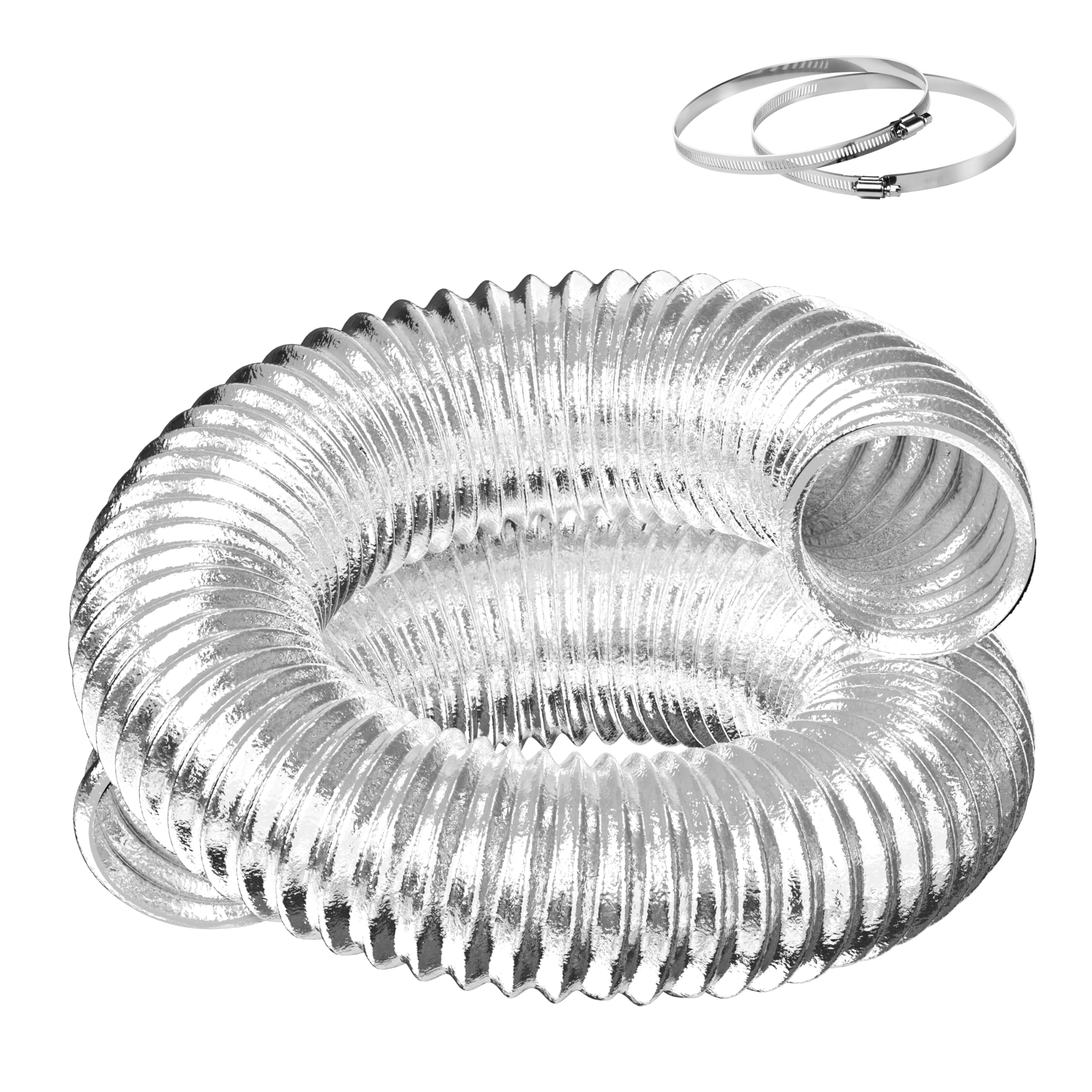
A three-layer aluminum duct pitched at cutting fan noise by up to half.
Most flex ducts are content to just move air; this one claims to do it quietly. The maker says the design reduces fan and carbon-filter noise by up to 50%., which makes it a sensible pick for a bedroom grow tent or a bathroom fan near a living space. The three-layer build stacks aluminum foil with a PET layer and steel wire helix, giving it resistance to rips, leaks, tears, and cuts that cheaper single-ply foil cannot match.
The fire-resistant construction suits dryer vent duty, with a temperature range from -30°C to 150°C and no gas release at high heat. At 25 feet with a 6-inch outside diameter, it snakes easily into cramped spaces — one 82-year-old owner reported installing it solo in a tight spot, showing how forgiving the material is. Owners also note it feels sturdier and better made than what big-box stores stock.
The honest note here is the install warning baked into the listing itself: violent installation is prohibited, meaning you should slide rather than yank. That caution shows up in owner experience — easy to fit, but treat the foil gently at the crimps. For attic ventilator fans or plenum flange hookups, buyers found it flexible and sturdy, and the included clamps make the final seal straightforward.
Rugged duct choice: fan noise is your pet peeve and you want a fire-resistant duct for a dryer or grow setup.
Bend gently: the foil rewards a gentle hand — force it onto a pipe and you risk a tear at the seam.
5. VIVOSUN 6 Inch 25 Feet Flexible Aluminum Ducting with 2 Clamps, Black

A heavy-duty aluminum roll with rustproof clamps that fits dryers and 3D-print venting alike.
VIVOSUN treats this duct as a connector first — it bridges duct fans, dryers, and inline blowers with a tight, leak-proof fit, and the listing spells out the golden rule: match duct size to fan diameter. That guidance saves you from the most common install mistake. The premium aluminum resists high temperatures and corrosion, while the stainless steel clamps stay rustproof and heavy-duty, so the junction does not loosen over time.
The multi-layer structure drives durability: an internal aluminum foil layer provides fire and flame retardancy, a black PVC outer layer adds flexibility and corrosion resistance, and the thermoplastic PET middle layer blocks cuts, tears, and leakage. The black outer shell doubles as light control — a boon for grow tents and cooling AV equipment racks where stray light or heat is the enemy. At 25 feet with a true 6-inch outside diameter, it handles short and long runs without losing shape.
Flexibility is the headline owners praise — the duct holds its bent shape without kinking, stretches to fit slightly larger openings without tearing, and works for everything from HVAC to exhaust to 3D printer ventilation. The value angle is strong, with owners noting it is cheaper than buying separate adapters. The one recurring gripe is length accuracy: some buyers found their roll measured shorter than the size ordered when fully extended, so measure your run before cutting.
Kit with clamps: a one-roll solution that crosses over between dryer venting, grow-room exhaust, and electronics cooling.
Add extra feet: a few reviewers point out the extended length runs shorter than the label, so allow extra if your run is near the limit.
6. SunStream 6 Inch 25 FT Dryer Vent Hose Flexible Aluminum Ducting
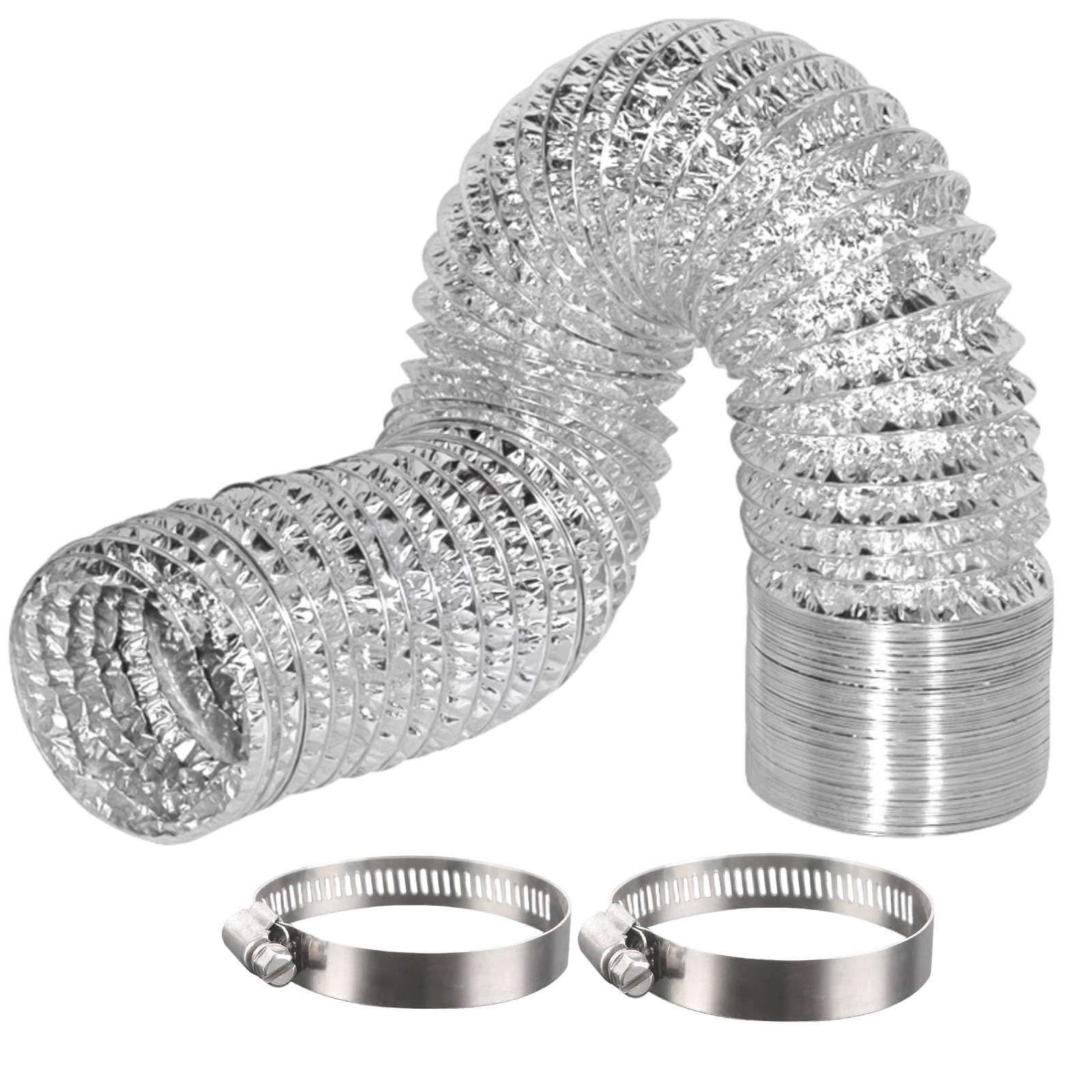
A lightweight foil-and-steel roll that keeps the price low without skipping the clamps.
Not every project needs a four-layer showpiece — sometimes you need a solid, leak-proof hose that does not cost a fortune. This SunStream duct pairs high-quality aluminum foil with a sturdy spiral steel wire to stay durable, leak-proof, and tear-proof, and it comes with two clamps in the box for quick fastening. The lightweight, compact design is easy to transport and store, which matters when you are hauling it up to an attic hatch.
The 25-foot length with a 6-inch outside diameter can be stretched or cut to whatever size your run demands, giving you a custom fit without buying a second roll. Owners found it big, easy to use, and free of installation trouble, with one contractor reportedly getting two uses out of a single roll. For bathroom exhaust vents and basic dryer hookups, this is a straightforward performer that does not overcomplicate the job.
The honest trade-off is that some owners describe it as a little flimsy — it works for now, but it does not have the heavy, padded feel of an insulated hose. That is the right call for a short, protected run where the duct is not constantly being moved or bumped. Keep it out of high-traffic zones and it will move air reliably for a long time.
Dryer vent value: you get a full 25 feet, two clamps, and a genuine 6-inch bore for less than most insulated alternatives.
Not for high heat: it is a lighter-build hose, so treat it as a set-and-forget duct rather than something you reposition weekly.
7. Rubber-Cal HVAC Insulated-Flex Duct Hose, 6″ Diameter x 25ft Long

An insulated roll that keeps portable AC air at temperature while muffling the rumble.
Portable air conditioners have a dirty secret: the exhaust hose radiates heat right back into the room it is trying to cool. This Rubber-Cal duct attacks that with insulation that maintains the temperature of the air inside, plus acoustical insulation that cuts the whoosh making portable AC units loud. The maker positions it for permanent and mobile air conditioning units — a narrower job than general HVAC.
At 25 feet with a 6.02-inch outside diameter, it is compressible and easy to transport, so you can squash it down for storage between seasons. Owners who used it for its intended AC duty found it heavy-duty with no leakage, and the insulation keeps the outer surface from turning into a radiant heater. It also works for mobile home and RV applications where temperature retention over a long flex run actually changes how well the system performs.
The catch is in the handling: owners describe the yellow insulation as brittle and itchy, and cutting it to length is genuinely hard work. Fit is the other watchpoint — shoppers say it does not play well with 12-inch duct collars or 8-inch fittings if you try to force it beyond its 6-inch purpose. Keep it paired with 6-inch gear and it is a solid insulated performer; expect to wear gloves and use a sharp blade when trimming.
Insulated pick: portable AC exhaust where keeping the air cool and the noise down genuinely matters.
Space needed: the fiberglass insulation is itchy and tough to cut — this is a two-glove job, not a quick snip.
8. VEVOR 6 Inch Insulated Flexible Duct R-6.0, 25 Feet Long with 2 Duct Clamps

An R-6.0 fiberglass wrap built for long runs where heat loss adds up fast.
When your duct run stretches 25 or 30 feet through a ceiling, bare aluminum lets your conditioned air bleed heat the whole way. This VEVOR roll brings an R-6.0 thermal resistance value, which is a meaningful step up in insulation and directly translates to less energy wasted and less noise carried through the building. The construction layers thick aluminum foil over a high-strength spiral steel wire, then encases it all in fiberglass insulation that absorbs sound while it blocks heat transfer.
The three-layer tough build — aluminum foil and PET film reinforced with a fiberglass grid — earns its durability reputation from owners who ran it through ceiling cavities. Buyers report the metal rings do not bend out of shape and the duct does not tear easily, even when snaked past pipes and screws. At 25 feet with included stainless steel clamps, it is a complete package for central AC, fresh-air systems, or greenhouse temperature control.
The honest friction point is rigidity: owners found it too stiff to squish past obstacles, requiring a ceiling opening for a 30-foot run, and the included clamps drew complaints for screws that are hard to move — some owners swapped in zip ties. Fit matters too: the outside diameter measures 8.19 inches once the thick insulation wraps around the 6-inch inner bore, so confirm your pass-through space can accommodate the bulk.
High R-value: long attic or ceiling runs where R-6.0 insulation pays for itself in energy savings and quieter operation.
Plan bends: the insulated bulk is rigid and wide, so map your route before you start pulling.
9. Cuchiilo 6 in. x 25 ft. Insulated Flexible Duct R4.2 Silver Jacket

An R-4.2 glass-wool duct that leans hard into sound absorption for bathroom fans.
Bathroom exhaust fans are notorious for rattling through the ceiling, and this Cuchiilo duct treats that noise as the primary problem to solve. The internal glass wool insulation is fluffy and dense, which absorbs sound in time — The maker claims this duct reduces noise by up to 85%., a figure that dwarfs the claims of thinner ducts. That makes it a strong candidate for venting a new bathroom fan to a soffit without turning the hallway into an echo chamber.
The build layers thickened aluminum foil over high-strength elastic spiral steel wire, with the glass wool sitting in the middle for high-temperature resistance and flame retardancy. It carries an R-4.2 insulation value, and the temperature resistance range spans from -4℃ to 454℃, so it shrugs off the hot, moist air a bathroom fan pushes through in winter. The aluminum foil is self-sustaining, meaning it holds its shape after installation instead of sagging and restricting airflow.
Owners who installed two new bathroom fans found it worked great for venting to the soffit, and the vacuum-packed roll expands nicely once opened. The honest friction is the install: the inner layer can tear when you stretch it over a rigid pipe, so it rewards patience and a roll of foil tape rather than brute force. The supplied clamps are metric, which means a standard socket may not fit them — a minor annoyance when you are already on a ladder.
Mid-grade wrap: bathroom or kitchen exhaust runs where 85% noise reduction makes the duct invisible in daily life.
Patience required: the inner foil is tougher than expected but still demands a careful pull onto rigid pipe — keep tape nearby.
Understanding the Specs
R-Value and Insulation
The R-value measures how well the duct resists heat flow — the higher the number, the better it keeps warm air warm and cool air cool over a long run. A bare aluminum hose has no R-value, an R-4.2 duct suits most residential runs, and an R-6.0 wrap earns its keep in attics or crawlspaces where the temperature swings are extreme. If your duct lives entirely inside a conditioned room, the insulation adds bulk and cost without much benefit.
Outside Diameter vs. Inside Diameter
Here is the trap that causes the most returns: a hose labeled 6 inches may measure 6.3 inches or more on the outside once the layers and wire helix are wrapped on. That extra fraction decides whether the duct seats onto your fan collar or hangs loose and leaks. Always match the duct size to the fan or fitting diameter — and if your port is exactly 6 inches, check the outside diameter spec before you buy rather than trusting the label.
Layer Count and Tear Resistance
Manufacturers advertise three-layer or four-layer builds, and the count is not just marketing. The typical stack includes an inner aluminum foil for fire resistance, a PET or thermoplastic middle layer to block cuts and tears, and a steel wire helix to hold the tube open on bends. When you stretch a hose over a rigid pipe, it is the PET layer that stops the foil from ripping at the crimps — hoses without it tear the moment you pull hard.
The Steel Wire Helix
The spiral wire running through the duct wall is what stops it from collapsing when you bend it around a corner. A strong helix keeps the bore open so air flows freely even in a tight 90-degree turn, while a weak one lets the hose pinch shut and choke your fan. If your run has sharp bends or you need to squash the duct into a narrow space, prioritize the wire quality over the outer material.
FAQ
Will a 6-inch duct hose fit my specific fan or dryer port?
How long does flexible aluminum ducting last before it needs replacing?
Can I cut a 25-foot duct hose down to a custom length?
Is insulated ducting worth the extra cost over bare aluminum?
Why does my flexible duct keep kinking and cutting off airflow?
What is the difference between R-4.2 and R-6.0 insulated duct?
Will an insulated duct fit through the same space as a bare aluminum hose?
Can I use a dryer vent hose for grow-tent exhaust instead?
Are the included duct clamps actually usable, or should I buy my own?
Final Thoughts: The Verdict
For most people, the 6 ac hose winner is the AC Infinity Flexible 6-Inch Aluminum Ducting because its four-layer build and true 6-inch diameter deliver the most reliable fit across grow tents, dryers, and HVAC runs. If you need lightproof ducting for a grow setup, grab the Hon&Guan 6 Inch Air Duct. And for a long ceiling run where heat loss matters, the VEVOR R-6.0 Insulated Duct is the one to reach for.
How We Picked
We do not accept paid placement. Every pick is matched to a real buyer and a real use-case; we do not hands-on test units.
Sources & Methodology
Specifications: manufacturer listings and product documentation. Review insights: verified customer reviews, as of September 2026. Pricing: not shown on this page (it changes often); check the current price via the retailer link.
As an Amazon Associate, Gadgets Feed earns from qualifying purchases. This does not affect which products we feature.