
Our readers keep the lights on and my morning glass full of iced black tea. As an Amazon Associate, I earn from qualifying purchases.
Specs are compiled from manufacturer listings and verified buyer reviews and can change over time — please confirm the key details on the product page before buying.
Finding an affordable camera for vlogging usually means juggling three fears at once: blurry footage when you walk, muffled audio when you talk, and a screen you can’t see when you’re filming yourself. The good news is that compact creators’ cameras have gotten remarkably good at solving all three without demanding a full paycheck. This guide cuts through the spec-sheet noise to show you the 5 models that actually deliver clean 4K, flip-out framing, and a mic input for real-world vlogging.
I’m Min — the founder and writer behind Gadgets Feed. This guide is built by comparing the manufacturers’ published specifications and the patterns across verified customer reviews, so you get each pick’s real strengths and trade-offs instead of marketing spin.
You will see exactly where your money goes, which trade-offs matter, and which compact body holds up for daily shooting. This is the practical rundown of the best affordable camera for vlogging that turns your talking-head idea into a clean, watchable channel.
Our Picks at a Glance


How To Choose The Best Affordable Camera For Vlogging
The core job of a vlogging camera is simple: it must capture you talking, clearly, in a format you can share instantly. But that simple job depends on a chain of features — a screen you can see, a mic that hears you, and a lens wide enough to include both you and your background.
Start with the flip screen
If you are filming yourself, a screen that swings out to face you is non-negotiable. It lets you frame your shot, check your focus, and confirm you are in the frame before you hit record. Every camera in this list includes one, because guessing at your framing is the fastest way to ruin a take.
Look for a mic input
Viewers forgive soft video, but they click away from bad audio. Built-in microphones have improved, yet an external microphone jack still gives you the option to upgrade your sound later. For the same reason, pay attention to any built-in wind guard — it is a small detail that saves your outdoor takes from sounding like a hurricane.
Check the lens and zoom flexibility
The lens defines what you can capture. A fixed wide-angle lens is great for arm’s-length talking heads and selfie-style framing, but it cannot reach distant subjects. An interchangeable lens system — or a camera with a real optical zoom range — gives you room to grow. Decide whether you will mostly film yourself or also shoot travel scenes, and pick accordingly.
Quick Comparison
| Model | Best For | Sensor Resolution | Max Video | Lens | Amazon |
|---|---|---|---|---|---|
| Sony ZV-1★ Best Overall | All-round creator | 20.1MP | 4K HDR | 24-70mm Zoom | Amazon |
| Canon PowerShot V10Most Portable | Pocket portability | 15.2MP | 4K 30fps | 19mm Fixed | Amazon |
| Sony ZV-1F Ultimate Kit | Beginners, complete kit | — | 4K | Fixed Wide | Amazon |
| Insta360 Luna Ultra | High-end zoom & reach | — | 8K 30fps | 9-60mm Zoom | Amazon |
| Sony ZV-E10 | Interchangeable lenses | 24.2MP | 4K | 16-50mm (E-mount) | Amazon |
In‑Depth Reviews
1. Sony ZV-1 Digital Camera
Our pick — 4.5★ from 2,000+ verified ratings; the strongest balance of quality and price.
The all-rounder that nails focus, sound, and skin tones straight from the start
This is the camera the crowd keeps coming back to — and the reason is clear: it is the rare compact that gets the fundamentals of vlogging right without making you learn a manual. Its 20.1MP stacked sensor (a large 1-inch chip that lets in plenty of light) pairs with a fast F1.8-2.8 ZEISS Vario-Sonnar T lens that zooms from 24-70mm. For you, that means sharp, punchy footage indoors and out, with a background-blur button that instantly gives your talking head that cinematic look.
On the audio and focus side, it is loaded. The side flip-out 3.0″ LCD screen lets you frame yourself perfectly, while Real Time Eye Autofocus locks onto your eyes and keeps you sharp even as you move. The forward-directional mic with a detachable wind screen solves the classic outdoors problem: your voice stays clear instead of getting washed out by wind. Buyers report the autofocus and face tracking are excellent, and the WiFi transfer to your phone is fast and painless for quick edits.
The honest trade-off is battery and longevity. Owners mention roughly 2 hours per battery charge (with some noting as little as 25 minutes of heavy shooting), so you will want spares, and there is a known overheating risk if you stream for very long sessions. Unlike the ZV-E10 below, there is no lens option — what you buy is what you shoot with. None of that stops it from being the best all-round pick: the photo and video quality is outstanding, and it is genuinely beginner-friendly.
Why it wins over vloggers
- Real Time Eye Autofocus tracks your eyes for sharp self-shots
- Skin-tone-tuned color keeps faces looking natural
- Detachable wind screen makes outdoor audio usable
The hurdles you will hit
- Battery life is short — pack extra cells for a full day
- Fixed lens means no upgrades later
- Long streaming sessions risk overheating
The smart money says: if you want one camera that does talking-heads, B-roll, and streaming credibly, this is the one to beat for a beginner or a growing channel.
Look elsewhere if: you plan to shoot for hours without stopping — the battery and heat limits make that a real struggle.
2. Canon PowerShot V10
A pocket-sized creator that slips into a fanny pack and still shoots true 4K
This is the camera for the vlogger who refuses to carry a bag. The PowerShot V10 is genuinely pocket-sized — owners describe it fitting in a pocket or a fanny pack — and it brings a clever built-in stand that folds front or back for hands-free shooting on a desk or a shelf. Its 15.2MP 1-inch back-illuminated CMOS sensor keeps low-light footage cleaner than you would expect from something this small.
The lens is a fixed 19mm wide-angle (35mm equivalent), which is a deliberate vlogging choice: it is wide enough to capture you plus your surroundings at arm’s length, and customers note it is a “wide lens that’s not too wide.” Video quality is a genuine high point — 4K at up to 30fps with three image stabilization modes (IS Off, IS On and IS Enhanced) available after a recent update. A third center microphone sits between the stereo pair to help strip out background noise from your takes.
The catch is that fixed wide-angle lens means there is no zoom while you film. Owners sum it up directly: “the only thing I don’t like is that you can zoom in/out while filming,” and battery life gets flagged as short in several hands. If your style is spontaneous, on-the-go clips rather than sit-down long-form, this is a superb, affordable companion.
Grab-it moment: the built-in stand plus pocket size makes this the easiest camera here to pull out, prop up, and start talking.
Reality check: no zoom means every shot is a wide shot — you will physically move closer, not zoom in.
3. Sony ZV-1F Ultimate Creator Kit

Everything a new creator needs in one box — camera, mic, light, and tripod
This bundle is built for the person who wants to start creating today, not after a week of buying accessories separately. The heart is the Sony ZV-1F, a compact 4K camera aimed squarely at beginners, and it ships with a high-quality condenser microphone, a SanDisk Extreme Pro 128GB memory card, a versatile U-grip, a tripod, a UV filter to protect the lens, and Movavi editing software. One buyer calls it the “best bang for your buck package out there” and uses it in the gym daily.
For self-filming, the ZV-1F leans on its Real-Time Eye Autofocus and a one-press Background Defocus button for that blurred-background look. Active Mode image stabilization is built in to smooth out the shake of walking shots, and an Intelligent Auto mode handles exposure and focus so beginners get clean results without touching settings. The built-in mic with a windscreen captures clear audio, per owners, which is a big plus for a camera at this level.
The trade-offs are typical of a beginner-first camera: the lens is fixed with no zoom, and the battery gets “mixed” reviews, with some owners calling it terrible. Buyers still call the video quality sharp and the colors vivid, and the included editing software closes the loop from shoot to publish. It is the least stressful way to go from zero to a fully equipped setup.
The package edge: the included mic, light, memory card, and tripod mean your first upload needs nothing else.
Know before you buy: you cannot zoom with the fixed lens, so plan your shots by moving yourself or the camera.
4. Insta360 Luna Ultra
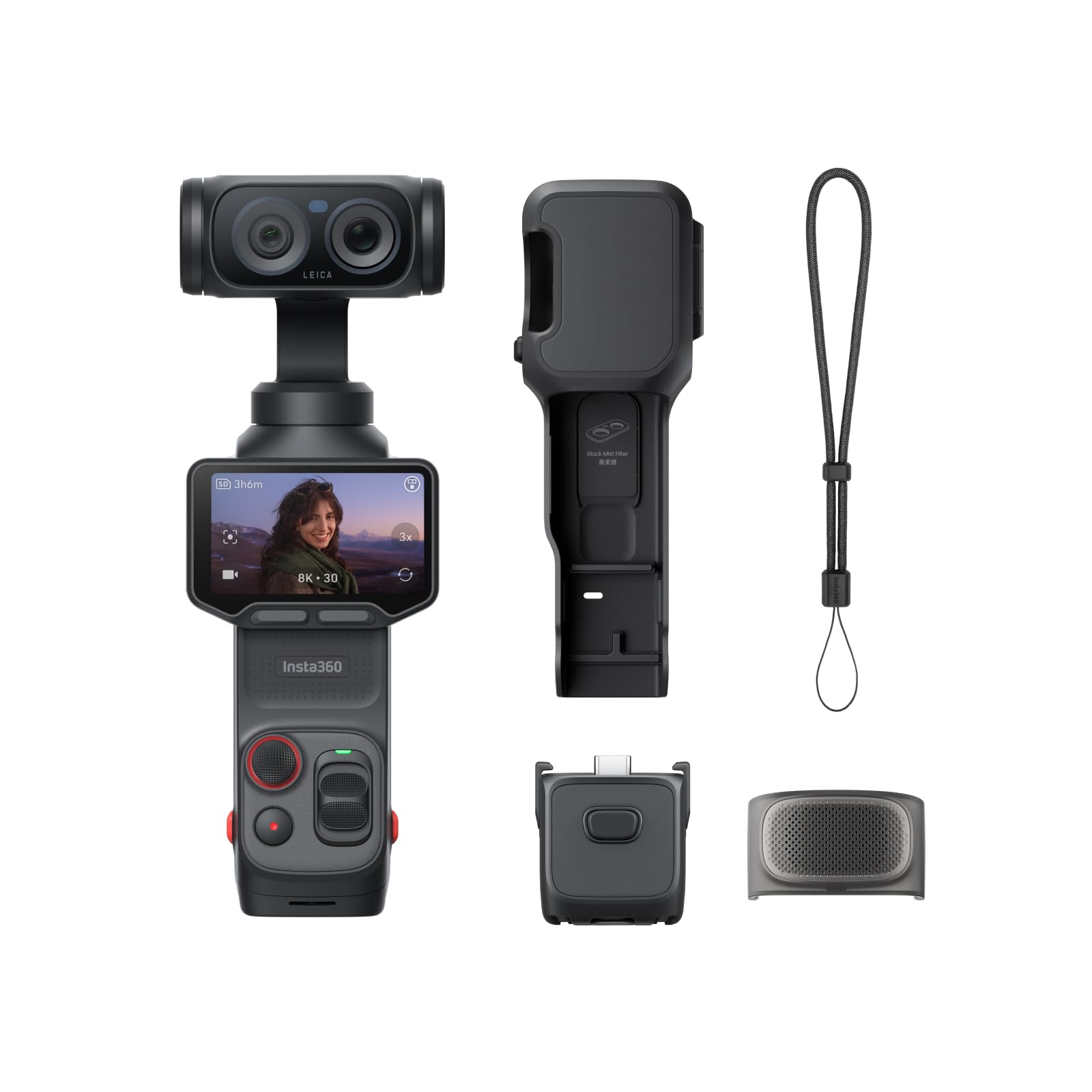
A pocket gimbal camera that reaches distant subjects with true 8K clarity
The Luna Ultra is the zoom champion of this list, and that makes it the pick for vloggers who do more than talk into the lens. Its dual Leica lens system pairs a 1-inch main sensor with a pro-grade telephoto lens (a 1/1.3-inch sensor at F2.0), giving you up to 6x lossless zoom and a 12x zoom range. A sports parent bought one to film a daughter’s volleyball games from the stands, and the 60mm telephoto end delivers real optical background blur — a rarity in this class.
For the travel vlogger, it is a complete tool. Owners used it as their sole camera on a 3-week Southeast Asia trip, praising the 20mm wide lens for crowded night markets and the 60mm zoom for distant temple details. It shoots cinematic 8K30fps with Dolby Vision and captures up to 14 stops of dynamic range, while a 4K60fps PureVideo mode handles low light. The detachable 2-inch OLED touchscreen works as a live remote up to 20m away — invaluable for framing group shots or filming yourself solo.
Battery life is a genuine strength here: up to 4 hours per charge, with fast charging to 80% in just 23 minutes. The recurring notes are about physical heft — it is noticeably weighty in a bag, and the lens module is front-heavy. Buyers also mention a learning curve for manual controls, though the auto modes handle most situations. For image quality and reach, owners see it as holding its own against far more expensive full-size cameras.
Why the crowd loves it
- 12x zoom range pulls distant subjects close
- 4-hour battery covers a full day of shooting
- Detachable screen doubles as a 20m remote
Trade-offs to weigh
- Noticeably heavier than pocket compacts
- Manual controls have a learning curve
- Less rugged than an action camera
Reach for this if: your vlogs need real zoom and top-tier image quality, whether you are filming sports, travel, or cinematic B-roll.
Think twice if: you want the lightest possible everyday carry — the pocket compacts above win on weight.
5. Sony ZV-E10 Mirrorless Camera
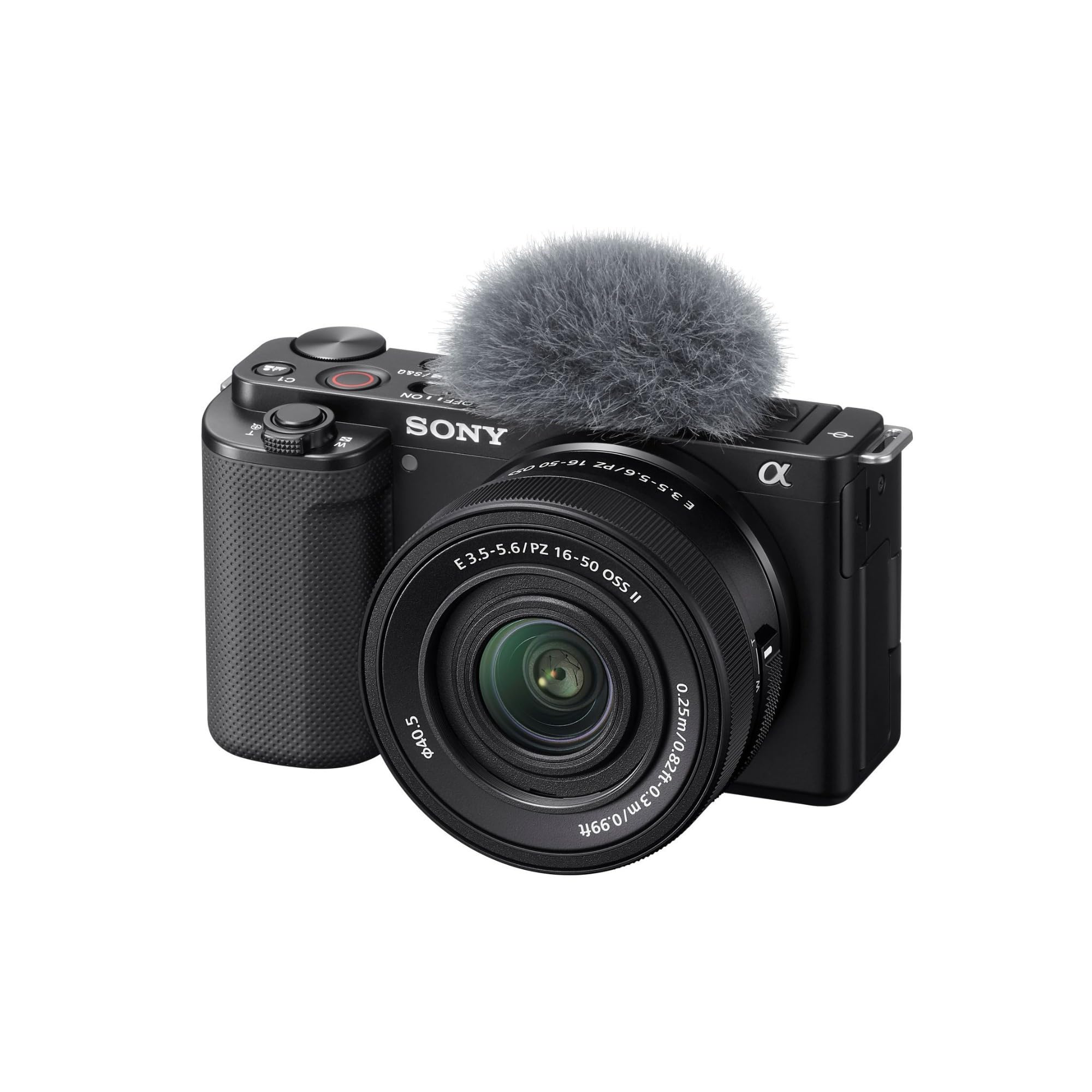
An interchangeable-lens mirrorless that grows with you from hobby to pro work
This is the camera for the creator who knows they will outgrow a fixed-lens compact. The ZV-E10 uses a larger APS-C sensor — a 24.2MP Exmor CMOS chip — which is meaningfully bigger than the 1-inch sensors in the compacts above, and that size translates directly to cleaner low-light footage and more control over background blur. It ships with the Sony E PZ 16-50mm F3.5-5.6 OSS II lens, and because it uses the Sony E mount, you can swap in affordable lenses later as your needs change.
Video is the priority here. It shoots 4K movie oversampled from a 6K readout with full pixel readout and no pixel binning — technical words that mean your footage holds more detail and less moiré than a typical 4K capture. The familiar vlogger tools are here too: a Background Defocus button for instant blurred-background toggling, a Product Showcase Setting that shifts focus from your face to an object you hold up, and swivel screen. Live streaming works over a single USB cable with no extra hardware.
Owners are emphatic about its value, calling it “a beast” for video and noting the stock lens is fine for family use, though they recommend an OSS lens or a stabilizer for professional-grade smooth shots. The honest gaps: there is no built-in flash (you will need an attachment), and the companion app draws complaints. For a first serious videography camera, buyers rate it as a professional entry-level tool that leaves room to grow.
Why it is the grow-with-me pick
- Interchangeable E-mount lens system is future-proof
- Larger APS-C sensor excels in low light
- 4K oversampled from 6K for extra detail
What to plan around
- No built-in flash — budget for an attachment
- Pro-level smooth shots need an OSS lens or gimbal
The long-game choice: if you are serious about videography and want a body that accepts better lenses later, this is the most future-proof affordable pick here — and its 24.2MP resolution leads the whole list.
Who should pass: anyone who never wants to think about lenses or attachments; the fixed compacts will serve you with less fuss.
Understanding the Specs
Sensor Size and Resolution
The sensor is the camera’s light-catching heart. Bigger sensors like the APS-C type in the ZV-E10 (24.2MP) capture more light, which means cleaner footage in dim rooms. The 1-inch sensors in the Sony ZV-1 (20.1MP) and Canon V10 (15.2MP) are smaller but still far better than a phone, and a higher megapixel count (MP) mainly gives you more room to crop your footage in editing.
Image Stabilization
This is the spec that decides whether your walking shots look smooth or seasick. It works by shifting the sensor or using software (or both) to cancel out your hand’s small movements. The Insta360 Luna Ultra goes further with 3-axis mechanical stabilization, while the Canon V10 offers three modes (IS Off, IS On and IS Enhanced) so you can match the setting to how much you are moving.
Autofocus and Face Tracking
When you film yourself, the camera must keep your eyes sharp as you move. Real-Time Eye Autofocus (found on the Sony models) locks onto your eyes specifically, while Face Detection tracks your face. A camera with fast, reliable autofocus means you rarely need to check focus — you just talk and trust the camera to follow you.
Lens and Zoom Range
The lens determines your field of view. A fixed wide-angle (like the Canon V10’s 19mm) is ideal for arm’s-length self-shots because it fits you plus your background. A zoom lens (like the Sony ZV-1’s 24-70mm, the ZV-E10’s 16-50mm, or the Luna Ultra’s 12x range) lets you frame distant subjects without walking closer — essential for travel and event vlogging.
FAQ
Do I need a camera with interchangeable lenses for vlogging?
How long does a vlogging camera battery last?
Is 4K video necessary for a vlogging camera?
Can I use an external microphone with these cameras?
What is a flip screen and why does it matter?
Which camera is better for a beginner, the Sony ZV-1 or the Canon V10?
Will these cameras overheat during long recording sessions?
What is image stabilization and do I really need it?
Final Thoughts: The Verdict
For most creators, the affordable camera for vlogging winner is the Sony ZV-1 because it balances a high 20.1MP resolution, a useful zoom lens, outstanding autofocus, and beginner-friendly controls in one compact body. If you want the ultimate reach and cinematic 8K quality, grab the Insta360 Luna Ultra. And for the pocket-size spontaneity of an on-the-go clip creator, the Canon PowerShot V10 is the one to reach for.
How We Picked
We do not accept paid placement. Every pick is matched to a real buyer and a real use-case; we do not hands-on test units.
Sources & Methodology
Specifications: manufacturer listings and product documentation. Review insights: verified customer reviews, as of September 2026. Pricing: not shown on this page (it changes often); check the current price via the retailer link.
As an Amazon Associate, Gadgets Feed earns from qualifying purchases. This does not affect which products we feature.