
Our readers keep the lights on and my morning glass full of iced black tea. As an Amazon Associate, I earn from qualifying purchases.
Specs are compiled from manufacturer listings and verified buyer reviews and can change over time — please confirm the key details on the product page before buying.
Electronic fishing accessories reveal fish locations instantly. These devices display depth, structure, and fish on a screen, whether mounted or castable. This guide matches each type to your fishing style and water conditions.
I’m Min — the founder and writer behind Gadgets Feed. This guide is built by comparing the manufacturers’ published specifications and the patterns across verified customer reviews, so you get each pick’s real strengths and trade-offs instead of marketing spin.
Electronic fishing accessories turn blind casting into targeted strikes. The right electronic fishing accessories show you depth, bottom structure, or a live underwater view, so every cast has a target.
Our Picks at a Glance


How To Choose The Best Electronic Fishing Accessories
Decide first: see fish, map bottom, or watch live video. This choice narrows your options to gear that fits your style.
Sonar vs. Camera: Know the Difference
Sonar uses sound waves to show depth, bottom contour, and fish arches in real time. An underwater camera gives you a live video look at structure and fish behavior. Sonar works in murky water and at speed; a camera needs clearer water to be useful.
Screen Clarity and Size
Larger, higher-resolution screens reveal fish and structure clearly. If you fish in bright daylight, look for a display that stays visible in the sun or has a sunshade. Backlit displays keep fishing viable after dark.
Matching Gear to Your Water
Kayak anglers and shore casters usually want portability and easy setups. Boat owners can handle a permanent mount with a larger transducer. Think about the cable length you need for your typical water depth so you aren’t limited on the water.
Quick Comparison
| Model | Best For | Max Depth | Display | Power Source | Amazon |
|---|---|---|---|---|---|
| Garmin Striker 4★ Best Overall | Serious boaters wanting GPS + sonar | 1,600 ft fresh / 750 ft salt | 3.5″ LCD | 12V draw 0.23A | Amazon |
| FishPRO Underwater CameraProven Ice Pick | Ice fishing & clear water scouting | 65 ft | 4.3″ IPS | 5,000mAh internal | Amazon |
| Garmin Striker CastBest for Shore | Shore and pier casters with a smartphone | 200 ft | Phone screen | 10+ hr USB-charge | Amazon |
| Daiwa 23 Leo Blitz S500 | Deep-drop bottom fishermen | — | — | Electric motor | Amazon |
| RICANK Handheld Finder | Budget-minded multi-method anglers | 328 ft | 4″ LCD | 4 AAA batteries | Amazon |
| Yoocylii Handheld Finder | Kayakers needing simple depth checks | 328 ft | LCD (4.6 cm) | 4 AAA batteries | Amazon |
| LUCKY Portable Finder | Beginners on a first fishing kit | 328 ft | 2″ LCD | 4 AAA batteries | Amazon |
| FourQ Underwater Camera | Anglers needing wide views & night vision | 65 ft | 4.3″ HD LCD | 5,000mAh internal | Amazon |
| Shimano PLEMIO 3000 | Anglers wanting an electric assist reel | — | — | Electric motor | Amazon |
In-Depth Reviews
1. Garmin Striker 4 Fishfinder
Our pick — over 4.5★ from 9,000+ verified ratings; the strongest balance of quality and price.
The all-rounder that reads depths at speed and maps your favorite spots.
This is the pick that earned its place with a huge following of owners. Rated 4.6 out of 5 by thousands of buyers, it’s the most-reviewed electronic fishing accessory in this list, and the crowd has spoken: quality is the thing everyone raves about here. Its CHIRP sonar sends a continuous sweep of frequencies, which translates into crisper fish arches and better target separation than a single-frequency ping.
You can keep your eyes on the water, not the menu, because the dedicated-button interface is easy to navigate even when the boat is bouncing. The 3.5-inch display (1.9 x 2.9 inches visible) stays readable, and buyers report it holds a depth reading at 25-30 mph—one review simply says it “reads depths at high speeds.” The transducer (the sensor that sends sonar pulses) mounts to your trolling motor or transom, and the unit clicks in and out of its bracket for quick removal when you dock.
It goes far beyond depth: the 1,600-foot freshwater maximum measuring depth is a 4.9x gap over the handheld units below, plus it tracks water temperature, battery voltage, and speed. The waypoint map lets you mark brush piles, stumps, and docks so you can return to productive water trip after trip. A few owners note the battery wires feel thin and the power hookup instructions are sparse, so budget a little care there.
What wins anglers over
- CHIRP sonar forms crisper fish arches for better separation
- Rated for 1,600 ft fresh and 750 ft salt water
- Built-in flasher mode suits ice fishing and vertical jigging
- IPX7 water rating stands up to splashes
The honest trade-offs
- Battery wires are thin and need securing
- Power hookup instructions could be clearer
- Not a touchscreen like pricier models
Reach for this if: you want one unit that handles kayak, small boat, ice, and vertical jigging without compromise.
Think twice if: you need contour mapping or downloadable charts, which this model leaves out.
2. FishPRO Underwater Fishing Camera
A magnetic-spool camera that shows real underwater action on a full-color screen.
When sonar tells you fish are present, this camera lets you see exactly what they’re doing. Its 1000TVL camera delivers clear, true-to-life video without fisheye distortion, and the 4.3-inch full-color IPS monitor keeps that view accurate from any angle. Owners consistently describe the picture as crisp even at night, thanks to built-in infrared lights.
The magnetic connection between the monitor and its 65ft spool means you can operate them together or separately, keeping the layout flexible on the ice. An integrated 5,000mAh battery runs up to 8 hours continuously, and the USB-C port lets you plug into a power bank to extend that as long as you have juice. In practice, replacement batteries have run owners up to 11 hours on a single charge.
One-button IR control cycles through three light levels to suit the water, and the flip-up screen cover doubles as a sunshade for bright days. The 1.8mm cable has a 488lb tensile strength core, so it shrugs off repeated ice lifts and snags. The recurring note from owners is to unplug the cord when storing to avoid battery drain, and a few units arrive with a weak battery that support quickly replaces.
Why it stands out
- Magnetic-spool system keeps monitor and camera secure
- IPS panel holds color accuracy at sharp angles
- Adjustable 45°/90°/180° fin detects surroundings easily
- 12-month warranty with 7×24 support
Know before you buy
- No video recording on this model
- Occasional battery defect on arrival
- Tripod not included in the package
Best for: ice anglers and clear-water boaters who want to watch fish react to their bait in real time.
skip it if: you fish murky water, where a camera loses its advantage to sonar.
3. Garmin Striker Cast
Cast this sonar from the bank and watch fish appear on your phone.
No boat, no problem. This rugged puck streams live sonar wirelessly to your smartphone or tablet through the free Striker Cast app, working from up to 200 feet away. Unlike a mounted unit, it shines for shore anglers and pier casters — one enthusiastic owner called it “great to use if you don’t have a boat.”
It weighs just 75g and attaches to a 20 lb. test line or higher, so you can pitch it toward structure and reel it back to read the bottom. Built-in GPS lets you create custom fishing maps with 1-foot contours using Quickdraw Contours software, and the Garmin Quickdraw Community lets you download maps others have made. Owners prize it for finding deep holes and drop-offs from shore.
The internal USB-rechargeable battery runs 10+ hours between charges, and it saves power by turning on automatically when it floats in water and off when removed. Rated IPX6/IPX7, it survives water exposure up to 1 meter for 30 minutes. The honest catch: image quality drops if you drag it fast or through choppy water, and heavy algae can confuse the readings.
The standout strengths
- Streams sonar up to 200 ft to your phone or tablet
- Self-powered on float, self-off when removed
- Maps 1-ft contours with Quickdraw software
- Rugged and light enough for a tackle box
Fair warnings
- Bluetooth drops briefly in some sessions
- Battery runs a full day, not two
- Requires careful casting and braided line
Grab it for: shoreline sessions, kayaks, or anyone who refuses to fish blind from the bank.
Look elsewhere if: you want a permanent boat display rather than your phone screen.
4. Daiwa S500JP 23 Leo Blitz Electric Reel

Electric winch power that spares your arms on 500-foot deep drops.
This is the motorized answer to deep-water exhaustion. The Daiwa Leo Blitz S500 combines a 3.6 gear ratio with a maximum winding force of 165, letting you haul line from serious depths without grinding your shoulders. Owners mention catching mid-sized halibut down to 4-500 feet with no issues, and one 86-year-old angler happily works Texas and the Gulf thanks to this reel doing the heavy lifting.
Its 16 kg maximum drag gives you the muscle to stop a powerful fish once it’s near the boat. The standard line winding weight runs PE 4-500, 5-400, or 6-300, meaning it pairs naturally with braided lines at various strengths. Normal winding speed hits 135 meters per minute at a 1 kg load, so you recover line quickly between drops.
The one thing to master is the learning curve. Owners recommend watching setup guides to understand operation, but once running, it’s a workhorse. Quality is what buyers praise most about this reel, and for the price tier, the consensus is that it performs exactly as a deep-water electric should.
Where it dominates
- Electric retrieve spares your arms on deep drops
- 16 kg max drag stops powerful bottom fish
- High-quality construction owners trust
Consider this
- Steeper learning curve for first-time electric users
- Premium investment for serious deep-sea anglers only
- Right-hand orientation limits left-hand casters
Choose it if: you regularly fish 300+ foot depths and want motorized retrieval to save your arms.
Pass it by: casual shallow-water anglers who don’t need electric assist.
5. RICANK Portable Fish Finder

A pocket-sized depth finder with a big 4-inch screen for any fishing method.
This handheld unit wins on sheer versatility at a budget-friendly price. It works for offshore, kayak, ice, lake, sea, and river fishing, with a 25ft cable and removable transducer float that you simply toss into the water. The 4-inch LCD display is actually larger than the Garmin Striker 4’s 3.5-inch screen — a 14% size advantage that makes it easier to read at a glance.
The sonar detects water depth from 3ft down to 328ft below the transducer, casting a 45° cone to spot fish, weeds, sand, and rocks. Owners have verified the depth readings are accurate at around 80 feet, though they’re honest that fish marking is less reliable than depth. The 5 sensitivity modes, battery save mode, backlight, and fish alarm give you plenty of control for different conditions.
Running on 4 AAA batteries, it supports 4-5 hours of continuous work, and battery save mode stretches that further. The build’s standout feature is the ease of use — owners consistently note how simple it is to operate and connect. The honest trade-off: functionality gets mixed feedback, so treat it as a reliable depth tool rather than a precise fish locator.
Why anglers like it
- 4″ screen is bigger than many pricier units
- 25ft cable with removable transducer float
- Multi-method use from ice to sea
- Battery save mode extends work time
Set expectations
- Fish marking is less reliable than depth readings
- False readings at speed — slow troll instead
- Water damage risk if dropped
Pick this up: if you want one low-cost depth finder that moves between kayak, shore, and ice.
Keep looking if: precise fish-location accuracy is your priority.
6. FourQ Underwater Fishing Camera
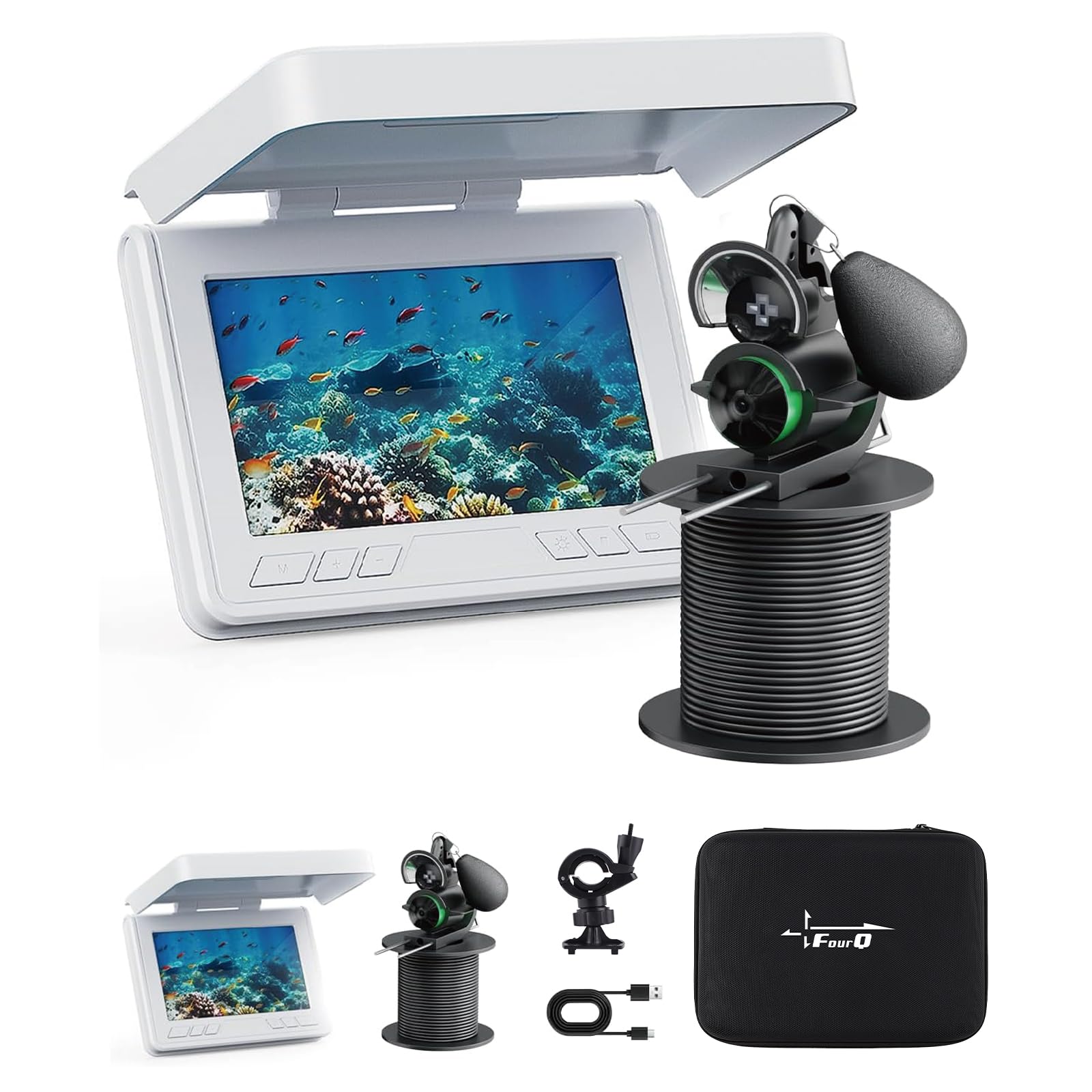
A budget camera with a 220° view that catches everything moving below.
This camera brings the wow factor of seeing underwater life without the premium price. Its 220° ultra-wide-angle lens captures an amazing view of everything happening below, from fish approaching your bait to the structure they’re hiding in. The 4.3-inch HD color screen stays visible even in bright conditions, and 12 IR lights illuminate the dark so fish show up clearly at night.
Power comes from a 5,000mAh rechargeable battery rated for 10+ hours of continuous use, so a full day on the water rarely needs a recharge. The 65ft waterproof cable reaches deep holes and pier spots, with a maximum weight capacity of 40 kg or 88 lbs for lifting. Owners praise the display quality most, noting it shows clear details of underwater structures and is easy to operate single-handedly while fishing.
The included mounts attach to your rod or boat, and the portable box makes it easy to carry anywhere. Setup is truly plug-and-play with no complex configuration. The honest concern: durability has an occasional outlier, so treat the cable connection gently and keep the unit dry when not in use.
The appeal
- 220° lens shows a massive underwater field
- IR night vision works in murky, dark water
- 5,000mAh battery runs 10+ hours
- Rod and boat mounts included
The reality check
- Occasional connection loss reported
- Best in clear, calm water
- 100 ft maximum depth rating in marketing vs 65 ft cable
Reach for it: if you want an underwater view for ice or lake fishing at a budget-friendly price.
Think twice if: you need video recording or heavily murky water performance.
7. Yoocylii Handheld Fish Finder

A lightweight kayak companion that reads depth from 3ft to 328ft for less.
Value for money is what wins this unit its fans. Made for kayak, dock, and ice fishing, it runs on 4 AAA batteries for 4-5 hours of continuous use. The 200 kHz sonar frequency sends a 45-degree beam down, detecting depth from 3ft to 328ft and showing approximate fish location and size.
Owners find it great at depth and weed detection, with one fly fisherman noting how useful it is for finding ledges and vegetation, even if actual fish detection is less precise. The neck strap keeps it handy while you paddle, and the compact size stores easily in a tackle box. It works in both fresh and salt water, and settings save automatically when you power off.
A 2-year warranty covers you if something fails, and the brand’s support is responsive when you need help. The screen stays visible in bright daylight, and the fish alarm and backlight let you keep fishing into the evening. The honest trade-off: accuracy gets mixed feedback, with some buyers reporting false readings, so treat it as a guide rather than gospel.
Strong points
- 2-year warranty beats most budget electronics
- Works in fresh and salt water
- Settings save when powered off
- Compact enough for a tackle box
Keep in mind
- Graphics are basic and dated
- Fish location accuracy is mixed
- Slow speeds under 5 mph required
Buy it for: kayakers who need reliable depth and bottom-type readings at a low entry price.
pass on it if: you demand modern graphics or precise fish marking in deep structure.
8. LUCKY Portable Fish Finder

A color-screen starter that reads bottom structure without the steep learning curve.
Functionality is what this unit’s owners celebrate most, making it a genuine beginner-friendly gateway into electronic fishing. The color LCD display stays visible under sunshine, and the backlight enables night fishing sessions. It detects fish location, water depth, short and tall weeds, sand, and rocks with its wired transducer.
The 25ft cable gives you reach into deeper water from a kayak or inflatable boat, and the detecting range runs from 3ft to 328ft within a 45° cone. Five assistant settings let you adjust sensitivity, use battery save mode, toggle the backlight, set fish alarms, and check the battery indicator. Switch the depth unit from meters to feet by holding the enter button for 5 seconds.
Running on 4 AAA batteries, it works 4-5 hours with fresh batteries. Owners find the depth accuracy solid — one tested it in a bucket — and the setup is genuinely simple with clear instructions. The honest note: fish tracking gets mixed feedback and the display is meters-only in some versions, so it’s a depth and structure tool first.
Beginner appeal
- Color display readable in bright sun
- Accurate depth and bottom structure readings
- Simple setup praised by owners
- Fish and fish school alarms included
Watch out for
- Some units report failing after two uses
- Fish tracking reliability is mixed
- Meters-only display on some versions
Start here: if you’re new to fish finders and want an affordable, readable depth tool for small boats.
Move on if: you need dependable fish-school tracking or a larger display.
9. Shimano PLEMIO 3000 Big Game Electric Reel

An electric reel that turns 500-foot bottom battles into a button press.
Shimano’s entry into the electric reel space brings Japanese engineering to deep-water sport fishing. Weighing 625g with a 3.6 gear ratio, this reel retrieves 64cm of line per crank turn, giving you solid pulling power for bottom fish. Its 10.0kg max drag provides the stopping force you need when a big snapper or grouper makes its final run.
Customers note great success at 105ft bottom fishing, with one pulling multiple snapper and triggerfish on a 12v 9ah battery and still having 85% charge left. Setup is genuinely simple — a 5-second button press gets it running. The ambidextrous hand orientation suits both left and right-hand casters.
The honest reality: reliability gets mixed feedback, and the manual is in Japanese with no English instructions, which frustrates some buyers. One owner describes needing to hold the button 3-6 seconds to retrieve, and occasional resets when unresponsive. Treat it as a budget-friendly entry into electric reels for shallow-to-moderate depths rather than a heavy-duty workhorse.
What it delivers
- Electric retrieve saves your arms on deep drops
- Ambidextrous hand orientation
- Simple 5-second setup process
- Efficient battery use on moderate depths
Be prepared for
- Manual is Japanese-only with no English guide
- Retrieve reliability can be inconsistent
- Best suited for shallow or slow-current fishing
Grab it for: anglers wanting electric assist at 100-200ft depths without paying flagship reel prices.
Look elsewhere if: you fish deep, strong-current water where reliability under load matters most.
Understanding the Specs
Depth Rating
The maximum measuring depth tells you how deep a fishfinder can reliably read the bottom. A freshwater unit rated for 1,600 feet covers deep lakes and reservoirs, while 328 feet suits most kayak and shore applications. Match the rating to your typical water, not your dream trip.
Display Size and Type
A larger display makes it easier to spot fish arches and structure. Standard LCD screens work well in moderate light, while IPS panels hold color accuracy at sharp angles — useful when you’re viewing from the side. Backlighting extends usability into low-light sessions.
FAQ
What is the difference between sonar and an underwater camera?
How deep can a handheld fish finder read?
Will a portable fish finder work on a moving kayak?
How long do batteries last on portable fish finders?
Can I use an underwater camera in salt water?
What does CHIRP sonar do better than standard sonar?
Do I need a GPS in my fish finder?
What is the difference between a fish finder and a castable sonar?
Final Thoughts: The Verdict
The clear winner for most anglers is the Garmin Striker 4, combining CHIRP sonar, GPS waypoint mapping, and legendary reliability — backed by tens of thousands of owners giving it a 4.6-star rating. If you want to see real underwater action rather than just read it, the FishPRO Underwater Camera delivers a crisp 4.3-inch IPS view with a 5,000mAh battery. And for shore anglers or anyone fishing without a boat, the Garmin Striker Cast turns your smartphone into a live sonar screen with 200 feet of wireless range.
How We Picked
We do not accept paid placement. Every pick is matched to a real buyer and a real use-case; we do not hands-on test units.
Sources & Methodology
Specifications: manufacturer listings and product documentation. Review insights: verified customer reviews, as of September 2026. Pricing: not shown on this page (it changes often); check the current price via the retailer link.
As an Amazon Associate, Gadgets Feed earns from qualifying purchases. This does not affect which products we feature.