
Our readers keep the lights on and my morning glass full of iced black tea. As an Amazon Associate, I earn from qualifying purchases.
Specs are compiled from manufacturer listings and verified buyer reviews and can change over time — please confirm the key details on the product page before buying.
Camping in summer heat usually means one of two things: sweating through the night in a stifling tent, or dragging along a heavy generator that drowns out the crickets. A true camping air conditioner changes that equation by running directly off your 12V battery bank, so you can actually sleep in comfort without hauling a noisy power source. The catch is that not every unit labeled “portable” can handle the job, and this guide separates the real off-grid coolers from the ones that barely dent the heat.
I’m Min — the founder and writer behind Gadgets Feed. This guide is built by comparing the manufacturers’ published specifications and the patterns across verified customer reviews, so you get each pick’s real strengths and trade-offs instead of marketing spin.
To sleep through a warm night in your camper, you need an ac for camping whose BTU output (cooling power) matches your battery capacity, so the unit can run until morning without draining your power bank.
Our Picks at a Glance
How To Choose The Best AC For Camping
Picking a camping AC is less about the brand name and more about the physics of your setup. You need to match how much heat the unit can remove (measured in BTU) with how much electrical power your battery or solar can supply. Getting this balance wrong means either a hot night or a dead battery by morning.
Understand the power source: 12V DC vs 120V AC
The biggest mistake campers make is buying a standard household window unit that needs a 120V wall outlet. In the woods, that means running a loud generator. True camping units like the rooftop Gidrox or the Somokg run directly on 12V DC, tapping straight into your RV or camper battery bank. This lets you cool all night on stored power without a generator humming in the background.
Match BTU to your space, not your ego
BTU (British Thermal Units) measures raw cooling power. A 5,100 to 5,200 BTU unit, like the Cybertake S2 Pro or the Outohome, suits small tents and compact spaces. A rooftop unit pushing 10,000 to 11,000 BTU, like the Gidrox or Somokg, handles full camper vans and truck sleepers. Buy too little power and you will feel the unit blowing air that never actually gets cold in a large space.
Check the real-world power draw
Manufacturers love quoting battery life, but the real number is the wattage draw. A unit pulling 400W per hour will drain a 400Ah battery much faster than one sipping 350W in ECO mode. Look for the actual amp draw at 12V — the difference between 30A full blast and 15A in ECO is the difference between a six-hour night and a full eight hours of sleep.
Quick Comparison
| Model | Best For | Cooling Power | Power Draw | Weight | Amazon |
|---|---|---|---|---|---|
| Gidrox 10000 BTU Rooftop★ Best Overall | RVs and campers with a 14×14 roof cutout | 10,000 BTU | 350W (ECO) | 59 lbs | Amazon |
| Somokg 11000 BTU 12VDual Climate | Off-grid vans needing heat and cool | 11,000 BTU | 35dB quiet | 43 lbs | Amazon |
| Cybertake S2 Pro | Tents and small spaces up to 130 sq ft | 5,100 BTU | 1kWh per 8 hours | 21 lbs | Amazon |
| Outohome 5200 BTU Portable | Spot cooling in tents and semi trucks | 5,200 BTU | 400W | 31.9 lbs | Amazon |
| EcoFlow WAVE 3 | Cordless cooling with built-in battery | 6,100 BTU | 1024Wh battery | 32 lbs | Amazon |
In‑Depth Reviews
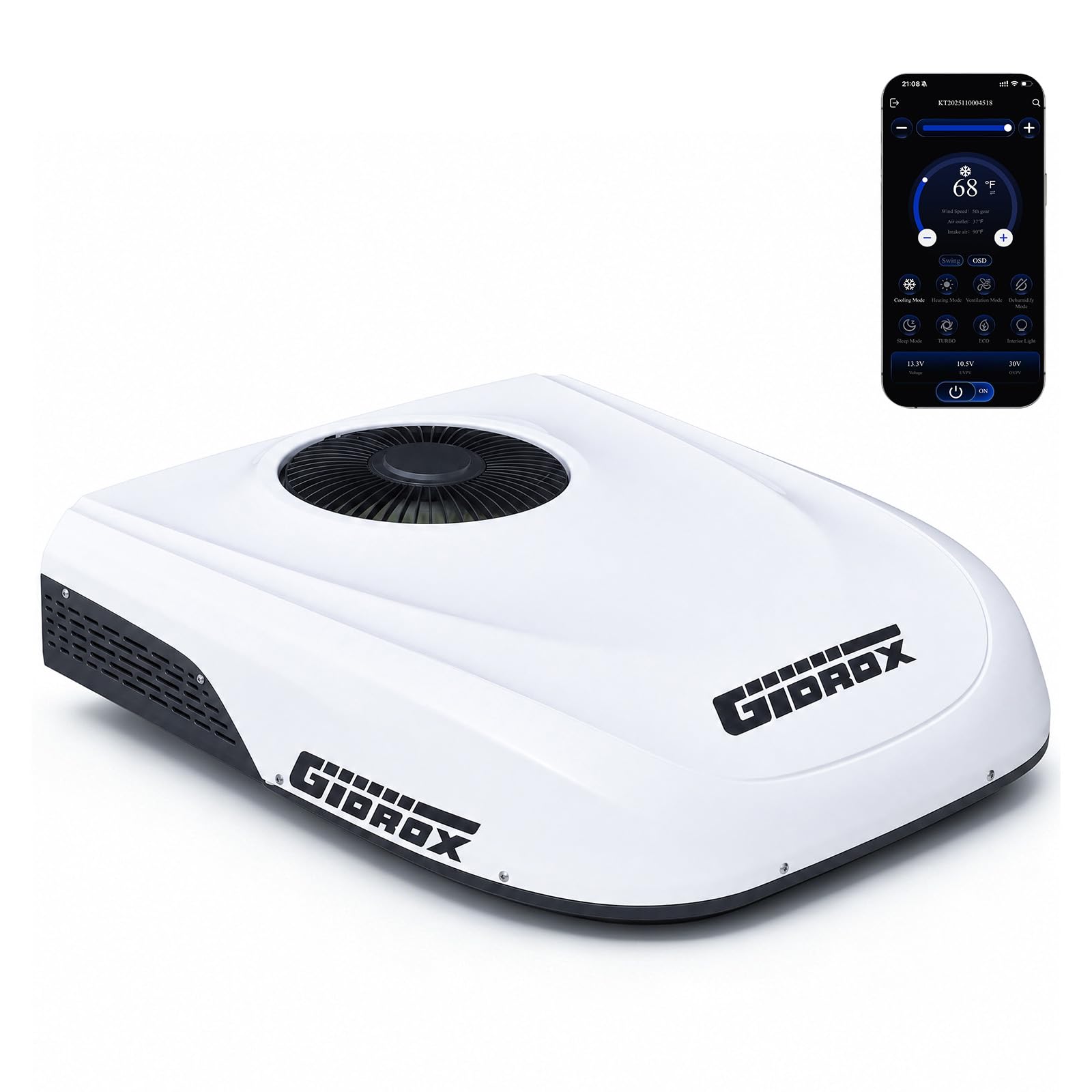
1. Gidrox 10000 BTU 12V DC Rooftop Air Conditioner
Our pick — 4.5★ from 30+ verified ratings; the strongest balance of quality and price.
The heavy hitter that turns a sweltering camper van into a 77°F retreat, even in Texas heat.
This is the unit you mount on your roof and forget about, because it is wired directly into your RV battery with no inverter needed. It delivers up to 10,000 BTU of cooling, and the inverter compressor is fast enough to chill the cabin within 3 minutes of switching on. That kind of speed matters when you pull into camp after a long hot drive and just want the van cool before you start unpacking.
Power efficiency is where this rooftop unit earns its keep. In ECO mode, owners measured the draw at roughly 350W, which pairs with a 400Ah battery for all-night use. One buyer ran it for a week straight on an 800W solar setup with a 600Ah bank — the kind of real-world endurance that separates a true off-grid unit from a toy. It is not light at 59 pounds, so expect to need a helper on the ladder, but the hardware kit and 19.7 ft power cable make the wiring straightforward once it is up top.
Buyers report the controls take some getting used to: “Draws ~30A @12V full blast, ~15A eco.” The ECO mode is locked to a fixed 79°F you cannot adjust, which annoys some owners, and there is no battery cutoff voltage setting to protect your bank. For an insulated camper, though, the cooling muscle is undeniable — one owner ran it nonstop in 100°F heat holding a steady 77°F by day and 73°F at night without a single hiccup. A second unit handled a bedroom, proving it scales beyond just the main cabin. The thing everyone raves about is how quietly it sleeps at 40dB in Sleep mode, so the compressor cycling on and off never wakes you.
What wins you over
- Rapid 3-minute cool-down on a 10,000 BTU inverter compressor
- 350W ECO draw sips battery for reliable all-night runs
- Library-quiet 40dB Sleep mode keeps the cabin restful
What to plan around
- Weighs 59 lbs, so roof installation needs a second pair of hands
- ECO mode locked at 79°F with no adjustment
- No battery cutoff voltage setting for bank protection
Reach for this if: you have a camper van or RV with a 14×14 roof cutout and a solid battery bank, and you want real cooling power without generator noise.
Think twice if: your setup is a small tent — this is a permanent rooftop fixture, not a portable you can move around camp.
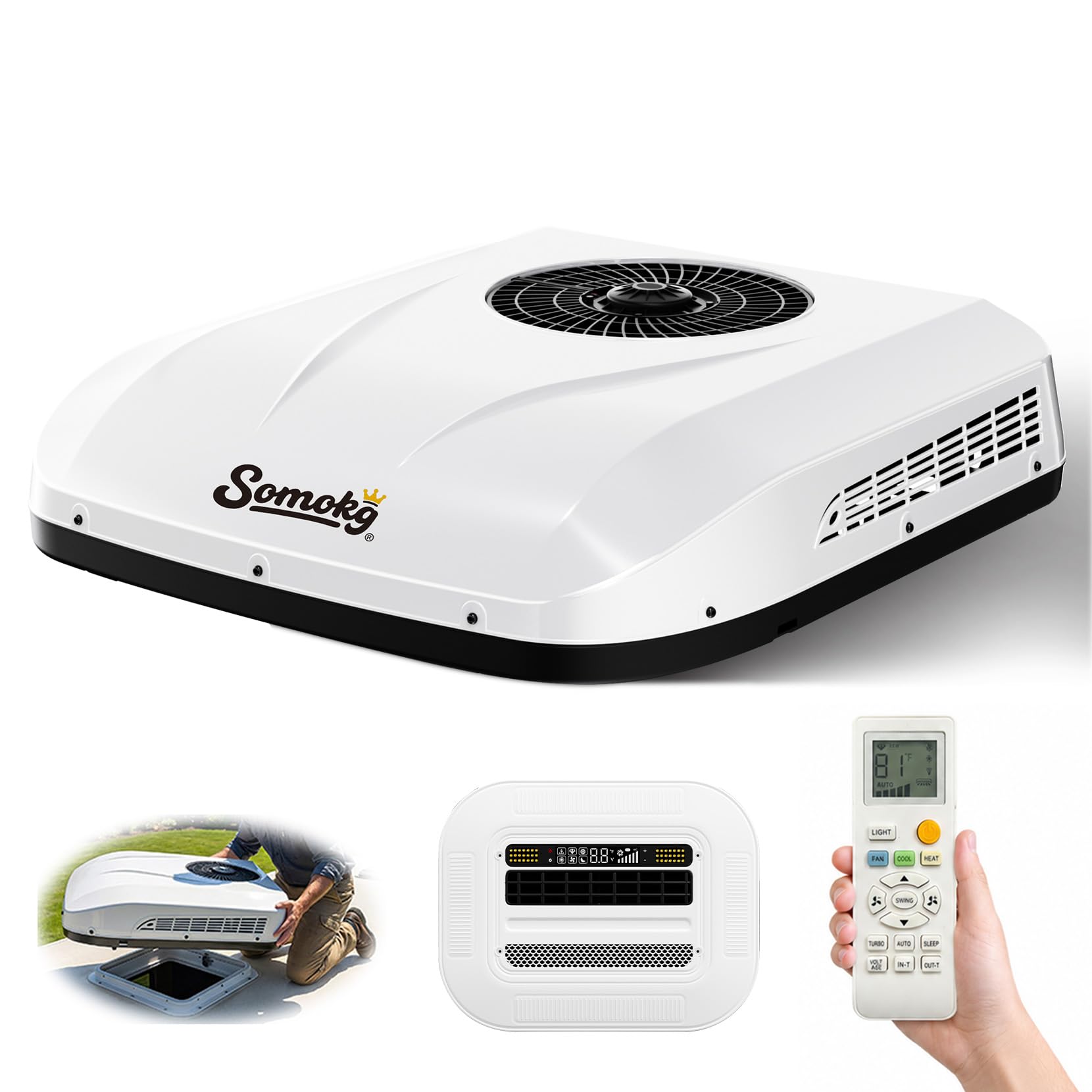
2. Somokg 11000 BTU 12V RV Air Conditioner with Heating
The off-grid all-rounder that cranks out 11,000 BTU of cool and 4,500 BTU of heat in a 43-pound package.
Most camping ACs are one-trick ponies that only cool, but this Somokg unit pulls double duty for year-round van life. It pushes a sturdy 11,000 BTU of cooling and switches to 4,500 BTU of supplemental heating when a frost rolls in, so the same rooftop box handles both a summer heatwave and a winter chill. At just 6.1 inches tall and 43 pounds, it is noticeably slimmer and lighter than the Gidrox above, which makes the DIY lift onto the roof far less intimidating.
The integrated soft start cuts startup surge by 70%, which protects your battery and extends the compressor’s life. On a 400Ah battery, owners get around 12 hours of cooling in ECO mode — enough for a full night plus morning coffee. It runs at just 35dB, which is quieter than the Gidrox’s 40dB Sleep mode, and the 360° adjustable vents spread the airflow evenly so you are not blasted in one spot. Buyers consistently praise how well it works and how easy the install is, with many calling it a better value than Coleman for boondocking.
Functionality is what wins people over — it is the most-praised aspect by owners, followed closely by installation ease. A few units arrived with a faulty fan board or an oscillating vent motor that broke, though the vendor’s responsive support replaced parts quickly. Plan for a thick-roof extension if your camper roof exceeds the standard depth, and you will have a dependable dual-season machine.
Off-grid verdict: the Somokg takes the crown for campers who want one rooftop unit that handles both sweltering summers and chilly shoulder-season nights, provided you carry at least a 300Ah battery.
3. Cybertake S2 Pro Portable Camping Air Conditioner
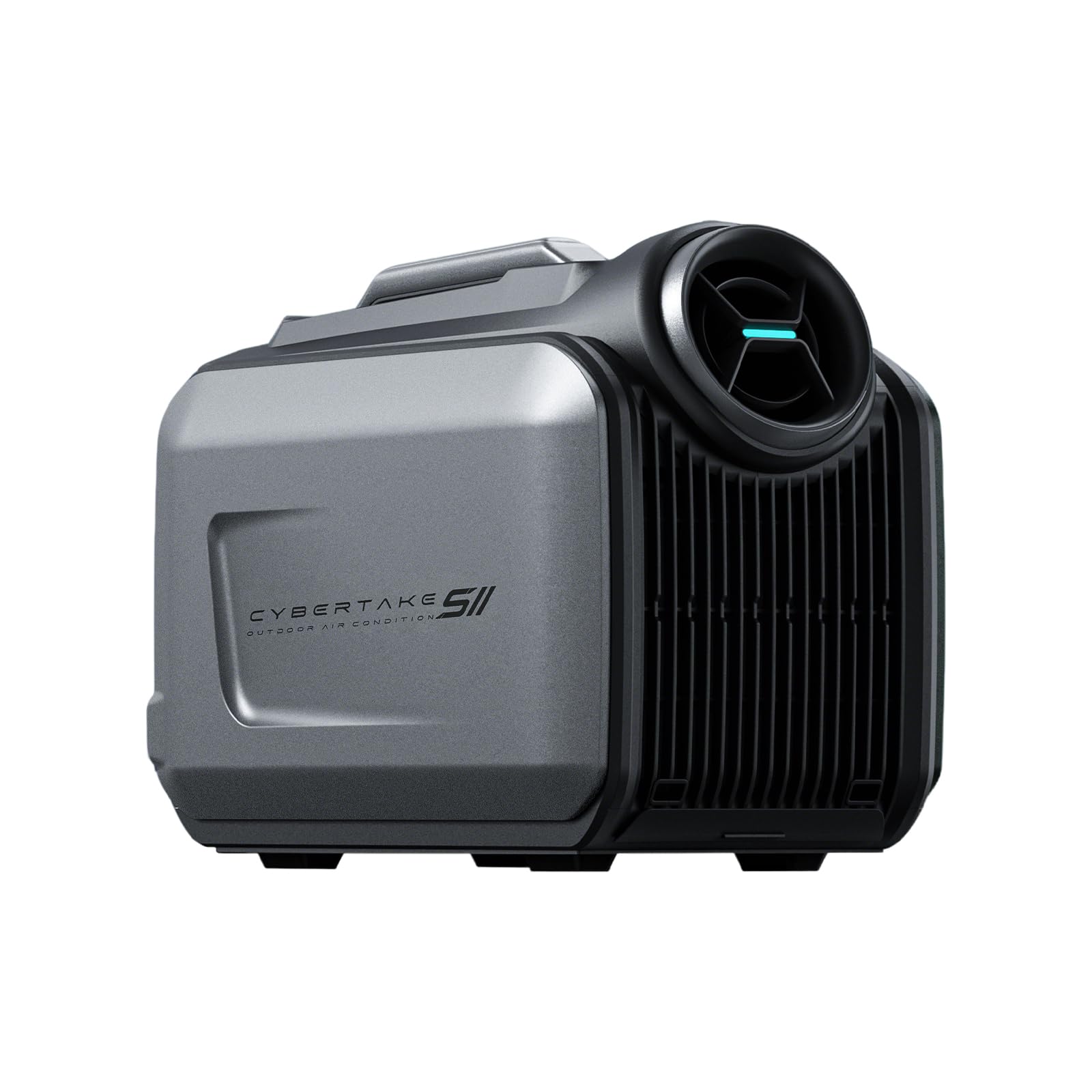
The featherweight 21-pound portable that cools tents or camper shells with three different power options.
This is the most flexible unit in the lineup because it accepts power from almost anything you own. You can plug it into a standard 100-240V wall outlet at home, tap a car or RV 12V/24V system, or feed it 48V DC from a portable power station. That kind of freedom means the same box cools your tent on a weekend trip and your cabin back home without needing a dedicated install. It pushes 5,100 BTU of cooling and 6,100 BTU of heating, enough to handle spaces up to 130 sq ft, and it drops the temperature down to a refreshing 60°F or warms it to 90°F.
Setup is genuinely instant — there is no roof cutout and no permanent mounting, just attach the hoses and plug it in. Owners highlight performance and low power consumption as the standout traits, with the Eco+ mode sipping as little as 1kWh per 8 hours of operation. The IPX4 water-resistant shell shrugs off splashes and rain, which is rare in this category and makes it a legit tent companion rather than a camper-only gadget. At 40dB it is quiet enough to sleep beside, and the compact size means it does not swallow your tent floor.
The honest catch is placement. This unit works best running from the outside of a tent or vehicle, venting the hot exhaust away from your sleeping space. Set up inside an SUV, the warm exhaust fights the cooling effect, and several owners noted the high power draw on MAX could drain a 2400W power station in about 5 hours. The app pairing is finicky — it is not on the Google Play store — and the remote control is sold separately, so factor that into your budget. For a tent camper who wants a true portable, this is the one to beat.
Why it clicks
- Three power inputs mean it works at home, in a car, or off a power station
- 5,100 BTU cool plus 6,100 BTU heat covers a full 130 sq ft
- IPX4 water-resistant shell survives rain and splashes
Where it stumbles
- Remote control and 12V-48V booster sold separately
- Inefficient when run entirely inside a vehicle
- App is not available on the Google Play store
Grab it for: tent campers and SUV sleepers who want one lightweight portable that adapts to whatever power source is available at the campsite.
skip it if: you expect to cool a large RV cabin — 5,100 BTU is sized for tight spaces, not wide-open campers.
4. Outohome 5200 BTU 4-in-1 Portable AC

A 31.9-pound spot cooler with a handy single-hand grip, built for tents and semi-truck cabs.
This is the budget-friendly entry point into camping ACs, slotting in well below the premium rooftop units while still offering genuine compressor-based cooling. Its built-in GMCC compressor pushes 5,200 BTU, which the maker claims can drop the temperature by 18°F in just 5 minutes. The adjustable range runs from 60°F up to 88°F, and rated power consumption stays under 400W per hour, so it plays nicely with a portable power station for a few hours of relief.
With dimensions of 22.4 inches deep by 11.2 inches wide and a 31.9-pound weight, it is noticeably more portable than the 59-pound rooftop units — small enough to carry one-handed via the built-in grip. It runs four modes (Cooling, Dehumidifying, Sleep, and Fan) all controllable by remote, plus a 24-hour timer for automatic shutdown. Below 70% humidity you can run it drain-free, which removes a whole chore from the camping routine.
What wins people over is how cold it blows in a small space — it brought a six-person tent down to a bearable temperature in the heat. The recurring reality check, though, is that it is strictly a spot cooler. Several owners found it ineffective in a shaded tent at 88°F and one reported it could not cool a pickup truck at the same temperature. The noise level of 46-50dB in Sleep mode is higher than both rooftop units, so you will hear it cycling through the night. Treat it as a targeted cooling tool for a tent or small camper room, and it earns its place.
Spot-cooling specialist: the Outohome is the right call when you need relief in one specific zone — a tent corner or a truck cab — rather than full-cabin climate control.
5. EcoFlow WAVE 3 Portable AC with Add-on Battery

The cordless 6,100 BTU powerhouse with a built-in 1024Wh battery for truly wireless off-grid cooling.
Every other unit on this list needs an external battery or a wired 12V connection, but the EcoFlow WAVE 3 packs its own power source. The integrated 1024Wh LFP (lithium iron phosphate) battery delivers up to 8 hours of cordless operation, so you can set it on the tent floor or truck bed and run it without any cables at all. When the battery runs low, the 1000W ultra-fast charging refills it in about 75 minutes from AC, a car outlet, or solar panels — making it the most self-contained option here.
The cooling muscle is serious for a portable: 6,100 BTU rated at 1800W of cooling power, which the maker claims drops the temperature 15°F in 15 minutes under extreme heat. It also heats with 2000W of real warmth, boosting 17°F at the vents within the same window. Owners praise the overall performance, with an HVAC-certified buyer noting it works exactly as a mini heat pump should — cooling about 20°F below ambient. It handles spaces from 120 to 180 sq ft, and the compact luggage-style 20-inch size with an ergonomic handle slips easily into an SUV or overlander.
The sticking point is honest battery expectations. An owner kept a 100 sq ft space cool through a 6-hour outage and still had 40% battery left, but a Florida trip with an insulated dog trailer drained the extended battery in just 2 hours. The manual’s 8-hour claim holds best in ECO mode with a well-insulated space, not a sweltering car interior. Duration and battery life are the most-discussed trade-offs, and there is no getting around the premium price tag. If you want zero wiring and the freedom to move cooling anywhere, this is the most polished option — just match your space and heat load to its real limits.
The self-contained pick: the WAVE 3 is for campers who refuse to mess with wiring and want a single box that cools, heats, and runs on its own battery, accepting that the premium cost and real-world runtime demands careful space sizing.
Understanding the Specs
BTU Cooling Power
BTU (British Thermal Units) is the standard measure of how much heat an air conditioner can remove in an hour. Higher numbers mean faster, stronger cooling in larger spaces. A 5,100 to 5,200 BTU unit suits a tent or small camper room, while a 10,000 to 11,000 BTU rooftop model is built for full camper vans and truck sleepers. Matching this number to your space is the single biggest factor in whether you sleep cool or toss and turn.
Power Draw in Watts
Your battery bank determines how long a camping AC can run, and the wattage draw tells you the real story. A unit pulling 400W per hour will drain a battery far faster than one sipping 350W in ECO mode. For 12V rooftop units, look at the amp draw — roughly 30A at full blast versus 15A in ECO is the difference between a short blast of cold air and a full night of sleep. Match the unit’s draw to your battery amp-hour capacity, and you will never wake up to a dead bank.
FAQ
Will a 12V camping air conditioner run all night on my RV battery?
What size tent can a 5,200 BTU portable air conditioner cool?
Can I run a camping AC directly from a portable power station?
What is the difference between a 12V DC rooftop AC and a 120V AC portable unit?
How many battery amp-hours do I need for a rooftop camping AC?
Are camping air conditioners with heating worth it?
How quiet is a camping air conditioner at night?
Can I install a rooftop RV AC by myself?
Final Thoughts: The Verdict
For serious RV and camper owners, the ac for camping winner is the Gidrox 10000 BTU Rooftop because its 350W ECO draw and rapid 3-minute cooling deliver dependable all-night comfort on a 400Ah battery. If you want both heat and cool in one slim rooftop unit, grab the Somokg 11000 BTU. And for tent campers who refuse to haul a heavy rooftop box, the Cybertake S2 Pro is the one to reach for with its three-way power flexibility and featherweight design.
How We Picked
We do not accept paid placement. Every pick is matched to a real buyer and a real use-case; we do not hands-on test units.
Sources & Methodology
Specifications: manufacturer listings and product documentation. Review insights: verified customer reviews, as of September 2026. Pricing: not shown on this page (it changes often); check the current price via the retailer link.
As an Amazon Associate, Gadgets Feed earns from qualifying purchases. This does not affect which products we feature.