
Our readers keep the lights on and my morning glass full of iced black tea. As an Amazon Associate, I earn from qualifying purchases.
Specs are compiled from manufacturer listings and verified buyer reviews and can change over time — please confirm the key details on the product page before buying.
You want a transformer that powers your landscape lights reliably for years, so focus on three things: leaving enough wattage headroom for future lights, picking a timer or sensor that fits your routine, and choosing a build that survives rain. This guide compares top mid-range and premium models so you can match the power source to your yard without overpaying or under-powering.
I’m Min — the founder and writer behind Gadgets Feed. This guide is built by comparing the manufacturers’ published specifications and the patterns across verified customer reviews, so you get each pick’s real strengths and trade-offs instead of marketing spin.
These are my picks for the 12 volt landscape lighting transformer worth your money today, chosen for reliable dusk-to-dawn control and clean 12V output.
Our Picks at a Glance
How To Choose The Best 12 Volt Landscape Lighting Transformer
The heart of any low-voltage lighting system is the transformer—it takes your home’s 120V power and steps it down to a safe 12V that runs your path lights and spotlights. Before you look at brands, you need to count the total wattage of every light you plan to connect, because that number sets the minimum size you should buy.
Calculate Your Wattage With Headroom
Every transformer has a rated capacity, like 200W or 300W. Professional installers stick to an 80 percent rule: never load a transformer past 80 percent of its rating, so a 300W unit is really suitable for about 240W of lights. This leaves room for voltage drop on long cable runs and keeps the unit cooler, which extends its life.
Pick the Right Timer and Sensor Combo
A photocell sensor turns lights on automatically at dusk and off at dawn, which is the most hands-off option. If you want lights off before dawn to save energy, look for a countdown timer that turns them off after 2, 4, 6, or 8 hours. Premium options let you control everything from a phone app instead of relying on a built-in clock.
Check the Voltage Taps for Long Runs
Basic transformers only output 12V. Higher-end units offer additional taps at 13V, 14V, or 15V. Using a higher tap on a long wire run compensates for voltage loss, keeping lights at the far end of your yard bright instead of dim.
Quick Comparison
| Model | Best For | Max Output | Voltage Taps | Timer / Sensor | Amazon |
|---|---|---|---|---|---|
| VOLT 300W Slim Line★ Best Overall | Pro-grade installs & long runs | 300W | 12V / 15V | Timer & Photocell | Amazon |
| DEWENWILS 200WSmart Value | Budget-friendly reliability | 200W | 12V / 14V | 5 Modes & Photocell | Amazon |
| GOODSMANN 120WCompact Pick | Small yards & simple setups | 120W | 12V | Clock & Photo Eye | Amazon |
| DEWENWILS 150W | Rust-proof stainless builds | 150W | 12V / 15V | Photocell & Countdown | Amazon |
| SUNVIE 200W | Weatherproof value | 200W | 12V | Timer & Photocell | Amazon |
| Malibu 200W Power Pack | Familiar & straightforward use | 200W | 12V | Sensor & Weather Shield | Amazon |
| Ring Transformer | Smart home app control | 200W | — | Ring App & Sidewalk | Amazon |
| SUNVIE 300W 2-Zone | Two independently timed areas | 300W | 12V / 14V | 5 Modes & Photocell | Amazon |
| Lightkiwi 300W | Multi-voltage flexibility | 300W | 12V / 13V / 14V / 15V | External (sold separately) | Amazon |
In-Depth Reviews
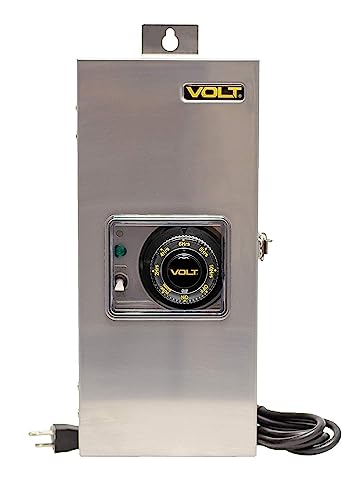
1. VOLT 300W Slim Line Low Voltage Transformer
Our pick — over 4.5★ from 350+ verified ratings; the strongest balance of quality and price.
The pro-level workhorse built to outlast your entire lighting system, backed for life.
If you want to install this once and never think about it again, this is the one. Owners describe quick, clean installations — the clamp-style terminals accept up to 10-gauge wire and lock in seconds, no screwdriver wrestling. One owner even reports being done in 15 minutes, and buyers report it delivers rock-solid 12 volt power that has been “working perfectly so far” for them.
The defining feature is the toroidal core (a donut-shaped magnetic core that runs cooler, quieter, and more efficiently than standard rectangular EI-laminated transformers). It adds five separate taps with 12V and 15V options, so you can run multiple lines in different directions and use the 15V tap to push power further down long runs without dimming the far lights. It delivers a huge 300W — a 2.5x gap over the GOODSMANN 120W — giving you room to expand later.
What wins people over is the build quality — the stainless steel enclosure, the built-in modular timer with a visible photocell, and the lifetime warranty that protects the core, enclosure, and components. The honest trade-off is the investment: it costs more than typical consumer units, and owners mention that for a small yard with just a few fixtures, you would be paying for capacity you won’t use.
Built to Last & Expand
- Lifetime warranty covers core and enclosure
- 5 taps with 12V/15V for long runs
- Quiet toroidal core runs cooler
Serious Investment
- Premium price tag for premium hardware
- More power than a small yard needs
Best for: homeowners planning a medium to large LED system who want one professional-grade unit with lifetime backing for the long haul.
Think twice if: you only have a handful of lights under 100W — a smaller unit saves money without sacrificing performance.
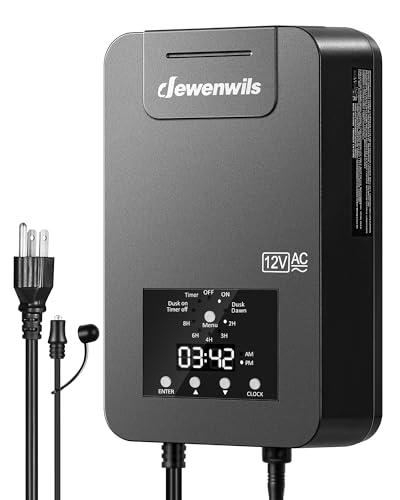
2. DEWENWILS 200W Low Voltage Transformer
A feature-packed 200W unit with a removable photocell that mounts where it sees the sky best.
This DEWENWILS delivers serious functionality for the price, and the cleverest detail is its removable photocell sensor (a light-sensitive switch that turns lights on at dusk). It comes on a 6.8-foot cord, so you can mount the transformer in a garage or under an eave while the sensor sits outside where it can actually see the sunset — solving a problem many fixed-sensor units have.
You get five setting modes — Manual ON/OFF, Dusk to Dawn, Dusk ON with a countdown off after 2/3/4/6/8 hours, and timer options — all controlled through a clear LED screen and simple buttons. It steps 120V AC down to 12V or 14V AC, giving you that higher tap for longer wire runs.
Reviewers call it reliable — one notes it has been “working great” for almost a year. The recurring gripe is the instruction manual, which owners say could be clearer about which terminal to use; if you’ve never wired a transformer before, budget a few extra minutes to study the diagram.
Flexible & Feature-Light on Price
- Removable photocell on a 6.8ft cord
- 5 modes with countdown timer options
- Built-in circuit protection with reset
A Few Setup Tangles
- Instructions need to be clearer
- Heavy unit — plan a solid mount
Reach for this if: you want the flexibility to install indoors while keeping the light sensor outdoors — rare at this price.
Look elsewhere if: you want a self-explanatory manual; first-time DIYers may find the wiring guide too thin.
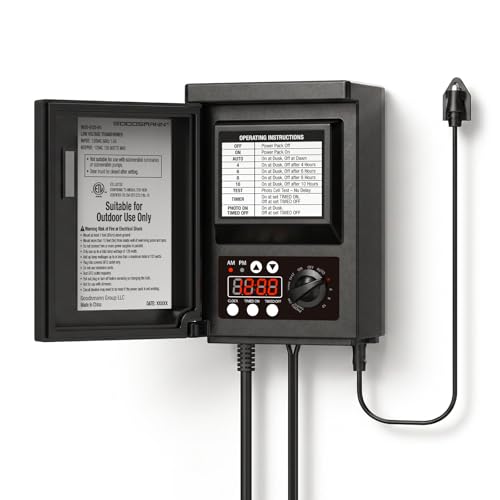
3. GOODSMANN 120W Outdoor Lighting Transformer
A tidy 120W box with a real clock timer, ideal for swapping out a failing transformer one-for-one.
GOODSMANN keeps things refreshingly simple — no app, no complexity — just a built-in clock that turns your lights on and off at whatever times you set, or on at dusk and off 4/6/8/10 hours later. That flexibility is why it stands out: owners who replaced clunky 20-year-old systems often praise the digital timer as a major upgrade.
At 120W it’s the smallest unit here, and that’s the point. For a typical home with a few path lights and spotlights, this is genuinely enough, especially since LED bulbs draw so little. One owner notes their 10 lights with a 75-foot run only draw about 30W, leaving plenty of headroom. And it works with halogen, incandescent, and LED fixtures alike, so it’ll pair with whatever you already own.
What wins people over is ease of use, and the magnetic front door protects the controls from sun and rain. But reliability is the most-discussed concern — a noticeable share of customers note sensor or timer failures, and several praise GOODSMANN’s customer service for replacing failed units quickly. Buy it knowing support is responsive, but treat it as a solid mid-tier value rather than a set-and-forget premium unit.
Real-world read: the tiny footprint and simple clock make it an easy DIY swap, but the durability chatter means it’s not the one to leave in a harsh coastal environment.
Best matched to: small to medium yards where you want straightforward timed control without paying for smart features.
4. DEWENWILS 150W Stainless Steel Transformer
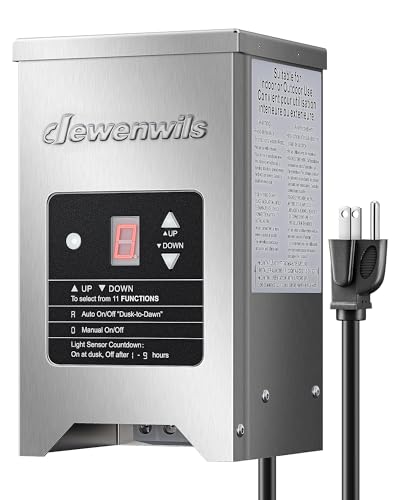
Heavy-duty stainless steel that shrugs off rust, wrapped around a simple two-button interface.
If your transformer lives near the coast or in a wet climate, the housing is the first thing to fail — and this DEWENWILS answers that with a proper anti-rust stainless steel body. Owners who’ve had units running up to 12 months consistently call out the quality, the build, and the brightness of the lights it drives.
Under the hood it steps 120V AC down to 12V or 15V AC, and that 15V tap is your answer to a long, heavily-loaded wire run. The interface is refreshingly simple — just ▲▼ buttons that cycle through Always On, Auto (dusk to dawn), Countdown (off after 1 to 9 hours), and Off. One owner notes the bright red LED display is easy to read at night.
The standout support story here: when one unit failed after 30 days, the company honored its 1-year warranty and had a replacement out within 24 hours. That kind of response builds real trust. The one functional complaint is minor — there’s only one 12V port, so owners running two separate 12V lines wish there were more.
Why it earns a spot: the ETL-listed (third-party safety certified) stainless build plus a responsive support team makes it a low-anxiety pick for exposed mounting.
The single limit: just one 12V tap means multi-circuit layouts need creative wiring.
5. SUNVIE 200W Landscape Lighting Transformer
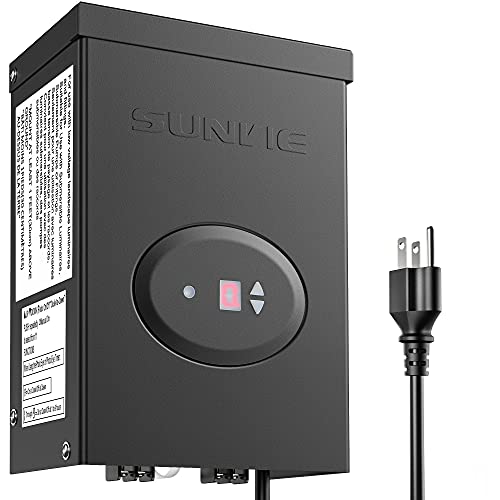
An IP65 waterproof 200W unit that keeps two separate 12V circuits humming quietly for years.
SUNVIE nails the essentials with an IP65 rating (effectively sealed against dust and low-pressure water jets) and a corrosion-resistant metal housing, so outdoor wall mounting is genuinely low-maintenance. Reviewers report powering 13 low-voltage lights for a year without a hiccup, and the dusk-to-dawn cycle’s reliability gets consistent praise.
It converts 120V AC to a safe 12V AC and gives you two sets of 12V output terminals, so you can run two separate circuits in different directions. The built-in timer and photocell offer the usual AUTO mode (dusk on, dawn off) plus a countdown mode that shuts lights off 1 through 9 hours after dusk — solid energy-saving flexibility with simple ▲▼ buttons.
The toroidal core (a donut-shaped magnetic core) runs more efficiently and more quietly than laminated transformers, and the whole unit is ETL-listed (safety-certified by a recognized lab). One planning note from owners: the light sensor is built into the housing, so the transformer must be mounted outside in direct light to sense dusk — if you wanted to hide it in a garage, this one won’t work for you.
Sealed & Serene
- IP65 waterproof metal housing
- Quiet, efficient toroidal core
- Two independent 12V output circuits
Sensor Constraints
- Must mount outside for the photocell to work
- No 15V tap for very long runs
Best for: straightforward outdoor mounting where weatherproofing matters and you want two separate circuits from one box.
Pass if: you need a high-voltage tap to fight dimming over very long distances.
6. Malibu 200 Watt Power Pack

The long-running name in landscape lighting, with a weather shield that protects its flip-up controls.
Malibu has been a fixture in low-voltage lighting for decades, and this 200W power pack is the familiar, no-nonsense option that many DIYers reach for first. Owners call it the easiest transformer they’ve used — the setup is straightforward, and the front cover protects the buttons and lettering from sun damage, which is a detail that matters for outdoor longevity.
It delivers up to 200W of 12V AC output with those classic modes: dusk-to-dawn, dusk-to-timed-off (4/6/8/10 hours), always on/off, or a fully custom on/off time. The built-in circuit overload protector adds a layer of safety. The manufacturer’s guidance is important here: total connected wattage should not exceed 75% of the transformer’s rating, so keep your light load under 150W.
The honest caveat from owners is durability — a notable share report units failing within months, though others say theirs ran for years. One owner successfully revived a 5-year-old unit with a reset button and a clean photo eye, and switching to LED bulbs (which draw far less) is the common tip for extending its lifespan. It’s a solid, easy pick, but not the one to choose if you demand ironclad longevity.
Why it’s loved: ease of installation is the dominant praise — owners who’ve owned multiple transformers consistently rank this one simplest.
The caveat to respect: treat it gently and keep the load light; longevity is the trade-off for that simplicity.
7. Ring Transformer for Smart Lights
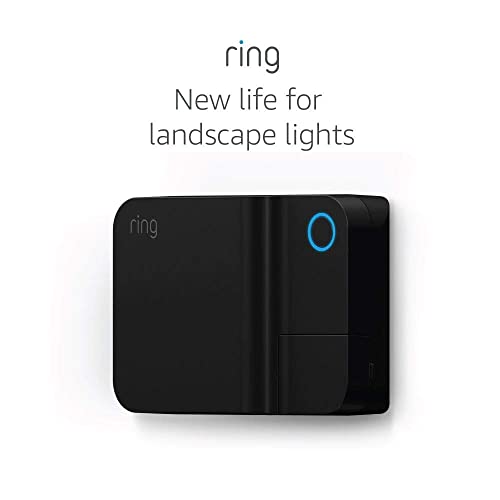
The bridge that makes your existing landscape lights obey your phone, not just a photocell.
This one is different by design: it’s not just a power supply but a smart hub that connects your non-Ring low-voltage lights to the Ring app. Once wired in — up to 200W of lights — you control everything from your phone: schedules, on/off, and syncing with other Ring devices like doorbells and cameras. It’s the obvious upgrade when an old dumb transformer finally dies and you’re already in the Amazon ecosystem.
Setup is genuinely fast — reviewers point out a roughly 2-minute install and smooth integration. The scheduling is astro-based (sunrise/sunset calculated for your precise location), which owners say beats the inaccurate photocells on their old Intermatic units.
Quality is the most-cited strength, and the compact matte black housing is rated weather-resistant, so it works indoors or out. The trade-offs are real but specific: owners note the wire terminals fit only one set of connections, so this suits a single circuit, and it requires surface mounting — there’s no plug-in option. The app connectivity gets mixed feedback, with occasional bridge connection hiccups reported.
Phone-First Control
- Astro-accurate dusk scheduling via app
- Integrates with Ring devices & Alexa
- Compact weather-resistant design
Ecosystem Limits
- Terminals fit only one wire circuit
- Requires surface mounting, no plug-in
Choose this if: you already use Ring or Alexa and want app control over an older lighting system without replacing every fixture.
skip it if: you want a standalone timer that doesn’t depend on WiFi or a smart home app.
8. SUNVIE 300W 2-Zone Transformer

A 300W powerhouse that runs two lighting zones on completely separate schedules from one box.
This is the answer for lighting layouts that need two different personalities — say, path lights that stay on all night in the front yard, while backyard entertaining lights cut off at 11 p.m. The dual-zone design lets you set independent modes for each zone with a dedicated button, all within a single 300W unit stepping 120V AC down to a safe 12V or 14V AC.
Another smart touch: the photocell sensor is external and comes on a 6.8-foot UL-listed cord. That means you can mount the transformer indoors or in a sheltered spot while the sensor sits outside to see the actual dusk light — a flexibility owners highlight. You get five modes total — Manual, AUTO (dusk to dawn), Countdown (off after 4/6/8 hrs), Timer, and Photocell-on-Timer-off — which covers nearly every lighting habit.
Quality and ease of installation are the dominant praises here, and it’s noted as a far more affordable route to 300W of capacity than some premium brands. The reliability picture is mixed though — a meaningful share of shoppers say failures around the two-month mark or erratic behavior later, though SUNVIE’s support team is repeatedly described as responsive, sending replacements promptly under the 12-month warranty.
The real appeal: two independently controlled zones plus an external sensor make it the most flexible layout tool at this capacity.
The honest caveat: reliability reports are split, so lean on the responsive warranty and test it early.
9. Lightkiwi 300W Multi-Tap Transformer
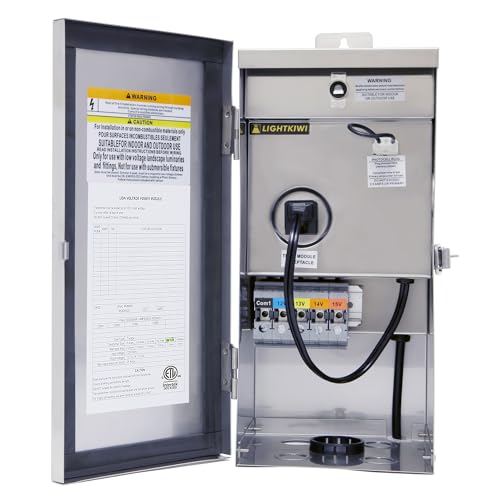
Adjustable 12V to 15V taps in a 17.5-pound stainless cabinet built for serious, long-run layouts.
When your wire runs stretch hundreds of feet, voltage drop is the enemy — and Lightkiwi gives you the cure with four selectable output taps: 12V, 13V, 14V, and 15V AC. Buyers report powering 32 LED lights across distances from 6 to 400 feet by mixing taps and wire gauges to keep brightness uniform. It’s the most flexible voltage tool here.
The 17.5-pound unit uses a high-performance toroidal core (that quiet, efficient donut-shaped transformer), and it’s the heaviest, most industrial-feeling option in the lineup. Owners describe a well-made stainless cabinet with a secure latch and a removable door, and it’s weathered two years of outdoor exposure while still looking new. It also has dual protection — an auto-reset thermal breaker plus a 25A magnetic circuit breaker — for defense against surges and overloads.
What wins people over is the industrial build and the ability to fine-tune voltage per circuit, all at a price buyers call excellent value. Two caveats stand out: there’s no built-in timer or sensor (buyers add one separately or use a smart plug), and it outputs AC — not DC — so it won’t drive some LED fixtures that require DC power.
Serious Voltage Flexibility
- 4 taps (12V-15V) for long, uneven runs
- Dual circuit breakers for protection
- Industrial stainless build that lasts
Requires Add-Ons
- Timer and photocell sold separately
- AC output won’t run some DC-only LEDs
Ideal for: complex yards with long distances and mixed light types where adjustable voltage per run makes the difference between dim and bright.
Not for: owners who want an all-in-one box with a built-in timer, or who have DC-only LED fixtures.
Understanding the Specs
Wattage Capacity & The 80% Rule
The wattage rating tells you the maximum load the transformer can safely feed, but you shouldn’t push it that far. The safe working limit is about 80% of the rated capacity — so a 200W unit is really meant for up to 160W of lights, and a 300W unit for up to 240W. Leaving that headroom keeps the unit cooler, reduces strain, and lets you add a few more lights down the road without buying a new transformer.
Voltage Taps
Voltage taps are the different output terminals on the transformer, usually labeled 12V, 13V, 14V, and 15V. As electricity travels down a long wire, it loses strength — that’s voltage drop — which makes lights at the far end dimmer. Using a higher tap (like 15V) on a long run compensates for that loss. Budget units only offer 12V, while premium multi-tap units let you match the voltage to each circuit’s length.
Photocell Sensors and Timers
A photocell is a light-sensitive sensor that turns the lights on when it gets dark and off when the sun rises — the classic dusk-to-dawn operation. Timers add scheduling flexibility: countdown timers shut lights off a set number of hours after dusk, while clock timers turn them on and off at specific times you pick. Smart transformers replace these with app-controlled astro timers that calculate your exact sunrise and sunset.
Toroidal Core
A toroidal core is a donut-shaped magnetic component inside the transformer, as opposed to the older rectangular EI-laminated design. Toroidal cores run more efficiently, generate less heat, hum less audibly, and produce less electromagnetic interference. It’s the sign of a higher-grade transformer and worth seeking out if yours will run near a patio or window where hum and heat matter.
FAQ
What size transformer do I need for my LED landscape lights?
What does the 15V tap do and when should I use it?
Can I install a low voltage transformer indoors?
What is the difference between 12V AC and 12V DC for landscape lights?
How long should a landscape lighting transformer last?
Why do my lights flicker or dim at the end of the wire run?
What does it mean when a transformer is ETL listed?
Can a smart transformer connect to my existing landscape lights?
Final Thoughts: The Verdict
Across the board, the 12 volt landscape lighting transformer winner is the VOLT 300W Slim Line because the toroidal core, five taps, and lifetime warranty make it the one install you’ll never revisit. If you want app control from your phone, grab the Ring Transformer. And for a budget-friendly 200W that covers most yards with real feature depth, the DEWENWILS 200W is the one to reach for.
How We Picked
We do not accept paid placement. Every pick is matched to a real buyer and a real use-case; we do not hands-on test units.
Sources & Methodology
Specifications: manufacturer listings and product documentation. Review insights: verified customer reviews, as of September 2026. Pricing: not shown on this page (it changes often); check the current price via the retailer link.
As an Amazon Associate, Gadgets Feed earns from qualifying purchases. This does not affect which products we feature.