
Our readers keep the lights on and my morning glass full of iced black tea. As an Amazon Associate, I earn from qualifying purchases.
Specs are compiled from manufacturer listings and verified buyer reviews and can change over time — please confirm the key details on the product page before buying.
If you rely on 18650 or 21700 cells for flashlights, vape mods, or cameras, the charger you pick decides how long those batteries last and how safe they are to use. A poor charger can undercharge, overheat, or permanently damage a 3.7V lithium cell, so this guide zeroes in on the safety and current-control features that prevent those failures.
I’m Min — the founder and writer behind Gadgets Feed. This guide is built by comparing the manufacturers’ published specifications and the patterns across verified customer reviews, so you get each pick’s real strengths and trade-offs instead of marketing spin.
Finding the right 3.7 volt battery charger means matching it to your cells’ size, your need for speed, and the safety features you expect.
Our Picks at a Glance
How To Choose The Best 3.7 Volt Battery Charger
Before you buy, check what your batteries are actually made of. A 3.7V lithium-ion (Li-ion) cell needs a specific charging profile, and so does a 1.2V nickel-metal hydride (NiMH) one. Some chargers handle both, but the current they deliver can vary greatly by chemistry.
Check Bay Count and Size Compatibility
Count how many batteries you charge daily. A two-bay unit covers an everyday flashlight user, while an eight-bay model suits someone managing a collection. Length and diameter matter too, since some bays are physically too short for cells like the 26650 or protected 21700.
Look for Adjustable Current
Small cells (like 10440 or RCR123A) can overheat if forced to accept 2A. A charger with selectable current lets you drop to 0.5A for delicate cells and use 2A or 3A for large 18650s. Selectable current is the top feature for extending battery lifespan.
Understand the Display
A basic LED shows red (charging) and green (full), which is enough for many buyers. An LCD that reports voltage, current, and capacity is far more useful if you want to verify whether a battery is genuinely holding its rated charge or is past its prime.
Safety Protections
Protection against overcharge, short circuit, reverse polarity, and 0V activation (reviving over-discharged cells) should be non-negotiable. These protections cut power on fault, preventing swollen cells and fire hazards.
Quick Comparison
| Model | Best For | Bay Count | Max Charge Current | Input Port | Amazon |
|---|---|---|---|---|---|
| Swanlake LCD 2-Bay★ Best Overall | Display-driven everyday charging | 2 | 2 A | USB-C | Amazon |
| Dlypow Universal 2-BayBest Value | Budget travel companion | 2 | 1 A | Micro USB | Amazon |
| Tenergy TN471U | Compact portable LCD charging | 2 | 1 A | Micro USB | Amazon |
| IMREN 26650 K2 | Fast 2A dual-slot charging | 2 | 2 A (2000 mA) | USB-C | Amazon |
| XTAR VC4SL | Capacity testing and grading | 4 | 3 A | USB-C | Amazon |
| MIEKLALE S8 | High-volume household charging | 8+2 | 4 A (shared) | Barrel Jack (12V) | Amazon |
| XTAR VC8 | Heavy-duty productivity and grading | 8 | 3 A | USB-C | Amazon |
In‑Depth Reviews
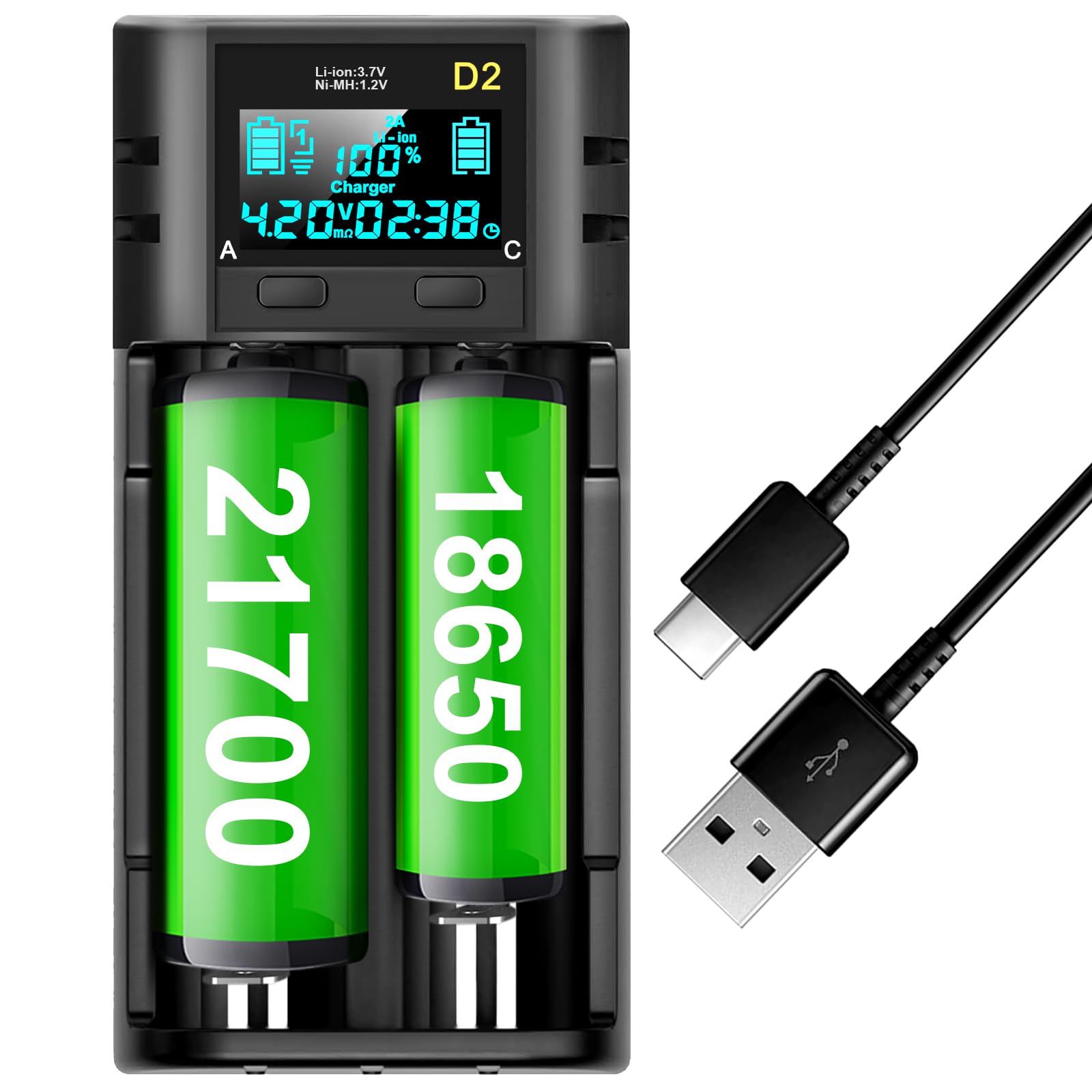
1. Swanlake LCD Display 2-Bay Charger
Our pick — over 4.5★ from 200+ verified ratings; the strongest balance of quality and price.
A 2-bay charger with a large LCD that displays real-time voltage, current, and charge percentage.
What wins people over is the way it balances genuine utility with approachable simplicity. The large LCD screen reports charging voltage, current, charging time, and the battery’s power percentage, so you can watch a cell climb from empty to full without guesswork.
Buyers report that a rechargeable cell pulled from an old yard-sale dog trimmer went to 100% in 3 to 4 hours, which points to real-world pacing you can plan around. It handles two batteries at once in independent slots, meaning a 21700 and an AA can charge side by side without one interfering with the other.
The adjustable current is the standout feature: you can select 0.5A, 1A, or 2A for lithium cells (NiMH is locked to 0.5A). That flexibility makes it safe for both fragile 10440 cells and high-capacity 26650s, and the UL certification adds a layer of safety assurance to the PC+ABS fire-resistant shell. It’s note this charger is UL-specified but runs on a 2A input, so pair it with a capable adapter for full speed.
What Earns the Top Spot
- Large screen shows voltage, current, time, and percentage in real time
- Adjustable 0.5A/1A/2A current protects small and large cells alike
- Two independent slots charge mixed battery sizes simultaneously
Honest Limitations
- Charges only two batteries at a time, not ideal for large collections
- NiMH cells are capped at 0.5A regardless of your setting
Your best move: This is the charger to buy if you want a clear read on every charge cycle without paying a premium.
Think twice if: You routinely charge more than two cells at once, in which case a four- or eight-bay unit makes more sense.
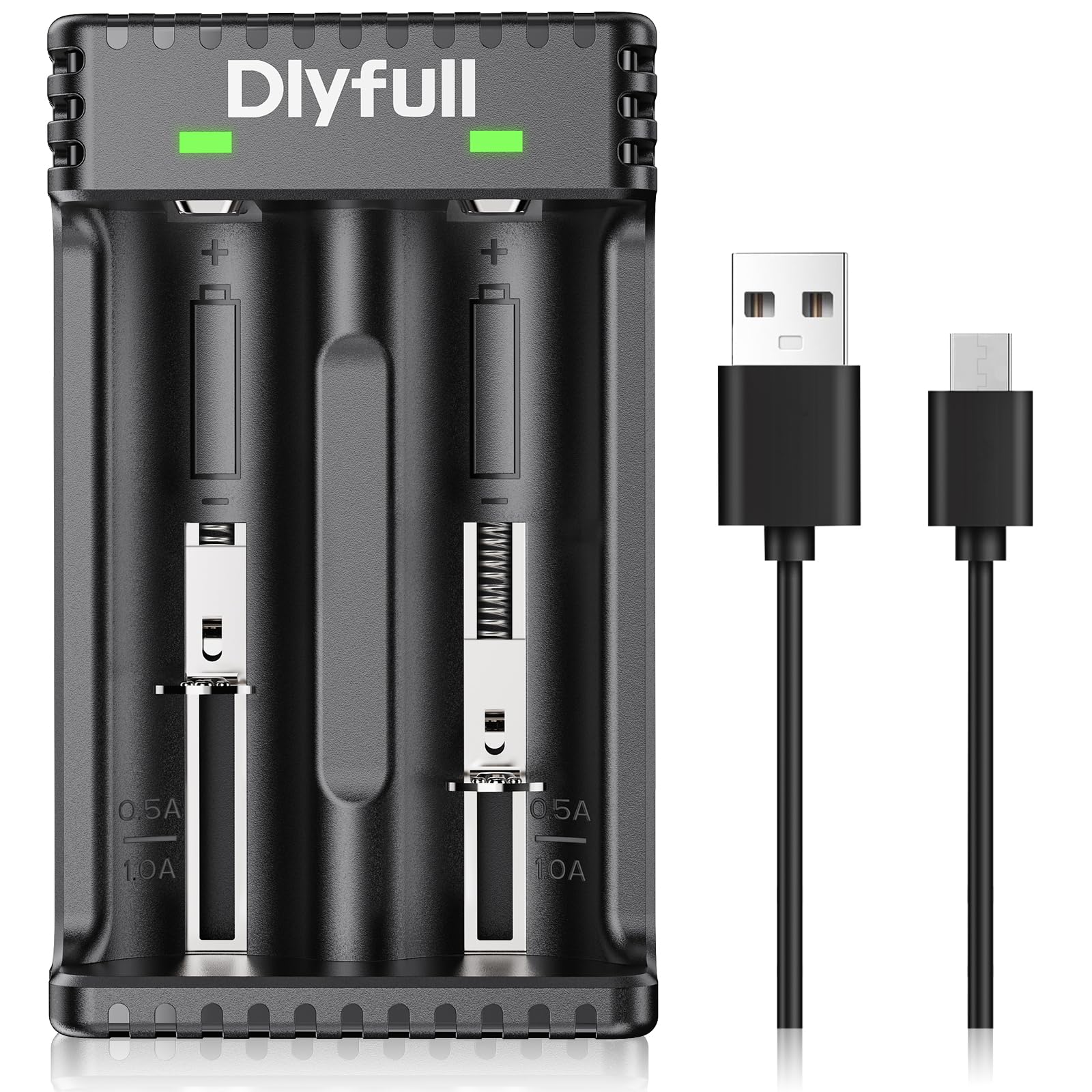
2. Dlypow Universal 2-Bay Charger
A 60g, budget-friendly 2-bay charger that handles 18650 and AA cells with built-in safety protections.
Weighing just 60g, this is the pick for a travel kit or a desk drawer where space is tight. It handles 18650, 14500, and RCR123A lithium cells plus AA, AAA, and C NiMH cells, which makes it the rare charger that genuinely does fit most of a household’s battery needs in one small body.
The strength here is the simplicity of its safety suite. Overcharge, short-circuit, and reverse-polarity protection are all built in, along with 0V activation to coax a deeply discharged cell back to life. Individual LEDs per slot show red for charging and green for full, so a glance tells you everything.
Owners mention it charges 2x 18650 batteries simultaneously and works well for gimbal batteries during video shoots, with a typical draw around 11W. The recurring wish is that it used USB-C instead of Micro USB — a fair complaint given that most phones now charge via USB-C, though the included cable keeps you going either way. It’s certified to FCC standards for safety.
Smart-buy read: The thing everyone raves about is how well it works for the money — functionality and solid build quality lead the feedback, with good charging capacity for different cell sizes.
Fit note: A handful of customers note compatibility quirks with 2/3 AA and 3.6V 21700 cells, so it’s best for standard 18650 and AA sizes.
Reach for this if: You want one featherweight charger that covers lithium and nickel cells for travel or casual home use.
Look elsewhere if: Your main battery is a 21700 or you strongly prefer USB-C cables, since this unit sticks with Micro USB.
3. Tenergy TN471U 2-Bay Universal Charger

A 2-bay charger that auto-detects Li-ion vs. NiMH chemistry and sets the correct voltage.
Tenergy’s smart charger reads the battery chemistry and sets the right charge voltage automatically, which is a genuine time-saver if you juggle both 3.7V Li-ion cells and 1.2V NiMH cells. Reviewers point out it charged a 3.7V 18650 Li-ion quickly with no issues, and the LCD screen tracks charging time, voltage, and progress in real time.
What impresses most is its compatibility list: it spans 18650, 26650, 18490, 18350, 17500, 14500, 10440, AA, and AAA sizes, making it one of the broader two-bay options here. At just 130g, it’s also light enough to travel, and the ability to power it from a USB port means you can charge from a laptop, car adapter, or power bank.
There’s a real trade-off to know about: durability feedback is mixed, with some owners reporting units that broke within days or died after about 35 days of use, often tracing back to the delicate Micro USB port. Using only the included cable and plugging it in gently seems to be the key to longevity — one owner’s second unit worked flawlessly for daily charging of one or two batteries. It ships with FCC and RoHS certifications and a one-year warranty.
Why it earns its spot: The auto-detect chemistry feature and broad size compatibility cover more ground than most two-bay competitors in the mid-range.
Honest caveat: The fragile Micro USB input is the recurring gripe — treat it gently and stick to the bundled cable.
Best for: Someone who wants automatic chemistry detection and LCD voltage readouts without stepping up to premium pricing.
Who should skip: Heavy daily users who need a unit that survives rough handling, since the port is the weak point here.
4. IMREN K2 26650 Charger
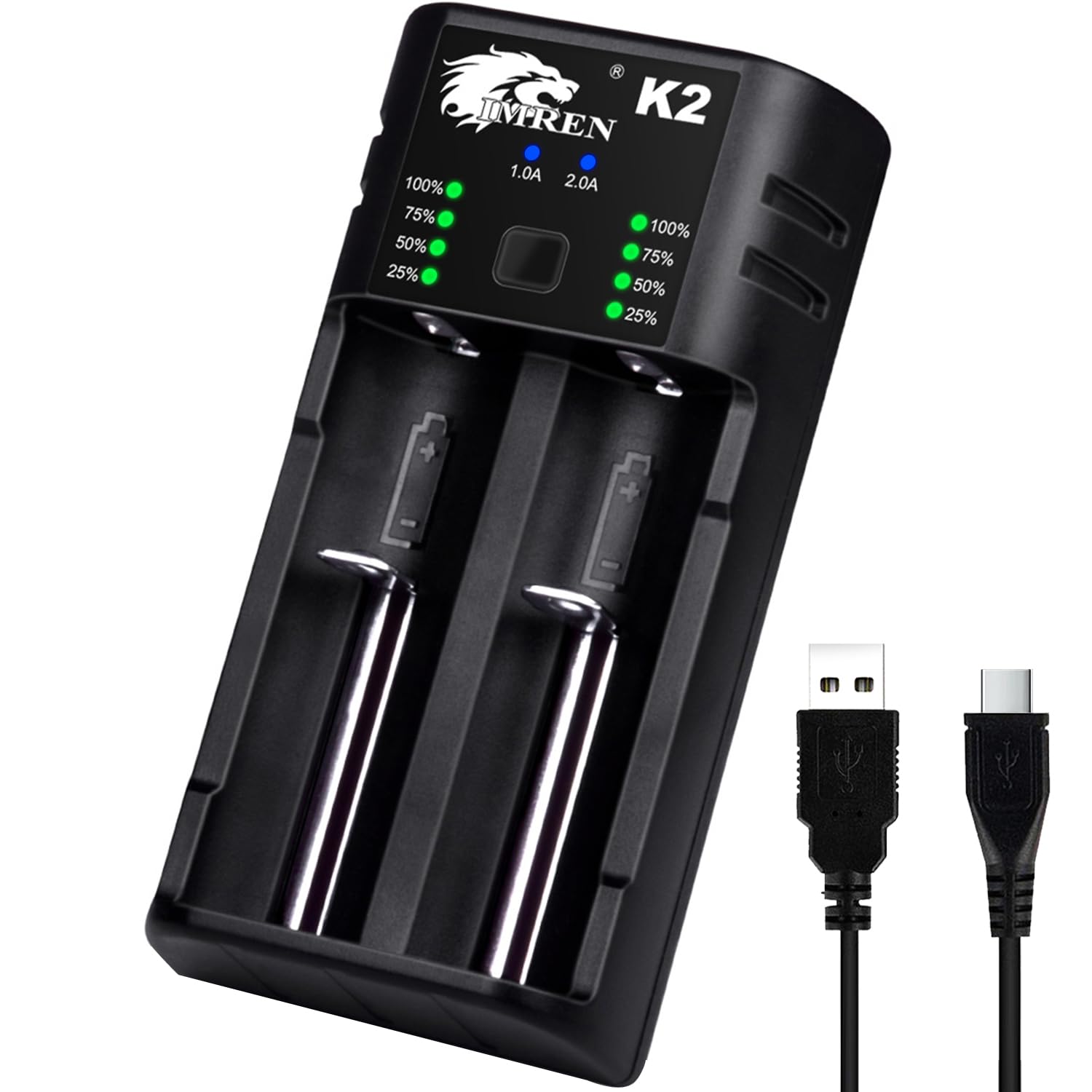
A 2-bay charger with wide 25mm slots and a 1A/2A switch for fast 26650 charging.
This charger’s claim to fame is its wide 25mm bay centers, which let you charge two 26650 batteries at the same time — a capability many standard chargers simply don’t offer. It’s also USB-C powered, so you can run it from a wall adapter, car charger, or power bank for portability.
The headline feature is the current switch: press the middle button and it jumps between 1A (1000mA) slow charge and 2A (2000mA) fast charge. That 2A mode cuts charge time meaningfully for high-capacity cells, which is why shoppers say getting a full bike-light battery overnight with no hassle. The full compatibility list covers 10440 through 21700 and 26650, plus Ni-MH and Ni-Cd A/AA/AAA/AAAA sizes.
The catches are real but manageable. The amp setting resets to 1A every time, so you must manually switch to 2A for larger cells — an easy thing to forget. And the build uses cheaper components, with one owner noting it feels fragile if dropped and has a loud spring. Buyers report a clear display and the ability to handle multiple battery types, with value for money being the most-praised aspect.
Why It Stands Out
- Wide 25mm bays charge two 26650 cells simultaneously
- One-button switch between 1000mA and 2000mA charging
- USB-C input works with wall, car, and power bank sources
What to Watch
- Amp setting resets to 1A after each use, requiring manual switching
- Build feels less rugged than premium rivals, with a loud spring mechanism
Grab it if: You own 26650 cells or want a genuinely fast 2A charge from a USB-C powered unit.
Pass it by if: You need a rugged daily driver, since the components here favor price over durability.
5. XTAR VC4SL 4-Bay Smart Charger

A 4-bay charger with capacity grading and internal-resistance testing to identify weak cells.
This is the pick for buyers who treat batteries as a serious investment. Its standout feature is grading mode, which tests a cell’s real capacity through a charge-discharge-recharge cycle, exposing batteries whose advertised specs are overstated. It also measures internal resistance via the IR display mode, giving you a health check on every cell you own.
The VC4SL charges four bays independently with manual current control from 0.25A up to 3A for a single slot when paired with a QC3.0 adapter. That flexibility means you can trickle-charge a fragile 10440 at 0.25A or fast-charge a 21700 at 3A, whichever suits the cell. The colorful VA LCD screen offers a 170° viewing angle, so you can read voltage, current, and capacity from across the room.
0V activation is built in to revive most over-discharged batteries, and it handles protected 21700 cells that many chargers reject. Note that charging performance gets mixed feedback — some call it blazing fast while others find specific modes slow — and the unit needs a quality USB-C PD cable and power brick to hit its advertised rates. An occasional unit arrives with screen quirks, though XTAR’s customer service is known for making it right.
Why enthusiasts choose it: Capacity grading and internal resistance testing turn a charger into a diagnostic tool, and charging capability is the most-praised feature in owner feedback.
Fair warning: You’ll need a quality QC3.0 adapter to open up 3A speeds; weak power bricks can cause erratic behavior.
This is for: The owner who buys batteries in bulk and wants to verify real capacity or revive old cells rather than toss them.
Not for: Beginners who just want a battery to charge without settings, or anyone without a decent QC3.0 wall adapter.
6. MIEKLALE S8 8+2 Bay Charger
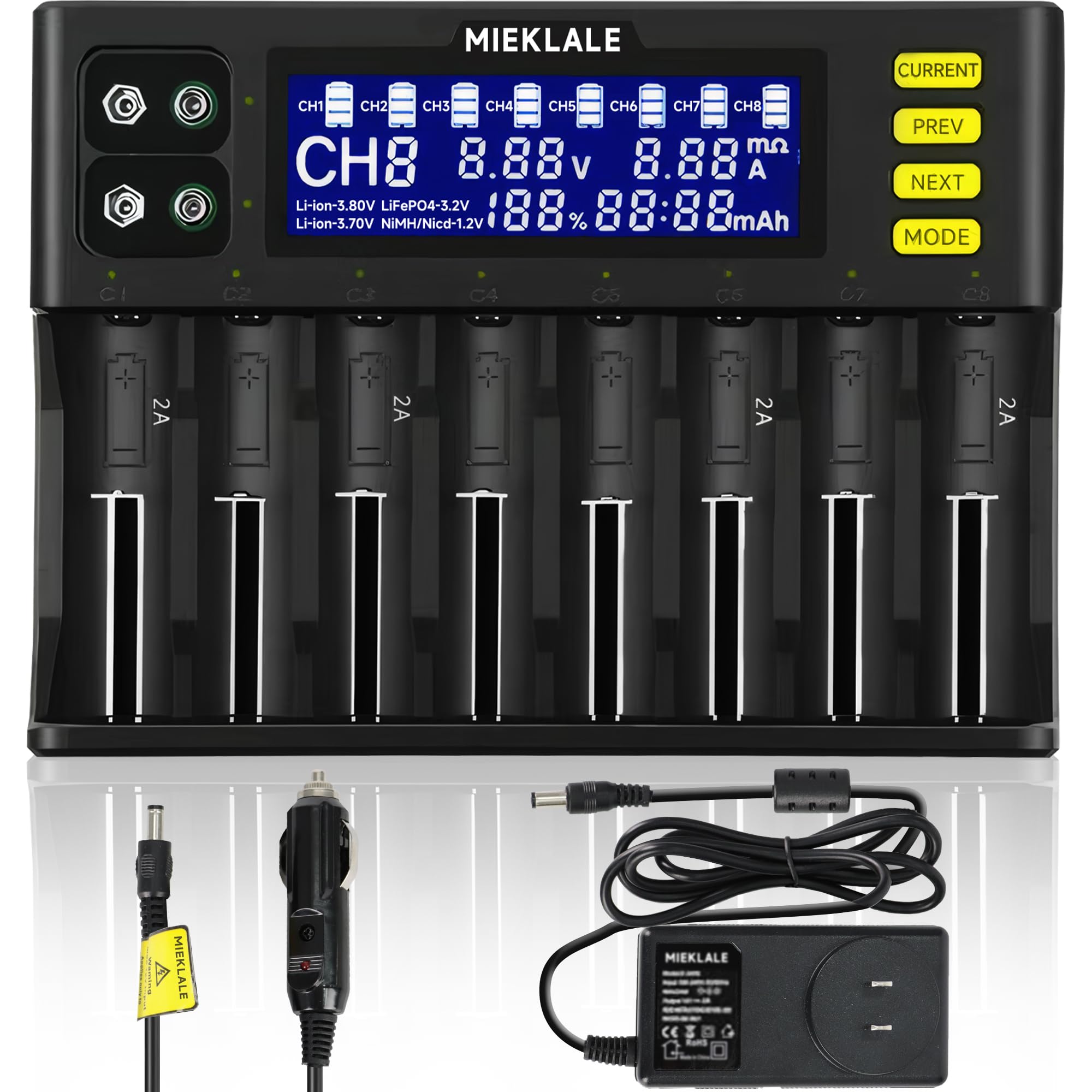
The household hub that swallows a week’s worth of drained cells in one go.
If your household runs on rechargeable batteries, this is the endgame. It offers eight standard slots plus two dedicated 9V bays, for ten total cells at once, and handles cells up to 72mm in length — which covers most 18650 and 26650 sizes, plus LiFePO4, RCR123, 9V, NiMH, and NiCd chemistry. The included 12V/4A power adapter and car power cable mean you can run a full charging session from a wall outlet or your vehicle.
Speed is a genuine strength here. With 2A current available across multiple channels simultaneously and a 12V/4A power supply, owners mention it charges eight cells fast with zero heat issues even under constant daily use. The LCD reports voltage, current, charging time, capacity in mAh, energy percentage, and internal resistance in mΩ for every slot, which is a remarkable amount of data for the price.
The interface takes a bit of learning — the review pages sum it up: it’s reliable and practical, but the button layout and settings menu have a learning curve before everything clicks. Lightweight build quality is the recurring note, though durability feedback leans positive overall. Quality and reliability are the most-praised aspects in owner feedback, with value for money reading as more mixed.
The Big Wins
- Ten total slots charge eight batteries plus two 9V cells at once
- Full LCD telemetry with voltage, current, and internal resistance
- Included 12V/4A adapter and car cable for anywhere charging
The Trade-offs
- Interface requires a learning curve before it becomes intuitive
- Build feels lightweight for a unit at this capacity level
Choose this if: You manage batteries for multiple devices and want one charging station instead of several small ones.
skip it if: You need a compact unit for travel, since this is a desktop fixture rather than a pocket charger.
7. XTAR VC8 8-Bay Charger with QC3.0 Adapter

The eight-bay titan that charges a full arsenal and grades your best cells.
This is the biggest and most complete charger in the lineup, and it arrives with a QC3.0 wall charger plus USB-C cable in the box — so no hunting for a capable adapter. It charges up to eight cells simultaneously, handling eight different sizes of 18650, 20700, 21700, or 1.2V NiMH AA/AAA/C batteries in any mix, with protected 21700 cells supported.
The four left bays (CH1-CH4) offer full capacity grading, running a charge-discharge-recharge cycle to test true battery capacity and separate good cells from weak ones. Maximum current jumps to 3A for a single slot when the battery’s internal resistance is low enough, and you can manually select from 3A, 2A, 1A, 0.5A, or 0.25A. The three-stage charging system plus over-current, over-voltage, and short-circuit protection make it a match for serious users.
Battery life is the most-praised aspect in owner feedback — customers note it survives heavy daily use. The honest limits: charging speed and capacity read as mixed, with some noting it doesn’t always hit advertised rates, and the 8-slot grading function only works on four bays. Grading an entire set of cells is slow work, with owners reporting eight-plus hours for a batch of 2100mAh cells.
What makes it premium: The bundled QC3.0 adapter removes the biggest headache with high-current chargers, and per-slot control with capacity grading is rare at any price.
Consider this: Only the left four bays test capacity, and grading is a slow, deliberate process — fine for analysis, not for quick top-ups.
This is your pick if: You maintain a serious collection of 18650 or 21700 cells and want to charge a full set while grading quality in one device.
Not the choice if: You charge one or two cells occasionally — the extra bays and grading features would go unused.
Understanding the Specs
Charge Current (A)
This number tells you how fast a charger pushes power into a cell. A higher rating like 2A or 3A fills a large 18650 quickly, but it can damage a small 10440 cell that isn’t built for that pace. That’s why adjustable current — dropping to 0.5A for delicate cells — matters more than a single high number on the box.
Bay Count and Slot Width
The number of bays decides how many cells you can charge at once, from two-bay travel units up to eight-bay desktop stations. Slot width and length matter too: standard 18650 cells are about 18mm wide and 65mm long, but larger 26650 or protected 21700 cells need physically wider bays to fit at all.
FAQ
Can one charger handle both 3.7V Li-ion and 1.2V NiMH batteries?
What does the mA or A rating on a charger mean for charge time?
Is it safe to leave 18650 batteries charging overnight?
Why won’t my charger recognize a battery that looks fine?
What is the difference between a protected and unprotected 21700 battery?
Can I charge a 26650 battery in a standard 18650 charger?
What does capacity grading or testing mode actually do?
Why does my charger need a QC3.0 adapter to charge at full speed?
Is a charger with an LCD display worth the extra cost over one with simple LED lights?
How do I know which charging current to select for my battery?
Final Thoughts: The Verdict
For most buyers, the 3.7 volt battery charger winner is the Swanlake LCD 2-Bay because it pairs a full information display with adjustable current and genuine safety certifications at a crowd-pleasing price. If you want capacity testing to verify your cells are honestly rated, grab the XTAR VC4SL. And for the person managing a whole collection of batteries, the MIEKLALE S8 with its ten slots is the one to reach for.
How We Picked
We do not accept paid placement. Every pick is matched to a real buyer and a real use-case; we do not hands-on test units.
Sources & Methodology
Specifications: manufacturer listings and product documentation. Review insights: verified customer reviews, as of September 2026. Pricing: not shown on this page (it changes often); check the current price via the retailer link.
As an Amazon Associate, Gadgets Feed earns from qualifying purchases. This does not affect which products we feature.