
Our readers keep the lights on and my morning glass full of iced black tea. As an Amazon Associate, I earn from qualifying purchases.
Specs are compiled from manufacturer listings and verified buyer reviews and can change over time — please confirm the key details on the product page before buying.
When the power goes out, you want your lights, fridge, heating, and well pump to keep running without you stepping outside in a storm. A standby generator does exactly that: it sits permanently outside, wired into your house, and starts automatically the moment the grid fails. The key is sizing—a unit too small won’t start your air conditioner, while one too large burns extra fuel every time it runs. The picks here range from a 10 kW unit (10,000 watts) that covers a typical home’s essentials to a 26 kW (26,000 watts) model built for large houses with heavy electrical loads, so you can match your panel size and appliance draw to the right machine.
I’m Min — the founder and writer behind Gadgets Feed. This guide is built by comparing the manufacturers’ published specifications and the patterns across verified customer reviews, so you get each pick’s real strengths and trade-offs instead of marketing spin.
Here is what matters most when choosing a whole house backup generator: match the wattage to your home’s actual needs, confirm the transfer switch amp rating, and check local noise rules before you commit.
Our Picks at a Glance
How To Choose The Best Whole House Backup Generator
Picking a standby generator starts with your home’s electrical panel and what you actually need to keep running. The biggest mistake is guessing at wattage instead of adding up your essential loads, then matching that number to the generator’s rated output.
Size the Wattage to Your Home, Not the Price
Every generator lists a maximum wattage, but your home’s demand is what decides the right size. A 10 kW unit covers a refrigerator, lights, and a furnace fan comfortably, while a 26 kW machine can handle a 200-amp panel plus central air conditioning. Check the data on each unit here: the 26 kW Generac pairs with a 200-amp switch, the 20 kW Kohler also carries a 200-amp switch, and the 10 kW Generac uses a 100-amp 16-circuit switch. That amp rating tells you how much of your panel the generator can actually feed.
Fuel Source Sets Your Runtime and Installation
All three picks here run on natural gas or LP gas, which means you need a plumbed fuel line or a large propane tank — not a jerry can of gasoline. That steady fuel supply is what lets an automatic unit run for days at a time. Installation cost is heavily impacted by how far the generator sits from your panel and gas meter, so get quotes from a certified and licensed electrician before you commit.
Noise, Monitoring, and Maintenance Are Daily Realities
Air-cooled standby units sound like a power mower running outside, so placement near a sound barrier or away from bedroom windows helps. Wi-Fi monitoring on the Generac models lets you check status and maintenance alerts from anywhere, though one owner found the app setup tricky. Factor in weekly self-test runs and annual service, plus battery replacement every couple of years, and you’ll know what you’re signing up for.
Quick Comparison
In‑Depth Reviews
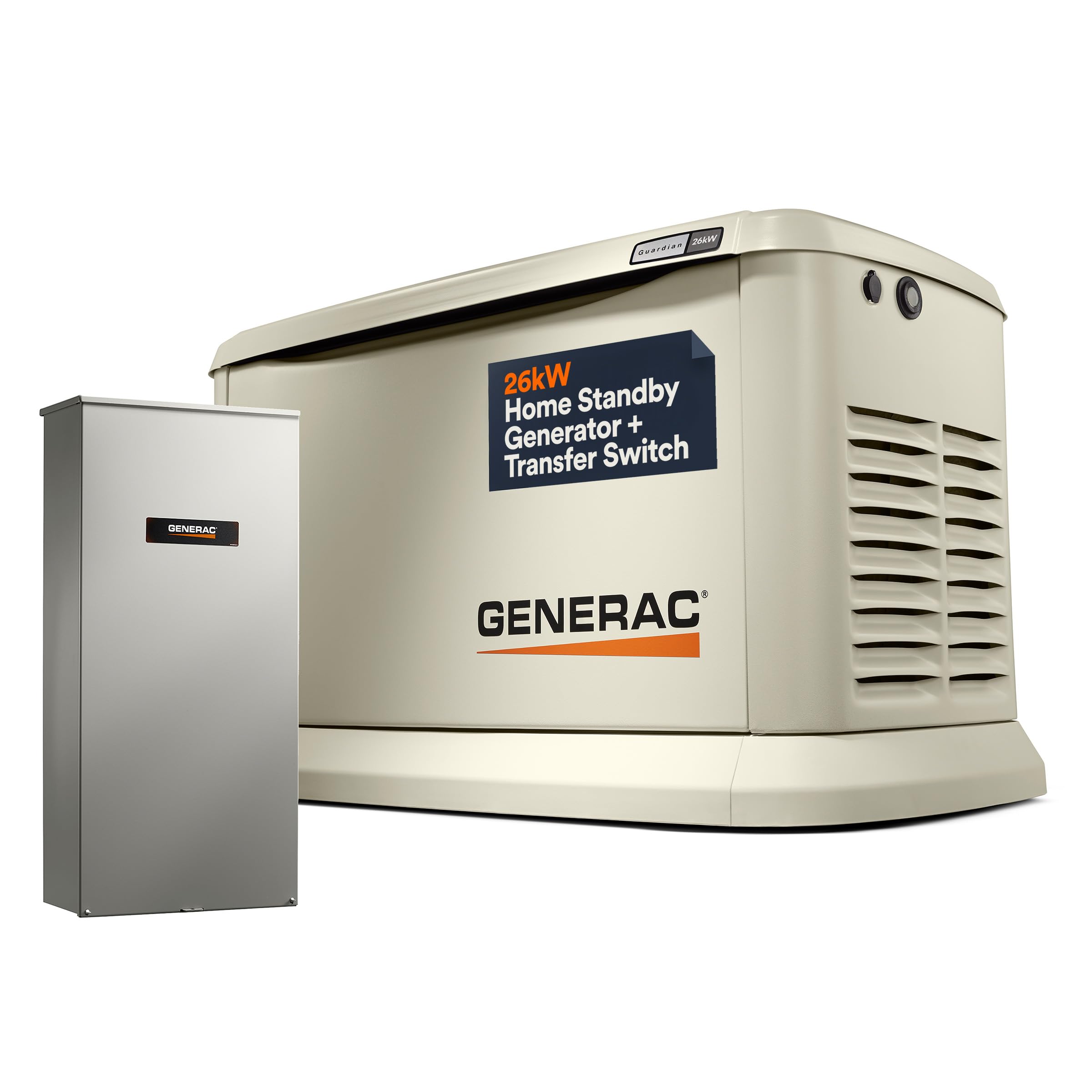
1. Generac Guardian 26kW Home Generator
Our pick — over 4★ from 50+ verified ratings; the strongest balance of quality and price.
Its 26 kW output and 200-amp transfer switch power a full-size home, including central air.
This is the unit you buy when you want your entire home — central air, well pump, electric water heater, the works — to keep running exactly as if the grid never blinked. Its 26 kW output is the strongest here, and that muscle is what lets it pair with a 200-amp transfer switch, so a full-size panel stays fully fed. The engine behind it is the biggest of the three, a 999 cubic centimeter G-Force unit built to handle heavy, repeated demand.
Because it runs on natural gas or LP gas with an aluminum enclosure, it’s built to sit outside permanently in all weather. True Power Technology keeps the electricity clean, with under 5% harmonic distortion — that means sensitive electronics like your TV and router won’t get the choppy power that can shorten their lives. It’s proudly engineered and assembled in the USA, and it’s backed by a 5-year limited warranty that covers the generator and the included 200A transfer switch.
Its audible hum is the main trade-off, though owners find it tolerable. Owners describe the sound as “kinda load” but tolerable, and for many that audible hum is actually a subtle comfort — you know the power is on while you’re inside. The bigger frustration buyers report is the delivery experience: “It took 10 days to get it delivered after it was in town,” and reaching a human for large-item shipping support was tough. A couple of owners also noted that running on propane requires a separate conversion kit and a battery, neither of which is included.
What you get
- 26 kW output handles large homes with central air and 200-amp panels
- Wi-Fi monitoring keeps you updated on status and maintenance from anywhere
- 5-year limited warranty on the unit and the included transfer switch
- Engineered and assembled in the USA
Know before buying
- Propane operation needs a conversion kit and a battery that aren’t included
- Audible from inside the house, which some owners don’t mind
- Delivery hiccups are a recurring complaint among owners
Built for big homes: if your panel is 200 amps and you refuse to pick which circuits live and which die, this is your generator.
Reality check: you’ll need your own battery and, for propane, a conversion kit before the installer can finish the job.
2. Generac Guardian 10kW Home Generator

Its 10 kW output and 100-amp switch cover essential circuits, with owners reporting 24-year lifespans.
This is the sensible pick for a typical home where you want the fridge, lights, furnace fan, and a few outlets running through an outage — not the whole 200-amp panel. Its 10 kW output rides on a 460 cubic centimeter G-Force engine, which is a 2.2x smaller engine than the 26 kW model up top, and it’s matched to a 100-amp 16-circuit transfer switch. That means an electrician chooses up to 16 circuits for backup, which keeps the install simpler and the fuel bill lower for everyday use.
Owners mention a predecessor unit lasting 24 years, backed by a 5-year warranty. The review pages tell the story best: “Nicely made. last one lasted 24 years” — a run that speaks to Generac’s low-maintenance design and the 5-year limited warranty standing behind it. Like its bigger sibling, it uses True Power Technology with under 5% harmonic distortion, so your electronics get clean, stable power, and the aluminum enclosure shrugs off outdoor weather. The same Wi-Fi monitoring is built in, letting you check status and maintenance alerts from your phone.
Its 10 kW output won’t start central air, so it’s best for essentials only. At 10 kW with a 100-amp switch, this unit will not start a large central air system — that’s a job for the 26 kW model. Owners also report the Wi-Fi setup can be stubborn, with one buyer noting it simply wasn’t working yet. Placement matters too: it sounds like a power mower from outside, so tuck it behind a sound barrier, and remember installation cost climbs with how far your panel and gas meter sit from the unit.
The strong points
- 100-amp 16-circuit switch keeps install and fuel costs down
- Customers note one lasting 24 years — serious longevity
- Clean power under 5% harmonic distortion protects electronics
- Wi-Fi monitoring and 5-year warranty included
Where it fits
- Not for whole-panel or central AC backup — that’s the 26 kW’s job
- Wi-Fi setup can be finicky according to owners
- Runs on natural gas or propane, so a fuel line is required
Reach for it if: your goal is keeping essentials alive affordably and you trust a machine whose predecessor ran for 24 years.
Look elsewhere if: you need to power a 200-amp panel or central air — step up to the 26 kW model with its 200-amp switch.
3. Kohler 20RESCL-200SELS 20,000W

It restores power in 10 seconds and features a corrosion-proof enclosure for coastal homes.
Its 10-second power restoration separates it from competitors. When the grid drops, this 20,000-watt air-cooled generator restores power to your home in 10 seconds—so fast that reviewers describe a 12-hour outage handled “smoothly, auto-started unnoticed.” It comes with a 200-amp automatic transfer switch (the device that flips your home from grid to generator power) rated for whole-house, service entrance use, and it includes load shedding (a feature that prioritizes circuits to avoid overloading). That’s the same 200-amp class as the 26 kW Generac, but at a 20 kW output that still covers a full modern home.
Where this one genuinely separates itself is the enclosure. It’s 100% corrosion-proof, a specification aimed squarely at coastal homes where salt air eats lesser metal boxes within a season. Add quiet operation and premium power quality, and you have a unit far more at home near the ocean than most of its peers. It’s a hefty 500 pounds and stands 48 by 26.2 by 29 inches, so this is a two-person install with professional help. It needs a Group 51 battery and comes with a 5-year/2000-hour limited warranty.
Service depends on finding a local Kohler technician willing to work on retail units. The 500-pound Kohler asks for knowledgeable local technicians, and some owners ran into Kohler service techs unwilling to work on retail models — so verify dealer support in your area before you buy. Reliability opinions are genuinely split, with one owner reporting a run of only 20 minutes before quitting while others report flawless multi-year service. Battery charging issues after a couple of years showed up too, though warranty-covered dealer replacement handled it. The included onCue monitoring lacks a reset button and needs a laptop for reconnection, which owners found frustrating.
What stands out
- Power restored in 10 seconds, automatically and quietly
- 100% corrosion-proof enclosure built for harsh seaside air
- 200-amp service entrance rated load shedding transfer switch included
Think twice if
- You lack a knowledgeable local Kohler technician for service
- Reliability reports are genuinely mixed among owners
- OnCue monitoring needs a laptop to reconnect, not a simple reset button
Coastal choice: the corrosion-proof shell and 10-second restart make it the pick for salt-air homes wanting fast, whole-panel power.
Service first: confirm a local dealer who will actually work on retail Kohler units — owners say that determines your whole experience.
Understanding the Specs
Wattage (kW) and Your Real Load
Kilowatts measure how much electrical power the generator can produce at once. Your home’s demand is the sum of everything you want running — lights, fridge, furnace, AC. A 10 kW unit handles essentials through a 100-amp switch, while 20-26 kW units feed a full 200-amp panel including central air. Match the output to your actual needs so you neither undersize into brownouts nor overspend on fuel you’ll never use.
Transfer Switch Amp Rating (100A vs 200A)
The transfer switch is the brain that disconnects you from the grid and connects you to the generator when power fails. Its amp rating must match your electrical panel: a 100-amp 16-circuit switch powers only the circuits you designate, while a 200-amp switch can cover your entire panel. All three picks here include the switch in the box, with the 26 kW Generac and 20 kW Kohler carrying 200-amp switches.
Fuel: Natural Gas or LP Gas
Standby generators run on piped natural gas or liquid propane instead of gasoline, which means no refueling during a multi-day outage. That fuel supply is plumbed in during installation, which is why a licensed electrician and, for gas, a certified technician handle the hookup. Fuel choice affects running cost and whether a large propane tank or a gas line is the better fit for your property.
Engine Displacement (cc) and Harmonic Distortion
Engine displacement in cubic centimeters tells you the engine’s size and workload capacity — the 26 kW Generac uses a 999 cc engine versus the 460 cc unit in the 10 kW model. Harmonic distortion measures power cleanliness; under 5% means the electricity is stable enough for sensitive electronics like TVs and routers. Bigger homes with heavy startup loads like AC compressors need the larger engine.
FAQ
Will a whole house generator run my central air conditioning?
What is the difference between a 100-amp and 200-amp transfer switch?
Can I install a standby generator myself to save money?
How long does a whole house generator last?
Is a standby generator loud enough to bother my neighbors?
Can I run the generator on propane instead of natural gas?
How fast does power come back after an outage?
What maintenance does a standby generator need?
Final Thoughts: The Verdict
For the majority of shoppers, the whole house backup generator winner is the Generac Guardian 26kW because its 26 kW output, 200-amp transfer switch, and 999 cc engine handle a full-size home including central air without compromise. If you want essentials-only backup at a friendlier entry point, grab the Generac Guardian 10kW, whose 100-amp 16-circuit setup keeps install simple and fuel bills low. And for fast restart in coastal conditions, the Kohler 20RESCL with its 10-second power restoration and corrosion-proof enclosure is the one to reach for — provided you have a local dealer who services it.
How We Picked
We do not accept paid placement. Every pick is matched to a real buyer and a real use-case; we do not hands-on test units.
Sources & Methodology
Specifications: manufacturer listings and product documentation. Review insights: verified customer reviews, as of September 2026. Pricing: not shown on this page (it changes often); check the current price via the retailer link.
As an Amazon Associate, Gadgets Feed earns from qualifying purchases. This does not affect which products we feature.