
Our readers keep the lights on and my morning glass full of iced black tea. As an Amazon Associate, I earn from qualifying purchases.
Specs are compiled from manufacturer listings and verified buyer reviews and can change over time — please confirm the key details on the product page before buying.
If you race RC cars, fly drones, or run a fleet of LiPo packs, the charger you pick decides how much time you spend at the bench instead of having fun. The key spec is dual AC/DC input, so you can charge from a wall outlet at home or a car battery at the field. This guide focuses on that dual AC/DC input, the charge current in amps, and the total wattage that actually dictates how fast your packs top up.
I’m Min — the founder and writer behind Gadgets Feed. This guide is built by comparing the manufacturers’ published specifications and the patterns across verified customer reviews, so you get each pick’s real strengths and trade-offs instead of marketing spin.
We break down the top performers for charging LiPo, LiHV, and NiMH packs at home or the track, helping you choose the ac/dc battery charger that matches your batteries and your charging habits.
Our Picks at a Glance
How To Choose The Best AC/DC Battery Charger
Start by checking your batteries’ voltage (like 3S or 6S) and chemistry (LiPo, LiHV, NiMH) to match a compatible charger. Check the voltage (like 3S or 6S) and chemistry (LiPo, LiHV, NiMH) of your packs, then match a charger that supports them — most here cover the common 1S-6S LiPo range and beyond.
Understand AC vs DC Power Limits
AC power comes from your wall outlet; DC power comes from a 12V source like a car battery or a separate power supply. Many chargers deliver far more wattage on DC input — for example, a unit might do 200W on AC but jump to 600W on DC — which means much faster charging when you’re at the field.
Match Charge Current to Your Battery
Charge current, measured in amps, controls how quickly a pack fills. A higher amp rating (like 15A or 20A) shortens charge time, but only up to what your battery safely accepts. Most LiPo packs charge at 1C — meaning a 5000mAh pack charges at 5A — but some support 2C or 3C for faster top-ups if your charger can deliver.
Check the Cell Count and Connectors
Your charger must match the cell count of your battery (1S is one cell, 6S is six cells in series). Also look at the output connector — XT60 is the most common for RC packs — and check whether the charger includes adapter cables for your specific connector type.
Quick Comparison
| Model | Best For | Charge Power (AC) | Charge Current | Input Voltage (DC) | Amazon |
|---|---|---|---|---|---|
| HOTA D6 Pro★ Best Overall | Versatile all-rounder | 200W | 0.5-15A | 6.5-30V | Amazon |
| Dght L6Best Value | Budget-friendly dual channel | 150W | 0.1-10A | 11-18V | Amazon |
| Gens Ace Imars Dual | High-power dual channel | 200W | 0.1-15A x2 | 7-30V | Amazon |
| OVONIC X1 | Fast charging with sync mode | 200W | 15A | — | Amazon |
| ISDT K2 Air | Compact smart charging | 200W | 20A | — | Amazon |
| Gens Ace Imars D300 | Bluetooth monitoring | 300W | 16A per channel | — | Amazon |
| ISDT K4 | Heavy-duty pro charging | 400W | 20A x2 | — | Amazon |
In-Depth Reviews
1. HOTA D6 Pro Dual Channel RC Battery Charger
Our pick — over 4.5★ from 100+ verified ratings; the strongest balance of quality and price.
The dual-channel master that handles nearly every battery chemistry you can throw at it.
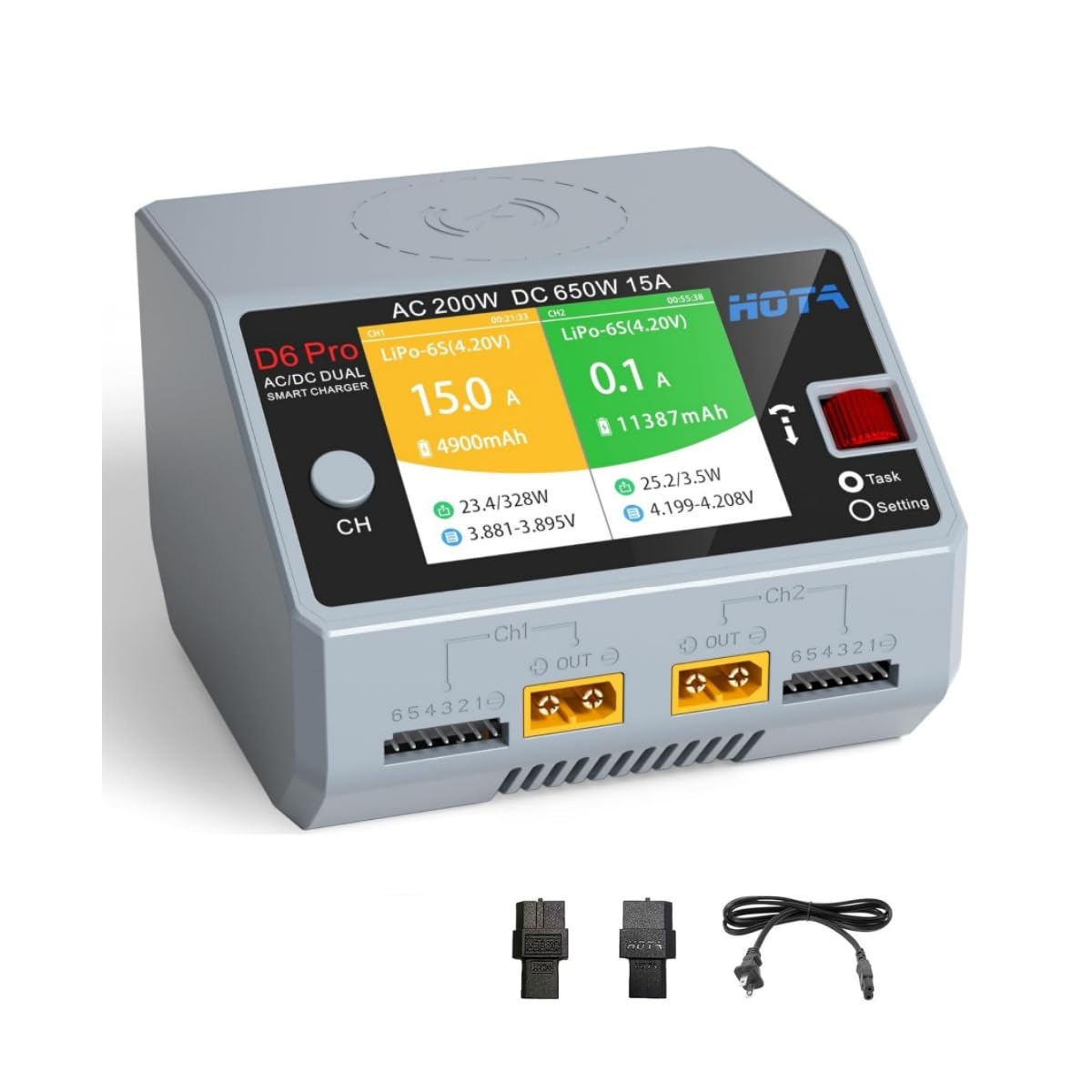
The HOTA D6 Pro earns the top spot because it balances power, compatibility, and ease of use better than anything else here. It accepts AC 100-240V from your wall or DC 6.5-30V from a field supply, and its charge current ranges from 0.5-15A on a single channel. On DC input it pushes 325W of charge power, while AC tops out at 200W with support for power distribution between the two channels.
What wins people over is the sheer functionality — owners consistently praise how much this unit does. It’s compatible with LiH/LiF/Lilon/Lixx 1-6S, NiZn/Nicd/NiMH 1-16S, Smart Battery 1-6S, Lead Acid 2-24V, and Enelop 1-16S, making it a true one-stop shop. Buyers report that it works with Spektrum smart batteries that have a balancing lead, and the large IPS screen offers a wide viewing angle with true color for easy monitoring.
The protection suite is comprehensive — overheating, time-exceeding, capacity, input reverse, output, short circuit, output current, over output voltage, and overcharge protection all built in. The output connector is XT60 to XT60. A quick note on the manual: it’s nearly useless, so plan to watch a setup video on YouTube if you’re new to balancing chargers.
What owners love
- Broad battery chemistry support from LiPo to Lead Acid
- Dual channels with independent power distribution
- Large IPS screen with wide viewing angle and true color
What to know before buying
- Instructions are minimal — expect a learning curve via online videos
- XT60 output requires adapters for other connector types
The crowd favorite: This is the charger to reach for when you have mixed fleets and want one unit that does it all — from LiPo race packs to NiMH receiver batteries.
Where it sits: It’s not the cheapest dual-channel option, but the 103 verified ratings average 4.6 stars, and the ease-of-use praise is loud and consistent.
2. Dght L6 AC/DC Balance Fast Charger
A low-cost dual-input charger that delivers surprising value with a huge accessory bundle.
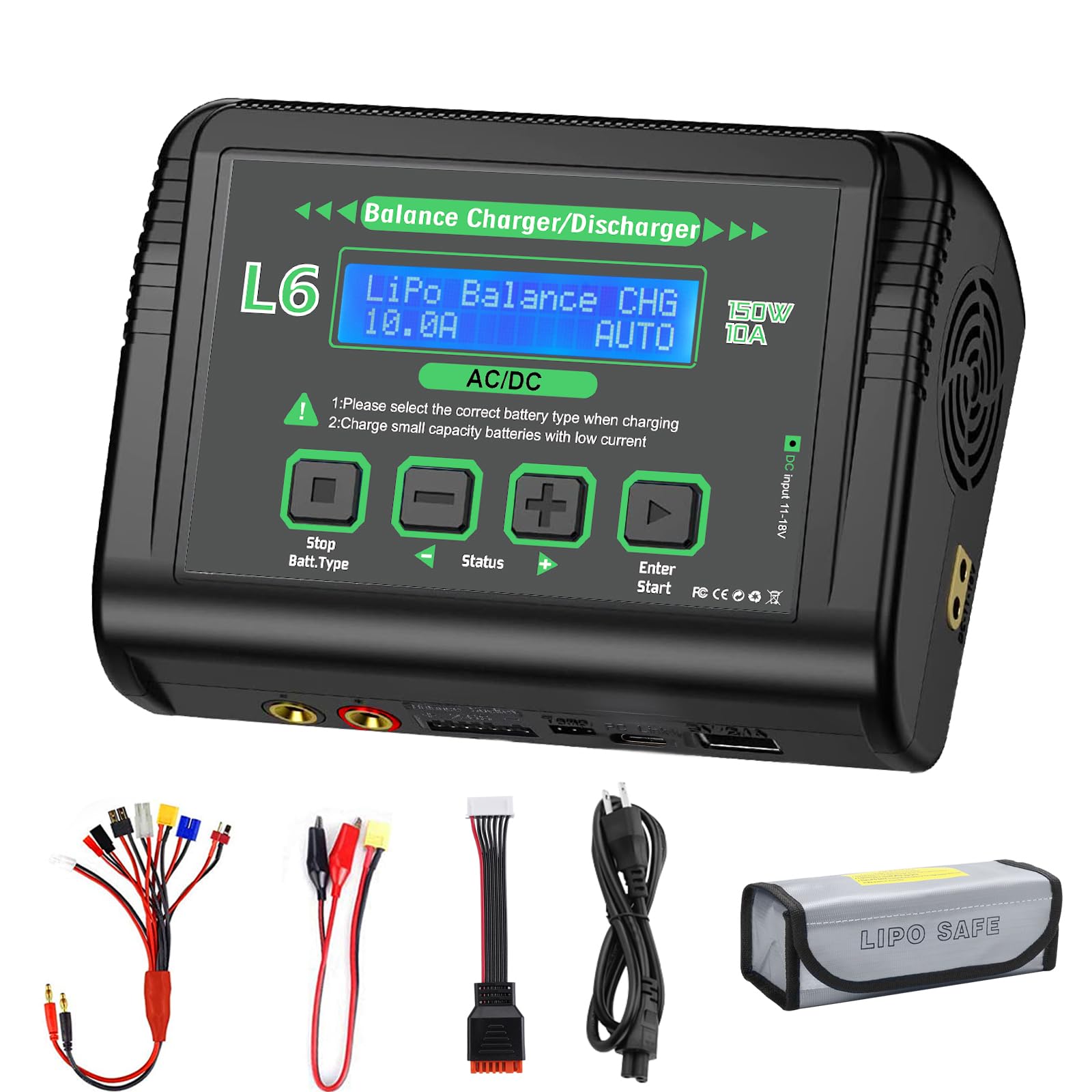
The Dght L6 is the value pick because it gives you AC/DC dual input and dual-channel charging without the premium price tag. It supports an impressive seven battery types — LiPo, LiFe, Li-ion, LiHv, NiMH, NiCd, and Pb — spanning 1-6S for LiPo and 1-15 cells for NiMH. On AC power it delivers 150W maximum output, and charge current runs from 0.1-10A, with discharge at 0.1-2A up to 10W.
The outfit is genuinely generous for the money. You get the AC power cord, DC cable, balance board, an explosion-proof bag, and an octopus multi-charging harness with TAMIYA, TAMIYA mini, JST, T Plug, EC3, TRX, and Deans connectors — so it adapts to nearly any RC pack you own. Owners find it simple and reliable, with the recurring point that a previous charger with these same features cost 2.5 times as much. One practical note: it handles tool battery balancing as well.
Smart protections include low input voltage limit, automatic charge current limit, Delta-peak sensitivity, capacity limit, processing time limit, and temperature threshold. You can store up to 20 memory profiles for your batteries, and firmware updates are supported. A 1-year warranty backs the unit.
Why it wins: The feature set alone justifies the price, but the included connector harness makes it ready to use the day it arrives.
The honest trade-off: At 150W AC and 10A max, it’s slower than higher-end units — best for sport packs, not racing teams needing rapid 15A charges.
Best for: Hobbyists who want one affordable charger that covers multiple battery chemistries and connector types without buying extra adapters.
Consider something else if: You need to charge large 6S 5000mAh+ packs at maximum speed — the 150W AC ceiling will hold you back.
3. Gens Ace Imars Dual Smart Lipo Charger

Serious dual-channel power with a wide DC input range for field charging.
The Gens Ace Imars Dual is built for enthusiasts who charge at the track or field, not just at home. It accepts AC 100-240V worldwide or DC 7-30V — giving it an 8% wider DC input range than the HOTA D6 Pro’s 6.5-30V floor, which matters if your field power supply runs at lower voltages. Charge current reaches 15A per channel, and the unit delivers AC 200W total or a massive DC 600W when you’re on a 12V source.
What stands out to owners is the ability to charge two batteries simultaneously — the review pages sum it up: owners mention it works better than other chargers they’ve used because you can charge two packs at once compared to others only handling one. The 2.4-inch IPS LCD display keeps things readable, and the unit supports LiPo/Li-ion 3.7V-22.2V (1S-6S), LiHV, LiFePO4, and NiMH/NiCd batteries.
On safety, the Gens Ace uses UL94-V0 flame-retardant material with low input voltage limit, automatic charge current limit, Delta-peak sensitivity, capacity limit, processing time limit, and temperature threshold protections. It comes with AC input cable, XT60-T adapters x2, XT60-EC5 x2, and XT60-EC3 x2 for connector flexibility.
Standout feature: The 600W DC power on dual channels makes this one of the fastest field-charging options in this lineup.
Fit note: Owners note the menu rewards patience — one put it colorfully, saying you need an IQ higher than your current humidity to operate it — so expect a learning curve.
Reach for this if: You regularly charge at the field and want the DC 600W headroom to fill two packs fast from a car battery.
Look elsewhere if: You only charge at home on wall power — the AC 200W ceiling is no better than cheaper units.
4. OVONIC X1 Dual RC LiPo Balance Charger

A feature-dense dual charger that emphasizes speed with a sync charging mode.
The OVONIC X1 targets racers and bashers who measure downtime in minutes. It runs AC 200W or DC 600W at 15A, and claims a 98% conversion efficiency that cuts charging time for equal-capacity batteries. Customers note charging four 6000mAh packs in under 30 minutes with two trucks running, and another took a 2S battery from storage to full in just 23 minutes.
Beyond raw speed, the X1 is packed with tools: temperature reading, parameter correction, sync charging mode, safety timer, capacity (mAh) cut-off, voltage check, auto power off, resistance detection, brightness adjustment, sound settings, accumulated charging times, self-test, and firmware upgrade. It handles LiPo/Li-Ion/LiFe/LiHv 1S-6S and NiMH 1S-16S with modes for charge, discharge, storage, balance, external discharge, digital power, and sync charge.
A 1-year warranty backs the unit, with overvoltage, overtemperature, overcurrent, short circuit, and reverse polarity protection. The package includes XT60-Deans, XT60-EC3, and XT60-EC5 adapters plus a USB-A to USB-A cable — though note that a DC connector wire is not included, which some owners flagged as a gap.
Speed highlights
- Sync charging mode merges channels for higher power
- Rapid charge times reported — four 6000mAh packs in under 30 minutes
- Includes Deans, EC3, and EC5 adapters
The catches
- No DC connector wire included in the box
- A small number of reviewers point out one channel not functioning as expected
Pick it for: Speed-focused owners who want 600W DC power, sync charging, and a wide adapter selection at a mid-range price.
Keep in mind: You’ll need to buy a DC cable separately for field charging — factor that into your setup.
5. ISDT K2 Air Smart Charger

A small footprint with a bright screen and smart features that warm up a race bag nicely.
The ISDT K2 Air crams a lot into a compact body that slips easily into your field gear. It offers AC 200W or DC 500W per channel (x2), pushing charge current up to 20A — more than most in this list. The 2.8-inch IPS LCD has a 178-degree viewing angle and stays readable in strong sunlight, which owners genuinely appreciate at outdoor events.
The K2 Air’s a neat extra is its two-way USB interface. The microUSB port connects to a PC for firmware updates, while the USB Type-C port outputs 5V/2A — enough to top up your phone at the field. DC and AC inputs are mutually exclusive by design, meaning you select one input at a time, which ensures safe operation. It supports LiFe, Lilon, LiPo 1-6S, LiHv, Pb 1-12S, and NiMH/Cd 1-16S chemistries.
Owners rave about the charging performance and the Bluetooth connectivity that works at roughly 25 feet for alarms and monitoring. The honest caveats: the fans are loud during discharge (they run at 100% or nothing), and multiple shoppers say the physical buttons feel fragile and can fail — so treat them gently. Also, there’s no balancer-only mode, though the ISDT BattGo app covers that gap.
Why it shines
- 20A charge current beats most rivals in this price band
- USB Type-C port charges your phone at 5V/2A
- Bright IPS screen readable in direct sunlight
Handle with care
- Buttons have a documented durability concern
- Fan runs at full speed or off, making discharge sessions noisy
The standout spec: At 20A max current, the K2 Air charges faster than the 15A units above — ideal for big 6S packs.
Who should pause: If you charge in a shared space, the fan noise during discharge could get old quickly; also budget for gentle button handling.
6. Gens Ace Imars D300 Plus Dual Channel Charger
A pocket-sized powerhouse that adds Bluetooth control and a 300W AC ceiling.
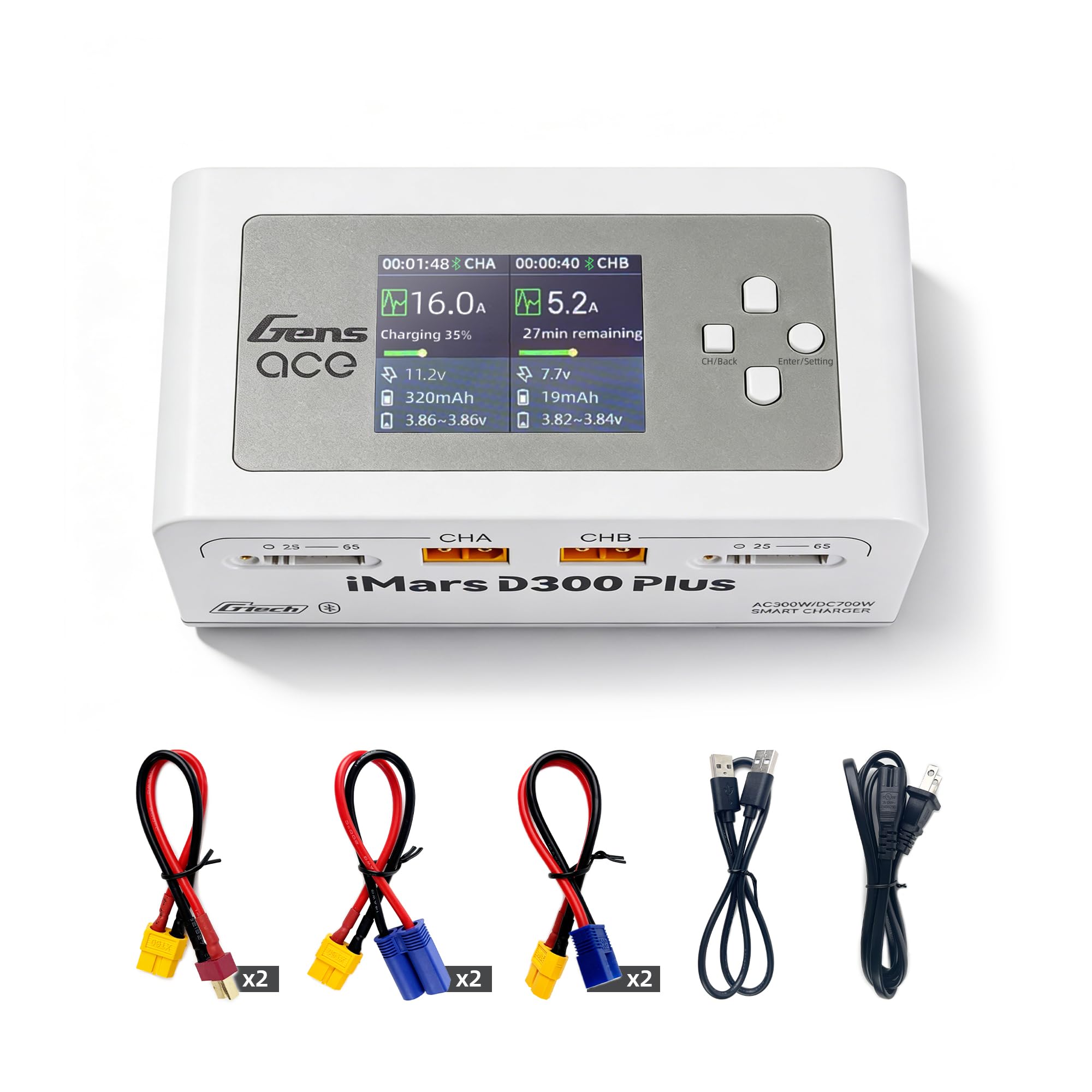
The Gens Ace Imars D300 Plus redefines what fits in a gear bag. It weighs just 530g — lighter than many single-channel chargers — yet pushes 300W AC / 700W DC with 16A per channel. For packs that support 2C-3C fast charging, a 6S 5000mAh pack can be ready in under 30 minutes. Owners who upgraded from an old 150W charger call it a huge leap, noting that not many chargers hit 300 watts off AC alone.
The headline feature is built-in Bluetooth, which pairs with the Gens Ace App for remote monitoring and control. Owners find the app faster than using the physical buttons and genuinely useful for checking charge status from across the room. The unit also has a built-in 5V/2.1A USB port for emergency phone charging and firmware updates, plus 7 onboard language options.
The D300 Plus covers LiPo, LiHV, LiFe, and Li-Ion batteries from 1S to 6S. Dual independent channels let you charge two packs with separate settings, and Sync Mode merges channels for higher output. It automatically recognizes G-Tech smart batteries and offers 7 modes including charge, discharge, balance, and storage. The UL94-V0 flame-retardant shell and 7-layer safety protection handle overcharge, overcurrent, short circuit, reverse polarity, and overheating.
What makes it special: The 300W AC output is rare at this size — you get fast charges at home without needing a separate DC power supply.
The minor gripe: It uses non-standard connectors rather than banana plugs, so owners with existing charger cables may need to buy new ones.
Grab this if: You want the most power per gram and love monitoring charges from your phone via Bluetooth.
Think twice if: You have a drawer full of banana-plug charger cables — you’ll likely need replacements for this unit.
7. ISDT K4 Dual Lipo Battery Charger

The heavy-duty workhorse for big packs and serious multi-battery operations.
The ISDT K4 is the charger you step up to when standard 6S support isn’t enough. It handles LiPo, LiIon, LiFe from 1-8S, plus LiHv and ULiHv 1-7S, Pb 1-14S, and NiMH/Cd 1-18S — the widest cell count range in this entire lineup. Each independent channel pushes 20A, with AC 400W total or a staggering DC 600W per channel. Owners have pushed it with 8S 12,000mAh packs and report it charges anything without hiccups.
The K4’s full-color LCD touch panel shows voltage, current, charge time, mode, battery type, internal resistance, and charged capacity in real time. It supports BattAir BT connection for mobile operation via the ISDT app, plus firmware updates to keep performance tune. Automatic battery type identification pairs with an intelligent charge algorithm, and charging stops automatically when full.
The aluminum alloy shell gives it a premium feel, and the advanced cooling air duct keeps efficiency high. Owners describe it as the best AC/DC charger in the ISDT line, noting the internal power supply simplifies setup. One voice mentions a cell reading 0.02V low that required an exchange, and another notes it ships in a thin plastic bag despite the nice box — small gripes on an otherwise stellar unit.
Flagship strengths
- 1-8S support covers the largest packs in this list
- 20A per channel with DC 600W per channel output
- Touchscreen display with full charge telemetry
Points to weigh
- The most expensive pick here by a wide margin
- A rare unit can arrive with calibration quirks requiring exchange
Who it’s for: RC pilots and racers running large 8S or high-capacity packs who need dual-channel 20A throughput and won’t outgrow it.
Who it isn’t for: Casual hobbyists charging 2S-3S sport packs — the premium price buys headroom you may never use.
Understanding the Specs
AC vs DC Input Voltage
AC input means you plug into a standard wall outlet (typically 100-240V). DC input means you connect to a 12V source like a car battery or bench power supply. Most dual-input chargers deliver significantly more wattage on DC — for example, the Gens Ace Imars does 200W on AC but jumps to 600W on DC, which means much faster charging when you’re away from a wall outlet.
Charge Current (Amps)
Charge current, measured in amps, dictates how fast a battery fills. A 10A charger tops up a 5000mAh pack at roughly twice the speed of a 5A charger, assuming the battery accepts the rate. Units range from 10A entry-level up to 20A on the high-end ISDT models. Always check your battery’s rated charge rate — usually 1C, meaning a 5000mAh pack charges at 5A — before cranking the amps up.
Cell Count and Battery Chemistry
Cell count (like 2S, 4S, or 6S) describes how many cells are wired in series, which determines the pack’s voltage. A 6S LiPo runs at 22.2V nominal, so your charger must support that cell count. Chemistry matters too — LiPo, LiHV, LiFe, and NiMH all have different voltage curves and require different charge algorithms. A smart charger with automatic cell detection reduces the risk of choosing the wrong settings.
Dual Channel vs Single Channel
Dual-channel chargers have two independent outputs, so you can charge two different batteries simultaneously with separate settings. Dual-channel chargers let you balance a 6S race pack on one output while topping off a 2S transmitter battery on the other. Some dual units also offer sync mode, which merges both channels to push more power into a single large pack.
FAQ
Can a 150W AC charger handle my 6S 5000mAh LiPo battery?
What is the difference between AC and DC input on a battery charger?
Will a dual-channel charger charge two different battery types at once?
How long does it take to charge a 2S or 3S LiPo battery?
Is storage mode important for LiPo battery longevity?
Do I need a balance board to use these chargers?
Can I use these chargers with lead-acid or NiMH batteries?
What safety features should I look for in an AC/DC charger?
Is the ISDT K4 worth its premium price over the other options?
Final Thoughts: The Verdict
For most people, the ac/dc battery charger winner is the HOTA D6 Pro because it combines broad chemistry support, dual-channel flexibility, and a 325W DC ceiling in one easy-to-use package. If you want high-power field charging with 600W DC output, grab the Gens Ace Imars Dual. And for large 8S packs or serious multi-battery operations, the ISDT K4 is the one to reach for if your budget stretches that far.
How We Picked
We do not accept paid placement. Every pick is matched to a real buyer and a real use-case; we do not hands-on test units.
Sources & Methodology
Specifications: manufacturer listings and product documentation. Review insights: verified customer reviews, as of September 2026. Pricing: not shown on this page (it changes often); check the current price via the retailer link.
As an Amazon Associate, Gadgets Feed earns from qualifying purchases. This does not affect which products we feature.