
Our readers keep the lights on and my morning glass full of iced black tea. As an Amazon Associate, I earn from qualifying purchases.
Specs are compiled from manufacturer listings and verified buyer reviews and can change over time — please confirm the key details on the product page before buying.
Water in your basement is a spectrum, and the sealer you need depends on where you fall on it. The picks below split into two very different camps: film-forming coatings that sit on the surface like paint, and penetrating sealers that soak into the concrete and react from the inside. Knowing which one your situation calls for is the real buying decision.
I’m Min — the founder and writer behind Gadgets Feed. This guide is built by comparing the manufacturers’ published specifications and the patterns across verified customer reviews, so you get each pick’s real strengths and trade-offs instead of marketing spin.
You will find the best basement cement sealer by matching the product type to your leak severity, surface condition, and whether you plan to paint over it later.
Our Picks at a Glance


How To Choose The Best Basement Cement Sealer
The first question is not which brand, but which mechanism. If you have active leaks or water pooling, you need a thicker coating that bridges gaps. If you have dampness, musty smells, or efflorescence (that white powdery salt stain) without visible water, a penetrating sealer is usually the cleaner fix that leaves the concrete looking unchanged.
Match the product to your water problem
Film-forming products like liquid rubber and acrylic masonry paint build a physical barrier on the wall surface, which makes them the right tool for blocking water that seeps through cracks and block joints. Penetrating silicates (mineral-based compounds that soak into pores) and lithium-based formulas instead react inside the concrete pores to reduce moisture vapor (humidity passing through the slab) from below — but they cannot fill an active crack or hole.
Check coverage and coats before you buy
A one-gallon can can range from covering roughly 75 square feet as a thick rubber coating to well over 200 square feet as a penetrating thin sealer. Multiply your wall or floor square footage by the recommended number of coats, then compare that against the stated coverage per gallon to avoid running out mid-project. The densest coatings often need two coats minimum for real protection.
Understand the cure and prep demands
Every sealer on this list only performs after proper surface cleaning and the right temperature window. Most require the concrete to be dry and the air temperature between 50 and 90 degrees Fahrenheit. A few penetrating products demand a second coat applied wet-on-wet (before the first coat dries) before the first dries, which changes how you schedule the job.
Quick Comparison
| Model | Best For | Type | Coverage | Finish | Amazon |
|---|---|---|---|---|---|
| Ames Blue Max Liquid Rubber★ Best Overall | Active leaks & crack bridging | Elastomeric Rubber | 1 Gal (thick coats) | Blue Film | Amazon |
| Lithi-Tek 9500 Ultra ConcentrateBest Value | Large floors & vapor blocking | Penetrating Silicate | 1,000 sq ft | Clear Matte | Amazon |
| Ames Block & Wall Liquid RubberWall Coating Pick | Wall coatings needing no odor | Elastomeric Rubber | 1 Gal (thick coats) | White Film | Amazon |
| RadonSeal Plus (2.5 Gal) | Radon & moisture reduction | Penetrating Silicate | 500 sq ft | Clear Matte | Amazon |
| INSL-X WaterBlock Paint | Finish & block paint in one | Acrylic Film | 75–125 sq ft | Semi-Gloss White | Amazon |
| Rust-Oleum Moisture Stop | Pre-coat floor sealing | Penetrating Fortifier | 200 sq ft | Clear | Amazon |
| RadonSeal Plus (5 Gal) | Whole-basement projects | Penetrating Silicate | 1,000 sq ft | Clear Matte | Amazon |
| TUFINEIN Liquid Rubber Sealant | Multi-surface repairs | Elastomeric Rubber | ~21 sq ft max | Neutral Gray Film | Amazon |
In‑Depth Reviews
1. Ames Blue Max Liquid Rubber Waterproofer
Our pick — over 4.5★ from 600+ verified ratings; the strongest balance of quality and price.
The rubber membrane that stretches 1200% to shrug off shifting foundations and crack movement.
The 1200% elongation rating (how far it stretches before tearing) makes this the top pick for a block wall that weeps during a storm. That flexibility is what lets the cured film flex with a settling house instead of cracking open again, where a rigid paint would fail. Buyers report the results plainly: “Been on the block wall for 1 month and we have had heavy rains. NO LEAKAGE!”
What wins people over is waterproofing, and application follows close behind. It brushes, rolls, or sprays on vertical and horizontal surfaces, and it doubles as a primer on metal or RV roofs.
Two honest caveats. It is UV sensitive, so any exterior, sun-exposed section needs a top coat to stay durable. And durability reviews run mixed even though some owners mention their application lasting over 6 years — the difference usually depends on surface prep and how many coats you commit to.
Why it stops leaks
- Self-leveling elastomeric membrane bridges hairline cracks in foundation walls
- Non-toxic and VOC compliant in all 50 states
- Works on concrete, wood, and metal surfaces
The trade-offs to know
- Requires a top coat on any sun-exposed exterior area
- Thick enough that owners scoop it from the pail rather than pour
The crowd favorite: reach for this when you have visible water intrusion and need a barrier that flexes instead of cracking.
Think twice if: you need a clear, invisible finish — this dries to a blue coating that stays visible.
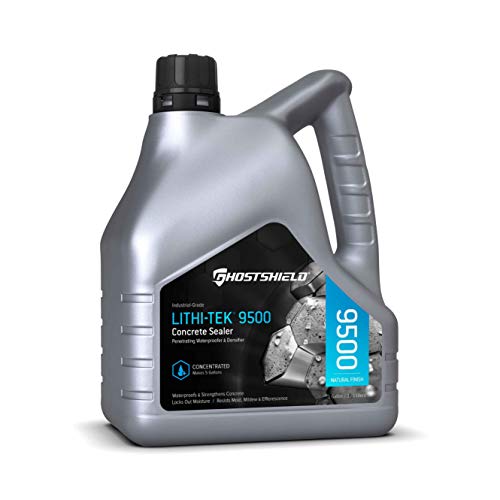
2. Lithi-Tek 9500 Ultra Concentrate
One gallon that becomes five, soaking deep to densify and waterproof a massive floor area.
This is the most cost-efficient fix for a damp slab, treating a vastly larger area than the Ames Blue Max because you dilute it. The 1-gallon ultra-concentrate mixes with 4 gallons of water to make 5 gallons of sealer — enough to treat up to 1,000 square feet per coat. The thing everyone raves about is ease of use, with far and away the most owners singling out how simple a sprayer application is.
It is a penetrating lithium formula, meaning it reacts inside the concrete to increase abrasion resistance and It strengthens the concrete surface by up to 50%. rather than leaving a film. Owners describe watching water bead like rain on a freshly waxed car within a couple of days, which is the signature of a properly densified floor. This makes it the cost-effective answer for large garages, driveways, and patios — customers note the dilution factor alone saved them hundreds of dollars versus ready-to-use gallons.
The occasional complaint about discoloration traces back to skipping that sequence.
Vapor-blocking workhorse: the dilution to 5 gallons and 1,000 sq ft coverage per coat make this the strongest per-dollar value for large floor areas — and it leaves no surface film at all.
The efficiency play: choose this for big slabs and vapor problems where you want natural, un-coated concrete that still shrugs off water.
Not for cracks: it cannot bridge an active gap, so pair it with a caulk or crack filler first.
3. Ames Block & Wall Liquid Rubber Waterproofer
A thick white rubber coating with no odor that owners have trusted for over a decade of wet basements.
This is the wall-coating pick because, unlike the Blue Max version which prioritizes extreme stretch, this formula has essentially no chemical smell — a major advantage for occupied homes. Buyers describe a frosting-thick consistency that does not run, goes on smoothly, and cleans up easily — and the low odor makes it workable even with a baby in the house. Effectiveness tops the list of what people praise most, and the verdict has some serious legs behind it: One owner reports using it for over 10 years to waterproof an entire basement..
It fills cracks well against cinderblock and planter beds, and several owners note it feels thicker than Drylok, which translates to fewer coats for confidence. The white color dries with a slight shimmer rather than a flat gray, which many find more finished-looking on exposed block. At 9.3 pounds for the 1-gallon pail, it is nearly identical in weight to its Blue Max sibling.
The honest split in the feedback is water resistance and adhesion — most owners see great results, but a few report peeling in spots, usually tied to applying a layer too thick. The guidance from experienced users is consistent: do not over-thick the coats, and let each layer dry properly.
The safe-bet seal: a no-odor, thick, crack-filling white membrane that has earned a decade of repeat purchases — the right call for finished-looking basement walls.
Reach for this if: you want a paint-like coating that fills cracks without the chemical fumes typical of heavy waterproofers.
Watch the coats: laying it on thick to save time is the one move that risks peeling.
4. RadonSeal Plus Concrete Sealer (2.5 Gal)
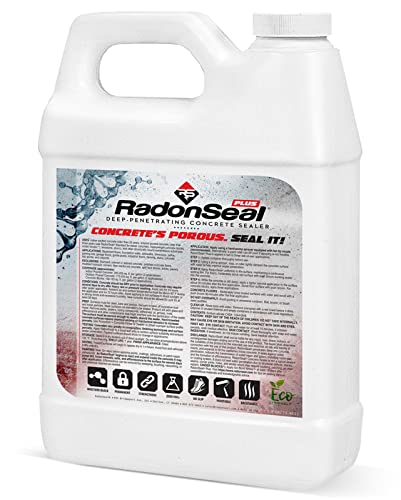
A deep-penetrating silicate that reacts inside the concrete to cut both moisture and radon readings.
This is the pick for the buyer whose concern goes beyond dampness into soil-gas territory, because it targets the source rather than just the surface. RadonSeal Plus works by penetrating deep into the concrete and reacting within the pore structure to seal capillaries from the inside, which is why it reduces moisture vapor transmission and radon entry rather than just blocking surface water. The measured results are striking: Reviewers point out ASTM F1869 moisture readings dropping from yellow to green and radon levels falling from 10-14 to 4-6 within 30 days on a treated section..
What people praise most is effectiveness, with application and the near-zero odor close behind. It sprays or rolls on easily, absorbs well into porous concrete, and leaves a natural invisible finish — no gloss, no darkening, no surface film at all. Because it forms the seal internally, it will not peel, blister, or wear away the way a surface coating can, and it chemically densifies weak concrete to reduce dusting.
The waiting game is the honest trade-off. The reaction is not instant: full strength develops over 60-90 days, and owners note you need light coats with no pooling. The 2.5-gallon container covers roughly 500 square feet and weighs in at 24 pounds.
Internal-seal specialist: the only type here that both densifies the slab and measurably lowers radon, all while leaving the floor looking untouched.
The long-game fix: ideal for finished spaces where you cannot afford a visible coating and want moisture and radon handled at the source.
Not a quick patch: its full-strength cure takes two to three months, so do not expect overnight results.
5. INSL-X WaterBlock Acrylic Masonry Waterproofer Paint

A waterproofing paint that doubles as a finished wall — one semi-gloss white coat that stops seepage.
For the basement you actually want to use, this is the rare product that seals and finishes in one step, unlike the clear penetrating sealers which leave you with bare gray concrete. It is a water-based acrylic coating built for vertical interior and exterior concrete — basement walls, cinder block, stucco, brick — and it dries to a bright white semi-gloss that looks like a deliberate paint job rather than a gray or blue sealer. Coverage runs 75 to 125 square feet per gallon depending on the surface.
The performance spec that matters for below-grade walls is the 12 psi (pounds per square inch) hydrostatic pressure rating — the force of standing water it can hold back. Owners confirm the real-world result: after a heavy rain post-application, no more water leaking in and everything stayed dry. Effectiveness is what gets praised most, and the quality feedback follows closely. The formula also It resists high alkalinity up to pH-13., which is the aggressive chemistry you find against fresh masonry.
The catch is discipline about the temperature window — you must paint only when surface and air temperatures sit between 50 and 90 degrees Fahrenheit. And like most masonry paints, a brush alone will not get the coverage you expect; owners who struggle early on find a long-nap roller is the tool that makes it go on bright and even.
The two-in-one: applies like a heavy paint, leaves a bright finished wall, and carries a serious 12 psi hydrostatic rating for below-grade confidence.
Reach for this if: you want a bright, clean, finished basement wall that also blocks water — without a separate seal step.
skip it if: you need to treat a floor or an actively flooding crack, since this is built for vertical masonry surfaces.
6. Rust-Oleum Concrete Moisture Stop Fortifying Sealer

The clear pre-coat that stops floor moisture from ruining the paint or epoxy you put on top.
If you want to paint or epoxy your concrete floor but moisture keeps pushing up through the slab, this is the product designed for that specific frustration. It stops that cycle by penetrating the surface and fortifying the concrete from the inside out — and critically, it does not alter the look of the concrete, so it is made to go underneath a coating. Unlike the INSL-X paint which is a finish itself, this is strictly a prep layer. Shoppers say the result directly: “After using this on my garage floor, a pesky wet spot stopped appearing after a heavy rain.”
Application is a waiting game with a payoff — you apply it and let it penetrate for 45 minutes, and it covers up to 200 square feet per gallon. Owners describe it as super easy to use with no fumes, drying quickly, and taking two or three coats on tougher rooms for safety. It also blocks damage from water, salt, and radon gas, and because it soaks in rather than filming over, it will not change how your floor looks.
This is the lightest-touch entry on the penetrating side. The 1-gallon container weighs 9.1 pounds, versus the 9.5-pound Ames Blue Max pail. The honest note from the review pages: some floors still had moisture issues afterward, which usually signals a condition called hydrostatic pressure strong enough that a surface sealer alone cannot win — that scenario belongs to an exterior drainage fix, not a can of sealer.
The coating enabler: seals and strengthens a floor from within so your paint or epoxy actually sticks and stays, all without changing the concrete’s appearance.
Choose this for: prepping a workshop or garage floor before you paint — it is the step that keeps moisture from ruining the topcoat.
Lower your expectations if: you have true groundwater pressure pushing through the slab; that needs outside drainage work.
7. RadonSeal Plus Concrete Sealer (5 Gal)
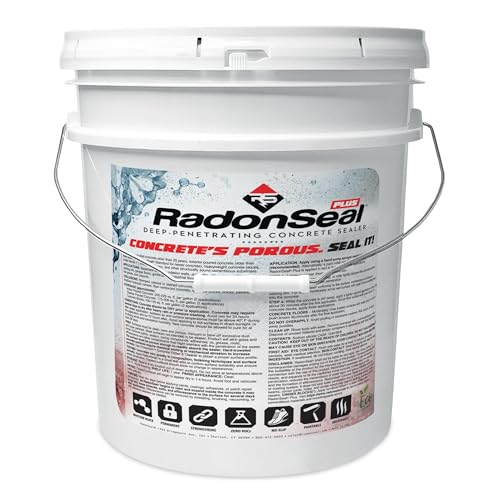
The full-house penetrating silicate that one owner first applied back in 2006 and has trusted ever since.
This is the same deep-penetrating RadonSeal Plus chemistry as its smaller sibling, scaled up for a whole basement at once. The 5-gallon container covers up to 1,000 square feet and weighs a substantial 48 pounds, and it targets floors, walls, slabs, and concrete block with the same internal-seal mechanism — reacting inside the pores rather than coating the surface. The longevity story is the standout here: One buyer first applied it to a 1,200 sq ft basement in 2006., One owner watched a friend’s radon levels drop dramatically within two weeks of application., and returned to use it again on a second house years later.
The most-praised trait is how easy it is to apply — it goes on water-like with a pump sprayer, has no odor, and cleans up without fuss. Buyers report big humidity wins, with Owners mention humidity readings dropping from the high 70s to the 40s percent range during rainy stretches.. Because it leaves no film and no gloss, it prepares concrete beautifully for paint, epoxy, or overlay afterward.
The honest sizing caveat: sealing performance gets mixed feedback in the review data, and the difference usually traces back to surface prep. The owners who ground walls down to bare, clean concrete saw dry basements with no efflorescence; those who applied over dirty or painted block sometimes saw water keep seeping. Expect to do two coats and accept that the cure builds strength over 60-90 days.
Prep decides everything: on clean, porous, bare concrete this is the proven whole-basement moisture and radon answer — but it rewards the owner willing to grind and clean first.
Pick this up for: one big project — a full basement of floors and walls where a single 5-gallon buy saves you from buying multiple smaller cans.
Be ready for the work: two coats on properly cleaned, bare concrete is the difference between a dry basement and a wasted weekend.
8. TUFINEIN Rubber Liquid Waterproof Sealant

A neutral-gray flexible rubber that handles everything from basement steps to boat floors and gutters.
This is the multitool of the list — a 53oz (1.5kg) rubber sealant aimed at foundations and basements but equally happy on metal roofs, sheds, gutters, wooden skylights, and even low-pressure fountains. Its elasticity is the selling point: it smoothly covers small gaps and cracks and resists deformation of the substrate, and it performs across a wide temperature band from -40°F to 176°F without cracking. Owners use it everywhere from garage floors and basement steps to the interior of a bay boat floor, where it stuck well and stayed non-slippery.
Quality is what earns the most praise, and application follows — it goes on like thick paint, forms a durable rubber membrane, and shows initial film formation within 2-4 hours. The formula is self-leveling and can be brushed, rolled, scraped, or even poured, which makes it forgiving for awkward spots. Owners describe it as superior to epoxy paints for basement steps and garage floors.
The catch is coverage, and it is a big one for budgeting. On concrete foundation vertical surfaces at 0.6 mm thickness it covers only about 21.4 sq ft, and a flat roof coat at 1 mm covers roughly half that. Buyers warn plainly that two coats covers less than 11 sq ft out of the 53oz container — so size your project carefully, and note it is not for walking surfaces since it stays tacky when cured.
Coverage reality check: a genuinely flexible, quality rubber sealant for smaller repairs and odd surfaces — just never assume a single can will stretch far.
Grab it for: patch jobs and multi-surface repairs where you value flexibility and a neutral gray finish over square-footage efficiency.
Look elsewhere if: you need to coat a large wall — the tiny coverage per can makes big areas expensive.
Understanding the Specs
Elongation
This number tells you how far a dried coating can stretch before it cracks. A thick rubber membrane like Ames Blue Max lists 1200% elongation, meaning it can flex and move with a settling foundation or a hairline crack without tearing. If your wall has active movement or existing cracks, a high-elongation coating is what you want — a rigid acrylic paint will simply crack again at the same spot.
Hydrostatic Pressure
This is the force of standing water pressing against your wall or floor from the outside, measured in psi (pounds per square inch). The INSL-X WaterBlock lists resistance up to 12 psi, which describes how much water pressure the dried film can hold back. Higher numbers mean the product is built for genuinely wet, below-grade conditions. Penetrating sealers handle this differently by reducing vapor transmission rather than resisting a pressure head.
Penetrating vs. Film-Forming
A film-forming sealer (liquid rubber, acrylic paint) sits on the surface as a visible barrier — the right choice for stopping water that seeps through cracks and block. A penetrating sealer (silicate, lithium formulas like Lithi-Tek and RadonSeal) soaks into the concrete and reacts inside the pores, sealing capillaries from within. It leaves no visible finish but cannot fill an active crack, so it suits dampness and vapor problems rather than active leaks.
Coverage Per Gallon
Coverage ranges wildly by product type. A thin penetrating concentrate can cover up to 200 or even 1,000 square feet per gallon, while a thick rubber coating might only stretch across 75 to 125 square feet. Multiply your wall or floor area by the number of recommended coats and divide by coverage to know exactly how many containers to buy — the densest coatings look cheapest per can but often cost more per square foot.
FAQ
Should I use a penetrating sealer or a rubber coating for my basement walls?
Will a basement sealer stop radon gas from entering?
Can I paint or epoxy over a concrete sealer later?
How many coats of basement sealer do I need?
How do I prepare my basement concrete before sealing?
How long does a basement cement sealer last?
What is the difference between a sealer rated for walls and one for floors?
Is there a sealer that stops water without changing how the concrete looks?
What temperature range can a rubber basement sealer handle?
Why does one can of sealer cover 200 square feet and another only covers 75?
Final Thoughts: The Verdict
If you want one dependable pick, the basement cement sealer winner is the Ames Blue Max Liquid Rubber because its 1200% elongation bridges the cracks that actually let water in, and the crowd has validated it with years of leak-free reports. If you want a clear, invisible treatment for a large floor and vapor problems, grab the Lithi-Tek 9500