
The difference between a muffled, distant recording and a crisp, professional-sounding broadcast often comes down to one decision: picking the right microphone without blowing your budget. Scrolling through endless listings of phantom power specs, pickup patterns, and connectivity standards can paralyze even a determined content creator, yet the market is flooded with options that promise clarity but deliver noise. This guide cuts through the chatter to focus on the handful of mics that actually deliver studio-quality vocal reproduction at prices that won’t make you wince.
I’m Min — the co-founder and writer behind Gadgets Feed. After spending weeks cross-referencing frequency response charts, signal-to-noise ratios, and real-world user tests across the sub- segment, I’ve isolated the models that solve the fundamental equation: maximizing vocal detail and ambient noise rejection while keeping the price accessible.
The core challenge is separating a truly capable cardioid dynamic or condenser from one that merely looks the part. The best affordable microphones balance build integrity, capsule sensitivity, and connectivity versatility so you can start recording, streaming, or podcasting with confidence immediately.
How To Choose The Best Affordable Microphones
Picking the right microphone at a reasonable price hinges on understanding three core variables: the capsule type, the connectivity standard, and the polar pattern. Most beginners overinvest in a single spec without considering how these elements interact in their actual recording environment. The goal is to match the mic’s technical strengths to the specific noise profile of your room and the equipment you already own.
Dynamic vs. Condenser Capsules
Dynamic microphones are rugged, require no external phantom power, and naturally reject ambient noise like air conditioning or computer fans. They produce a warmer, less detailed sound that is ideal for loud sources or untreated rooms. Condenser capsules are far more sensitive, capturing subtle vocal texture and high-frequency detail, but they also amplify background hiss and room reflections. For a standard home studio or bedroom setup, a dynamic mic often delivers a cleaner signal without needing acoustic treatment.
XLR vs. USB Connectivity
USB microphones offer plug-and-play simplicity — you connect directly to your computer and start recording without any additional gear. XLR mics require an audio interface or mixer to convert the analog signal, adding cost and complexity but granting far greater control over gain staging and future upgradability. A hybrid USB/XLR mic provides the best of both worlds: immediate convenience for newcomers and the option to integrate into a professional analog chain later. For budget-minded buyers, a dedicated USB mic with decent build quality usually hits the sweet spot.
Polar Patterns and Off-Axis Rejection
A cardioid polar pattern is the standard for vocal recording because it captures sound primarily from the front while rejecting noise from the sides and rear. This reduces room echo and keyboard clatter significantly. Multi-pattern mics (stereo, omnidirectional, bidirectional) offer flexibility but often compromise the quality of the cardioid mode at the same price point. For most podcasters, streamers, and voice-over artists, a well-executed cardioid-only mic outperforms a cheap multi-pattern alternative.
Quick Comparison
On smaller screens, swipe sideways to see the full table.
| Model | Category | Best For | Key Spec | Amazon |
|---|---|---|---|---|
| Sennheiser Profile | Premium USB Condenser | Pristine voice clarity out of the box | Cardioid condenser, 125dB sensitivity, metal housing | Amazon |
| MAONO PD100X | Hybrid USB/XLR Dynamic | Flexible setups with RGB and software EQ | 24-bit/48kHz, USB-C & XLR, 40Hz–16kHz response | Amazon |
| MAONO PD100 | XLR Dynamic | Broadcast-style warmth at low cost | Cardioid dynamic, 60Hz–14kHz, metal construction | Amazon |
| HyperX SoloCast 2 | USB Condenser | Compact gaming setup with tap-to-mute | 24-bit/96kHz, USB-C, built-in pop filter & shock mount | Amazon |
| Behringer Bigfoot | Multi-Pattern USB Condenser | Versatile room capture on a budget | 4 selectable patterns, USB, metal body | Amazon |
| Sennheiser XS 1 | Handheld Dynamic | Live vocals and mobile karaoke | Cardioid dynamic, 103dB SPL, XLR connector | Amazon |
| Mackie EM-91C | XLR Condenser | Spoken word with sibilance control | Large-diaphragm cardioid, includes shock mount & cable | Amazon |
In‑Depth Reviews
1. Sennheiser Professional Profile

The Sennheiser Profile delivers the kind of natural, warm vocal reproduction that typically requires a separate audio interface and an expensive XLR condenser. Its 125dB sensitivity and cardioid capsule capture voice with body and presence while rejecting off-axis noise effectively, and the 1.2-meter USB-C cable makes plug-and-play setup genuinely painless. The metal housing and weighted base provide stability, and the on-board gain, mix, and volume knobs let you dial in sound without launching a single software utility.
What sets this mic apart in the affordable segment is its refusal to rely on proprietary software for sound shaping. Sennheiser engineered the capsule to sound finished right out of the box, so you get smooth, non-tinny audio even on a laptop headphone jack. The integrated headphone jack with real-time monitoring and a dedicated mute button add practical value for streamers who need to cut audio fast during a live session. At 717 grams, it has a reassuring heft that cheap plastic mics cannot match.
Real users consistently report that the Profile eliminates the thin, hollow quality of entry-level USB mics. The low-profile table stand is compact but may need a boom arm for optimal placement, and the lack of XLR means you cannot expand into a professional analog rig later. For anyone who wants one cable, zero driver fuss, and Sennheiser’s German-engineered sound signature, this is the definitive pick in the premium tier.
Why it’s great
- Warm, natural Sennheiser sound without software
- Solid metal build with tactile onboard controls
- Plug-and-play USB-C on PC, Mac, and Linux
Good to know
- XLR is not available for analog upgrades
- Table stand is low; a boom arm is recommended
2. MAONO PD100X

The MAONO PD100X bridges the gap between beginner simplicity and professional flexibility by packing both USB-C and XLR outputs into a single dynamic body. Its 24-bit/48kHz sampling rate and 40Hz–16kHz frequency response capture 50% more sound detail than cheaper 16-bit alternatives, and the MaonoLink software allows customizable noise reduction that adapts to your room’s specific noise profile. The dynamic core and cardioid pattern work together to reject ambient clicks and hums, delivering a focused vocal track even in less-than-ideal spaces.
Gamers and streamers will appreciate the three-mode RGB lighting with eight color options that syncs with your desktop aesthetic, accessible via the dedicated button or the software app. The tap-to-mute function and the 2-in-1 smart knob for gain and monitoring volume provide instant control during live broadcasts. The built-in headphone jack enables zero-latency monitoring, so you hear exactly what the mic hears. All smart features, including mute and RGB, function only over USB, while XLR mode strips it to pure analog audio — a clean trade-off for those who prioritize sound over bling.
Customer reviews highlight the PD100X’s ability to deliver warm, detailed vocal quality with minimal background interference after adjusting the software noise gate. The main limitation is the working distance — you must stay relatively close to the capsule — but that is typical for dynamic mics. The plastic housing feels less premium than all-metal competitors, but the dual connectivity and software depth make it the most adaptable mid-range option available.
Why it’s great
- USB and XLR in one mic for future flexibility
- Customizable noise reduction and RGB via software
- Tap-to-mute and real-time monitoring onboard
Good to know
- Smart features (mute, RGB) disabled in XLR mode
- Requires close proximity for best signal
3. MAONO PD100

The MAONO PD100 is a pure XLR dynamic microphone that punches far above its price point for anyone who already owns an audio interface or mixer. Its 600-ohm impedance and 60Hz–14kHz frequency range produce a warm, mellow sound that flatters male vocals particularly well, and the integrated double-layer pop filter inside the metal grille attenuates plosive bursts without an external windscreen. The cardioid pattern focuses pickup on the top of the mic, which encourages proper technique and minimizes room reflections.
The bundle is surprisingly generous for the price: the mic ships with a heavy round metal base, a desktop stand with a 2.36-inch rod extender, and a 2-meter XLR cable. The included threads support both 5/8-inch and 3/8-inch standards, so mounting to any professional boom arm or stand is straightforward. The all-metal chassis with sleek black finish looks at home in a broadcast studio and feels sturdy enough for daily use. Because it is a dynamic capsule, it requires no phantom power, reducing setup complexity.
Real-world users note that the PD100 excels at voice-over and podcasting applications where a warm, non-boxy tonal character is desired. The main catch is that it requires significant gain — most audio interfaces need to be pushed, and a inline preamp like a Fethead can help achieve optimal levels without noise floor issues. If you have an interface and value broadcast-style sound at an entry-level budget, this is the strongest performer in its class.
Why it’s great
- Warm, flattering broadcast tone for vocals
- All-metal build with dual-thread compatibility
- Generous bundle includes stand, extender, and XLR cable
Good to know
- Needs high gain; may require an inline booster
- Handling noise can be an issue without shock mount
4. HyperX SoloCast 2
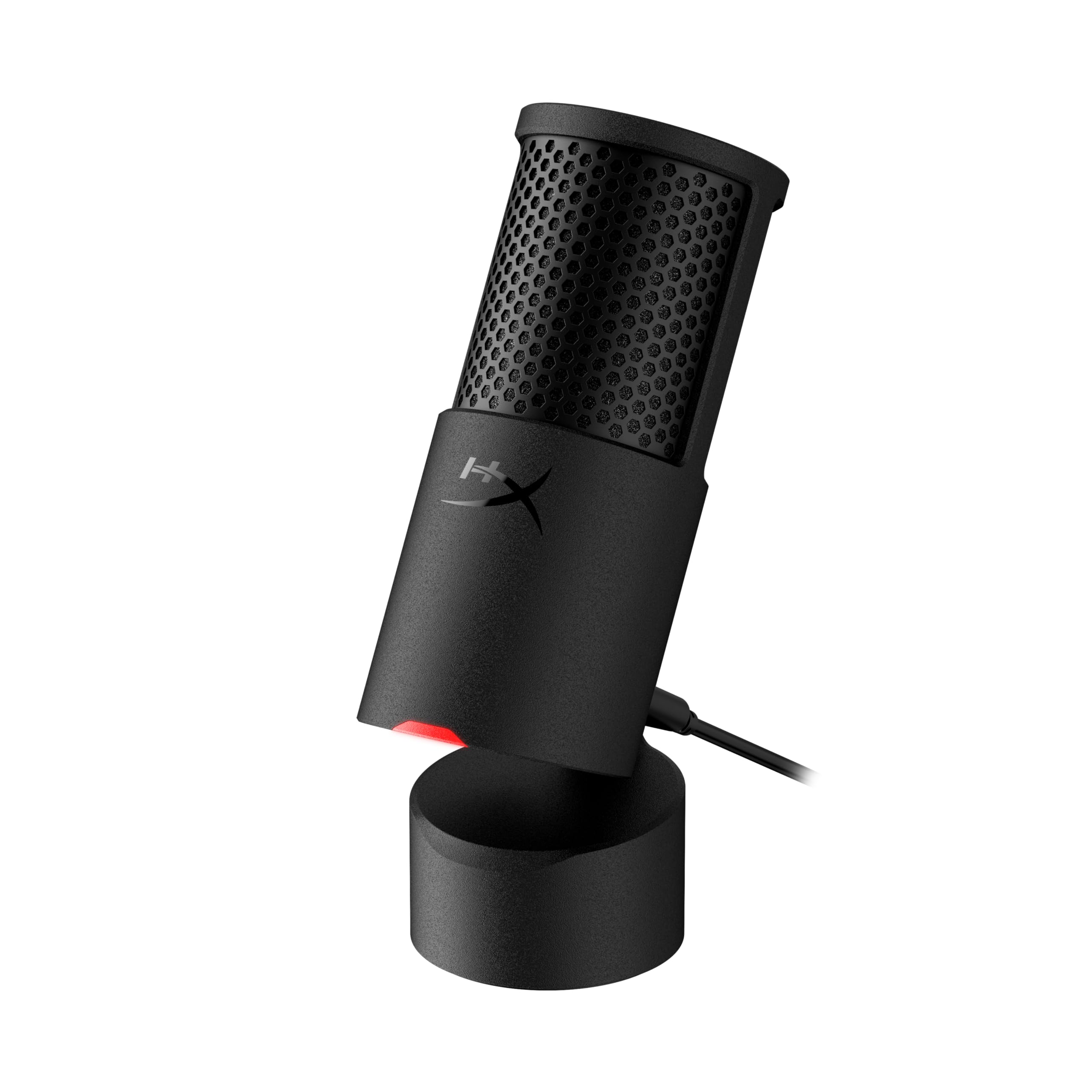
The HyperX SoloCast 2 delivers studio-quality 24-bit/96kHz recording in a remarkably compact form factor that fits any gaming desk without clutter. Its built-in internal shock mount and foam pop filter reduce vibration and plosives without external attachments, and the cardioid polar pattern focuses on your voice while rejecting keyboard switches and background chatter. The tiltable, weighted base keeps the mic stable during intense gaming sessions, and the 3/8-inch and 5/8-inch threads allow easy mounting on a boom arm when you need better positioning.
The tap-to-mute sensor with a red LED indicator is one of the most intuitive mute controls in the budget segment — a single tap silences the mic and the light confirms status at a glance. The HyperX NGENUITY software adds high-pass, low-pass, and voice enhancement filters that you can save directly to the microphone, making your sound profile portable across different computers. The plug-and-play USB-C connection requires no driver installation on Windows, macOS, or gaming consoles.
Reviewers consistently praise the SoloCast 2 for its clear, full-bodied voice reproduction and the convenience of the internal pop filter. The only notable flaw is that the USB-C port on the lower rear of the mic can dislodge if the cable is tugged during use, so securing the cable or using a boom arm is recommended. Additionally, the stand is low, so taller users or those who want the capsule closer to their mouth will need an aftermarket arm. For gamers and streamers who prioritize a clean, clutter-free setup, this mic is a top contender.
Why it’s great
- 24-bit/96kHz audio with internal shock mount
- Tap-to-mute with clear red LED status indicator
- Customizable filters saved on-mic via NGENUITY
Good to know
- USB-C port on lower rear can unplug with movement
- Low stand height; boom arm recommended for optimal placement
5. Behringer Bigfoot

The Behringer Bigfoot is a multi-capsule USB condenser microphone that offers four selectable polar patterns — stereo, cardioid, omnidirectional, and bidirectional — giving you room to adapt to interviews, conference calls, instrument recording, or podcasting from a single device. Its metal housing and heavy build provide stability on the desktop, and the integrated headphone jack with direct monitoring lets you hear yourself in real time without latency. The 20dB audio sensitivity captures a wide dynamic range, making it suitable for both close-miked vocals and ambient room capture.
Plugging the Bigfoot directly into a PC or Mac via USB turns it into a complete recording interface without any additional hardware. The cardioid mode delivers clean vocal reproduction with a low noise floor, and the stereo mode captures a wider soundstage for acoustic guitar or room ambience. Users report that activating Windows Audio Enhancements or using an ASIO driver like asio4all improves latency performance for DAW-based recording. The mic ships with a solid base and a quality USB cable, so you can start recording immediately.
Real-world feedback highlights the Bigfoot’s exceptional value when purchased at a discount, with many comparing its sound quality favorably to more expensive multi-pattern mics like the Blue Yeti. The main caveat is that the omnidirectional and bidirectional modes pick up considerable background noise in untreated rooms, so the cardioid setting is the safest default. If you need pattern flexibility for varied recording scenarios and want to keep costs minimal, the Bigfoot delivers remarkable versatility.
Why it’s great
- Four switchable polar patterns for different use cases
- Solid metal construction with built-in monitoring
- True plug-and-play USB on PC and Mac
Good to know
- Non-cardioid patterns amplify room noise significantly
- Vibrations from the desktop can be audible; boom arm recommended
6. Sennheiser XS 1

The Sennheiser XS 1 is a handheld dynamic microphone built for live vocal performances, karaoke, and spoken word events where durability and clarity are essential. Its cardioid polar pattern and 103dB SPL handling capacity ensure that your voice cuts through loud environments while rejecting feedback from monitor speakers. The XLR-3 connector locks securely into standard mixer inputs, and the silent mute switch on the body allows quick audio cuts without the audible pop that cheap mics produce. The metal grille and chassis feel nearly indestructible, which is critical for mobile use and public events.
Compared to Sennheiser’s own e835, the XS 1 trades a bit of low-end warmth for a clearer, more present mid-range, making it particularly effective for speech intelligibility in noisy rooms. The included carrying pouch and mic clip make transport easy, and the 15.68-ounce weight gives it a substantial, non-toy feel in hand. It does not require phantom power, so it works with any standard mixer or PA system that has an XLR input. Users consistently mention that it feels built to Sennheiser’s German standards despite being manufactured in China.
Real-world feedback from trivia night hosts, church sound techs, and amateur singers confirms that the XS 1 delivers reliable, clear sound at a fraction of the cost of the industry-standard SM58. The only limitation is its frequency response, which slightly rolls off the extreme high end — this is a trade-off for the feedback rejection that live environments demand. For a rugged, go-anywhere vocal microphone at a budget price, the XS 1 is the clear winner in the handheld dynamic category.
Why it’s great
- Rugged Sennheiser build quality at a budget price
- Cardioid pattern rejects feedback in live sound
- Silent mute switch and included carrying pouch
Good to know
- Frequency response rolls off extreme highs for feedback control
- Lacks the low-end warmth of Sennheiser’s e835
7. Mackie EM-91C

The Mackie EM-91C is a large-diaphragm cardioid condenser microphone designed specifically for spoken word applications, with a frequency response that rolls off the high end to tame sibilant vocal recordings. Its 78dB sensitivity and stainless steel construction make it a rugged option for home studio voice-over work, and the included shock mount and XLR cable mean you have everything needed to connect to an audio interface out of the box. The cardioid pattern provides good off-axis rejection, keeping room reflections out of the primary vocal track.
What distinguishes the EM-91C from other budget condensers is its deliberate top-end shaping — it avoids the piercing, harsh high-frequency peaks that plague many cheap large-diaphragm mics, making it ideal for long-form narration, audiobooks, and podcasts where vocal fatigue is a real concern. The shock mount is surprisingly decent for the price, isolating the capsule from desk thumps and footfall vibrations. Users who pair it with a low-cut filter around 100Hz report a clean, full-bodied sound for male and female narration alike.
Customer feedback consistently notes that the EM-91C punches above its weight class when used for voice-over and streaming, though it is not recommended for acoustic instruments or singing due to the rolled-off highs. The requirement for 48V phantom power means you need an interface or mixer with that capability, adding a barrier for absolute beginners. If you already have an XLR interface and prioritize a smooth, non-fatiguing spoken word sound, the Mackie EM-91C delivers professional character at an entry-level price.
Why it’s great
- Rolled-off highs prevent sibilance in spoken word
- Includes shock mount and XLR cable in the box
- Stainless steel construction feels premium for the price
Good to know
- Requires phantom power (48V) from an interface
- Not ideal for singing or acoustic instrument recording
FAQ
Do I need phantom power for a dynamic microphone?
What is the practical difference between 16-bit and 24-bit recording?
Can I use an XLR microphone with a USB-only computer?
Final Thoughts: The Verdict
For most users, the best affordable microphones winner is the Sennheiser Profile because it delivers the most natural, warm vocal sound without requiring any software tweaks, plus it offers onboard controls and a headphone jack for real-time monitoring. If you want the flexibility to upgrade to an XLR setup later while keeping USB convenience, grab the MAONO PD100X with its dual connectivity and customizable software features. And for pure broadcast-style warmth at the lowest entry point, nothing beats the MAONO PD100 XLR dynamic — provided you have an audio interface ready.