
Our readers keep the lights on and my morning glass full of iced black tea. As an Amazon Associate, I earn from qualifying purchases.
Specs are compiled from manufacturer listings and verified buyer reviews and can change over time — please confirm the key details on the product page before buying.
If you need to warm a whole garage, basement, or greenhouse—not just the spot right in front of the heater—you need a 220-volt model. A 220-volt electric heater pulls roughly double the power of a standard plug-in unit, so it can push serious heat into large or drafty spaces without running all day. Below are the 220-volt options that make sense for different rooms, from compact wall panels to heavy-duty shop blowers, so you can match the heat output to the square footage you need to warm.
I’m Min — the founder and writer behind Gadgets Feed. This guide is built by comparing the manufacturers’ published specifications and the patterns across verified customer reviews, so you get each pick’s real strengths and trade-offs instead of marketing spin.
You will find practical, room-by-room advice here, and the 220 electric heater comparisons focus on wattage, installation needs, and the honest feedback from people who live with these units daily.
Our Picks at a Glance


How To Choose The Best 220V Electric Heater
A 220-volt heater is a different beast from the portable space heater you plug into a regular outlet. It is usually meant to be a permanent or semi-permanent part of a room, and it delivers enough power to actually heat a large space. Before you buy, you need to check three things: your available circuit, your wall space, and the square footage you intend to warm.
Check your electrical setup first
The single biggest mistake is buying a 240V heater when your home only has a 120V outlet nearby. Many of these units must be hardwired directly into a circuit or connected to a specific outlet type, like a NEMA 14-50P plug or a 20A receptacle. You will often need an electrician for installation, especially for high-wattage units that demand a dedicated breaker. Look at the amperage draw listed for each heater and compare it to your breaker capacity before you commit.
Match the wattage to the room size
As a rule of thumb, the higher the wattage, the larger the space you can heat. A 500-watt wall panel is perfect for a small bathroom or office, while a 4,800-watt or 7,500-watt unit is built for garages and workshops. Wattage also determines how quickly a room warms up. A higher-wattage fan heater can raise a cold garage by 20°F in half an hour, while a lower-wattage convection panel warms a small room more slowly.
Understand the different heat types
You will see three main methods in this list. Fan-forced heaters use a blower to push warm air out into the room, which heats a space quickly and is ideal for garages and basements. Radiant heaters warm the objects and people directly in front of them, which is great for workshops but less effective at warming an entire drafty room. Convection heaters create a slow, natural air flow with no fan at all, making them dead silent and effective for tightly sealed living spaces like bedrooms and bathrooms.
Quick Comparison
| Model | Best For | Heat Output | Coverage | Amperage | Amazon |
|---|---|---|---|---|---|
| King PAW2422-W★ Best Overall | Zone heating in basements | 500 watts | 400 sq ft | 9.38 A | Amazon |
| DR. Infrared DR218Greenhouse Pick | Greenhouse freeze protection | 3000 watts | 600 sq ft | 12.5 A | Amazon |
| Stiebel Eltron CK TrendQuiet Performer | Basements & bathrooms | 2000 watts | — | 8.7 A | Amazon |
| Cadet Com-Pak CS202 | Replacing old Cadet units | 2000 watts | 250 sq ft | 8.33 A | Amazon |
| Envi LE5022D | Bedrooms & offices | 500 watts | 150 sq ft | 2.27 A | Amazon |
| NewAir Garage Heater | Large shops & garages | 4800 watts | 500 sq ft | 30 A | Amazon |
| InoKraft 7500W | Extra-large garages | 7500 watts | 750 sq ft | 31.25 A | Amazon |
| Bio Green PHX 2.8 | Greenhouses & sheds | 2800 watts | 215 sq ft | 13 A | Amazon |
| Broan-NuTone 198 | Whole small rooms | 4000 watts | 265-400 sq ft | 16.67 A | Amazon |
In-Depth Reviews
1. King PAW2422-W Pic-A-Watt Wall Heater
Our pick — over 4.5★ from 300+ verified ratings; the strongest balance of quality and price.
The hardworking wall heater that tailors its output to the room you actually have.
You can match this King heater to your room’s exact size because its Pic-A-Watt element (a heating element you can set to different wattage outputs) lets you choose the heat level instead of being locked into one. It uses a forced-air design with a squirrel cage blower (a cylindrical fan that pushes air steadily) to distribute warmth gently. Buyers report it sounds like a quiet forced-air vent, not a loud fan, so you won’t need to turn up the TV to hear over it.
Owners consistently call out the straightforward installation and the fast heat-up time as the top reasons they are satisfied. The unit is meant to be hardwired into a 220V circuit and needs a thermostat to control it, so basic wiring skills are required. The build quality gets mostly positive feedback, with one owner noting the unit is “well built & should last for years”—the adjustable wattage was the feature that sealed the deal for them.
The noise level earns mixed feedback, though most find it acceptable, and a few mention the sides can bow during installation if you are not careful, which can misalign the screw holes. It serves best as a primary heat source for a finished basement or a supplemental heater for a bedroom, not as a main heater for a whole large open floor plan. Owners mention it is “great for new construction/basements; heats rooms well, quiet, unobtrusive,” which sums up its place in a home perfectly.
What wins people over
- Adjustable wattage lets you match heat to room size
- Pushes out strong, fast heat across up to 400 sq ft
- Runs quietly, more like a vent than a space heater
What to watch
- Needs a 220V thermostat and basic wiring skill
- Noise is a touch louder than “whisper silent” for some
Perfect for: anyone finishing a basement or adding zone heat to a 400 sq ft room who wants a quiet, adjustable wall unit.
Think twice if: you are not comfortable with hardwiring and basic electrical work, or you expect it to heat an entire open floor plan.
2. Dr. Infrared Heater DR218-3000W
The radiant tower that keeps tender plants alive through the worst of winter.
This green tower is built to keep greenhouses and workshops above freezing when temperatures drop. Its radiant heating element warms objects directly—like your plants and tools—while a fan moves air around the space. It lists a coverage of 600 square feet, and owners have tested it in real winter conditions: one review shows it kept an 8x12ft polycarbonate greenhouse (508 cu ft) at 38-39°F during a 17.1°F night, running 4.9 hours and using 7.1kWh over that 12-hour stretch.
What stands out is the performance and solid build, which are the two most-discussed positives. It is compact and light, easy to move where you need it, and the enclosed heating element needs very little maintenance. The 240V model requires a 20A outlet, so it is not a simple plug-into-the-wall situation, but anyone setting up a greenhouse for cold-weather growing usually has that circuit planned already. Customers note it cycles on and off properly with the thermostat and runs quietly with steady heat.
The catch is that its reach and power have limits. Heat output gets mixed feedback: it is excellent for a small-to-mid greenhouse, but it is not going to warm a large, uninsulated shop on its own. One owner in Michigan found it could not maintain 45°F in a 10x10ft greenhouse during single-digit temperatures and needed a backup unit. A couple of reviewers point out serious reliability issues with the thermostat wiring, so this is a heater to keep an eye on rather than set-and-forget. Shoppers say it handled a Montana spring freeze without issue, which is the exact scenario this unit was made for.
Best in its class: For keeping a greenhouse above freezing during bitter nights, this radiant heater does the job efficiently, though extreme cold and large spaces will test its limits.
A word of caution: The thermostat wiring has been the source of rare but serious failures, so it is worth monitoring during the first few cold snaps.
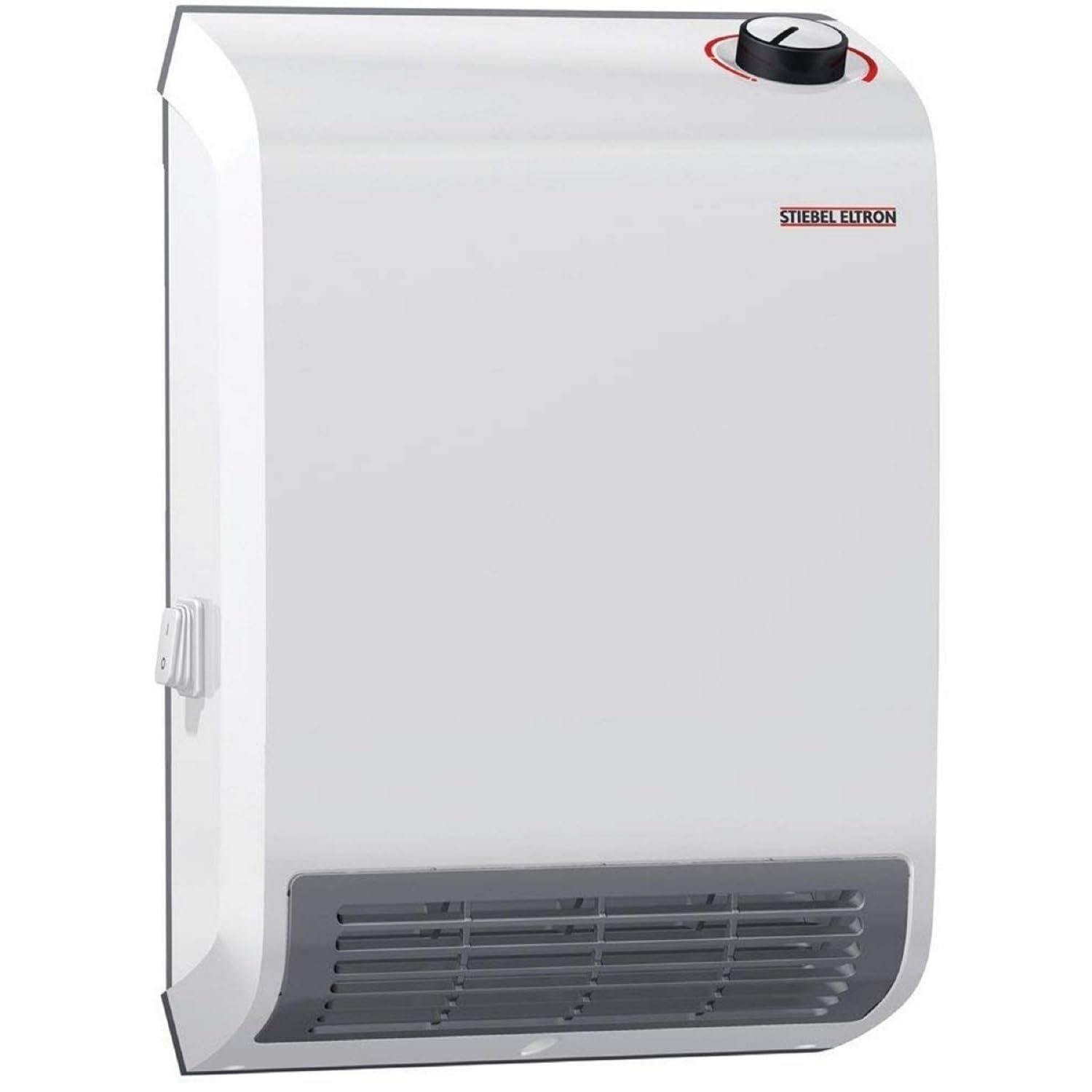
3. Stiebel Eltron CK Trend Wall Heater
A German-engineered fan heater that warms a chilly basement in two hours flat.
Stiebel Eltron brings a level of engineering to this wall-mounted fan heater that shows in the details. The glass-reinforced polycarbonate radial fan is rated at just 49 dB(a)—about the level of a quiet conversation—so it is genuinely unobtrusive when it kicks on. It uses a ceramic PTC heating element (a type of element that self-regulates its temperature), which is known for longevity and steady output. The unit is rated at 2000 watts on 240V and drops to 1800 watts on a 208V circuit, giving you roughly 6824 BTU/hour of heat at 240V.
Real-world performance is this heater’s strongest point: buyers report it heated a basement from 58°F to 67°F in 2 hours, then held 65°F on a cycle of 15 minutes on and 45 minutes off. That efficiency is why owners call it economical and recommend the 240V version over weaker 120V alternatives. The simple knob control is another plus—owners prefer it over complex digital panels that can fail.
Installation is where this unit asks the most of you. It must be hardwired, so most homes will need an electrician. There is no exterior knockout for conduit (a pre-cut hole for wiring), so wiring must enter from the back—drilling your own hole can void the warranty. It is ETL listed (certified for US and Canada safety standards) and comes with a 3-year warranty. Most owners are happy, but a few report the unit shutting down after a few seconds due to overheating, so careful, correct wiring is essential.
Real-world winner: For a large basement, bathroom, or office that needs quiet, efficient heat, this unit raises the temperature dramatically in a couple of hours and holds it there on a low-power cycle.
Installation reality: This is not a DIY plug-in; budget for an electrician to hardwire it properly, and know that the fan is slightly audible when it is on high.
4. Cadet Com-Pak CS202 Wall Heater

The drop-in replacement that slides into a 40-year-old wall can like it was made for it.
Cadet has been making these wall heaters for decades, and this Com-Pak model exists for one very practical reason: replacing old, failing units. It connects to an existing wall can with a single screw, which is why installation is the second most-praised aspect after its overall performance. Owners mention swapping out a unit in a 40-year-old condo with ease, removing the old heater and sliding this one in without any wall damage. The 2000-watt output on 240V is rated to warm about 250 square feet, making it a solid performer for medium bedrooms, bathrooms, and small living spaces.
The assembly itself is a forced-air unit with an 8-inch by 10-inch face, and it can be installed horizontally or vertically to fit whatever orientation your current setup uses. That flexibility is a huge plus for replacements. It is assembled in the USA and backed by a 5-year warranty, which gives it a durability story that matches its purpose. The most common praise is that it works quietly and keeps the room at the temperature you set, exactly as expected.
What you need to know before ordering is that this is the heater assembly only. You have to buy the wall can, grille, and thermostat separately, and those are required for installation. That makes the upfront cost a little higher than the sticker suggests. The durability feedback is mixed, though the flip side of that is one owner noting the design “hasn’t changed in 20 years”—which is precisely why it fits old installations so well. For anyone with a dead Cadet heater in the wall, this is the most straightforward fix available.
The easy route: If you have an old wall can already in place, this single-screw swap is the fastest way to get reliable heat again, with the bonus of a US-made build.
Budget note: Remember the grille, wall can, and thermostat are sold separately, so factor those into the total cost before you start the project.
5. Envi 220V Electric Panel Heater
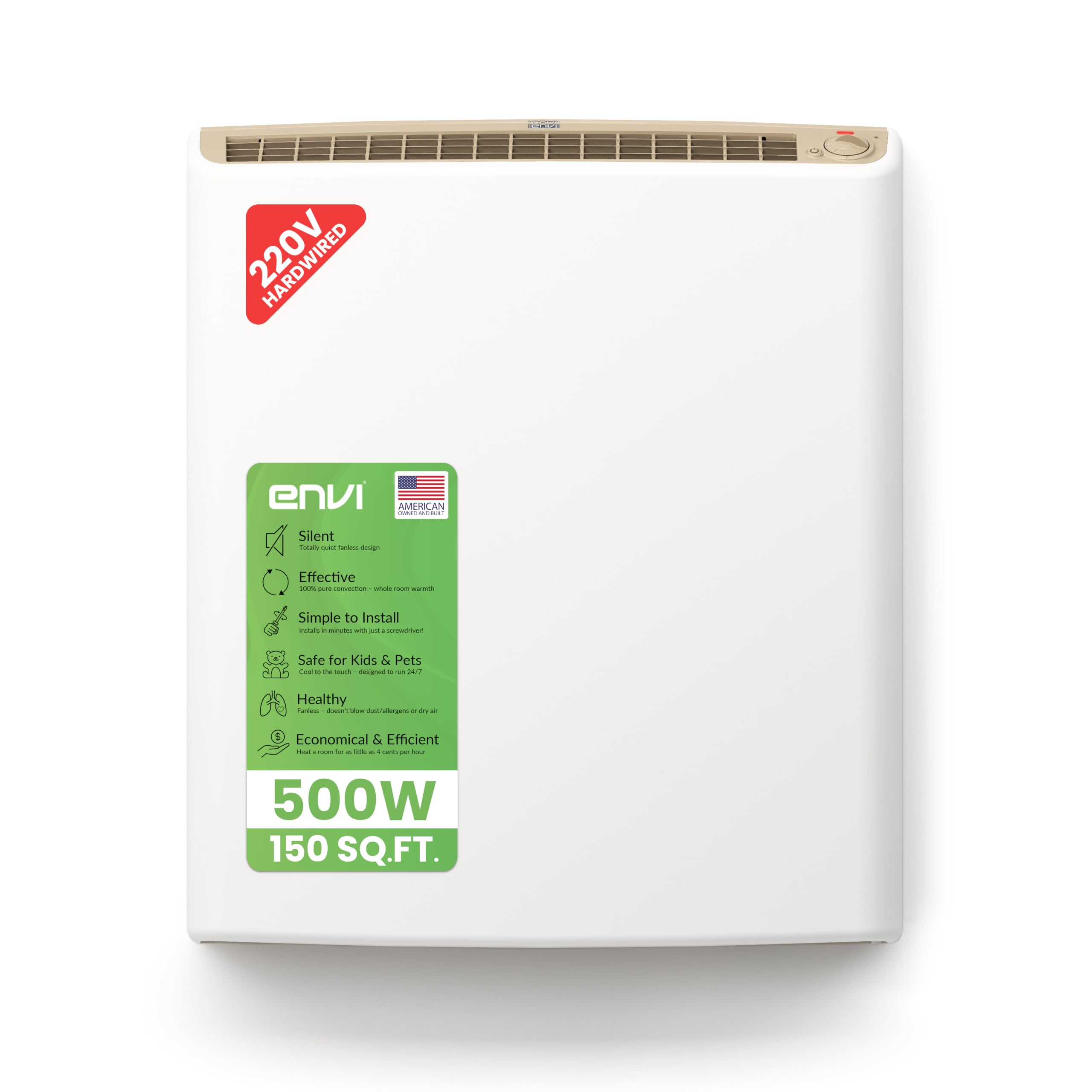
The whisper-quiet panel that blends into the wall and holds a room at a steady 72 degrees.
If you have ever been annoyed by the hum of a fan heater in a bedroom, this Envi panel is the answer. It uses a fan-less convection design, which means no moving parts and no noise—just a natural updraft of warm air that circulates gently through the room. The unit is only 2 inches thin and mounts flat against the wall, so it disappears into the decor while providing steady, low-wattage heat. At 500 watts and 220V, it draws just 2.3 amps, which is low enough that you can install multiple units on the same circuit without tripping a breaker.
That low power draw is the core of its appeal. The manufacturer claims you can cut heating bills by up to 50% by heating only occupied rooms. Owners echo that sentiment, with one noting they put two in a 350 square foot room and “get too hot when turned half way up,” adding that the extra upfront cost is worth the energy savings. The surface stays cool to the touch at around 90 degrees Fahrenheit, and a wall-sensor cuts power if the unit is removed, which makes it a genuinely child- and pet-safe option for 24/7 use.
The honest trade-off is that 500 watts is a modest amount of heat. It is perfect for a small bathroom, office, or single bedroom, but the heating performance gets mixed feedback from owners who expected more warmth in larger spaces. It is hardwired only, so installation requires a 220V circuit, though the included mounting kit and template make the physical mounting straightforward. One owner found it easy to install and praised the modern, flat-to-the-wall design. A single unit is not going to warm a large open-concept area, but for supplementing heat in the room you are actually in, it is an efficient, silent choice.
Made for small rooms: For a bedroom or bathroom that needs a constant, silent warmth without blowing dust around, the Envi is a clean, safe, and energy-conscious pick.
Reality check: It will not blast heat into a large space, and it is a hardwired unit, so you will need an electrician or some wiring expertise.
6. NewAir 4800W Garage Heater
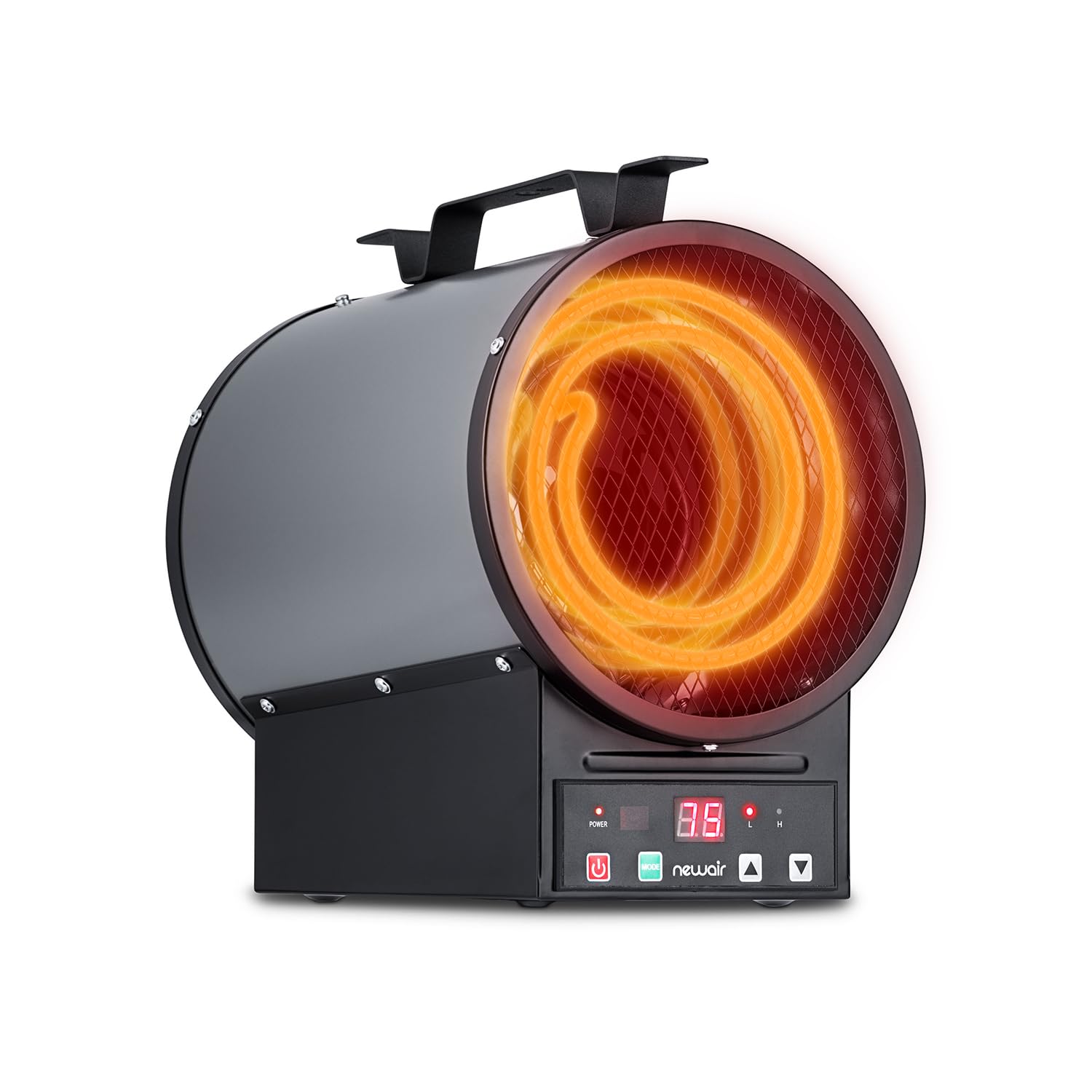
The compact powerhouse that turns a freezing garage into a sweatshirt-optional workspace fast.
NewAir packs a serious punch into a unit that is barely larger than a 12-pack of soda. Delivering 4,800 watts on a 240V circuit, this heater takes an 18×18 insulated garage from 45°F to 68°F in under 30 minutes, per owners. It is rated to warm up to 500 square feet, and the real-world reviews back that up, with one owner comfortably heating a 600-sf garage in a sweatshirt when it was 15°F outside. The design is versatile too—you can run it freestanding on the floor or mount it to the wall or ceiling with the included bracket.
Owners praise this unit’s performance and heat output most, which makes sense given its power. The included remote control lets you adjust temperature, fan speed, and a timer from across the room, and the digital thermostat gives you precise control. It uses a UL-certified 30-amp, 3-prong plug, but no cord is included—you will need to wire in your own 10/3 cable (a thick, 3-wire cable rated for 30 amps) or hire an electrician, and the unit requires a dedicated 240-volt outlet.
The main drawbacks are the thermostat and long-term durability. Customers note the temperature control is finicky—the knob sits on the back, making it hard to see and reach once mounted—and there are rare reports of the thermostat sticking and the unit not shutting off. A few buyers mention durability issues over time, though customer service is generally positive, with NewAir replacing units that fail within the first year. The fan is audible but conversation is still possible; it is not a quiet bedroom heater. For a workshop needing fast, serious heat, this delivers.
The roaring positives
- Blasts a cold garage up to comfortable temps in under half an hour
- Freestanding or wall/ceiling mount flexibility
- Remote control and digital thermostat for easy adjustments
The honest downsides
- Thermostat knob placement on the back is awkward
- Requires professional wiring; no cord or plug included
Reach for this if: you need to make a 400-600 sq ft garage or workshop comfortably workable during winter and want serious heat on demand.
Look elsewhere if: you need a quiet, set-and-forget heater for living spaces, as this is built for the noise and demands of a shop.
7. InoKraft 7500W Garage Heater
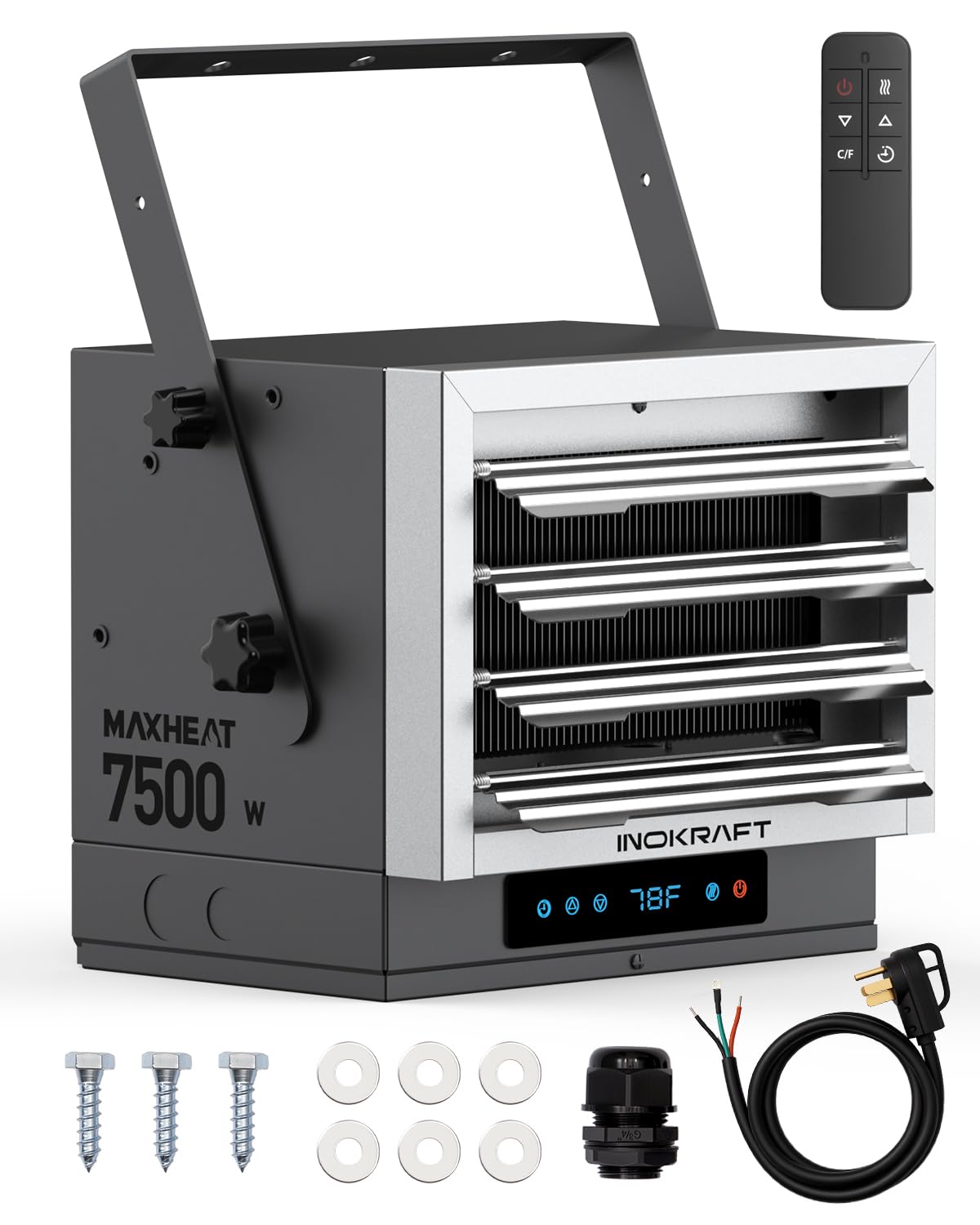
The heavy-duty blower that brings a 950 sq ft garage up to a working temperature in two hours.
When a two-car garage is not cutting it, the InoKraft steps in with a massive 7,500 watts of fan-forced heat. Rated for 750 sq ft, one owner reports it warmed a 950 sq ft garage from 39°F to 65°F in 2 hours at 10°F outside. The unit operates at a quoted 65 dB, which is a noticeable hum but acceptable for a workshop environment. It comes with a NEMA 14-50P plug and an 8.2-foot power cord, which simplifies the electrical connection compared to hardwiring—though the manufacturer still recommends professional installation.
Quality is the most-discussed positive, followed closely by heating performance. This is a well-built machine, and owners consistently describe it as solid and durable. The digital thermostat lets you set a precise temperature from 40°F to 99°F and program a 1-24 hour timer. There is also an ECO mode that automatically adjusts output based on the ambient temperature and shuts off power when it is not needed, which helps keep the electric bill in check. The included remote actually works well, and owners appreciate being able to adjust the heat without walking across a cold garage.
The trade-off is the built-in thermostat’s accuracy. Because the sensor sits near the heat source, reviewers point out it can read up to 10°F higher than the actual room temperature near the ceiling, causing the unit to shut off before the space is truly warm. The solution many use is an external wall thermostat. Installation also requires a sturdy mount—one owner reinforced it with a 2×4, and a few note the included single-bolt mount feels tenuous on drywall alone. The verified comparison shows this unit’s noise at 65 dB is a real consideration if you plan to spend hours in a man-cave rather than a workshop.
The top performer: For serious garage heating where 750 sq ft or more needs to get warm fast, the InoKraft is the strongest, best-reviewed option in this roundup.
The fine print: Budget for an external thermostat to get accurate temperature control, and plan for a solid mounting solution beyond the factory single-bolt setup.
8. Bio Green PHX 2.8/US Greenhouse Heater

The stainless steel workhorse with two separate heating elements for flexible greenhouse warmth.
Bio Green designed this heater for the specific demands of a greenhouse, and it shows in the features. It houses two independently adjustable heating elements—one at 1000 watts and one at 1800 watts—which together give you up to 2800 watts of power. That flexibility means you can run just the smaller element on a mild night or both for deep winter freezes. It is ideal for spaces up to 215 sq ft with standard 6.6-foot ceilings, and the stainless steel housing is built to handle the damp, shock-prone environment of a greenhouse. The unit can stand on the floor or hang from the included chains.
The two most-praised aspects are performance and temperature control. The thermostat is steplessly adjustable across a wide range, from -58°F up to 79°F, and it automatically starts and stops the heater to hold your target temperature. There is also a dedicated air circulation mode that turns the unit into a fan, moving up to 16,000 cubic feet of air per hour to prevent heat from building up right around your plants. Shoppers say it holds a 10’x20′ greenhouse at 65°F in 12°F weather, with one 27-year grower calling it the best they’ve used.
Reliability is where opinions split. While many owners have used theirs for years without issue, a few report units failing after about two years of service, with one citing a broken plug on arrival and no weekend technical support available. The unit requires a 220V connection with a 6-20R receptacle and a 20A GFCI breaker, so it is not a standard plug-in. The controls are a manual dial system rather than digital, which some owners love for simplicity and others find imprecise. It is built for greenhouses and sheds, not living spaces, but within that niche it performs excellently.
For serious growers: If you need to keep a mid-sized greenhouse above freezing all winter, the dual-element design and high fan volume make this a premium, effective tool.
The risk: The reliability record is mixed—most units run for years, but a handful fail after two, and weekend support is not available.
9. Broan-NuTone 198 Wall Heater

The high-capacity wall unit that can heat two small rooms at once with a quiet, downward airflow.
This Broan-NuTone is the biggest wall heater in the lineup, cranking out 4,000 watts on a 240V circuit to warm between 265 and 400 square feet. That kind of power means it can handle an open basement or a large tiled bathroom that smaller units cannot touch. It uses a heavy-duty blower wheel and a fan to push air through a louvered grille that directs heat downward toward the floor, which creates more even warmth than heat that rises straight up. The 18-gauge steel grille has a baked enamel finish designed to hold up for years in high-traffic areas.
Heat output and easy installation are the top positives, with owners noting it warms tile bathrooms in minutes—a task that took their old space heaters hours. One owner reports it heats an uninsulated gazebo through Illinois winters. The unit can be recessed into the wall or surface-mounted, giving you flexibility depending on your framing. It is factory wired for 4000 watts at 240V but can be converted to run at 2000 watts on 120V if you ever move it to a different setup, which is a rare and useful feature.
The durability and noise records are the weak points. A number of buyers report units that died after a few weeks or years, with issues around the thermal overload switches and reset buttons. The fan also earns mixed feedback for noise—some find it very quiet, while others describe it as loud enough to notice. One owner’s main complaint is that the heat control only offers “hot or not hot” rather than a true medium setting. Still, the positive reviews are strong, and the brand’s long history means replacement parts are easy to find. This is a powerful option for a large room, but it is worth buying from a source with a good return policy.
The big heater: For a large basement or a room that smaller wall units cannot handle, the 4000-watt output delivers fast, substantial warmth.
Proceed with caution: The reliability record is the most mixed in this list, so pay attention to the warranty and be ready to use it if needed.
Understanding the Specs
Wattage vs. Square Footage
Wattage is the single most important number on a 220-volt heater because it dictates how much heat the unit can produce and, therefore, how large a space it can warm. As a very rough guide, a 500-watt heater suits a small room up to about 150 sq ft, a 2000-watt unit can handle around 250 sq ft, and a 4800-watt or higher unit is for garages and workshops up to 500-750 sq ft. Be honest about your space: an under-powered heater will run constantly and still leave you cold.
Amperage & Circuit Requirements
Every heater draws a certain amount of current, measured in amps, which tells you what kind of circuit it needs. A unit drawing 8.7 amps can run on a standard 15-amp 240V circuit, while a 30-amp unit like the NewAir or the 31.25-amp InoKraft requires a dedicated, beefier circuit. You cannot plug a 30-amp heater into a normal outlet—it needs a specific plug type and a breaker rated for that load. Always check your home’s electrical panel before buying a high-wattage unit.
FAQ
Can I plug a 220-volt heater into a regular wall outlet?
Will a 240-volt heater work on a 220-volt supply?
How many square feet will a 5000-watt garage heater heat?
What is the difference between fan-forced and radiant heaters?
Do I need a special thermostat for a hardwired wall heater?
Is a 220-volt heater more energy-efficient than a 120-volt one?
Can I mount a garage heater on the ceiling?
How long does a 220V wall heater last?
What is the difference between 2000W at 240V and 2000W at 208V?
Why do some heaters need a 20-amp or 30-amp breaker?
Final Thoughts: The Verdict
For most people, the 220 electric heater winner is the King PAW2422-W because it offers adjustable wattage and quiet performance in a wall-mounted design that suits basements and large rooms. If you need serious heat for a garage or workshop, grab the InoKraft 7500W for its raw power and ECO mode. And for anyone with a greenhouse to protect, the Dr. Infrared DR218 is the specialist that keeps plants alive through freezing nights. Buyers who match wattage to room size and plan for professional installation stay warm all winter.
How We Picked
We do not accept paid placement. Every pick is matched to a real buyer and a real use-case; we do not hands-on test units.
Sources & Methodology
Specifications: manufacturer listings and product documentation. Review insights: verified customer reviews, as of September 2026. Pricing: not shown on this page (it changes often); check the current price via the retailer link.
As an Amazon Associate, Gadgets Feed earns from qualifying purchases. This does not affect which products we feature.