
Our readers keep the lights on and my morning glass full of iced black tea. As an Amazon Associate, I earn from qualifying purchases.
Specs are compiled from manufacturer listings and verified buyer reviews and can change over time — please confirm the key details on the product page before buying.
The real question for a basement floor isn’t the color — it’s whether the coating will still be there in a year. Basements are wet, cool, and prone to dusty concrete, and that combo peels cheap paint fast. The honest place to start is the difference between a simple acrylic paint and a true two-part epoxy kit, because that one decision decides everything else about your project.
I’m Min — the founder and writer behind Gadgets Feed. This guide is built by comparing the manufacturers’ published specifications and the patterns across verified customer reviews, so you get each pick’s real strengths and trade-offs instead of marketing spin.
Basement floors face moisture, scuffs, and heavy traffic, so the best basement floor coating must balance easy application with genuine long-term durability for your space.
Our Picks at a Glance

How To Choose The Best Basement Floor Coating
Before you pick a can, you need to match the coating type to your basement’s reality. A dry, low-traffic storage room tolerates a simple acrylic. A workshop where you drag toolboxes and roll heavy equipment demands a real epoxy. Every option here is genuinely worth using — the task is finding the one that matches your floor’s condition and your patience for prep.
One-Part Paint vs Two-Part Epoxy
A one-part acrylic floor paint is the weekend-friendly option. It rolls on like thick paint, cleans up with soap and water, and skips the measuring and mixing that epoxy demands. The trade-off is pure toughness: owners consistently report peeling where car tires rest or where moisture pushes up from below. A two-part epoxy, by contrast, requires mixing a resin and a hardener, but it cures into a much harder, chemical-resistant film that shrugs off scuffs and standing water. If your basement could flood or sees real abuse, the extra effort of epoxy is worth it.
Coverage, Coats, and Cure Time
Every can lists a coverage figure in square feet per gallon, and that number drives how much you buy. A coating that covers 300-400 square feet per gallon on smooth concrete will drop to 200-300 on rough, porous slabs — so buy extra if your floor is old and pitted. Plan on two coats for even color, and pay attention to the difference between dry-to-touch and full cure. Full cure, which is when the coating actually reaches its final hardness, can take anywhere from 4 hours to 5 days depending on the formula. Walking on it too early is the fastest way to ruin a fresh coat.
Quick Comparison
| Model | Best For | Coverage | Finish | Type | Amazon |
|---|---|---|---|---|---|
| KILZ 1-Part Epoxy★ Best Overall | Large basements | 300-400 sq ft | Satin | One-part epoxy-acrylic | Amazon |
| SENVEN AcrylicBest Value | Quick roll-on jobs | 120 sq ft | Semi-Gloss | One-part acrylic | Amazon |
| matvio Two-Part EpoxyMoisture Shield | Moisture-prone slabs | 135 sq ft | Satin | Two-part epoxy | Amazon |
| DuraGrade Concrete Paint | No-etch prep | 300-350 sq ft/gal | Gloss | One-part coating | Amazon |
| KOMPOZIT Acrylic | Self-priming speed | 300-400 sq ft/gal | Satin | One-part acrylic | Amazon |
| Everflow MPC-100 | Showroom gloss | — | High-gloss | 100% solids epoxy | Amazon |
| ShangTianFeng 5 Gal | Huge square footage | 800-1000 sq ft | High gloss | One-part acrylic | Amazon |
| ArmorPoxy Epoxy Kit | Full DIY overhaul | 300 sq ft | High-gloss | 100% solids epoxy | Amazon |
In-Depth Reviews
1. KILZ 1-Part Epoxy Concrete & Garage Floor Paint
Our pick — over 4★ from 3,000+ verified ratings; the strongest balance of quality and price.
The one-part epoxy-acrylic that stretches a single gallon across a whole basement.
If you want the easiest path to a clean, protective basement floor without the mixing hassle of a true epoxy, this KILZ formula earns its spot as the top pick. The one-part epoxy-acrylic blend rolls on with a roller or brush and cleans up with soap and water, yet it resists scuffing, cracking, peeling, fading, and even hot tire pickup. That hot tire resistance matters more than you’d think — it means the coating is designed to hold up where car tires and heavy equipment actually touch the surface.
Before you buy, know that one gallon covers 300-400 square feet on smooth concrete and 200-300 on rough, so a single can handles a typical mid-size basement in one or two coats. The make-or-break step is surface prep: buyers who pressure-washed, applied a primer, and let it cure for a month saw it hold up for two years, resisting oil and coolant stains with only minor scuffs from dragging equipment. Skip the prep, and a vapor barrier issue underneath will cause adhesion failure no matter what brand you use.
That 1,000+ owner crowd favors this one at a solid 4.3-star clip. Buyers report the “easy application” is the thing everyone raves about, and a gallon goes a long way — one project covered 288 square feet with a quarter can left over. The honest caveat is durability under real abuse: this is acrylic-based, not true epoxy-grade, so it’s not built for driving and turning wheels directly on it. Keep it to foot traffic, storage, and light workshop use and the value is hard to argue with.
Why It Wins
- One part, so no mixing or measuring required
- Spreads 300-400 square feet per gallon on smooth surfaces
- Low-VOC water base cleans up with just soap and water
- Handles interior and exterior horizontal concrete
Where It Fits
- Acrylic durability, not true epoxy toughness
- Needs a good primer for best adhesion
- Some report the gray reads closer to light blue
Grab it if: you want one straightforward can that covers a large dry basement with minimal fuss and easy clean-up.
Think twice if: you expect to drive on the floor or your slab has moisture seeping up — that needs a real two-part epoxy and a vapor barrier.
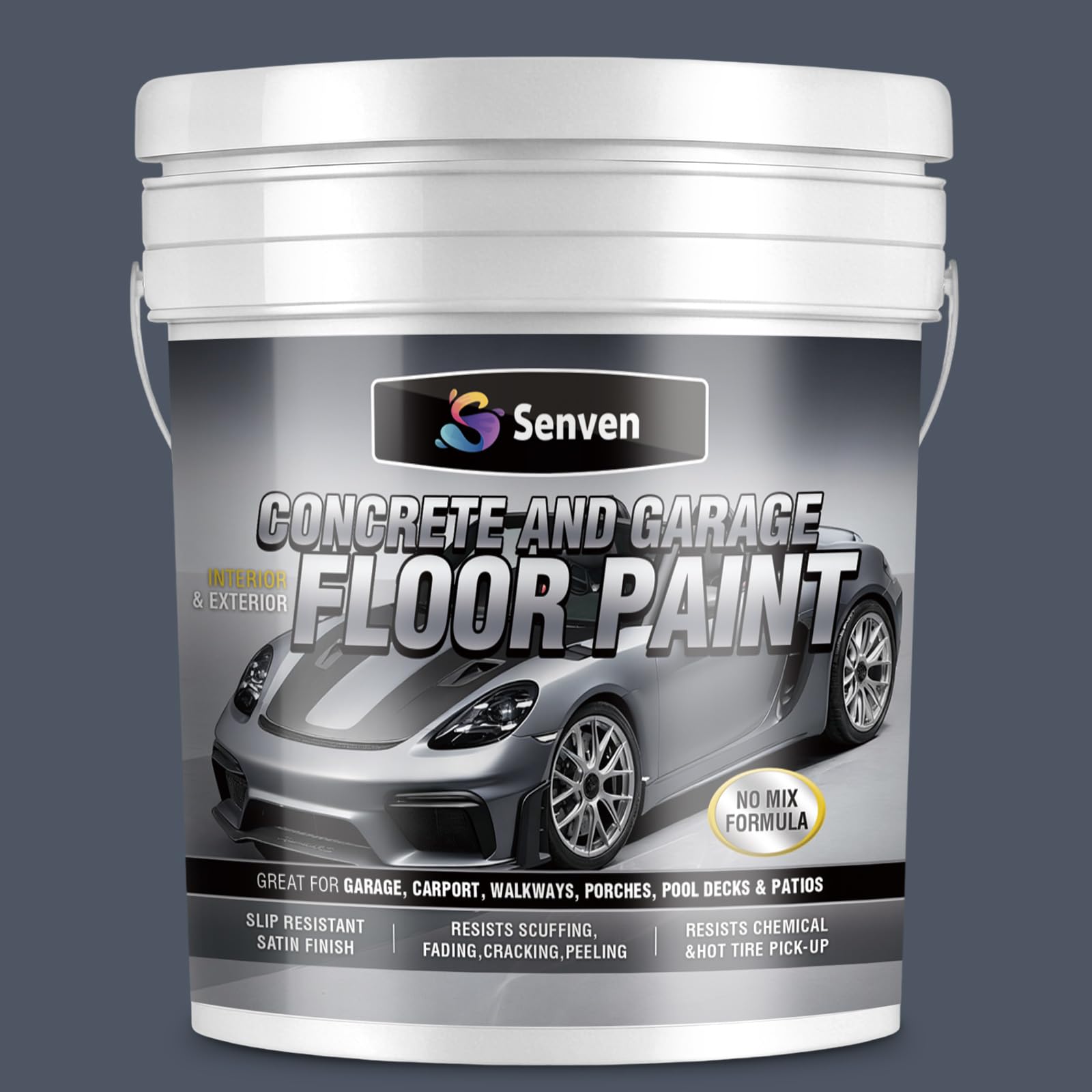
2. SENVEN Acrylic Concrete & Garage Floor Paint
A budget-friendly semi-gloss that dries fast and rolls on smooth for small floors.
If your budget is tight and your basement floor is small, the SENVEN acrylic gives a professional semi-gloss look without the heavy price tag of a real epoxy system. It is a one-part, water-based acrylic that applies cleanly with a brush or roller, and it resists scuffing, cracking, peeling, and fading — the same basic protection promises as the pricier KILZ above, just in a smaller-can footprint.
There’s a clear trade-off you should see coming. This acrylic covers up to 120 square feet per gallon, which is a notably smaller area than the 300-400 the KILZ reaches on smooth concrete. That means for a large basement you’d need several gallons, and the per-square-foot value shifts accordingly. It’s a pick for a utility room, a small workshop, or a porch project — not for sprawling open slabs.
The customer crowd is modest but genuinely pleased, landing at 4.0 stars. What wins people over is the quality feel and fast drying — owners mention it dries within 5 minutes to the touch and looks great by morning with fairly low odor. The thing everyone notes is how easy it is to roll on, with a gloss top coat optionally added for extra shine. The honest caution: on a floor that sees wet traffic too soon, adhesion can fail — there’s a documented case of paint lifting onto a towel a week after application. Dry, low-traffic spaces are where this one shines.
Quick call: The low entry price and fast-drying, easy-rolling formula make this ideal for a small dry room.
Reality check: Its 120-square-foot-per-gallon coverage and acrylic softness mean it’s not the pick for huge or hard-use floors.
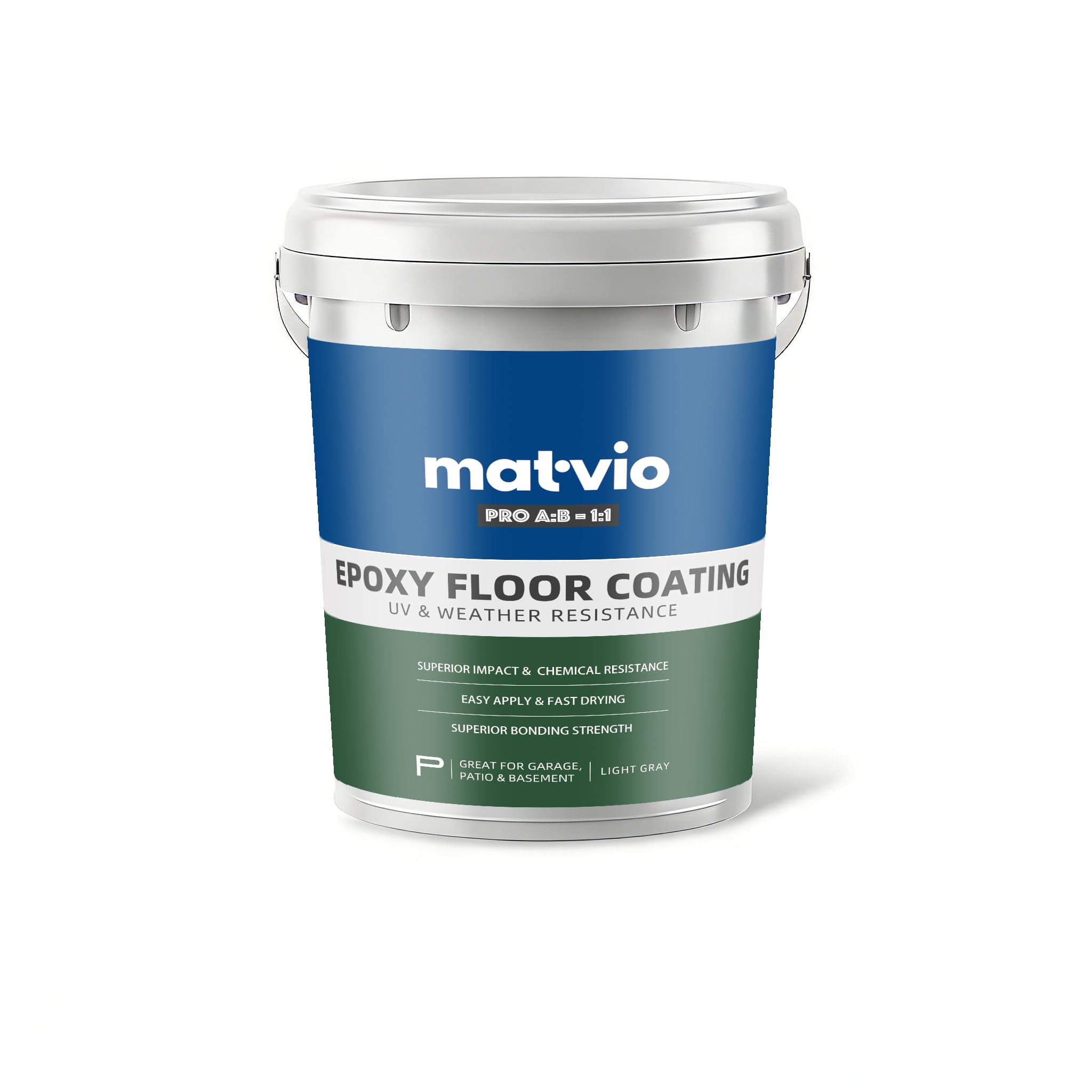
3. matvio Two-Part Epoxy Floor Coating
A true two-part epoxy that locks down dust and resists chemicals on damp concrete.
If your basement concrete is slightly dusty or shows signs of moisture, the matvio system adapts to the problem instead of fighting it. It is a genuine two-component epoxy with a pre-measured 1:1 mix ratio, and it works two ways: on slightly dusty concrete, you use the first coat as a primer-sealer to lock down the dust, then the second coat builds the thick protective film. On solid clean concrete, a single thick coat often does the job. That flexibility is rare in this category.
The toughness comes from chemistry, not marketing. Once cured, it forms a 4H pencil-hardness surface (a standard scale where 4H means it resists abrasion from tools and vehicles), with an anti-slip textured finish that resists oil, gasoline, and household chemicals. The water-based, low-VOC formula (low in volatile organic compounds, the fumes that cause headaches) keeps the smell down enough for enclosed basements and workshops attached to your home — a genuine advantage over solvent-heavy epoxies. The self-leveling action smooths out minor imperfections and brush marks into a smooth, glossy light gray finish.
At 4 liters per kit with roughly 135 square feet of coverage per coat, the value math works for small-to-mid rooms. Owners mention an “easy to apply” experience with a “good finish,” and coverage can stretch to 135-160 square feet depending on application thickness. The recurring gripe is the packaging — the two parts come in plastic bags you squeeze into a bucket, which is messy — and owners admit the coating scuffed when heavy appliances were dragged too early, likely before full cure. Two coats covered about 300 square feet with spare material.
Reach for this if: you need epoxy-level chemical and moisture resistance in an enclosed space and want the dust-sealing primer trick built right in.
Look elsewhere if: you can’t stand fiddly bag packaging or you expect to walk on it the next day — full hardness needs patience.
4. DuraGrade Concrete Paint & Protective Floor Coating

Industrial-strength one-part coating that skips etching and still shrugs off five years of abuse.
The standout feature here is what you don’t have to do: DuraGrade applies directly to clean, dry concrete with no etching and no primer required. For a basement where you dread the acid-etch prep step, that alone saves hours and simplifies everything. The trade-off for that convenience is the premium price per can and the smaller quart size, which means big projects need multiple cans.
What the customer crowd loves most is the durability — this RUST BULLET formula is reported to hold up a full 5 years on a garage floor with no flaking, peeling, or discoloration, even through Midwest temperature extremes and road salt exposure. The coverage spec reads 300-350 square feet per gallon per coat, and owners confirm a little goes a long way, noting a quart covers more space than expected. It resists wear, chemicals, moisture, and impact, which is exactly what a basement floor asks for.
The honest catch is in the application details. This is a solvent-based coating, so you need serious ventilation and a mask during application — the fumes are real, unlike the water-based acrylics on this list. Owners stress thin coats to avoid popping bubbles and say dry time varies wildly, from hours in summer to 2-3 days in a dry November. The finish, though, is worth it: a shiny gloss that owners describe as looking like no car was ever parked there, and a fountain coated in it looks like it holds clear blue water.
The Payoff
- No etching or primer step saves serious prep time
- Proven 5-year durability on garage floors
- Resists oil, grease, and household chemicals
- Works indoors and out in sun and rain
The Prep Reality
- Solvent fumes demand ventilation and a mask
- Thick coats bubble — thin coats are a must
- Hardens in the can overnight, so use fresh each session
Choose it for: the floor where you refuse to etch but still want a genuinely tough, glossy, long-lasting finish.
skip it if: you’re coating in a tight, unventilated basement room and can’t manage solvent fumes safely.
5. KOMPOZIT Acrylic Concrete & Garage Floor Paint
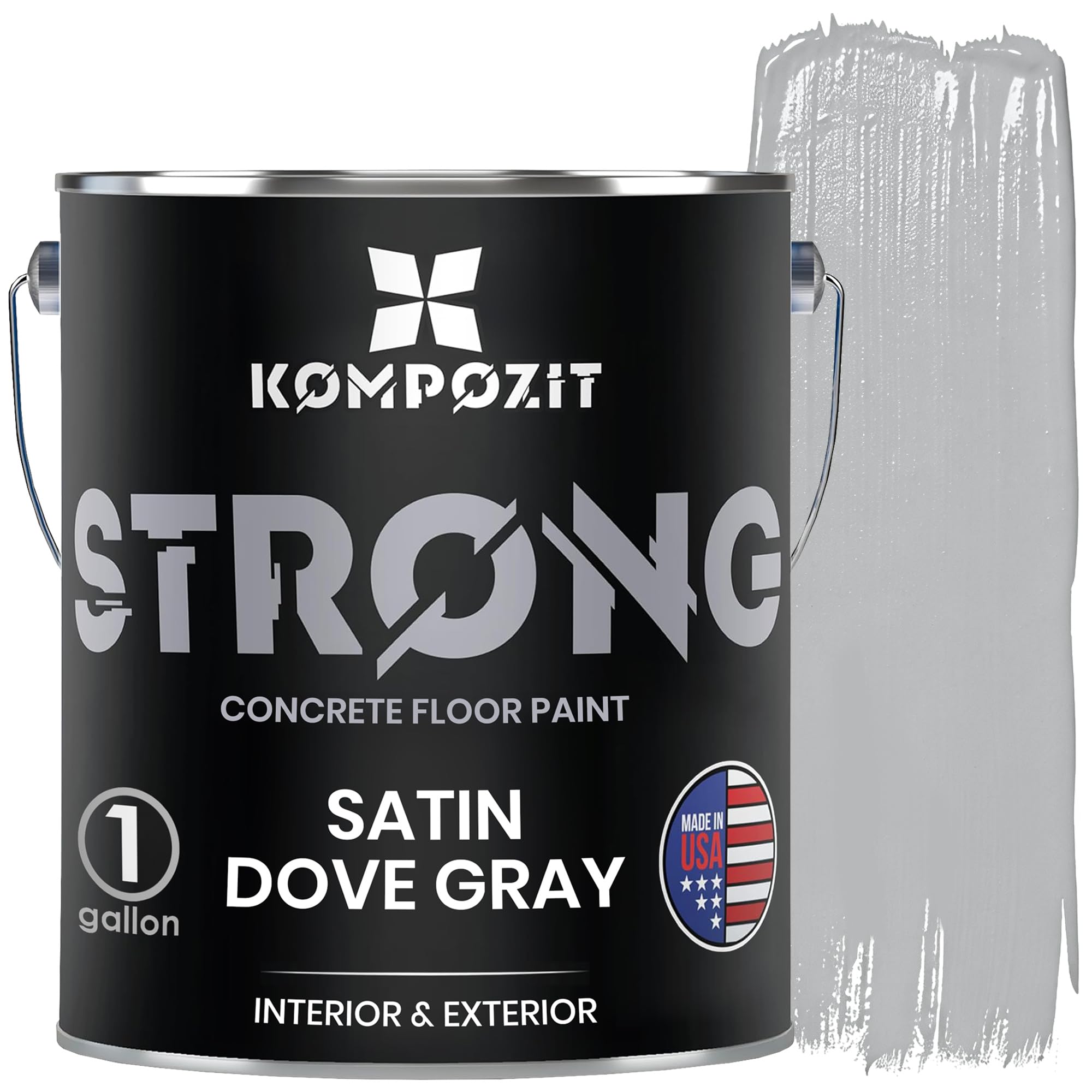
A self-priming Dove Gray acrylic that skips the separate primer coat entirely.
This KOMPOZIT formula is built for the DIYer who wants fewer steps and faster results. It’s a self-priming 100% acrylic coating, which means on properly prepared concrete you can skip the separate primer step that other one-part paints like the KILZ above explicitly recommend. That saves time, labor, and material costs right off the bat, and it’s made in the USA to boot.
The speed numbers are the selling point. This paint dries to the touch in 30 minutes to 2 hours, supports light foot traffic in 8 hours, and handles vehicle traffic in 48-72 hours — a much faster turnaround than the slow-curing epoxies on this list. Coverage lands at roughly 300-400 square feet per gallon depending on surface porosity, and owners confirm one can handles two-plus coats on a decently sized area, even covering old rust-stained concrete completely.
What impresses owners most is the durability — customers note it “stays put” through sun and rain on a walkway without fading or washing away, and the coverage earns constant praise. At 4.2 stars from a smaller crowd of owners, the consensus is solid. The one real red flag in the data is that it can peel under car tire contact even after two coats and a 72-hour cure, so keep this one on foot-traffic surfaces like basements, porches, and walkways rather than expecting it to endure heavy vehicle turning.
Bottom line: A self-priming acrylic that’s all about speed of application and genuinely fade-resistant coverage on foot-traffic floors.
Worth knowing: The brand touts hot tire resistance, but real-world reports say tire contact is exactly where it can fail — keep it off drive-over zones.
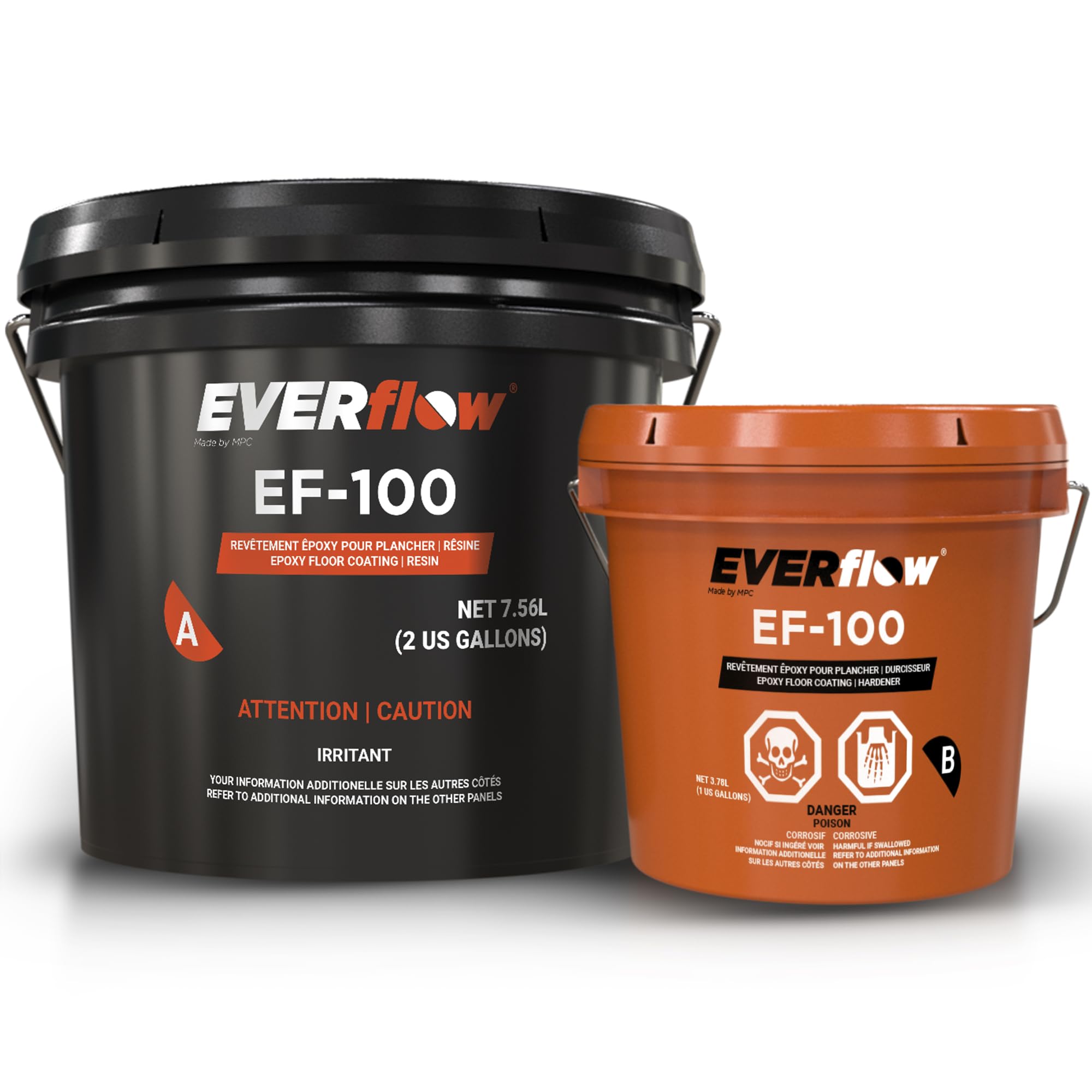
6. Everflow by MPC Epoxy Resin Floor Coating Kit
A 100% solids self-leveling epoxy that transforms concrete into a thick layer of glass.
If the goal is a show-quality glossy floor that looks wet even when dry, this Everflow MPC-100 kit is the serious upgrade from acrylic paints. It’s a 100% solids two-component self-leveling epoxy resin, meaning no solvents to shrink away as it cures, and it’s explicitly designed for residential, industrial, and commercial floors alike. This is the pick when you want a true transformation, not just a color change.
The defining visual is the finish — owners describe it as looking exactly like “a thick layer of glass,” which is the high-gloss pay-off that no rolled-on acrylic can match. The kit covers roughly 240 square feet in a single coat per 3-gallon kit, and a 900-square-foot pole barn project used 6 gallons total across two coats with 300 pounds of decorative flake added. It’s cycloaliphatic-formulated to resist water spotting and amine blushing, with excellent adhesion, abrasion, impact, and chemical resistance.
Bring real respect for the mixing process. The epoxy generates heat fast once mixed — owners warn to pour within 5-10 minutes and split it into smaller buckets to control the heat, and full cure takes 48 hours before heavy items can go on top. Done right, the results last: 19 months later one owner reports the floor still looks new under heavy tool drops. The occasional bad batch exists, where epoxy solidified within minutes, smoking and melting its bucket — so test a small mix first before committing the whole floor.
The Gloss Payoff
- Thick, self-leveling finish hides minor imperfections
- Resists water spotting, abrasion, and chemicals
- Works for garage, workshop, or commercial space
The Workload
- Two-part mixing with real heat management needed
- Full 48-hour cure before heavy load
- Occasional defective batch reported — test first
Best for: the project where you want that thick, glossy, glass-like finish and are willing to learn careful two-part mixing.
Not for: impatient DIYers — heat management, work time, and a full 48-hour cure all demand discipline.
7. ShangTianFeng 5 Gallon Professional Floor Paint
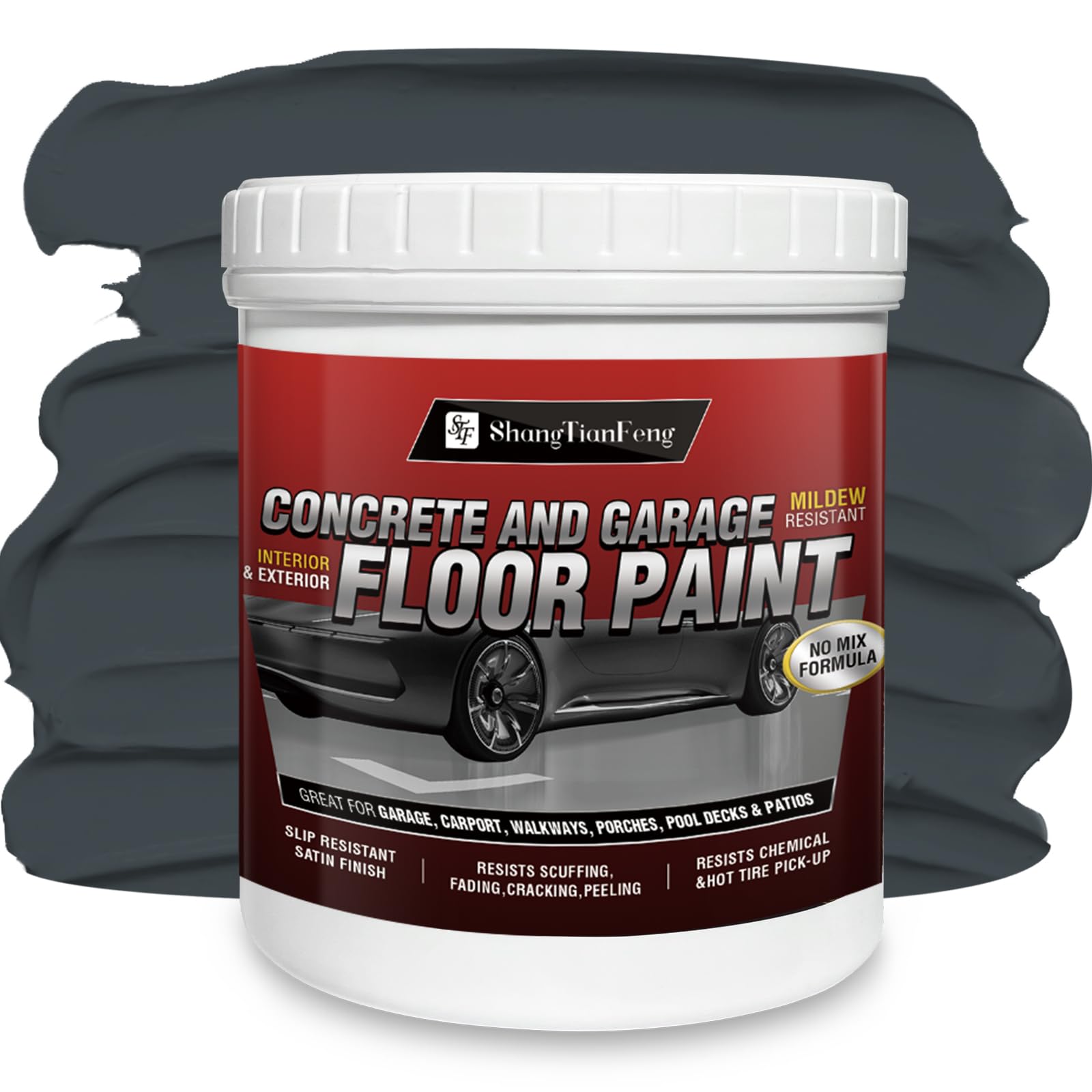
Five gallons of go-anywhere acrylic that covers an entire basement overhaul in one can.
For the biggest basement jobs, this 5-gallon ShangTianFeng bucket is the most efficient way to buy acrylic floor coating in bulk. The no-mix formula stirs for two minutes and is ready to use straight out of the can, covering a massive 800-1000 square feet. That single number makes it the clear choice when you’re painting a full basement, a large workshop, or even a pool deck where moisture is a constant threat.
The protection story is quietly impressive. This isn’t just paint — it’s advertised as a high-gloss satin finish with dual water and slip resistance, defending against scuffing, fading, cracking, peeling, chemicals, mildew, and hot tire marks. The VOC content comes in at just 2 g/L with formaldehyde at 8 mg/kg, both far below national standard limits, and the manufacturer states emissions drop to zero after a full 5-day cure. For an enclosed basement, that low-odor profile is a comfort.
Owners at a strong 4.4-star clip report fast drying with low odor and genuinely good coverage, with one application drying within 24 hours and looking “beautiful.” It goes on thick and strong, fills cracks and voids, and even reduced one pool project’s paint needs from 6-7 gallons down to 3. The recurring issue is adhesion strength under aggressive tape — painters tape pulled up spots in a few places — which is a sign to remove tape while the coat is still wet and treat the surface gently during the first days.
Why it scales: One bucket handles 800-1000 square feet, so you avoid buying and color-matching multiple smaller cans.
Watch out for: Wet paint that pulls up with tape — keep tape removal early and gentle, and respect the full 5-day cure.
8. ArmorPoxy 100% Solids Garage Epoxy Floor Kit
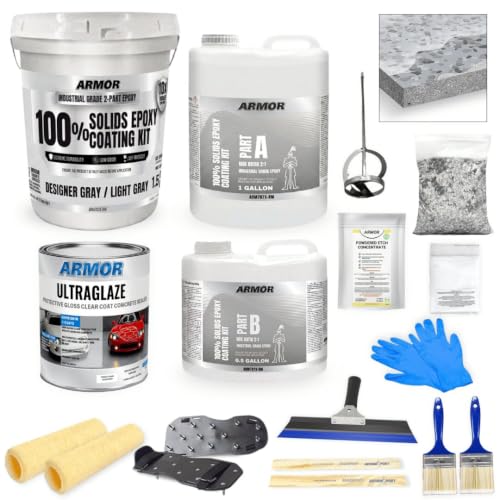
The all-in-one 17-piece kit that supplies everything for a contractor-grade glossy floor.
This is the complete package for the DIYer who wants a professional-looking floor without hunting down separate supplies. The ArmorPoxy kit is built on a 100% solids military-grade epoxy the maker says bonds permanently to concrete, and the 17-piece set includes the etching solution, decorative flake mix, non-slip additive, roller, and squeegee. For a 300-square-foot basement or garage, everything you need arrives in one box.
The wear resistance is the headline claim. The 3-layer epoxy system shields floors from oil, solvents, and spills, with a textured finish that prevents slips even when wet. Cure time is genuinely faster than water-based epoxies: 24 hours to cure and 72 hours before it’s vehicle-ready. The kit also allows for custom flake designs — start with a medium broadcast of flakes or add heavier coverage for a car-showroom look.
The owner crowd at 4.1 stars emphasizes two things: ease of use and the included accessories. Reviewers point out the kit saves assembly time and delivers a professional look, with one 550-square-foot new garage project coming out clean and a 1-year follow-up showing no cracking or flaking in a heated space. The downside shows up in the details: the epoxy tub isn’t clearly marked for the mixing ratio, the included squeegee is cheap, and the 1-pound flake bag is skimpy for heavy coverage — most projects bought extra flake. A few owners saw peeling in humid conditions where the clear coat stayed tacky, so dry, controlled conditions matter.
The Complete Set
- Includes etching solution, flakes, additive, roller, and squeegee
- Fast 24-hour cure, driver-ready in 72 hours
- Clear instructions plus an instructional video
- Slip-resistant textured finish for wet zones
DIY Frustrations
- Mixing ratio isn’t marked clearly on the tub
- Included squeegee and 1 lb flake bag run short
- Humidity can leave the clear coat tacky
Pick this when: you want one kit with every tool included for a 300-square-foot room and a fast cure window.
Prepare for: extra flake purchases, careful ratio measuring, and waiting for a dry, low-humidity stretch of days.
Understanding the Specs
One-Part vs Two-Part Chemistry
The single most important choice you’ll make is which chemical system to use. One-part paints — acrylics and epoxy-acrylic blends like the KILZ, SENVEN, and KOMPOZIT — come ready to roll with no mixing, and they clean up easily with soap and water. Two-part epoxies like the matvio, Everflow, and ArmorPoxy require mixing a resin with a hardener, which triggers a chemical reaction that cures into a much harder, denser film. That reaction is why two-part epoxies resist chemicals, standing water, and scuffs far better than one-part acrylics, but it’s also why they demand careful measurement and faster work once mixed.
Coverage Math
Coverage is listed in square feet per gallon, and it directly decides how many cans you buy. A gallon covering 300-400 square feet on smooth concrete (like the KILZ at 300-400 and KOMPOZIT at 300-400) stretches much further than one listing 120 square feet (like the SENVEN). The catch is that rough, porous concrete soaks up dramatically more — KILZ drops to 200-300 square feet on rough surfaces. Always buy at least 10-20% extra, and plan on two coats for even color. For big areas, the 5-gallon bucket covering 800-1000 square feet is the most economical route.
Cure Time vs Dry Time
These are two completely different numbers, and confusing them ruins finishes. Dry-to-touch is when you can lightly touch the surface — the KOMPOZIT dries to the touch in 30 minutes to 2 hours, and the SENVEN within 5 minutes. Full cure is when the coating reaches its final hardness, and it’s much longer: KILZ lists 4 hours, while the solvent-heavy epoxies like Everflow need 48 hours and the ShangTianFeng states a full 5 days for emissions to drop to zero. Walking on a floor before full cure is the fastest way to embed scuffs and footprints permanently.
Water Resistance and Moisture
Every product here is listed as waterproof, but that doesn’t mean every product handles a damp slab. Waterproof describes the cured film’s ability to repel liquid on the surface — not the floor’s ability to block moisture seeping up from below. If your basement has a vapor barrier issue or visible efflorescence, the moisture pushes up and separates the coating from the concrete, causing the peeling that shows up in reviews of otherwise good paints. That’s why the matvio two-part epoxy’s built-in strategy — using the first coat as a dust-sealing primer — is uniquely valuable on slightly dusty basement slabs.
FAQ
Is epoxy or acrylic paint better for a basement floor?
How many square feet does a gallon of basement floor paint cover?
Why does basement floor paint peel off?
Do I need to etch my concrete before applying floor coating?
How long does basement floor paint take to dry?
Can I paint a damp or dusty basement floor?
Is basement floor coating safe to apply indoors?
Which basement floor coating is best for car tires and heavy traffic?
Final Thoughts: The Verdict
If you want one dependable pick, the top basement floor coating pick is the KILZ 1-Part Epoxy because it balances genuine durability, a huge 300-400-square-foot coverage per gallon, and easy roller application at a crowd-pleasing 4.3-star level. If you want show-quality gloss and chemical resistance, grab the ArmorPoxy kit with everything included. And for a huge single-can project, the ShangTianFeng 5-gallon is the one to reach for.
How We Picked
We do not accept paid placement. Every pick is matched to a real buyer and a real use-case; we do not hands-on test units.
Sources & Methodology
Specifications: manufacturer listings and product documentation. Review insights: verified customer reviews, as of September 2026. Pricing: not shown on this page (it changes often); check the current price via the retailer link.
As an Amazon Associate, Gadgets Feed earns from qualifying purchases. This does not affect which products we feature.