
Our readers keep the lights on and my morning glass full of iced black tea. As an Amazon Associate, I earn from qualifying purchases.
Specs are compiled from manufacturer listings and verified buyer reviews and can change over time — please confirm the key details on the product page before buying.
On a tight budget, the key is finding a camera that fires fast, sees in the dark, and lasts through the season. You want a camera that fires fast, sees in the dark, and survives a season of rain and freezing temps. We focus on models that deliver clear daytime and nighttime shots without cellular subscription costs.
I’m Min — the founder and writer behind Gadgets Feed. This guide is built by comparing the manufacturers’ published specifications and the patterns across verified customer reviews, so you get each pick’s real strengths and trade-offs instead of marketing spin.
Whether you’re scouting public land or your own backyard, finding the right budget game camera means balancing trigger speed, night vision range, and power efficiency against what you’re willing to spend.
Our Picks at a Glance
How To Choose The Best Budget Game Camera
Night performance matters most because that’s when you capture most scouting footage. A camera’s night vision quality separates useful from frustrating.
Decide if you need a glow
No-glow cameras use invisible 940nm LEDs so animals never see a flash, which is ideal for skittish deer. Low-glow models use 850nm LEDs, which cast a faint red beam that can spook game but often gives a brighter image at longer range.
Check the trigger speed
Look at how fast the sensor fires after detecting motion. A 0.1s trigger catches a deer mid-stride, while slower triggers often produce a tail or an empty frame. Also confirm the detection range in feet so you know how far from a trail you can mount it.
Count the power requirements
Non-cellular cameras sip power because they aren’t constantly searching for a signal, so a set of AA batteries can last months. Solar models add a panel that tops up the internal battery, but on cloudy weeks you may still need a backup charge.
Quick Comparison
| Model | Best For | Trigger Speed | Night Vision Range | Photo Resolution | Amazon |
|---|---|---|---|---|---|
| Meidase P70★ Best Overall | Best Overall Clarity | 0.1s | 100ft | 64MP | Amazon |
| Spypoint FORCE-4KPremium Pick | Premium Pick | 0.4s | 110ft | 48MP | Amazon |
| GardePro E5SBest Value | Value for Money | 0.1s | — | 64MP | Amazon |
| Misstech Solar | Set & Forget Solar | 0.1s | — | 64MP | Amazon |
| MAXDONE Solar WiFi | App Control | — | 65ft | 64MP | Amazon |
| XTU 4K Solar | Solar Convenience | 0.2s | 65ft | 64MP | Amazon |
| WOSPORTS Mini 2 Pack | Budget Champion | — | — | 36MP | Amazon |
| Spypoint FORCE-24 | Budget-Friendly Simplicity | — | 70ft | 24MP | Amazon |
In‑Depth Reviews
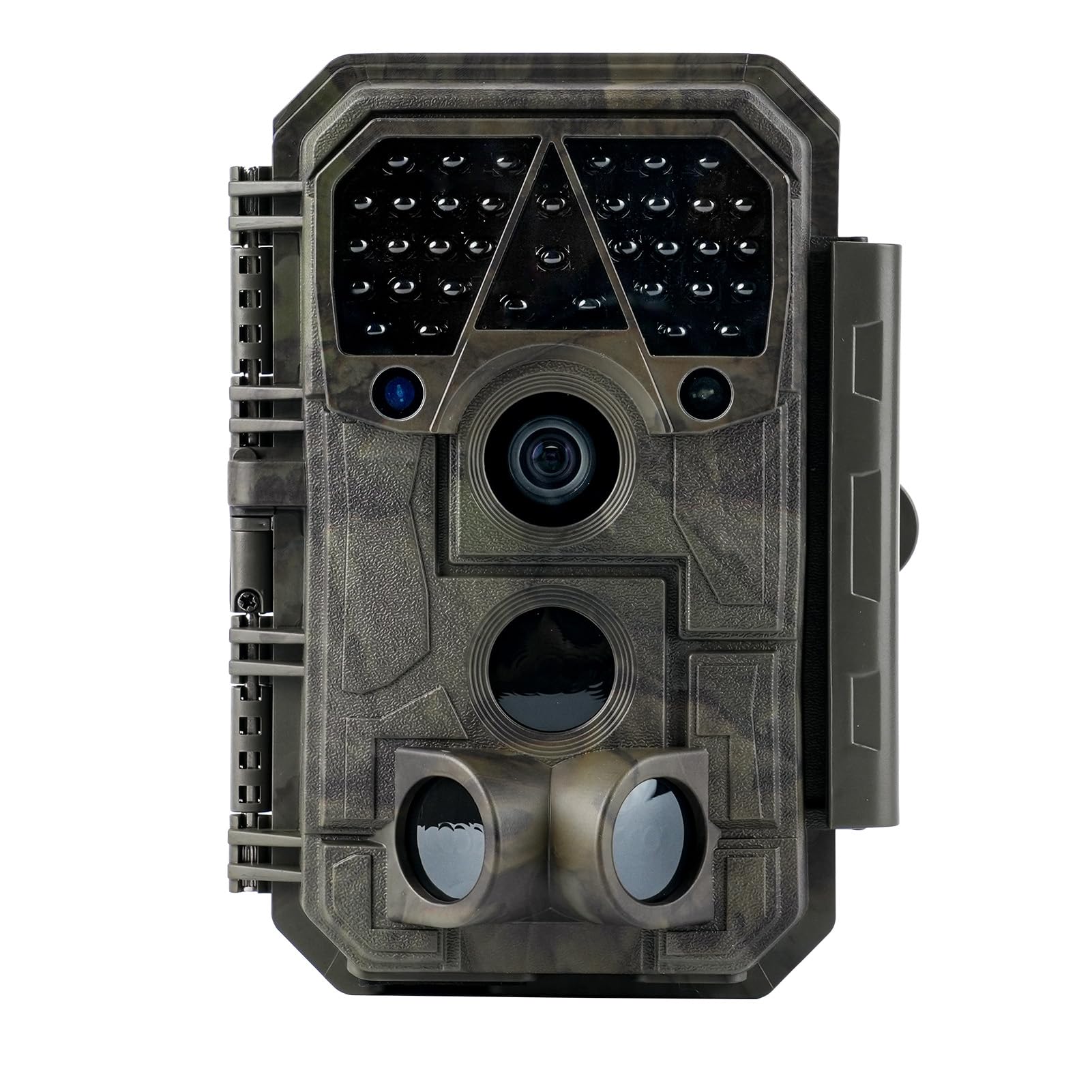
1. Meidase P70 Trail Camera
Our pick — over 4★ from 750+ verified ratings; the strongest balance of quality and price.
Best overall for crisp captures that outperform pricier models.
You get a 64MP still resolution that resolves fur and antler detail in daylight, paired with a 1296p video mode that keeps motion smooth. That resolution sits above the 36MP stills on the WOSPORTS 2-pack, which matters when you zoom in to identify a specific deer or read an ear tag.
The defining spec here is the 0.1s trigger speed, backed by side sensors that catch animals moving fast across the frame rather than just straight at the lens. At night, the no-glow 940nm IR lights reach 100ft without emitting any visible beam, so you won’t spook wary bucks — buyers report it “takes great pictures in daylight or nighttime” and note the quality edges out pricier brands they’ve run before.
It runs on 8 AA batteries and uses H.264 compression to keep video files small for quick transfers to your laptop. There’s a 2.4-inch color display for reviewing shots on the spot, and if you add the Meidase SP350 solar panel (sold separately) you can stretch those batteries even further.
Built to Deliver
- Fast 0.1s trigger catches quick movement
- 100ft no-glow IR won’t alert game
- Supports SD cards up to 512GB for long deployments
Know the Trade-offs
- Needs 8 AA batteries and an SD card you supply
- Night video trigger range is closer than the photo range
Who it’s for: The hunter or property owner who wants premium-grade daytime and nighttime stills without a cellular plan.
Reality check: Night video only triggers reliably out to about 15ft, so set it tight on the trail you’re scouting.
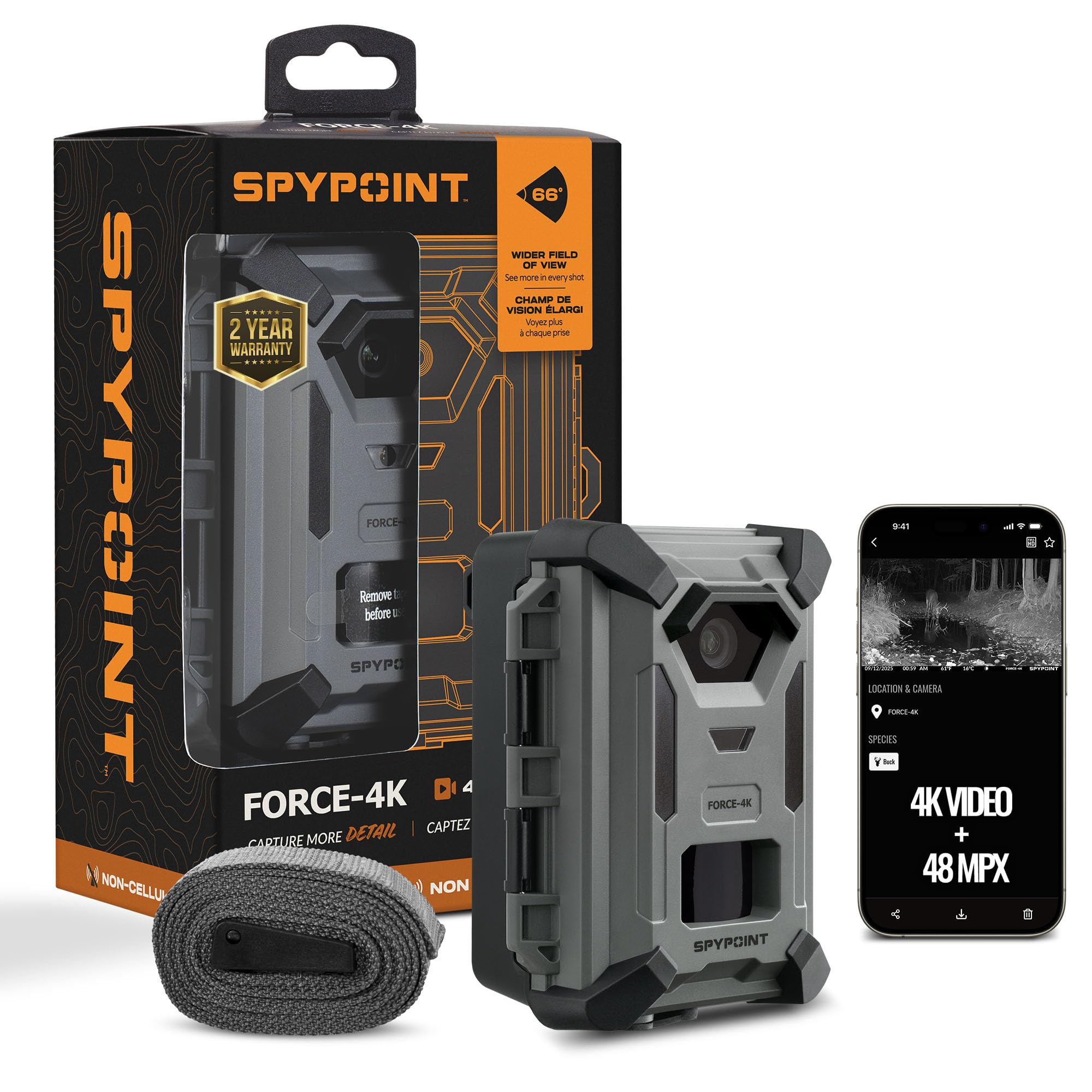
2. SPYPOINT FORCE-4K Trail Camera
Premium pick for 4K video sharpness on a budget.
If you plan to keep clips for the details, the FORCE-4K’s 4K video with sound is the reason to stretch your budget. Its 48MP stills produce sharp images, and the 66° field of view covers more ground per frame, so a passing herd doesn’t slip past the edge of the shot.
Detection reaches an impressive 110ft — the longest on this list — with a 0.4s trigger that still catches a walking deer cleanly. It also includes a two-inch color LCD screen, so you can format your SD card and review captures right at the tree without a phone app. A rugged build holds up to seasons in the field, and owners describe the battery as still near full after a full month of use.
Keep in mind this is a pure non-cellular design with no Bluetooth, so photo retrieval always means pulling the SD card. It also wants 8 AA batteries and your own card, since neither ships in the box.
The Payoff
- True 4K video with crisp audio
- 110ft motion detection range leads the list
- Two-year warranty backs the build
Before You Buy
- No cellular or Bluetooth — SD card retrieval only
- Requires an SD card up to 256GB, not included
Reach for this if: You want the best video clarity and longest detection range and you’re fine walking the card out each visit.
Look elsewhere if: You need to check cameras remotely from your truck or phone.
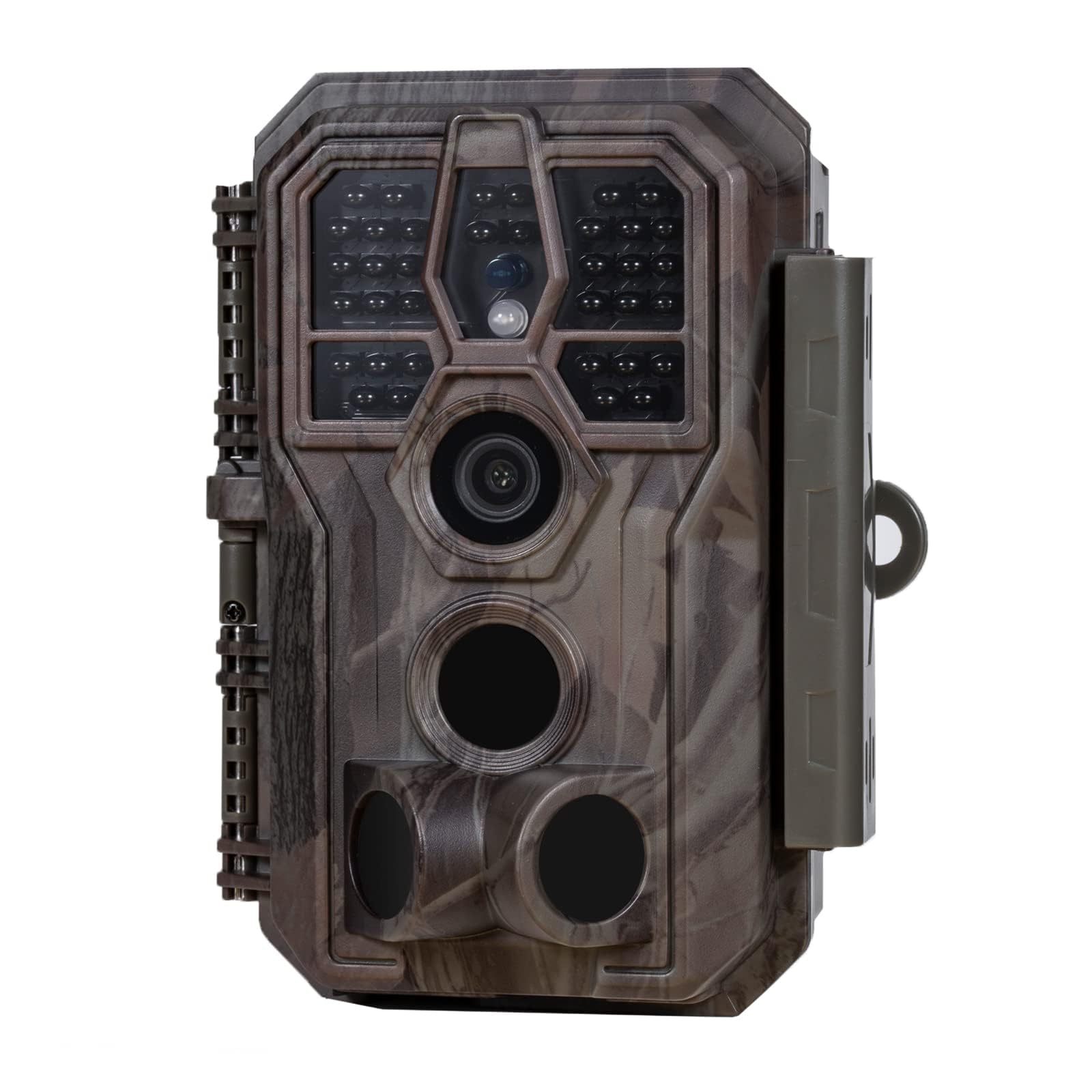
3. GardePro E5S Trail Camera
Dependable value pick that retains settings without batteries.
Buyers consistently rate this near the top for value, and the reason shows up in daily use: the 64MP stills and 1296p HD video hold up well, and the 0.1s trigger with three PIR sensors catches fast-moving deer that slower cameras miss. It also carries an IP66 waterproof rating, so rain and snow won’t force an early retrieval.
The battery story is where it wins loyal fans. It runs on 8 AA batteries, and owners mention lithium cells lasting a full season with charge to spare by December. Settings persist even when you pull the batteries out, which saves you the frustration of reprogramming after every swap. A 120-degree field of view covers a wider zone than many rivals in this class.
It’s a wired, non-cellular design, so you’ll retrieve the SD card to see what it caught. Some owners mention the microphone can crackle on video clips, and that it needs your own 8 AA batteries and SD card to run.
What It Delivers
- 0.1s trigger plus three PIR sensors for wide coverage
- Settings persist without batteries installed
- 120° field of view captures more of the trail
The Fine Print
- Supports GardePro’s own SP350 solar panel only
- Some video clips show mic crackle
Best for: Hunters who want 0.1s trigger speed and season-long battery life at a mid-range price.
Watch out for: The five-minute delay between power-on and activation — plan your setup accordingly.
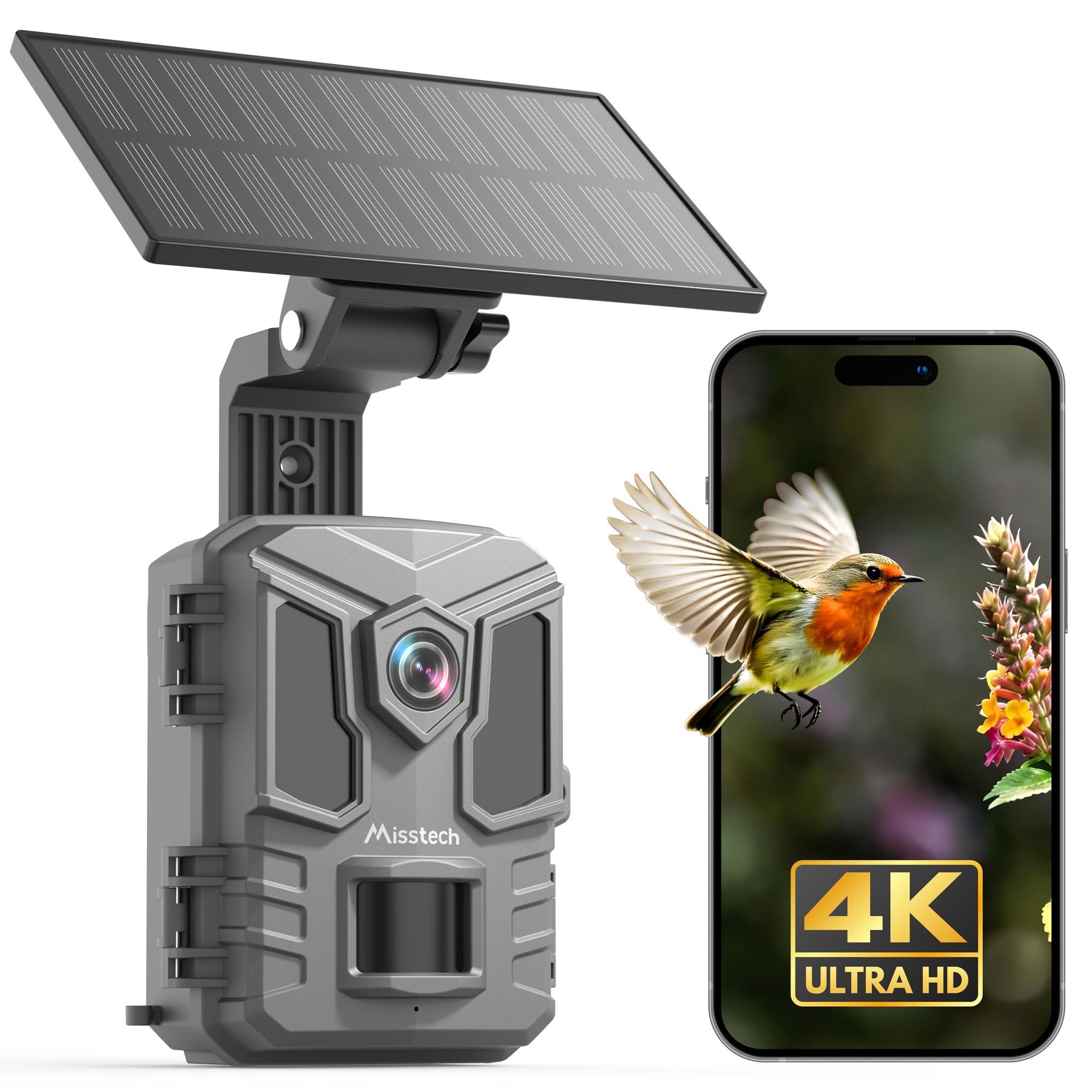
4. Misstech Solar Trail Camera
Solar-powered workhorse that maintains full charge for weeks.
This one pairs a built-in rechargeable battery with a solar panel that owners say keeps it at 100% charge through days in the forest — one spot-check after three days and two nights in the woods showed it still fully topped up. The 0.1s activation speed and a 5-frame sequence mode catch fast animals in detail, while 4K video and 64MP stills come through a wide f/1.6 aperture lens that handles low light at dawn and dusk.
It ships ready to run with an 8GB SD card included, good for up to 30 days of loop recording. The Trailcam Go phone app works within 30-50m in open areas, letting you pull clips without removing the card, and the MapPin feature saves the camera’s location in the app so you can find the exact tree again later. A moon phase, temperature, and time stamp prints on every photo automatically.
The solar USB plug can be finicky to align when remounting the panel, and WiFi downloads run slow unless you use the app’s selective download option. Video saves in AVI format, so you’ll need to convert clips before editing.
Why It Stands Out
- Solar keeps battery at 100% with no manual swaps
- 8GB SD card included in the box
- Moon phase and temperature stamp on every shot
Minor Annoyances
- AVI video format needs converting for editing
- Tight WiFi range means standing near the camera
The verdict: A near-total-ownership camera for anyone who wants to mount it once and forget it through a whole season.
The one catch: You’ll need to be within about 10ft for the WiFi gallery, so plan card pulls or app downloads accordingly.
5. MAXDONE Solar WiFi Trail Camera
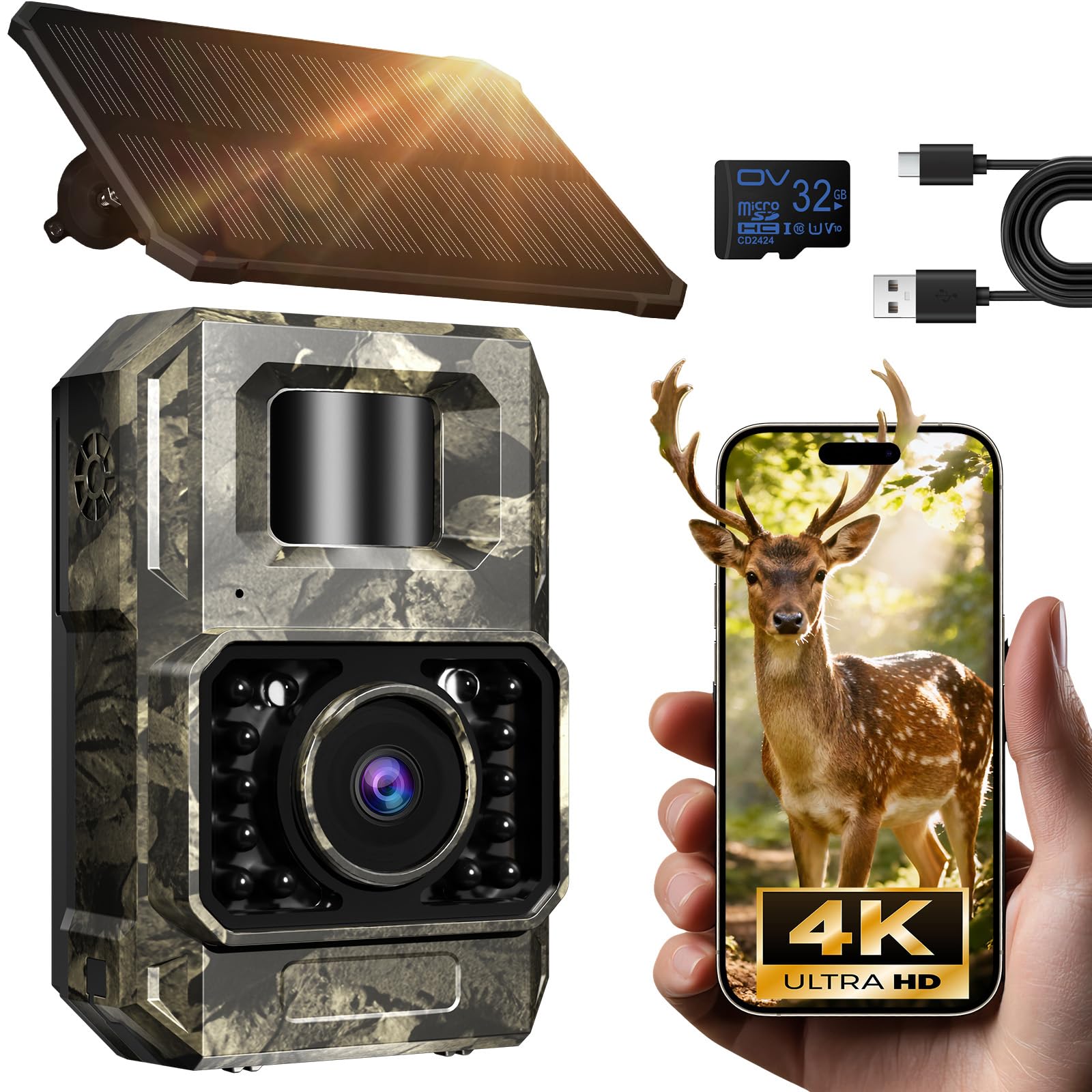
The connected option that lets you preview shots on your phone without pulling the card.
This is the pick when you want to check a camera without walking a card back to your laptop. It pairs with the TrailCam GO app over its own built-in WiFi, so you can preview, download, and share photos from up to 55ft away in open ground — no home WiFi, no monthly fees. A 100° wide-angle lens records 64MP stills and 4K video, and the H.264 compression keeps file sizes small for faster transfers.
Night vision uses low-glow 850nm IR LEDs good to 65ft, and adaptive lighting automatically balances brightness to avoid blown-out or pitch-black frames. It ships with a 32GB micro SD card pre-installed, so it works from the start, and the detachable solar panel keeps the internal battery topped up on long deployments.
Setup demands a learning curve — aggressive default settings produced black night captures until owners adjusted the baseline config and ran a firmware update. The connection is close-range only, and one report noted the battery lasts about a week if you charge manually without the panel doing the work.
What Wins People Over
- 32GB SD card included — no extra purchase needed
- 100° wide-angle lens covers a broad zone
- Solar panel and power bank support for long trips
The Honest Gripes
- WiFi connects close-range only, up to 55ft
- Default night settings need adjusting for clear shots
Pick this if: You want phone-based previews and solar power in one box that includes its own SD card.
Think twice if: You want true remote viewing from home — this camera connects only when you’re standing nearby.
6. XTU 4K Solar Trail Camera
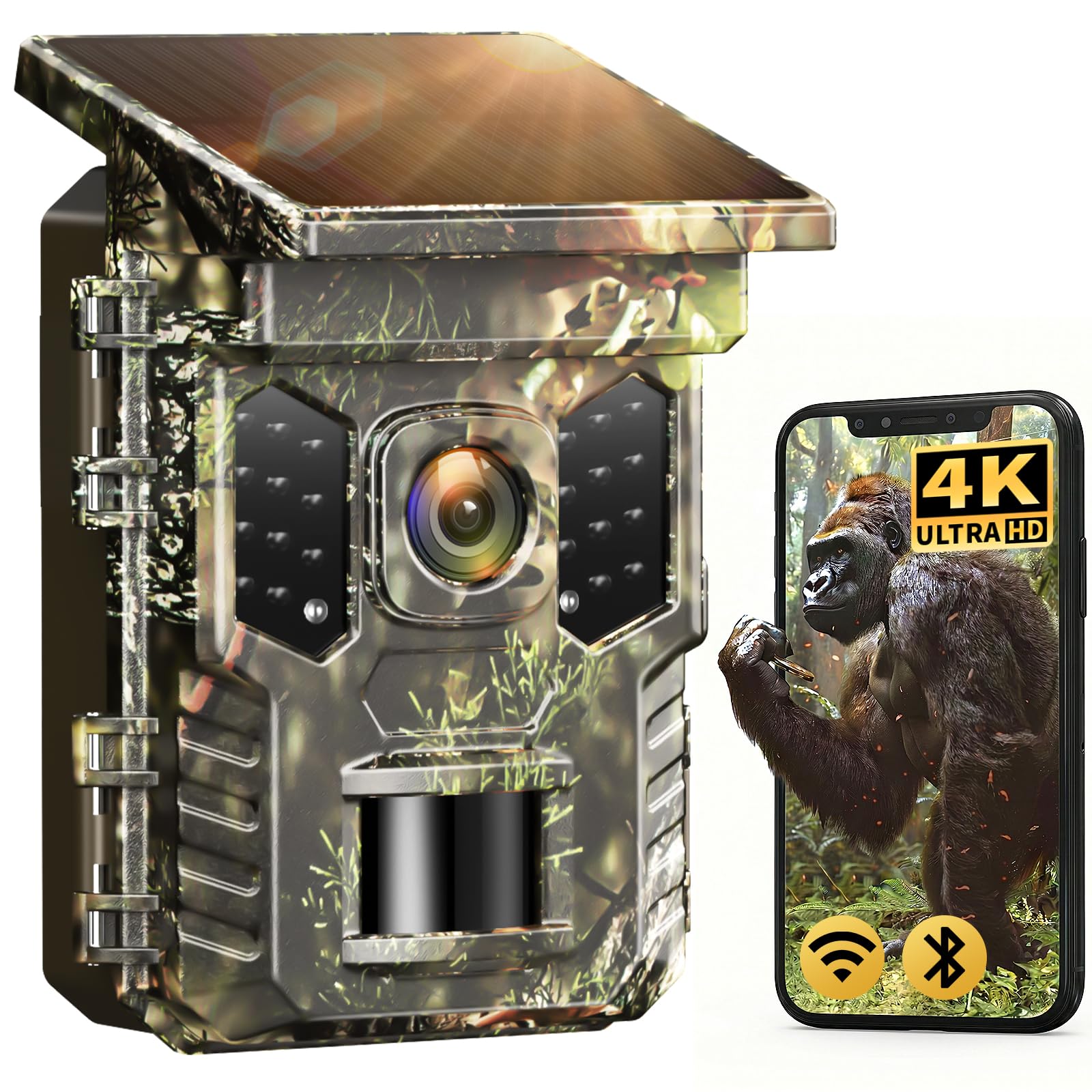
A solar-powered scout that keeps recording through cloudy stretches.
This one layers multiple power paths so it keeps going when other solar cams quit. A built-in rechargeable battery runs the camera, solar charging tops it up on remote trails, USB-C offers a quick recharge at camp, and 4 AA backup batteries (not included) carry it through cloudy, cold stretches. That flexibility is what buyers praise most, alongside 4K video and 64MP stills.
The 0.2s trigger with 70ft detection range helps cut empty clips, and low-glow 850nm IR LEDs light the scene out to 65ft. It hits IP66 waterproofing for rain, snow, and heat, and the TrailCamGO app lets you view and download footage on-site over built-in WiFi up to 49ft away. Owners confirm it “has continued to work flawlessly for several weeks now.”
Expect mixed opinions on the WiFi stability — it’s strictly a local, close-range connection, and some buyers found the range claim optimistic when walls were involved. The solar panel also reduces battery drain rather than fully replacing manual charging in heavy cloud.
The Strengths
- Four power options — solar, USB-C, DC 6V, or AA backup
- 65ft night vision with low-glow IR
- Smart false-trigger filtering cuts empty clips
Where It Struggles
- WiFi range holds up only in open areas
- Solar tops up but doesn’t fully replace manual charging
Grab this for: Long deployments on food plots where you need battery flexibility and don’t want a monthly bill.
skip it if: You expect reliable app connections from inside your house.
7. WOSPORTS Mini Trail Camera 2 Pack
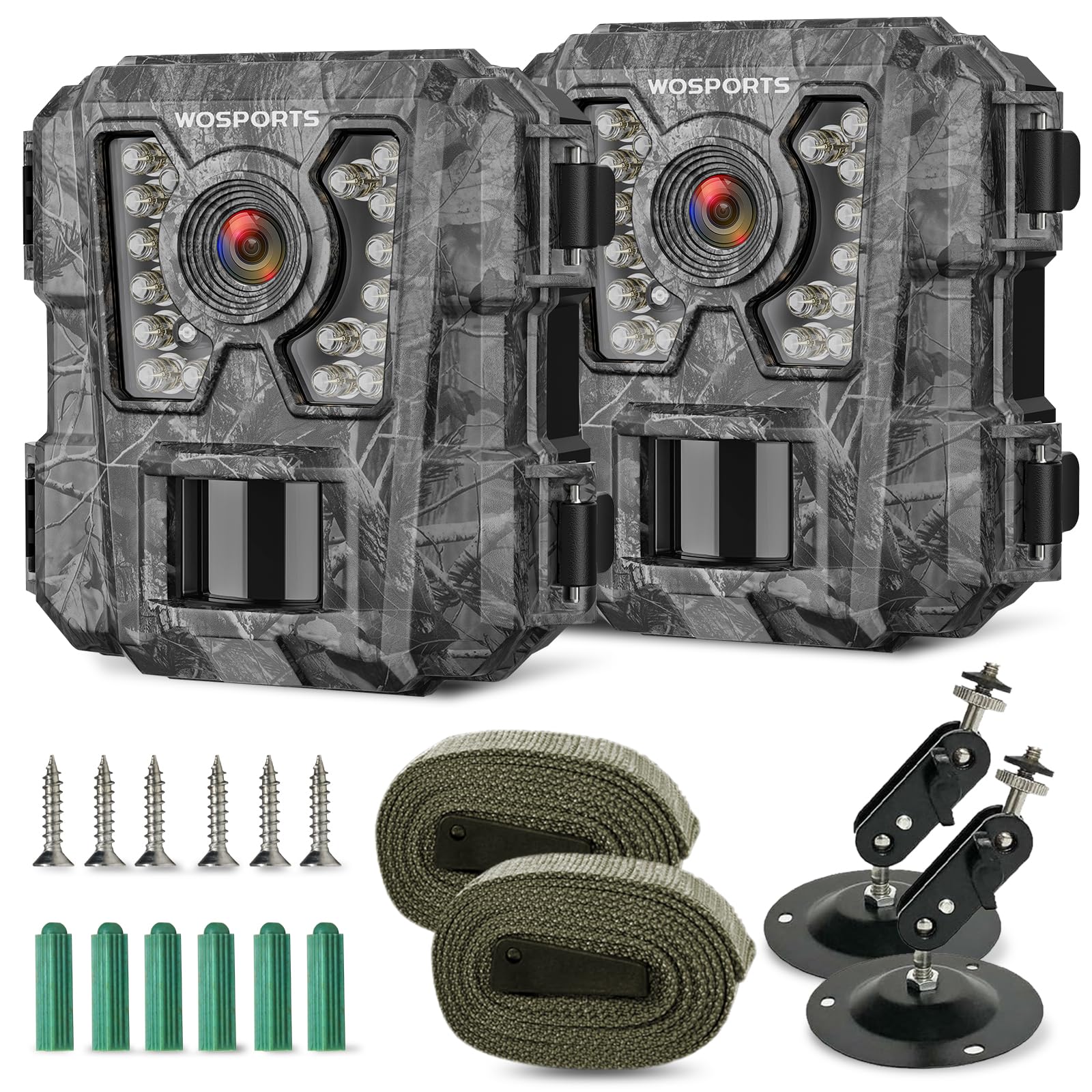
Two capable mini cams that cover twice the ground for the price of one.
Sometimes you need coverage on two trails, and this 2-pack delivers without doubling your spend. Each compact camera measures just 4.25 × 4.21 × 3.43 inches, so the camouflage bodies slip into a tree line and stay virtually unnoticeable — owners running them at high altitude and in bad weather report they keep shooting clear frames. The 36MP stills run below the 64MP top-tier options on this list, but they hold up fine for identifying animals and reading patterns.
Each unit runs on just 4 AA batteries (not included), and the low-power design supports long standby — buyers describe getting about 8 months from a set. The 850nm infrared LEDs deliver black-and-white night vision without disturbing wildlife, and the adjustable mounting strap fixes to trees, posts, and fences in minutes.
There’s no WiFi and no app here — this is a pure push-button, SD-card camera (max 32GB, not included). The SD card door has no lock, which matters if you’re on public land where theft is a concern. It also helps to peel the plastic lens cover off new units before first use.
What You Get
- Two cameras for one low price — double the coverage
- Only 4 AA batteries per camera for months of run time
- Compact camo body blends into cover
Be Aware
- No lock on the SD card door — a theft risk on public land
- Max 32GB SD card support limits long video runs
Reach for this if: You need two scouting points covered on a tight budget and want small, hidden cameras.
Consider the catch: The door latch keeps honest folks honest but won’t stop a determined thief.
8. SPYPOINT FORCE-24 Trail Camera
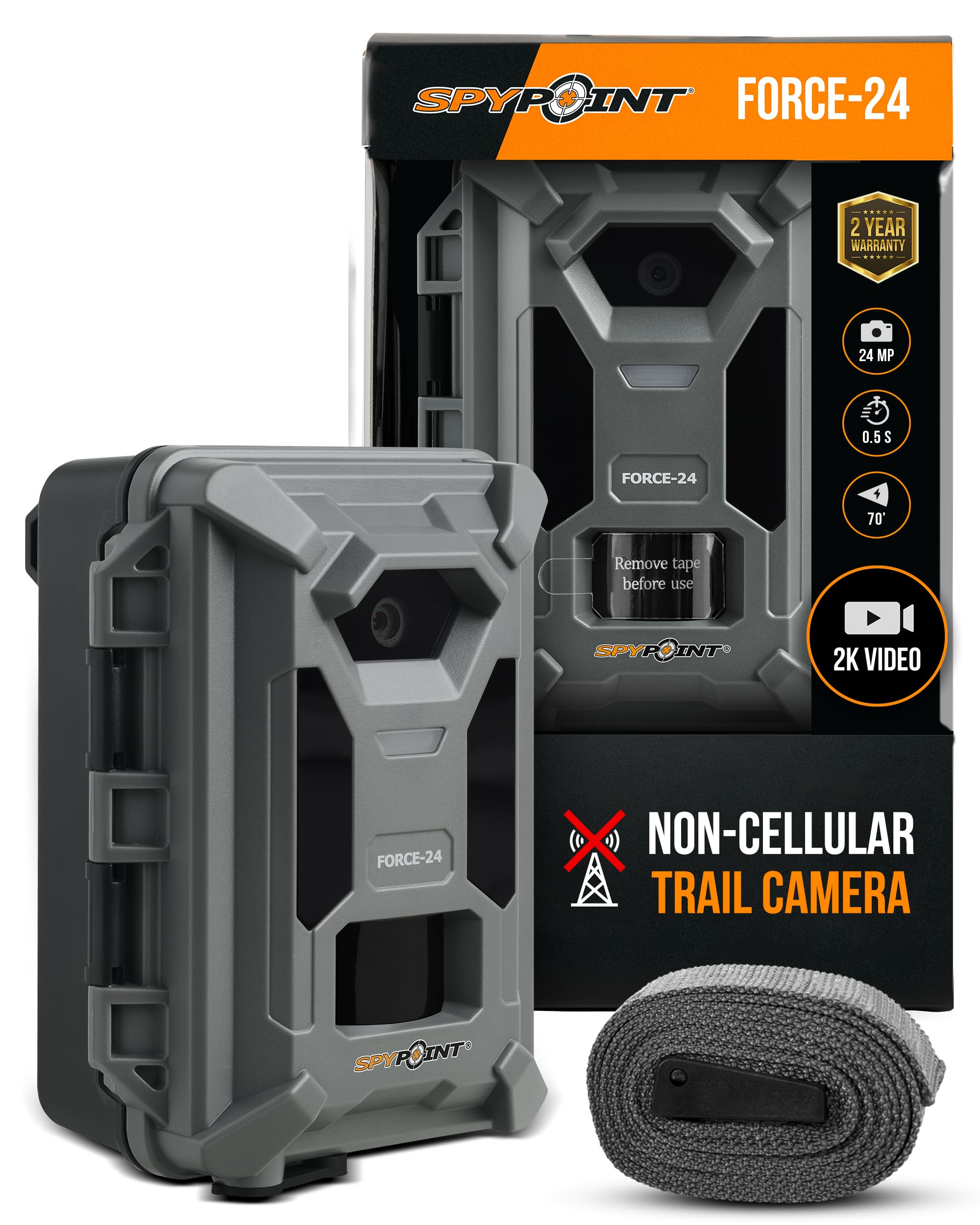
A simple, no-contract scout for hunters who skip the cellular hype.
If your last few cameras got complicated with SIM cards and data plans, this one strips all that away. The FORCE-24 is pure non-cellular: mount it, format your SD card, and walk back later to see what it caught. Motion-activated sensors reach 70ft out, and the 2K video with sound delivers twice the resolution of standard HD for sharp clips of passing game.
Owners who’ve cycled through other brands call it the best simple camera they’ve run in years, praising the solid build and intuitive setup screen. Because there’s no signal searching or data transmission, the battery sips power instead of draining — fewer trips out to swap cells. The 24MP stills fall short of the higher-resolution options above, and some owners note the picture quality isn’t as sharp as an older 8MP model they kept, but for basic scouting it does the job.
You’ll want to grab an SD card (not included) and use the built-in screen to format it before the first run. There’s no WiFi or Bluetooth, so viewing always means pulling the card.
Why It Works
- 2K video with audio — double standard HD resolution
- Non-cellular design extends battery life significantly
- 70ft motion detection covers a solid trail width
The Trade-off
- 24MP stills trail the higher-res options on this list
- No wireless — SD card retrieval every visit
The bottom line: A dependable, low-maintenance camera for old-school hunters who want good clips without the subscription game.
Who it’s not for: Shooters who measure quality in megapixels above all else.
Understanding the Specs
Trigger Speed & Detection Range
Trigger speed is how fast the camera fires after sensing motion, measured in seconds — 0.1s is fast enough to catch a deer mid-stride. Detection range tells you how far out the sensor picks up movement, so a 100ft range lets you mount the camera well back from the trail without missing action.
Night Vision Type & Resolution
No-glow IR uses invisible 940nm LEDs that won’t spook game, while low-glow 850nm LEDs cast a faint red beam but often reach farther with brighter images. Still resolution in megapixels determines how much detail you can zoom into — 64MP captures more fur and antler detail than a 36MP or 24MP sensor.
FAQ
What does trigger speed mean and why does it matter?
How many batteries do these game cameras need?
Do I need an SD card or is one included?
What is the difference between no-glow and low-glow night vision?
How long do batteries last in a non-cellular trail camera?
Can I view photos on my phone without removing the SD card?
Is solar power worth it on a budget game camera?
What does IP66 waterproof rating mean for outdoor use?
Final Thoughts: The Verdict
For most buyers, the budget game camera winner is the Meidase P70 because it pairs a 0.1s trigger with 100ft no-glow night vision and 64MP daytime clarity that reviewers point out beats pricier brands. If you want the step-up in video with a longer 110ft reach, grab the SPYPOINT FORCE-4K. And for covering two trails without the subscription overhead, the WOSPORTS 2-pack is the one to reach for.
How We Picked
We do not accept paid placement. Every pick is matched to a real buyer and a real use-case; we do not hands-on test units.
Sources & Methodology
Specifications: manufacturer listings and product documentation. Review insights: verified customer reviews, as of September 2026. Pricing: not shown on this page (it changes often); check the current price via the retailer link.
As an Amazon Associate, Gadgets Feed earns from qualifying purchases. This does not affect which products we feature.