
Our readers keep the lights on and my morning glass full of iced black tea. As an Amazon Associate, I earn from qualifying purchases.
Specs are compiled from manufacturer listings and verified buyer reviews and can change over time — please confirm the key details on the product page before buying.
Cutting aluminum with a standard wood blade is a recipe for melted edges, grabbed workpieces, and a blade that dies fast. You need a blade with a special tooth shape called TCG (Triple Chip Grind) that scores the metal before the next tooth clears it away. Below, we’ve matched nine specific 12-inch blades to the exact kind of aluminum work you do, from thin extrusions to thick bar stock.
I’m Min — the founder and writer behind Gadgets Feed. This guide is built by comparing the manufacturers’ published specifications and the patterns across verified customer reviews, so you get each pick’s real strengths and trade-offs instead of marketing spin.
To cut cleanly without burning the metal, you need a blade built for non-ferrous materials. Our focused list of the best 12 inch miter saw blade for aluminum groups top-rated models by tooth count and cutting mission.
Our Picks at a Glance


How To Choose The Best 12 Inch Miter Saw Blade For Aluminum
To cut aluminum cleanly and safely, you need to match three specs on your blade: tooth count, arbor size (the center hole that fits your saw’s shaft), and hook angle (the tilt of each tooth). Get these wrong, and you will see rough edges and risk dangerous kickback (when the blade grabs the metal and throws it back at you).
Match tooth count to material thickness
High tooth counts like 96 to 120 give you a smoother finish on thin material. The extra teeth mean each one removes less metal, so you get a finer edge on sheet goods and extrusions.
Check the hook angle for safety
Standard wood blades have a positive hook angle that pulls the blade into the cut. Aluminum blades use a negative hook angle, which pushes back and stops the blade from grabbing the work violently.
Quick Comparison
| Model | Best For | Teeth | Arbor | Item Weight | Amazon |
|---|---|---|---|---|---|
| MASTEC 100T★ Best Overall | Best Overall | 100 | 1-Inch | 1.27 kg | Amazon |
| Diablo D1296NPremium Durability | Premium Durability | 96 | 1-Inch | 4.8 oz | Amazon |
| TWIN-TOWN 96TSmooth Finish | Smooth Finish | 96 | 1-Inch | 2.4 lb | Amazon |
| OSHLUN 120T | Professional Use | 120 | 1-Inch | 3 lb | Amazon |
| CRALY 100T | Sharpness | 100 | 1-Inch | — | Amazon |
| COMOWARE 100T | Budget Value | 100 | 1-Inch | 1.13 kg | Amazon |
| TOMAX 120T | Thin Aluminum | 120 | 1-Inch | — | Amazon |
| UXACE 100T | Thin Kerf | 100 | 1-Inch | — | Amazon |
| VORTEX 5-Pack | High Volume | 100 | 1-Inch | — | Amazon |
In-Depth Reviews
1. MASTEC TCG 100-Tooth
Our pick — over 4.5★ from 700+ verified ratings; the strongest balance of quality and price.
The crowd favorite that slices through 6061-T6 aluminum with a clean, burr-free edge.
For a clean cut on tough aluminum stock, this blade delivers because of its 100 carbide teeth on a 1-inch arbor (the center hole that fits your saw’s shaft). The TCG tooth profile (a design where one tooth scores the metal and the next clears it) keeps the edge smooth, so you get a burr-free finish without extra sanding.
Real-world use confirms its heavy-duty performance.. Buyers report it cuts 6061-T6 aluminum with a 3/8-inch wall cleanly, holds true at 4500 RPM on a table saw, and handles deep milling on angle stock without complaining.
Weighing 1.27 kg, it is a touch heavier than the budget COMOWARE blade below, which gives it a more solid, stable feel in the cut. The durability is solid, though a few owners note carbide tips can occasionally come off, so treat it with care on hard impacts.
What wins people over
- Cutting performance is the top praise, with 84 owners citing clean, fast results.
- Build quality earns strong marks from 59 buyers who say it feels premium.
- Cuts aluminum T-trac and angle stock without snagging or rough edges.
The trade-offs to know
- A few owners mention carbide tips can dislodge on hard use.
- Not ideal for very thick aluminum where you need a slower feed rate.
Reach for this if: you want a dependable 100-tooth blade that handles everything from thin extrusions to heavy wall tube.
Look elsewhere if: you are doing production cutting all day, where the occasional tip loss becomes a real cost.
2. Diablo D1296N 96-Tooth
The premium pick that shrugs off impacts and stays sharp through hundreds of cuts.
If you have been burned by cheap blades that lose teeth, this Diablo is built to survive. It uses Tri-Metal Shock-Resistant Brazing (a method of welding the carbide tips that absorbs impacts better than standard brazing) and a Perma-SHIELD Non-Stick Coating that resists heat, gumming, and corrosion.
Blade quality is the top praise, with 58 owners highlighting it.. One owner reports using it for over eight years on aluminum, copper, wood, and plastic, still cutting with a milled finish..
It runs at a 5000 RPM max and uses a 96-tooth TCG profile with a 0.09-inch thickness. Customers note it grabs if the work is not flush against the fence, so support your material well and it rewards you with clean, quick cuts through solid bar stock.
Why it leads the premium tier
- Blade quality is the top praise, cited by 58 owners who trust it for years.
- Cut quality is second, with 46 buyers reporting burr-free finishes.
- Survives an unsecured off-cut flying without damaging the teeth.
What to watch for
- Need a slow feed rate to avoid the blade grabbing on thin material.
- The 96-tooth count is better for general use than for ultra-fine finishing.
Choose this when: you want a blade that lasts for years and handles aluminum, copper, and plastic without dulling.
Think twice if: you are on a strict budget, because this is a premium investment, not a throwaway.
3. TWIN-TOWN 96-Tooth TCG
A smooth-cutting 96-tooth blade that chews through thick aluminum headers with ease.
What wins people over here is the smoothness of the cut, with 58 owners naming it the standout feature. The blade uses C4 grade ultra-fine grain carbide teeth (a very dense, hard grade of carbide) that The maker claims the C4 carbide stays sharp up to 2X longer than standard blades..
The coating is the quiet hero. An Electrophoretic Coating (a protective layer applied with an electrical charge) resists rust and corrosion, so the blade survives a humid shop without developing a rough surface. Reviewers point out it cuts through thick aluminum shower door headers precisely on a 10-inch miter saw.
Unlike the 100-tooth blades above, this one uses 96 teeth, making it a versatile middle ground. It has a 1-inch arbor and weighs 2.4 pounds, giving it a hefty, stable feel that reduces chatter. Buyers also use it for PVC baseboard and Lexan without melting the plastic.
Its strongest points
- Smooth cut is the top praise, with 58 owners citing burr-free edges.
- Blade quality is second, with 54 buyers impressed by the C4 carbide.
- Cuts thick aluminum and plastic without melting or leaving burrs.
Honest limits
- Durability gets mixed feedback, so longevity is not fully proven.
- An occasional catch happens if you feed too fast on edging.
Best for: the shop owner who cuts a mix of thick aluminum and plastic and wants one blade that does both smoothly.
Skip if: you are a contractor who needs a blade that takes constant abuse, as durability reports vary.
4. OSHLUN 120-Tooth SBNF

A 120-tooth professional blade that cuts thick aluminum “like butter” with zero clogging.
For production work, this Oshlun is the workhorse. It packs 120 teeth on a 1-inch arbor with a negative hook angle (the teeth lean back, preventing the blade from grabbing and pulling the work). The C-1 carbide tips are precision ground and stay sharp through heavy use.
Cut quality is the top praise, with 41 owners citing clean, burr-free edges.. One robotics team cut over 100 pieces of aluminum with 0.125-inch walls, lubricating with wax and clamping the work, and reported no tooth loss at all. The copper-plugged expansion slots control heat and reduce noise.
At 3 pounds, it is the heavy option here, which translates to a stiff, stable body that does not wander in the cut. Shoppers say it handles everything from 26-gauge sheet to 1-inch thick 7075 aluminum, and the self-cleaning design prevents the aluminum smear that clogs lesser blades.
Built for volume: the 120-tooth count and negative hook make it ideal for repeated, precise cuts on thick stock.
The catch: durability is mixed in the data, with a small number of owners reporting teeth breaking on first use, so inspect it on arrival.
5. CRALY 100-Tooth Black Ice
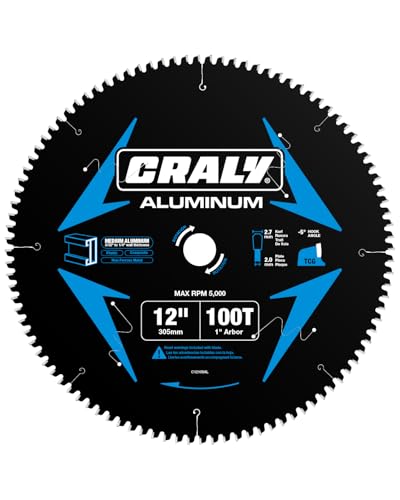
Ultra-fine carbide and a Black Ice coating keep this 100-tooth blade slicing cleanly cut after cut.
This CRALY blade earns its place on sharpness, with 50 owners naming it the standout quality. The ultra-fine grain carbide delivers a clean cutting surface, and the laser-cut hardened steel body keeps it true. Buyers report it cuts through 1/8-inch aluminum rails “like butter.”
The Black Ice anti-stick coating is the key differentiator. It reduces friction, heat, and corrosion during use, which means less aluminum sticking to the teeth and fewer burn marks on your workpiece. The thin kerf design (the width of the cut slot) at 2.7 mm removes less material.
Performance is the second most-praised feature with 41 mentions, and buyers highlight how it stays sharp through a large volume of pool cage aluminum. It handles carbon fiber sheets and acrylics too, making it a versatile shop blade. If you dislike the screech of abrasive blades, this one runs quieter, though a few note loud screeching on thicker cuts.
Sharpness you can feel: the ultra-fine carbide and coating make this the pick for clean finishes on thin to medium aluminum.
Who it is not for: the 2.7 mm kerf means it is not ideal for ultra-thick stock where you need the mass of a heavier blade.
6. COMOWARE 100-Tooth TCG

The budget-friendly 100-tooth blade that delivers clean cuts when you support the work well.
At the entry level of this list, the COMOWARE is the value pick. It uses tungsten carbide teeth with 6% cobalt (a binder that makes the carbide tougher) and a Teflon anti-stick coating to reduce friction. The 1-inch arbor fits both round and diamond hole machines.
Cut quality is the top praise, with 31 owners citing clean results on aluminum stock and 2020 extrusion.. When you compare it to the MASTEC above, it is lighter at 1.13 kg versus 1.27 kg, a small gap but noticeable in the hand. The key to success here is supporting the aluminum well during the cut.
The honest trade-off is durability. Owners mention it “cuts super cleanly for the first five cuts,” then requires more force as it dulls faster than premium options. It is ideal for light, occasional work like cutting aluminum frames for shower doors, not for production runs.
Where it shines
- Cut quality is the top praise, with 31 owners citing clean edges.
- Value for money is a strong point, with 16 buyers calling it worth the price.
- Weighs 1.13 kg, making it easy to handle on a miter saw.
Where it falls short
- Durability is a real concern, with 13 owners reporting teeth bending or breaking.
- Sharpness drops noticeably after the first several cuts.
Grab it if: you need a spare blade for light, occasional aluminum cuts and want to save money.
Pass on it if: you cut aluminum daily and need a blade that keeps its edge for hundreds of cuts.
7. TOMAX 120-Tooth Thin Aluminum

The specialized 120-tooth blade built for thin aluminum walls under 1/8-inch thick.
This TOMAX targets a specific job: cutting thin aluminum, defined here as less than 1/8-inch wall thickness. The 120-tooth count gives you a high number of cutting edges, which is exactly what you want for a smooth finish on gutters, box beams, and channels. It uses a TCG grind (Triple Chip Grind) for a durable, smooth cut.
Construction-grade carbide teeth resist wear, and the Electrophoretic Coating reduces rusting and corrosion. Customers note it makes quick work of 0.080-inch wall aluminum deck railings with a nice smooth cut, and it stays sharp after dozens of 24-inch cuts on 1/8-inch plate.
The trade-off for that fine finish is that this blade is not built for thick, heavy stock. It is for thin and medium aluminum, plastics, and non-ferrous metals. If you are cutting 1/4-inch bar stock, you are better served by the MASTEC or Diablo above, which have the mass for tougher work.
Designed for finesse: the 120 teeth and thin-stock focus make it the pick for rain gutters, railings, and box beams.
Know its limit: skip it for thick bar stock where the thinner body will flex and chatter.
8. UXACE 100-Tooth Thin Kerf
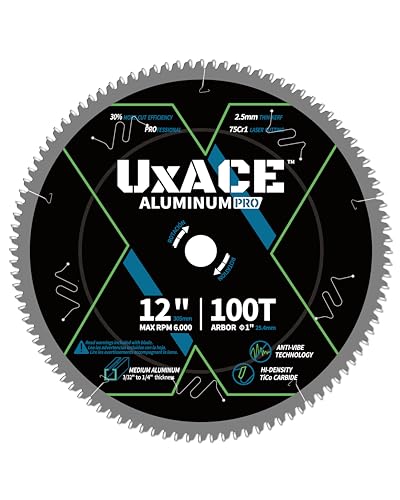
A laser-cut thin kerf blade that saves power on cordless tools while cutting smoothly.
If you run a cordless miter saw, this UXACE is worth a close look. Its defining feature is the laser-cut thin kerf design (the width of the cut slot is just 2.5 mm), which The maker claims the thin kerf saves up to 30% power in a cordless tool.. Less material removed means less resistance, so your battery lasts longer.
The blade uses professional-grade TiCo carbide tips (a blend of titanium and cobalt that stays sharp) on a 75Cr1 hardened steel body. It is rated for 6,000 RPM, and the Anti-Vibe Technology reduces vibration and noise for more stable cuts. Reviewers point out it cuts through 3/16-inch steel and 3-inch exhaust tubes cleanly.
Performance and quality are the tied top praises, with 24 owners each. The one significant complaint in the data is durability, with some buyers reporting the blade should have lasted longer. It is a great choice for medium aluminum, plastic, and composite on a cordless tool, but treat it as a consumable.
Why it stands out
- Thin kerf design saves power on cordless tools, per the maker.
- Performance and quality are the top praises, with 24 owners each.
- Rated for 6,000 RPM, ideal for high-speed miter saws.
What to expect
- Durability is mixed, with several owners wishing it lasted longer.
- The thin body is best for medium stock, not heavy impacts.
Pick this for: cordless miter saw users who want a smooth cut without draining the battery fast.
Be aware: the thin kerf trades some durability for efficiency, so it is not the choice for daily heavy cuts.
9. VORTEX DIAMOND 100-Tooth 5-Pack
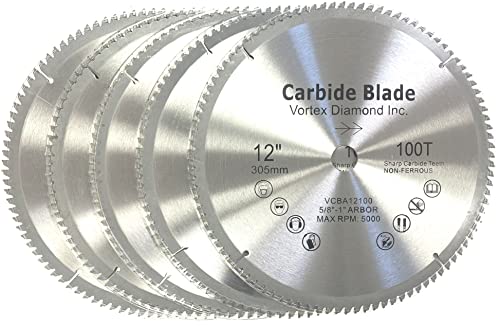
Five 100-tooth blades in one box, perfect for crews that go through carbide fast.
This VORTEX DIAMOND pack is a volume play for the shop or crew that burns through blades. You get 5 blades of 12-inch diameter, each with 100 titanium carbide teeth and a Triple Chip Tooth Grind. The arbor fits both 1-inch and 5/8-inch saws, and the max RPM rating is 5000.
Functionality is the top positive praise, with 18 owners citing clean cuts on 80/20 extrusions and acrylics. The value for money is the second most-praised feature with 15 mentions, which makes sense when you are getting five blades for roughly the price of two premium singles. One owner runs it on a DeWalt construction site saw for acrylic work.
The honest caution here is that cutting performance gets mixed feedback. Some shoppers say super clean cuts, while others found it chattered and shook on 0.125-inch aluminum. The blade quality is also mixed, with some praising it and others finding it poor. This is a solid budget option for plastics and light aluminum, not for demanding metal work.
Volume value: five 100-tooth blades make this the cost-effective choice for crews cutting plastics and light extrusions.
Know the fit note: performance on thicker 0.125-inch aluminum is inconsistent, so buy it for lighter duty.
Understanding the Specs
Tooth Count and TCG Grind
Higher tooth counts like 96 to 120 give smoother finishes on thin material. The TCG (Triple Chip Grind) tooth shape has every other tooth doing a scoring cut, which prevents the chattering and burrs you get with standard wood blades on aluminum.
Arbor Size and Hook Angle
The arbor is the center hole that fits your saw’s shaft. Most of these blades use a 1-inch arbor, which fits most 12-inch miter saws. A negative hook angle means the teeth lean back, which stops the blade from grabbing the work and pulling it violently.
FAQ
What does TCG stand for on an aluminum saw blade?
Can I use a 12-inch miter saw blade for aluminum on a table saw?
How many teeth do I need for cutting aluminum?
Should I use a wood blade for aluminum if it is all I have?
What is the difference between a 96-tooth and a 120-tooth blade for aluminum?
Why does my blade leave burrs when cutting aluminum?
What is the maximum RPM for these 12-inch aluminum blades?
How long does a carbide-tipped aluminum blade last?
Final Thoughts: The Verdict
For the majority of shoppers, the 12 inch miter saw blade for aluminum winner is the MASTEC 100-Tooth TCG, because it pairs clean cutting performance with a reliable build at a sensible price. If you want a blade that survives years of mixed metal work, grab the Diablo D1296N. And for the budget-conscious shop, the COMOWARE is the one to reach for on light, occasional cuts.
How We Picked
We do not accept paid placement. Every pick is matched to a real buyer and a real use-case; we do not hands-on test units.
Sources & Methodology
Specifications: manufacturer listings and product documentation. Review insights: verified customer reviews, as of September 2026. Pricing: not shown on this page (it changes often); check the current price via the retailer link.
As an Amazon Associate, Gadgets Feed earns from qualifying purchases. This does not affect which products we feature.