
Our readers keep the lights on and my morning glass full of iced black tea. As an Amazon Associate, I earn from qualifying purchases.
Specs are compiled from manufacturer listings and verified buyer reviews and can change over time — please confirm the key details on the product page before buying.
For a flawless automotive paint job, your compressor is the real artist — if it runs dry or pulses in the middle of a panel, you get orange peel, sags, and wasted clear coat. The fix is matching the machine to the gun, and this guide cuts through the marketing to the specs that actually matter: CFM at the pressure you spray at, tank size for steady delivery, and motor quality that survives a full-day session.
I’m Min — the founder and writer behind Gadgets Feed. This guide is built by comparing the manufacturers’ published specifications and the patterns across verified customer reviews, so you get each pick’s real strengths and trade-offs instead of marketing spin.
Ignore the horsepower sticker and look at CFM — that is what keeps a spray gun laying down a wet coat without stalling. This roundup of the air compressor for auto painting choices targets 20-gallon tanks and up, with honest notes on which one fits a weekend fender versus a full restoration.
Our Picks at a Glance


How To Choose The Best Air Compressor For Auto Painting
Spraying a car is different from running a nail gun — it demands a steady, high-volume airflow for minutes at a time. Pick the wrong unit and you’ll watch the gauge drop mid-panel, which ruins the finish and your afternoon.
Start with CFM, not horsepower
Horsepower is a marketing number that varies by manufacturer. The figure that decides whether your spray gun works is CFM (cubic feet per minute) at 90 PSI — the volume of air the pump can deliver while holding that pressure. A full-size HVLP (high volume, low pressure) auto spray gun can sip 8-12 CFM, so anything under that forces you to pause and wait.
Match tank size to your project
The tank acts as an air reservoir that smooths out delivery — the pump fills it, then the gun draws from it. For small touch-ups a 20-gallon tank works, but for a full car you want a bigger buffer so the pump isn’t cycling constantly. A larger receiver (the storage tank) also gives you more time before the motor kicks in again.
Quick Comparison
| Model | Best For | CFM at 90 PSI | Tank Capacity | Max Pressure | Amazon |
|---|---|---|---|---|---|
| Klutch 29-Gallon★ Best Overall | Home garage all-rounder | 5.1 cfm | 29 gallons | 175 PSI | Amazon |
| Campbell Hausfeld VT6290Heavy Duty | Dual-voltage shop use | 5.5 cfm | 20 gallons | 135 PSI | Amazon |
| Ingersoll Rand SS3L3Pro Grade | Continuous car painting | 11.3 cfm | 60 gallons | 135 PSI | Amazon |
| Stealth 20 Gallon Ultra Quiet | Quiet detailing work | 5 cfm | 20 gallons | 150 PSI | Amazon |
| California Air Tools 20020 | Noise-sensitive home shops | 5.3 cfm | 20 gallons | 125 PSI | Amazon |
| Craftsman 20 Gal | Nailers and light painting | 5 cfm | 20 gallons | 175 PSI | Amazon |
| Stealth 20 Gal (SAQ-12018) | Spraying guitars, small parts | 5 cfm | 20 gallons | 150 PSI | Amazon |
| VEVOR Gas 15HP | Off-grid, no power source | 33 cfm | 30 gallons | 115 PSI | Amazon |
| Ingersoll Rand 2475N7.5 | Pro shop, never runs dry | 24 cfm | 80 gallons | 175 PSI | Amazon |
In-Depth Reviews
1. Klutch 29-Gallon Air Compressor
Our pick — 4.5★ from 700+ verified ratings; the strongest balance of quality and price.
The quiet vertical tank that keeps pace with your spray gun without gulping floor space
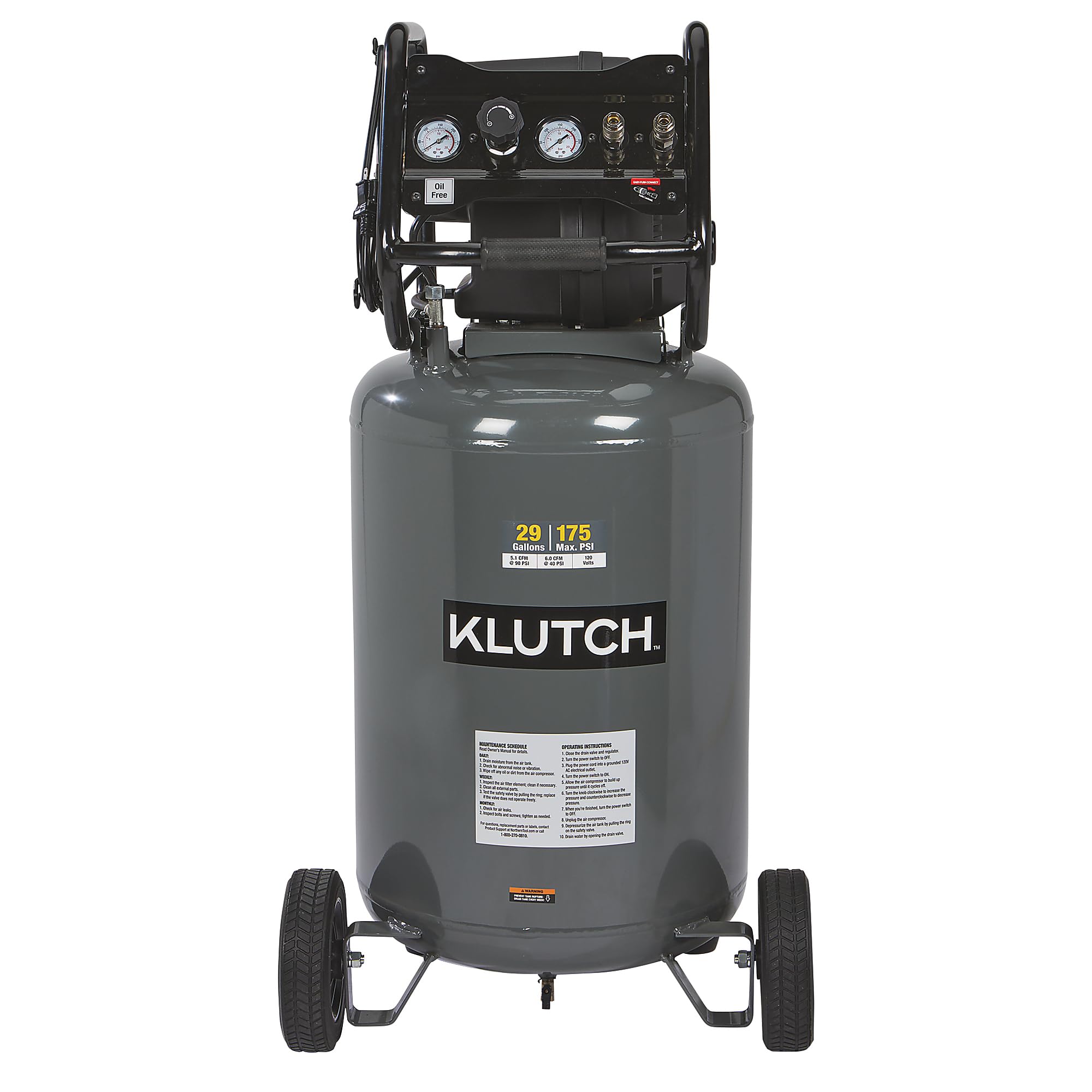
For home-garage painters, the Klutch earns its top spot by pairing a 29-gallon tank with a 5.1 CFM output at 90 PSI — enough stored air to finish a fender before the motor has to refill, which is exactly what owners say they love. They report it “keeps up with my air tools without having to stop and let the tank fill up constantly.”
Its 2.5 HP motor pushes 175 PSI maximum pressure, and because the pump is oil-free, you skip oil changes and the risk of oil spills near your paint booth. Buyers repeatedly describe it as quieter than expected — some say they can barely hear it running upstairs — and the tall vertical build tucks into a corner better than a horizontal 29-gallon unit would. The large flat-free tires make it easy to roll across a shop floor.
What wins people over is sheer performance, with far and away the most owners singling that out, along with strong value-for-money impressions. The recurring trade-off is pressure retention: a few owners found the tank loses a little pressure over days sitting idle, and some would like faster initial refill, so expect to check the drain and fittings if you store it long-term. The dual outlets and brass quick-connect coupler mean you can switch from your spray gun to a blow gun one-handed without hunting for a wrench.
That quick coupler also means you can run a second tool while the first is connected, ideal for test panels. Buyers report it holds pressure for a week without leaks. and works well for RV tires, nailing, and painting alike. For the weekend painter who wants one compressor that does everything without dominating the garage, this is the balanced pick.
quiet power house
- 29-gallon tank buffers long spray passes
- Oil-free pump needs no maintenance
- Quiet enough for home use
heavy weight
- Some owners note slow initial fill from empty
- Pressure retention can drop over days idle
quiet jobs: you want one 120-volt compressor that handles priming, painting, and air tools in a small shop.
portability: you plan full-day continuous production, where a bigger CFM unit is safer.
2. Campbell Hausfeld 20-Gallon Air Compressor
A cast-iron, oil-bath workhorse that runs on either 120V or 240V shop power
The Campbell Hausfeld VT6290 separates itself with an oil-lubricated cast-iron pump rated for up to 5,000 hours of service. — and it delivers 5.5 CFM at 90 PSI. Owners running intermittent spray work call it high quality, reliable, and note it runs quieter than direct-drive units they’ve owned, which matters when you’re concentrating on a wet edge.
Its dual-voltage 2 HP motor is the standout spec: plug into a standard 120V outlet at 15A, or switch to 240V at 7.5A for better efficiency in a wired shop. The 20-gallon horizontal tank rolls on 10-inch semi-pneumatic wheels, and the ASME-code receiver (a tank built to a recognized safety standard) gives you confidence storing compressed air. Owners mention it reaches full 135 PSI pressure in about four minutes without tripping breakers.
The catch is preparation: it ships without oil, so you’ll add about 12 oz of 10W-30 before first start, and some owners swap the factory drain petcock for a ball valve after a few uses. An occasional unit arrives with shipping damage — loose boxes are the usual culprit — but the manufacturer has sent free replacement parts when owners reach out. Given the lower review volume, this is a quiet-but-confident pick for someone who values a serviceable, American-made pump over the oil-free convenience trend.
tight budget: a shop with 240V available that wants a repairable, oil-bath pump for years of service.
pro use: budget for oil and a better drain valve; it’s not quite plug-and-play.
3. Ingersoll Rand SS3L3 Single Stage Air Compressor
The 60-gallon vertical that sprays whole cars without breaking a sweat
Ingersoll Rand’s SS3L3 is where auto painting gets serious: it pushes 11.3 CFM at 90 PSI — more than double the output of any 20-gallon unit on this list — with a 60-gallon tank and 100% continuous duty rating. That means you can run a full-size HVLP spray gun for an entire base-and-clear session without the motor overheating or the pressure collapsing mid-panel. One owner calls it “perfect garage compressor” for car painting needs.
The cast-iron pump is rated for over 5,000 hours of service., and the auto start/stop pressure switch means it runs only when the tank needs it. Owners praise the synthetic lubricant lasts 2,000 hours between changeouts. — and the oil sight gauge makes checking levels a glance-and-go task. Despite the industrial output, buyers consistently say it’s “very quiet for my shop.”
Reviewers also note the air stays dry if you rig up an aftercooler, which is critical for paint work where moisture ruins finishes. The honest caveats: it runs on 220V so you’ll likely need an electrician to hardwire it, and some owners say a DA sander can out-draw it during continuous use — so it’s built for painting and tools rather than nonstop sanding. At roughly four feet tall and needing two people to move, this is a stationary shop anchor, not a portable.
brand loyal: dedicated car and full-panel painting where air starvation simply isn’t an option.
cost saving: it demands 220V wiring and floor space a homeowner might not have.
4. Ingersoll Rand 2475N7.5 Two-Stage Air Compressor

A two-stage giant that a medium shop can run all day and never drain
At the top of the heap sits the Ingersoll Rand 2475N7.5, a two-stage 7.5 HP compressor that delivers a staggering 24 CFM at 90 PSI into an 80-gallon ASME receiver tank. Two-stage means the air is compressed twice for higher pressure and efficiency — here maxing at 175 PSI — and owners say even a medium-sized shop “will never run out of air.” This is the unit you buy when a paint booth is a business, not a hobby.
The cast-iron pump is rated for over 15,000 hours of service., and the 100% continuous duty rating means the motor is designed to run nonstop through a full production shift. It’s built to be serviced, with individually cast cylinders and an overhung crankshaft that simplify maintenance. Owners coming from smaller units say it “works much better than the 5 hp I had,” which is the expected step-up.
The trade-offs are real: 611 pounds and a 230V connection mean professional installation, and owners note the synthetic oil is expensive to replace. Buyers also mention it lives up to its continuous-use claim so far, with no worry about running out of air mid-job. If you’re spraying complete vehicles daily or running several guns at once, nothing else on this list keeps up.
Its sheer output means you can also run sandblasters and DA sanders simultaneously, turning it into the centerpiece of a full fabrication shop. The distinction from the smaller SS3L3 is the two-stage design — it’s not just more air, it’s more efficient air at higher pressure.
workshop duty: for daily full-vehicle painting where downtime means lost revenue.
home garage: the 611-pound weight and 230V hookup demand a permanent shop location.
5. California Air Tools 20020
The 70 dB unit that lets you hold a conversation while the tank fills
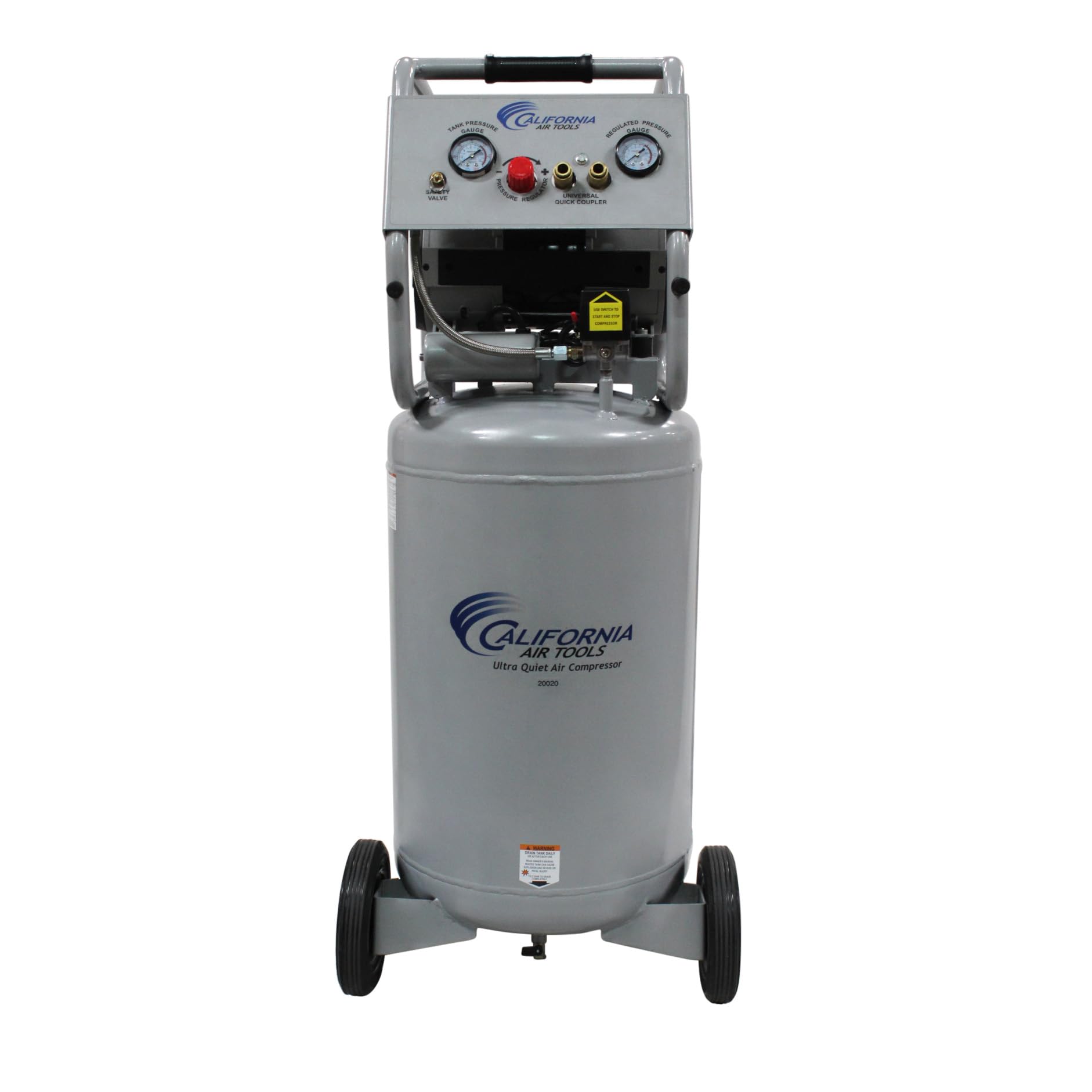
If your compressor lives near living spaces or you simply hate ear protection, California Air Tools sets the standard at 70 dB — quiet enough that owners say normal conversation continues while it runs. Its 2.0 HP motor spins at just 1680 RPM, which cuts noise and wear, and the oil-free dual-piston pump is rated for over 3,000 hours of service.. It delivers 5.3 CFM at 90 PSI into a 20-gallon steel tank.
Owners upgrading from pancake units note the 20-gallon tank sustains about five minutes of continuous spray before refilling., and the refill is quick. It runs on a low 14-amp draw, so any standard 110V/60Hz outlet handles it without a dedicated circuit, and thermal overload protection guards the motor. The upright design keeps a small footprint, and at 134 pounds the wheeled base rolls around a garage fine.
Reviewers call it a premium-feeling product, with one owner moving up from a 10-gallon version that lasted three years in a demanding shop setting. The mixed reliability reports are worth noting: a few owners experienced failures after about a month of use, and one measured actual output lower than the 5.3 CFM label suggests. If you treat it as a quiet, low-duty painter rather than a continuous-production unit, it meets expectations.
ultra quiet: for noise-sensitive environments and moderate spray workloads, this 70 dB unit is the best-behaved pick here.
indoor use: a basement or attached-garage shop where noise bothers the household.
speed needs: occasional reliability complaints suggest it’s best for hobby-level rather than daily pro use.
6. Stealth 20 Gallon Ultra Quiet Air Compressor

A hushed 68 dB unit that handles detailing tools without waking the block
The Stealth earns its “ultra quiet” name with an advertised 68 dB noise level — and owners confirm it, with one replacing a loud 95 dB unit and measuring just 65 dB at 8-10 feet away, describing a softer purr rather than a clatter. It pairs that silence with a 1.8 HP oil-free motor pushing 5 CFM at 90 PSI into a 20-gallon alloy steel tank, which is solid for detailing guns and mechanical tools.
Customers note it works well with detailing tools and some mechanical tools, with a heavy-duty steel tank that sits on 8-inch rubber wheels for easy movement. It carries a Limited Lifetime Warranty, which is a strong statement of confidence from the manufacturer. The oil-free design means no lubrication and less mess, and two quick couplers let you switch between a detailing gun and a blow gun fast.
The mixed feedback centers on compression speed — some owners say it builds pressure very fast while others report it takes longer to reach full 150 PSI capacity, so early owners should expect some variation. One critical review described a unit failing within two weeks and poor support, though that sits against a majority reporting quiet, reliable service. For a 20-gallon tank it’s notably quieter than the Craftsman or Campbell Hausfeld, making it a strong detailing-touch-up choice.
noise sensitive: quiet detailing work in a driveway or residential garage where neighbors are close.
high pressure: you need continuous high-volume output for full-car production painting.
7. STEALTH 20 Gallon Ultra Quiet (SAQ-12018)

The quiet oil-free unit guitar builders trust for flawless lacquer finishes
This second Stealth entry shares the SAQ-12018 model number but earns its own spot with a telling review pattern: owners are using it specifically for spray lacquer on guitars and detail guns for full-body paint, reporting “flawless finishes” with no oil contamination in the air. The oil-free induction motor runs below 70 dB and is rated for over 1,000 hours of service., delivering a maximum 150 PSI and 5 CFM at 90 PSI.
Its Q235B steel construction and large rubber wheels make it stable and mobile, with a rubber-reinforced handle for transport. Owners say it doesn’t take up much room and is “pretty quiet” compared to other oil-free compressors, with the 20-gallon tank exceeding expectations for full body painting with both detail and full-size guns. The Limited Lifetime Warranty backs the alloy steel build.
A few owners note the drain is awkward to access, and one had a filter crushed in shipping — though the seller over-compensated for the issue. Compared to the other Stealth 20-gallon, this listing skews toward spray-finish work based on the reviews, making it the niche choice for airbrush artists and custom painters who need clean, quiet air. The primary distinction is verified spray-use cases rather than a spec difference, so pick this variant if finish quality is your obsession.
small footprint: fine-finish spraying — guitars, custom parts, detail work — where oil-free air is non-negotiable.
low ceilings: draining the tank is fiddly, so plan for that maintenance step.
8. Craftsman 20 Gallon Oil-Free Air Compressor

The trusted red badge with 175 PSI headroom for nailers and intermittent spray
Craftsman brings brand trust to a 20-gallon package with a stainless steel tank that resists corrosion from the moisture that plagues paint work, plus a 175 PSI max pressure rating that gives you real headroom over the 135-150 PSI units. Its 1.8 HP oil-free motor delivers 4 SCFM at 90 psi — enough for a paint sprayer used intermittently, plus nailers, drills, and chisels. Owners say it takes up less room than a horizontal 30-gallon tank.
The setup experience draws consistent praise as “amazingly easy,” with two quick couplers and two rubber wheels included, and one owner replaced a 30-year-old Craftsman with this unit — the kind of brand loyalty that speaks to perceived longevity. It’s described as “fairly quiet,” with the vertical stainless steel tank saving shop floor space versus horizontal designs.
The honest downside is durability: multiple reviewers point out the motor burning up within two months, framed against others who’ve had no issues, and one alarming review described a near-fire after two years. Given the positive quality sentiment outweighs the negative, this reads as a value pick for light-to-moderate duty — not a continuous-production workhorse. If you need proven daily reliability for a paint business, the Ingersoll Rand units justify their higher cost.
Buyers also note it fills a 20-gallon portable tank in half the time of their old unit, and the stainless tank holds pressure well. The included 6-foot hose means you’ll add a longer line for spray work, but the core package is solid for the home shop.
easy start
- 175 PSI maximum outperforms pricier 20-gal rivals
- Stainless steel tank resists rust
- Easy setup from the start
loud noise
- Multiple early motor failures reported
- 4 SCFM at 90 psi limits continuous spray
occasional use: budget-conscious buyers doing light painting, nailing, and inflation without needing all-day output.
daily jobs: anyone relying on it daily for professional income, given the durability pattern.
9. VEVOR 15HP Gas Powered Air Compressor

A gas-driven 33 CFM monster that sprays anywhere there’s no power outlet
When there’s no electrical service at the job site, the VEVOR gas-powered unit is the answer: its 15 HP gas engine drives a piston pump delivering an enormous 33 CFM at 115 PSI — more than three times the airflow of the biggest electric unit here — into a 30-gallon horizontal tank. Owners say it “runs my spray gun no issue, fills my truck tires fast, and builds pressure super fast.”
The dual air outlets let two tools run simultaneously, ideal for a helper on a large panel, and the cast iron cylinders and frames resist wear. An automatic shut-off protects the pump from damage during low oil levels, a smart safety touch for a gas engine. Four smooth-rolling wheels make it mobile for outdoor project sites, and at 271 pounds it’s the kind of unit you roll, not carry.
The honest trade-offs are significant: shoppers say a non-functional pressure relief valve, an inaccurate outlet gauge, and quick-connect fittings incompatible with standard US hoses — corner-cutting that undermines an otherwise impressive machine. Reliability is the bigger question mark, with one owner reporting a breakdown within five months and unhelpful support. This is a niche pick for remote-site work where the raw output justifies the compatibility headaches.
off grid: construction sites, farms, or anywhere without reliable electricity that needs massive airflow.
indoor work: a home garage, where electric units offer better fit, finish, and support.
Understanding the Specs
CFM at 90 PSI — the real number
The cubic feet per minute a pump delivers while holding 90 PSI tells you if your spray gun starves. A full-size HVLP gun can pull 8-12 CFM, so look for the highest number your budget allows — that’s the difference between a wet coat and a splutter.
Duty cycle and tank size
Duty cycle is the percentage of time a motor can run before it needs to cool — 100% means continuous use. The tank (in gallons) stores air so a smaller pump can still deliver bursts. For painting, a bigger tank smooths out delivery so the gun doesn’t see the pump cycling.
FAQ
What CFM do I need to spray a car with an HVLP gun?
Is oil-free or oil-lubricated better for auto painting?
How big a tank do I need for painting a full car?
Will a 120-volt compressor work for auto painting?
Is 175 PSI better than 150 PSI for spraying?
Why does my compressor need a dryer or filter for paint?
What does 100% continuous duty rating mean?
Is a gas-powered compressor good for auto painting?
Final Thoughts: The Verdict
For the majority of shoppers, the air compressor for auto painting winner is the Klutch 29-Gallon because it pairs a 5.1 CFM output with a big 29-gallon tank, oil-free simplicity, and a 175 PSI ceiling that satisfies weekend painters and workshop multitaskers alike. If you want continuous, production-grade output for full-car resprays, grab the Ingersoll Rand SS3L3 with its 11.3 CFM at 90 PSI and 60-gallon tank. And for quiet touch-up and detailing work in a residential garage, the California Air Tools 20020 is the one to reach for, holding conversation-level 70 dB noise while you work.
How We Picked
We do not accept paid placement. Every pick is matched to a real buyer and a real use-case; we do not hands-on test units.
Sources & Methodology
Specifications: manufacturer listings and product documentation. Review insights: verified customer reviews, as of September 2026. Pricing: not shown on this page (it changes often); check the current price via the retailer link.
As an Amazon Associate, Gadgets Feed earns from qualifying purchases. This does not affect which products we feature.