
Our readers keep the lights on and my morning glass full of iced black tea. As an Amazon Associate, I earn from qualifying purchases.
Specs are compiled from manufacturer listings and verified buyer reviews and can change over time — please confirm the key details on the product page before buying.
You want to capture two people talking without a tangle of cables ruining your shot. The real question is if you need pocket-sized clip-ons for a phone or rugged XLR plugs for stage gear — and this guide sorts that out by pairing each system with its true use case.
I’m Min — the founder and writer behind Gadgets Feed. This guide is built by comparing the manufacturers’ published specifications and the patterns across verified customer reviews, so you get each pick’s real strengths and trade-offs instead of marketing spin.
From ultralight clip-ons to phantom-power stage rigs, the seven systems below define the best 1 Microphones 2 Transmitter System for your recording setup.
Our Picks at a Glance


How To Choose The Best 1 Microphones 2 Transmitter System
Every system here shares one job: a single receiver pulls clean audio from two separate transmitters worn by two different people. The differences that matter are how the transmitters attach, what your recorder accepts, and how long the batteries hold out on a shoot.
Match the Receiver to Your Recorder
The receiver is the box that plugs into your camera, phone, or mixer. If you shoot on a smartphone, you need a receiver with a USB-C or Lightning connector — and some kits bundle both. If you record on a DSLR or camcorder, a receiver with a 3.5mm output is the standard. For stage sound, you are plugging an XLR receiver straight into a mixer or powered speaker instead.
Weigh the Transmitters — Literally
A transmitter that is too heavy will drag a shirt collar down and look clumsy on camera. The lightest clip-ons here sit around 9 to 10 g, which is light enough that a magnet or clip holds them discreetly. Heavier XLR plug-on transmitters are not worn at all — they attach to the base of a wired microphone, so weight matters less and durability matters more.
Check the Battery Math
Two transmitters run twice the power draw, so battery strategy is not optional. The best video kits include a charging case that refills both transmitters and the receiver together, pushing total runtime past 40 hours. Stage-style systems use built-in rechargeable batteries that run 6 to 9 hours per charge, and you recharge them with cables instead of a case.
Quick Comparison
| Model | Best For | Transmission Range | Weight per TX | Battery Life | Amazon |
|---|---|---|---|---|---|
| DJI Mic Mini★ Best Overall | Phone & camera creators | 400m | 10 g | 48h with case | Amazon |
| Hollyland Lark M2Most Versatile | Multi-device creators | 300m | 9 g | 40h with case | Amazon |
| MAONO Wave T5Best for USB-C Phones | USB-C phone creators | 300m | 9 g | 30h with case | Amazon |
| RØDE Wireless GO (Gen 3) | Professional video | — | — | 40h+ recording | Amazon |
| YXG UHF M-ONE | Stage & instrument | 160 ft | — | 9h | Amazon |
| EBJ Wireless XLR | PA & live sound | 50m / 164 ft | — | 6–8h | Amazon |
| BOYA BY-WM8 Pro-K2 | Budget dual-mic shoots | 100m | — | 6h+ | Amazon |
| ACEMIC Q2/AT-5 | Accordion players | 132 ft | — | 6h | Amazon |
In-Depth Reviews
1. DJI Mic Mini (2 TX + 1 RX + Charging Case)
Our pick — over 4.5★ from 23,500+ verified ratings; the strongest balance of quality and price.
The tiny clip-on that disappears on camera yet records like a full-size rig.
You barely notice the transmitters are there — each one weighs only 10 g, so it sits on a collar or magnet without dragging the fabric or stealing the frame. Underneath that featherweight shell, the system records at a 48kHz sampling rate with 120 dB SPL handling, which means loud laughter or a raised voice stays clear instead of distorted.
The range is a head-and-shoulders lead over every other video kit here: 400m of stable transmission, a 4.0x gap over the BOYA’s 100m, so you can roam a busy street or a large room without dropouts. Noise cancellation runs at two levels — a Basic setting for quiet interiors and a Strong mode that keeps vocals intelligible in chaotic outdoor sound.
Battery life is the other headline number: the charging case brings the whole kit to 48 hours of combined use, which owners sum up as “phenomenal.” The catch is that the magnetic clip needs a firm surface — on a thick puffer jacket it can struggle to hold. It records through the DJI OsmoAudio ecosystem or Bluetooth, and the transmitter alone can pair straight to a phone or PC, though the native camera app may need a third-party recorder for that route.
What wins people over
- Featherlight 10 g transmitters stay put and look invisible on camera
- 400m range covers busy outdoor shoots without signal loss
- Two-level noise cancellation keeps vocals clean indoors and out
- 48h total runtime with the charging case for multi-day trips
Where it trips up
- Magnetic clip needs a firm fabric, not thick puffy coats
- No small case for carrying just the transmitters
Reach for this if: you shoot interviews, vlogs, or livestreams on a phone or camera and want the lightest, longest-lasting dual-mic kit available.
Think twice if: you need a small pouch for transmitter-only travel — this kit expects you to use the full charging case.
2. Hollyland Lark M2 Wireless Microphone
One kit, three receivers, and every device in your bag finally gets clean audio.
This is the only system on the list that ships with three receivers — a camera unit plus USB-C and Lightning dongles — so you can move between a DSLR, an Android phone, and an iPhone without buying adapters. Each transmitter weighs just 9 g, edging out the DJI’s 10 g, and records true 48kHz/24-bit audio that owners describe as studio quality from a pocket-sized unit.
The range stretches to 300m line-of-sight, and a high-gain antenna keeps the human body from blocking the signal when you turn your back to the receiver. Noise cancellation is a one-touch yellow button on the transmitter, with a green indicator on the receiver confirming it is active. Battery life reaches 40 hours with the charging case, which fully recharges the whole set twice in under two hours each time.
The trade-off for all that flexibility is the short USB-C connector on the dongle receiver — it can sit proud on a thick phone case and need an extension. For guitarists and movers, the magnetic strap mount scores high, though the magnets can pop off if knocked hard. Pre-paired at the factory, the system connects the moment you open the box, and a volume knob on the receiver gives you manual gain control on the fly.
The one-kit-for-everything pick: three receivers and 40h of charge make this the best value for creators who alternate between phone, camera, and computer.
The honest limit: the short USB-C dongle calls for an extension adapter on bulky phone cases.
Best for: creators who want one system that records to any device they own.
Look elsewhere if: you only ever shoot on a camera — the bundled extras are unnecessary.
3. MAONO Wave T5 Wireless Lavalier Microphone
A pocket-sized rig that turns a USB-C phone into a broadcast deck.
Talking-head creators will love the four one-tap voice presets — Vocal Enhancer for balanced everyday sound, Brightness for punchy social clips, Warmth for storytelling, and Magnetic Radio for that deep broadcaster tone. No EQ work needed after the fact, which is a genuine time-saver. The transmitters sit at 9 g each and record 48kHz/24-bit audio with an 80dB signal-to-noise ratio.
Noise cancellation gets its own dedicated ENC chip with three modes and 14 adjustable levels, tunable through the Maono Link app, so you can dial in exactly how much street or café rumble to strip away. Range reaches 300m in open areas and 100m with the transmitter behind your back — steady even when you spin or walk away from the receiver.
Battery life is the strong suit: each transmitter runs up to 9 hours, and the charging case extends the kit to 30 hours total for multi-day shoots. The receiver itself needs no charging and includes a Type-C port to keep your phone powered while you record. The most-discussed themes in owner feedback are quality and sound clarity, and the recurring note is that a transmitter is sensitive enough to pick up clothing rustle — clip it to a firm collar rather than loose fabric.
The creator-friendly wins
- Four voice presets replace post-production EQ work
- ENC chip with 14 levels of noise cancellation control
- 30h total runtime across case and transmitters
- Receiver charges your phone while recording
The practical catches
- High sensitivity picks up fabric rustle on loose clothing
- Some kits ship with two magnets instead of the advertised four
Grab it for: USB-C iPhone or Android creators who want studio presets and deep noise-cancellation control without editing.
skip it if: you need an analog 3.5mm receiver for an older camera — this is a USB-C-first system.
4. RØDE Wireless GO (Gen 3)

The safety net that rescues clipped audio before you even notice it.
This is the one system a busy video professional buys for its forgiveness. It records over 40 hours of 32-bit float audio on board, a format that lets you recover a clipped or too-quiet take in post without re-shooting. Intelligent GainAssist handles input levels automatically, so you are not riding gain knobs while a subject starts talking mid-scene.
Transmission runs on a Series IV 2.4 GHz digital link with 128-bit encryption, which keeps the signal stable and private. Compatibility is universal: USB-C and locking 3.5mm outputs connect to cameras, smartphones, and computers, and the box includes 3.5mm TRS, USB-C, and Lightning cables plus a charging hub that tops up all units at once.
The 300 g carry weight and compact transmitters disappear on a subject, and owners have run three straight days of interviews on a single charge. The recurring note is speed: transferring long recordings over USB runs about 5MB/s, which is slow for lengthy files — plan for it. Magnetic clips are sold separately, and the audio quality, while excellent, is only a subtle step above the earlier Gen 2 for most ears. New buyers get the cleanest workflow, complete with furry windshields and a carry pouch.
Why pros trust it
- 32-bit float recording rescues clipped or quiet audio
- GainAssist automates levels for run-and-gun shoots
- 128-bit encrypted transmission keeps signal stable
- 40+ hours of on-board recording per charge
The workflow friction
- USB transfer speed around 5MB/s drags on long files
- Magnetic clips cost extra on top of the kit price
Choose this when: you shoot interviews or corporate video and want a safety net against audio disasters.
Reconsider if: your budget is tight — the accessory caveats add cost and the transfer speed tests patience.
5. YXG UHF Wireless XLR Transmitter and Receiver

The plug-on that frees any wired mic and delivers phantom power on the move.
If you already own good wired microphones, this system turns them wireless without a second purchase. The XLR transmitter plugs into the base of any dynamic or condenser microphone, delivers 48V phantom power to it, and beams the audio to an XLR receiver over a UHF connection reaching 160 feet. That makes it a different beast from the clip-on lavaliers above — this is gear for a stage, a PA system, or a mixer, not for a shirt collar.
The audio path is clean: a 107 dB signal-to-noise ratio keeps hiss low, and 24-bit/48kHz resolution preserves detail. Latency sits under 0.25 milliseconds, so a performer’s live monitor stays in sync. Up to 10 sets can run in the same venue, and 20 channels give you room to dodge interference. The built-in lithium battery runs 9 hours per charge, and owners confirm you can charge while performing — a real upgrade over rivals that pause during a top-up.
One owner ran three units for a stereo DJ setup from a mixer to powered speakers without a hitch, and another clocked 3+ hours on an SM58 with charge-and-play still working. The mixed feedback centers on noise — a few users report hiss in demanding rooms, so this favors personal and small-venue use over critical live broadcast. It is the budget-friendly path into wireless XLR, roughly a fraction of premium rack systems.
The price-to-value read: you get phantom power, sub-millisecond latency, and 9 hours of charge for far less than branded wireless XLR rigs.
The honest caveat: a handful of owners note hiss in large or noisy rooms, so treat it as a small-venue performer.
For the gigging musician: this is the cheap, flexible way to cut cables on stage.
Not for: critical broadcast work where hiss-free audio is non-negotiable.
6. EBJ Wireless Microphone System UHF XLR
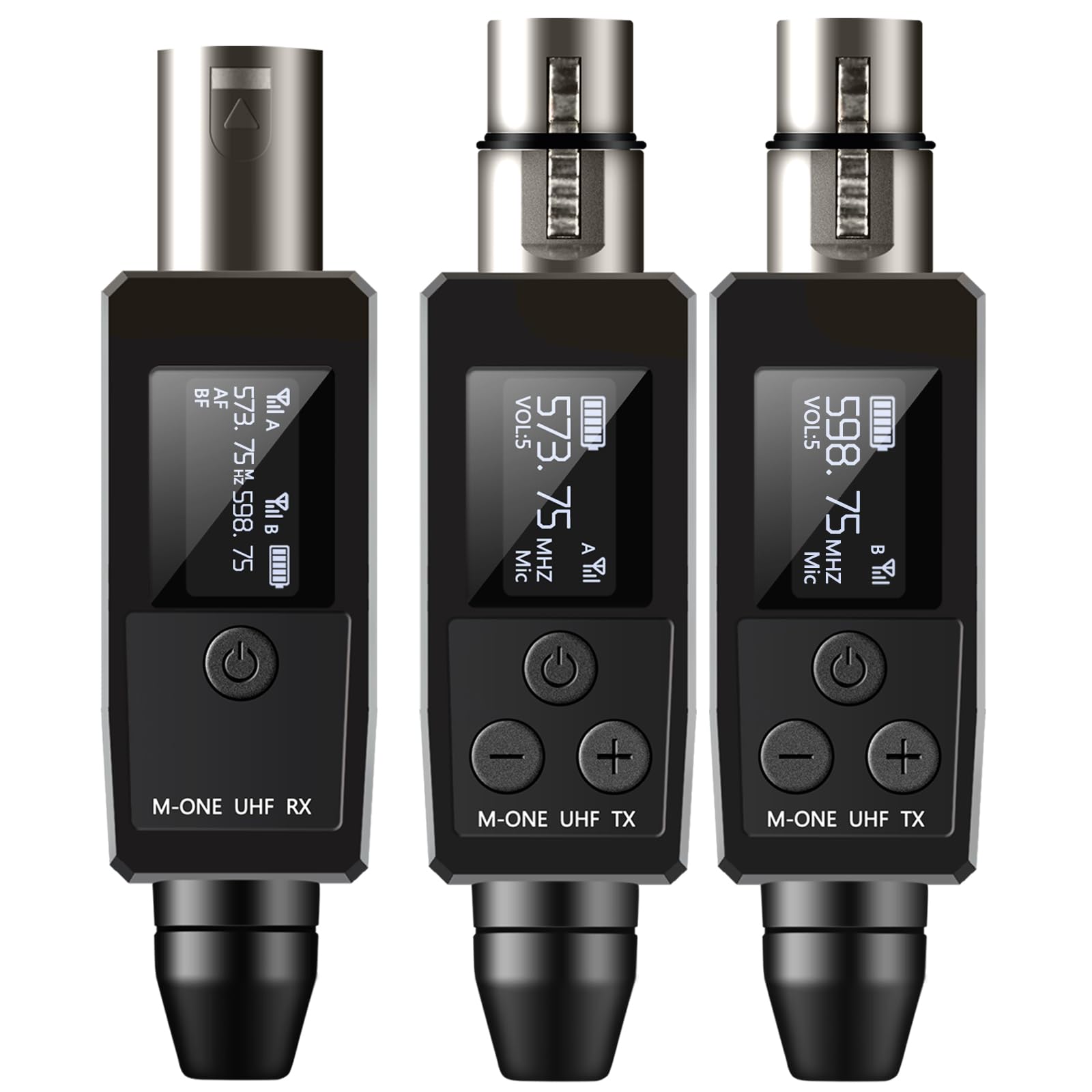
A palm-sized XLR bridge that sends a wired mic signal 164 feet across a venue.
This sibling to the YXG system shares the same slim 1.18 x 0.79 x 4.72-inch body — a 3.2x size gap versus the DJI kit’s charging-case footprint — but it targets a slightly different buyer. It is built for plugging a dynamic or condenser microphone into an XLR transmitter and running the signal to a PA speaker or mixer, with 48V phantom power on tap for condenser mics that need it.
The UHF band delivers wireless transmission up to 50 meters, or 164 feet in open air, dropping to 30 meters across obstacles. A 107 dB signal-to-noise ratio keeps the audio clear, and latency stays under 0.25 milliseconds so live monitors do not drift. Up to 15 systems can share one venue, with 20 broadcast channels for interference management.
Owners highlight phantom-power capability as the standout feature, with one noting it feeds clean audio from mics that require it. Battery runtime lands between 6 and 8 hours on the built-in lithium cells. Real-world reports show real range — one user ran the link 100 feet to a powered speaker and another converted a corded mic to wireless, both cleanly. A few listeners flag a hiss with 48V condenser mics, so dynamic mics play safer here. The recurring advice is to buy the correct version: this 2TX/1RX kit is built for mics, while a stereo feed to speakers needs two single kits.
What earns its spot
- 48V phantom power lets condenser mics run wireless
- 100-foot-plus real-world range across a venue
- 6–8h battery with quick recharging
- Under 0.25ms latency keeps live audio in sync
Know before you buy
- Noticeable hiss with 48V condenser mics for some users
- Pick the right kit version — the 2TX/1RX mixes channels for mics
Best suited to: mobile DJs and venue hosts who need a compact wireless bridge to powered speakers.
Pass if: you are an audiophile running high-end condenser mics — the hiss floor will bother you.
7. BOYA Dual Wireless Lavalier Microphone BY-WM8 Pro-K2

The entry ticket to two-person wireless recording without a hefty bill.
This is the most budget-friendly route into a true 2-transmitter and 1-receiver setup for cameras and smartphones. The operation range reaches up to 100m, or 300 feet, without obstacles — a 4.0x gap behind the DJI’s 400m — which is plenty for a typical interview room or street shoot. Two bodypack transmitters and two omnidirectional lavalier mics come in the box, each running over 6 hours on a pair of AAA batteries.
It is built for interviews, news gathering, and field production, with a camera-mount receiver that works across DSLR, camcorder, and smartphone via the included cables — one 1/8-inch to XLR and one 1/8-inch to 1/8-inch. Owners find the mics simple to use, with clear voice capture when they get back to the edit. A one-year BOYA warranty backs the kit.
The budget reality shows up in battery behavior: some owners using high-capacity rechargeable AAAs report the transmitters drain fast, and a show over an hour risks losing signal. Treble response draws a mild critique too. For a hobbyist filming a small studio video or a first interview, this is a clever value pick; for marathon livestreams, the DJI or Hollyland hold the edge on endurance.
The entry-level wins
- True 2-TX and 1-RX system at a budget-friendly price
- 300-foot open-air range covers most interview spaces
- Works across camera, camcorder, and smartphone
- Includes both XLR and 1/8-inch output cables
The budget trade-offs
- Rechargeable AAA batteries drain fast in the transmitters
- Treble response could be smoother for critical ears
Ideal for: the first-time interviewer or studio hobbyist who wants a dual-mic kit without overpaying.
Think longer if: your recordings routinely pass the one-hour mark — battery drain becomes the limiting factor.
8. ACEMIC Dual UHF Accordion Wireless Microphone Q2/AT-5

The only mic here built to strap onto an accordion and move with the player.
Accordionists face a problem general lavaliers ignore: the instrument moves, and both hands are busy. This system solves it with Velcro-mounted transmitters that stick near the keyboard and bass changers, each fitted with a flexible gooseneck so you can aim the mic heads at the reeds. It captures sound from both sides of the instrument for a fuller, balanced take.
Transmission runs on UHF with infrared auto-pairing and a 48kHz sampling rate, reaching 132 feet (40 meters) in open areas. Twenty adjustable channels let you dodge interference, and up to four systems can run together on stage. The receiver packs a single 1/8-inch output, so you feed it into a mixer or recording interface rather than straight to a powered speaker.
Built-in rechargeable batteries in both transmitters and the receiver deliver 6 hours per charge, refilled in 2.5 to 3 hours through the bundled 2-in-1 cable. Owners praise long battery life and clean, latency-free sound, noting it handles high volume without distortion. The honest caveats are fit-specific: gooseneck stability on energetic players, and the receiver’s 1/8-inch jack instead of XLR feels basic at this premium price point. This is a specialist tool for a specific instrument, not a general-purpose kit — and for its niche it earns strong praise from players recording to a DAW or gigging amplified.
Why accordionists like it
- Gooseneck transmitters aim at both keyboard and bass reeds
- 6h battery per charge with 2.5–3h refill time
- Handles high volume without distortion
- Velcro mount removes without damaging the instrument finish
The specialist catches
- Receiver uses 1/8-inch jack, not XLR, at a premium price
- Gooseneck can shift on energetic performers
Made for: accordion and sax players who want stage mobility without losing reed detail.
Not for: general videography — the receiver output limits where you can plug in.
Understanding the Specs
Transmission Range and Frequency
Range tells you how far the transmitter can roam from the receiver before the signal drops. Clip-on systems often claim 300 to 400 meters in open air, while UHF XLR systems quote 50 to 160 feet — the difference is that video users roam freely while stage users stay near a PA. Frequency matters too: 2.4GHz systems are common for video but can clash with Wi-Fi, while UHF bands tend to cut through venue noise with less interference.
Sampling Rate and Bit Depth
Sampling rate (measured in kHz) and bit depth (measured in bits) define how faithfully a mic captures sound. A 48kHz/24-bit recording captures detailed, accurate audio — enough for professional voice work. The DJI and Hollyland both deliver this, while the RØDE goes further with 32-bit float, a format that records so much headroom you can rescue a clipped take in editing. Lower specs like 40-18KHz frequency response range still sound fine for casual use but lack the top-end sparkle.
Noise Cancellation and Phantom Power
Noise cancellation strips background rumble from your voice. Some systems offer a simple on/off toggle, while others give multiple strength levels — DJI has Basic and Strong, and MAONO offers three modes with 14 levels. Phantom power is a different feature entirely: it sends 48V through an XLR cable to power condenser microphones that have no battery of their own. Only XLR plug-on transmitters like the EBJ and YXG include it, so they can turn any condenser mic wireless.
Battery and Charging Case Strategy
Two transmitters drain power twice as fast, so check how a system recharges. Video kits bundle a charging case that refills everything together, pushing total runtime to 30, 40, or even 48 hours. Stage-style XLR systems rely on built-in batteries running 6 to 9 hours per charge, recharged by cable. For long shoots, the case is the winner; for gigs, a quick cable top-up between sets works fine.
FAQ
What does 2 transmitters and 1 receiver actually mean for my recording?
Will a clip-on system work with my DSLR camera?
What is the difference between 2.4GHz and UHF wireless transmission?
How long does the battery last on a dual-transmitter system?
Can these systems connect directly to an iPhone or Android phone?
What is phantom power and why would I need it in a wireless system?
Is a heavier XLR transmitter system better than a lightweight clip-on?
What does 32-bit float recording do that a 24-bit system cannot?
How many of these wireless systems can run in the same room at once?
Can I use a wireless XLR system with an electric guitar or bass?
Final Thoughts: The Verdict
If you want one dependable pick, the best pick is the DJI Mic Mini because its 10 g transmitters, 400m range, and 48-hour case battery make it the most complete dual-mic kit for creators, and it holds the highest owner satisfaction in this list. If you want the freedom to record on any device, grab the Hollyland Lark M2 with its three included receivers and 40-hour runtime. And for stage or instrument work, the EBJ Wireless XLR is the one to reach for when you need phantom power and cable-free reach across a venue.
How We Picked
We do not accept paid placement. Every pick is matched to a real buyer and a real use-case; we do not hands-on test units.
Sources & Methodology
Specifications: manufacturer listings and product documentation. Review insights: verified customer reviews, as of September 2026. Pricing: not shown on this page (it changes often); check the current price via the retailer link.
As an Amazon Associate, Gadgets Feed earns from qualifying purchases. This does not affect which products we feature.