
Our readers keep the lights on and my morning glass full of iced black tea. As an Amazon Associate, I earn from qualifying purchases.
Specs are compiled from manufacturer listings and verified buyer reviews and can change over time — please confirm the key details on the product page before buying.
Before you hand over your money for a 150cc scooter or mini-motorcycle, ask yourself one honest question: do you want a machine that starts on the first crank and gets you to work, or a project that eats your weekends? The owner reports split sharply — two well-reviewed daily riders versus two stretched trikes with a few buyers describing electrical fires and a seller who won’t help. This guide compares the four most-searched gas-powered, street-legal 150cc options to help you match one to your commute, skill level, and assembly tolerance.
I’m Min — the founder and writer behind Gadgets Feed. This guide is built by comparing the manufacturers’ published specifications and the patterns across verified customer reviews, so you get each pick’s real strengths and trade-offs instead of marketing spin.
I’ve separated the dependable two-wheelers from the risky three-wheelers to give you a clear-eyed verdict on the 150cc scooter market where a fuel-injected two-wheeler is the most reliable everyday choice for new riders.
Our Picks at a Glance

How To Choose The Best 150cc Scooter
Before you sort through engine specs, decide what job this machine must do. A 150cc class gas scooter is a commuter tool, not a highway cruiser — most owners use them for city errands, campus runs, and short A-to-B trips. That single decision filters out half the options immediately.
Match the engine size to the real road
Look closely at the displacement because the class accepts engines from 149cc up to 170cc as the same style of ride. A 168cc fuel-injected engine gives you noticeably stronger city acceleration than a bare 150cc carbureted motor, especially when you are pulling away from a stoplight with a passenger. Check what the spec sheet lists for max speed and assume you will see a few mph less in real traffic with wind.
Weigh the assembly and reliability trade-off
Most of these arrive partially assembled in a crate — somewhere between 80% and 95% built. That means you will attach handlebars, mirrors, a battery, and sometimes the rear wheels yourself. Read the owner feedback on whether the manual is clear or missing entirely, because that determines if your first afternoon is a pleasant 40-minute job or a research project. Ask yourself honestly if you are comfortable with basic wrench work before committing.
Quick Comparison
| Model | Best For | Engine Specs | Max Speed | Dry Weight | Amazon |
|---|---|---|---|---|---|
| X-PRO Lifan KP Mini 150★ Best Overall | New riders wanting a fun, reliable mini-motorcycle | 150cc Lifan engine | ~60-65 mph stock | 242 lbs capacity | Amazon |
| HHH Tank 200 EFI Scooter | Daily commuters wanting fuel injection and storage | 168cc EFI air-cooled | 62 mph claimed | 300 lbs | Amazon |
| ICEBEAR Ruckus PST150-19N Trike | Buyers drawn to three-wheel stability | 150cc engine | — | 570 lbs | Amazon |
| Venom Reckless Trike PST150-19N | Riders wanting a digital dash and disc brakes | 150cc fully automatic | — | 400 lbs | Amazon |
In‑Depth Reviews
1. X-PRO Lifan KP Mini 150 Gas Motorcycle
Our pick — over 4★ from 20+ verified ratings; the strongest balance of quality and price.
The mini-bike that new riders call a perfect first motorcycle thanks to a Lifan engine.
If you are a beginner, this is the machine owners consistently describe as the ideal gateway into riding. What wins people over is the build quality of the Lifan engine — a name recognized for reliability — combined with a frame that arrives in a protective crate about 95% assembled. The set-up job is just the battery, mirrors, and handlebars, which an owner put together in roughly 30 to 90 minutes without any help. After that, it “started and ran perfect on the first crank,” right out of the crate.
The digital upgrades make it feel far more modern than its price tier suggests. A free upgraded LCD tachometer (a screen that shows your engine speed) displays your speed as digital numbers along with an odometer for mileage, your RPM, the temperature, and the local time. Buyers report it hits a max of about 60-65 mph stock, and they note it reaches 75+ mph once upgrades are added — though it is not suitable for sustained freeway riding. The new fatty exhaust gives the bike a deeper engine sound and more horsepower, adding to the fun factor.
The catch is honesty about the paperwork and a few delivery quirks. This bike cannot be sold to California, and the Manufacturer Statement of Origin (MSO) plus the Bill of Sale arrive by separate mail, so plan for that lag before you register it. A small number of crates arrived with minor damage like a missing axle bolt, though the seller responded by sending the replacement part. The provided assembly instructions are reportedly weak, but owners agree the build is “rather intuitive” once you look at the parts.
What New Riders Praise
- High build quality is the most-discussed strength, with owners saying it performs and looks better than a Grom-style bike
- Easy assembly is the second most common praise — most finish in under an hour and a half
- Starts immediately and runs well from the first crank
Honest Limitations
- Not freeway-suitable — plan for surface streets only at stock speed
- No oil filter, which left one owner wondering about long-term engine life
- Crate damage and missing hardware happen occasionally, though the seller sends replacements
Grab it if: you are a first-time rider who wants a dependable, fun mini-motorcycle that assembles fast and starts every time.
Think twice if: you plan to commute on high-speed freeways daily, since stock power tops out around 60-65 mph.
2. HHH Tank 200 EFI Scooter

A fuel-injected scooter with real highway legs and the storage to carry your day.
If you commute daily and want both power and practicality, the HHH Tank 200 EFI delivers a proper step-through scooter — not a mini-motorcycle like the X-PRO above. Its 168cc air-cooled engine uses electronic fuel injection (EFI — a system that meters fuel electronically for crisper throttle response, better efficiency, and easier cold starts). That injection is the standout spec: owners mention up to 80 mpg on a ride, so your fuel costs stay low even with a long daily route.
The automatic CVT (Continuously Variable Transmission — a transmission that shifts gears for you, so there is no manual clutch or gear lever) makes acceleration smooth and easy in city traffic. A front hydraulic disc brake delivers the even stopping force you want at city speeds, and a long 52-inch wheelbase keeps the ride stable. The scooter also carries real luggage: you get spacious under-seat storage plus a detachable rear trunk, so a grocery run or a laptop commute needs no backpack. It is built to leave smaller commuter scooters in the dust, with a claimed max speed of 62 mph, and one buyer reports real-world figures of 76 mph downhill and 60 mph uphill.
The trade-off is assembly and consistency. The scooter arrives about 95% assembled, and owners split on the experience: some call it easy, while others flag that the hardware bags lack labels and no instruction manual comes in the box — one owner cautions that “parts will vibrate and fall off randomly” unless you use thread-locking compound on the bolts. Quality is the most-mentioned positive, with riders noting this Yamaha-style scooter is well-built with no cheap plastic feel, and value-for-money is the second most common praise. Reliability reports are mixed — most run great, but a few owners say theirs stopped working, so expect to handle basic wrench work yourself.
Fuel-Sipping Hauler: the 168cc EFI engine with 80-mpg reports plus under-seat and trunk storage makes this the most practical daily rider here, beating both trikes on cost-per-mile by a wide margin.
Be Ready to Build: with no printed manual and unlabeled hardware bags, this scooter suits buyers comfortable figuring out assembly themselves — and willing to Loctite the bolts from day one.
Reach for this if: your ride is a daily city or highway commute and you want fuel injection, automatic shifting, and real storage space.
Look elsewhere if: you expect showroom-ready assembly instructions or a dealer-warranty safety net, since reliability reports are genuinely mixed.
3. ICEBEAR Ruckus PST150-19N Stretched Trike
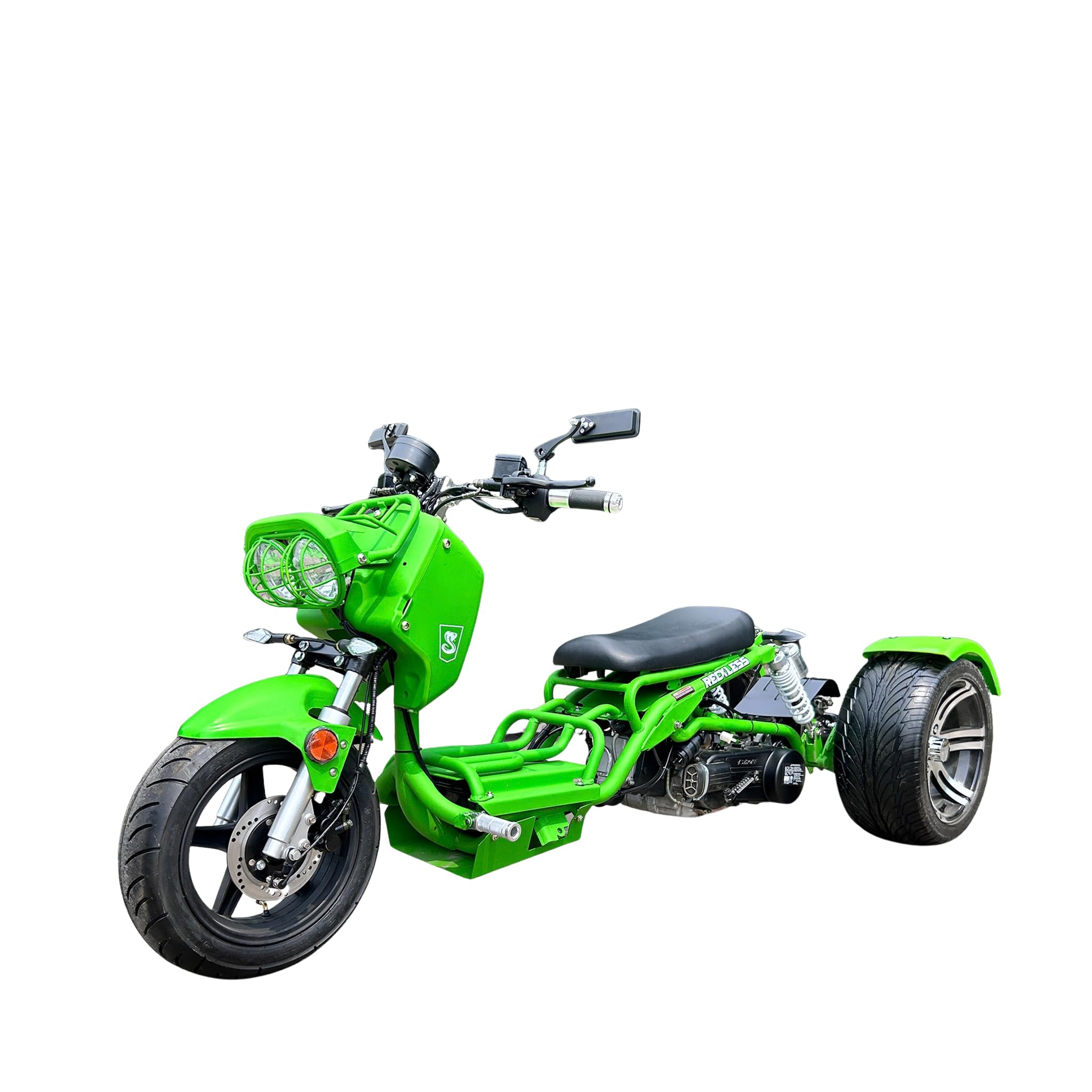
A three-wheel cruiser whose low center of gravity draws stares at every stop.
This stretched trike aims at riders who want the stability of three wheels without giving up the scooter feel. The selling point is the low center of gravity paired with responsive steering, which the maker says delivers exceptional control, plus a comfortable ergonomic seat with ample legroom for longer rides. The 150cc engine provides enough power for urban commutes and leisure cruising, and the whole machine is built on an aluminum frame that keeps the weight manageable for its size.
The honest reality from owners is a split you must weigh carefully. The machine is a genuine head-turner — one rider reported that every trip to the store draws at least two people asking where he bought it, and another called it a nice ride that is only “a little ruff on the bumps.” But the negative experiences are serious. Customers note the unit can arrive with no owners manual, scratched paint, and bent forks, and one owner described an electrical fire where the seller refused to assist. At 570 pounds, this is the heaviest pick here by a wide margin — it outweighs the HHH Tank scooter above by roughly 1.9x — so you will need a trailer or truck bed to move it home from the crate.
This is the pick to choose with your eyes fully open. The 1-year / 4,000 miles warranty and included MCO Title and Bill of Sale are real benefits for getting it registered, but the sparse review history is not reassuring. The crowd that loves it uses it for short, low-speed neighborhood cruising where the three-wheel stability and curb appeal shine — not as a primary commuter. If you are handy, patient, and prepared to tighten, adjust, and troubleshoot from day one, the stability payoff is real; if you want a turn-key machine, this is not it.
Showpiece Cruiser: the three-wheel stance and low center of gravity deliver genuine stability and constant compliments at low speeds, and the aluminum build keeps the 570-pound weight from feeling worse.
Project-Box Warning: reports of no manual, bent forks, and an electrical fire with poor seller support make this a gamble best left to patient tinkerers who can verify the unit on arrival.
Best for: riders who prioritize low-speed stability and love being the center of attention on short neighborhood cruises.
Not for: anyone needing a dependable daily driver or expecting a low-maintenance crate-to-road experience.
4. Venom Reckless Trike PST150-19N
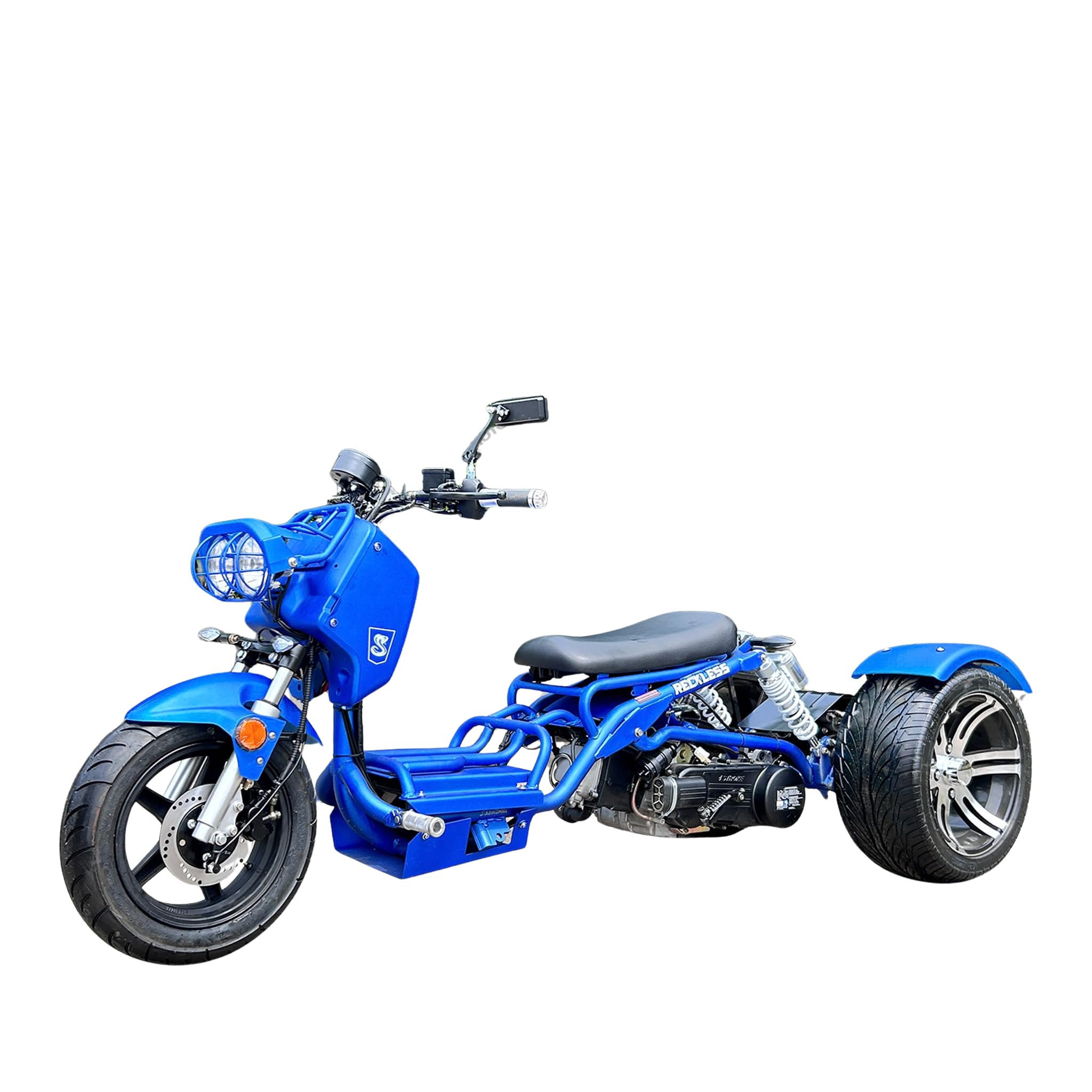
A fully automatic trike that leans on a digital dash and dual disc brakes for confidence.
This is the more feature-loaded sibling of the ICEBEAR trike above, and it shares the same stretched three-wheel platform with a few key upgrades. The fully automatic 150cc engine means there is no clutch or gear shifting — just twist and go — which lowers the learning curve for new riders. It also brings a built-in digital speedometer and an LED lighting system for a more modern cockpit, plus front and rear disc brakes for what the maker calls reliable stopping power at every speed.
The wheel setup is where this model differentiates itself: a 12-inch front wheel paired with 14-inch rear wheels, sized to deliver smooth rides across various road conditions. At 400 pounds, it is noticeably lighter than the 570-pound ICEBEAR version, which makes it easier to maneuver in a driveway or garage even though both share the same PST150-19N part number. Like its sibling, it includes the 1-year / 4,000-mile warranty plus the MCO Title and Bill of Sale paperwork for street-legal registration.
Here is the catch you must accept before buying: this arrives 80% assembled, which is a far bigger build than the two-wheelers above. You are responsible for attaching the 3 wheels, rear suspension, chain, handlebars, mirrors, and battery — a substantial afternoon of work that demands mechanical confidence. The review history mirrors the ICEBEAR exactly, including the same reports of a missing owners manual, scratched or bent parts on delivery, and one owner describing an electrical fire with an unhelpful seller. The riders who enjoy it call it a good ride that earns compliments, but the risk profile is identical to its stablemate.
Feature-Rich Platform: the digital speedometer, LED lights, and dual disc brakes make this the most modern-feeling trike of the two, and the lighter 400-pound frame is genuinely easier to live with.
Big Assembly Ask: an 80% crate build with wheels, suspension, and chain to install yourself — combined with serious quality complaints — makes this a committed DIY purchase, not a bolt-on-and-go scooter.
Choose this if: you want the three-wheel stability with a digital dash and are fully comfortable assembling a motorcycle from a crate.
Pick something else if: you want a reliable first scooter — the two-wheeled options above offer far more consistent owner satisfaction for the same kind of money.
Understanding the Specs
EFI vs. Carburetor
Electronic fuel injection (EFI) meters fuel into the engine electronically instead of using a mechanical carburetor. In plain terms, you get easier cold starts, smoother throttle response, and often better gas mileage — the HHH Tank reviewers point out up to 80 mpg. A carbureted engine like the one on the X-PRO is simpler and cheaper to repair, but it can be finickier to start in cold weather and may need choke adjustments.
CVT Transmission
CVT stands for Continuously Variable Transmission, which is a fancy way of saying the scooter shifts gears for you automatically. There is no clutch lever and no gear shifter — you twist the throttle and go, which makes these machines ideal for new riders and stop-and-go city traffic. The X-PRO mini-bike, by contrast, is a manual-style motorcycle where you shift gears yourself, so consider which experience you actually want before buying.
Street-Legal Paperwork
Gas scooters and mini-motorcycles need proper documentation to be registered and ridden on public roads. Look for a Manufacturer Statement of Origin (MSO) and a Bill of Sale, which you use to get a title in your state. The X-PRO ships these by separate mail, and both trikes include them in the crate with a 1-year / 4,000-mile warranty. Also check whether the brand restricts sales — the X-PRO cannot be sold to California.
Crate Assembly Percentage
Manufacturers ship these machines partially built to keep freight costs down. The advertised percentage tells you how much work remains: the X-PRO arrives about 95% assembled, meaning just battery, mirrors, and handlebars; the HHH Tank is similar; but the Venom trike arrives only 80% built, requiring you to mount the wheels, rear suspension, chain, and more. Read the percentage honestly against your own mechanical skill before committing.
FAQ
Is a 150cc scooter fast enough for highway riding?
Do I need a motorcycle license to ride a 150cc scooter?
How much assembly is required when the scooter arrives?
What paperwork do I need to get these street legal?
Is a three-wheel trike more stable than a two-wheel scooter?
What is the difference between the X-PRO mini-bike and a traditional scooter?
How much weight can a 150cc-class machine carry?
Which is more reliable, a fuel-injected or carbureted engine?
Do these scooters come with a warranty?
Why did you include the trikes if they have bad reviews?
Final Thoughts: The Verdict
For most riders, the best 150cc scooter choice in this lineup is the X-PRO Lifan KP Mini 150 because its owner praise centers on exactly what new riders need — dependable build quality and easy assembly with a Lifan engine that starts on the first crank. If you want automatic shifting, fuel injection, and real storage for a daily commute, grab the HHH Tank 200 EFI. And for the rider set on three-wheel stability, the ICEBEAR Ruckus trike delivers the looks and low-speed confidence — just go in knowing the quality reports make it a genuine gamble.
How We Picked
We do not accept paid placement. Every pick is matched to a real buyer and a real use-case; we do not hands-on test units.
Sources & Methodology
Specifications: manufacturer listings and product documentation. Review insights: verified customer reviews, as of September 2026. Pricing: not shown on this page (it changes often); check the current price via the retailer link.
As an Amazon Associate, Gadgets Feed earns from qualifying purchases. This does not affect which products we feature.