
Our readers keep the lights on and my morning glass full of iced black tea. As an Amazon Associate, I earn from qualifying purchases.
Specs are compiled from manufacturer listings and verified buyer reviews and can change over time — please confirm the key details on the product page before buying.
When you pack for the backcountry, every ounce in your bag must earn its place. You need gear light enough to carry for miles yet tough enough to survive a sudden storm or a rocky campsite. The right setup hinges on shelters and sleep systems that balance weight, warmth, and durability.
I’m Min — the founder and writer behind Gadgets Feed. This guide is built by comparing the manufacturers’ published specifications and the patterns across verified customer reviews, so you get each pick’s real strengths and trade-offs instead of marketing spin.
You are shopping for dependable backcountry camping gear, so we break down nine proven tents, sleeping bags, and stoves that real hikers rely on for multi-day trips.
Our Picks at a Glance


How To Choose The Best Backcountry Camping Gear
Backcountry camping means carrying everything on your back, so your choices come down to a constant trade-off between weight and comfort. Before you buy, think about the coldest temperatures you will face, how many people you are sheltering, and whether you prefer cooking a hot meal or eating cold. These three questions will guide almost every decision you make.
Match Your Sleep System to the Season
Your sleeping bag and pad work together to keep you warm. The bag traps your body heat, while the pad blocks the cold ground from stealing it. Look at a bag’s temperature rating as a guideline, not a guarantee, and remember that a warm sleeper can often use a lighter bag than a cold sleeper. For the pad, an R-value (a measure of how well it resists heat loss to the ground) of 5 or higher is a safe target for three-season trips.
Weigh the Shelter Against the Weather
A tent’s weight matters most when you are hiking uphill, but its weather protection matters most when a storm rolls in at night. Freestanding tents with their own poles are quicker to pitch on any ground, while trekking-pole designs save weight but need your hiking poles for support. Check both the packed weight and the floor space to make sure the tent fits your body and your gear comfortably.
Don’t Overlook the Cooking System
A stove can be the difference between a hot meal after a long day and a cold, miserable one. Look for a model with a pressure regulator (a part that keeps fuel flow steady) so it boils water fast even when the canister is low or the temperature drops. Consider the total weight of the stove, the fuel canister, and your pot, since that whole kit rides in your pack.
Quick Comparison
| Model | Best For | Weight | Key Spec | Type | Amazon |
|---|---|---|---|---|---|
| MSR PocketRocket Deluxe★ Best Overall | Fast Boiling | 2.9 oz | Boils 1L in 3.5 min | Stove | Amazon |
| Underwood 4 Season TentWinter Warrior | Winter Camping | 4.4 lbs | 35.8″ Center Height | Tent | Amazon |
| Naturehike Down BagUltralight Warmth | Ultralight Warmth | 1.3 lbs | 650 Fill Power | Sleeping Bag | Amazon |
| Teton LEEF Mummy Bag | Cold Weather Value | 3.5 lbs | Roomier Mummy Fit | Sleeping Bag | Amazon |
| ALPS Lynx 1 | Solo Shelter | 4 lbs 1 oz | 20 sq ft Floor | Tent | Amazon |
| Naturehike R5.8 Pad | Warm Insulation | 1.2 lbs | R-Value 5.8 | Sleeping Pad | Amazon |
| Kelty Grand Mesa 2P | Roomy Couples | 4 lbs 1 oz | 30 sq ft Floor | Tent | Amazon |
| Night Cat Ultralight | Minimalist Weight | 2 lbs | Trekking Pole Setup | Tent | Amazon |
| Kelty Cosmic 20 | Premium Down Warmth | 2 lbs 6 oz | ISO Limit 21°F | Sleeping Bag | Amazon |
In‑Depth Reviews
1. MSR PocketRocket Deluxe Ultralight Camping and Backpacking Stove
Our pick — over 4.5★ from 800+ verified ratings; the strongest balance of quality and price.
The ultralight stove that still delivers a big, wind-resistant flame for your morning coffee.
This stove’s pressure regulator delivers consistent flame control, making it feel like a full-size kitchen burner. It weighs just 2.9 ounces, so you will barely notice it in your pack, yet it boils 1 liter of water in 3.5 minutes even in colder weather and with low fuel. That speed comes from the pressure regulator (a part that keeps the gas flowing steadily as the canister empties), which also lets you drop the flame to a gentle simmer for cooking things like hashbrowns without burning them.
The built-in piezo push-start lighting (a button that creates a spark to ignite the gas) means no fumbling for a lighter. Owners rave about how it boils fast even in wind, rain, and high elevation, and the broad burner resists gusts that would snuff out weaker stoves. It folds down small enough to fit inside a 750ml pot with your cook kit, and the self-sealing threaded isobutane-propane canister (sold separately) screws on securely.
The one honest trade-off is that it is slightly larger than the most minimal stoves on the market, but buyers consistently say the extra size is worth it for the performance. The crowd favorite — 4.8 stars across 800+ ratings — is proof of how well it works in the field. Whether you are thru-hiking or just want a reliable weekend boil, this little stove earns its place.
What Wins Hikers Over
- Boils 1L in 3.5 minutes even in cold weather
- Low simmer control for real cooking, not just boiling
- Push-start ignition is reliable and protected
The Trade-Offs
- Slightly larger footprint than minimalist stoves
- Fuel canister is not included
Reach for this if: you want a dependable, fast-boiling stove that disappears into your pack for any backcountry trip.
Think twice if: you are counting every fraction of an ounce and never need to simmer a real meal.
2. 1/2 Person 4 Season Backpacking Tent, Lightweight Waterproof Winter Tent
A four-season shelter that shrugs off snow and wind without emptying your wallet.
This 4-season tent’s snow skirt and PU5000mm rain fly are engineered for winter storms. It is a true 4-season shelter, meaning it handles winter snow as well as summer bugs, thanks to a snow skirt (a fabric flap around the base that keeps snow from blowing in) and a full-coverage rain fly. The PU5000mm coating on the fly keeps the interior dry, and the aircraft-grade aluminum poles are light yet tough enough to withstand high winds.
Buyers report this tent survived a full Patagonia O-Circuit trek, staying dry through rain and snow while remaining windproof. The freestanding design makes setup quick, and the double-layer door provides ventilation without letting bugs in. With a center height of 35.8 inches and a floor of 31.8 x 86.6 inches, it is roomy for one person to change clothes inside, though a 6-foot-tall user will find it snug.
The honest caveat is that some owners note the rain cover can wrinkle and pool water, and taller campers will feel cramped. But for the price, this is a remarkably capable winter tent. The thing everyone raves about is the quality-to-cost ratio, with many saying it competes with shelters costing far more.
Field-Proven Toughness: owners mention it survived the Patagonia O-Circuit, dry in rain and snow, windproof — a remarkable feat at this weight.
Who Fits Best: average-height solo campers who want a true 4-season shelter without the premium price tag of big brands.
3. Naturehike Ultralight Backpacking RDS Down Sleeping Bag
Featherweight down warmth that packs to the size of a water bottle for your pack.
Weighing just 1.3 pounds (about 565g), this sleeping bag is roughly the same weight as a bottle of water, making it a dream for ultralight hikers. The 295g of duck down with 650 fill power (a measure of how much warmth each ounce of down provides) traps still air for a thick, cloud-like feel. It compresses down to a tiny stowed size of 4.7 x 10.2 inches, so you can grab it from your pack with one hand.
The warmth is the standout feature, with buyers praising how it keeps them toasty near freezing. It is rated for a comfortable temperature range of 42.8°F to 51.8°F, making it ideal for three-season use. The 20D400T nylon fabric is wear-resistant and soft, while the professional YKK two-way zipper prevents snagging and allows two bags to be zipped together for a couple’s setup.
The trade-off is that some cold sleepers find it too thin for below-freezing nights, and a few owners noted the drawstring closure has weak stitching. But as a summer or base-layer bag for warm sleepers, it shines. One buyer took it on the Camino Frances pilgrimage and called it one of the top five items they used, keeping them warm while packing incredibly light.
The Lighter Side
- Weighs 1.3 lbs — same as a bottle of water
- 650 fill power down for high warmth-to-weight
- YKK zipper lets you zip two bags together
Before You Buy
- Thin for cold sleepers below freezing
- Drawstring closure has weak stitching
Best for: warm sleepers and ultralight hikers who want maximum warmth per ounce for three-season treks.
Not ideal if: you sleep cold and plan to tackle freezing nights without extra layers.
4. Teton LEEF Lightweight Mummy Sleeping Bag
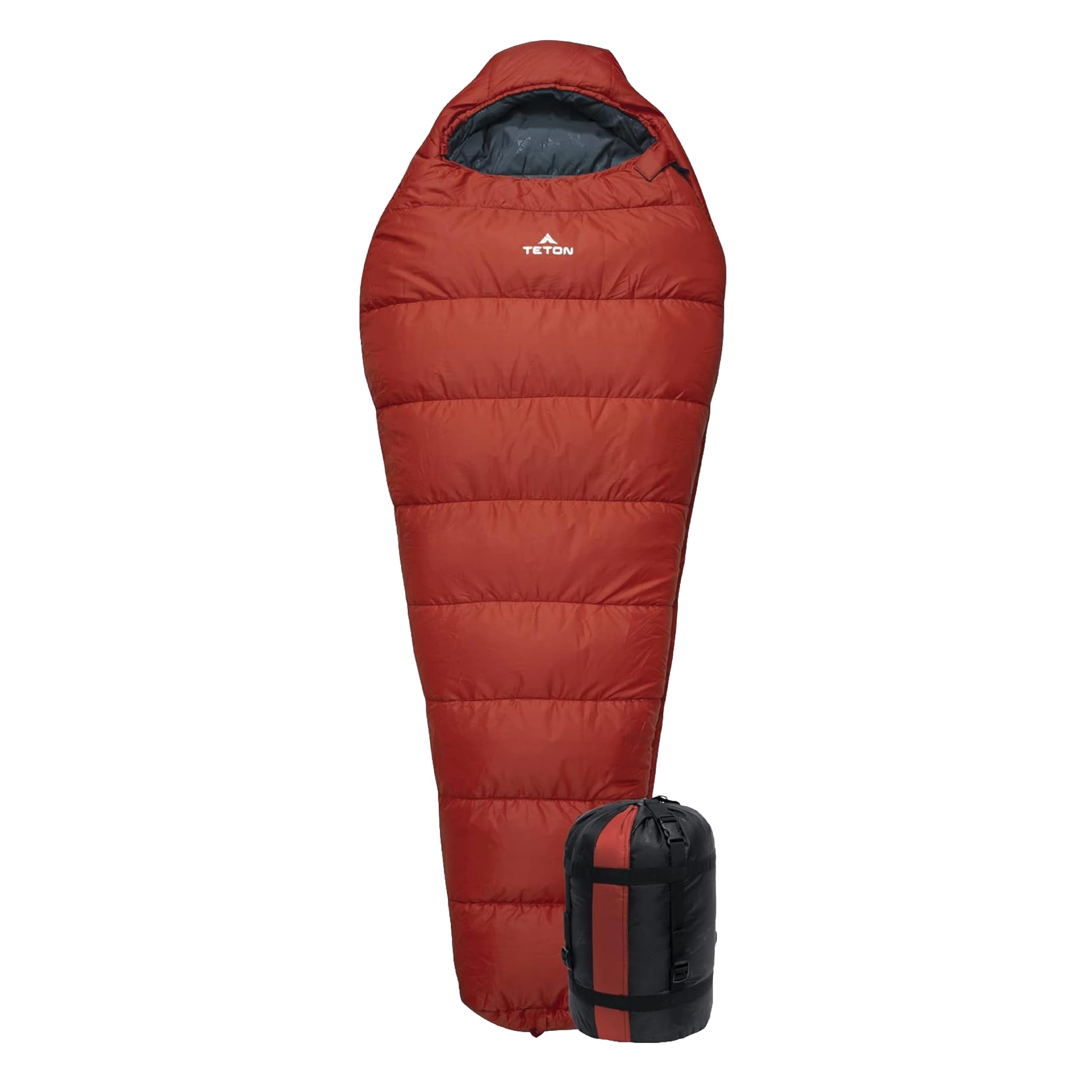
A warm, roomy mummy bag that keeps you cozy at 20°F without the premium price tag.
If you sleep cold and hate feeling trapped in a tight cocoon, this Teton LEEF bag is for you. It offers a roomier mummy design that allows easy movement while still packing down small with the included compression sack. Weighing 3.5 pounds, it is not the lightest option, but the warmth it delivers is exceptional for the price.
Available in 0, 20, or 30-degree temperature ratings, this bag is built for serious cold. Customers note staying warm even at sub-freezing temperatures, with one owner noting it kept them dry and toasty through heavy rain and 40°F temps. The polyester ripstop material is durable, and the zipper glides smoothly with a Velcro hood lock to keep the warmth sealed in.
The recurring gripe is that the bag is hard to repack into its compression sack, and it is not machine washable. But for side and stomach sleepers, the space to move is a huge win. It fits comfortably up to 6’5″ with size 14 feet, making it a versatile choice for taller campers who often struggle to find bags that fit.
Roomy and Warm: the extra shoulder and foot room is a blessing for side sleepers, and owners confirm it holds up night after night.
The Catch: wrestling it back into the compression sack takes patience, so budget extra time at camp.
5. ALPS Mountaineering Backpacking-Tents Lynx 1

A freestanding solo tent that sets up in minutes and stands firm against mountain weather.
This freestanding tent’s factory-sealed rainfly and aluminum poles offer dependable weather protection. Weighing 4 lbs 1 oz, it is built for solo backpackers who want a freestanding shelter (one that stands on its own poles without needing stakes) that is quick to pitch. The aluminum two-pole construction allows for setup in about 15 minutes, with the instructions sewn right into the bag so you never lose them.
The weatherproofing is serious: a 75D 185T factory-sealed rainfly with 1500 mm coating and a 75D 185T 2000 mm poly taffeta floor keep you dry in heavy rain. The half-mesh walls boost airflow, reducing condensation on warm nights, while the vestibule provides gear storage so your pack stays dry. It packs down to 17″ x 5″, slipping easily into your backpack.
Field-tested for 7 nights in New Mexico, it survived hail, rain, wind, and dirt without issue. The main complaints are that the stock stakes bend easily in rocky terrain and the fit is tight for taller campers, with gear relegated to your feet. The crowd favorite — 4.7 stars across 900+ ratings — reflects its reputation as a reliable, affordable solo shelter that outshines pricier alternatives.
Solid Foundation
- Freestanding design pitches and moves easily
- Factory-sealed rainfly keeps you dry
- Half-mesh walls reduce condensation
Watch Out For
- Stock stakes bend in rocky ground
- Tight fit for taller solo campers
Who it beats: entry-level campers prioritizing reliability and quick setup over shaving every ounce, compared to lighter single-wall trekking-pole tents.
Who it does not: ultralight purists who measure every gram and need a compact 1-person footprint.
6. Naturehike PFAS-Free Ultralight Sleeping Pad with R5.8

A 3.2-inch thick pad with certified R-value that blocks the cold ground all night.
This pad’s certified 5.8 R-value blocks ground cold down to -4°F. It has a professional testing certification of 5.8 high R-value (the measure of how well it resists heat loss to the ground), making it suitable for temperatures above -4°F. The 3.2-inch thickness provides both high resilience and shock absorption, so you do not feel every rock beneath you.
The 3D three-dimensional heat-reflective structure uses aluminum layers inside each air chamber to reduce heat loss from convection, locking in warmth while the perforated design cuts down on noise. It weighs just 560g (19.8 oz) and packs down to a small 3.9 x 7-inch roll, ideal for bikepacking or backpacking. The punching point structure distributes pressure evenly when you lie down.
Buyers confirm the R-value holds true, staying warm at 28°F in base layers, and it is comfortable for side sleepers up to 190 lbs. The patented dual-vent valve makes inflation easy with the included bag, though some owners note you need to apply more pressure than expected. The main drawbacks are that it is not the lightest pad available, and the inflation bag takes getting used to.
Certified Warmth: the 5.8 R-value is verified, not a marketing guess, and it keeps you warm in base layers at 28°F.
The Adjustment: the bag inflation system works well once you learn it, but some owners switch to a mini inflator for convenience.
7. Kelty Grand Mesa 2P Backpacking Tent

A freestanding 2-person tent with generous vestibule space for gear-heavy trips.
This 2-person tent’s 30 sq ft floor and 44-inch peak height offer generous space for couples. You get 30 square feet of interior floor space and a peak height of 44 inches, all in a 2-person model that weighs 4 lbs 1 oz. Because it is freestanding (no stakes needed to hold its shape), you can pitch it, then lift and move it to find the ideal campsite—a big advantage on rocky or sloped ground.
Setup is genuinely fast, with Kelty Quick Corners keeping poles in place and color-coded clips making attachment obvious. Reviewers point out a 3 to 5-minute setup time, even alone. The EZ-Zip vestibule provides covered gear storage, keeping your pack and boots dry. The 68D polyester floor and rainfly are weather-resistant with fully taped seams, and it stayed bone dry in sideways rain during field tests.
The honest trade-off is size: at 85 x 57 inches, it is tight for two average-sized adults, and several owners recommend it as a roomy 1-person tent instead. The zippers can be stiff when new, and the ground cover is sold separately. But the crowd favorite — 4.5 stars across nearly 500 ratings — reflects its reputation as a well-made, lightweight, and affordable 3-season shelter.
Why It Works
- 30 sq ft floor with 44-inch peak height
- Freestanding and moves as a unit
- Vestibule covers gear storage
Fair Warning
- Better as a roomy 1P than a comfy 2P
- Stiff zippers initially, ground cover separate
Reach for this if: you are a solo camper who wants extra space to stretch out or a couple who does not mind cozy quarters for a few nights.
Look elsewhere if: two large adults need separate sleeping space and ample gear room on multi-week trips.
8. Night Cat Ultralight Tent 1 Person

A featherweight 2-pound shelter for minimalist hikers who already carry trekking poles.
This 2-pound trekking-pole shelter is for ultralight hikers who already carry poles. It weighs just 2 lbs, making it one of the lightest options here, and it packs down compactly into your backpack. The bivy-style shelter is designed for one person, with a floor of 100 x 125 centimeters that offers enough room to sleep comfortably.
Setup is quick and simple with the included stakes and ropes, taking just minutes once you get the hang of it. The durable nylon fabric and waterproof rainfly keep you dry through thunderstorms, and the vestibule fits a backpack and shoes. Shoppers say using it six times in light wind and rain without issues, praising the weight-to-value ratio compared to premium brands.
The honest catch is that the trekking pole (not included) is essential, and the pegs can fail in hard or soft ground, so you will want to carry alternatives. Some owners note the rainfly only covers the vent, requiring a larger setup for heavy rain, and the front fly string system can be confusing at first. It is ideal for weekend warriors who prioritize weight over luxury.
Featherweight Champion: at 2 lbs, it disappears into your pack, and the vestibule swallows your backpack and boots.
Know Before You Go: bring spare stakes and practice the fly rigging at home, because this shelter demands a bit more setup finesse.
9. Kelty Cosmic 20 Down Mummy Sleeping Bag

A warm, compressible down bag with an honest 21°F rating and eco-friendly materials.
This down bag’s 21°F ISO limit rating and 550 fill power deliver reliable cold-weather warmth. It has an ISO limit rating of 21 degrees, meaning you will stay warm down to that temperature with proper layers, and an ISO extreme rating of -11 degrees for survival situations. The 550 fill power compressible down (a measure of how much loft each ounce provides) packs down small while delivering serious warmth.
The sustainability story is strong: the shell and liner use recycled nylon and polyester taffeta finished with a PFAS-free durable water repellent, and the down is 100% ethically sourced and traceable via RDS (Responsible Down Standard). It weighs about 2 lbs 6 oz, and the Regular size fits sleepers up to 6 feet, with the mummy cut providing decent room for shoulders and a roomy foot box.
Buyers report it stays warm in the high 20s°F when you wear a base layer, and the dual-direction zippers (which open from either end) glide smoothly even in the dark. It compresses small enough to fit a motorcycle saddlebag or a 50L backpack. The main trade-off is the snug mummy fit, which may feel tight for broad-shouldered sleepers, but the warmth-to-compression ratio is tough to top at this level.
The Warmth Factor
- ISO limit 21°F keeps you warm in real cold
- 550 FP down packs down extremely small
- RDS certified, PFAS-free recycled fabrics
Consider This
- Snug mummy cut for broad shoulders
- Not the lightest down option for its warmth
Standout Spec: a 21°F ISO limit rating in a bag that packs to 13 x 7 inches — that is the warmth-to-compression mic drop.
The Single Caveat: if you are claustrophobic in tight bags, the mummy cut will test you, though the foot box offers room to wiggle.
Understanding the Specs
R-Value on Sleeping Pads
R-value measures how well a pad resists heat loss to the ground. A higher number means more insulation and a warmer night. For three-season backpacking, look for an R-value around 5, while winter camping needs closer to 7. The Naturehike R5.8 pad is a good example of a certified rating that delivers real warmth in cold conditions.
Fill Power in Down Bags
Fill power measures the loft, or fluffiness, of down insulation. A higher number, like 650 or 550, means the down takes up more space per ounce, trapping more warm air. Higher fill power bags are lighter and more compressible for the same warmth, but they cost more. The Naturehike’s 650 fill power beats the Kelty’s 550 in warmth-to-weight, while the Kelty compensates with more total down.
Freestanding vs. Trekking-Pole Tents
Freestanding tents have their own poles and stand up anywhere, even on rock slabs or sand, without stakes. Trekking-pole tents, like the Night Cat, save weight by using your hiking poles for support, but they need stakes and proper ground to pitch. Freestanding models cost a bit more weight but offer more flexibility in campsite selection.
Pressure-Regulated Stoves
A pressure regulator on a stove keeps the gas flow steady as the canister empties or the temperature drops. This means consistent boiling speed and the ability to simmer, which basic stoves lack. The MSR PocketRocket Deluxe uses this technology to boil 1 liter in 3.5 minutes even in cold weather.
FAQ
What R-value do I need for a backcountry sleeping pad?
How do sleeping bag temperature ratings work?
Is a 4-season tent worth it for summer backpacking?
Can I use a trekking-pole tent without trekking poles?
What is the difference between down and synthetic sleeping bags?
How fast should a backpacking stove boil water?
How much should my backcountry gear weigh?
Will a mummy sleeping bag fit a tall or broad-shouldered person?
Final Thoughts: The Verdict
If you want one dependable pick, the backcountry camping gear winner is the MSR PocketRocket Deluxe because it delivers restaurant-grade cooking performance in a 2.9-ounce package that disappears into your pack. If you want a true 4-season shelter that handles snow and wind, grab the Underwood Winter Tent. And for cold-weather sleepers who value eco-friendly warmth, the Kelty Cosmic 20 is the one to reach for.
How We Picked
We do not accept paid placement. Every pick is matched to a real buyer and a real use-case; we do not hands-on test units.
Sources & Methodology
Specifications: manufacturer listings and product documentation. Review insights: verified customer reviews, as of September 2026. Pricing: not shown on this page (it changes often); check the current price via the retailer link.
As an Amazon Associate, Gadgets Feed earns from qualifying purchases. This does not affect which products we feature.