
Reaching 100x optical zoom means seeing details from nearly a mile away — the feathers on a bird at the treeline, the text on a stadium banner, the texture of a lunar crater. That level of magnification demands dedicated optics; no smartphone sensor, regardless of computational tricks, can match the physical focal length of a true superzoom lens. This guide separates the cameras that deliver on their extreme reach from those that sacrifice sharpness for a bigger number on the box.
I’m Min — the co-founder and writer behind Gadgets Feed. I spend hundreds of hours researching and analyzing the technical specifications of superzoom cameras, comparing optical formulas, sensor sizes, and stabilization systems to identify models that genuinely deliver usable results at maximum focal length.
Whether you need to document wildlife without disturbing it or capture concert stage details from the back row, the right 100x optical zoom camera must balance focal range against image quality, stabilization hardware, and practical portability.
How To Choose The Best 100X Optical Zoom Camera
A larger zoom number is meaningless if the camera cannot keep the image steady or fails to focus on a distant subject. You must evaluate the interplay between focal length, sensor resolution, stabilization technology, and lens speed to ensure your investment delivers sharp, usable results at the far end of that zoom range.
Optical Zoom vs Total Zoom: The Real Reach
Total zoom combines optical, digital, and dynamic fine zoom, but only the optical figure represents true lens magnification. A 100x optical zoom lens, expressed in millimeters (e.g., 24-2400mm equivalent), physically extends the glass to capture distant light. Digital zoom simply crops the sensor, reducing resolution. Always compare optical zoom specifications; ignore combined or digital figures when evaluating reach.
Stabilization: The Make-or-Break Factor
At extreme telephoto lengths, even minor hand shake translates into significant frame movement. Optical Image Stabilization (OIS) physically shifts lens elements to compensate, while sensor-shift stabilization moves the image sensor itself. Dual detect systems combine both for superior results. For handheld shooting at 100x or beyond, a camera without robust stabilization will produce blurry results regardless of its lens quality.
Sensor Size and Low-Light Performance
Nearly all superzoom cameras use a 1/2.3-inch sensor, requiring a tradeoff: extreme zoom reach versus larger pixels for better light gathering. A 16MP or 20MP resolution on this small sensor produces noisy images above ISO 800, making bright daylight conditions the sweet spot. Avoid expecting DSLR-quality low-light performance; instead, prioritize lens speed (lower f-numbers) and raw file support for post-processing flexibility.
Autofocus System: Speed at Long Focal Lengths
Contrast-detection autofocus is standard in this category, but the number of focus points, phase-detection hybrid systems, and manual focus override capabilities vary widely. Fast-moving subjects like birds in flight require quick, accurate focus tracking. A camera with a dedicated manual focus ring or wheel offers critical control when autofocus hesitates at maximum zoom.
Quick Comparison
On smaller screens, swipe sideways to see the full table.
| Model | Category | Best For | Key Spec | Amazon |
|---|---|---|---|---|
| Nikon COOLPIX P1000 | Premium | Ultimate zoom range | 125x optical / 24-3000mm | Amazon |
| Nikon COOLPIX P950 | Premium | 83x zoom with bird mode | 83x optical / 24-2000mm | Amazon |
| Canon PowerShot SX60 | Mid-Range | Renewed value with 65x zoom | 65x optical / 21-1365mm | Amazon |
| Panasonic LUMIX FZ80D | Mid-Range | 60x zoom with 4K photo burst | 60x optical / 20-1200mm | Amazon |
| Kodak PIXPRO AZ653 | Mid-Range | Entry-level 65x zoom | 65x optical / 24-1560mm | Amazon |
| Minolta Pro Shot 20MP | Mid-Range | Budget 67x zoom for outdoor | 67x optical / 2.8-5.6 aperture | Amazon |
| Panasonic LUMIX ZS99 Silver | Mid-Range | Pocket-sized 30x travel zoom | 30x optical / 24-720mm | Amazon |
| Panasonic LUMIX ZS99 Bundle | Mid-Range | 30x zoom with accessories | 30x optical / 24-720mm LEICA | Amazon |
| Panasonic LUMIX TZ99 White | Mid-Range | Compact 30x zoom for concerts | 30x optical / 24-720mm | Amazon |
| Samsung Galaxy S24 Ultra | Premium | Smartphone with 100x digital zoom | 100x digital / 200MP sensor | Amazon |
| Canon Powershot SX740 HS | Premium | Compact 40x zoom with 4K | 40x optical / 24-960mm | Amazon |
In‑Depth Reviews
1. Nikon COOLPIX P1000 – 125x Optical Zoom

The Nikon COOLPIX P1000 currently holds the record for the longest optical zoom in a consumer camera, offering 125x magnification with a 24-3000mm equivalent lens. This is the only camera that can capture a sharp image of the moon’s craters without a telescope attachment. The dual detect image stabilization is critical here: at 3000mm, every hand tremor becomes visible, and the system compensates admirably for handheld use up to roughly 1500mm in good daylight. Beyond that, a tripod becomes necessary for consistent sharpness.
The P1000 records 4K UHD video with stereo sound and includes an accessory hot shoe for external microphones, making it a capable tool for long-distance videography. The vari-angle 3.2-inch LCD and 0.39-inch OLED electronic viewfinder provide flexible framing options. However, the body is substantial — it weighs over 3.1 pounds and demands a purpose-built camera bag. Battery life is a notable weakness; carrying spares is mandatory for day-long shoots.
Image quality at the maximum focal length suffers from atmospheric heat shimmer and softness compared to wider angles, but no other compact camera can reach this far. The 16MP 1/2.3-inch sensor produces acceptable results in bright conditions, though low-light performance is limited. Raw file support is included, allowing post-processing to correct exposure and sharpness. For enthusiasts who need the absolute maximum reach without carrying a spotting scope, the P1000 is the definitive choice.
Why it’s great
- Unmatched 125x optical zoom (3000mm equivalent)
- Dual detect image stabilization for handheld telephoto
- 4K UHD video recording with accessory hot shoe
- Raw file support for professional workflow
Good to know
- Heavy body requires dedicated bag and tripod for max zoom
- Battery life is short; multiple spares recommended
- Atmospheric blurring at extreme focal lengths
2. Nikon COOLPIX P950 – 83x Optical Zoom

The Nikon COOLPIX P950 is the slightly lighter sibling of the P1000, offering 83x optical zoom (24-2000mm equivalent) with an improved manual focus wheel that gives photographers precise control at long focal lengths. The built-in Bird and Moon modes simplify shooting for those specific scenarios, automatically optimizing shutter speed and metering. The 16MP 1/2.3-inch sensor is identical to the P1000, delivering comparable image quality at a lower maximum zoom figure.
Vibration reduction is effective for handheld shooting up to about 1000mm, and the 4K UHD video capability covers most documentation needs. The vari-angle LCD and electronic viewfinder are present, but the camera body is still substantial at 2.5 pounds. The macro mode allows focus as close as 1 cm at the wide-angle end, giving versatility beyond pure telephoto work. Wi-Fi connectivity enables quick transfers to a smartphone for social sharing.
User feedback highlights excellent image stabilization and macro capabilities, but notes that autofocus can struggle with fast-moving subjects like birds in flight. The P950 represents a strong balance between extreme zoom and portability, avoiding the bulk and price of the P1000 while still delivering 83x optical reach. For wildlife watchers and casual astronomers who want dedicated bird mode and a manageable carry weight, the P950 is the pragmatic recommendation.
Why it’s great
- 83x optical zoom with 2000mm equivalent reach
- Dedicated Bird and Moon scene modes
- Manual focus wheel improves control at zoom extremes
- Good image stabilization for handheld use
Good to know
- Autofocus can be slow for moving subjects
- Body remains large and somewhat heavy
- Small sensor limits low-light performance
3. Canon PowerShot SX60 HS – 65x Optical Zoom

The Canon PowerShot SX60 HS brings 65x optical zoom (21-1365mm equivalent) in a package that benefits from Canon’s well-regarded HS System — combining a 16.1MP CMOS sensor with the DIGIC 6 image processor. The wide-angle end starts at 21mm, which is wider than most superzooms, making it useful for landscape and architectural photography before zooming into distant subjects. The vari-angle 3-inch LCD and built-in electronic viewfinder offer flexible framing in bright sunlight.
Wi-Fi and NFC connectivity are built in, enabling wireless image transfer to iOS or Android devices. The SX60 records 1080p HD video at 30fps with stereo sound and allows optical zooming while recording. The 61-point autofocus system covers the frame well, and optical image stabilization helps maintain sharpness at the telephoto end. This model comes as a renewed product, offering a mid-range price point for those who want verified refurbished quality.
Customer reviews note that the SX60 is excellent for light birding and evidentiary photography, with a solid build that feels robust. However, the battery charger is sometimes reported as non-functional on arrival, which is a risk with renewed units. The camera is slower than modern mirrorless cameras, and burst shooting is limited to about 6.4fps. For budget-conscious shooters needing 65x optical zoom with Canon’s dependability, the SX60 is a strong candidate.
Why it’s great
- 65x optical zoom with wide 21mm start
- Wi-Fi and NFC for easy image transfer
- Vari-angle LCD and electronic finder
- Canon HS System for color accuracy
Good to know
- Renewed unit may have charger issues
- Slower burst rate than modern alternatives
- Maximum video resolution is 1080p
4. Panasonic LUMIX FZ80D – 60x Optical Zoom

The Panasonic LUMIX FZ80D (also known as FZ85D) delivers 60x optical zoom from 20mm wide to 1200mm super-telephoto, with a Power Optical Image Stabilizer that keeps shots steady at long focal lengths. The 18.1MP 1/2.3-inch sensor supports 4K video recording and 4K Photo burst at 30fps, allowing frame extraction of decisive moments. The 0.39-inch OLED viewfinder and 3.0-inch touch LCD with 1.84M dots provide crisp previews even in bright conditions.
USB-C charging is a modern convenience, eliminating the need for a dedicated charger cable setup. The camera body is compact for its class, weighing roughly 640 grams, which makes it travel-friendly compared to bulkier superzooms. The FZ80D includes creative functions like Focus Select, Focus Composite, and Brightness Composite, giving users advanced tools for tricky lighting or depth-of-field scenarios.
Reviewers confirm that the FZ80D is a good point-and-shoot for wildlife and bird photography, with enough manual controls to satisfy enthusiasts. However, the lens aperture narrows to f/5.9 at telephoto, limiting light capture in overcast conditions, and there is no built-in Wi-Fi on this model — a surprising omission for a 2024 release. Battery life averages around 1.5 hours, requiring planning for longer outings. For photographers who prioritize optical reach and 4K features over wireless connectivity, the FZ80D is a capable performer.
Why it’s great
- 60x optical zoom with 1200mm reach
- 4K Photo burst at 30fps for extracting frames
- USB-C charging for convenient top-ups
- Bright OLED viewfinder and touch LCD
Good to know
- No built-in Wi-Fi for wireless transfer
- Lens aperture narrows to f/5.9 at telephoto
- Battery life requires spare batteries for all-day shoots
5. Kodak PIXPRO AZ653 – 65x Optical Zoom
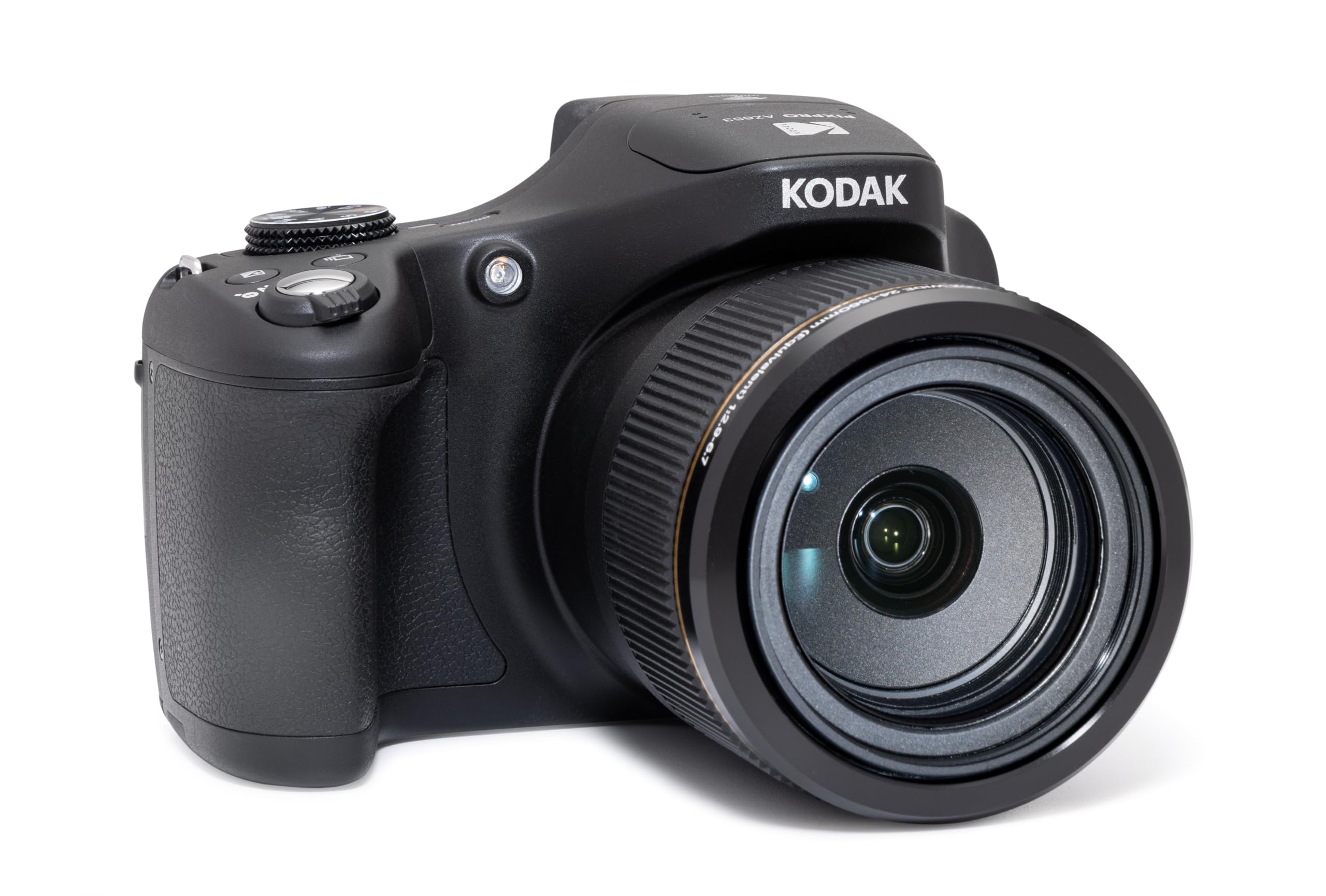
The Kodak PIXPRO AZ653 enters the superzoom market with a 65x optical zoom lens (24-1560mm equivalent) and a 20MP BSI CMOS sensor that supports RAW file capture. The 3-inch LCD and electronic viewfinder provide dual framing options, and built-in Wi-Fi enables wireless sharing via the PIXPRO Remote Viewer app. The inclusion of 1080p full HD video at 30fps with optical image stabilization rounds out the feature set for video documentation.
This camera is aimed squarely at beginners and budget-conscious travelers who want significant reach without learning manual controls. The auto and scene modes handle most shooting conditions, and the 5fps burst shooting is adequate for static wildlife. USB-C connectivity is a welcome addition at this price tier, making charging simpler on the go. The lens starts at f/2.9 at wide-angle but narrows to f/6.7 at telephoto, which is slower than some competitors.
User reports indicate that the AZ653 is a fun camera for family trips and distant landscapes, with the 65x zoom being its standout feature. Build quality is acceptable for the price, but the fixed screen is a limitation for overhead or low-angle shots. Low-light performance is poor, which is standard for this sensor size. For entry-level users seeking maximum optical zoom per dollar, the AZ653 offers a compelling cost-to-reach ratio.
Why it’s great
- 65x optical zoom at a very accessible entry price
- 20MP BSI CMOS sensor with RAW support
- Wi-Fi connectivity for easy smartphone transfer
- USB-C charging for modern convenience
Good to know
- Fixed LCD screen limits creative angles
- Small sensor leads to poor low-light performance
- Autofocus can be inconsistent at extreme zoom
6. Minolta Pro Shot 20MP – 67x Optical Zoom

The Minolta Pro Shot offers 67x optical zoom in a lightweight body designed for outdoor enthusiasts. The 20MP sensor captures detailed stills, and the optical image stabilization system minimizes blur from hand movement or vibration. The 3-inch articulating LCD screen is a significant advantage at this price, allowing low-angle wildlife shots and high-angle crowd photography without lying on the ground or climbing onto chairs.
Full HD 1080p video recording at 30fps is included, along with 27 scene modes that auto-optimize settings for portraits, night shots, fireworks, panoramas, and more. Face, smile, and blink detection aids portrait photography. Wi-Fi connectivity enables wireless transfer and remote camera control via a companion app. The camera ships with a 16GB SD card, making it ready out of the box.
Customer feedback highlights excellent outdoor zoom performance for distant subjects like birds and air shows, outperforming phone zoom easily. However, quality control issues have been reported: some units arrive with faulty card readers or charging failures, and the menu system is non-intuitive. Battery life varies, with some users experiencing rapid drain. For hikers and day-trippers who want a long zoom companion with an articulating screen, this Minolta is a capable option if you get a functional unit.
Why it’s great
- 67x optical zoom with articulating LCD screen
- 20MP sensor captures detailed outdoor stills
- Wi-Fi remote control and transfer
- Includes 16GB SD card and accessories
Good to know
- Quality control and battery life can be inconsistent
- Menu system requires time to learn
- Not suitable for indoor or quick snapshots
7. Panasonic LUMIX ZS99 Silver – 30x Optical Zoom

The Panasonic LUMIX ZS99 packs a 24-720mm LEICA DC lens with 30x optical zoom into a body that truly fits in a jacket pocket. This is the go-to option for concert-goers and travelers who need reach without a dedicated camera bag. The lens features 5-Axis Hybrid OIS+, providing stabilization that works well up to the full 720mm focal length in good light. The 1,840k-dot tiltable touchscreen enables creative low-angle shots, and USB-C charging keeps the camera powered without proprietary cables.
4K video recording at 30p and 4K Photo burst at 30fps allow extraction of stills from motion. HD high-speed video at 120fps supports slow-motion playback for action sequences. Bluetooth v5.0 enables instant connection to the Panasonic Image App for seamless image transfer. At roughly 44 grams for the battery, the entire setup remains lightweight for all-day carry. The hybrid autofocus system with 121 focus points provides solid tracking performance for a compact.
Users confirm that the 30x optical zoom is unmatched by any phone for stage shots, and the pocketability makes it venue-friendly. However, overheating can occur, with 4K video capped at 15 minutes and 1080p at 30 minutes. The small sensor shows its limits in low light, producing noisy results. The ZS99 is not a replacement for a bridge camera, but for those who prioritize portability over extreme reach, it delivers impressive optical zoom in a compact form.
Why it’s great
- True pocket-size with 30x optical LEICA zoom
- 5-Axis Hybrid OIS+ stabilization
- Tiltable touchscreen for flexible composition
- 4K Photo burst and Bluetooth 5.0 transfer
Good to know
- Overheating limits 4K video to 15 minutes
- Low-light performance is weak
- Premium price for a compact superzoom
8. Panasonic LUMIX ZS99 Bundle – 30x Optical Zoom
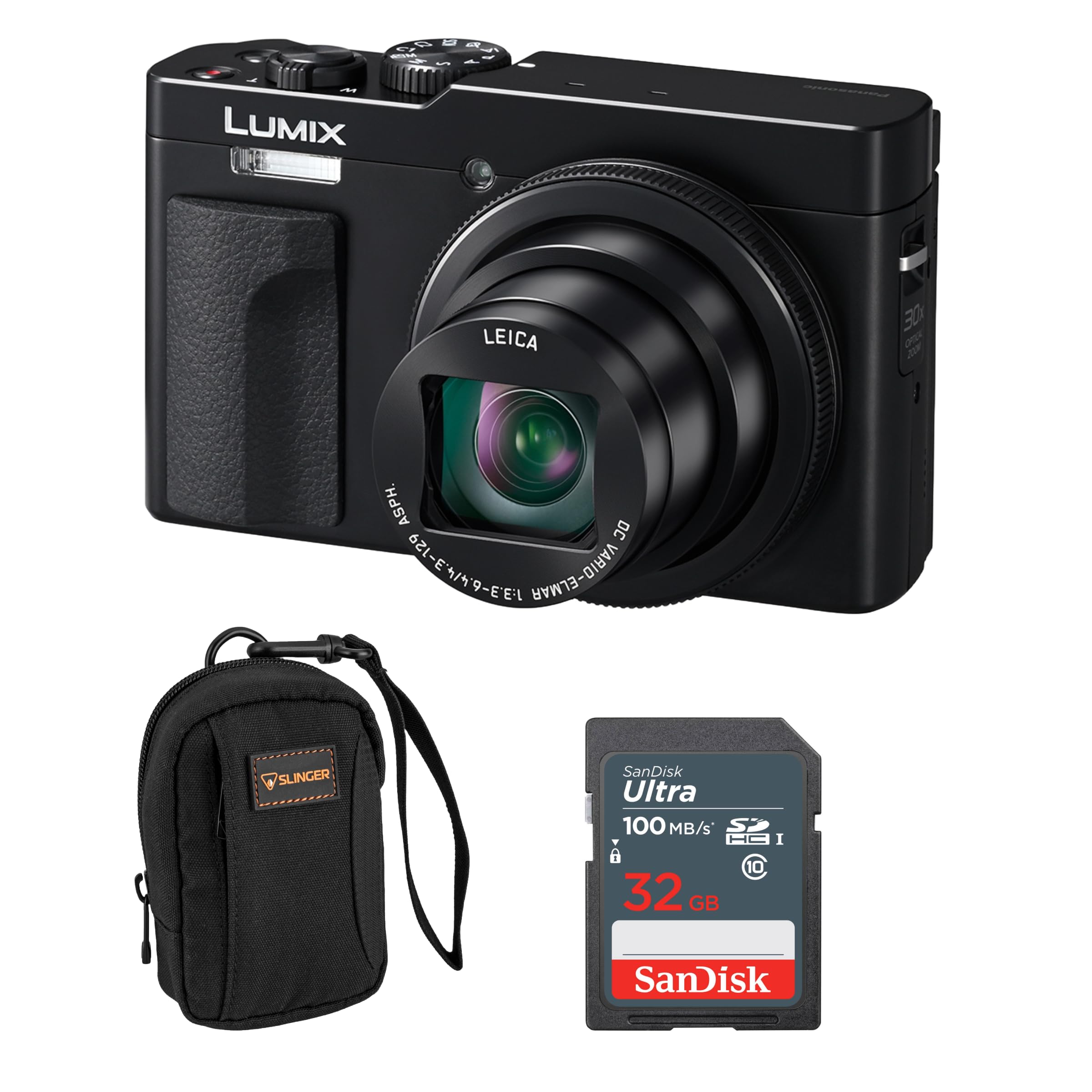
This bundle pairs the same Panasonic LUMIX ZS99 camera featured above with a Slinger Alpine camera bag and a 32GB SanDisk memory card, providing everything needed to carry and shoot immediately. The core camera specifications remain identical: the 30x optical zoom LEICA lens (24-720mm equivalent), 5-Axis Hybrid OIS+ stabilization, tiltable 1,840k-dot touchscreen, and 4K video capabilities. The bag is sized specifically for the compact body, adding protection during transit.
The ZS99’s ability to slip into a bag or large pocket while offering 30x optical zoom makes it the strongest competitor to smartphone zoom systems. The dedicated Send Image button on the camera body simplifies Bluetooth 5.0 transfers to a paired smartphone. USB-C charging reduces cable clutter when traveling. The bundle eliminates the need to purchase a memory card separately, which is a minor but convenient saving.
Customer feedback mirrors the standalone ZS99: excellent zoom for concert photography, compact form factor, but wireless transfer setup can be finicky, with some users reporting the Bluetooth feature is difficult to connect. The flash location is also slightly awkward, easily blocked by fingers. The bundle pricing is competitive given the included accessories. For travelers who want a purpose-built bag and card included, this is the turnkey option in the compact superzoom space.
Why it’s great
- Same pocketable 30x zoom LEICA optics
- Includes bag and memory card for travel readiness
- Tiltable LCD and USB-C charging
- Dedicated Send Image button for wireless sharing
Good to know
- Bluetooth transfer can be difficult to configure
- Flash location is easy to block with fingers
- Small sensor limits low-light photography
9. Panasonic LUMIX TZ99 White – 30x Optical Zoom

The Panasonic LUMIX TZ99 is functionally identical to the ZS99, featuring the same 30x optical zoom LEICA lens (24-720mm) and 20.3MP sensor, but sold in a white colorway under a slightly different regional model number. The compact dimensions — it genuinely fits in a pocket — make it ideal for concerts and family events where bag restrictions apply. The 1,840k-dot tiltable touchscreen enables selfie and low-angle shooting, and USB-C charging eliminates proprietary cables.
4K video at 30p and 4K Photo burst at 30fps provide flexibility for capturing action. HD high-speed video at 120fps supports slow-motion playback of live performances. Bluetooth v5.0 offers always-on connection for automatic image transfer. The stepped zoom feature and Lens Position Resume function are practical for concert photography, allowing users to recall a specific focal length quickly. The battery is rated for about 2 hours of typical use.
User reviews praise the build quality and color accuracy out of camera, with minimal editing needed for social media. However, autofocus can be inconsistent in low light, with some users reporting worse image quality than an iPhone 16 Pro in dim conditions. The LCD screen is also hard to read in direct sunlight. For concert-goers who need optical zoom in a venue-friendly pocket camera, the TZ99 delivers but has clear low-light limits.
Why it’s great
- Pocketable 30x zoom with LEICA optics
- Tiltable touchscreen for creative angles
- Stepped zoom and Lens Position Resume features
- USB-C charging and Bluetooth 5.0 connection
Good to know
- Autofocus struggles in low-light concert settings
- LCD screen is difficult to see in bright sunlight
- Image quality does not match flagship phones at night
10. Canon Powershot SX740 HS – 40x Optical Zoom

The Canon Powershot SX740 HS offers a 40x optical zoom (24-960mm equivalent) in a compact body weighing approximately 299 grams. The 21.1MP CMOS sensor paired with the DIGIC 8 image processor supports 4K video recording and high-speed continuous shooting at up to 10fps. The 3.0-inch tilt LCD enables selfie and low-angle capture, and Wi-Fi with Bluetooth compatibility allows automatic image transfer to a smartphone while shooting.
This Japan import model is favored by those who want a compact camera with substantial zoom for travel and events. The 40x range is sufficient for many zoo, stadium, and landscape scenarios without the bulk of a bridge camera. The DIGIC 8 processor delivers good color science and acceptable noise handling up to ISO 800. 4K video with a wide viewing angle expands creative options beyond stills.
Reviewers from the Japanese market confirm the camera delivers on its zoom promise, being lighter and more wieldy than a DSLR for day trips and motorcycle tours. However, the single autofocus point is a limiting factor, and the camera lacks raw file support, relying on JPEG processing. The tilt LCD is not fully articulating, limiting overhead shots. For compact camera users who prioritize 40x optical zoom in a lightweight body, the SX740 HS is a capable if dated option.
Why it’s great
- 40x optical zoom in a very lightweight body
- 4K video with DIGIC 8 processing
- 10fps burst shooting for action sequences
- Wi-Fi and Bluetooth for automatic transfer
Good to know
- Single autofocus point limits focusing flexibility
- No raw file support
- Tilt LCD is not fully articulating
11. Samsung Galaxy S24 Ultra – 100x Digital Zoom

The Samsung Galaxy S24 Ultra includes a 200MP primary sensor and a separate 50MP periscope telephoto lens that enables optical-quality zoom steps, but the advertised 100x zoom is entirely digital — cropped from the sensor with computational processing. Unlike a dedicated superzoom camera with a physical lens extension, the S24 Ultra’s 100x mode produces heavily processed images with visible noise and loss of fine detail at maximum magnification. The 505 PPI AMOLED display and S Pen input are unrelated to zoom capability.
This renewed model runs the global version of One UI with Galaxy AI features and supports 5G connectivity. The 5000mAh battery provides all-day power, and the 8K video recording at 7680p resolution offers high-resolution capture. The phone functions as a pocketable communications device that happens to include a super-telephoto mode, but it is not a substitute for a dedicated optical zoom camera for wildlife or astronomical photography.
Customer reviews focus on the phone’s overall performance, condition as a renewed unit, and savings compared to new. Some users report the phone heating up and one noted the description was misleading regarding the unlocked status. For users who demand a single device for communication and casual distant photography, the S24 Ultra provides a 100x digital zoom option, but dedicated cameras offer superior optical image quality at that focal length.
Why it’s great
- Combines flagship smartphone with 100x digital zoom
- 200MP sensor for high-resolution stills
- 5000mAh battery with 8K video recording
- Galaxy AI features and 5G connectivity
Good to know
- 100x zoom is purely digital, not optical
- Heavily processed images at max zoom
- Renewed unit condition and unlock status vary
FAQ
Can a 100x optical zoom camera replace a telescope for moon photography?
Why do 100x zoom camera images look soft at maximum focal length?
Is image stabilization enough to shoot 100x zoom handheld?
What is the difference between 60x, 83x, and 125x optical zoom in real-world use?
Can I use a 100x zoom camera for professional photography?
Final Thoughts: The Verdict
For most users, the best 100x optical zoom camera winner is the Nikon COOLPIX P1000 because its 125x optical zoom (3000mm equivalent) is the undisputed record-holder, offering the longest reach available in a consumer camera. If you want a better weight-to-reach balance and dedicated bird/moon modes, grab the Nikon COOLPIX P950. And for the most compact travel-friendly option that still delivers serious optical zoom, nothing beats the Panasonic LUMIX ZS99 with its pocketable 30x zoom LEICA lens.