
Our readers keep the lights on and my morning glass full of iced black tea. As an Amazon Associate, I earn from qualifying purchases.
Specs are compiled from manufacturer listings and verified buyer reviews and can change over time — please confirm the key details on the product page before buying.
Finding a 6-inch flex duct is easy; finding one that won’t kink, tear, or leak air at every connection is the actual battle. You need something that routes air from a dryer, bathroom exhaust fan, or grow tent without collapsing at the first bend. This guide cuts through the spec noise to show which aluminum and insulated options genuinely hold up to real installation abuse.
I’m Min — the founder and writer behind Gadgets Feed. This guide is built by comparing the manufacturers’ published specifications and the patterns across verified customer reviews, so you get each pick’s real strengths and trade-offs instead of marketing spin.
You need a 6in flex duct that fits your fan collars, survives without tearing, and keeps heat or cold where it belongs—so before you buy, check the layer count, insulation, and end fittings.
Our Picks at a Glance


How To Choose The Best 6-Inch Flex Duct
Before you buy, you need to decide if you are moving hot air that can lose energy (dryer, furnace) or just circulating air (grow tent, bathroom fan). That single question decides whether a bare aluminum skin is enough or if you need a thick insulated jacket.
Count the layers, not just the price
A basic duct is one layer of foil. A durable one stacks multiple layers — often two layers of aluminum foil around a PET thermoplastic middle, all wrapped around a steel-wire spiral. That spiral is what stops the tube from flattening when you bend it around a corner, and the extra layers are what stop leaks and tears when you pull it over a fan collar.
Insulated vs. bare: it is a heat-loss question
Bare aluminum moves air fine, but it radiates heat along the whole run. If your duct travels through a hot attic or a cold crawlspace, an insulated version with fiberglass or glass wool between the layers keeps the air inside at the temperature you want. The trade-off is bulk — insulated ducts are noticeably thicker and stiffer, so they are harder to thread through tight floor joists.
Watch how the box expands
Flex duct ships compressed. Several owners warn that once you open the packaging, the tube springs out and will never go back to its compact size. That means you should bring the duct to the installation site before you cut the strap, not open it in the garage and then try to haul 25 feet of springy aluminum through the house.
Quick Comparison
| Model | Best For | Length | Build Type | Includes Clamps | Amazon |
|---|---|---|---|---|---|
| AC Infinity Flexible★ Best Overall | All-around aluminum runs | 25 ft | 4-layer Aluminum | Yes (2) | Amazon |
| HVAC Premium AluminumBudget Champion | Bathroom & range vents | 25 ft | Aluminum jacket | No | Amazon |
| VIVOSUN Flex DuctBest Value | Budget-friendly venting | 25 ft | Multi-layer Aluminum | Yes (2) | Amazon |
| InfiniPower Dryer Duct | Dryer & heating vents | 25 ft | 3-layer Aluminum + PET | Yes (2) | Amazon |
| Hon&Guan Insulated | Noise & heat reduction | 8 ft | 4-layer PVC + glass wool | Yes (2) | Amazon |
| Rubber-Cal Insulated-Flex | AC units & thermal runs | 25 ft | Insulated Aluminum | No | Amazon |
| VEVOR R-6 Insulated | Long HVAC ceiling runs | 25 ft | R-6.0 3-layer | Yes (2) | Amazon |
| ATOM NEXUS Dryer Hose | Heavy-duty dryer venting | 25 ft | 4-layer Heavy-duty | Yes (2) | Amazon |
| Dundas Jafine R6 | Attic & crawlspace runs | 25 ft | Insulated R-6 Black Jacket | No | Amazon |
In-Depth Reviews
1. AC Infinity Flexible 6-Inch Aluminum Ducting
Our pick — over 4.5★ from 22,500+ verified ratings; the strongest balance of quality and price.
The 25-foot aluminum run that bends around obstacles without fighting back.
Owners reach for this single 25-foot roll to handle HVAC, dryer, or grow-tent runs. A four-layer design wraps a fire-resistant inner foil in tear-resistant thermoplastic, with a steel-wire spiral inside so the tube holds its shape at sharp angles instead of kinking shut. Buyers report: “Fits perfect and quality matched my expectations,” and the included pair of stainless steel clamps means you are not hunting for hardware at the last minute.
The crowd favorite here — It earns 4.6 stars across 22,000+ owner reviews. — and what wins people over is simple functionality: the tube slides onto a standard inline fan and just works. It is flexible enough to bend around a window border while still feeling sturdy, and it cuts cleanly with snips when you need a shorter run. The 300-inch length (25 feet) gives you plenty of slack to route through awkward spaces.
The honest caveat is durability, which gets mixed owner reports. The material resists kinking well, but sharp edges or burrs on adjacent metal can tear the outer layer, so tape overlaps and file down any rough collars during install. Fit is the other watchpoint: some owners mention it doesn’t mate well with 4-inch fittings, so double-check your collar diameter before committing.
Why It Wins
- 4-layer aluminum and thermoplastic build shrugs off tears and cuts
- Steel-wire spiral keeps the tube open around tight bends
- Two stainless steel duct clamps included for a snug start
Watch Out For
- Sharp metal burrs can puncture the outer layer
- 4-inch fittings reportedly don’t always match this 6-inch tube
Reach for this if: you want one dependable 25-foot aluminum roll for fans, vents, or grow-room air movement and you value a kink-free bend.
Look elsewhere if: your collars are 4 inches or you are routing against raw, sharp-edged metal.
2. HVAC Premium 6-Inch Aluminum Hose
A no-frills aluminum hose that makes bathroom and range hood venting simple.
This is the entry-level pick that skips the marketing and just moves air. An aluminum housing on both the outside and inside gives it solid insulation value for the money, while an air-tight inner core reduces pressure loss along the run. That matters when you are pushing exhaust through a long overhead path and you do not want the fan struggling against leaks.
Customers note using it specifically for “6” bathroom exhaust fan units,” and another owner threaded it through floor joists for an overhead oven vent fan and found it easy to work with. The reinforced metallized polyester jacket resists tears and punctures, and it handles sharp bends without kinking. At a lower price point than the premium insulated rolls, this is the definition of a budget-friendly workhorse for straightforward venting jobs.
The trade-off is that this bare aluminum duct does not carry the multi-layer or insulated protection of pricier options, and it ships without clamps, so you will need to supply your own. It withstands up to 25 psi of pressure, far beyond any home fan’s output., which is far beyond what any home fan will produce, so you have a wide safety margin for airflow. If your project is a simple bathroom or range vent, this gets it done without the premium spend.
Best value call: owners who need a basic, sturdy aluminum hose for fan units and overhead oven runs find this fits perfectly and arrives fast. It suits the buyer who wants function over layered extras.
Grab it for: dry, straightforward venting where the run is short and you want to spend less.
Think twice if: you need insulation against heat loss or you expect to install it without buying additional clamps.
3. VIVOSUN 6 Inch Flex Aluminum Ducting
A well-priced multi-layer duct that owners trust for HVAC, exhaust, and even 3D printer venting.
This duct keeps appearing in reviews for its good quality and genuine functionality across short and long runs. The build stacks heavy-duty aluminum foil as the internal and outer layers with a PET thermoplastic middle that resists cuts and tears while stopping leaks. Two stainless steel clamps in the matching opening size come in the box, so you can tighten a leak-free junction right away.
What wins people over is the quality — thick, reinforced aluminum that holds its shape without kinking and handles hot air routing well. Owners note it works for HVAC, exhaust, and even 3D printer ventilation projects, and that it is cheaper than buying separate adapter hardware. The built-in steel wire means you can compress or reshape the length to fit your fan, and the silver foil finish keeps things light and portable.
The recurring gripe is that the measured length can fall short of the stated figure, so if you need an exact run, buy extra. Durability also gets mixed notes on the thinner foil sections, and the outside diameter of 15.2 centimeters (roughly 6 inches) means you should match it to a 6-inch fan collar exactly for the tightest seal. For the price, this is a strong mid-range choice.
The Strong Points
- Multi-layer foil with PET middle resists leaks and tears
- Two stainless steel clamps included
- Steel-wire core lets it flex without kinking
The Catch
- Actual stretched length can run shorter than ordered
- Thinner foil sections draw mixed durability reports
Pick it if: you want a solid, everyday aluminum duct with clamps included and a price that undercuts the premium names.
skip it if: your run must be exactly 25 feet with zero tolerance for a shorter stretch.
4. InfiniPower Flexible 6-Inch Aluminum Ducting
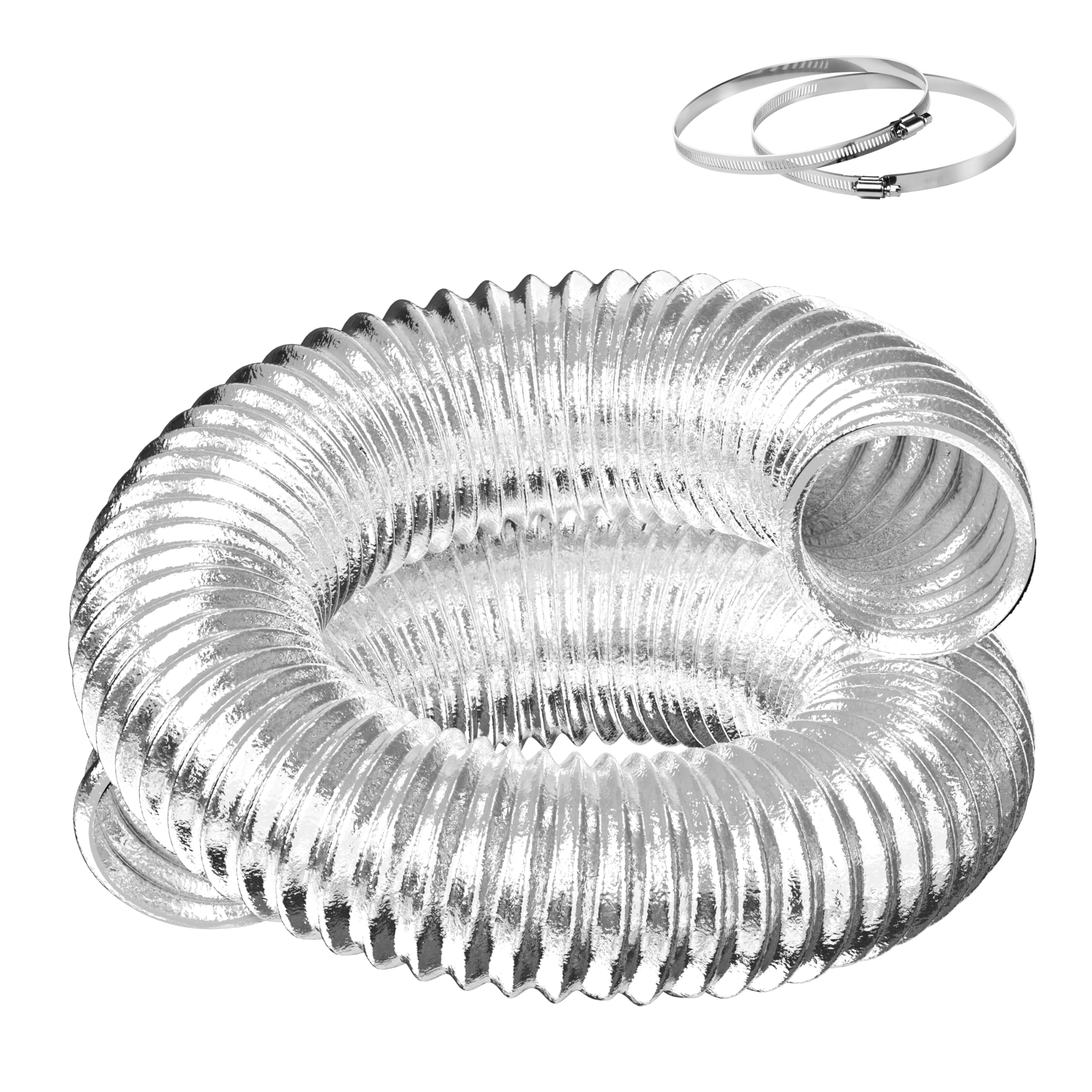
The duct that an 82-year-old owner installed solo in a cramped space without tears.
This 25-foot duct is easy to install because three layers of aluminum foil wrap around a PET layer (a strong plastic film) and a steel-wire helix (a spiral wire that keeps the tube open). Reviewers point out it slides right onto a duct fan or vent exhaust and fits into tight, awkward spots without a struggle—one retired owner handled the whole install alone and was happy the cat could not knock it loose.
The duct handles temperatures from -30°C to 150°C (-22°F to 302°F)., and the build is fire-resistant with no gas release in high heat. That makes it a solid pick for dryer vents and heating runs where the air gets genuinely hot. The package arrives with two clamps, so you have everything needed for a secure connection at both ends.
Owners sum up the experience as sturdy and strong, with a thick exterior that is not about to sprout holes. The one warning from the maker is simple: gentle handling during install, since violent yanking is prohibited. Durability gets consistent praise, and the quality earns the strongest owner feedback of all the aspects tracked.
Standout quality: the thick, sturdy exterior and easy fit in cramped spaces are what owners praise most, with quality leading the feedback. It suits anyone who wants a no-tear dryer or heating vent they can install solo.
Best for: owners of dryers and heating setups who want a fire-resistant, thick-walled duct that installs in tight spots.
Not for: anyone planning to manhandle the duct hard during install, as violent handling is prohibited.
5. Hon&Guan 6-Inch Insulated Flexible Duct

The insulated 8-foot section that quiets a rumbling dryer and kills the heat bleeding off a portable AC.
If noise and heat are your enemies, this is the duct to reach for. The internal glass wool structure is fluffy and dense, which lets sound waves escape through the holes rather than reflecting back down the hose — Shoppers say the glass wool core cuts dryer and fan noise by up to 50%.. One owner said it “significantly reduced the rumble noise from my dryer hose,” which is exactly the win most people are chasing.
This is also where the thermal insulation matters. The four-layer design stacks PVC, two layers of aluminum foil, and a central glass wool core, It withstands temperatures from -22°F to 302°F (-30°C to 150°C).. Portable AC owners noticed the hose stayed barely warm where the old one was scorching hot, and rooms cooled much faster as a result. The thick outer PVC layer even resists pets biting through the jacket.
The honest trade-off is the inner foil, which some owners found thin and tricky to connect without tearing when using hose clamps. Durability and fit both draw mixed feedback, so handle the inner layer gently at the connection points. At 8 feet, this is a shorter, purpose-built section rather than a full 25-foot roll, making it ideal for a single AC or dryer hookup.
Why Owners Love It
- Glass wool core cuts fan and dryer noise by up to 50%
- Insulation keeps portable AC hoses barely warm
- Thick PVC outer layer resists pet bites
The Limitation
- Thin inner foil can tear when you tighten hose clamps
- Only 8 feet long, so it will not cover a long run
Choose it for: a dryer or portable AC where you want the rumble gone and the heat contained in a short, manageable section.
Pass it by if: you need one continuous roll longer than 8 feet for a full attic or wall run.
6. Rubber-Cal HVAC Insulated-Flex Duct Hose

An insulated 25-footer that keeps air temperature stable for permanent and mobile AC units.
This is the insulated duct for buyers who want temperature control over a long 25-foot stretch. The insulation maintains the temperature of the air inside the hose, so it suits both permanent and mobile air conditioning units where you do not want the cold or heat leaking out before it reaches the vent. It also provides acoustical insulation, cutting down the noise of air rushing through the tube.
Owners found it heavy-duty with no leakage, and one working on a 12-inch duct noted it fit tight without needing tape or straps once wrestled into place. The material is compressible and easy to transport, which helps when you are hauling a full 25-foot roll into an attic. For the price, it delivers solid insulated performance without the boutique markup.
The catch is the yellow fiberglass insulation inside, which several owners describe as brittle and itchy — one advised rolling the foil back carefully to contain the dusty fibers during cutting. Fit is the most-discussed downside, with reports that it does not match some 12-inch collars and 8-inch fittings, so measure your connection points first. If the diameter matches, this is a capable insulated workhorse.
Function first: owners confirm it works as a dependable insulated hose. Treat the yellow fiberglass carefully when cutting and confirm your collar size, because fit draws the most critical feedback here.
Best for: AC ducting over a full 25-foot run where thermal and acoustic insulation matter more than easy cutting.
Not ideal for: anyone with non-standard collar sizes or a low tolerance for itchy fiberglass dust during install.
7. VEVOR Insulated Flexible Duct 6-Inch x 25 Ft

A rigid R-6 insulated duct that survives a brutal 30-foot ceiling pull with no tears or bent rings.
This is the duct for the serious HVAC installer who needs real thermal resistance over distance. The R-6.0 rating means the fiberglass insulation between the layers is doing heavy lifting to reduce heat loss, and the thick aluminum foil outer layer with high-strength spiral steel wire keeps the structure intact. One owner routed 30 feet through a ceiling, dragging it past rebar and a dryer brush, and reported no tears and no bent rings afterward.
The 3-layer construction — aluminum foil, PET film, and a fiberglass grid — delivers that R-6.0 thermal resistance value while absorbing operational noise. It can be bent, compressed, or cut to fit without damaging the interior, which keeps air resistance low. Owners confirm strong airflow and meaningful noise reduction once installed, and the included stainless steel clamps handle the connections.
The trade-off is rigidity: the insulation adds about 2 inches of width, making this duct too stiff to squish past pipes and screws, so plan for a wider opening. The included clamps also draw criticism, with one owner ditching them for zip ties after struggling with a hard-to-turn screw. Fit and length both get mixed feedback, but for a long, straight insulated run, this is a sturdy option.
The Big Wins
- R-6.0 fiberglass insulation cuts heat loss over long runs
- Survives rough handling without tearing or bending
- Bendable and cuttable without harming airflow
The Hurdles
- Too rigid to squeeze through tight pipe clusters
- Included clamps have a stubborn screw; zip ties may work better
Reach for it when: you have a long attic or ceiling run and want R-6 insulation that will not tear or collapse during a rough pull.
Find another option if: your path is full of tight turns around pipes where a stiffer insulated duct will not fit.
8. ATOM NEXUS 6 Inch Dryer Vent Hose

The cloth-textured dryer hose that survived being stepped on and dragged across the floor without ripping.
This is the heavy-duty answer for dryer venting where thinner ducts keep failing. The four-layer build combines thickened aluminum foil, thermoplastic, and steel wire, creating a duct that owners describe as far sturdier than the thin 8-foot versions they replaced. One owner stepped on it, dragged it, and suspended it from the ceiling — and it vented perfectly with no leaks or lint escaping.
Installation is where this duct shines. Owners struggling to get a traditional tube back onto their dryer found this one stretched easily to get a good grip without ripping. The flexibility and the 25-foot length drew consistent praise, with one owner noting the black color looks good in place. It connects cleanly to duct fans and exhaust equipment, and the two included steel clamps secure both ends.
The main hassle is cutting: the material is tough, so come prepared with a quality pair of snips. The clamp screw head is also an unusual wide flat-and-Phillips combo, and the nut sits close to the band, which makes standard tools awkward. Durability leads the owner feedback as the strongest aspect, so this is built to last through rough handling.
Built to endure: durability earns the most owner praise here, backed by reports of the duct surviving steps, drags, and ceiling hangs. The trade-off is a tough cut and an odd clamp screw design.
Pick it for: awkward dryer setups where a fragile duct keeps failing and you need something that survives real abuse.
Leave it if: you expect a quick cut with basic scissors, since the tough material demands quality snips.
9. Dundas Jafine Insulated Flexible Duct

A code-friendly insulated duct that expands from a tiny box into a full 25-foot attic run.
This is the insulated duct for buyers who want a recognized safety standard on the job. It is UL 181 listed as a class 1 air duct (a safety rating for fire and smoke resistance) and bears the UL mark, which matters for inspections and confidence. The core is a blanket of formaldehyde-free fiberglass insulation wrapped around a flexible helix of 2-ply polyester laminate and corrosion-resistant galvanized wire, all jacketed in a fire-retardant black polyethylene vapor barrier (a plastic layer that blocks moisture).
The clever a neat extra is the packaging: the whole 25-foot duct compresses into a box roughly 2.5 feet long, then springs out to its full length when opened. That makes transport easy, but it expands irreversibly — owners warn to open it only at the installation site, because it will never fit back in the box. One owner connected a range hood to a roof vent and found it cut easily with a fresh razor blade.
The recurring warning is to treat the expansion carefully: good quality and fast shipping earn praise, but the duct does not re-pack once released. The plastic center ring also limits it to low-heat applications like AC rather than high-temp furnace exhaust. An occasional unit has arrived damaged or cut into pieces, so inspect on delivery. For general HVAC intake and exhaust with a recognized rating, this is a dependable premium choice.
Premium and compliant: the UL 181 listing and formaldehyde-free insulation set this apart for buyers who need recognized standards. Just remember to open the box at the install site, since full expansion is one-way.
Best for: heating and AC ventilation runs where a UL 181 class 1 rating and thermal insulation are required.
Not for: high-temperature furnace exhaust (the plastic ring limits it to low heat) or anyone who opens the box before reaching the attic.
Understanding the Specs
Layer Count and Material Build
A duct’s durability comes from how many layers wrap the air path. A single foil layer tears easily, while a four-layer build — typically aluminum foil, PET thermoplastic, and a steel-wire spiral — resists cuts and leaks. The steel-wire helix is the part that stops the tube from kinking shut at a sharp bend, which keeps air moving freely.
Insulation and R-Value
Bare aluminum radiates heat along the whole run, which wastes energy if the duct travels through a hot attic or cold crawlspace. Insulated ducts wrap the inner core in fiberglass or glass wool to keep the air at its target temperature. An R-6.0 rating tells you the insulation resists heat flow strongly; higher R-values mean better thermal efficiency at the cost of a thicker, stiffer tube.
FAQ
How do I know if a 6-inch duct will fit my fan or dryer collar?
Will the actual length match the 25-foot label on the box?
Can this flex duct handle the heat from a dryer or furnace?
What is the difference between insulated and bare aluminum flex duct?
Why does my flex duct keep kinking when I bend it around a corner?
Is a 4-layer duct always better than a 3-layer one?
Can I cut a flex duct to a shorter length?
Why is insulated flex duct so much stiffer than bare aluminum?
Final Thoughts: The Verdict
For most buyers, the 6in flex duct winner is the AC Infinity Flexible because its four-layer build and steel-wire core handle the widest range of jobs with the least fuss. If you want insulated ducting that quiets a dryer or portable AC, grab the Hon&Guan Insulated. And for a budget-friendly bare aluminum roll with clamps included, the VIVOSUN Flex Duct is the one to reach for.
How We Picked
We do not accept paid placement. Every pick is matched to a real buyer and a real use-case; we do not hands-on test units.
Sources & Methodology
Specifications: manufacturer listings and product documentation. Review insights: verified customer reviews, as of September 2026. Pricing: not shown on this page (it changes often); check the current price via the retailer link.
As an Amazon Associate, Gadgets Feed earns from qualifying purchases. This does not affect which products we feature.