
Our readers keep the lights on and my morning glass full of iced black tea. As an Amazon Associate, I earn from qualifying purchases.
Specs are compiled from manufacturer listings and verified buyer reviews and can change over time — please confirm the key details on the product page before buying.
Choosing a home audio receiver feels like decoding a secret language of watts, channels, and HDMI versions. But the real question is simpler: do you want to feel the rumble of an action scene, hear every note of your vinyl, and control it all without a pile of remotes? The best receivers for your home deliver cinema-grade sound that leaves your TV’s built-in speakers sounding thin and lifeless.
I’m Min — the founder and writer behind Gadgets Feed. This guide is built by comparing the manufacturers’ published specifications and the patterns across verified customer reviews, so you get each pick’s real strengths and trade-offs instead of marketing spin.
Whether you prioritize movie immersion, music fidelity, or next-gen gaming, this breakdown of the top audio receiver for home helps you match the right amp to your speakers and your space.
Our Picks at a Glance

How To Choose The Best Audio Receiver For Home
The perfect receiver depends on what you connect to it. A vintage turntable and a pair of floor-standing speakers need a different machine than a 4K projector setup with surround sound. Let’s walk through the key specs that separate a good match from a frustrating one.
Count Your Channels First
A 7.2-channel receiver powers seven speakers and two subwoofers. This is different from a 5.1.2 setup, which has five ear-level speakers, one subwoofer, and two overhead or height channels for Dolby Atmos. Choose a receiver that supports at least as many channels as you plan to wire, but remember you can often start with fewer speakers and expand later.
HDMI is the Backbone
All your video sources — the cable box, gaming console, streaming stick — should plug into the receiver, which then sends the picture to your TV. Look for HDMI 2.1 with 8K/60Hz and 4K/120Hz pass-through if you own a new console or an 8K television. Features like eARC (Enhanced Audio Return Channel) let your TV send high-quality audio back to the receiver from its built-in apps.
Power and Calibration
Watts per channel show how loud the receiver can play before distortion, but your speaker’s sensitivity matters just as much. Room correction software like Audyssey or YPAO uses a microphone to measure your room’s acoustics and adjust speaker levels for balanced sound. Room correction can improve good speakers from decent to spectacular.
Quick Comparison
| Model | Best For | Watts/Channel | Channels | HDMI | Amazon |
|---|---|---|---|---|---|
| Denon AVR-S960H★ Best Overall | Overall 8K Value | 90W | 7.2 | 8 (6 In / 2 Out) | Amazon |
| Pioneer VSX-935Smart Value Pick | DIY Enthusiasts | — | 7.2 | HDMI 2.1 | Amazon |
| Onkyo TX-NR6100Powerhouse Choice | THX Certified Power | 210W | 7.2 | 8 | Amazon |
| Yamaha RX-V6A | Music Streaming | — | 7.2 | 7 (In) / 1 (Out) | Amazon |
| Cambridge Audio AXR100 | Pure Stereo Music | 100W | 2.1 | None | Amazon |
| Denon AVR-X1700H | Streaming + Theater | 80W | 7.2 | 6 (In) / 1 (Out) | Amazon |
| Yamaha RX-A2A | Premium AVENTAGE | — | 7.2 | 7 (In) / 1 (Out) | Amazon |
| Onkyo TX-RZ50 | Dirac Live Calibration | — | 9.2 | HDMI 2.1 | Amazon |
| Marantz Stereo 70s | Slim Hi-Fi Stereo | 75W | 2.2 | 6 (In) / 1 (Out ARC) | Amazon |
In‑Depth Reviews
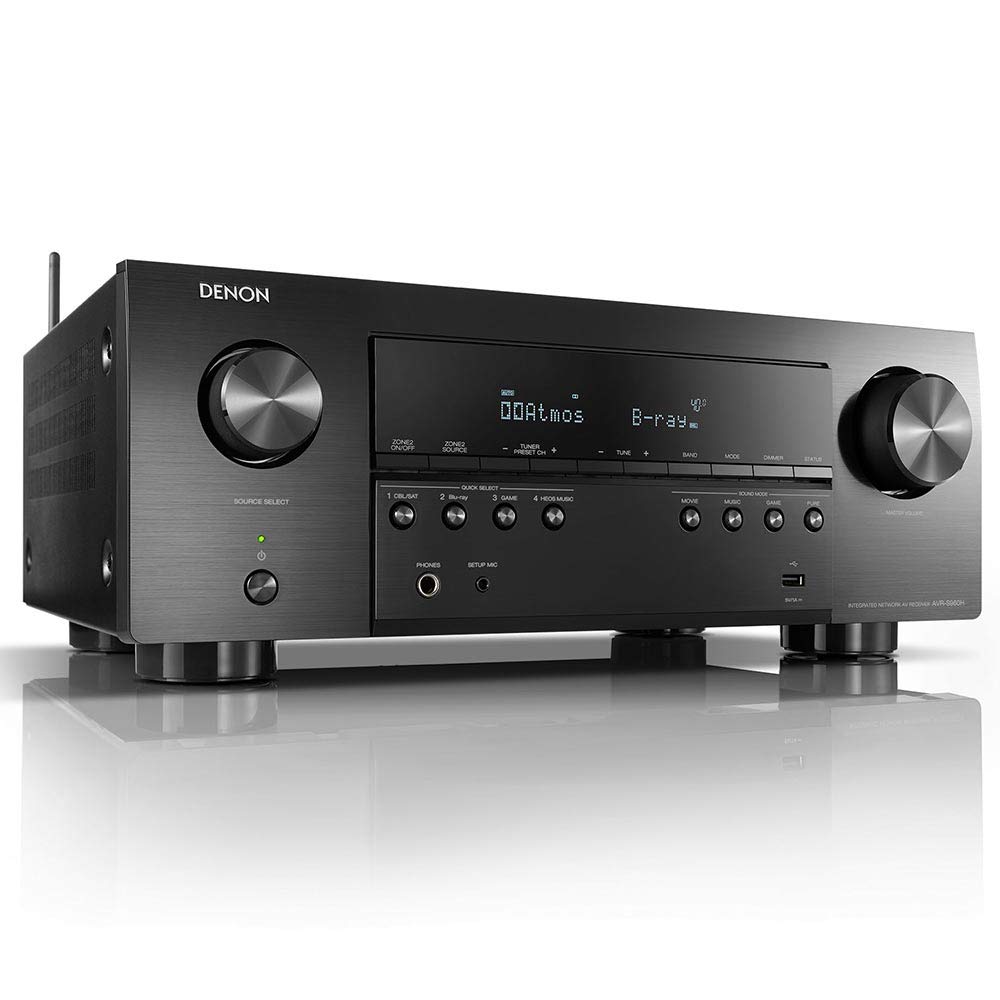
1. Denon AVR-S960H 8K Ultra HD 7.2 Channel AV Receiver
Our pick — over 4★ from 800+ verified ratings; the strongest balance of quality and price.
The 8K-ready all-rounder that brings cinema-grade immersion to consoles and projectors alike.
This Denon is the one to beat if you want every modern feature without stepping up to the flagship price tier. It delivers crisp video with 8K/60Hz and 4K/120Hz pass-through, meaning your next-gen console can push maximum frame rates while the receiver handles the audio. Next-gen gaming gets a boost from Variable Refresh Rate (VRR) and Auto Low Latency Mode (ALLM), which reduce lag and screen tearing during fast action.
The sound side is anchored by Dolby Atmos Height Virtualization and DTS Virtual:X, which create a 3D bubble of sound — so you sense helicopters overhead without installing ceiling speakers. Setting it up is less stressful than most, thanks to the on-screen assistant and Audyssey MultEQ XT room calibration that tunes each speaker for your exact room shape. Buyers report the guided setup and Audyssey results are what win people over, dramatically boosting surround and ceiling levels.
Connectivity is generous with 8 HDMI ports (6 in / 2 out) and HDCP 2.3 processing, plus a phono input for a turntable. The dual HDMI outputs let you run a projector and a TV at the same time. Voice control works with Amazon Alexa, Google Assistant, and Apple Siri, and the HEOS app streams to other rooms via Wi-Fi or AirPlay 2. The main thing owners watch is heat — it runs hot in enclosed cabinets, so give it room to breathe. An occasional unit has arrived with Bluetooth dropouts, but overall this is the crowd favorite across 800+ ratings.
What Owners Love
- Audyssey calibration creates a balanced, accurate surround field
- 6 HDMI 2.1 inputs support HDR10+ for vibrant, high-contrast imagery
- Compact 13″ depth fits neatly into most media cabinets
What to Watch
- Runs hot under normal use; requires open ventilation or active cooling
- Phone app and remote feel less premium than the receiver itself
Your best bet if: you want one receiver that handles 8K video, next-gen gaming, and multi-room music without a steep learning curve.
Think twice if: you have a sealed AV cabinet with no airflow — you will need to add a cooling fan.
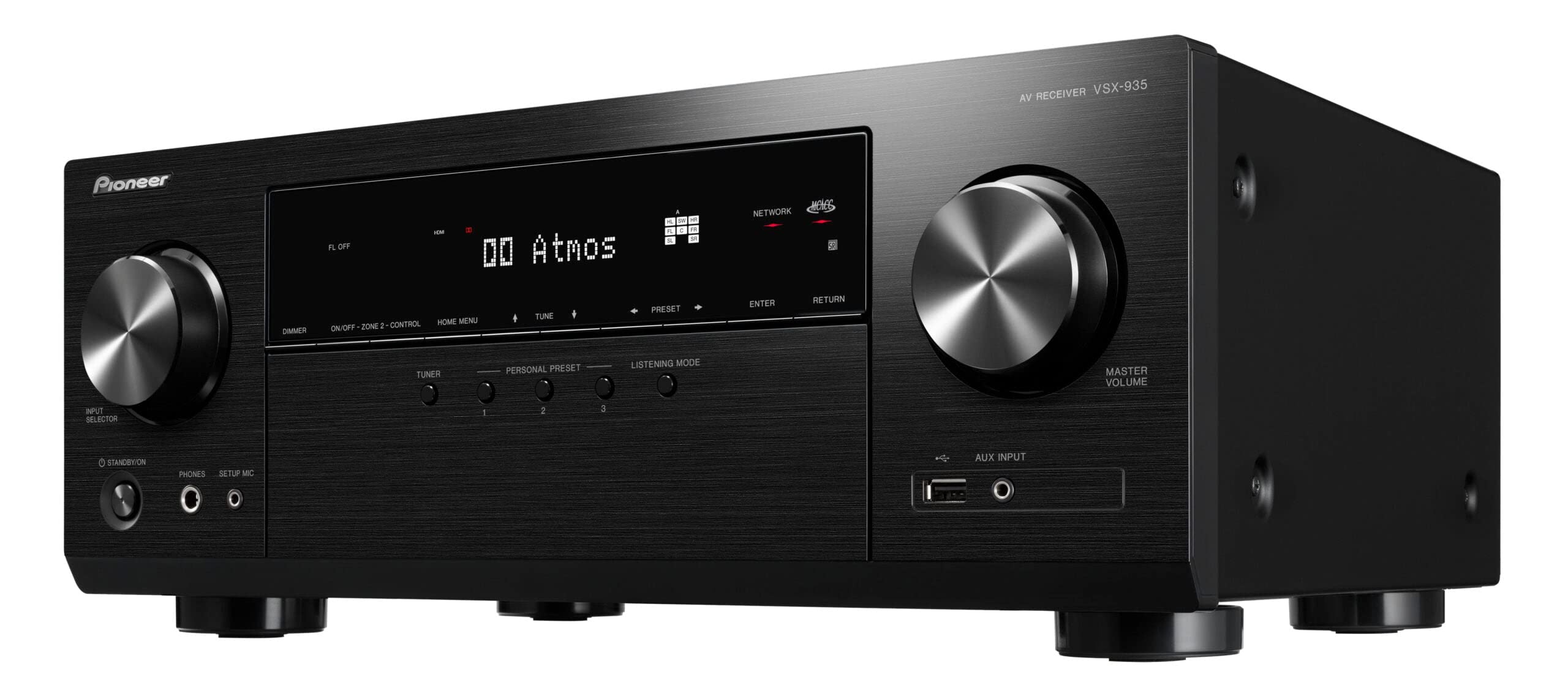
2. Pioneer VSX-935 7.2 Channel Surround Sound Network Receiver
A capable 7.2-channel performer that rewards owners willing to fine-tune it manually.
This Pioneer brings 8K HDMI 2.1 connectivity and enhanced gaming features to a price point that undercuts many rivals. It handles Dolby Atmos Height Virtualization, which fabricates a convincing height effect from traditional speaker layouts — so you get a sense of overhead sound without buying extra in-ceiling speakers. The unit is physically compact at 6.81″ tall, making it a strong fit for AV shelves with limited vertical clearance.
Where this receiver shines is for the hands-on owner. Owners mention that manual speaker setup yields fantastic results — crisp, clear, and loud, with all speakers playing properly for music. As owners put it: “This was my first time replacing an amplifier on my own. It was easy to hook it up to my Bose speakers and the sound is incredible!” The auto-calibration is less impressive than the manual route, so budget time to tweak settings by ear.
The recurring fit-note is Bluetooth — some owners find two-way pairing finicky and the interface dated. There is no dedicated Bluetooth button, and the menu system feels like a step back in time. Quality feedback is genuinely mixed, so this is not the receiver for someone who wants a flawless out-of-box experience. But for the enthusiast who enjoys dialing in settings, it delivers strong surround sound with 8K readiness at a smart price.
Where it fits: If you enjoy tweaking settings and don’t mind a learning curve, this receiver rewards your effort. Its 4.2-star rating shows owners who spend time on setup are happy, while those wanting instant plug-and-play often struggle.
Reach for this if: you are comfortable with manual calibration and want 8K HDMI support without paying a premium.
Look elsewhere if: you rely heavily on Bluetooth streaming — that is its weakest link.
3. Onkyo TX-NR6100 7.2 Channel THX Certified Network AV Receiver
THX certification and serious wattage make this the choice for big, demanding speaker setups.
If your listening room is large or your speakers are power-hungry, the Onkyo TX-NR6100 brings a massive 210W per channel — a 2.3x gap over the Denon AVR-S960H’s 90W output. That headroom translates to clean, easy volume without strain, and owners driving Klipsch setups report it plays louder than comparable Denon models. The THX Select certification means the amplifier has passed thousands of tests to ensure nothing is added to or taken away from the source material.
Movie fans get 5.2.2-channel Dolby Atmos and DTS:X playback, meaning you can set up a standard 5.1 surround system plus two ceiling or height speakers for overhead sound effects. It also passes 8K video through HDMI 2.1 at 40Gbps on three inputs, so your future 8K TV stays compatible. A separate Zone 2 output lets a second room play different content—one owner runs a Roku and DVD player through it smoothly, with the Roku remote even turning the receiver on and off.
The praise here is loud and clear: sound quality and value for money are the most-discussed positives, with buyers calling it superb value for the power and sheer number of features. The downside is a mixed reliability picture — an occasional unit arrives defective, and some customers note units powering off randomly. Buyers warn that some units ship with HDMI issues, so purchasing from an authorized retailer matters. Note the deep 21″ chassis: it is 62% deeper than the Denon’s 13″, so measure your cabinet before buying.
What wins people over: 128 owners single out sound quality, and a further 101 praise the value — for THX-certified power, the price-to-feature ratio is hard to argue with.
The honest catch: its depth makes it a poor fit for shallow shelves, and its reliability record is more checkered than the Denon’s.
Choose this for: a dedicated home theater where raw power and certified audio fidelity matter more than cabinet fit.
skip it if: you want a slim unit that slots into standard furniture — it simply will not fit.
4. Yamaha RX-V6A 7.2-Channel AV Receiver with MusicCast

A multi-room music hub that streams TIDAL, Spotify, and more to every corner of your house.
This Yamaha is built for the listener who splits their time between movies and music. It supports MusicCast, which streams to compatible speakers in other rooms, plus AirPlay 2, Bluetooth, and Spotify Connect directly. Services like TIDAL, Qobuz, Amazon Music HD, and SiriusXM are all built in, so you can start a playlist without ever touching your phone. Voice control works through Alexa, Google Assistant, or Siri via AirPlay 2.
For video, it supports Dolby Vision, Hybrid-Log Gamma, and BT.2020 (wide color gamut) for richer colors, with 7 HDMI inputs (1 with eARC) handling 8K60 and 4K120 signals. Gamers get reduced lag through ALLM (Auto Low Latency Mode) and VRR (Variable Refresh Rate). On audio, Dolby Atmos with Height Virtualization and DTS:X create surround effects, while YPAO R.S.C. multipoint room correction automatically adjusts sound to your room’s acoustics. One owner praised it for driving 4-ohm front speakers during TV streaming, and liked that it doesn’t auto-power-on with the TV’s eARC signal, giving manual control.
Sound quality is the most-praised aspect, with owners loving its clarity and detail. The trade-offs are real: the setup has a steep learning curve, the on-screen menu feels dated, and Bluetooth can drop connections. The physical manual is online only, which frustrates less tech-savvy buyers. Its HDMI bandwidth is capped at 21Gbps, so uncompressed 4K/120 or 8K/60 is off the table. This is a great value for music-first homes that do not need the absolute latest video spec.
Where it wins: For pure streaming versatility and multi-room audio, few receivers this price match its service list and MusicCast ecosystem.
Where it falls short: The 21Gbps HDMI ceiling and app-dependent controls hold it back from being the top overall pick.
Best for: music lovers with a modest speaker setup who want whole-home streaming and a path to grow later.
Not ideal for: hardcore gamers needing full-bandwidth 4K/120 — look to the 8K-ready Denon instead.
5. Cambridge Audio AXR100 FM/AM Stereo Receiver

A two-channel classic that reveals hidden details in your records — no video, no fuss.
If your priority is music — vinyl, CD, or high-quality streaming — this Cambridge Audio receiver skips video entirely and focuses on stereo purity. It delivers 100W per channel of clean, warm sound that owners describe as revealing details in recordings they had never heard before. Paired with quality bookshelf speakers, it produces a wide, detailed soundstage without harsh treble. One owner found the unit rivals high-end Onkyo and Denon units for a fraction of the hassle.
The AXR100 includes a dedicated phono stage, so your turntable plugs straight in without an extra preamp box. It also has a subwoofer output to add low-end punch, plus digital inputs for a TV or CD player. The build quality is solid and the classic grey faceplate looks at home in a traditional hi-fi rack. Reviewers point out a straightforward 30-minute setup with multiple sources, and the unit runs cool with no audible fan noise.
Devoted two-channel fans praise its power, sound quality, and value — all four top aspects score positive. The realistic caveats: the Bluetooth range is short, sometimes interrupted by movement, and the remote’s blue-on-black buttons are hard to read in a dark room. There is no HDMI or surround processing, so this is strictly for the stereo listener, not the home theater crowd. An occasional unit has had reliability issues, but most owners are delighted with the musical performance.
Owners Rave About
- 100W per channel delivers punchy, clean bass and smooth highs
- Built-in phono stage means instant vinyl playback
- Runs cool and quiet with no distracting fan noise
The Honest Caveats
- Bluetooth range is limited to a few feet in some rooms
- No HDMI inputs — TV sound needs an optical or analog connection
The standout-spec mic-drop: 100W of clean, warm stereo power with a phono stage — if you have two great speakers and a turntable, this is everything you need.
Know before you buy: it is a stereo receiver, so a 5.1 surround setup is out of the question.
6. Denon AVR-X1700H 7.2 Channel AV Receiver

This 7.2-channel receiver offers an easy upgrade path, and its color-coded speaker terminals make wiring straightforward—so you can connect your system without confusion.
The AVR-X1700H is Denon’s answer for the buyer who wants 8K readiness and theater immersion without the flagship price tag. It offers 3 dedicated 8K inputs and 1 output with 8K/60Hz and 4K/120Hz pass-through, plus 8K upscaling on all 6 HDMI inputs. That means even older 1080p sources get sharpened for your new television. Gaming gets VRR and ALLM support for smoother, lag-free play.
Multi-dimensional audio is the headline: Dolby Atmos, DTS:X, and DTS Virtual:X are all here, alongside Dolby Atmos Height Virtualization that fakes height channels when you lack physical ceiling speakers. In a 7.1.2 setup in a medium room, owners describe a theater-like experience where surround and height speakers pull you into the action. A 5-way binding post connector type means solid, secure speaker wire connections.
What sets this Denon apart is setup. The color-coded back panel and on-screen quick setup guide walk you through connecting everything, and the Audyssey calibration handles room tuning. Owners call it the easiest receiver setup they have experienced. The included phono input handles both MM and MC cartridges (one at a time), a key factor for vinyl fans. Quality and sound quality are the top positive aspects, with buyers loving the build and the value. The main adjustment is that auto-calibration sometimes needs manual tweaks for unusual room shapes, and the HEOS app feels clunky compared to rivals.
The thing everyone raves about: 104 owners highlight build quality, and 73 more call out the sound — a consensus pick for solid, reliable home theater performance.
Keep in mind: the mic cable is short for odd setups, and there are no RCA AUX inputs for legacy gear.
Pick this if: you want a straightforward 7.2-channel receiver with 8K inputs, easy wiring, and dependable Denon sound.
Pass if: you need more than one HDMI output for a second display — this has just one.
7. Yamaha RX-A2A AVENTAGE 7.2-Channel AV Receiver

Yamaha’s premium AVENTAGE line adds Surround:AI smarts that fine-tune audio in real time.
This is the entry point to Yamaha’s top-tier AVENTAGE series, which carries a reputation for premium build quality and refined sound. The defining feature is Surround:AI, technology that analyzes the audio signal in real time and automatically tune sound and effects — dialogue stays clear during explosions, and ambient noise levels adjust on the fly. Owners upgrading from older budget Yamahas describe a noticeable improvement in balance and refinement at high volume.
The video department is fully loaded: 7 HDMI inputs (1 with eARC) support 8K60 and 4K120, with Dolby Vision, HDR10+, and HLG passthrough for state-of-the-art picture quality. ALLM and VRR make it gaming-ready. It is also Roon Tested and works with Sonos via a Sonos Port, so it can slot into an existing Sonos ecosystem. It weighs 25.4 pounds — a sign of the heavy internal build — and relies on the 5th center foot and sturdy chassis for vibration damping.
What owners prize most is overall quality and sound, with many calling it a meaningful step up from budget receivers when driving older speakers. The YPAO R.S.C. multipoint calibration works well, with one owner completing setup in about 10 minutes. The honest drawbacks: configuration can feel over-complicated for beginners, and some report intermittent no-signal issues with certain TVs that a power cycle fixes. It lacks analog video inputs, and some feel the standard menu is less flashy than rivals. This is a premium pick for those who value refined sound and smart auto-tuning.
What wins fans: 55 owners call out the build quality and 51 the sound — the AVENTAGE name delivers on its premium promise.
Worth knowing: both the setup complexity and value-for-money opinions are genuinely split, so this rewards patient, knowledgeable buyers.
Best for: the enthusiast who wants Yamaha’s smartest auto-tuning and a rock-solid chassis to drive aging speakers to new life.
Skip if: you want the simplest possible setup — its configuration depth can overwhelm beginners.
8. Onkyo TX-RZ50 9.2-Channel THX Certified AV Receiver

Dirac Live room correction transforms your space into a precisely tuned listening environment.
For the serious home theater builder, this Onkyo is less about wattage and more about precision. Its headline feature is Dirac Live, a room-correction system that measures your actual room acoustics and adjusts speaker output for accurate, balanced sound. Owners describe the calibration results as impressive — Dirac Live significantly improved clarity and crossover performance compared to simpler systems. It supports up to 11.2 channels of processing with pre-outs for a full 7.2.4 layout, so you can run four ceiling speakers for object-based Dolby Atmos.
The TX-RZ50 pairs its calibration smarts with THX Certification, confirming the amplifier adds nothing to and removes nothing from the source material. A Klipsch tune Mode automatically applies the correct crossovers when you tell it which Klipsch speakers you own. For video, HDMI 2.1 supports 8K60 and 4K/120 for razor-sharp gaming, and the receiver is Works With Sonos Certified — it can join a Sonos system using up to three Sonos Ports for three independent zones.
Measurements aside, owners call the sound quality a massive upgrade over older receivers, with one noting it gives a “beast of an amplifier” feel. Quality and sound quality are the top positives. The learning curve is steep, though: Dirac Live setup can be buggy, requiring troubleshooting over network drops, and the Onkyo app is weaker than the competition. There is no printed manual — just a PDF. It also needs an external amp to reach its full 11-channel potential. This is a powerful tool for enthusiasts willing to invest setup time.
Why It’s a Flagship
- Dirac Live delivers precise, room-corrected sound that rivals pricier models
- 9.2 channels with 11.2 processing and pre-outs for future expansion
- THX Certified for guaranteed accuracy with any source
Where It Tests You
- Dirac calibration can be finicky, with network and SNR errors
- No printed manual; app control is underwhelming
For whom: the dedicated home theater enthusiast who wants Dirac Live’s professional-grade calibration and room to grow to 7.2.4 Atmos.
Who should pass: first-time buyers wanting a quick, simple setup — the calibration learning curve is real.
9. Marantz Stereo 70s Slimline Stereo Receiver
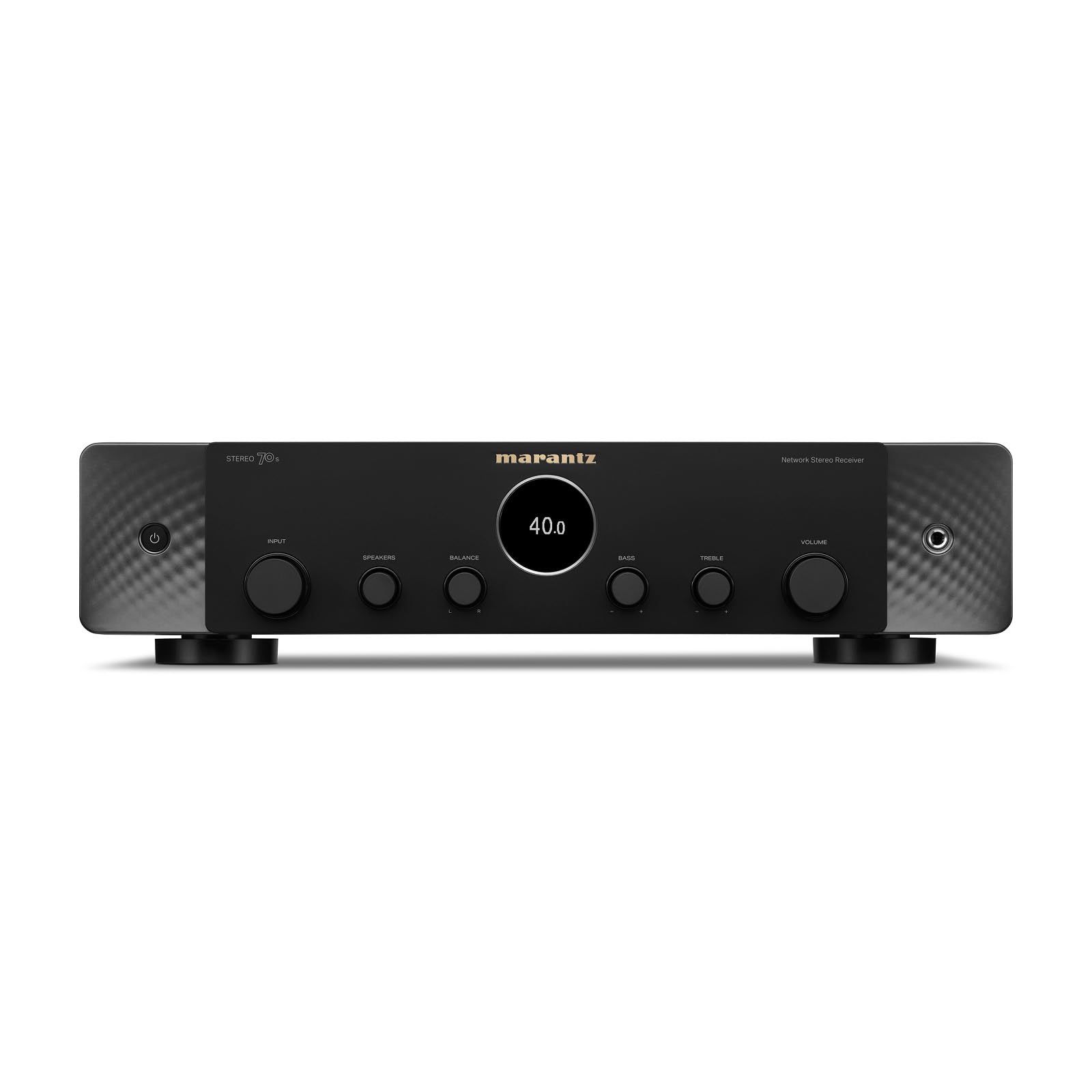
A slim 4.1-inch-tall stereo receiver that brings high-end Marantz warmth to small spaces.
If your room cannot fit a full-size AV receiver, this Marantz solves the problem with elegance. At just 4.1 inches tall, it slides into shelving where standard units cannot — yet it delivers 75W per channel of fully discrete Class A/B amplification. Owners with high-end speakers like B&W 705s and Klipsch RP-500Ms report the signature Marantz warmth shines, with one describing it as making their bookshelves “shine” and praising its ability to balance bright speakers.
Despite the stereo focus, this unit handles serious home theater duty: it connects to your TV via HDMI ARC for crisp dialogue clarity, and supports up to two subwoofers for added bass. Six HDMI inputs include 8K support for future-proofing, and two subwoofer outputs let you run a 2.2 setup. It streams via HEOS with high-resolution audio up to 192 kHz/24-bit and DSD support, and includes a phono input for vinyl.
The trade-off is simple: this is a dedicated two-channel receiver, so there is no surround processing. Owners upgrading from older Marantz models describe a subtle but superior sound for both music and AV use, and the redesigned menu system is a major improvement. One caveat: some shoppers say the HEOS streaming feature not functioning as advertised, and the phono preamp can lack gain, causing a volume drop on that input. This is a niche, premium pick for music-first listeners with limited shelf space.
The defining trait: owners focus entirely on sound quality and build — for a two-channel purist with high-end speakers, few slim units match its finesse.
The fine print: it is stereo-only, and the HEOS app has drawn some negative reports from buyers.
The standout-spec mic-drop: 75W of Marantz-tuned Class A/B power in a 4.1-inch-tall chassis — high-end stereo sound that fits where full-size receivers cannot.
One honest limit: the advertised HEOS streaming has not worked for every owner, so Bluetooth may be your fallback.
Understanding the Specs
Watts Per Channel
This number tells you how much amplifier power the receiver can deliver to each speaker. Higher wattage means the receiver can play louder without distorting, which matters most in large rooms or with speakers that are not very efficient. A receiver like the Onkyo TX-NR6100, rated at 210W, has far more headroom than a 90W unit, making it better suited to big, power-hungry floor-standing speakers.
Channel Configurations
A 7.2 receiver powers seven speakers and two subwoofers. The notation can get specific: a 5.2.2 setup means five ear-level speakers, two subwoofers, and two height channels for Dolby Atmos overhead effects. A 9.2-channel receiver like the TX-RZ50 can drive even more speakers. Always match the receiver’s channel count to the speakers you plan to connect, and remember you can start smaller and expand.
HDMI Version and eARC
HDMI 2.1 is the current standard, supporting 8K/60Hz and 4K/120Hz video — the latter essential for next-gen consoles running high refresh rates. eARC (Enhanced Audio Return Channel) lets your TV send high-quality, uncompressed audio back to the receiver from its built-in streaming apps. If you have an 8K TV or a PlayStation 5, look for a receiver with HDMI 2.1 inputs and eARC output.
Room Correction
Brands package their own room-tuning software using an included microphone: Denon uses Audyssey, Yamaha uses YPAO, and Onkyo offers Dirac Live on higher models. These systems measure how your room reflects sound and adjust speaker levels, delays, and frequencies for more balanced audio. A good calibration can make budget speakers sound dramatically better — prioritize it over raw wattage in acoustically challenging rooms.
FAQ
What is the difference between a 5.1 and a 7.2 receiver?
Do I need a receiver with 8K HDMI for my current TV?
What does Dolby Atmos Height Virtualization do?
Can I connect my turntable to any of these receivers?
What is eARC and why does it matter for TV sound?
Is a stereo receiver or an AV receiver better for music?
How important is the room calibration software?
Will these receivers work with my existing Sonos system?
Why does my receiver run so hot and should I worry?
What is the difference between passing through and upscaling video?
Final Thoughts: The Verdict
Across the board, the audio receiver for home winner is the Denon AVR-S960H because it balances 8K/60Hz video pass-through, next-gen gaming features, Audyssey room calibration, and generous connectivity into one reliable package. If you want THX-certified power for a demanding speaker setup, grab the Onkyo TX-NR6100 with its commanding 210W per channel. And for pure vinyl and CD listening in a small space, the slim, warm-sounding Marantz Stereo 70s is the one to reach for. The Denon’s 4.4-star rating across 800+ owners gives it an edge in proven reliability over the Onkyo, which offers more power but a deeper chassis and mixed reliability reports.
How We Picked
We do not accept paid placement. Every pick is matched to a real buyer and a real use-case; we do not hands-on test units.
Sources & Methodology
Specifications: manufacturer listings and product documentation. Review insights: verified customer reviews, as of September 2026. Pricing: not shown on this page (it changes often); check the current price via the retailer link.
As an Amazon Associate, Gadgets Feed earns from qualifying purchases. This does not affect which products we feature.