
Our readers keep the lights on and my morning glass full of iced black tea. As an Amazon Associate, I earn from qualifying purchases.
Specs are compiled from manufacturer listings and verified buyer reviews and can change over time — please confirm the key details on the product page before buying.
When you plug in a Level 2 electric car charger or a big RV, the outlet itself becomes the weakest link. This guide breaks down the real difference between a cheap outlet that fails and a heavy-duty one that handles years of daily charging.
I’m Min — the founder and writer behind Gadgets Feed. This guide is built by comparing the manufacturers’ published specifications and the patterns across verified customer reviews, so you get each pick’s real strengths and trade-offs instead of marketing spin.
Note: this list uses flexible matching for the 240v rating, so not every pick is the exact number searched; the nearest same-type size serves the same purpose. Here is how to choose the right 240 amp outlet for your EV, RV, or welder without getting burned.
Our Picks at a Glance


How To Choose The Best 240V 50-Amp Receptacle
Buying a 50-amp outlet is not like buying a phone charger. A loose or weak connection under continuous load generates heat, which melts terminals and starts electrical fires. Focus on the physical build, the certification, and the wire it accepts before you look at anything else.
Match the plug configuration first
The NEMA code on your plug determines which outlet you can use. A NEMA 14-50R has four prongs and carries 125/250 volts, making it the standard for most RVs and nearly all Level 2 EV chargers. A NEMA 6-50R has three prongs and carries 250 volts only, which is what welders, plasma cutters, and electric stoves typically use. Buying the wrong one means an adapter or a return, so check your cord’s plug before you commit.
Check for a continuous-use rating
An EV charger draws current for hours, not minutes, which is called a continuous load. Standard outlets are not always rated for that abuse, but heavy-duty receptacles are built for it. Look for the 75°C rating on the spec sheet and a manufacturer note that the unit is “fully rated for continuous use,” because that single detail is the difference between a safe install and a slow-motion fire hazard.
Quick Comparison
| Model | Best For | Configuration | Amperage | Outdoor Box | Amazon |
|---|---|---|---|---|---|
| Hubbell HBL9450A★ Best Overall | Daily EV charging | NEMA 14-50R | 50 A | No | Amazon |
| Leviton 1450REV Plus | Plug-in EV charging | NEMA 14-50R | 50 A | No | Amazon |
| RVGUARD 14-50RBest Value | Budget-minded EV owners | NEMA 14-50R | 50 A | No | Amazon |
| PAULINN Outlet Box | Lockable outdoor installs | NEMA 14-50R | 50 A | Yes | Amazon |
| Joinfworld Outlet Box | Tesla charging outdoors | NEMA 14-50R | 50 A | Yes | Amazon |
| RVMATE Outlet Box | RV campsite hookups | NEMA 14-50R | 50 A | Yes | Amazon |
| VEVOR Outlet Box | Rust-resistant outdoor use | NEMA 14-50R | 50 A | Yes | Amazon |
| STARELO 14-50R Box | Compact indoor outlets | NEMA 14-50R | 50 A | Yes | Amazon |
| STARELO 6-50R Box | Welders and power tools | NEMA 6-50R | 50 A | Yes | Amazon |
In‑Depth Reviews
1. Hubbell HBL9450A Straight Blade Receptacle
Our pick — over 4.5★ from 700+ verified ratings; the strongest balance of quality and price.
The industrial-grade receptacle that EV owners call the gold standard for a reason.
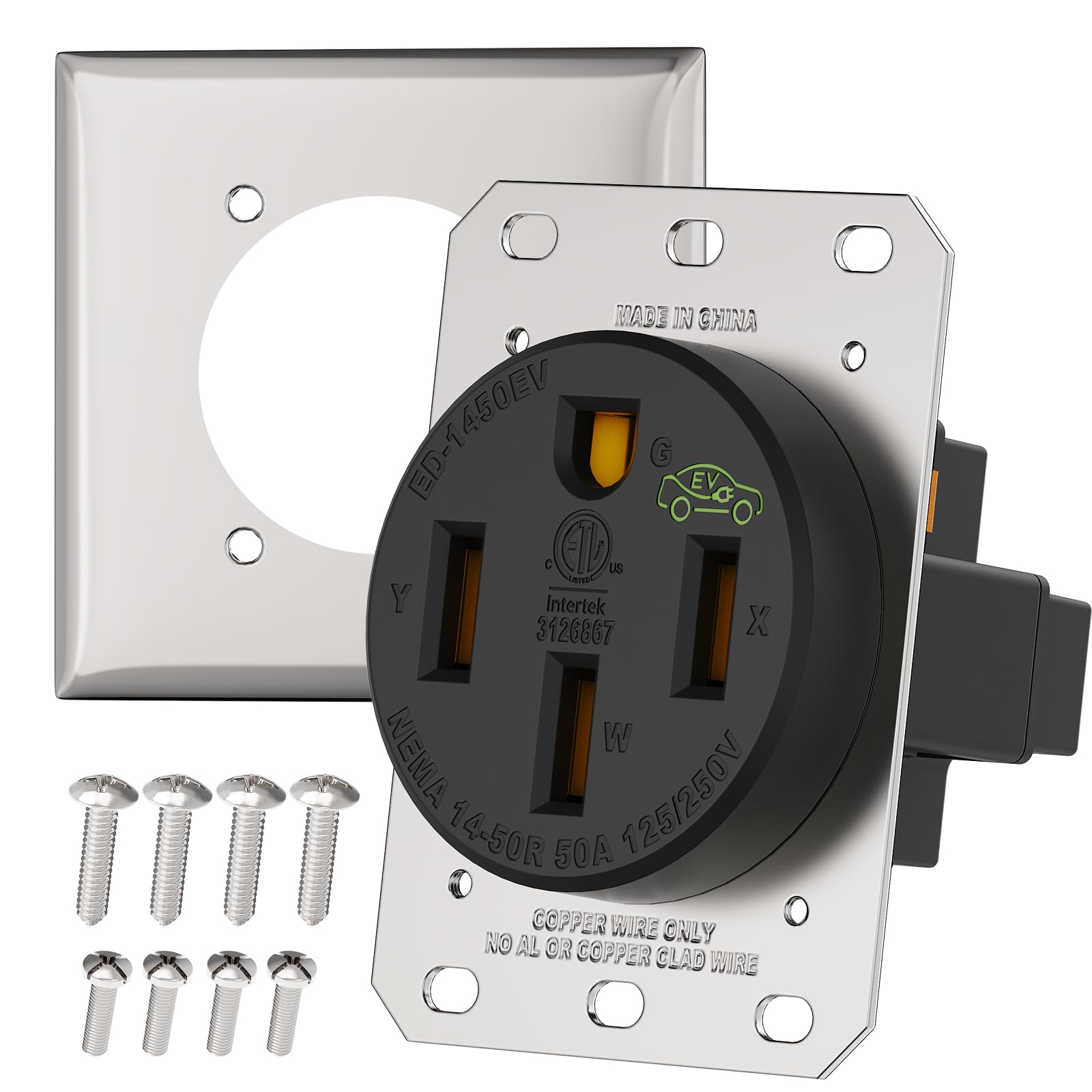
This is the receptacle serious EV owners choose when they want the plug-in charger to outlast the car. It is rated for continuous use at 50A with a 75°C rating, which means it is built to handle the hours-long draw of a Level 2 charger without the heat buildup that plagues lighter outlets. Buyers report it keeps the entire assembly cool during operation, even on back-to-back charging sessions.
You can tighten the screws firmly without ruining the heads, thanks to the anti-strip design and larger metal contact points. This outlet is physically heavier than lighter-duty models, with thicker internal wiring and terminals that hold up to a tug test—the same check an electrician performs before signing off on a job.
Owners who switched from cheaper brands describe it as “the to go outlet for charging my electric car,” noting it doesn’t overheat like cheaper outlets.
What wins people over
- Rated for continuous 50A use so it survives daily EV charging
- 75°C rating means it runs cooler under sustained load
- Screws that don’t strip under torque, saving you install headaches
Who should think twice
- Premium price versus a standard household receptacle
- Large physical size may not fit a standard outlet box
The crowd favorite: 4.8 stars across 700+ owners, with quality and build quality the traits mentioned most by a wide margin. This is the receptacle to pick if you plug and unplug an EV charger daily and want zero thermal worries.
Reach for it if: you want one install that never needs revisiting. Look elsewhere if you only need a bare-bones outlet for occasional use on a tight budget.
2. Leviton 50 Amp EV Charging Receptacle 1450R
A brand-name safeguard built for the long charge times an EV demands.
Leviton engineered this receptacle specifically for plug-in EV charging, which means it is designed to sustain extended charge time and the high frequency of insertions that EV chargers require. Unlike a standard outlet, its pressure-wire terminals keep full contact with conductors, staying tight under heat cycles.
The terminals require 75 inch-pounds of torque, a spec the instructions walk you through, and owners who followed it report clean, secure installs on 40A GFI breakers with no issues after dozens of charges. It is built from durable, high-impact nylon, and the screw terminals are beefy enough to handle repeated tightening.
Owners describe replacing burnt lightweight outlets used for a Rivian R1S, catching the problem before it became a fire hazard. The honest caveat is that its larger face needs a bigger wall plate and may require box hole modification, and a few owners note the terminal screws can strip if you overtighten past the spec.
Owners mention this unit is noticeably heavier and safer than budget outlets that tend to fail, which is why many treat it as a semi-permanent installation rather than something you plug and unplug daily.
Built for the long haul: a dependable choice for Level 2 charging that owners trust more than budget outlets, with pressure-wire terminals that hold a full-contact connection.
Who it beats: any basic receptacle that is not EV-rated.
The one caution: plan for a larger wall plate and follow the 75 inch-pound torque spec to avoid stripping the terminal screws.
3. RVGUARD 50 Amp EV Charging Receptacle
The half-price alternative that skips the Hubbell tax without skipping the build.
This is the receptacle that makes you question why the premium brands cost double. It uses durable high-impact nylon and heavy-gauge brass contacts, and it is fully rated for continuous use, making it a legitimate option for EV charging stations and high-draw appliances like an electric stove. Customers note it “worked great for a 40A charger,” which is exactly the continuous-load scenario that kills weak outlets.
The included stainless-steel wall plate and mounting screws remove a separate purchase from your list, and the unit is ETL listed as a complete set of receptacle plus plate. It is built for #4, #6, or #8 AWG copper wire only, and the 3mm Allen lugs on the terminals give you a solid clamping point that owners describe as perfect for a continuous usage system.
One honest perspective comes from a buyer using it for a GE electric range instead of an EV, who noted it performs at half the price of the Hubbell without being half the quality. The wiring clamp gets mixed feedback, so seat the wire fully before torquing down.
Where it shines
- Roughly half the price of premium brands with comparable build
- ETL listed receptacle and wall plate as one set
- Fully rated for continuous use at 50A
The small print
- Wiring clamp gets mixed feedback on seating
- Must go in a 2-gang or larger outlet box
Best for: the budget-conscious EV or RV owner who wants a properly built, fully rated receptacle without paying the industrial-brand premium.
Skip it only if: you need the absolute maximum contact force of a Hubbell for a very high-mileage daily charger. Otherwise this delivers 90% of the performance for half the spend.
4. PAULINN 50 Amp RV Outlet Box
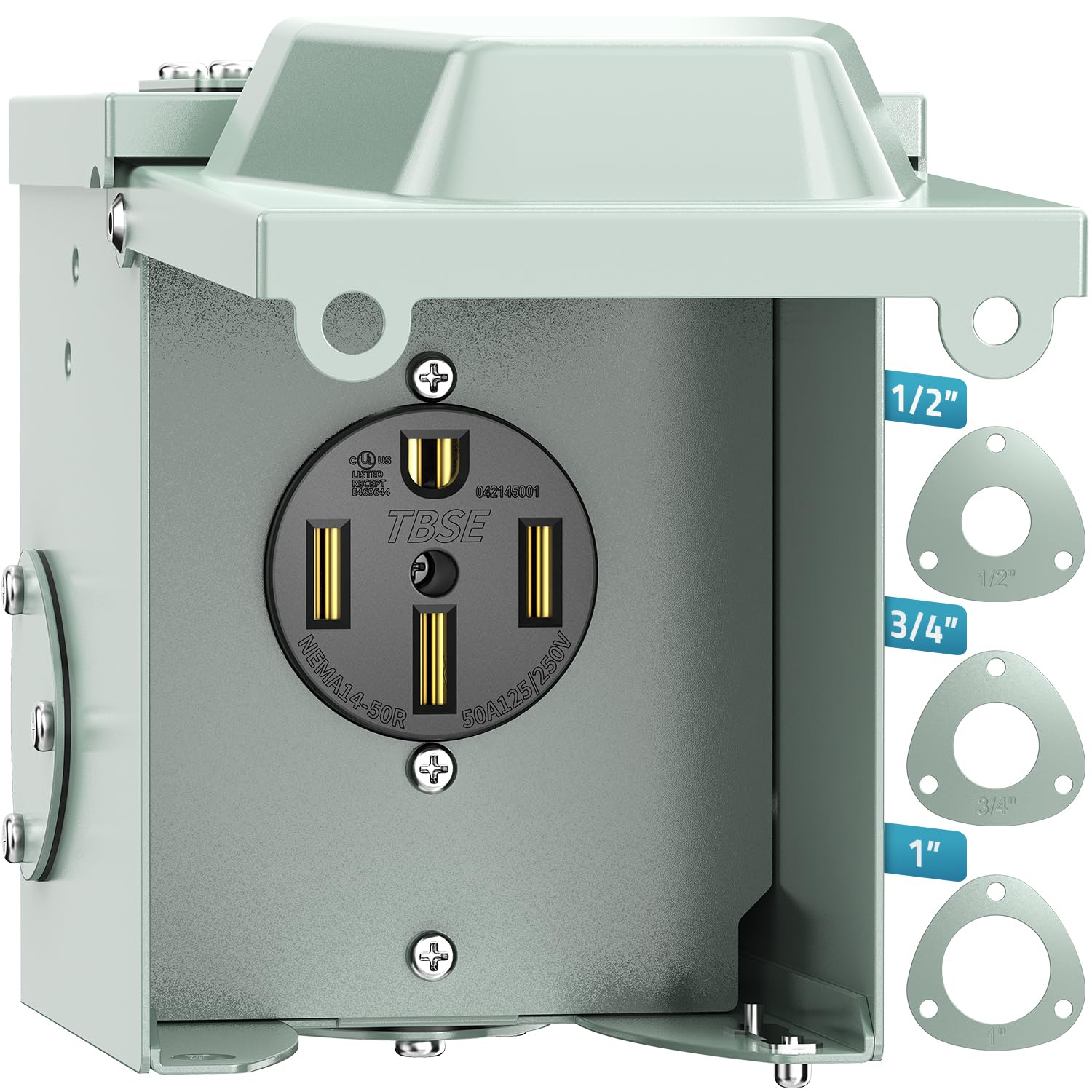
A sturdy outdoor box with a lockable swing cover that keeps curious hands and weather out.
This is a UL Listed outdoor panel with an enclosed, lockable swing cover, which means you can secure your RV or EV connection against theft and disconnection. The locking part sits at the bottom of the cover, so a padlock actually stops someone from unplugging your rig while you sleep. Owners praise the matte, scratch-resistant, rust-resistant paint as a visible step up in longevity.
The arc-shaped interior design gives you more working room than a right-angle box, which owners say makes it easier to seat a big heavy-duty RV power cord. You get three standard knockout sizes at 1″, 3/4″, and 1/2″ for wiring, and the cover can shut fully even with a cord plugged in, keeping rain, UV, and dust off the connection.
Buyers most often praise the build quality, calling it sturdy, solid, and NEC-compliant. The mixed feedback centers on the knockouts being tough to remove and the interior feeling tight when wiring thick cable through the back. It also is described as not fully weatherproof by one owner, so mount it in a sheltered spot if you can.
Strong points
- Lockable swing cover deters theft and unplugging
- UL Listed 50 amp, 125/250V NEMA 14-50R receptacle
- Scratch-resistant matte paint for outdoor longevity
Watch for
- Knockouts can be stubborn to punch out
- Interior gets tight with heavy-gauge wire
Pick this if: you park an RV or EV outdoors and want a lockable, UL Listed box that survives the elements. Everyone raves about the build quality.
Know before you buy: budget extra time for the knockouts and consider a metal punch rather than a screwdriver to open them cleanly.
5. Joinfworld 50 Amp RV Power Outlet Box
A cold-rolled steel box with a damping cover that stays put wherever you flip it.
Tesla owners are all over this one, and the reason shows up fast in the reviews. One owner charges a Model 3 through a 40-amp circuit and reports a solid 30 mph charge rate with the unit “working perfectly,” which is the real-world validation EV buyers want before they commit. The UL Listed 50-amp receptacle inside gives you the safety certification to back up the performance claim.
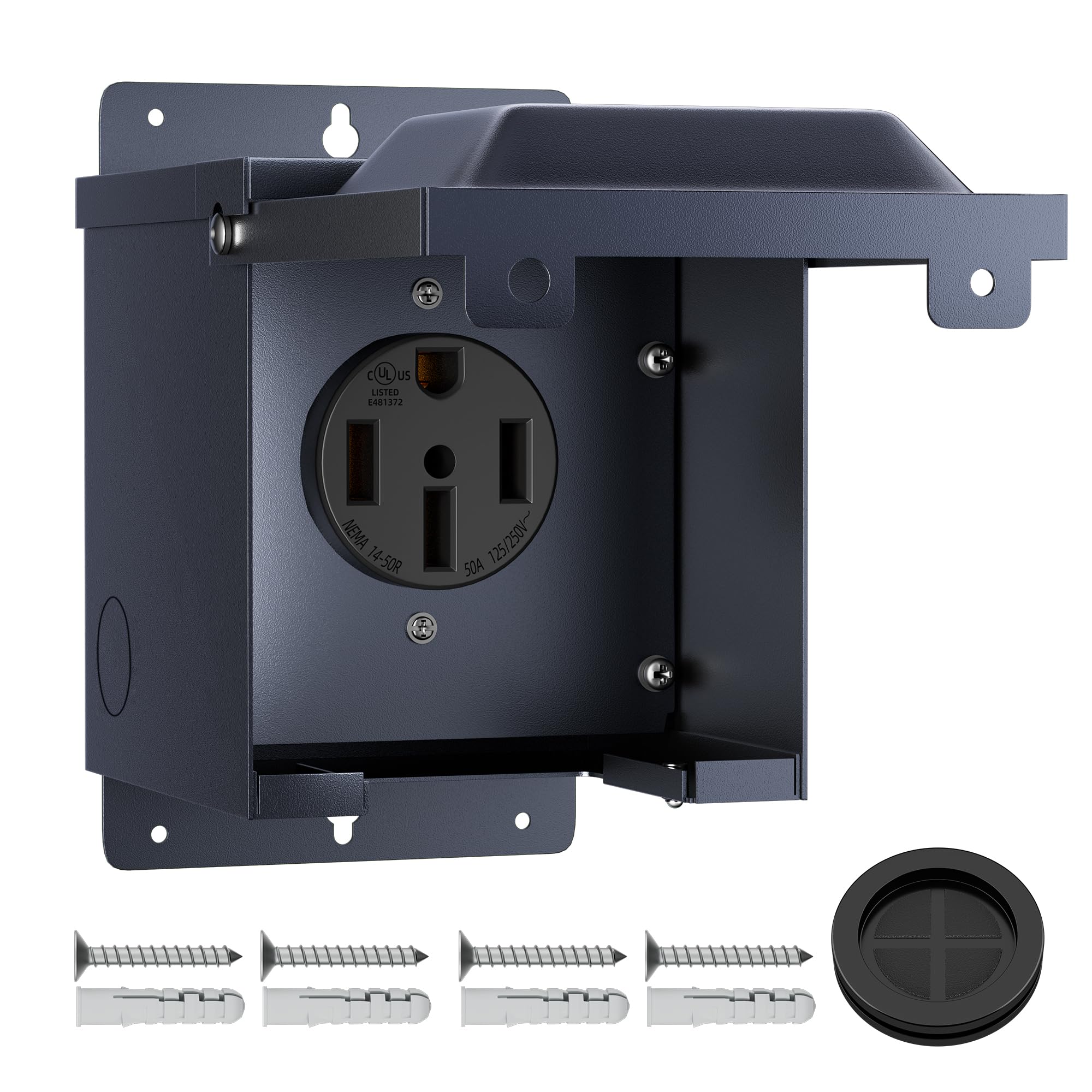
The enclosure uses heavy-duty cold-rolled steel with a dual rust-resistant coating, so it stands up to rain, dust, and UV exposure outdoors. The swing cover has a damping system that stays put at any angle—a real help when you are holding a heavy RV cord in one hand and need the cover open with the other.
Installation is genuinely friendly: the front panel pops out for hookup, then screws back into place, and the included punchout with a rubber ring makes conduit entry easy. Drilled mounting brackets sit above and below the box so you can secure it to a post or wall without custom drilling. An occasional unit arrives with a bent bracket or damaged finish from shipping, which is the one recurring delivery complaint.
Functionality first: this is a straightforward, well-made outdoor box that excels at the single most common job — feeding a Level 2 EV charger — with a cover that actually stays open while you work.
Best for: EV owners who want a no-drill outdoor install and a cover that behaves. It pairs especially well with Tesla chargers, where reviewers point out flawless daily operation.
Consider the alternative: if you need heavier-duty internal terminals for an industrial-grade receptacle swap, you may want to pair this box with a separate Hubbell or Leviton receptacle like the RVMATE owner below did.
6. RVMATE 50 Amp RV Power Outlet Box
A powder-coated metal box with color-coded terminals that electricians genuinely enjoy wiring.
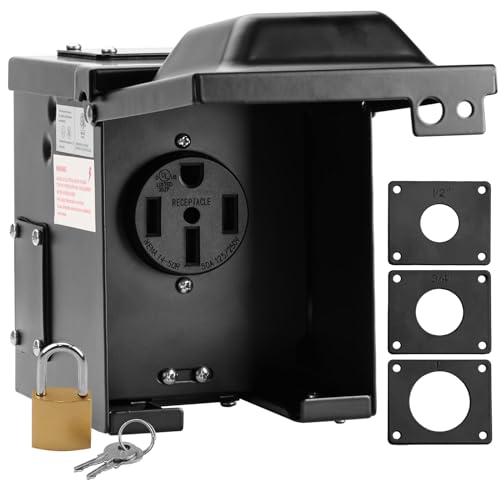
This ETL Listed box comes with a detail that installers notice immediately: the top of each terminal screw is painted a different color so you know exactly where each wire goes. Shoppers say their electrician “loved this enclosure” and found it very easy to work with, which is the highest compliment a DIY-friendly box can earn. It is built for 50A 125/250V service with a NEMA 14-50R receptacle inside.
The no-drilling design uses three removable panels on the left, right, and bottom, each with pre-drilled holes and three aperture gaskets sized at 1/2 inch, 3/4 inch, and 1 inch for different wire gauges. There is enough interior space to close the lid even with a large plug handle inserted, so rain and dust stay off the connection while your RV is plugged in.
The powder-coated heavy-duty metal resists rust, and a waterproof rubber gasket sits under the removable panel for extra sealing. The M8 x 10mm terminal screws hold wires firmly, and the long 10-inch grounding wire gives you flexibility during installation. The honest feedback is that the wiring compartment could be larger for heavy-gauge wire management, and the lid does not lock into place when flipped up, so you hold it while feeding wires.
What stands out
- Color-coded terminal screws make correct wiring simple to use
- Pre-drilled panels with three aperture sizes for any conduit
- 10-inch grounding wire adds install flexibility
The trade-offs
- Wiring compartment is snug with heavy 6-gauge cable
- Lid needs holding while you work inside
Pick this for: a clean home or campsite install where you want an enclosure that an electrician will not complain about. Quality and build quality are the most-praised traits.
One upgrade path: buyers running a continuous-duty EV charger sometimes swap in a Hubbell receptacle for the included one, treating the RVMATE as a well-built shell worth keeping.
7. VEVOR 50 Amp RV Power Outlet Box

An alloy-steel outdoor box with a password lock and a NEMA 3R weatherproof rating.
This is the box you want when the outlet lives on a pole or an exterior wall with zero shelter. The housing gets special treatment to resist rust, and the NEMA 3R protection rating means it is built for outdoor waterproof and dustproof duty. A prominent door panel design lets you close the box even while a power cord is connected, and the product adds a password lock for security against tampering.
The VEVOR comes with pre-knocked holes in three different aperture sizes, so you pick the one that matches your conduit instead of drilling fresh holes. Inside, the wiring space is generous, giving you room to make connections without fighting the box. The pre-equipped grounding wire is extended to 15cm, a thoughtful length that makes installation noticeably more flexible when your ground point is not directly behind the box.
Owners describe it as very sturdy with a perfect fit, easy for an electrician to install, and ideal for everything from RV parking to plugging in an EV charger. Buyers report one recurring shipping issue: a solid unit arriving with a dent or hole in the external box from rough handling, which is a delivery problem rather than a design flaw.
Built for exposure: when your outlet has to face the weather directly with no overhang, the NEMA 3R rating and rust-resistant alloy housing make this the dependable outdoor choice.
Reach for this if: you need a lockable, weatherproof box for a fully exposed outdoor location, from a new lot with fresh power to a construction site. The password lock is a unique touch for deterring unauthorized use.
Inspect on arrival: given the shipping damage reports some owners see, open the box and check the housing before you mount it so you can swap a dented unit early.
8. STARELO NEMA 14-50R Outlet Box
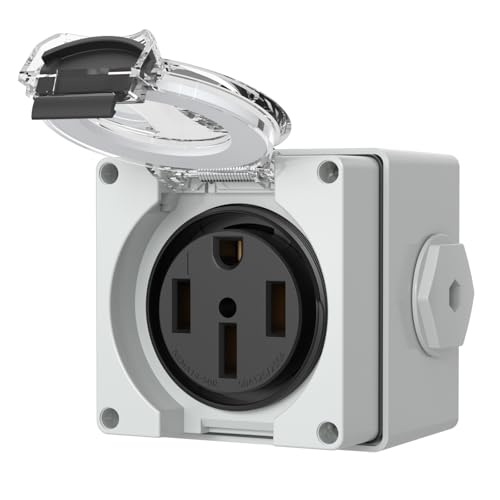
A tidy ETL Listed box that disappears onto a wall while still delivering 50 amps.
This is the pick for indoor or sheltered installs where a bulky metal box would look out of place. The compact design is the defining trait, with owners praising the streamlined look and reporting that the plastic shell holds plugs tight. It is ETL Listed at 125/250V and 50A with a 3 Pole 4 Wire Grounding configuration, and the IP66 protection class means it seals against dust and water when closed.
The protective ABS plastic box flips shut when idle to keep dust out, and owners using it for an indoor EV charger report flawless overnight performance, charging from 70% to 80% in about an hour at 220/240V. The manufacturer includes threaded ports at 1″ and two at 3/4″ so you can route conduit cleanly into the enclosure.
The honest limitation is interior space. Because the build is so compact, the maker explicitly recommends 8AWG or 10AWG wire over 6AWG, which simply will not fit comfortably. Owners confirm it is watertight only when the cover is closed, so it is not a box for charging in active rain. Compatibility also draws mixed notes, so match it to your specific plug carefully.
Why it earns its spot
- Compact footprint that looks clean on any wall
- IP66 protection against dust and water when closed
- Reliable performance owners verified with overnight EV charging
Who it is not for
- Requires 8AWG or 10AWG wire — 6AWG will not fit
- Not a live-rain charging box since it seals only when shut
Best for: the owner who values a small, clean silhouette and charges in a garage or under cover. The compact size wins people over immediately.
Match your wire first: if your run already uses thick 6AWG copper, choose a roomier box instead of fighting the space constraints here.
9. STARELO NEMA 6-50R Outlet Box
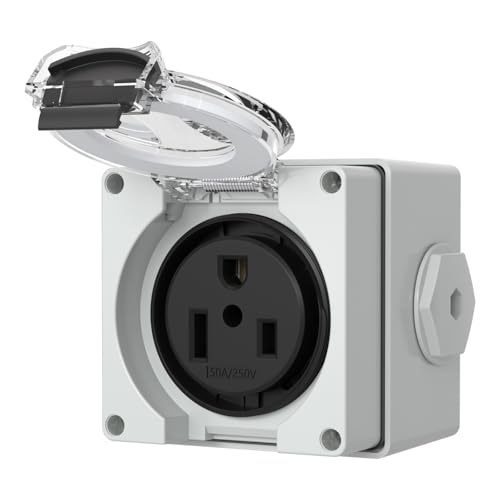
The three-prong 250-volt box built for welders, plasma cutters, and heavy shop tools.
This is the outlet for the workshop, not the driveway. Its NEMA 6-50R configuration carries 250V at 50A with a 2 Pole 3 Wire Grounding setup, which is exactly what welders, plasma cutters, and electric stoves need. It is ETL Listed and carries an IP66 protection rating, so the covered plastic box also survives outdoor duty when you need power away from the shop.
Owners running 220-volt service through a garage to an exterior wall report this box handled their welder perfectly, and the sealing capabilities get regular praise for outdoor connections. The compact design keeps the footprint small, and the value proposition is strong, with buyers noting they paid half the price of comparable shop outlets.
The recurring fit criticism is specific and worth heeding: the threaded fittings are metric rather than standard American pipe sizes, so you need metric conduit fittings or adapters. One owner also flags that the interior is tight for 6AWG wire with three conductors, making the hot leg hard to bend inside. The high-quality build and clean install experience keep most buyers satisfied despite these quirks.
Shop-tested strengths
- 250V 50A output matches welder and plasma cutter needs
- IP66 sealing rated for outdoor connections
- Strong value versus dedicated shop outlets
Shop-floor warnings
- Metric threads need adapters for standard conduit
- Interior is cramped for thick 6AWG wire
Grab this for: a welder or plasma cutter outlet where you need the three-prong 6-50 configuration and want weather protection built in. The sealing is the trait owners call out most for outdoor use.
Plan around the metric threads: buy metric conduit fittings before install day, or be ready to adapt, so you are not stuck mid-project.
Understanding the Specs
What NEMA 14-50R vs 6-50R means
The NEMA code tells you the physical plug shape and electrical configuration. A 14-50R has four prongs and handles 125/250 volts, which is why RVs and nearly all Level 2 EV chargers use it. A 6-50R has three prongs and handles 250 volts only, common for welders and stoves. Match the code to your plug and you avoid adapters entirely.
Why the 75°C rating matters
That temperature number on the spec sheet is a safety threshold. EV chargers draw current for hours, and the heat builds inside the outlet terminals. A receptacle rated for continuous use at 75°C is engineered to shed that heat safely, while a cheaper outlet without that rating is the one that melts. If you charge daily, do not skip this spec.
Copper wire size and torque
Heavy-duty receptacles specify the copper wire gauge they accept, often #4, #6, or #8 AWG. Bigger chargers want thicker wire, and the manufacturer’s torque spec on terminal screws matters just as much. Torque them to the stated inch-pounds, often around 75, so the connection stays full-contact and never loosens under heat cycles. Loose is what starts fires.
Enclosure ratings for outdoor use
If your outlet lives outside, the box rating tells you how much weather it survives. NEMA 3R and IP66 both signal strong protection against rain and dust, but the catch is usually the cover. Many boxes seal fully only when closed, so check whether the lid can shut over a plugged-in cord if you plan to charge in the open.
FAQ
Will a 50 amp receptacle work with my 40 amp EV charger?
What is the difference between NEMA 14-50R and 6-50R?
Why do cheap 50 amp outlets melt during EV charging?
Can I use 6 AWG wire with every 50 amp outlet box?
Do I need an electrician to install a 50 amp outlet?
What does a 75°C rating mean on a receptacle?
Are these outlets weatherproof for outdoor installation?
Can one 50 amp outlet power an RV and an EV charger?
Final Thoughts: The Verdict
The crowd favorite among 240 amp outlet upgrades is the Hubbell HBL9450A, because its industrial build and continuous 50A rating make it the undisputed king for daily EV charging without heat worries. If you want the brand-name protection at a lower cost, the Leviton 1450R is the safer pick with pressure-wire terminals built for plug-in chargers. And for a fully outdoor, lockable install, the PAULINN outlet box pairs UL Listed safety with a theft-deterring swing cover, making it the one to reach for on a pole or exposed wall.
How We Picked
We do not accept paid placement. Every pick is matched to a real buyer and a real use-case; we do not hands-on test units.
Sources & Methodology
Specifications: manufacturer listings and product documentation. Review insights: verified customer reviews, as of September 2026. Pricing: not shown on this page (it changes often); check the current price via the retailer link.
As an Amazon Associate, Gadgets Feed earns from qualifying purchases. This does not affect which products we feature.